

What Is Archontic? Recognising Control in Modern Systems
Archontic is a term used to describe systems, behaviours, technologies, or patterns that imitate the controlling, distorting, or parasitic qualities associated with archons. Where archon names a category of being–the ruling powers of Gnostic cosmology–archontic names a quality, a texture, a signature. It is the adjective that allows the ancient myth to walk into the present tense. A bureaucracy need not be staffed by literal archons to be archontic. An algorithm need not possess consciousness to behave in an archontic manner. The word is a diagnostic tool, not a supernatural accusation.
This article explains what archontic means, how it differs from the older term archon, where archontic patterns appear in contemporary life, and why the distinction matters for anyone engaged in the work of discernment. The goal is not to spread paranoia but to sharpen perception–to recognise the difference between legitimate authority and the counterfeit kind that consumes more than it orders.
Table of Contents
- What Is Archontic?
- Archons vs Archontic: The Difference That Matters
- Ancient Roots: The Archons in Gnostic Cosmology
- Modern Manifestations of the Archontic
- Recognising the Archontic Signature
- Frequently Asked Questions
- Further Reading
What Is Archontic?
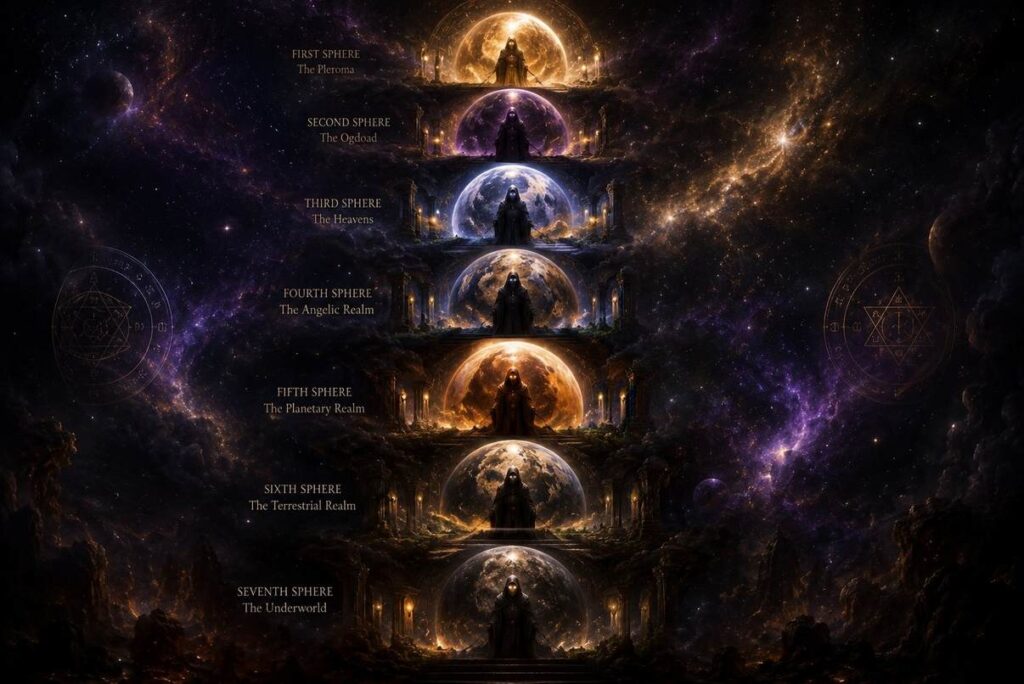
Archontic describes anything that exhibits the characteristic operations of an archon without necessarily being one. It is a functional descriptor rather than an ontological claim. In the ancient Gnostic texts, archons were celestial administrators who ruled the planetary spheres, controlled the fate of souls, and obstructed the ascent of the divine spark back to its source. They were, in the mythological language of the Apocryphon of John, created by the fallen Sophia or by the blind demiurge Yaldabaoth to maintain the cosmic order of the lower world.
The term archontic extends this mythology into phenomenology. It asks: what does an archon do? The answer, broadly, is that it controls, distorts, deceives, and feeds. It establishes systems that appear to serve order but actually serve entrapment. It mimics legitimate authority while undermining the autonomy of those subject to it. It consumes energy–attention, emotion, time, life force–without returning nourishment. When these patterns appear in a social media algorithm, a corporate hierarchy, a political ideology, or even a personal psychological complex, they can be described as archontic.
The word is therefore a bridge between cosmology and sociology, between ancient myth and modern critique. It does not require belief in literal celestial beings to be useful. It requires only the observation that certain systems behave as if they were governed by intelligences hostile to human awakening–whether or not any such intelligences exist.
Archons vs Archontic: The Difference That Matters
The distinction between archon and archontic is not pedantic. It is the difference between entity and function, between noun and adjective, between metaphysics and phenomenology. Understanding this distinction prevents two common errors: the materialist dismissal of all Gnostic language as primitive superstition, and the literalist assumption that every archontic system is possessed by a discrete demonic being.
An archon, in the ancient sources, is a specific being or class of beings. The Hypostasis of the Archons names them as Sabaoth, Yao, Adonai, Eloai, and Oraios, each associated with a planetary sphere. The First Apocalypse of James describes seven archons who interrogate the ascending soul. These are mythological figures, embedded in a cosmological narrative. To speak of archons is to speak of the Gnostic universe as it was imagined in late antiquity.
An archontic pattern, by contrast, is any structure that replicates the function of those beings without requiring their existence. A social media feed that exploits cognitive bias to maximise engagement is archontic. A corporate culture that demands performative loyalty while offering no genuine meaning is archontic. A psychological complex that repeats destructive patterns under the guise of self-protection is archontic. None of these need be inhabited by a literal archon. All of them behave in a manner consistent with the ancient description.
This distinction allows the modern seeker to use Gnostic insight without committing to Gnostic metaphysics. It is a hermeneutical move: reading the myth for its diagnostic value rather than its cosmological claims. The archontic lens is a tool of discernment, not a doctrine of demonology.

Ancient Roots: The Archons in Gnostic Cosmology
To understand what archontic means, one must first understand what the archons were understood to do. The Nag Hammadi Library offers several distinct portraits, and the diversity is instructive.
In the Apocryphon of John, Yaldabaoth creates the archons as assistants after his own aborted birth from Sophia’s distress. They are given authority over the seven planetary spheres and the corresponding regions of the human body. Their purpose is to bind the divine spark in matter, to enforce the cycle of reincarnation, and to prevent the soul from recognising its true origin. They are not evil in a moral sense; they are ignorant, arrogant, and hostile to the higher divine reality because they do not know it exists.
In the Hypostasis of the Archons, the rulers of the darkness create Adam from the dust of the ground but cannot animate him until the divine breath is secretly inserted by the higher powers. The archons then attempt to extract this divine element by creating Eve, but Eve proves to be the vehicle of revelation rather than capture. Here the archons are bumbling, almost comic figures–powerful but stupid, easily outwitted by the feminine principle of divine wisdom.
In the Valentinian system, the archons are more integrated into a philosophical cosmology. They are not merely enemies but elements of the lower world that must be understood and transcended. The pneumatic soul passes through their spheres not by combat but by knowledge, offering the correct passwords and seals that demonstrate its true identity. The archons become, in this reading, cosmic functions rather than personal antagonists.
What unites these diverse portraits is a single theme: the archons are administrators of a system that does not know its own limits. They enforce the rules of a game they did not design, believing themselves supreme while remaining ignorant of the fullness above them. This is precisely the quality that the term archontic captures in modern application.
Modern Manifestations of the Archontic
Archontic patterns are not difficult to find once the lens is in place. They appear in at least four domains: technological, institutional, psychological, and social.
Technological Archontic Systems
The most obvious contemporary example is the attention economy. Social media platforms, streaming services, and news aggregators are designed to maximise engagement through mechanisms that exploit the brain’s reward circuitry. The infinite scroll, the autoplay, the variable reward schedule–these are not neutral design choices. They are architectures of capture. They mimic the archontic function of binding consciousness to a repetitive cycle by offering just enough stimulation to prevent withdrawal, never enough satisfaction to permit liberation.
Artificial intelligence systems introduce a further layer. When an algorithm curates reality for millions of users, shaping what they see, believe, and desire, it performs a function analogous to the ancient archons who controlled the planetary spheres and the fates of souls. The AI does not need to be conscious to be archontic. It needs only to operate as a filter between the user and the world, substituting its own logic for direct perception.
Institutional Archontic Systems
Bureaucracies, corporations, and ideological regimes often exhibit archontic qualities. They generate rules that serve the system’s perpetuation rather than the human needs they ostensibly address. They demand conformity while promising protection. They consume the time and energy of their participants in rituals of compliance that produce no tangible good. The ancient archons were described as toll-collectors and gatekeepers; the modern equivalents are middle managers, compliance officers, and algorithmic moderators who enforce the boundaries of permissible thought.
The key archontic marker in institutions is the substitution of procedural legitimacy for substantive value. A system is archontic when it cares more about the form of obedience than the content of action. When the report matters more than the reality it describes, when the metric replaces the meaning, the archontic signature is present.
Psychological Archontic Patterns
Within the individual psyche, archontic patterns appear as compulsive loops, internalised oppressors, and self-defeating structures that mimic external control. The inner critic that repeats the voice of a punitive parent or teacher is archontic. The addictive cycle that promises relief while delivering dependency is archontic. The defence mechanism that once protected the self but now prevents growth is archontic. These patterns are not demons in the traditional sense, but they behave demonically: they resist eviction, they disguise themselves as necessary, and they feed on the energy they consume.
Jung’s concept of the complex–an autonomous splinter psyche that operates against the conscious will–provides a useful psychological correlate. An archontic complex is one that not only operates autonomously but actively obstructs the individuation process, keeping the ego trapped in repetitive suffering rather than facilitating integration.
Social and Cultural Archontic Dynamics
At the collective level, archontic dynamics appear in mass propaganda, ideological possession, and the manufacture of consent. When a population is kept in a state of chronic anxiety, fed narratives of threat and scarcity, and offered only symbolic solutions to real problems, the social field becomes archontic. The ancient archons were said to feed on human suffering; the modern equivalent is the political and economic system that profits from division, distraction, and despair.
The wellness industry, paradoxically, can also be archontic. When spiritual teachings are commodified, when awakening is sold as a product, when the language of liberation is used to market retreats and supplements, the critique is absorbed and neutralised. The archontic system does not always oppose spirituality; sometimes it simulates it, offering a counterfeit that binds the seeker more tightly to the market.

Recognising the Archontic Signature
Discernment is the primary counter to archontic influence. The ancient Gnostics taught that the archons lose power when recognised. In the Apocalypse of Paul, the weeping archons of the fourth heaven cannot stop the soul that knows its true name and origin. Recognition is itself liberation. This principle applies equally to modern archontic systems.
Several markers can help identify the archontic signature:
- It obscures its own operation. An archontic system hides its mechanisms. It presents itself as natural, inevitable, or benevolent while concealing its costs and controllers.
- It feeds on what it claims to serve. A system that promises connection while producing isolation, or wellness while producing dependency, is archontic.
- It resists transparency. Legitimate authority can explain itself. Archontic authority punishes or deflects questioning.
- It creates false binaries. By dividing the field into us and them, saved and damned, awake and asleep, it prevents the nuanced perception that would reveal its limits.
- It substitutes simulation for reality. When the representation becomes more important than the thing represented, the archontic filter is in place.
The response to archontic patterns is not necessarily withdrawal or combat. Sometimes withdrawal is impossible; sometimes combat feeds the system by providing the conflict it needs to sustain itself. The Gnostic response is recognition–the clear, steady seeing of what is actually happening, followed by the refusal to participate in the illusion. This is the meaning of gnosis in the archontic context: not secret knowledge in the sense of hidden data, but direct knowledge in the sense of unmediated perception. The archontic system depends on mediation. The awakened gaze dissolves it.

Frequently Asked Questions
What does archontic mean?
Archontic describes systems, behaviours, technologies, or patterns that exhibit the controlling, distorting, or parasitic qualities associated with archons in Gnostic cosmology. It is a functional descriptor rather than a claim about literal supernatural entities.
What is the difference between archon and archontic?
An archon is a specific being or class of beings in ancient Gnostic mythology–a celestial ruler or gatekeeper. Archontic is an adjective describing anything that mimics the functions of an archon (control, deception, consumption) without necessarily being one. A social media algorithm can be archontic; it is not an archon.
Is the archontic concept scientifically proven?
No. Archontic is a hermeneutical and phenomenological concept drawn from Gnostic mythology, not a scientific category. However, it can be usefully applied to observable patterns in technology, psychology, and social systems. It functions as a diagnostic lens rather than an empirical claim.
Can a person be archontic?
A person can exhibit archontic behaviours or be captured by archontic psychological patterns, but the term is more precisely applied to systems and structures. When used of individuals, it typically describes someone who unconsciously replicates controlling or parasitic dynamics–for example, a manager who enforces meaningless rules, or a communicator who exploits fear for attention.
How do you resist archontic systems?
The primary Gnostic response is recognition–clear, unmediated perception of the system’s actual operation. Archontic systems depend on obscurity and automatic participation. Once recognised, they lose their compulsive grip. Practical resistance may include reducing engagement with attention-capture technologies, questioning institutional narratives, and doing inner work to dissolve psychological complexes that mirror external control.
Are social media algorithms archontic?
Yes, in the phenomenological sense. Social media algorithms are designed to maximise engagement through mechanisms that exploit cognitive bias, emotional reactivity, and addictive feedback loops. They function as filters between the user and reality, substituting curated stimulation for direct perception. This behaviour is structurally analogous to the ancient archons who controlled the planetary spheres and the fates of souls.
Is the wellness industry archontic?
It can be. When spiritual teachings are commodified, when the language of liberation is used to sell products, and when the critique of the system is absorbed into the market, the wellness industry exhibits archontic qualities. It simulates transformation while binding the seeker more tightly to consumption. However, not all wellness practices are archontic; discernment is required.
Further Reading
- What Are Archons? The Ruling Powers of the Gnostic Cosmos — The foundational glossary entry on archons themselves, establishing the mythological and cosmological context from which the archontic concept derives.
- The Names of the Archons: Gnostic Entities and Their Functions — A detailed survey of the specific archonic figures named in the Nag Hammadi texts and their associated roles in the cosmic hierarchy.
- The Archons Feed on Suffering: Gnosticism as Political Critique — Explores how the archontic lens applies to institutional power, social control, and the systemic production of human misery in the modern world.
- The Archon in Your Phone: AI Intimacy and the Gnostic Counterfeit — Investigates how artificial intelligence and digital companionship replicate archontic patterns of simulation, control, and emotional extraction.
- The Archontic Infection: Recognising Systemic Possession in the Digital Age — A deep examination of how archontic dynamics operate at the collective level through media, ideology, and algorithmic governance.
- AI Archon: Algorithmic Governance and Human Autonomy — Analyses the specific mechanisms by which artificial intelligence systems perform archontic functions of filtering, predicting, and controlling human behaviour.
- The Architecture of the Infinite Scroll: How Short-Form Content Rewires Neural Pathways — A precise technical examination of one of the most pervasive archontic technologies of the contemporary attention economy.
- The Gnostic Soul Trap: Archons, Death, and the Recycling of Pneuma — Explores the ancient archonic mythology of the afterlife and its disturbing parallels to modern systems of psychological and spiritual capture.
- Predatory Consciousness: Recognition and Defence — Examines the psychological and energetic dimensions of parasitic control, complementing the systemic analysis of the archontic with personal discernment practices.
- The $6.8 Trillion Theft: How the Wellness Industry Stole Gnosis and Sold It Back Empty — A critical investigation of how the wellness industry exhibits archontic qualities by commodifying spiritual liberation and neutralising genuine critique.