Codex X: Marsanes — Sethian Platonism at Its Most Technical
The Nag Hammadi Library preserves thirteen papyrus codices, yet one stands alone as both the most philosophically ambitious and the most physically devastated. Codex X contains essentially a single tractate–Marsanes–accompanied by fragmentary remains of other texts now beyond recovery. And that sole surviving work is the most challenging in the entire library: fragmentary, technically dense, philosophically uncompromising, and often incomprehensible without extensive background in Middle Platonic metaphysics [1].
Where Zostrianos narrates the dramatic journey through thirteen aeons and Allogenes maps the triple-powered ontology with systematic precision, Marsanes operates as the capstone dissertation–the final examination paper for the Platonizing Sethian curriculum. It is not a travelogue but an ontological analysis, not a revelation discourse but a metaphysical treatise disguised as autobiography. For specialists, it is essential; for general readers, it is optional. But for anyone seeking to understand the outer limits of Gnostic philosophical ambition, Marsanes marks the summit [2].
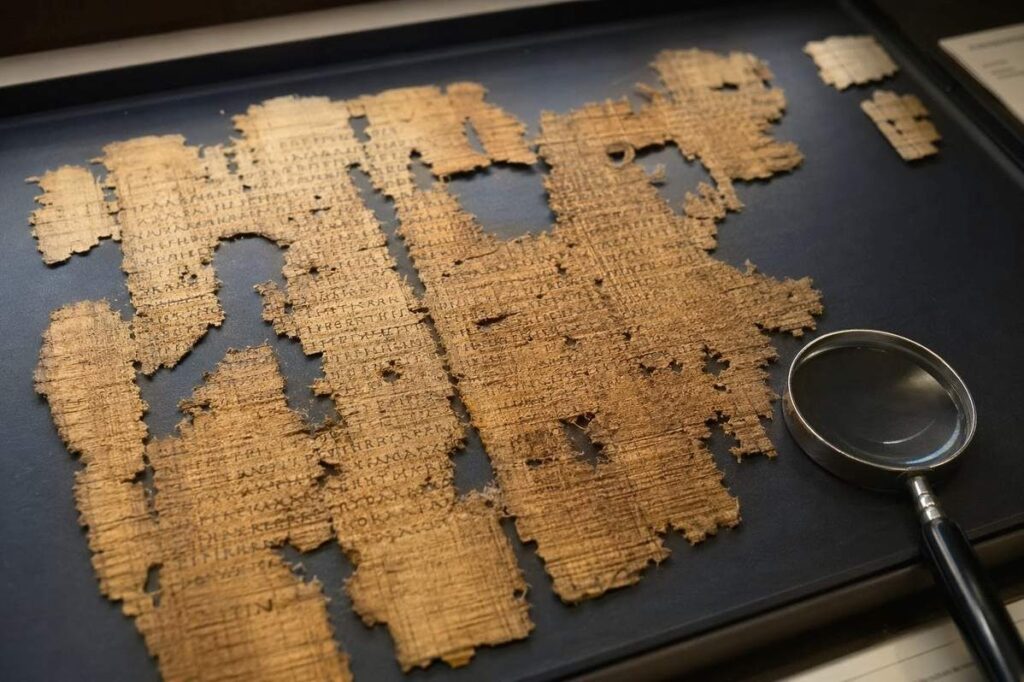
Table of Contents
- What is Codex X?
- Manuscript Context
- Marsanes (NHC X,1)
- The Three Substances
- The Transmigration of Souls
- Negative Theology and the Incomprehensible Father
- Autobiographical Elements
- Reading Order for Codex X
- Why Codex X Matters
- Comparative Context: The Platonizing Trilogy
- Frequently Asked Questions
- Further Reading
- References and Sources
What is Codex X?
Codex X (Nag Hammadi Codex X) is the most fragmentary and philosophically demanding codex in the library. It contains Marsanes (NHC X,1), a Platonizing Sethian treatise on the three substances (matter, soul, spirit) and the transmigration of souls, alongside unidentified fragmentary remains too damaged to classify. Composed in the late second or early third century CE and copied in Sahidic Coptic in the mid-fourth century, Marsanes represents the furthest development of Sethian engagement with Platonic metaphysics–particularly the Parmenides and Sophist [1][3].
Manuscript Context
Discovery and Physical State
Codex X was discovered in December 1945 by Muhammad Ali al-Samman and his brothers, buried alongside the other twelve codices in a sealed jar near the Jabal al-Tarif cliff [4]. From the outset, its physical condition was catastrophic. The codex is severely damaged–perhaps the most fragmentary in the entire Nag Hammadi Library–with only portions of the original system recoverable from the surviving papyrus [5].
The codex originally contained multiple tractates bound in a single leather volume, yet the ravages of time, moisture, and soil chemistry reduced much of it to illegibility. Unlike Codex I (the Jung Codex), which was acquired early and protected in institutional conservation, Codex X passed through antiquities markets without proper preservation, accelerating its decay [6]. What survives is a ghost of a once-comprehensive metaphysical architecture–broken glimpses that scholars have painstakingly reconstructed through collation with parallel philosophical sources.
The Codex as Capstone
The placement of Marsanes as the sole substantial tractate in Codex X–positioned near the end of the numerical sequence–suggests that ancient collectors may have regarded it as a capstone text. The codex appears as the philosophical achievement of the manuscript collection: the point where mythological narrative yields to rigorous ontological analysis [3]. Whether this positioning was deliberate or accidental remains uncertain, but the effect is striking. After traversing the narrative gospels, the cosmological dramas, and the technical ascent manuals of the preceding codices, the reader who reaches Codex X encounters pure metaphysics–the abstract foundation upon which all the mythological superstructure rests [2].
Marsanes (NHC X,1)
The text presents itself as a revelation given to Marsanes–possibly a fictional figure, possibly a historical Gnostic teacher–concerning the nature of the divine, the structure of reality, and the path of return. “Marsanes, the one who is worthy, the one who has been begotten by the father.” The protagonist addresses his audience with the authority of one who has traversed the ontological levels and returned to teach [7].
The content is technical in the extreme. Marsanes describes a complex hierarchy of divine beings, from the invisible spirit through multiple levels of aeons, each with its own characteristics and epistemological demands. The text draws heavily on Platonic metaphysics–particularly the Parmenides and the Sophist–but transforms it through Gnostic soteriology. Where Plato analyses the one and the many as abstract philosophical problems, Marsanes treats them as existential stations through which the soul must pass [8].
Primary Source Citation: NHC X,1 — “The father exists before all things. He is the one who is hidden, the one who is unknown, the one who is incomprehensible. He is the one who is without quality, the one who is without substance, the one who is without form.” (Translation: Funk 2004)
The Three Substances
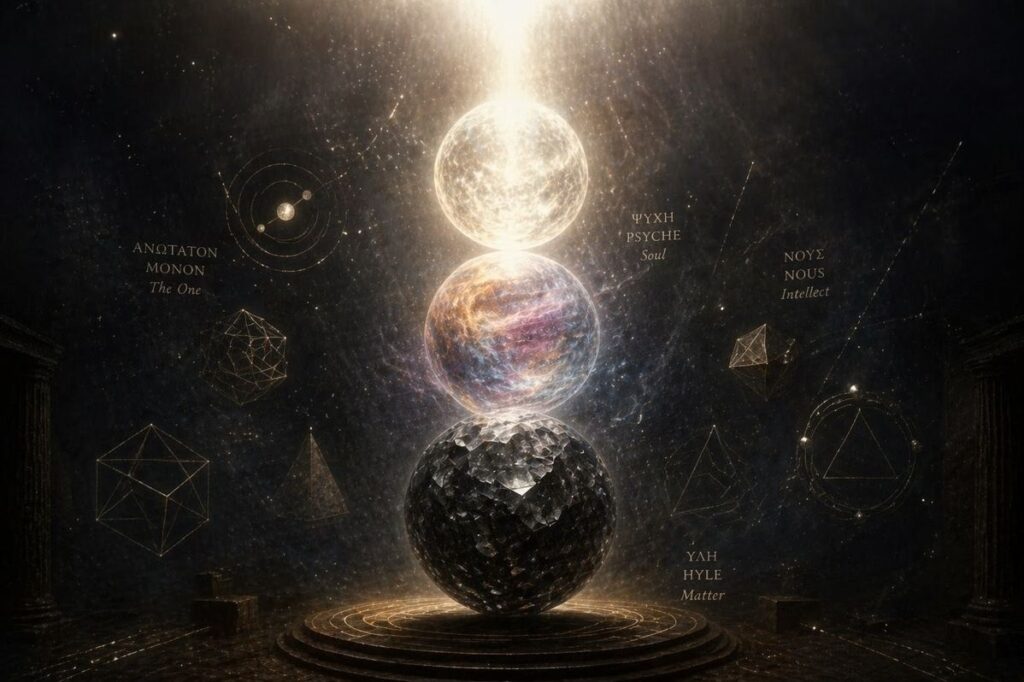
At the heart of Marsanes lies a systematic analysis of the three substances (treis ousiai): hyle (matter), psyche (soul), and pneuma (spirit). This triad is not unique to Marsanes–it appears throughout Platonic and Stoic philosophy–but the text deploys it with distinctive Gnostic urgency. Each substance corresponds to a level of reality and a mode of cognition, and the soul’s task is to distinguish them, transcend the lower two, and restore itself to the pneumatic realm [9].
Matter (hyle) is the realm of flux, illusion, and archonic deception–the “garment of darkness” that the demiurge weaves for the entrapped divine spark. Soul (psyche) is the intermediate realm of emotion, desire, and discursive reason–the territory of the planetary powers who administer fate. Spirit (pneuma) is the divine substance itself, the “garment of light” that the initiate recovers through progressive initiation. Marsanes maps the boundaries between these substances with geological precision, describing how the soul passes from one to the next through specific cognitive transformations [10].
The text also describes a fourth level beyond the three substances–the “silence” that transcends even spirit. This is not a substance but the absence of all substantial determination, the ground from which the three substances emerge and to which they ultimately return. The silence is not empty but superabundant–too full for categorical determination, too complete for analytical grasp [11].
The Transmigration of Souls
Marsanes presents a theory of transmigration (metensomatosis) that differs significantly from standard Platonic or Pythagorean models. Souls do not merely reincarnate into new bodies; they migrate across ontological levels, ascending or descending according to their capacity for gnosis. “Some souls have come from the superior realm, others from the inferior, and others from the middle” [9].
This is not the mechanistic karma of popular imagination but a dynamic system of ontological mobility. The soul that recognises its true nature can ascend directly; the soul that remains ignorant may descend further into material entanglement. Marsanes describes his own passage through these levels–not as a single lifetime’s journey but as a multi-stage progression across incarnations, each offering opportunities for recognition or further forgetfulness [7].
The text’s anthropology is thus hierarchical but not deterministic. Even the most material-bound soul retains a trace of the pneumatic spark, and even the most advanced initiate has not fully transcended the risk of relapse. The transmigration system functions as a cosmic educational programme–not punishment but pedagogy, administered by the divine economy to ensure that no soul is abandoned before it has exhausted every possibility of awakening [10].
Negative Theology and the Incomprehensible Father
The negative theology of Marsanes is extreme–even more radical than in Allogenes or the Apocryphon of John. The divine is not merely hidden or distant but absolutely unknowable, approachable only through successive negations. “The father exists before all things. He is the one who is hidden, the one who is unknown, the one who is incomprehensible” [8].
Where Allogenes counsels the initiate to “stay incognizant” of the highest reality, Marsanes pushes this apophaticism further. The Father is “without quality, without substance, without form”–not a being among beings but the condition for the possibility of being itself. This is not the hidden God of biblical theology, who remains concealed by will or majesty, but the radically transcendent One of Platonic metaphysics, who exceeds even the categories of existence and non-existence [11].
The text engages directly with Plato’s Parmenides–the dialogue that explores the consequences of positing the One. Where Plato’s gymnastic exercise tests the limits of dialectic, Marsanes transforms it into soteriology. The soul’s ascent is not merely a journey through space but an intellectual progression through the hypotheses of the Parmenides, negating each determination until reaching the absolute indeterminacy of the source [12].
Primary Source Citation: NHC X,1 — “He is the one who is without quality, the one who is without substance, the one who is without form. He is the one who is superior to all these, the one who is prior to all things.” (Translation: Funk 2004)
Autobiographical Elements
Unlike the more abstract Allogenes, Marsanes embeds its metaphysics in autobiographical narrative. The protagonist describes his own spiritual journey–his struggles, his revelations, his moments of doubt and recognition. “I, Marsanes, have come to know the truth through the power that dwells in me” [7].
These autobiographical passages are less accessible than the dramatic narrative of Zostrianos because they are embedded in technical discussion. Marsanes does not recount his adventures in the aeons as a travel story; he uses his own experience as evidence for metaphysical claims. “I have travelled through the substances, I have seen the boundaries, I have recognised the silence.” The first-person voice serves philosophical demonstration rather than literary entertainment [9].
For readers, this creates a distinctive texture–the intimacy of autobiography filtered through the density of technical terminology. One senses a real person behind the abstractions, a practitioner who has undergone the transformations he describes, yet the veil of philosophical language prevents the direct emotional connection that Zostrianos or the Apocryphon of John establishes [2].
Reading Order for Codex X
For newcomers: Skip Codex X entirely. Return only after mastering more accessible texts such as the Apocryphon of John, Gospel of Truth, and Gospel of Philip. Marsanes assumes background knowledge that newcomers cannot be expected to possess.
For advanced study: Read Marsanes only after completing Zostrianos and Allogenes. Approach with scholarly commentary–preferably Funk’s critical edition or Turner’s analysis in Sethian Gnosticism and the Platonic Tradition. Do not attempt this text without preparation in Middle Platonism and familiarity with the Parmenides [13].
For comparative study: Read Marsanes alongside the Three Steles of Seth to understand the range of Sethian doxological practice. Compare its negative theology with that of Allogenes and the longer recension of the Apocryphon of John to map the development of apophaticism in the tradition [14].
Why Codex X Matters
Philosophical Sophistication
For understanding the philosophical sophistication of Gnosticism, Marsanes is essential. It shows that Gnosticism was not merely mythological narrative or visionary experience but also rigorous metaphysical speculation engaging with contemporary Platonism at the highest level. The text’s analysis of the three substances, its theory of transmigration, and its engagement with the Parmenides demonstrate authors fully conversant with the philosophical schools of their era [8].
The Intellectual Ascent Model
Marsanes also reveals the diversity of Gnostic approaches. Where Zostrianos presents ascent as spatial journey through aeons, and Allogenes presents it as cognitive negation of the knowable, Marsanes presents it as intellectual progression–moving from lower to higher levels of understanding until reaching the unknowable source. The ascent is not baptismal (as in Zostrianos) or apophatic (as in Allogenes) but analytical: the soul distinguishes substances, recognises boundaries, and ultimately transcends distinction itself [10].
Diversity of Gnostic Approaches
The text confirms that Sethianism was not a monolithic system but a spectrum of approaches. At one end stands the mythological narrative of the Apocryphon of John; at the other, the metaphysical abstraction of Marsanes. Between them lie the ritual ascent of Zostrianos, the negative theology of Allogenes, and the hymnic doxology of the Three Steles. Together they demonstrate that Gnosticism could accommodate both the storyteller and the philosopher, both the visionary and the dialectician [2].
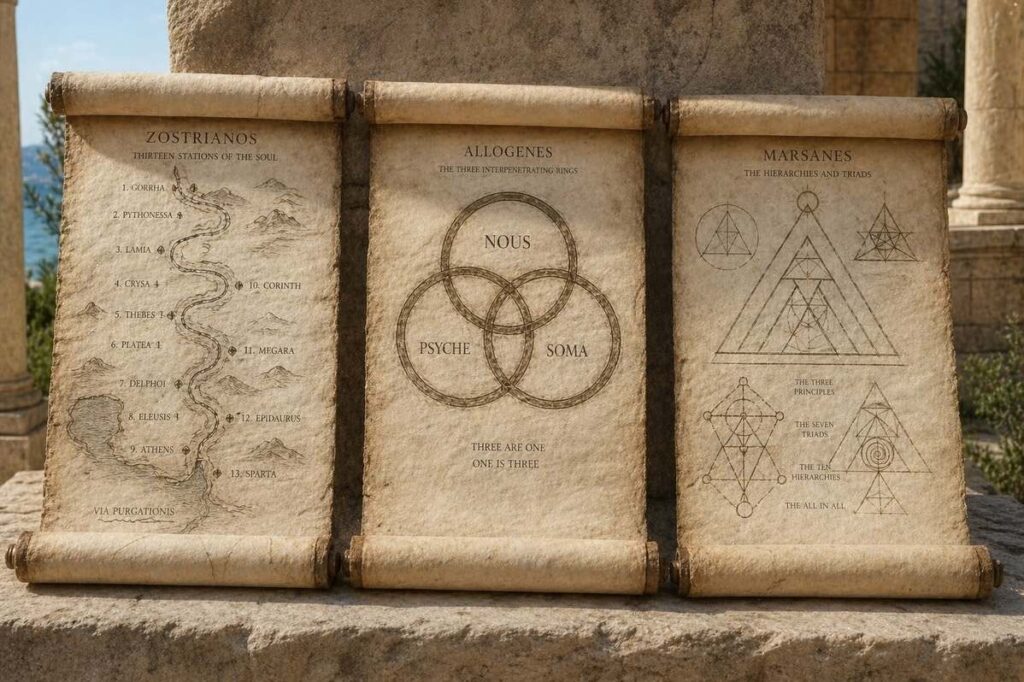
Comparative Context: The Platonizing Trilogy
Marsanes belongs to a small but significant group: the Platonizing Sethian treatises. Alongside Zostrianos (NHC VIII,1) and Allogenes (NHC XI,3), it forms a trilogy of highly technical ascent literature that engages Middle Platonic metaphysics while maintaining Sethian theological commitments [15].
Porphyry records that Plotinus’s Gnostic opponents possessed “revelations of Zoroaster and Zostrianos and Nicotheos and Allogenes and Messos and Marsanes and others”–a direct attestation that Marsanes circulated among the philosophers of Plotinus’s circle in third-century Rome [12]. This is not merely a bibliographic note; it confirms that Marsanes was read not by isolated sectarians but by intellectuals engaged in the most advanced philosophical debates of the era.
Each member of the trilogy has its own character. Zostrianos is the most narratively elaborate, describing thirteen aeons with multiple baptisms. Allogenes is the most philosophically precise, with its detailed analysis of the Triple-Powered One. Marsanes is the most metaphysically abstract, mapping the three substances and the silence beyond them. Together they demonstrate the range of Platonizing Sethianism–not a single system but a family of approaches united by shared philosophical vocabulary and theological concerns [13].
When read alongside the Three Steles of Seth (NHC VII,5)–which shares the Barbeloite theology and employs similar doxological formulae–the Platonizing trilogy reveals the liturgical and communal dimensions of this tradition. These were not merely philosophical speculations but ritual texts, designed to be performed, contemplated, and enacted by communities of practitioners [14].
“The father exists before all things. He is the one who is hidden, the one who is unknown, the one who is incomprehensible.”
— Marsanes, NHC X,1

Frequently Asked Questions
What is Codex X in the Nag Hammadi Library?
Codex X is the most fragmentary and philosophically demanding codex in the Nag Hammadi Library. It contains Marsanes (NHC X,1), a Platonizing Sethian treatise on the three substances and the transmigration of souls, alongside unidentified fragments too damaged to classify. It represents the most advanced metaphysical speculation in the collection.
What is Marsanes about?
Marsanes (NHC X,1) is a revelation text attributed to Marsanes, presenting a systematic metaphysical analysis of the three substances–matter (hyle), soul (psyche), and spirit (pneuma)–and the soul’s transmigration through ontological levels. It engages deeply with Platonic philosophy, particularly the Parmenides, and pushes negative theology to its extreme limits.
What are the three substances in Marsanes?
The three substances are matter (hyle), soul (psyche), and spirit (pneuma). Matter is the realm of flux and archonic deception; soul is the intermediate realm of desire and discursive reason; spirit is the divine substance the initiate recovers through progressive transformation. Beyond these three lies a fourth level–the silence that transcends all substantial determination.
How does Marsanes differ from Zostrianos and Allogenes?
While all three are Platonizing Sethian texts, Zostrianos presents ascent as a spatial journey through thirteen aeons with baptisms at each level. Allogenes presents ascent as cognitive negation of the knowable through the Triple-Powered One. Marsanes presents ascent as intellectual progression–analysing the three substances and transcending distinction itself through metaphysical discrimination.
What is the transmigration of souls in Marsanes?
Marsanes presents a theory of transmigration (metensomatosis) in which souls migrate across ontological levels rather than merely reincarnating into new bodies. Souls ascend or descend according to their capacity for gnosis. This is not mechanistic karma but a cosmic educational programme ensuring no soul is abandoned before exhausting every possibility of awakening.
Why is Marsanes considered the most difficult Nag Hammadi text?
Marsanes is fragmentary, technically dense, and philosophically demanding. It requires extensive background in Middle Platonic metaphysics, familiarity with Plato’s Parmenides and Sophist, and patience with abstract terminology. Unlike narrative texts such as the Apocryphon of John, it offers metaphysical analysis rather than dramatic storytelling.
Should beginners read Codex X?
No. Codex X is recommended only for advanced readers with prior knowledge of Sethian cosmology and Platonic philosophy. Beginners should start with more accessible texts such as the Apocryphon of John, Gospel of Truth, and Gospel of Philip. Marsanes should be approached only after mastering Zostrianos and Allogenes, preferably with scholarly commentary.
Further Reading
The following articles from the ZenithEye archive provide additional context for understanding Codex X within the broader landscape of Gnostic traditions:
- The Nag Hammadi Library: Complete Index — Return to the master guide for all 46 tractates and 13 codices.
- Marsanes: Platonizing Sethian Metaphysics — Deep analysis of the three substances, transmigration, and the engagement with Platonic philosophy.
- Zostrianos: The Complete Journey Through the Thirteen Aeons — The narrative complement to Marsanes, offering the most detailed Sethian ascent journey.
- Allogenes: The Sethian Ascent to the Unknowable One — The second member of the Platonizing trilogy, presenting negative theology and the Triple-Powered One.
- The Three Steles of Seth: Sethian Hymns of Ascent — The liturgical and doxological dimension of the Sethian tradition that underlies Marsanes’s metaphysics.
- The Apocryphon of John — The foundational Sethian text providing the mythological framework behind Marsanes’s abstract analysis.
- Nag Hammadi Library: Complete Reader’s Guide — Strategic pathways through all 46 tractates for every level of inquiry.
- Nag Hammadi Archive Hub — Central gateway to all codex overviews, thematic collections, and reading paths.
- Sethian and Valentinian: Two Great Streams — Comprehensive guide to distinguishing the two major theological systems in the library.
- Codex VIII: Zostrianos and Ascent Literature — The codex containing the narrative counterpart to Marsanes’s metaphysical treatise.
References and Sources
The following sources support the claims and quotations presented in this article. All citations to the Nag Hammadi Library represent direct translations from the Coptic text as established in the standard critical editions.
Primary Sources and Critical Editions
- [1] Robinson, J.M. (Ed.). (1988). The Nag Hammadi Library in English (4th ed.). Brill.
- [2] Turner, J.D. (1990). “Nag Hammadi Codices XI, XII, XIII.” In Nag Hammadi Codices XI, XII, XIII. Brill.
- [3] Funk, W.P. (2004). Marsanès (NH X). Bibliotheque copte de Nag Hammadi, Section “Textes” 27. Presses de l’Universite Laval/Peeters.
- [4] Robinson, J.M. (1979). “The Discovery of the Nag Hammadi Codices.” Biblical Archaeologist, 42(4), 206-224.
- [5] Robinson, J.M. (2009). “The Discovery of the Nag Hammadi Codices.” Journal of Coptic Studies, 11, 1-21.
Scholarly Monographs and Commentaries
- [6] Turner, J.D. (2001). Sethian Gnosticism and the Platonic Tradition. Peeters.
- [7] King, K.L. (1995). Revelation of the Unknowable God: With Text, Translation, and Notes to NHC XI,3 Allogenes. Polebridge Press.
- [8] Burns, D.M. (2014). Apocalypse of the Alien God: Platonism and the Exile of Sethian Gnosticism. University of Pennsylvania Press.
- [9] Mazur, Z. (2010). “The Platonizing Sethian Gnostic Background of Plotinus’s Mysticism.” PhD dissertation, University of Chicago.
- [10] Layton, B. (1987). The Gnostic Scriptures: A New Translation with Annotations and Introductions. Doubleday.
Comparative Studies and Thematic Analyses
- [11] Pearson, B.A. (2007). Ancient Gnosticism: Traditions and Literature. Fortress Press.
- [12] Porphyry. (c. 300 CE). Life of Plotinus 16. (Attestation of Marsanes in Plotinus’s circle).
- [13] Logan, A.H.B. (1996). Gnostic Truth and Christian Heresy: A Study in the History of Gnosticism. T&T Clark.
- [14] Meyer, M. (Ed.). (2007). The Nag Hammadi Scriptures: The International Edition. HarperOne.
- [15] Markschies, C. (2000). Valentinus Gnosticus? Untersuchungen zur valentinianischen Gnosis mit einem Kommentar zu den Fragmenten Valentins. Mohr Siebeck.