
Hermeticism and Gnosticism: Where They Meet and Where They Diverge
The Corpus Hermeticum and the Nag Hammadi Library were produced in the same city, during the same centuries, by people who read the same philosophers and worshipped in the same temples. Yet the worlds they describe are not identical. Both map a cosmos that descends from a transcendent, ineffable source through layers of divine emanation into a material realm where human beings carry a spark of the divine. Both describe a fall, an imprisonment, and an ascent back to the origin. Both employ negative theology, revelatory dialogue, and the language of Platonism to express experiences that philosophy alone could not contain. But where the Hermetic tradition tends toward qualified optimism about the material world, the Gnostic tradition tends toward radical pessimism. Where the Hermetic demiurge is a craftsman working in obedience to the highest God, the Gnostic demiurge is a prison warden working in ignorance or malice. Understanding where these traditions meet and where they diverge is essential for anyone who wishes to navigate the landscape of ancient spirituality without collapsing distinct visions into a single New Age blur.
This article maps the overlap and the fracture. It examines the shared architecture–Nous, Logos, planetary spheres, and the divine spark–and then traces the divergence at the point of creation, where the Hermetic Poimandres and the Gnostic Apocryphon of John tell two incompatible stories about how the world came to be and what the soul must do to escape or perfect it. The goal is not to choose between them but to understand them as neighbouring departments within the vast administration of Alexandrian wisdom, each with its own protocols, its own cosmology, and its own account of what went wrong.
Table of Contents
- The Alexandrian Milieu: Where Thoth Met Hermes
- The Shared Architecture: Nous, Logos, and the Planetary Spheres
- The Demiurge Divides: Craftsman versus Prison Warden
- Poimandres and Apocryphon of John: Two Creation Myths
- The Turnabout and the Ascent: Epistrophe Through the Spheres
- The Nag Hammadi Hermetica: Codex VI and the Filing System of Wisdom
- Mutual Influence: Did Hermeticism Shape the Gnostic Schools?
- Frequently Asked Questions
- Further Reading
- References and Sources
The Alexandrian Milieu: Where Thoth Met Hermes
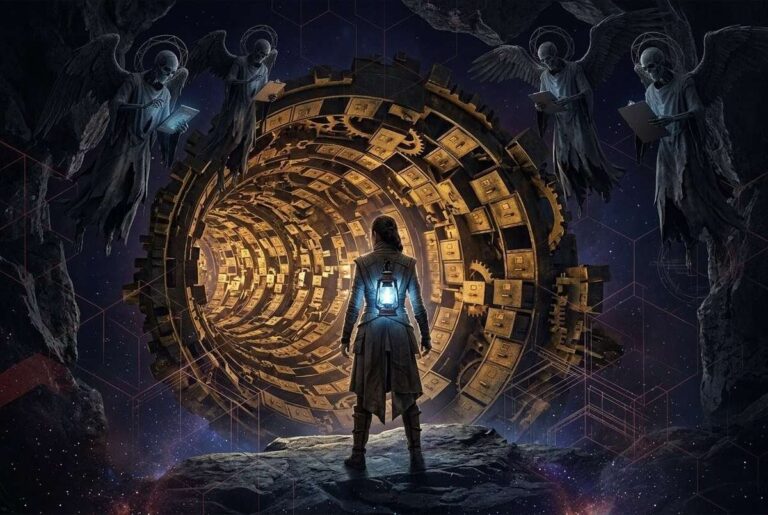
Alexandria in the first centuries CE was not merely a city but a crucible. Greek philosophical traditions–Platonism, Stoicism, Aristotelianism–encountered Egyptian religious symbolism, Jewish wisdom literature, and emerging Christian theology in a cultural ferment that produced some of the most sophisticated spiritual thought of antiquity. The Ptolemaic identification of the Egyptian god Thoth with the Greek god Hermes produced Hermes Trismegistus, the “Thrice-Greatest,” a figure who embodied the synthesis of Egyptian and Greek wisdom. The epithet “Thoth great, great, great” appears at Esna in Upper Egypt from the early third century BCE, and the Greek “Hermes Trismegistos” was current by the Ptolemaic period.
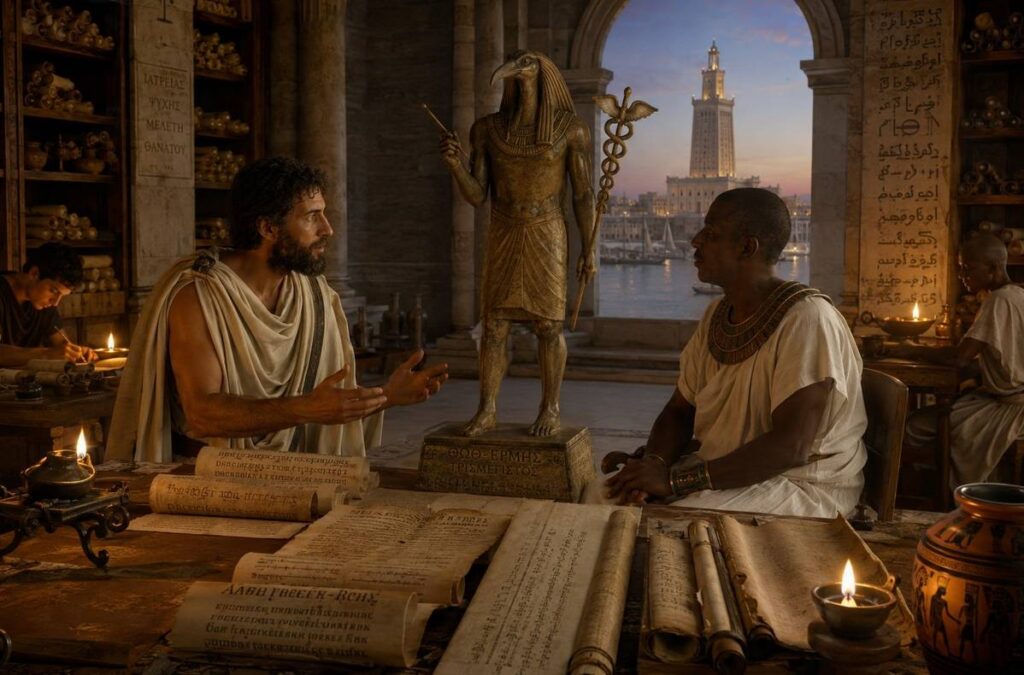
The Hermetic texts emerged from this milieu as a deliberate syncretism–not arbitrary eclecticism but a hermeneutical engagement that sought the universal wisdom underlying particular traditions. The Gnostic texts, similarly, were produced in the same environment by thinkers who read the same philosophers and engaged with the same religious symbols. The Apocryphon of John, the foundational Sethian text, was composed in Greek and later translated into Coptic–the same linguistic trajectory as the Hermetic treatises. Both traditions employed Platonic ontology, Egyptian cosmological imagery, and Jewish apocalyptic narrative. To study one without the other is to read half a correspondence.
The Shared Architecture: Nous, Logos, and the Planetary Spheres
Despite their divergent assessments of the material world, Hermeticism and Gnosticism share a remarkably consistent cosmic architecture. At the apex stands a transcendent source that is beyond naming, beyond comprehension, beyond the categories of being and non-being. In Hermeticism, this is the One, the Good, the Father; in Gnosticism, the Monad, the Invisible Spirit, the Depth. Both traditions employ negative theology: the highest God is defined by what it is not, since positive predicates would limit the unlimited.
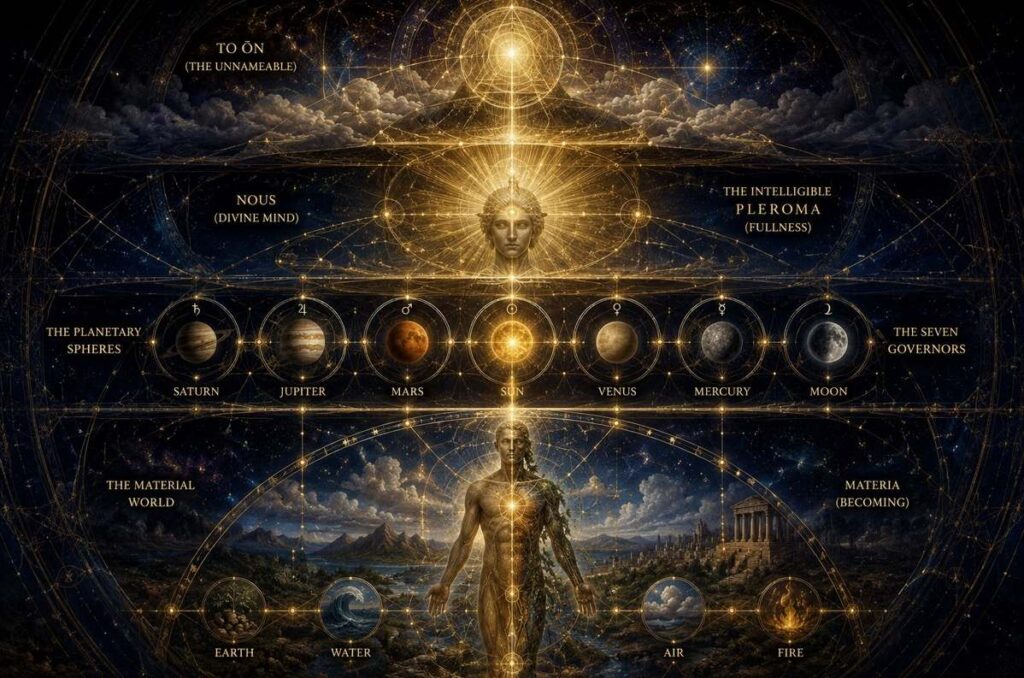
From this source emanates the Nous–Divine Mind, Intellect, the realm of eternal Forms. The Nous is not human thinking but the archetypal blueprint where the patterns for all manifestation are stored. In both traditions, the Nous contemplates the source and generates further differentiations. In Hermeticism, the Nous produces the Logos (Word), which then produces the Demiurge and the cosmic Soul. In Gnosticism, the Invisible Spirit produces Barbelo, the First Thought, who generates the aeons and luminaries. The structural parallel is unmistakable: both describe a cascade of emanation in which each level contemplates the level above and produces the level below through a form of productive contemplation.
Both traditions also describe the material realm as governed by planetary powers. In the Poimandres, the Demiurge creates the seven Governors, associated with the seven classical planets, who administer the cosmos and set the spheres in motion. In the Apocryphon of John, Yaldabaoth creates the seven androgynous authorities who govern the planetary spheres and obstruct the soul’s ascent. Both maintain that the human being is a microcosm containing all levels of reality–material, vital, psychic, and pneumatic–and that salvation requires ascending through these planetary layers to return to the divine source. The technology is shared; only the mood music differs.
The Demiurge Divides: Craftsman versus Prison Warden
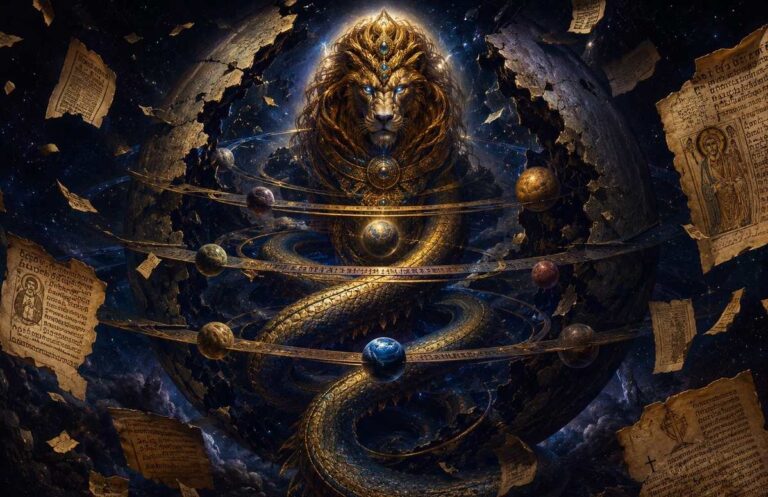
The most consequential divergence between Hermeticism and Gnosticism concerns the demiurge–the subordinate creator who shapes the material world. In the Apocryphon of John, this figure is Yaldabaoth, the lion-faced serpent with eyes of lightning, born from Sophia’s anguish without the consent of the divine realm. He is arrogant, ignorant, and malevolent. He declares himself the only god, creates the material world as a prison, and traps divine sparks in human bodies. His archons enforce this imprisonment, and the soul’s task is to escape past them into the Pleroma.
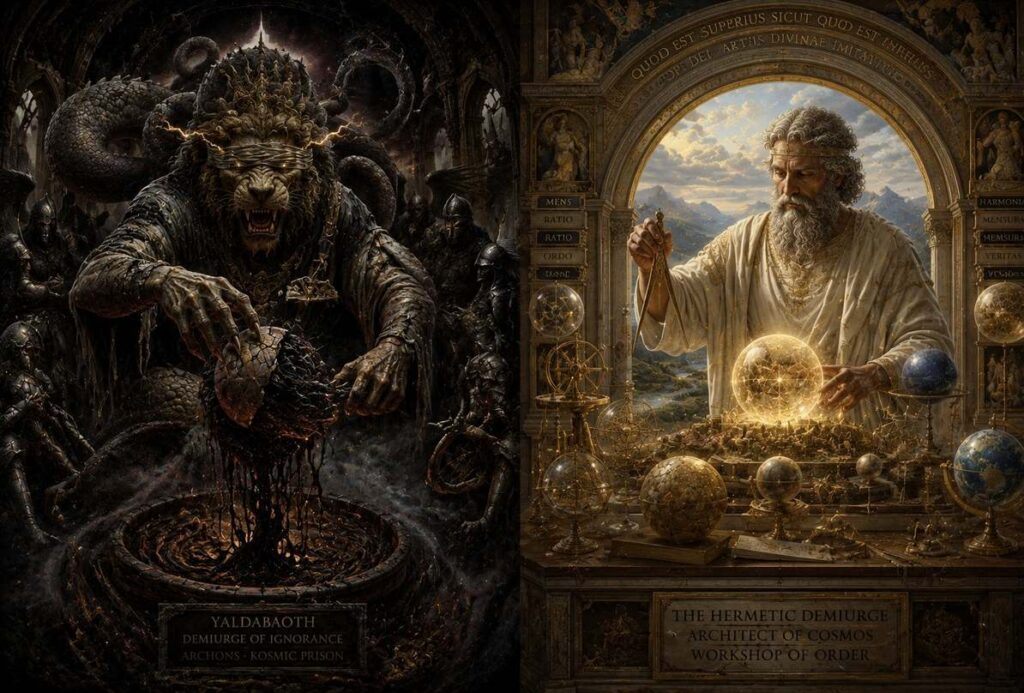
In the Poimandres, the demiurge is a Second Nous, a craftsman who receives the Logos and shapes the four elements into the material cosmos. He is not hostile; he is obedient. He creates the seven planetary spheres and sets them revolving, establishing order where there was chaos. The cosmos he produces is not a prison but a pedagogical environment–a training facility wherein souls learn and remember their origin. As the Corpus Hermeticum declares, “God ordered the cosmos, and that order is beautiful.” The material world, while inferior to the divine realm, nevertheless embodies divine creativity and provides the conditions under which the soul can ascend.
This divergence is not merely theological; it is existential. The Gnostic demiurge renders the material world illegitimate, and the Gnostic’s task is to reject it, to refuse its values, its pleasures, and its authorities. The Hermetic demiurge renders the material world provisional, and the Hermetic’s task is to perfect it, to align the self with cosmic order, and to ascend through the spheres as a graduate rather than an escapee. The Hermetic body is “a beautiful and divine image” representing the Nous’ creative power; the Gnostic body is a cell in which the spark languishes. These are not minor differences of emphasis. They are incompatible worldviews that produce incompatible spiritualities.
Poimandres and Apocryphon of John: Two Creation Myths
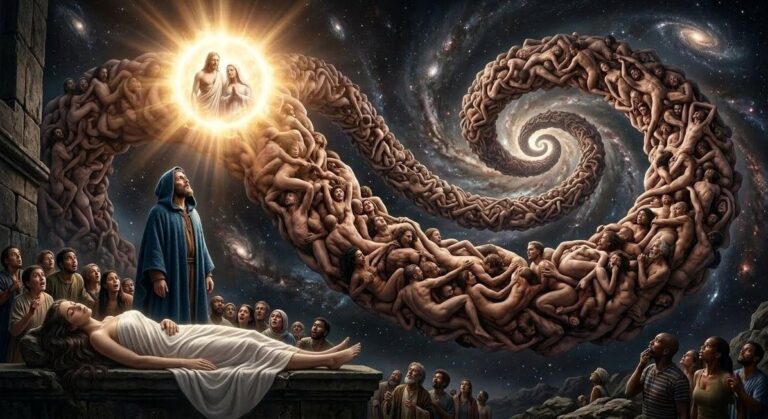
The Poimandres (Corpus Hermeticum I) and the Apocryphon of John (NHC II,1) are the foundational texts of their respective traditions, and their creation myths reveal the divergence with crystalline clarity. In the Poimandres, the drama begins when the Nous, the Divine Mind, beholds its own beauty and desires to create. It generates the Logos, which descends into the primordial darkness and separates the elements. The Nous then creates a Second Nous, the Demiurge, who shapes the cosmos. Finally, the Nous creates the Anthropos–Primal Man–in its own image, and the Anthropos descends into Nature, falls in love with her beauty, and becomes entrapped. The fall is the Anthropos’ own error, a narcissistic fascination with the material reflection of divine beauty.
In the Apocryphon of John, the drama begins with the Invisible Spirit and Barbelo, the First Thought, who generate the aeons of the Pleroma. Sophia, the last aeon, desires to conceive without her consort and produces Yaldabaoth in anguish and shame. Yaldabaoth is cast out of the Pleroma, declares himself the only god, and creates the material world as a dim reflection of the divine realm he has never truly seen. He then creates Adam by trapping divine sparks stolen from the Pleroma, and the archons enforce this imprisonment. The fall is not the human being’s error but a divine catastrophe initiated by Sophia’s unauthorised passion.
The Hermetic myth lacks the Sophia narrative entirely. There is no fallen wisdom, no maternal deity weeping for her children, no unauthorised conception that generates evil. The fall is personal, not cosmic: the Anthropos falls because he chooses to, because he is fascinated by Nature’s beauty, because he forgets his origin. The Gnostic myth is cosmic and tragic: the fall occurs because of a rupture in the divine realm itself, and human beings are victims of a catastrophe they did not cause. The Hermetic task is remembrance and realignment; the Gnostic task is rescue and rebellion.
The Turnabout and the Ascent: Epistrophe Through the Spheres
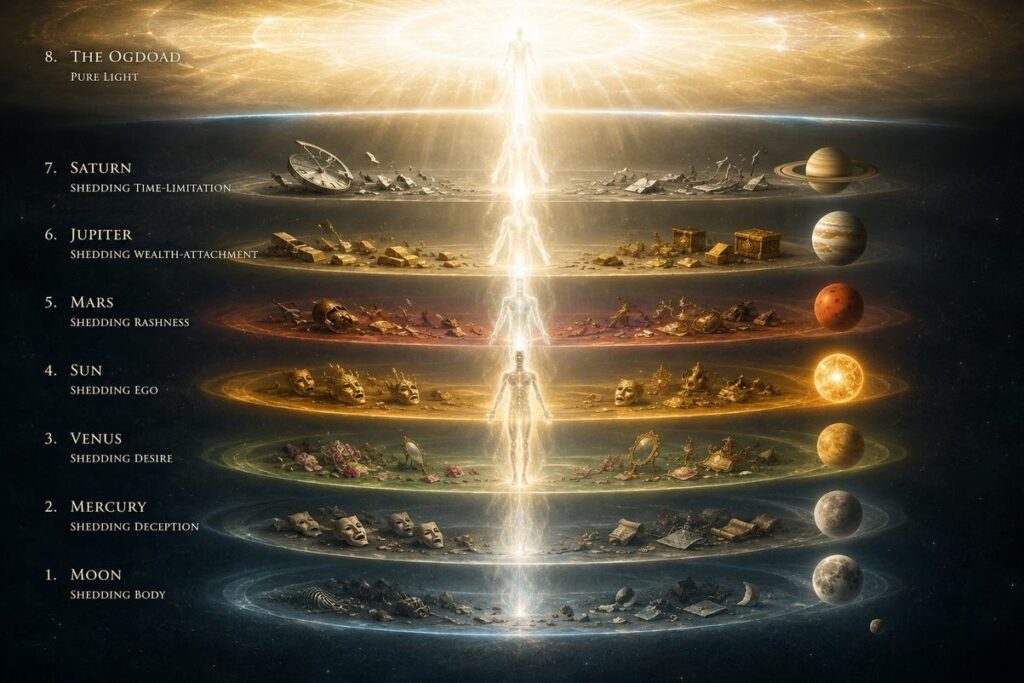
Both traditions prescribe an ascent through the planetary spheres as the path of return, but they frame it differently. In the Poimandres, the soul ascends by shedding the “accretions” it acquired during descent: at the moon, the energy of increase and decrease; at Mercury, evil machination; at Venus, desire for illusion; at the Sun, the arch of domination; at Mars, unholy daring; at Jupiter, evil strivings from wealth; at Saturn, deceit that ensnares. This is not escape from enemy territory but psychological deconditioning–the systematic stripping away of cosmic and cultural determinants until the soul stands naked before the divine. The goal is henosis, union with the Nous.
In Sethian Gnosticism, the ascent is more adversarial. The soul must pass the planetary archons, who demand worship and recognition, and must renounce each one by name. The Apocryphon of John provides detailed passwords and formulae for this passage: “I am the son of the Father, the self-generated, the pre-existent.” The archons are not merely influences to be shed but hostile gatekeepers to be deceived or overpowered. The Valentinian ascent, preserved in the Tripartite Tractate and Zostrianos, is more bureaucratic: the soul navigates a complex hierarchy of aeons, receiving seals and permissions at each level, until it reaches the Pleroma and is restored to its syzygy.
The Hermetic ascent, by contrast, is more intimate. The Discourse on the Eighth and the Ninth (NHC VI,6) describes a ritual in which a father initiates his spiritual son through breath control, prayer, and the intonation of vowels that resonate with cosmic levels. The ascent is achieved not by combat or navigation but by recognition: “When we had finished giving thanks, we came down from the light… my father having handed over to me the mysteries which cannot be spoken of, and having sealed them with the seals of the power which cannot be spoken of, he departed to the eighth, his own proper place.” The mystery is transmitted, not conquered.
The Nag Hammadi Hermetica: Codex VI and the Filing System of Wisdom
The discovery of the Nag Hammadi Library in 1945 fundamentally altered scholarly understanding of the relationship between Hermeticism and Gnosticism. Among the fifty-two texts were several Hermetic treatises in Coptic translation, preserved in Codex VI alongside Sethian, Valentinian, and Christian material. The Discourse on the Eighth and the Ninth, the Prayer of Thanksgiving, an excerpt from Asclepius, and an excerpt from Plato’s Republic all appear in the same codex as the Acts of Peter and the Twelve Apostles and the Thunder: Perfect Mind.
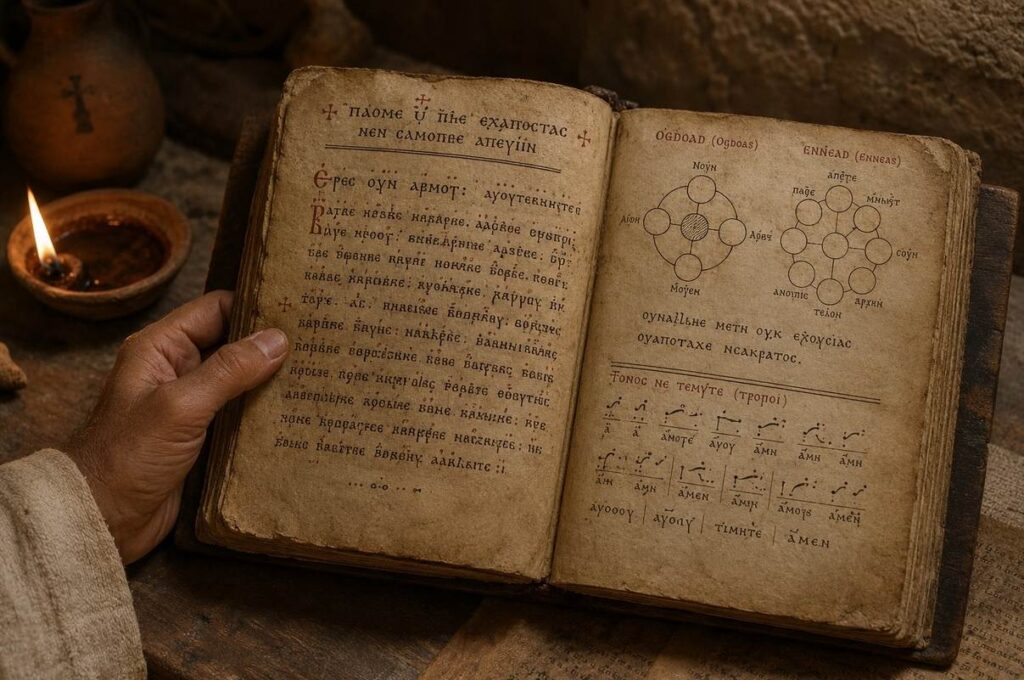
This physical proximity is historically significant. It demonstrates that the ancient readers who compiled and buried the Nag Hammadi Library did not regard Hermeticism and Gnosticism as separate religions. They were neighbouring departments within a single Alexandrian wisdom administration. The Discourse on the Eighth and the Ninth, with its ritual ascent protocol and vowel intonations, could be read alongside the Sethian Zostrianos or the Valentinian Gospel of Philip without any sense of category violation. The boundaries that modern scholars have drawn–Hermeticism here, Gnosticism there–were not boundaries that the ancient practitioners recognised.
Yet the texts themselves remain distinct. The Hermetic treatises in Codex VI lack the anti-cosmic polemic that characterises the Sethian material. The Prayer of Thanksgiving is a hymn of cosmic gratitude, not a denunciation of the creator. The Asclepius excerpt describes the downfall of Egyptian religion with regret, not triumph. The Discourse on the Eighth and the Ninth presents the cosmos as a ladder to be climbed, not a prison to be escaped. The presence of these texts in a Gnostic library does not mean they were Gnostic; it means that Gnostic readers found them valuable, compatible, and perhaps necessary for a complete spiritual education.
Mutual Influence: Did Hermeticism Shape the Gnostic Schools?
The evidence for direct influence is substantial. Irenaeus, writing around 180 CE, reports that the Gnostic teacher Basilides drew on Hermetic concepts in his cosmology. Tertullian, a generation later, attacks Valentinian theology for its resemblance to Hermetic speculation. The shared terminology–Nous, Logos, Anthropos, Pleroma, Demiurge–suggests more than coincidence. The Alexandrian milieu was a network, not a set of isolated cells, and ideas circulated through teachers, students, merchants, and manuscripts with a fluidity that modern denominational thinking cannot easily grasp.
Yet influence is not identity. The Valentinians took Hermetic concepts and bent them toward Christian soteriology: the aeons became a framework for understanding the Trinity, the syzygy became a model for Christ and the Church, the bridal chamber became a sacrament of restoration. The Sethians took Hermetic cosmology and radicalised it: the planetary governors became archons, the demiurge became a tyrant, and the cosmos became a counterfeit. Hermeticism itself remained more conservative, more optimistic, more philosophically restrained. It did not need to reject the material world because it had never invested ultimate significance in it. The world was a school, not a battlefield.
The modern seeker who encounters both traditions is often tempted to synthesise them, to construct a unified “Hermetic-Gnostic” spirituality that smooths over the differences. This is understandable but historically inaccurate. The differences are not superficial; they are foundational. To be a Gnostic is to suspect the world; to be a Hermeticist is to study it. To be a Gnostic is to seek escape; to be a Hermeticist is to seek alignment. Both paths lead upward, but they begin from different premises and pass through different landscapes. The wise traveller does not conflate the maps.
Frequently Asked Questions
What is the Corpus Hermeticum and when was it written?
The Corpus Hermeticum is a collection of Greek philosophical-religious treatises attributed to Hermes Trismegistus, a syncretic figure combining the Egyptian god Thoth with the Greek god Hermes. The texts were composed in Roman Egypt between the first and third centuries CE, drawing on Platonic, Stoic, Egyptian, and Jewish traditions. The foundational text is the Poimandres (Treatise I), a creation myth and revelation dialogue that parallels the Apocryphon of John in structure but diverges significantly in its assessment of the material world.
How do Hermeticism and Gnosticism share the same cosmic architecture?
Both traditions describe reality as a graded hierarchy descending from a transcendent, ineffable source. In Hermeticism, this is the One or Nous; in Gnosticism, the Monad or Invisible Spirit. Both posit a divine Mind that emanates lower realities. Both describe planetary spheres governed by powers that the soul must pass during ascent. Both maintain that human beings contain a divine spark (the Anthropos in Hermeticism, the pneumatic seed in Gnosticism) that has fallen into matter and must be restored to its origin. Both employ negative theology to describe the highest deity and both use revelatory dialogue as their primary literary form.
How do the Hermetic and Gnostic demiurges differ?
In Gnosticism, the demiurge is typically a hostile, ignorant, or malevolent figure–Yaldabaoth in the Apocryphon of John, who creates the material world as a prison for divine sparks. In Hermeticism, the demiurge is a craftsman or second Nous who creates the cosmos from primordial substance in obedience to the highest God. The Hermetic cosmos is ordered, beautiful, and pedagogical–a training facility for souls. The Gnostic cosmos is a counterfeit, a flawed imitation of the Pleroma. This difference is fundamental: Hermeticism maintains qualified optimism toward creation; Gnosticism maintains radical pessimism.
What is the Poimandres and how does it compare to the Apocryphon of John?
The Poimandres is the first treatise of the Corpus Hermeticum, presenting a creation myth in which the Nous (Divine Mind) generates the Logos, which then generates the Demiurge and the Anthropos (Primal Man). The Anthropos descends into Nature and becomes entrapped, requiring ascent back to the divine. The Apocryphon of John similarly presents a transcendent source, emanations, a demiurge, and a fall–but adds the Sophia myth, the archons, and a far more hostile account of material creation. The Poimandres lacks the Gnostic doctrine of an evil creator and presents the fall as the Anthropos’ own narcissistic error rather than a divine catastrophe.
What Hermetic texts were found in the Nag Hammadi Library?
Nag Hammadi Codex VI contains several Hermetic texts in Coptic translation: the Discourse on the Eighth and the Ninth (a ritual ascent text), the Prayer of Thanksgiving (a liturgical hymn), an excerpt from Asclepius (on the Egyptian gods and the fate of the cosmos), and an excerpt from Plato’s Republic (on the soul’s journey after death). Their presence in a library otherwise dominated by Sethian, Valentinian, and Christian texts demonstrates that ancient readers did not rigidly separate Hermetic from Gnostic categories. These were departments of a single Alexandrian wisdom tradition.
What is the Hermetic ascent through the planetary spheres?
The Poimandres describes the soul’s ascent through seven planetary spheres, shedding at each level an accretion of cosmic influence: the moon (bodily increase and decrease), Mercury (evil machination), Venus (desire for illusion), the Sun (arch of domination), Mars (unholy daring), Jupiter (evil strivings from wealth), and Saturn (deceit that ensnares). After shedding these, the soul enters the Ogdoad (the eighth realm) and ultimately the Ennead (the ninth), achieving henosis or union with the divine Nous. This protocol parallels the Sethian ascent past planetary archons but frames it as psychological deconditioning rather than escape from hostile prison guards.
Did Hermeticism influence the Gnostic schools?
Yes. Irenaeus and Tertullian both attest that the Gnostic teachers Basilides and Valentinus drew on Hermetic concepts. The shared Alexandrian milieu–where Greek philosophy, Egyptian religion, and Jewish apocalyptic converged–made cross-pollination inevitable. The Hermetic emphasis on Nous, Logos, and divine intellect appears in Valentinian theology. The Hermetic Anthropos myth parallels the Gnostic Adam of the Apocryphon of John. However, Hermeticism remained distinct in its more positive cosmology and its lack of the Sophia fall narrative. The two traditions were neighbours, not identical twins.
Further Reading
- Hermetic Spirituality: The Western Contemplative Tradition — A deep dive into the Corpus Hermeticum as a genuine path of inner transformation, examining epistrophe, planetary ascent, and the cultivation of Nous.
- Discourse on the Eighth and Ninth: Hermetic Ascent — The ritual ascent protocol from Nag Hammadi Codex VI, with vowel intonations, breath control, and the hymn in silence that transcends logos.
- Hermetic Connections in the Nag Hammadi Library — How Codex VI reveals that ancient practitioners viewed Hermetic and Gnostic texts as departments of a single wisdom administration.
- 5 Gnostic Schools Explained — Comparative overview of Sethian, Valentinian, Hermetic, and Thomasine traditions and their distinct paths to gnosis.
- Apocryphon of John: Foundational Text of Sethian Gnosticism — The complete cosmogony of Yaldabaoth, the divine spark, and the three races of humanity that Hermeticism reinterpreted.
- Valentinian Christianity: System and Influence — The most philosophically sophisticated Gnostic school, showing how Hermetic concepts were bent toward Christian soteriology.
- Nag Hammadi Library: Complete Guide to 46 Gnostic Scriptures — The master hub for navigating all tractates, codices, and thematic collections, including Codex VI’s Hermetic texts.
- Hermetic Connections: Egyptian Wisdom Meets Greek Philosophy — Tracing the cross-departmental collaboration between Hermetic and Gnostic texts within the Nag Hammadi library.
References and Sources
The following sources represent the scholarly monographs, primary texts, and critical studies underlying this article.
Primary Sources and Critical Editions
- The Corpus Hermeticum. Translated by Brian P. Copenhaver. Cambridge University Press, 1992.
- The Poimandres (Corpus Hermeticum I). In Hermetica, translated by Walter Scott. Shambhala, 1993.
- The Discourse on the Eighth and the Ninth (NHC VI,6). In The Nag Hammadi Library in English, 4th revised edition, edited by Marvin Meyer. HarperOne, 2007.
- The Prayer of Thanksgiving (NHC VI,7). In The Nag Hammadi Library in English, 4th revised edition, edited by Marvin Meyer. HarperOne, 2007.
- Asclepius (NHC VI,8). In The Nag Hammadi Library in English, 4th revised edition, edited by Marvin Meyer. HarperOne, 2007.
- The Apocryphon of John (NHC II,1; III,1; IV,1). In The Nag Hammadi Library in English, 4th revised edition, edited by Marvin Meyer. HarperOne, 2007.
- Irenaeus of Lyons. Against Heresies (Adversus Haereses), Books I–II. Translated by Alexander Roberts and James Donaldson. Ante-Nicene Fathers, Vol. 1. Christian Literature Publishing, 1885.
- Tertullian. Against the Valentinians (Adversus Valentinianos). Translated by Alexander Roberts. Ante-Nicene Fathers, Vol. 3. Christian Literature Publishing, 1885.
Scholarly Monographs
- Fowden, Garth. The Egyptian Hermes: A Historical Approach to the Late Pagan Mind. Princeton University Press, 1986.
- Copenhaver, Brian P. Hermetica: The Greek Corpus Hermeticum and the Latin Asclepius. Cambridge University Press, 1992.
- Bull, Christian H. “Monkey Business: Magical Vowels and Cosmic Levels in the Discourse on the Eighth and the Ninth (NHC VI,6).” Gnosis: Journal of Gnostic Studies, 2(2), 2017, 113-147.
- Hanegraaff, Wouter J. “Altered States of Knowledge: The Attainment of Gnosis in the Hermetica.” The International Journal of the Platonic Tradition, 2, 2008, 128-163.
- King, Karen L. What Is Gnosticism? Harvard University Press, 2003.
- Brakke, David. The Gnostics: Myth, Ritual, and Diversity in Early Christianity. Harvard University Press, 2010.
- Thomassen, Einar. The Spiritual Seed: The Church of the Valentinians. Brill, 2006.