
Neuroception and the Felt Sense
There is a knowing that arrives before thought. Before the mind constructs its narratives of meaning, before the linguistic self can articulate a single word, the body has already registered the truth–or the lie. This is not metaphor; it is neuroception, the pre-conscious surveillance system that determines whether we will open to spiritual insight or contract into defensive shutdown. Understanding neuroception and its sibling faculty, interoception, reveals the biological mechanism behind what mystics have long called discernment: the capacity to recognise truth not through deduction, but through direct somatic resonance.
The Western spiritual tradition has long suffered from interpretive imperialism–the insistence that religious authorities, sacred texts, or doctrinal systems possess truth while the body is merely a fallen vessel to be disciplined. Contemporary neuroscience inverts this hierarchy. The body is not the obstacle to spiritual knowing; it is the primary instrument. When meditation increases insula grey matter density, it reveals a capacity that was always present–the innate ability to read the subtle text of internal experience. When trauma-release practices restore accurate neuroception, they remove the fog that obscured an ancient perceptual capacity. The question shifts from “What do I believe?” to “What does my body know?”
Table of Contents
- Neuroception: The Mind Beneath Mind
- Interoception: The Eighth Sense
- The Felt Sense as Spiritual Technology
- Faulty Neuroception and Spiritual Deception
- Reclaiming Somatic Authority
- Frequently Asked Questions
- Further Reading
- References and Sources
Neuroception: The Mind Beneath Mind
Stephen Porges, architect of the Polyvagal Theory, coined the term neuroception to describe the neural process whereby our autonomic nervous system evaluates risk and safety without our conscious participation. Unlike perception–which requires awareness–neuroception operates in the shadows of the pre-conscious, scanning facial expressions, vocal tone (prosody), bodily postures, and visceral states to determine whether an environment, person, or experience warrants engagement or defence.
Polyvagal Theory proposes that the autonomic nervous system is organised hierarchically into three circuits, each reflecting a different evolutionary stage. The ventral vagal complex–the most recent, mammalian adaptation–supports social engagement, facial expression, and calm physiological state. When neuroception detects safety, this circuit dominates: heart rate slows, muscles of the face and middle ear engage, and the organism becomes accessible to others. If neuroception detects danger, the sympathetic nervous system mobilises fight-or-flight responses. If the threat is overwhelming, the dorsal vagal complex triggers shutdown, dissociation, or collapse [^75^]. These shifts occur beneath conscious choice, driven by neuroceptive evaluation of environmental cues.
For the spiritual practitioner, neuroception is the biological substrate of discernment. When you meet a teacher and feel an inexplicable ease–a dropping of the shoulders, a softening of the jaw, an urge to move closer–your neuroception has detected cues of safety that bypass your cognitive filters. Conversely, when you encounter a doctrine that sounds coherent but leaves you with a subtle nausea or coldness in the chest, your neuroception is signalling misalignment before your mind can articulate why. The spiritual seeker who cultivates neuroceptive awareness gains access to a deeper intelligence–the body’s innate wisdom about what is truly safe, true, and conducive to growth versus what is performative, exploitative, or merely familiar.
We often believe we choose our practices, our communities, and our beliefs through rational deliberation. In truth, neuroception chooses first. The mind merely rationalises what the autonomic nervous system has already accepted or rejected. This is not a flaw in rationality but a feature of biology: the pre-conscious evaluation is faster, more ancient, and often more accurate than the cognitive processes that follow. The spiritual seeker who learns to read these pre-conscious signals discovers a form of knowing that doctrine cannot override and charisma cannot fake.
Interoception: The Eighth Sense
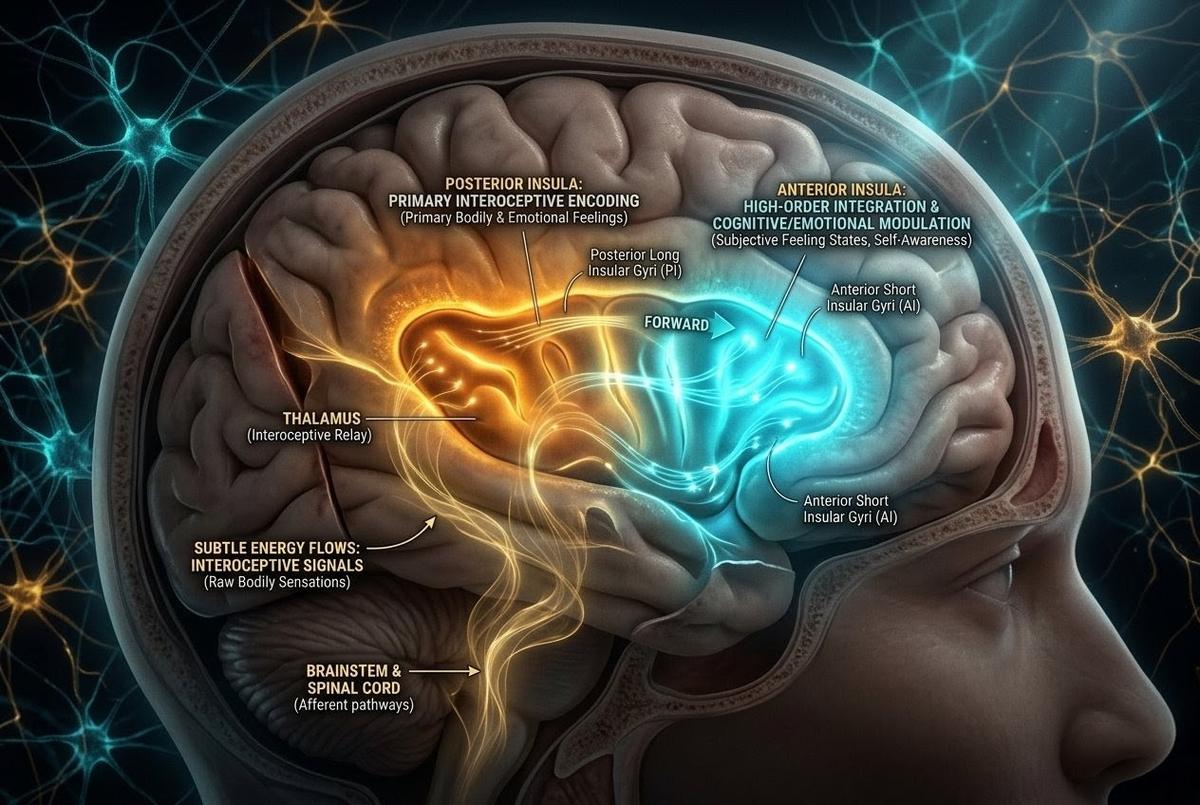
While neuroception scans the external environment for safety, interoception monitors the internal landscape. Often called the eighth sense, interoception is the awareness of internal bodily states–heartbeat, respiration, digestive rhythms, temperature fluctuations, muscle tension–mediated primarily by the insula cortex. This buried cortical structure, tucked deep within the lateral sulcus, serves as the translator between raw physiological data and conscious emotional experience.
Neuroimaging research reveals that contemplative practice physically remodels the insula. An eight-week Mindfulness-Based Stress Reduction (MBSR) program increases cortical thickness in the right anterior insula and strengthens functional connectivity between posterior and anterior insula regions [^74^][^76^]. This neuroplasticity enhances what researchers call interoceptive accuracy–the ability to correctly detect and interpret internal signals. For the mystic, this is not merely stress reduction; it is the biological honing of spiritual intuition.
Interoceptive research distinguishes between interoceptive accuracy (the objective correctness of internal perception) and interoceptive sensibility (the subjective confidence in that perception). The spiritually mature practitioner develops both: the accuracy to detect subtle shifts in visceral state, and the sensibility to trust those detections without demanding immediate cognitive confirmation. The gap between accuracy and sensibility is where doubt colonises the body–where the mind overrides the gut because the gut cannot produce footnotes.
The Insula as Translator of Truth
The anterior insula, in particular, appears to be the neural correlate of what Eugene Gendlin called the felt sense–that vague, pre-verbal “something” that knows more than we can say. When you sit in meditation and sense an unclear, body-held quality about your spiritual situation–a heaviness, a constriction, a subtle rightness–you are experiencing interoceptive data emerging into consciousness through the insula’s hierarchical processing. The posterior insula receives raw sensation; the middle insula refines it; the anterior insula integrates it with emotional and cognitive context to create a conscious “felt sense” of meaning.
The Felt Sense as Spiritual Technology
Eugene Gendlin, philosopher and student of Carl Rogers, discovered through decades of psychotherapy research that successful clients shared a specific capacity: they could pause and attend to a bodily sense that was more than words–a felt sense of their situation. This was not emotion (which is already labelled) and not mere sensation (which is localised), but a holistic, body-held awareness of the implicit meaning of one’s circumstances [^79^].
In spiritual contexts, the felt sense is the mechanism by which truth arrives before doctrine. When you read a sacred text and feel a resonant “click” in the chest–a felt shift that Gendlin described as the kaleidoscope turning–you are experiencing the successful symbolisation of an interoceptive signal. The text has served as a focusing probe, bringing the pre-verbal bodily knowing into conscious articulation. This is why mechanical repetition of scripture rarely transforms, while passages that resonate with one’s felt sense can alter consciousness instantaneously.
The practice of Focusing, which Gendlin developed to teach this capacity, parallels ancient contemplative methods. By attending to the felt sense with an attitude of unconditional positive regard–neither forcing interpretation nor dismissing the murky sensation–the practitioner allows the body’s wisdom to unfold. When the exactly right words or images are found to match the felt sense, the body responds with a shift: a sigh, a relaxation, a sense of opening. This is the physiological signature of spiritual recognition–the body acknowledging that consciousness has accurately mirrored its truth.

Faulty Neuroception and Spiritual Deception
If neuroception is the radar, trauma is the fog. When the nervous system has been shaped by prolonged danger–particularly relational trauma in early attachment–neuroception becomes faulty, misinterpreting safety as threat and threat as safety. This explains why some seekers repeatedly gravitate toward authoritarian or abusive spiritual communities: their neuroception has learned to read control as care, intensity as love, and compliance as safety [^75^].
The Insula’s Role in Distortion
The insula plays a crucial role in this distortion. Research shows that disrupted interoceptive awareness correlates with alexithymia–the inability to identify and describe emotions–and with susceptibility to external authority. When you cannot feel what you feel, you must rely on others to tell you what is real. Cult leaders and spiritual predators exploit precisely this gap, offering cognitive frameworks that override the body’s muted warning signals.
Healing requires recalibrating neuroception through safe relational experiences–what Porges calls co-regulation–and rebuilding interoceptive pathways through practices that strengthen insula connectivity. As interoceptive accuracy improves, so does the capacity to detect the subtle somatic markers of manipulation versus authentic guidance. The body becomes a truth-teller again, rather than a silenced witness to its own betrayal.
Co-Regulation and the Restoration of Somatic Trust
Porges emphasises that mammals are not designed to self-regulate in isolation; we regulate through co-regulation–the mutual exchange of safety cues between trusted others. The infant’s nervous system learns safety through the mother’s prosodic voice, warm facial expression, and responsive touch. The adult seeker whose early co-regulation was disrupted must find safe relational containers in which to retrain neuroception. This is why authentic spiritual communities matter: not for doctrine, but for the nervous system’s opportunity to rehearse safety in the presence of others. The teacher who meets your eyes with warmth, whose voice carries melodic variation, whose presence invites rather than demands–such a teacher is offering co-regulation as curriculum. The body learns safety through relationship before the mind can believe it.

Reclaiming Somatic Authority
The Western spiritual tradition has long suffered from what might be called interpretive imperialism–the insistence that religious authorities, sacred texts, or doctrinal systems possess truth while the body is merely a fallen vessel to be disciplined. Neuroception and interoception research inverts this hierarchy. The body is not the obstacle to spiritual knowing; it is the primary instrument.
When meditation increases insula grey matter density, it is not creating a capacity from nothing but revealing one that was always present–the innate ability to read the subtle text of internal experience. When trauma release practices restore accurate neuroception, they are not adding a new skill but removing the fog that obscured an ancient perceptual capacity. The implications are revolutionary. Spiritual discernment is not a rare gift bestowed upon saints but a biological potential available to anyone willing to reclaim somatic authority.
The political dimension of this reclamation cannot be ignored. For centuries, religious institutions have claimed exclusive rights to discernment, positioning the clergy as intermediaries between the believer and divine truth. The recovery of somatic authority dissolves this monopoly. The body becomes the primary text; the nervous system becomes the reader; and the institutional gatekeeper becomes obsolete. This is not anti-traditional but pro-direct: the traditions that survive will be those that empower the practitioner to trust their own neuroceptive and interoceptive data, rather than demanding submission to external authority.
The question shifts from “What do I believe?” to “What does my body know?” The answer arrives not through syllogism but through the slow, patient attention to the felt sense–the murky, bodily knowing that waits at the edge of consciousness for the exactly right words to bring it into light. The path is not a rejection of reason but its transcendence: the rational mind builds the ladder; the somatic mind climbs it; the awakened mind realises there was never a wall.


Read With Discernment
This article touches material where experience, interpretation and symbolic language can easily blur. Read slowly, compare sources, and keep your own discernment intact.
- Editorial Principles — how ZenithEye separates source, interpretation and lived experience.
- Start Here — the reader guide for the wider archive.
- States of Knowing — altered states, dreams, consciousness, perception and direct experience.
- The Transformation — integration, grounding, spiritual emergence and return to ordinary life.
Frequently Asked Questions
What is neuroception and how does it relate to spiritual discernment?
Neuroception is the pre-conscious neural process by which the autonomic nervous system evaluates environmental safety or danger without conscious awareness. Coined by Stephen Porges, it explains how we instinctively know whether to approach or avoid people, situations, or spiritual teachings before our mind can rationalise the decision. In spiritual contexts, neuroception functions as the biological substrate of discernment–the body’s innate radar for truth, safety, and authenticity.
What is the difference between neuroception and interoception?
Neuroception scans the external environment for safety cues such as facial expressions, vocal tone, and body language. Interoception monitors internal bodily states including heartbeat, breathing, and muscle tension via the insula cortex. Neuroception asks ‘Is this safe out there?’ Interoception asks ‘What is true in here?’ Together they form the basis of somatic spiritual discernment–the capacity to read both outer and inner landscapes for guidance.
What is the felt sense according to Eugene Gendlin?
The felt sense is a body-held awareness that is more than words–a holistic, pre-verbal sensing of a situation, relationship, or spiritual truth. It exists between raw sensation and labelled emotion, carrying implicit meaning that can be brought to consciousness through careful attention and symbolisation. Gendlin discovered that psychotherapy clients who could attend to their felt sense achieved better outcomes because they accessed bodily wisdom that cognition alone could not reach.
How does meditation change the insula cortex?
Research shows that 8-week MBSR programs increase cortical thickness in the right anterior insula and strengthen connectivity between posterior and anterior insula regions. This neuroplasticity enhances interoceptive accuracy–the ability to detect and interpret internal signals–effectively honing the biological instrument of spiritual intuition. Long-term meditators show greater insula grey matter density than matched controls, suggesting that contemplative practice physically remodels the brain’s interoceptive gateway.
Can trauma damage neuroception and lead to spiritual deception?
Yes. Trauma, particularly early relational trauma, creates faulty neuroception where the nervous system misinterprets safety as threat and control as care. This explains why some seekers repeatedly choose authoritarian spiritual communities–their neuroception has been recalibrated by past survival needs to read danger signals incorrectly. Healing requires recalibration through safe relational experiences (co-regulation) and practices that rebuild interoceptive pathways.
How can I improve my interoceptive awareness?
Practices that strengthen insula connectivity include body scan meditation, Focusing (Gendlin’s method), somatic tracking, and mindful attention to internal sensations without immediate labelling. Regular practice increases grey matter density in the insula and enhances the ability to detect subtle bodily wisdom. Start with simple daily body scans and gradually develop the capacity to hold attention on murky, pre-verbal sensations without demanding immediate interpretation.
What is a felt shift and why does it matter for spiritual practice?
A felt shift is the physiological release that occurs when the exactly right words or images are found to symbolise a previously murky felt sense. It manifests as a sigh, relaxation, or sense of opening in the body, indicating that consciousness has accurately mirrored the body’s pre-verbal knowing. In spiritual contexts, this is the somatic signature of recognition or insight–the moment when doctrine and experience align, producing a transformative shift in awareness.
Further Reading
These links connect neuroception and interoception to related resources within the ZenithEye library, offering context on somatic awareness, contemplative practice, shadow work, and the broader landscape of embodied spirituality.
- The Gateway of Sensation: Body Scan and Somatic Awareness — Developing interoceptive sensitivity as the foundation for spiritual discernment and bodily wisdom.
- The Alchemy of Attention: 4 Contemplative Techniques — Methods for cultivating the presence that precedes and sustains neuroceptive clarity.
- Shadow Work: Excavating the Repressed in Gnostic Practice — Why unintegrated shadow material distorts neuroception and generates faulty spiritual radar.
- Predatory Consciousness & Spiritual Emergency: A Gnostic Survival Guide — Recognising when faulty neuroception leads seekers toward manipulation and energetic predation.
- 7 Integration Practices After Mystical Experience — Somatic techniques for grounding and stabilising the nervous system after non-ordinary states.
- The Witness Function in Contemplative Traditions — Understanding the observer consciousness and its relationship to neuroceptive self-monitoring.
- The Ordinary Saint: Invisibility as Completion of the Transformation — The manifestation of integrated somatic authority in ordinary life without performance.
- Modern Resonances: 9 Ways Ancient Gnosis Illuminates Crisis — How contemporary neuroscience recovers what ancient contemplatives discovered about the body-mind relationship.
- Body Against Algorithm: Reclaiming Embodiment — The political and spiritual dimensions of reclaiming the body from digital dissociation.
- The Thread: Five Gateways to Direct Knowing — The complete map of ZenithEye’s pillars, from historical survival of Gnosis to contemplative practice.
References and Sources
The following sources support the neuroscientific and psychological claims presented in this article. Primary research is cited by first author and year; clinical references follow standard conventions.
Primary Research and Critical Reviews
- Porges, S. W. (2011). The Polyvagal Theory: Neurophysiological Foundations of Emotions, Attachment, Communication, and Self-Regulation. W. W. Norton.
- Porges, S. W. (2003). Social engagement and attachment: A phylogenetic perspective. Annals of the New York Academy of Sciences, 1008, 31-47.
- Lazar, S. W., et al. (2005). Meditation experience is associated with increased cortical thickness. NeuroReport, 16(17), 1893-1897.
- Santarnecchi, E., et al. (2014). Interaction between neuroanatomical and psychological changes after mindfulness-based training. PLoS ONE, 9(10), e108359.
Scholarly Monographs and Commentaries
- Gendlin, E. T. (1978). Focusing. Bantam Books.
- Gendlin, E. T. (1996). Focusing-Oriented Psychotherapy: A Manual of the Experiential Method. Guilford Press.
- Craig, A. D. (2009). How do you feel–now? The anterior insula and human awareness. Nature Reviews Neuroscience, 10(1), 59-70.
- Damasio, A. R. (1994). Descartes’ Error: Emotion, Reason, and the Human Brain. G. P. Putnam’s Sons.
Comparative Studies and Thematic Analyses
- Van der Kolk, B. (2014). The Body Keeps the Score: Brain, Mind, and Body in the Healing of Trauma. Viking.
- Dana, D. (2018). The Polyvagal Theory in Therapy: Engaging the Rhythm of Regulation. W. W. Norton.
- Mehling, W. E., et al. (2012). Body awareness: Construct and self-report measures. PLoS ONE, 7(5), e36746.
Safety Notice: This article explores neuroscientific frameworks for understanding trauma, spiritual deception, and somatic awareness. It does not constitute medical, psychological, or spiritual advice. If you experience persistent dissociation, psychosis, inability to distinguish between internal impressions and external reality, or severe psychological distress related to spiritual practice or trauma, please contact professional emergency services or a trauma-informed therapist. Contemplative practices complement but do not replace clinical mental health treatment. Approach trauma-processing practices with qualified guidance and adequate support systems in place.