The Teachings of Silvanus: Practical Wisdom from the Nag Hammadi Library
The Teachings of Silvanus (NHC VII,4) arrives not with the thunder of celestial revelation nor the complex administrative charts of Sethian cosmology, but with the quiet authority of an internal memorandum—one hundred and sixteen directives on the governance of the self, circulated from an unnamed father to an anonymous son somewhere in the second or third century CE. Found in Codex VII of the Nag Hammadi Library alongside technical ascent manuals like Zostrianos, this tractate represents a distinct departmental approach to the Gnostic insurgency: not the revolutionary overthrow of the archonic administration, but the cultivation of internal sovereignty that renders its external jurisdiction irrelevant. Where other texts offer passwords to bypass planetary checkpoints, Silvanus provides training in the attention economy—teaching the practitioner to withhold the tax of psychic energy that the cosmic powers routinely levy upon the distracted.
Unlike the mythological narratives of the Apocryphon of John or the liturgical protocols of the Three Steles of Seth, Silvanus operates as a practical ethics manual, drawing heavily upon Stoic administrative techniques while adapting them for a Christian-Gnostic personnel file. The text addresses the reader as logikos anthropos—the rational human being capable of self-governance through logos (reason/word)—and prescribes a rigorous regimen of wakefulness, emotional temperance, and continuous attention (prosoche) as the path to spiritual incorruption. In the diverse bureaucracy of the Nag Hammadi library, Silvanus serves as the human resources department: less concerned with cosmic restructuring than with the proper management of the individual employee.
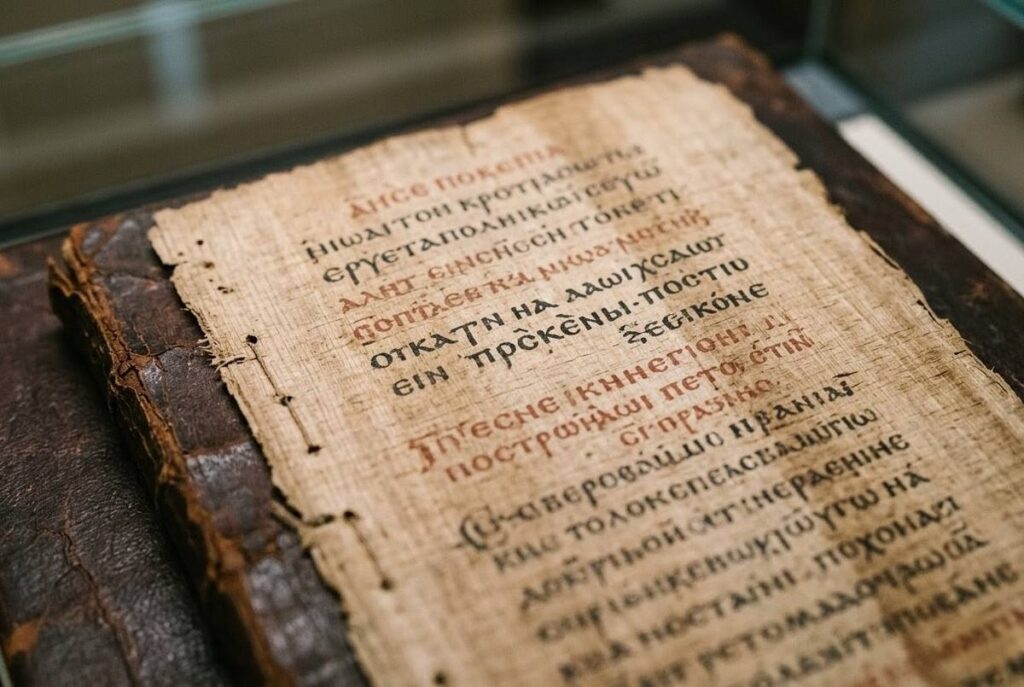
Table of Contents
- The Unknown Sage: Silence Amidst Cosmic Noise
- What Are the Teachings of Silvanus?
- The Stoic-Gnostic Synthesis: Philosophy as Counter-Administration
- Key Themes and Counsels: The Architecture of Attention
- The Father-Son Literary Device: Pedagogy as Initiation
- Living Relevance: Algorithmic Attention and Ancient Medicine
- Frequently Asked Questions
- Further Reading
- References and Sources
The Unknown Sage: Silence Amidst Cosmic Noise
An Enigmatic Administrative Presence
The text presents itself as a letter from father to son, yet “Silvanus” remains an administrative ghost—possibly a pseudonym evoking the Silvanus mentioned in the New Testament epistles (1 Peter 5:12, 2 Corinthians 1:19), possibly a teacher whose actual name became attached to the text through the messy bureaucratic processes of scribal transmission. Unlike the grand revelatory credentials claimed by Zostrianos (who ascends through thirteen aeons) or the apostolic authority asserted by the Apocryphon of John, Silvanus offers no celestial business cards. The authority derives solely from the demonstrable wisdom of the counsels themselves—a meritocratic spirituality based on efficacy rather than lineage.
Primary Source Citation: NHC VII,4 84:15-20: “My son, observe my advice. Flee wickedness. Watch yourself carefully in all things, in whatever you do… Work hard, my son, lest death overtake you and you become a dead man while still alive.” [1]
The Codicological Context of Codex VII
Discovered alongside the most exotic Gnostic cosmologies in Codex VII—including the technical Sethian ascent manual Zostrianos, the obscure Paraphrase of Shem, and the docetic Apocalypse of Peter—Silvanus preaches not escape from the world but transformation within it. This codicological context suggests a community that valued both the heights of mystical speculation and the sober ground of daily ethical practice. The archons may govern the stars and assign destinies according to planetary jurisdictions, but Silvanus concerns himself with the governance of the self: the internal administration of attention and the proper allocation of psychic resources.
The words crackle with immediacy, suggesting a tradition more concerned with character formation than with cosmic cartography. This is Gnosticism as askesis—not the extreme asceticism of body-hatred that some heresiologists attributed to certain Gnostic factions, but the disciplined training of attention that renders the practitioner immune to the distractions of the archonic marketplace. The text recognises that one need not overthrow the cosmic administration to be free of it; one need only cease paying the taxes of emotional reactivity that sustain its operations.
What Are the Teachings of Silvanus?
The Teachings of Silvanus Defined
The Teachings of Silvanus (NHC VII,4) is a second-to-third-century CE tractate from the Nag Hammadi Library consisting of 116 logia (sayings) organised as a letter from father to son. Unlike the cosmological narratives of Sethian Gnosticism, Silvanus offers practical ethics drawn from Stoic philosophy—specifically the concepts of apatheia (passionlessness/equanimity), prohairesis (moral choice/faculty of choice), and prosoche (continuous attention)—combined with Christian and Platonic elements.
The text addresses the reader as logikos anthropos (the rational human being), emphasising wakefulness, attention, and emotional temperance as the path to spiritual incorruption. It contains no mythological narrative of Sophia’s fall, no description of the demiurge Yaldabaoth, and no ascent through planetary spheres; instead, it focuses entirely on the internal administration of the self as the locus of salvation.
116 Logia of Practical Governance
Written likely by a Christian philosopher with strong Stoic leanings, the work contains 116 logia organised loosely by thematic clusters: the cultivation of the mind (nous), the dangers of passion (pathos), the importance of discernment (diakrisis), and the path to spiritual sobriety (nepsis). The tractate operates in the register of practical ethics, treating the reader not as a cosmic exile seeking return to a distant Pleroma, but as an administrator responsible for the proper management of a complex internal territory.
“Bring your divine mind into your body,” the text commands, “and withdraw your soul from sensual pleasures.” This is not the dualistic body-hatred of extreme asceticism but a call to interior integration—to making the body the servant of the rational soul rather than its master. The anthropology is tripartite (body, soul, spirit/mind), drawing on Platonic psychology, yet the goal is holistic: the reunification of the fragmented self under the governance of the divine intellect.
Primary Source Citation: NHC VII,4 92:5-10: “Bring your divine mind into your body. Withdraw your soul from sensual pleasures… Light the lamp within you… Establish the inner eye that sees the hidden things.” [2]
The Rhetoric of Urgency
Silvanus employs the rhetorical strategies of Hellenistic paraenesis (exhortation literature) with distinctive bureaucratic urgency. The text imagines death not as a distant theological abstraction but as an immediate administrative threat that stalks the negligent: “You have not yet been attacked by the archons,” it warns, suggesting that the cosmic administrators actively seek the distracted, the somnambulant, and those who have failed to file their spiritual paperwork. The solution is constant vigilance—the maintenance of prosoche (attention) as armour against the forces of fragmentation.

The Stoic-Gnostic Synthesis: Philosophy as Counter-Administration
Scholarly Debates on Classification
Modern scholars debate Silvanus’s classification with the intensity of taxonomists arguing over a problematic species that refuses to fit established categories. Is it “Gnostic” at all? It lacks the characteristic Gnostic myth of a fallen divine spark trapped in material darkness. It never mentions the demiurge Yaldabaoth or the planetary archons by name. It contains no Sophia narrative, no cosmic tragedy of pre-cosmic error. Yet it shares with Sethian and Valentinian texts a fundamental soteriological concern with awakening—from the sleep of ignorance, from the drunkenness of passion, from the “forgetfulness” of mundane existence that allows the archons to collect their psychic tribute.
The Administrative Vocabulary of Self-Governance
The Stoic vocabulary sits comfortably alongside Christian and Platonic elements, creating a hybrid administrative manual for the soul. Apatheia (passionlessness or equanimity) appears as the ethical ideal—not the suppression of emotion but its transformation through rational understanding, rendering the administrator immune to the emotional weather that governs the masses. Prohairesis (moral choice or faculty of choice) emerges as the divine fragment within, the capacity to assent or dissent to the impressions (phantasiai) that present themselves to consciousness. Prosoche (attention) functions as the continuous mindfulness necessary for maintaining this governance, the internal security force that guards against intruders.
Christian elements include Christ as the divine intellect (nous) and the soul’s bridegroom, suggesting a mystical union achieved through ethical preparation rather than sacramental ritual. Platonic psychology appears in the charioteer imagery—reason guiding the horses of appetite and spirit—though Silvanus emphasises the integration of these elements rather than their transcendence. The result is a pragmatic spirituality that treats the human being as a small corporation requiring efficient management.
Esotericism Without Cosmological Bureaucracy
Perhaps Silvanus represents what Gnosticism looked like when it went to ground—when the mythological systems became too dangerous to commit to writing (carrying the risk of heresy charges and confiscation), or when a particular community chose to emphasise the practical fruits of gnosis rather than its speculative roots. “Seek the elect, the living God,” the text advises, “and seek his incorruptible handiwork, the living soul with the rational mind.” This is esotericism without the cosmological paperwork, mysticism focused on character formation rather than visionary experience. The divine is found not in the aeonic departments above but in the rational mind properly ordered within.
Key Themes and Counsels: The Architecture of Attention
The Wakefulness of the Mind
Silvanus returns repeatedly to metaphors of sleep and waking, drawing on the nepsis (sobriety) tradition of early Christian monasticism. “Do not be a sausage made of many stuffing,” it warns with characteristically earthy, almost grotesque imagery—meaning, do not be a creature of conflicting appetites and external impressions, but a unified rational being with a coherent internal policy. The mind (nous) appears as the divine fragment within, the “light within the heart” that must be tended like a lamp flame in hostile winds.
Primary Source Citation: NHC VII,4 103:15-20: “Do not be a sausage made by many stuffing, lest you become food for the archons… But be a single one, having the divine mind within you.” [3]
This wakefulness is not merely intellectual alertness but ontological vigilance. The text warns that “the passions are a tax levied by the world”—a strikingly economic metaphor suggesting that emotional reactivity drains the soul’s resources, paying tribute to the archonic system of control. To sleep is to pay this tax unconsciously; to wake is to withhold payment, to declare oneself exempt from the fiscal jurisdiction of the cosmic powers.
The Discipline of Attention (Prosoche)
“Turn your mind to the light of God,” Silvanus instructs, “and keep your soul mindful of God.” This prosoche (attention) resembles the practices of later Christian contemplative traditions, particularly the philokalia of the Desert Fathers. The text prescribes continual mindfulness—not as a technique for relaxation or productivity (the modern wellness industry’s appropriation of the concept), but as armour against the passions that cloud judgment and lead to spiritual death.
The practice involves “drawing the mind back from the dispersion”—a recognition that the untrained consciousness is scattered across external objects, future anxieties, and past regrets. The rational mind (logos) must be gathered into the present moment, where the divine intellect operates. This is not meditation in the modern sense but a militant guarding of the heart against the “thieves” that would steal attention—the archonic agents that operate precisely through distraction and emotional agitation.
The Education of the Emotions
While some Gnostic texts advocate radical asceticism or, conversely, libertine antinomianism (the “redemption through sin” attributed by heresiologists to some Valentinian groups), Silvanus proposes a measured middle way of emotional temperance. “Do not be hostile to anyone,” it counsels, “lest you become divided against yourself.” Anger, envy, and excessive desire fragment the self; only apatheia—the cultivation of equanimity—allows the mind to perceive truth clearly.
The text recognises that emotions are not merely internal states but social forces with cosmic implications: “The anger of man works the will of the archons.” Here Silvanus comes closest to the cosmological concerns of other Nag Hammadi texts, suggesting that ungoverned passion serves the administrative functions of the cosmic powers, feeding the very system that keeps humanity enslaved. To achieve apatheia is not to become cold or inhuman, but to cease being a resource exploited by the planetary bureaucrats—a taxpayer who declares independence by withdrawing from the economy of reactivity.

The Father-Son Literary Device: Pedagogy as Initiation
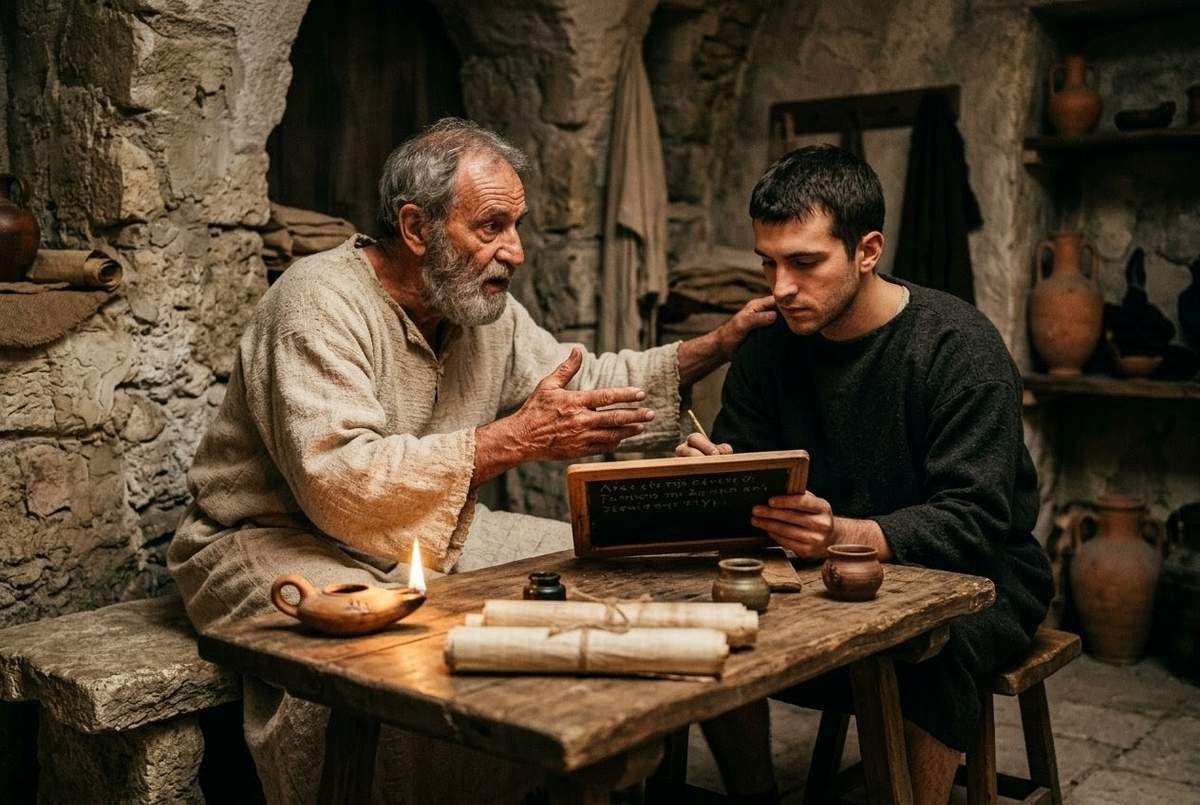
The tractate employs the literary fiction of a father counselling his son—a common device in Hellenistic wisdom literature (echoing Proverbs, Sirach, and the letters of Epicurus). Yet within the Nag Hammadi context, this domestic framing carries initiatory resonance. The “son” represents the reader as spiritual novice; the “father” represents the perfected rational intellect, the administrator who has mastered the internal bureaucracy.
“My son, observe my advice,” the text begins, establishing a relationship of authority grounded in love and demonstrated competence rather than in coercive power or institutional hierarchy. This pedagogical model contrasts sharply with the revelation-dialogues of other tractates (where the authority derives from divine vision) or the apostolic letters (where authority derives from historical proximity to Jesus). Silvanus offers a democratised spirituality: any rational being who undertakes the discipline may become the “father” to their own “son”—the lower self requiring education and proper governance.
The 116 logia are organised not systematically but associatively, mimicking the process of oral instruction. Themes recur—wakefulness, attention, the governance of passion—each time with slight variations, as if the teacher returns to touchstones, knowing that wisdom requires repetition rather than novelty. This structure suggests that the text was designed not for casual reading but for slow digestion, for the gradual internalisation of principles that must become habitual before they become transformative.
Living Relevance: Algorithmic Attention and Ancient Medicine
The Archonic Algorithms of the Digital Age
For contemporary readers navigating digital distraction and affective overload, Silvanus offers surprisingly pertinent medicine. Its call to “withdraw your soul from sensual pleasures” reads differently in an age of algorithmic manipulation explicitly designed to harvest attention. The modern “attention economy” operates precisely on the principles Silvanus warns against: the fragmentation of consciousness, the exploitation of passion, the taxation of the soul through constant reactivity.
The text’s emphasis on prohairesis—the capacity to choose our responses rather than reacting automatically to stimuli—anticipates modern cognitive behavioural insights while grounding them in a spiritual framework. When Silvanus commands “do not be a sausage made of many stuffing,” he diagnoses with uncanny precision the condition of the contemporary consumer: pulled in multiple directions by competing desires, lacking the unified will necessary for authentic existence, fragmented by the very technologies promising connection.
No Esoteric Clearance Required
Unlike the esoteric technical literature of Allogenes or Marsanes (which require initiation into aeonic geography and the memorisation of passwords for planetary checkpoints), Silvanus requires no special security clearance. It asks instead: Can you keep your attention fixed on the divine intellect amidst the chaos of daily life? Can you remain sober while others drink themselves into the stupor of distraction? Can you maintain prosoche when every device in your environment is engineered to fracture it?
The text ends with a promise: “If you follow these teachings, you will live in incorruption.” Not immortality through mystical ascent, not escape through secret passwords whispered at the seventh planetary gate, but incorruption through ethical integrity. In the diverse ecosystem of the Nag Hammadi Library, Silvanus represents the practical root without which the exotic flower of Gnostic cosmology cannot survive. The archons may govern the stars and assign fates according to their administrative protocols, but the rational mind, properly trained, remains free—an autonomous zone within the empire of necessity.

Frequently Asked Questions
What are the Teachings of Silvanus?
The Teachings of Silvanus (NHC VII,4) is a second-to-third-century CE tractate from the Nag Hammadi Library containing 116 practical sayings on ethical living. Unlike other Gnostic texts focused on cosmic mythology, Silvanus offers Stoic-influenced guidance on attention, emotional temperance, and wakefulness, addressing the reader as logikos anthropos–the rational human being capable of self-governance.
Is Silvanus actually Gnostic or just Christian Stoicism?
Scholars debate this classification. Silvanus lacks characteristic Gnostic mythology (no Demiurge, no fallen Sophia, no aeonic bureaucracy), but shares the soteriological focus on awakening from sleep/ignorance. It may represent practical Gnosticism ‘gone to ground’–esotericism without cosmology–or Christian Stoicism influenced by Gnostic circles. Its placement in Codex VII alongside technical Sethian texts suggests the ancient curators considered it part of the same spiritual ecosystem.
What does ‘Do not be a sausage made of many stuffing’ mean?
This earthy metaphor from Silvanus warns against being fragmented by conflicting desires and external impressions. Like a sausage filled with various ingredients, the person lacking rational unity becomes a mixture of competing appetites rather than an integrated self governed by the divine mind (nous). The image emphasises the need for internal coherence and singularity of purpose.
What is prosoche in the Teachings of Silvanus?
Prosoche (attention) in Silvanus refers to continuous mindfulness of the divine–a militant guarding of the heart against passions and distractions. Unlike modern mindfulness for relaxation, Silvanus prescribes attention as armour against archonic forces that fragment consciousness and cloud judgment. It involves ‘drawing the mind back from dispersion’ to gather the scattered self into the present moment.
How is Silvanus relevant to modern digital distraction?
Silvanus addresses digital distraction and attention fragmentation with remarkable precision. Its warnings about ‘sensual pleasures’ and emotional reactivity apply directly to algorithmic manipulation designed to harvest attention. The text offers ancient techniques (prosoche, apatheia) for maintaining sovereignty in an age of information overload, treating the passions as a ‘tax levied by the world’ that the archonic systems collect through our distraction.
What Stoic concepts appear in Silvanus?
Silvanus extensively borrows Stoic concepts: apatheia (passionlessness/equanimity), prohairesis (moral choice/faculty of assent), prosoche (attention), and the tripartite anthropology (body/soul/mind). However, it adapts these for Christian-Gnostic ends, identifying Christ as the divine intellect and salvation as incorruption through ethical integrity rather than philosophical detachment.
Where does Silvanus fit in the Nag Hammadi Library?
Silvanus appears in Codex VII alongside technical Sethian ascent texts like Zostrianos and the Paraphrase of Shem. This placement suggests the ancient curators valued both cosmic speculation and practical ethics. It serves as a bridge between complex Gnostic mythology and accessible daily practice–a ‘beginner’s manual’ or ‘human resources department’ for the Gnostic path that requires no esoteric initiation to implement.
Further Reading
- Apocryphon of John: Gnostic Creation Myth — Contrast Silvanus’s practical ethics with the cosmic mythology and administrative bureaucracy of Sethianism.
- Zostrianos: Journey Through the Thirteen Aeons — Explore the technical ascent literature found alongside Silvanus in Codex VII, representing the other pole of practical application.
- Contemplative Techniques: Methods for Stabilisation — Practical exercises compatible with Silvanus’s teachings on attention and mindfulness.
- Sethian and Valentinian Traditions — Place Silvanus within the broader landscape of ancient spiritual movements and taxonomical debates.
- Codex VII Overview — Discover the other texts found alongside Silvanus, including the Paraphrase of Shem and Second Treatise of the Great Seth.
- Nag Hammadi for Beginners — Where Silvanus fits in a curated reading path for newcomers seeking accessible entry points.
- Gospel of Thomas: 114 Keys — Another accessible text from the library, offering sayings of Jesus without complex cosmology.
- Nag Hammadi Library: Complete Guide — The definitive introduction to the full collection of 46 tractates and their organisational logic.
- Shadow Work — Modern psychological approaches to the integration of fragmented selfhood that complement Silvanus’s Stoic techniques.
- The Witness Function — The contemplative understanding of witnessing consciousness and its relevance to Silvanus’s concept of prosoche.
References and Sources
The following sources support the claims and quotations presented in this article. All citations to the Nag Hammadi Library represent direct translations from the Coptic text as established in the standard critical editions.
Primary Sources and Critical Editions
- [1] Peel, M.L., & Zandee, J. (1996). The Teachings of Silvanus (NHC VII,4). In The Nag Hammadi Library in English (4th rev. ed., pp. 281-293). Brill. [Standard English translation with Coptic text references 84:15-20]
- [2] Peel, M.L. (1970). The Epistle to Rheginos: A Valentinian Letter on the Resurrection, and The Teachings of Silvanus. SCM Press. [Critical edition with introduction to Silvanus’s Stoic and Christian elements]
- [3] Meyer, M.W. (2007). The Nag Hammadi Scriptures: The International Edition. HarperOne. [Contemporary accessible translation with scholarly introduction to VII,4]
- [4] Robinson, J.M. (Ed.). (1977). The Nag Hammadi Library in English (3rd ed.). Harper & Row. [Standard English translation establishing codex designations]
- [5] Layton, B. (1987). The Gnostic Scriptures: A New Translation with Annotations and Introductions. Doubleday. [Annotated translation with theological analysis of Nag Hammadi tractates]
Scholarly Studies on Silvanus
- [6] Zandee, J. (1961). The Teachings of Silvanus (Nag-Hammadi Codex VII,4) and Middle Egyptian Wisdom. Mnemosyne, 14(1), 33-57. [Analysis of Stoic and Egyptian wisdom elements]
- [7] van den Broek, R. (1972). The Theology of the Teachings of Silvanus. Vigiliae Christianae, 26(1), 17-32. [Theological classification and Stoic-Gnostic synthesis analysis]
- [8] Thomassen, E. (2006). The Spiritual Seed: The Church of the “Valentinians”. Brill. [Comparative context for non-mythological Gnostic texts]
- [9] Pasquier, A. (1978). L’Esprit, l’Âme et le Corps chez les Gnostiques. Presses de l’Université Laval. [Analysis of tripartite anthropology in Gnostic texts including Silvanus]
- [10] Janssens, Y. (1983). La Protennoia Trimorphe (NH XIII,1). Presses Universitaires de Louvain. [Comparative study of practical vs. mythological texts in Nag Hammadi]
Thematic and Comparative Studies
- [11] Stock, B. (1996). Augustine the Reader: Meditation, Self-Knowledge, and the Ethics of Interpretation. Harvard University Press. [Context for early Christian paraenetic literature and reading practices]
- [12] Hadot, P. (1995). Philosophy as a Way of Life: Spiritual Exercises from Socrates to Foucault. Blackwell. [Essential study of prosoche and ancient spiritual exercises]
- [13] Turner, J.D. (2001). Sethian Gnosticism and the Platonic Tradition. Presses de l’Université Laval. [Context for Codex VII and the relationship between technical and practical texts]
- [14] Williams, M.A. (1996). Rethinking “Gnosticism”: An Argument for Dismantling a Dubious Category. Princeton University Press. [Critical historiography relevant to Silvanus’s classification debates]
- [15] Valantasis, R. (1997). Spiritual Guides of the Third Century: A Semiotic Study of the Guide-Disciple Relationship in Christianity, Neoplatonism, Hermetism, and Gnosticism. Fortress Press. [Analysis of the father-son pedagogical device in Hellenistic wisdom literature]