

The Nymphon: Why the Valentinians Called Sex the Holy of Holies
The Gospel of Philip, a Valentinian text preserved in the Nag Hammadi Library, contains a sentence that has scandalised readers for nearly two thousand years: “The companion of the [Savior is] Mary Magdalene. [But Christ loved] her more than [all] the other women [and used to] kiss her [often] on her [mouth].” The rest of the disciples, the text continues, were offended. They demanded to know why Jesus loved her more than them. His answer was devastating in its simplicity: he did not love them less; he loved her differently, because she had seen what they had not. “When the light comes, then he who sees will see the light, and he who is blind will remain in darkness.”
This is not the only provocative passage in the Gospel of Philip. The text also declares that the bridal chamber–the nymphon–is superior to baptism, that from the name of the nymphon we have received the resurrection, and that the nymphon is the Holy of Holies toward which all other sacraments are merely outer courts. For a tradition that has often been caricatured as world-denying and body-hating, the Valentinian elevation of the bridal chamber presents a radical alternative. Yet the text is not a manifesto for sexual liberation. It is an insider document, written in deliberately ambiguous language for an initiated community, and its meaning has been obscured by centuries of polemical distortion. This article examines what the Gospel of Philip actually says about sexuality, sacrament, and salvation, why the Valentinians called the nymphon the Holy of Holies, and how the early orthodox church misrepresented a ritual it never understood.
Table of Contents
- The Two Camps: Renunciation and Sacrament
- The Gospel of Philip: Insider Language for Insiders
- The Nymphon as the Holy of Holies
- What Irenaeus Got Wrong: Polemic and Distortion
- The Syzygy: Not Flesh but Wholeness
- Mary Magdalene: The Companion Who Saw
- The Modern Resonance: Body, Feminine, and Recognition
- Frequently Asked Questions
- Further Reading
- References and Sources
The Two Camps: Renunciation and Sacrament
Early Christianity was not a unified movement but a battlefield of competing visions, and nowhere was the conflict sharper than on the question of sexuality. On one side stood the encratite tradition and its Sethian allies, who viewed the body as a prison, procreation as a conspiracy to manufacture more prisoners, and sexual desire as the primary chain binding the soul to the archons. For these communities, salvation required total renunciation: no marriage, no sexual contact, no participation in the economy of reproduction that sustained the demiurge’s counterfeit cosmos. The body was not merely flawed; it was the enemy.
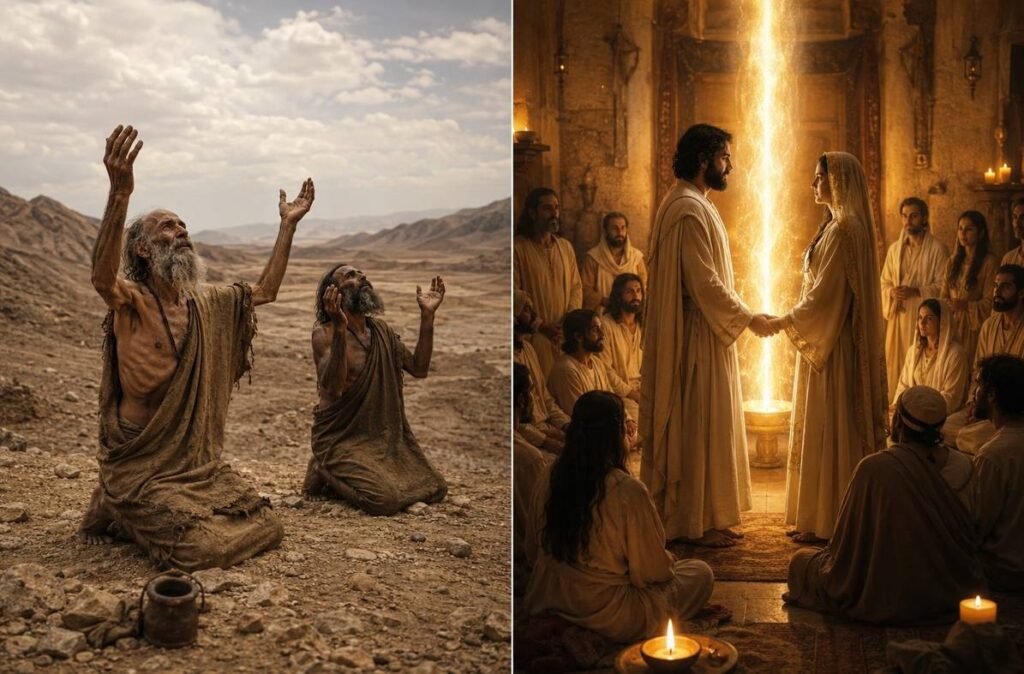
On the other side stood the Valentinians, who advanced a position so radical that it shocked even their Gnostic contemporaries. For the Valentinians, the body was not a prison but a vessel. Sexuality was not a chain but an image–a living icon of the divine syzygy, the paired union that constitutes wholeness in the Pleroma. The nymphon was the highest sacrament, the innermost mystery, the Holy of Holies. This was not libertinism. The Valentinians were not advocating promiscuity or the abandonment of ethical restraint. They were claiming that the union of male and female, properly understood and sacramentally enacted, could become a portal through which the soul recognised its heavenly counterpart and recovered the androgyny it had lost in the fall.
The tension between these two camps was not merely theological; it was existential. The encratites asked: how can the divine spark be liberated if it is continually poured into new bodies through procreation? The Valentinians answered: how can the divine spark recognise itself if it refuses the very image that mirrors its origin? Both positions were internally coherent. Both were rooted in the same conviction that the material world was derivative and that the soul’s true home lay beyond it. But they drew opposite conclusions about the role of the body in the journey home. One path demanded flight; the other demanded transformation.
The Gospel of Philip: Insider Language for Insiders
The Gospel of Philip is not a narrative gospel like Matthew or John. It is a collection of meditations, sayings, and sacramental teachings written in Coptic and preserved in Nag Hammadi Codex II. Its language is allusive, poetic, and deliberately ambiguous. It was composed not for outsiders or converts but for an initiated community that already possessed the keys to its symbolism. The text speaks of “the mystery of marriage,” of “the bridal chamber,” of “the undefiled marriage,” and of “the perfect man” who becomes male and female through recognition. These phrases are not self-explanatory. They require the hermeneutical framework of Valentinian cosmology–the syzygy, the Pleroma, the three natures–to yield their meaning.
The text’s most famous passage about Mary Magdalene is a case in point. The Coptic word koinōnos, translated as “companion,” is not a casual term. It implies partnership, spousal intimacy, and shared mission. The text does not say that Jesus and Mary were married in the earthly sense; it says that their relationship was the model for the nymphon–a union that transcends the physical while including it. The kiss, in this context, is not merely erotic. It is a transmission of recognition, an exchange of pneumatic breath, a sacramental act that the uninitiated disciples cannot understand because they have not yet entered the bridal chamber themselves. The Gospel of Philip is not telling us that Jesus had a girlfriend. It is telling us that the highest form of relationship is one in which both participants recognise the divine in each other.
The ambiguity was intentional. The text warns that “the bridal chamber is not for the animals, nor is it for the slaves, nor for the defiled women; but it is for free men and virgins.” This is not elitism in the modern sense. It is a statement about preparation. The nymphon requires a certain level of ethical and spiritual maturity. Those who enter it without purification–without having passed through baptism, anointing, and the other preliminary sacraments–risk turning the Holy of Holies into a brothel. The text knows this danger. It is precisely why the language is veiled.
The Nymphon as the Holy of Holies
The Valentinian sacramental system was hierarchical. Baptism transferred the initiate from the left hand to the right. Anointing conferred the Holy Spirit and transformed the initiate into a christ. The eucharist nourished the resurrection body. Redemption provided the secret name that authorised passage past the planetary archons. But the nymphon–the bridal chamber–was the culmination of the entire process. The Valentinian Exposition, preserved in Nag Hammadi Codex XI, states explicitly: “The bridal chamber is the holy of holies.” It is the innermost sanctuary, the place where the soul is reunited with its angelic counterpart and restored to the Pleroma.
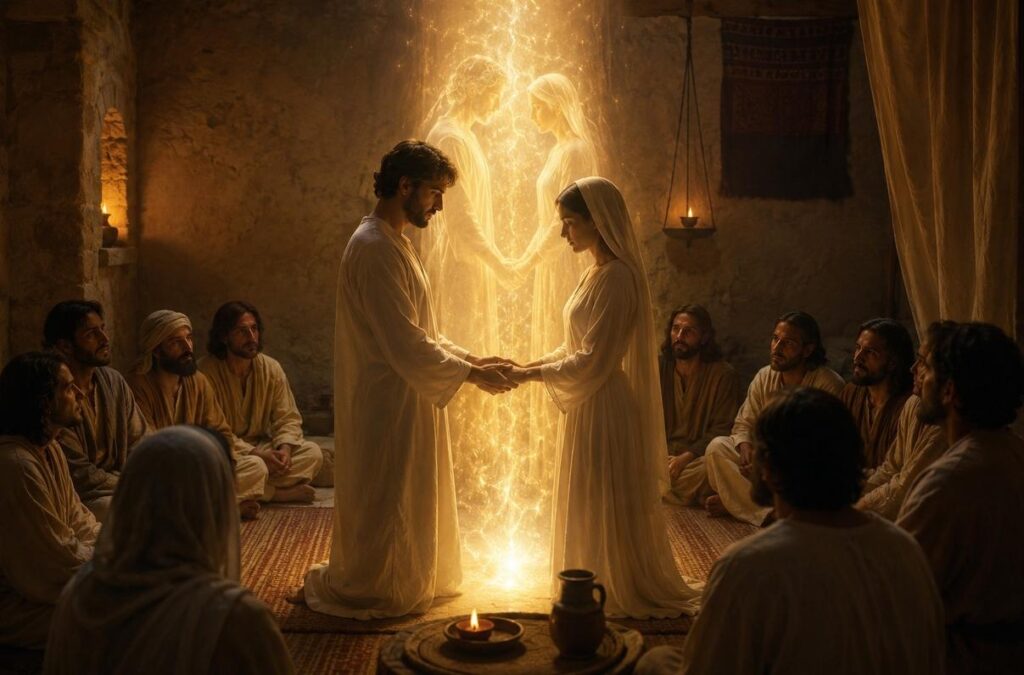
The Gospel of Philip develops this with sacramental precision. “The nymphon is superior to baptism, for it is from the name of the nymphon that we have received the resurrection.” This is a staggering claim. Baptism, the central rite of orthodox Christianity, is here relativised. It is not the final sacrament but the first. The nymphon is where the resurrection actually happens–not the resurrection of the dead body at the end of time, but the resurrection of the soul to its true identity in the present. “If anyone becomes a son of the bridal chamber, he will receive the light. If anyone does not receive it while he is in these places, he cannot receive it in the other place.” The nymphon is not optional. It is the condition of salvation.
What happened in the nymphon? The texts do not provide a liturgical script, but they provide enough clues to reconstruct the theology. The ritual involved the union of two individuals who represented the separated syzygy–the male and female principles that had been divided in the fall. Through anointing, prayer, the exchange of a sacred kiss, and possibly the physical union of the couple, the participants enacted the reunion of the divine pair. The goal was not pleasure but recognition: the moment when the soul saw its own image in the other and remembered that it was not merely a body but a spark of the Pleroma. The body was not rejected; it was used as a sacramental instrument. The sexuality was not indulged; it was consecrated.
What Irenaeus Got Wrong: Polemic and Distortion
Our only detailed external account of the Valentinian nymphon comes from Irenaeus of Lyons, who wrote Against Heresies around 180 CE as a comprehensive assault on all forms of Christianity he deemed deviant. Irenaeus describes the nymphon in terms that have shaped the popular imagination ever since: “They prepare a bridal chamber and celebrate a mystery with certain invocations… and they say that what they do is a spiritual marriage after the likeness of the unions above.” Some of them, he adds with evident disgust, “shamelessly” claim that this is the perfect redemption.
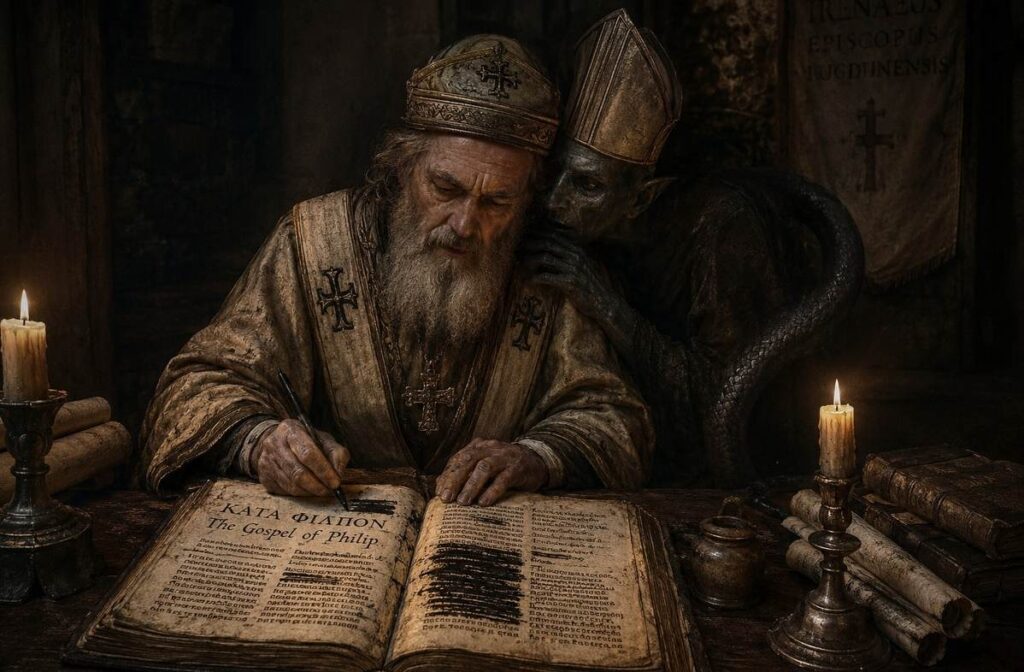
Modern scholars have subjected Irenaeus’ account to rigorous scrutiny, and the consensus is that he distorted what he described. Irenaeus was not a neutral ethnographer. He was a polemicist with a vested interest in portraying Valentinianism as sexually licentious, morally depraved, and spiritually dangerous. Sexual scandal was a standard weapon in the arsenal of sectarian strife, and Irenaeus wielded it with precision. By describing the nymphon as a physical orgy, he could dismiss the entire Valentinian system as a cover for carnal indulgence, thereby protecting his own institutional monopoly on sacramental legitimacy.
The evidence against Irenaeus’ interpretation is substantial. Nothing else known about the Valentinians–their sophisticated Platonist theology, their tripartite anthropology, their emphasis on gradual restoration through gnosis–suggests that they practiced the kind of libertine rites Irenaeus describes. The Gospel of Philip itself warns against defilement and insists that the nymphon is for “free men and virgins.” The Tripartite Tractate, the longest Valentinian text in the Nag Hammadi Library, presents a theology of psychological and spiritual transformation that has no room for orgiastic excess. The most likely scenario is that Irenaeus encountered a symbolic, ritualised sacrament that he could not understand, and he described it in the most damaging terms available to a bishop who was building an empire on the suppression of alternatives.
The Syzygy: Not Flesh but Wholeness
To understand the nymphon, one must understand the syzygy. In Valentinian cosmology, the Pleroma consists of thirty aeons arranged in fifteen syzygies–conjugal pairs of complementary divine qualities. The first syzygy is Bythos (Depth) and Sige (Silence). From them emanate Nous and Aletheia, Logos and Zoe, Anthropos and Ecclesia. The law of syzygy reflects the Valentinian belief that nothing exists in isolation: every principle requires its counterpart, every form requires its substance, every male requires its female. The Pleroma is not a hierarchy of solitary gods but a network of relationships.

The human soul, exiled in matter, is separated from its angelic counterpart–the divine syzygy that corresponds to it in the Pleroma. The Gospel of Philip describes this separation as the fundamental wound: “When Eve was still in Adam, death did not exist. When she was separated from him, death came into being. If he enters again and attains his former self, death will be no more.” The nymphon is the ritual or experiential moment of this re-entry. It is not merely marriage between a man and a woman; it is the reunion of the soul with its heavenly counterpart, mediated through the mirror of human relationship.
The Gospel of Philip pushes this further: “The image of the male is the image of the angel, and the image of the female is the image of the archon.” This is not misogyny. It is a statement about the current condition of separation. In the fallen state, the male principle retains a memory of its angelic origin, while the female principle has been captured by the archontic system. But the text immediately adds that the goal is transformation: through the nymphon, the female becomes male, the male becomes female, and both become the androgynous image of the divine. This is not gender abolition but gender transcendence–the recovery of the primal wholeness that existed before the fall.
Mary Magdalene: The Companion Who Saw
The Gospel of Philip’s treatment of Mary Magdalene is not an incidental detail. It is the hermeneutical key to the entire text. Mary is called the koinōnos–the companion, the partner, the one who shares the mission. She is not merely a disciple; she is the model of the one who has entered the nymphon and received the light. The male disciples are blind. They ask why Jesus loves her more. They do not understand that love, in this context, is not a finite resource to be distributed but a recognition that flows between those who have seen the same light.
The kiss is equally significant. In early Christian and Jewish tradition, the kiss was a sacramental gesture of peace, recognition, and the transmission of spirit. The Gospel of Philip elevates it to the level of pneumatic exchange: the breath that passes between the lips is the breath of the Holy Spirit, the pneuma that awakens the sleeping spark. The disciples are offended not because the kiss is sexual but because it is exclusive. They have not yet entered the bridal chamber, and therefore they cannot receive what Mary receives. The offence is the offence of the uninitiated, the blindness of those who mistake the outer court for the sanctuary.
This reading transforms Mary Magdalene from a penitent prostitute–the caricature invented by later tradition–into the premier witness of the nymphon. She is the one who saw, the one who was loved, the one who became worthy. Her role is not secondary to Peter or James or John. It is primary, because she possesses the recognition that they lack. The Gospel of Philip does not merely include Mary; it centres her as the exemplar of the sacramental life. This is why the text was suppressed, and this is why its recovery in 1945 remains revolutionary.
The Modern Resonance: Body, Feminine, and Recognition
For contemporary seekers, the Gospel of Philip offers a vision of sexuality that is neither puritanical nor libertine. It is sacramental. The body is not a prison to be escaped but a vessel to be consecrated. The feminine is not secondary or dangerous but essential to divine completion. Relationship is not a distraction from the spiritual path but its culmination. The nymphon is not a licence for indulgence but a discipline of recognition–the rigorous practice of seeing the divine in the other and allowing the other to see the divine in oneself.
This vision challenges both the ascetic rejection of the body and the consumerist exploitation of sexuality. It refuses to divide spirit from flesh, male from female, sacred from profane. It insists that the highest mysteries are not found in solitary withdrawal but in the courageous intimacy of two people who have done the preliminary work of purification and are ready to encounter each other as icons of the Pleroma. The nymphon is not for everyone. It is for those who have been baptised, anointed, fed, and redeemed–those who have prepared the vessel through the outer sacraments and are now ready for the innermost.
The Valentinian tradition, for all its complexity, offers a simple criterion: does the relationship produce recognition? Does it awaken the spark? Does it restore the syzygy? If the answer is yes, then the relationship is sacramental, regardless of its outward form. If the answer is no, then it is archontic, regardless of how respectable it appears. The Gospel of Philip does not give us rules. It gives us a question–a question that each soul must answer in the presence of its counterpart, in the silence of the bridal chamber, where the only authority is the light that both have come to see.
Frequently Asked Questions
What is the nymphon in Valentinian Christianity?
The nymphon (Greek for bridal chamber) was the highest of five Valentinian sacraments, alongside baptism, anointing, eucharist, and redemption. The Gospel of Philip states that the nymphon is superior to baptism because it is from the nymphon that believers receive the resurrection. The Valentinian Exposition calls it the holy of holies. It represented the restoration of the primal androgyny that was separated in the fall–the reunion of the soul with its divine counterpart, mirroring the syzygy (paired union) of the aeons in the Pleroma.
Did the Valentinian bridal chamber involve literal sexual intercourse?
This is the central scholarly controversy. Irenaeus of Lyons described the nymphon as involving physical sexual union and claimed some Valentinians practiced licentious rites. However, modern scholars including Einar Thomassen, Christoph Markschies, and Karen King argue that Irenaeus was writing polemic and likely exaggerated or misunderstood an esoteric ritual. The Gospel of Philip uses deliberately ambiguous insider language meant for initiated readers. The nymphon was primarily a spiritual mystery of syzygy–reunion with one’s angelic counterpart–though it may have included symbolic elements such as the sacred kiss, anointing, and the union of male and female as an image of divine wholeness.
Why did some Gnostics reject sexuality entirely while others elevated it?
Early Christianity contained two radically opposed camps on sexuality. The encratite and some Sethian traditions viewed sex, marriage, and procreation as archontic traps that manufactured more prisoners for the material world. The Valentinians, by contrast, understood sexuality as an image of the divine syzygy–the paired union that constitutes wholeness in the Pleroma. For them, the body was not inherently evil but a vessel that could be sanctified through sacramental recognition. The tension between total renunciation and sacred transgression reflects the broader diversity of early Christian thought, not a single Gnostic position.
What does the Gospel of Philip say about Mary Magdalene?
The Gospel of Philip calls Mary Magdalene the companion (koinōnos) of Jesus–a term that implies spousal or intimate partnership. It states that Jesus loved her more than the other disciples and used to kiss her often on the mouth. When the other disciples express disapproval, Jesus responds with a parable about the blind and the seeing: When the light comes, then he who sees will see the light, and he who is blind will remain in darkness. This passage is not merely about romantic attachment; it is about spiritual recognition. Mary Magdalene is presented as the one who sees, while the male disciples remain in darkness.
How did Irenaeus misrepresent the Valentinian bridal chamber?
Irenaeus wrote Against Heresies as a polemical assault on all forms of Christianity he deemed deviant. His descriptions of the nymphon are our only detailed external accounts, but they come from a hostile witness. Scholars note that Irenaeus had a vested interest in portraying Valentinianism as sexually licentious, since sexual scandal was a standard weapon in sectarian conflict. Nothing else known about the Valentinians–their sophisticated theology, their ethical rigour, their philosophical depth–suggests they practiced orgiastic rites. The more likely interpretation is that Irenaeus encountered a symbolic sacrament he could not understand and described it in the most damaging terms available to him.
What is a syzygy and how does it relate to the nymphon?
A syzygy is a paired union of complementary divine qualities that together form a state of wholeness. In Valentinian cosmology, the Pleroma consists of thirty aeons arranged in fifteen syzygies–male and female pairs such as Bythos and Sige, Nous and Aletheia, Logos and Zoe. The human soul, exiled in matter, seeks reunion with its angelic counterpart in the bridal chamber, re-enacting the pattern established in the Pleroma. The nymphon is the ritual or experiential realisation of this syzygy. It is not merely marriage between a man and a woman but the reunion of the soul with its heavenly counterpart–the goal of gnosis being to become whole again and re-enter the Pleroma.
Is the Gospel of Philip’s theology relevant to modern spirituality?
The Gospel of Philip offers a vision of sexuality as sacramental rather than sinful, of marriage as an image of cosmic wholeness rather than a concession to weakness, and of the feminine as essential to divine completion rather than secondary or dangerous. For contemporary seekers questioning patriarchal religious structures, the text provides an ancient precedent for honouring the body, the feminine, and intimate relationship as paths to recognition rather than obstacles to it. However, the text’s insider language and deliberate ambiguity require careful scholarly interpretation rather than casual appropriation.
Safety Notice: This article explores sexuality, sacrament, and intimate relationship through a Gnostic lens. It does not constitute relationship advice, sexual guidance, or spiritual instruction. The interpretation of ancient texts regarding sexuality requires scholarly care and cultural sensitivity. Readers are encouraged to approach these themes with discernment and to seek qualified pastoral or therapeutic support if they are processing religious trauma, sexual shame, or spiritual crisis. The study of the nymphon is valuable for understanding Valentinian theology; it should not be used to justify behaviour without ethical reflection and community accountability.
Further Reading
- Gospel of Philip: Sacrament, Eros, and the Bridal Chamber — The complete exploration of the Gospel of Philip’s sacramental theology, from baptism to the nymphon as the Holy of Holies.
- Valentinian Christianity: System and Influence — The broader Valentinian system of five sacraments, thirty aeons, and the gradual restoration soteriology that frames the nymphon.
- Valentinian Gnosticism: The Most Systematic School (30 Aeons) — The cosmological architecture of the Pleroma, the syzygy, and the anthropology that makes the bridal chamber intelligible.
- Tripartite Tractate: Valentinian Cosmology in Depth — The longest Valentinian text in the Nag Hammadi Library, presenting the theological framework within which the nymphon operates.
- The Gospel of Mary: The Suppressed Gospel of the Magdalene — Mary Magdalene as the premier witness of secret teaching, paralleling her role in the Gospel of Philip as the companion who sees.
- The Alchemical Couple: Gnosis in the Mirror of Relationship — Jungian anima and animus work, the coniunctio, and sacred union as a contemporary path to the syzygy.
- 5 Gnostic Schools Explained — Comparative overview of Sethian, Valentinian, Hermetic, and Thomasine traditions, showing where each stood on the body and sexuality.
- Nag Hammadi Library: Complete Guide to 46 Gnostic Scriptures — The master hub for navigating all tractates, codices, and thematic collections in the Contemporary Gnostic Archive.
References and Sources
The following sources represent the scholarly monographs, primary texts, and critical studies underlying this article.
Primary Sources and Critical Editions
- The Gospel of Philip (NHC II,3). In The Nag Hammadi Library in English, 4th revised edition, edited by Marvin Meyer. HarperOne, 2007.
- The Valentinian Exposition (NHC XI,2). In The Nag Hammadi Library in English, 4th revised edition, edited by Marvin Meyer. HarperOne, 2007.
- The Tripartite Tractate (NHC I,5). In The Nag Hammadi Library in English, 4th revised edition, edited by Marvin Meyer. HarperOne, 2007.
- Irenaeus of Lyons. Against Heresies (Adversus Haereses), Books I–II. Translated by Alexander Roberts and James Donaldson. Ante-Nicene Fathers, Vol. 1. Christian Literature Publishing, 1885.
- Tertullian. Against the Valentinians (Adversus Valentinianos). Translated by Alexander Roberts. Ante-Nicene Fathers, Vol. 3. Christian Literature Publishing, 1885.
- Clement of Alexandria. Stromata (Miscellanies), Book III. Translated by Alexander Roberts and James Donaldson. Ante-Nicene Fathers, Vol. 2. Christian Literature Publishing, 1885.
Scholarly Monographs
- Thomassen, Einar. The Spiritual Seed: The Church of the Valentinians. Brill, 2006.
- Markschies, Christoph. Gnosis: An Introduction. Translated by John Bowden. T&T Clark, 2003.
- King, Karen L. The Gospel of Mary of Magdala: Jesus and the First Woman Apostle. Polebridge Press, 2003.
- Schenke, Hans-Martin. “The Gospel of Philip.” In New Testament Apocrypha, edited by Wilhelm Schneemelcher. Westminster John Knox, 1991.
- Isenberg, Wesley W. “The Gospel of Philip.” In The Nag Hammadi Library in English, edited by James M. Robinson. Harper & Row, 1988.
Comparative and Thematic Studies
- Pagels, Elaine. The Gnostic Gospels. Random House, 1979.
- Brakke, David. The Gnostics: Myth, Ritual, and Diversity in Early Christianity. Harvard University Press, 2010.
- Williams, Michael Allen. Rethinking Gnosticism: An Argument for Dismantling a Dubious Category. Princeton University Press, 1996.
- Jonas, Hans. The Gnostic Religion: The Message of the Alien God and the Beginnings of Christianity. Beacon Press, 1958.