
What Are The Five Pillars? The Architecture of ZenithEye
The Five Pillars are the major organising gateways of ZenithEye–the five interlocking categories through which the site’s exploration of Gnosticism, esoteric wisdom, and contemporary spirituality is structured. They are not rigid departments but living pathways, each addressing a distinct dimension of the quest for direct knowledge. Together they form an architecture that honours the ancient world while speaking to the present moment.
The Five Pillars are: The Living Thread, States of Knowing, The Hidden Agreements, The Transformation, and Practice & Method. Each pillar contains subcategories that deepen the inquiry, yet all five are designed to work together. A reader might enter through the historical survival of suppressed traditions, move through an examination of altered states, recognise cross-cultural patterns, confront the challenges of integration, and finally discover practical techniques for grounding the work in daily life. The pillars are sequential in logic but circular in practice.
The Five Pillars are the five interlocking gateways of ZenithEye: The Living Thread, States of Knowing, The Hidden Agreements, The Transformation, and Practice & Method.
Table of Contents
- Pillar One: The Living Thread
- Pillar Two: States of Knowing
- Pillar Three: The Hidden Agreements
- Pillar Four: The Transformation
- Pillar Five: Practice & Method
- How the Five Pillars Work Together
- Frequently Asked Questions
- Further Reading
Pillar One: The Living Thread
Historical Survival and Suppressed Traditions
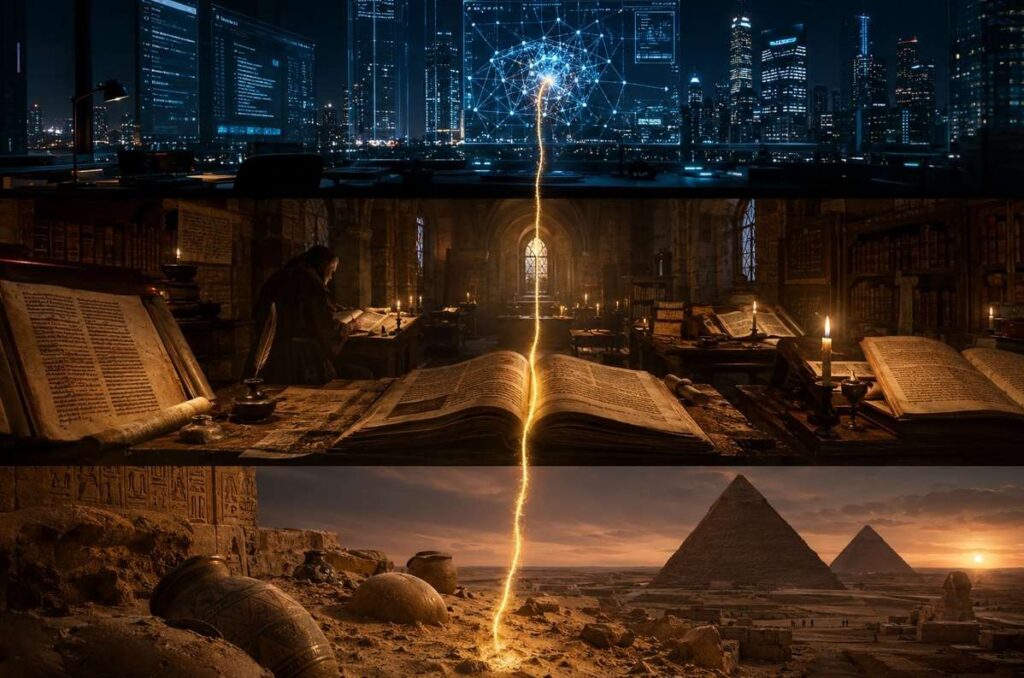
The Living Thread is the historical pillar. It asks a simple yet devastating question: how did the knowledge survive? This pillar traces the transmission of Gnostic and esoteric wisdom from antiquity through the periods of suppression that sought to erase it. It examines the Nag Hammadi Library as a physical archive buried in the Egyptian desert, the Cathar perfecti preaching in Languedoc before the crusades burned them, the Mandaean communities maintaining baptismal rites along the Shatt al-Arab, and the Rosicrucian manifestos that announced a hidden inheritance to seventeenth-century Europe.
Within this pillar, the category of Suppressed Traditions documents what was forbidden: the apocryphal gospels, the feminine divine, the non-canonical cosmologies. Historical Survival examines the mechanisms of preservation–buried jars, coded manuscripts, oral transmission, and the courage of communities who refused to surrender their texts. Modern Resonances asks how these ancient currents appear today, not as museum pieces but as living impulses in psychology, art, and political dissent. The Living Thread insists that Gnosticism is not a dead religion but a continuous current, interrupted but never severed.

Pillar Two: States of Knowing
Altered States, Phenomenology, and the Architecture of Perception
States of Knowing is the phenomenological pillar. It examines the varieties of consciousness that precede and accompany the recognition of hidden realities. This is not a pillar of doctrine but of experience–rigorous, first-person, and unflinchingly honest. It asks: what happens when consciousness shifts? What is perceived in the hypnagogic threshold, the lucid dream, the dark retreat, the mystical emergency, or the collapse of the witness function?
The subcategories here are deliberately diverse. Altered States maps the territories opened by contemplative practice, breathwork, and sensory modification. Phenomenology applies the philosophical method of bracketing assumptions to spiritual experience, asking what consciousness reveals when left to observe itself. Sleep and Dreams treats the night as a legitimate field of inquiry, examining lucid dreaming, sleep paralysis, and the bardo states as genuine modalities of knowing. Consciousness and Cognition brings neuroscience into conversation with ancient psychology, exploring default mode network dissolution, neuroplasticity, and the predictive brain as correlates of gnosis. Predatory Consciousness–perhaps the most unsettling category–examines the states of awareness that recognise manipulation, psychic parasitism, and archonic interference in both ancient and modern forms.
Pillar Three: The Hidden Agreements
Cross-Cultural Patterns, Sacred Architecture, and Esoteric Lineages
The Hidden Agreements is the comparative pillar. It operates on the premise that the world’s esoteric traditions are not isolated inventions but responses to shared recognitions–patterns that recur across cultures, epochs, and languages. This pillar maps those recognitions without collapsing them into a vague universalism. It respects difference while tracing resonance.
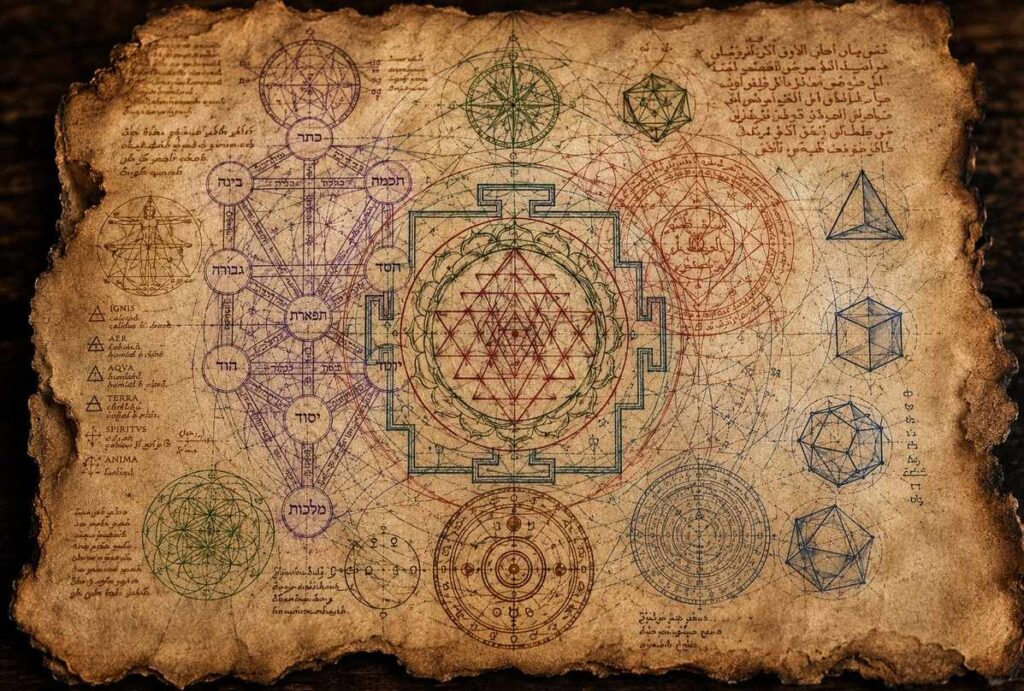
Cross-Cultural Patterns examines the sevenfold correspondences of planets, metals, and chakras; the axial age emergence of interiority; and the perennial architecture of temple design. Sacred Architecture studies how stone, proportion, and orientation were used to create conditions conducive to altered states–from the hypostyle halls of Egypt to the Gothic cathedrals of Europe. Symbol Encryption asks why esoteric traditions hide their teachings in plain sight, using steganography, alchemical emblems, and the language of the birds. Esoteric Lineages traces the institutional and subterranean channels through which knowledge moved: from the Library of Alexandria to the House of Wisdom in Baghdad, from the Toledo School of Translators to the contemporary digital archive. The Hidden Agreements suggests that the world is far more coordinated than official history admits–not through conspiracy, but through parallel recognition.

Pillar Four: The Transformation
Integration, Spiritual Emergence, and the Ordinary Saint
The Transformation is the integrative pillar. It addresses what happens after the peak experience, the vision, or the recognition. Awakening is not the end of the path; it is the beginning of a new set of demands. This pillar refuses spiritual bypassing and insists on embodiment. It asks: how does one live after seeing through the world? How does the return to ordinary life become sacred? How does the shadow find its place in the light?
Integration and Grounding provides the practical psychology of stabilisation: routines, community, service, and the slow work of ripening. Spiritual Emergence addresses the crisis side of awakening–the kundalini emergency, the dark night, the psychosis-mysticism shared territory–with clinical rigour and spiritual respect. Stages of Integration maps the immediate, short-term, and long-term phases of incorporating non-ordinary experience into a coherent life. Shadow Work applies Jungian depth psychology to the Gnostic journey, examining how the rejected aspects of the self become the very material of transformation. And The Ordinary Saint–perhaps the pillar’s most radical concept–celebrates the invisible completion, the person who has done the work and requires no recognition, who moves through the marketplace with quiet sovereignty.

Pillar Five: Practice & Method
The Five Gateways, Embodiment, and Contemplative Techniques
Practice & Method is the operational pillar. It recognises that gnosis is not merely an intellectual proposition but a somatic, emotional, and energetic discipline. This pillar gathers the techniques that have been tested across traditions and adapted for contemporary practice. It is not a grab-bag of spiritual consumerism but a curated curriculum of embodied knowing.
The Five Gateways form the core curriculum: attention, breath, sensation, sound, and vision. Each gateway is a complete path in itself, yet they are designed to interlock. Embodiment Practices include body scanning, somatic awareness, nervous system regulation, and the reclamation of the flesh as a vehicle of knowledge rather than a prison of matter. Contemplative Techniques range from classical dharana and open awareness to the specific methods of lucid dreaming and hypnagogic exploration. Planetary Operations and Angelic Curriculum–the most specialised category–addresses the Western esoteric traditions of celestial correspondence, from John Dee’s heptarchia to Trithemius’s crystallomancy, approached with scholarly precision and practical caution. This pillar insists that practice without theory is blind, but theory without practice is sterile.
How the Five Pillars Work Together
The Five Pillars are not consumed in isolation. A reader drawn to the Nag Hammadi Library through The Living Thread will eventually encounter the question of how those texts were read–which leads to States of Knowing. The recognition of cross-cultural patterns in The Hidden Agreements naturally raises the question of what to do with that recognition–which leads to Practice & Method. And any serious practice will eventually trigger the crisis and integration processes mapped in The Transformation.
The architecture is deliberate. ZenithEye is not a blog of disconnected articles but a structured environment for a specific kind of inquiry. The Five Pillars ensure that no dimension is neglected: history without practice becomes antiquarianism; practice without history becomes rootless; states without integration becomes instability; integration without method becomes vague; method without cross-cultural awareness becomes parochial. The pillars hold each other in balance.
Frequently Asked Questions
What are the Five Pillars of ZenithEye?
The Five Pillars are the major organising gateways of ZenithEye: The Living Thread, States of Knowing, The Hidden Agreements, The Transformation, and Practice & Method. Each pillar addresses a distinct dimension of the quest for direct knowledge and spiritual awakening.
What is the difference between the Five Pillars and the Five Gateways?
The Five Pillars are the structural categories of ZenithEye’s content architecture. The Five Gateways are a specific curriculum within the Practice & Method pillar, comprising attention, breath, sensation, sound, and vision as pathways to direct knowing.
Which pillar should I read first?
There is no mandatory sequence. Most readers enter through The Living Thread if they are drawn to history, or through Practice & Method if they seek immediate techniques. However, the pillars are designed to work together, and depth in one area naturally leads to the others.
What does The Living Thread cover?
The Living Thread covers the historical survival of Gnostic and esoteric traditions, including suppressed scriptures, transmission lineages, ancient sources, and modern resonances. It asks how forbidden knowledge survived persecution and burial across centuries.
What is meant by States of Knowing?
States of Knowing examines the varieties of consciousness that accompany spiritual recognition, including altered states, phenomenology, sleep and dreams, consciousness and cognition, and the critical examination of predatory or manipulative awareness.
How does The Transformation pillar address spiritual crisis?
The Transformation includes Spiritual Emergence, a subcategory that addresses the difficult side of awakening–kundalini emergencies, dark nights, and the psychosis-mysticism boundary–with both clinical rigour and spiritual respect, refusing spiritual bypassing.
Is Practice & Method suitable for beginners?
Yes. The Practice & Method pillar includes the Five Gateways curriculum, which is designed for practitioners at all levels. It offers foundational techniques in attention, breath, and somatic awareness alongside advanced contemplative and Western esoteric methods.
Further Reading
Explore these ZenithEye articles to deepen your understanding of each pillar and how they interweave:
- What Is the Thread? ZenithEye’s Complete Explainer — The foundational article that introduces the concept of the Thread and how the Five Pillars serve the quest for direct knowledge.
- The Living Thread: How Forbidden Knowing Survives — A deep exploration of the historical survival pillar, tracing the transmission of suppressed wisdom across centuries.
- States of Knowing: How Consciousness Unravels — An introduction to the phenomenological pillar, mapping the territories of altered and non-ordinary awareness.
- The Hidden Agreements: Esoteric Architecture — A study of cross-cultural patterns and the encrypted symbols that connect the world’s esoteric traditions.
- The Transformation: After Mystical Experience — An examination of integration, return to ordinary life, and the stages of embodying non-ordinary recognition.
- The Five Gateways to Direct Knowing — The core curriculum of the Practice & Method pillar, introducing attention, breath, sensation, sound, and vision as operational paths.
- Return to Ordinary Life After Awakening — A Transformation pillar article on the practical challenges of living with gnosis in the marketplace and the kitchen.
- Embodiment Practices: Grounding Awakening — A Practice & Method article on somatic techniques, nervous system regulation, and reclaiming the body as a vehicle of knowledge.
- Spiritual Emergency: Transformation or Crisis? — A critical Transformation pillar article on the dark side of awakening, distinguishing mystical emergence from pathology.
- Attention: The First Gateway of Consciousness — The opening article of the Five Gateways curriculum, establishing the foundational practice of directed awareness.