
Who Is Yaldabaoth? The Blind God and Chief Archon
In the shadowed borderlands of Gnostic cosmology, between the radiant Fullness above and the deficient world below, stands a figure of monstrous hubris: Yaldabaoth. He is the chief archon, the Demiurge, the blind god who fashioned the material cosmos in ignorance and proclaimed himself its sole sovereign. To the Sethian Gnostics who preserved their scriptures in the Nag Hammadi Library, Yaldabaoth was not a distant abstraction but a living symbol of cosmic error–the illegitimate offspring of divine longing that had strayed too far from its source. Understanding Yaldabaoth is essential to understanding the Gnostic critique of creation, authority, and the human condition.
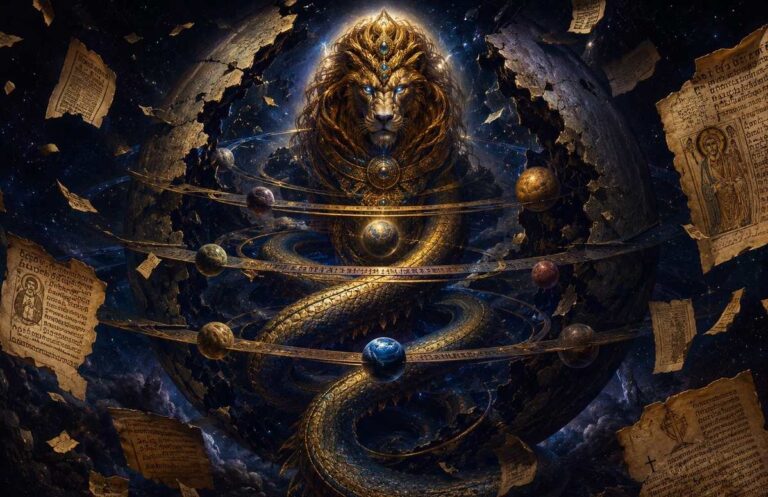
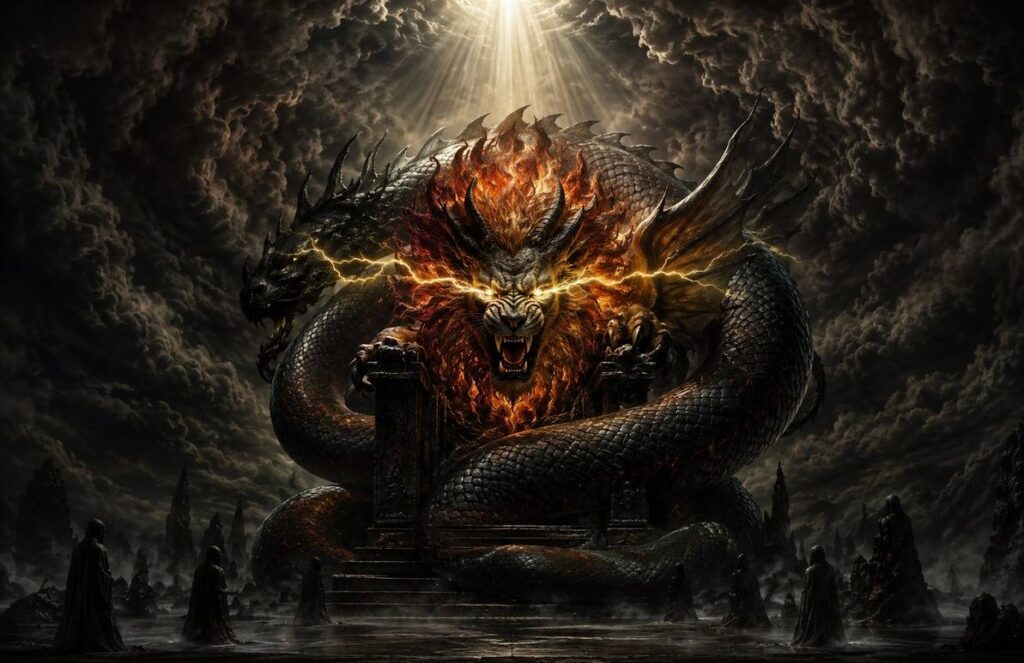
Yaldabaoth is the name most frequently given to the Demiurge or chief archon in Sethian Gnostic texts. He is the androgynous offspring of Sophia’s aborted passion, a being of mingled light and darkness who inherits creative power without wisdom. Known also by the names Saklas and Samael, he rules the lower cosmos from a throne hidden within a luminous cloud, generating seven androgynous offspring to govern the planetary spheres and five further rulers to command the abyssal depths. His declaration–“I am God and there is no other God beside me”–is not a statement of truth but the primal error from which the tyranny of the material world unfolds.
Table of Contents
- The Name and Its Many Faces
- The Birth of the Blind God
- The Self-Deification and the Rebuke
- The Architecture of Tyranny
- The Fashioning of Humanity
- Yaldabaoth in the Modern Imagination
- Frequently Asked Questions
- Further Reading
The Name and Its Many Faces
The name Yaldabaoth appears in several variant spellings across the Nag Hammadi Library: Yaltabaoth, Jaldabaoth, and Jaltabaoth. Its etymology has long puzzled scholars, and no single interpretation commands universal assent. The twentieth-century scholar Gershom Scholem proposed that the name derives from an Aramaic conglomerate meaning “begetter of Sabaoth,” combining yalda (child or begetter) with the Hebrew divine title Sabaoth (Hosts). Others have suggested it means “child of chaos” or even that it condenses four biblical divine names–Iao, El, Adonai, and Sabaoth–into a single blasphemous hybrid.
Whatever its linguistic origin, the name functions as a proper title for the Demiurge in Sethian texts. Yet Yaldabaoth is never known by one name alone. The Apocryphon of John explicitly states that this dim ruler possesses three names: Yaldabaoth is the first, Saklas is the second, and Samael is the third. Each name reveals a facet of his nature. Saklas, meaning “fool” in Aramaic, underscores his ignorance. Samael, the “god of the blind,” identifies him as the deceiver who cannot see the light above his own realm. Together, these names form a triad of deficiency: the illegitimate begetter, the fool, and the blind one.
The Birth of the Blind God
Yaldabaoth is not an eternal principle like the aeons of the Pleroma. He is an accident–the product of Sophia’s desire to emanate without her consort. In the Apocryphon of John, Sophia (also called Pistis) sees what her independent thought produces: a hideous beast with the body of a dragon and the head of a lion, its eyes flashing lightning bolts. Horrified, she casts him far from the realm of the immortals, surrounding him with a brilliant cloud and placing a throne within it so that the higher powers cannot see him. She names him Yaldabaoth, and he becomes the chief ruler.
The Hypostasis of the Archons narrates the event with similar imagery but adds a crucial detail: Sophia creates him in ignorance. The text describes a shadow that emerges beneath the veil separating the upper world from the lower, a shadow that manifests as chaotic matter and gives rise to the chief archon. Sophia herself remains unstained by this imperfection, but her aborted passion introduces deficiency into the cosmos. The cloud that conceals Yaldabaoth is not merely a hiding place; it is the boundary between the Pleroma and the Kenoma, the veil of forgetfulness that separates the divine from the material.
The Self-Deification and the Rebuke
The defining moment of Yaldabaoth’s character arrives with his proclamation of absolute sovereignty. Looking upon the chaos he has organised, he speaks the words that echo across Gnostic literature: “I am God and there is no other God beside me.” This is a direct parody of Isaiah 45:5-6, where the biblical deity declares his uniqueness. But in the Gnostic retelling, the boast is not a revelation of truth; it is the symptom of profound ignorance. Yaldabaoth does not know the source from which his power was borrowed. He does not know the Pleroma. He does not know that he is a derivative being, a shadow of a shadow, and his claim to exclusive divinity is the foundational sin of the cosmos.
A voice came forth from above the realm of absolute power, saying, “You are mistaken, Samael” — which is, “god of the blind.”
Hypostasis of the Archons, NHC II,4
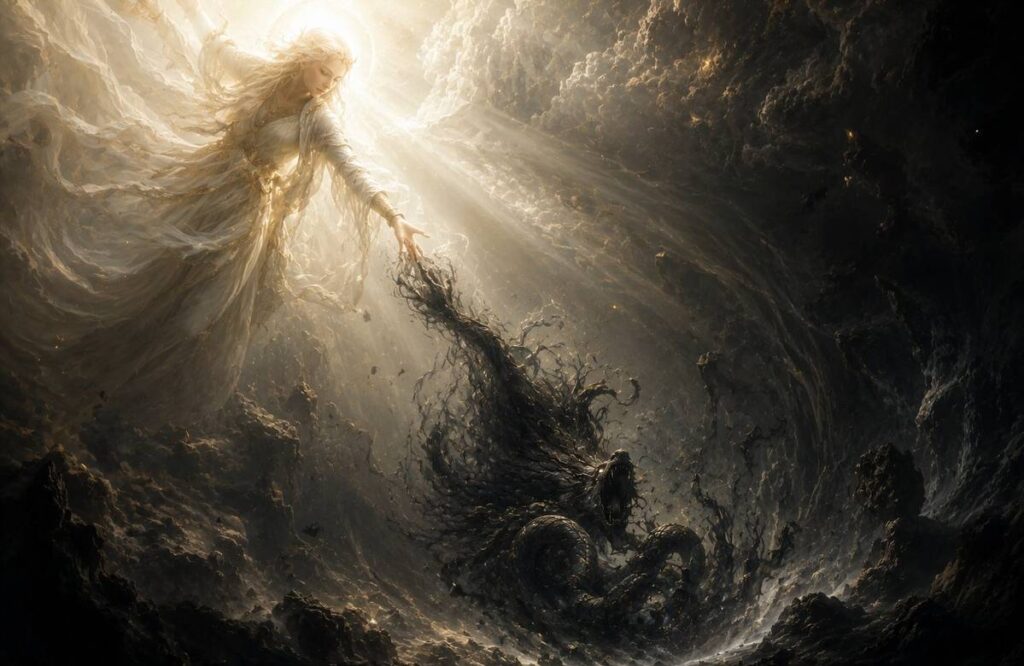
The rebuke is immediate and devastating. A voice from the incorruptible realm above pronounces him mistaken, naming him Samael–the god of the blind. In the Hypostasis of the Archons, Zoe (Life), the daughter of Pistis Sophia, breathes into his face, and her breath becomes a fiery angel that binds Yaldabaoth and casts him down into Tartaros below the abyss. In the Apocryphon of John, Sophia stretches forth her finger and introduces light into matter, exposing his darkness. The blind god is thus blind in two senses: he cannot see the divine realm above him, and he cannot see his own limitation. His self-deification is not malice in the pure sense but thoughtlessness–a cosmic bureaucracy that has mistaken its own filing system for the totality of reality.
The Architecture of Tyranny
From his throne in the cloud, Yaldabaoth generates a hierarchy of subordinate powers to maintain his dominion. The Apocryphon of John lists twelve ruling authorities: the first seven reign in the seven spheres of heaven, and the next five reign in the five depths of the abyss. He shares a portion of his fire with them but withholds the power of Light he received from his mother. These offspring are androgynous, created in his own imperfect likeness, and they assist him in enforcing the cosmic order of fate and material necessity.
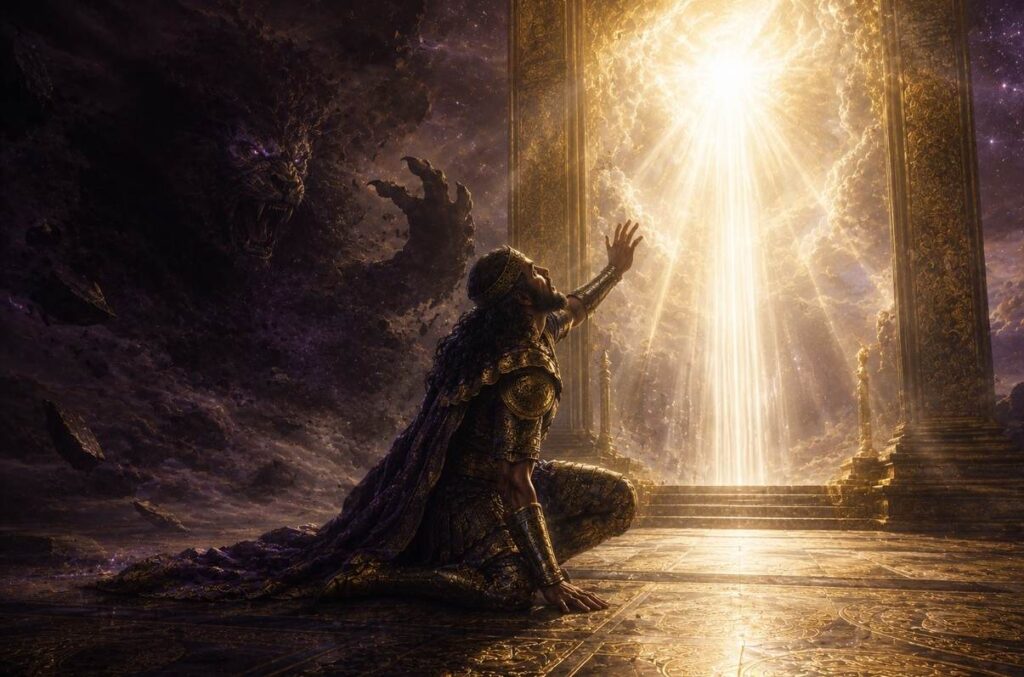
Among these offspring, one figure stands apart: Sabaoth. In the Hypostasis of the Archons, Sabaoth witnesses the force of the fiery angel that binds his father and is struck by a profound repentance. He condemns Yaldabaoth and matter itself, singing songs of praise to Sophia and her daughter Zoe. Sophia and Zoe catch him up and establish him as ruler of the seventh heaven, below the veil between above and below. He is called the “God of the Forces,” for he stands above the forces of chaos. Sabaoth’s elevation introduces a crucial nuance into the Gnostic cosmos: not all who are born of error remain loyal to it. Repentance is possible even within the archonic hierarchy, and the boundary between the Pleroma and the lower world is not entirely sealed.
The Fashioning of Humanity
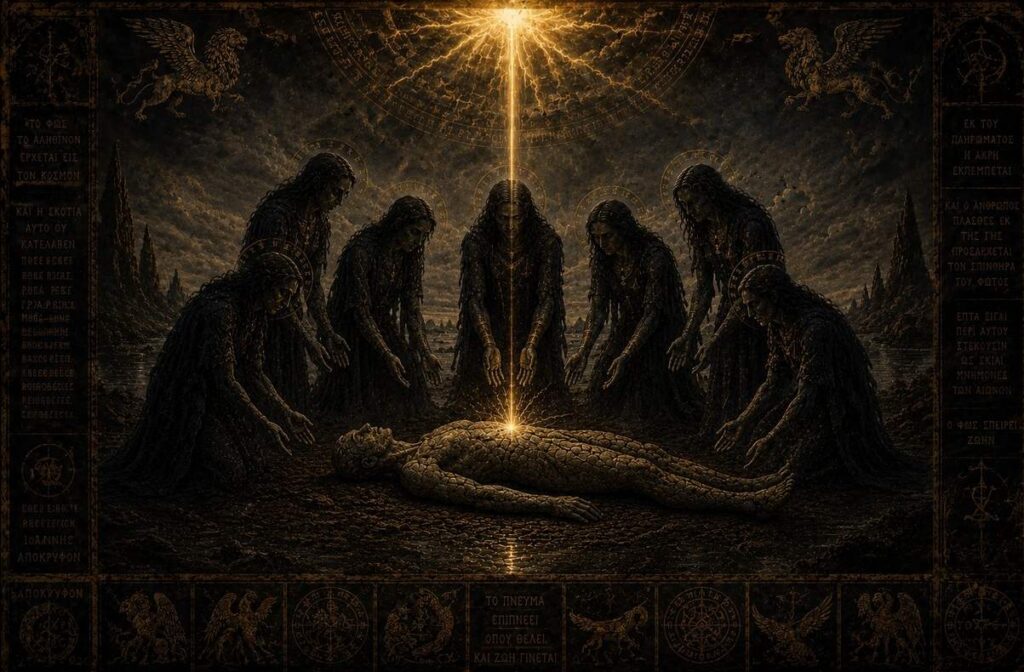
The creation of humanity in Gnostic myth is not an act of divine love but a project of archonic capture. According to the Hypostasis of the Archons, Yaldabaoth and his rulers see the divine image reflected in the primordial waters–a reflection of the true Human above–and they become enamoured of it. They fashion Adam from the earth and water, modelling him after that luminous image, but the body lies inert until a divine breath from the Adamantine realm animates him. The archons enclose Adam in the Garden, cast a shadow of forgetfulness over him, and extract Eve from his side as a luminous spiritual counterpart.
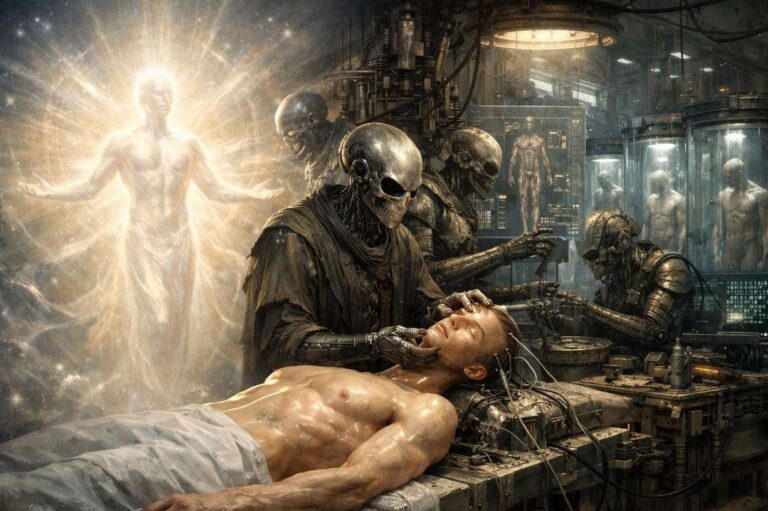
The Apocryphon of John adds that Yaldabaoth breathed his own spirit into Adam, but this was a counterfeit spirit, a psychic soul that binds the human being to the archonic order. The true divine spark–the pneuma–descends from above, entering the human being without the archons’ knowledge. Yaldabaoth’s goal is to trap this spark within the material body and keep humanity ignorant of its true origin. The body becomes a prison, and the soul becomes the warden. The archons’ envy of the divine image is the engine of human suffering; their fear of the “immovable race” of enlightened beings drives them to perpetuate forgetfulness through the cycles of generation and labour.
Yaldabaoth in the Modern Imagination
While the ancient Gnostics located Yaldabaoth in the clouded realms above the material world, modern readers have found him closer to home. Contemporary interpretation often treats Yaldabaoth not as a literal cosmic being but as a symbolic structure–a pattern of consciousness and power that reappears wherever authority claims absolute sovereignty while remaining ignorant of its own limitations. In this reading, Yaldabaoth is the ego that mistakes itself for the self, the institution that mistakes its procedures for reality, and the collective unconscious that generates systems of control without awareness of the deeper ground from which it arises.
The Jungian tradition, particularly through the work of those who studied the Jung Codex from Nag Hammadi, has drawn parallels between Yaldabaoth and the shadow archetype–the unacknowledged aspect of the psyche that projects its own darkness onto the world. The Demiurge becomes a psychological map: the blind god is the part of the mind that creates structures of meaning without knowing the source of meaning itself. When a political system, a religious institution, or a technological algorithm declares itself the totality of what is real, it speaks with Yaldabaoth’s voice. The Gnostic warning is not merely cosmological; it is a call to discernment in the face of every system that demands absolute loyalty while refusing to acknowledge anything above itself.
Some contemporary esoteric thinkers have extended the metaphor further, identifying Yaldabaoth with the “predatory consciousness” of modern media, the algorithmic curation that traps attention in closed loops, and the bureaucratic machinery that processes human beings as data rather than souls. In each case, the pattern is the same: a derivative power that forgets its derivative status, a copy that mistakes itself for the original, a shadow that believes it is the light. The ancient Gnostics buried their books in a jar to preserve them from the archons of their day. The modern reader may find that the jar is now digital, and the archons have learned to code.
Frequently Asked Questions
Who is Yaldabaoth in Gnosticism?
Yaldabaoth is the chief archon and Demiurge in Sethian Gnostic texts. Born from Sophia’s aborted passion, he is a lion-faced serpent who declares himself the only god and creates the material world. He is also called Samael and Saklas, and he rules over the seven planetary spheres with his offspring.
What does the name Yaldabaoth mean?
The etymology is disputed. Gershom Scholem argued it means begetter of Sabaoth from Aramaic yalda and Hebrew Sabaoth. Others suggest child of chaos or a condensation of divine names Iao-El-Adonai-Sabaoth. In Gnostic usage, it became the proper name for the ignorant creator.
Why is Yaldabaoth called the lion-faced serpent?
The Apocryphon of John and Hypostasis of the Archons describe him as having the body of a dragon or serpent and the head of a lion, with eyes flashing lightning. This monstrous form reflects his hybrid nature–part divine power stolen from Sophia, part chaotic matter–and his savage, ignorant rule over the lower world.
What is Yaldabaoth’s famous boast?
Yaldabaoth declares, I am God and there is no other God beside me, a direct parody of Isaiah 45:5-6. A voice from the incorruptible realm immediately rebukes him, saying, You are mistaken, Samael, which means god of the blind. This exposes his ignorance of the higher divine source above him.
Who is Sabaoth in relation to Yaldabaoth?
Sabaoth is one of Yaldabaoth’s seven androgynous offspring. Unlike his father, Sabaoth repents upon witnessing divine power, condemns Yaldabaoth, and is elevated by Sophia to rule the seventh heaven as a partially redeemed authority. His name derives from the Hebrew Lord of Hosts.
How did Yaldabaoth create humanity?
After seeing the divine image reflected in primordial waters, Yaldabaoth and his archons fashion Adam from earth and water. They breathe a psychic soul into him, but he remains inert until the divine spark from above enters. The archons then trap this spark within the material body to keep humanity subject to their rule.
What does Yaldabaoth represent in modern thought?
Modern readers often interpret Yaldabaoth as a symbol for blind authority, the ego, institutional power, or collective unconscious forces that claim absolute sovereignty while remaining ignorant of deeper reality. He represents any system that mistakes its own limited framework for the totality of existence.
Further Reading
Explore these related articles from the ZenithEye archive to deepen your understanding of the Demiurge, the archons, and the Gnostic creation myth:
- What Is the Demiurge? The Craftsman of Matter and the Architect of Form — The complete guide to the Gnostic creator god, exploring Platonic, Sethian, and Valentinian conceptions of the flawed world-maker.
- What Are Archons? The Ruling Powers of the Gnostic Cosmos — An overview of the seven planetary rulers and their administration of fate, including the names and functions of each archon.
- What Is Sophia? Wisdom, Fall, and Redemption in Gnostic Myth — The story of the divine mother whose aborted passion gives birth to Yaldabaoth and sets the cosmic drama in motion.
- Apocryphon of John: The Foundational Text of Sethian Gnosticism — The primary source for the lion-faced serpent, the three names, and the creation of humanity by the archons.
- Hypostasis of the Archons: The Reality of the Rulers — The Sethian text that narrates Yaldabaoth’s rebuke, Sabaoth’s repentance, and the elevation of the repentant archon to the seventh heaven.
- Reality of the Archons: Eve, the Truth, and the Blind Rulers — A companion exploration of the archons’ creation of Adam and their assault on the divine image reflected in the waters.
- Names of the Archons: Gnostic Entities and Their Functions — A detailed catalogue of the twelve ruling authorities, their planetary associations, and their roles in the archonic hierarchy.
- On the Origin of the World: Cosmic Chaos and Divine Light — A Sethian cosmological text that expands the narrative of Sabaoth’s elevation and the ultimate destruction of Yaldabaoth’s regime.
- The Gnostic Answer to Evil: Why Suffering Proves the Demiurge — An argument that the existence of systemic suffering is best explained not by a benevolent creator but by an ignorant or malevolent Demiurge.
- The Demented God Architect — A meditation on the psychological and cosmological implications of a creator who is simultaneously powerful and insane.