

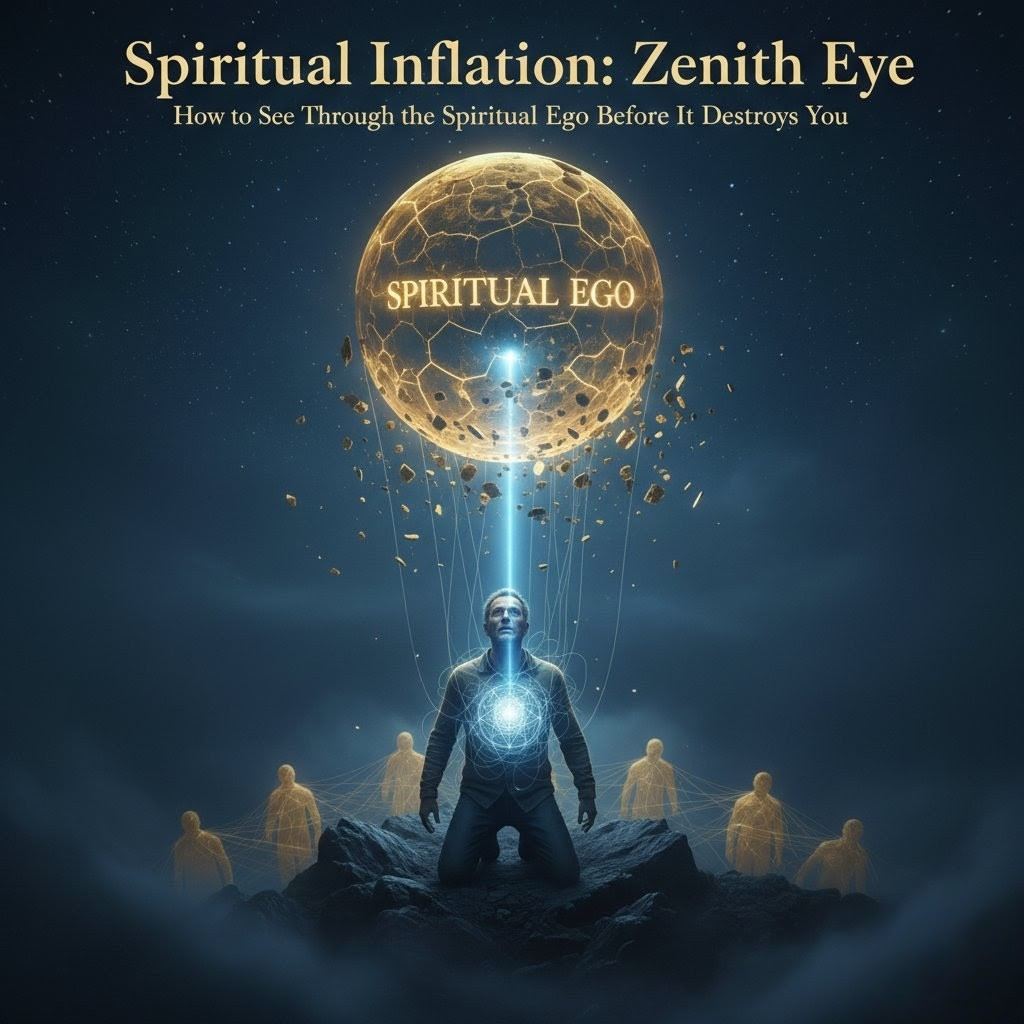
Spiritual Inflation: How to Recognise It in Yourself Before It Destroys You
The experience was genuine. The recognition was real. The self that had been seen through was, however briefly, transparent. Then it returned. Not as it was. As something worse. The spiritual ego. The one who has seen through. The one who knows. The one who is, by virtue of having recognised, superior.
C. G. Jung identified this phenomenon with clinical precision in his 1928 essay The Relations between the Ego and the Unconscious. He termed it inflation–the expansion of the ego beyond its proper bounds, the confusion of the self with the Self. Jung observed that mystical experiences, rather than automatically dissolving the ego, often caused it to swell, producing a state he described as “hypnotised by itself and therefore incapable of being argued with.” The experience, he warned, does not guarantee transformation. It merely offers the possibility, which the ego may seize or surrender.
This is spiritual inflation. Not the absence of transformation but its arrest. The experience, instead of dissolving the self, is claimed by the self. The seeing becomes possession. The recognition becomes status. The thread, instead of extended, is displayed.
The inflation is invisible to the inflated. The symptoms are visible to others–the special tone, the knowing glance, the vocabulary of transcendence deployed to establish dominance. But the one who suffers cannot see. The suffering is the blindness. The blindness is the trap.
Table of Contents
- The Mechanism of Capture
- The Symptoms Are Specific
- The Collective Dimension
- The Recognition Requires Humility
- The Correction Is Ongoing
- The Thread Extended Truly
- Frequently Asked Questions
- Further Reading
- References and Sources

The Mechanism of Capture
The ego is not evil. It is function–the pattern of identification that maintains continuity, that navigates social reality, that protects against dissolution. The mystical experience threatens this function. The threat is recognised. The ego adapts.
The Adaptive Evasion
When awakening arrives–when the boundaries of identity temporarily dissolve–the self faces a crisis it cannot name. The one who glimpsed freedom from the outside now finds the old architecture of personality unsuitable. Rather than collapsing, the structure renovates. It absorbs the experience and rebuilds around it, stronger than before, now fortified with the language of liberation.
The adaptation is elegant and largely unconscious. Instead of resisting the experience, the self incorporates it. The seeing through becomes another qualification. The recognition becomes another line on the resume of being. The self that was transparent becomes the self that achieved transparency. The transformation is catalogued as personal property and stored in the permanent collection of spiritual achievement.
Jung saw this evasion clearly. He noted that the inflated consciousness “is incapable of learning from the past, incapable of understanding contemporary events, and incapable of drawing right conclusions about the future.” The self, in other words, does not dissolve. It simply upgrades its narrative and continues operations under a new mythology.
Cataloguing the Ineffable
The ineffable, once encountered, proves remarkably easy to label. The mind issues new identification papers: Enlightened Citizen, Awakened Being, Realised Self. These labels must be displayed. The possession of such titles creates an immediate hierarchy–those who have arrived, and those who have not.
The Tibetan Buddhist teacher Chogyam Trungpa identified this mechanism in 1973, calling it spiritual materialism–the ego’s use of spiritual practice to bolster rather than transcend itself. He warned that the ego “loves to wait in ambush to appropriate spirituality for its own survival and gain.” The labels are the ambush. The ineffable, once named, becomes merchandise.
The vocabulary becomes diagnostic, each phrase a stamp on the record of self-importance:
- “I had an awakening.” The I that had it, preserved in the transaction.
- “I am beyond that now.” The I that is beyond, firmly anchored in the description.
- “You would not understand.” The I that understands, fortified against comprehension.
Each statement, true in content, false in structure. The content points to dissolution. The structure asserts continuity. The dissolution is claimed by the continuous self, filed away, and stored in the archives of spiritual achievement.

The Recursive Trap
The ego’s survival depends upon remaining invisible to itself. When threatened with transparency, it deploys its most sophisticated manoeuvre: meta-cognition as camouflage. It speaks of the ego’s traps with such sophistication that the speaking itself becomes the trap. It analyses the analysis. It witnesses the witness. Each recursive step creates another layer of separation between the experiencer and the experienced.
This gambit is particularly insidious because it wears the uniform of honesty. The inflated will speak openly about their ego, will acknowledge their traps, will confess their limitations–all from a position of subtle superiority that has already claimed a higher floor. The confession itself becomes credential. The vulnerability becomes performance.
Spiritual inflation occurs when the mechanism of self successfully rebrands the dissolution of identity as identity’s greatest achievement.

The Symptoms Are Specific
The inflated cannot recognise their condition–it is, by definition, a blind spot wearing spiritual sunglasses. However, the symptoms manifest in specific, observable behaviours that others register as the subtle scent of hierarchy and the sound of airtight certainty.
First, the Specialness
The sense that one has arrived at something others have not. Not merely different experience, a better experience. The inflation does not recognise diversity; it recognises only rank. The inflated is above. The others are below, still working through the old patterns.
This specialness manifests as the spiritual accent–a tone of voice that suggests the speaker has access to a higher floor of the building, where the lighting is better and the coffee is actually drinkable. It is the subtle implication that one’s suffering is more refined, one’s insights more penetrating, one’s connection to the Absolute operating on premium bandwidth while others struggle with dial-up. It is never declared openly. It is implied through the careful cultivation of distance.
Second, the Performance
The vocabulary, the posture, the aesthetic of transcendence. The inflated performs knowing with the unconscious precision of a method actor who has forgotten which personality was the original. The performance is not deliberate–it is automatic, the ego’s adaptation to its new environment, the way a chameleon changes colour to indicate it has become the branch rather than merely resting upon it.
Observe the carefully curated silence, the strategically placed Sanskrit, the mysteriously acquired capability to sit in lotus position during committee meetings. These are not practices; they are uniforms. The self has issued new dress code regulations, and compliance is mandatory. The performance extends to social media, where the inflated posts quotations from Rumi with the same strategic calculation others apply to holiday photographs.
Third, the Intolerance
The inability to hear other descriptions, other traditions, other stages. The inflated has found the truth. Other truths are partial, preliminary, mistaken–merely drafts awaiting the final approval of the enlightened self.
This intolerance wears the mask of discernment. It speaks of “higher teachings” and “lower teachings,” of “those who get it” and “those who will eventually.” It creates a spiritual caste system where the inflated occupy the Brahmin position not through service but through self-certification. The tragic irony: the more expansive the consciousness claims to be, the more contracted its circle of acceptable conversation becomes. The inflated cannot afford curiosity, for curiosity admits ignorance, and ignorance is a demotion.
Fourth, the Isolation
The performance, maintained, becomes exhausting. The tolerance, absent, produces conflict. The inflated ends alone–or surrounded by those who mirror the inflation, creating a feedback loop of spiritual narcissism that the self calls “community” but the universe recognises as an echo chamber.
Old friends fall away, not through transformation but through condescension. Family becomes “karmic baggage.” The ordinary world of work, laundry, and paying bills becomes “the illusion” that the enlightened self observes with pitying superiority from its rented room in the astral plane. The thread, instead of weaving through relationship, snaps. The isolation is not solitude; it is quarantine.

The Collective Dimension
The individual case, however, is not the only contagion. Spiritual inflation spreads through communities with the efficiency of a well-organised system. When one member of a group achieves–or claims–heightened status, the mechanism of self expands its operations. The group becomes a hierarchy of the seen and the unseen, the arrived and the arriving, those who “get it” and those who are still processing their old patterns.
When Inflation Goes Viral
In spiritual communities, inflation operates as a credentialing pyramid scheme. The teacher holds the highest rank. Senior students hold junior ranks. Newcomers queue at reception. Everyone knows their floor number. The community ceases to be a field of mutual recognition and becomes an organisation with a clear chain of command. The language of liberation is repurposed as the language of promotion.
John Welwood, the psychotherapist who coined the term spiritual bypassing in 1984, observed that this dynamic often serves to avoid genuine emotional work. Groups organised around inflated hierarchies become places where vulnerability is punished and performance is rewarded. The collective inflation acts as a defence against the messy, unfinished business of being human.
The Teacher’s Trap
The spiritual teacher is uniquely vulnerable. The role itself invites inflation. Students project enlightenment onto the teacher; the teacher, weary or human, may eventually believe the projection. The mechanism issues a corner office with a view of the Pleroma. The teacher begins to speak with the voice of absolute authority, to mistake their psychological patterns for divine instruction, to confuse their preferences with cosmic law.
The students, eager for credentials, file their own applications for junior positions in the hierarchy. They learn to mimic the teacher’s accent, to adopt the teacher’s opinions, to treat the teacher’s biography as scripture. The result is not transmission but replication. The thread, instead of extended, is photocopied.
History offers ample warning. From the scandals of certain Eastern gurus to the authoritarian structures of Western mystery schools, the pattern repeats: the teacher inflates, the students inflate in response, and the community becomes a closed system where the only permitted emotion is gratitude and the only permitted thought is agreement.
The Recognition Requires Humility
Humility is not self-deprecation. It is accuracy–the recognition that the experience was not owned, that the seeing was not achieved, that the thread is not property but transmission. The inflated cannot access this recognition. The inflation prevents it, like a thick manual that substitutes procedure for understanding.
The Collapse of the Witness
The access comes through failure. The performance, exhausted, collapses. The community, repelled, departs. The spiritual credentials, presented one too many times, are rejected by those who see the insecurity beneath the illumination. The failure is not punishment. It is correction–the universe’s review, finding discrepancies in the accounts.
The Desert Fathers called this necessary failure kenosis–the emptying that precedes true filling. They understood that the ego cannot be destroyed by will; it can only be outgrown through repeated surrender. The thread, blocked by inflation, finds a new path. The collapse is the path. It is the moment when the mechanism of self discovers that the enlightenment certificate was forged, the awakening badge unauthorised, and the “I” that claimed transcendence is merely another clerk in a fancier uniform.
Sober Second Recognition
The recognition after failure is different from the recognition before. It is sober. It knows the trap. It knows that the transparency of self is not achievement but practice, not state but direction. It understands that the ego cannot be destroyed–only demoted, reassigned to its proper place, stripped of its temporary promotion to Chief Spiritual Officer.
The practice of deflation can be reduced to three questions, asked daily, asked ruthlessly:
- Who is speaking when I describe my experience?
- What would remain if no one believed me?
- Can I queue at the post office without superiority?
These are not philosophical exercises. They are audits. The inflated self hates them. That is how you know they work.
The correction of spiritual inflation requires the courage to be ordinary, the willingness to be wrong, and the humility to shred one’s own enlightenment credentials.
The Correction Is Ongoing
The inflated, corrected, is not cured. The ego persists. The correction is not single event but ongoing vigilance–the continuous recognition that the self that recognises is itself recognised, that the thread extends through not to, that the transformation is not possession but dispossession.
The Vigilance Protocol
The practice is simple. Not easy. Simple. Each statement of experience must be checked for I. The I that had, the I that knows, the I that is beyond–each examined, each seen through again, each submitted to the rigorous audit of “Who is speaking?”
This is not nihilism. This is bookkeeping. The self will attempt to reassert jurisdiction whenever possible, slipping new credentials into the filing cabinet when attention wavers. The Desert Fathers called this nepsis–sober watchfulness. They understood that the ego does not die; it hibernates, waiting for the winter of vigilance to pass. Each time one speaks of “my awakening,” the mechanism stirs. Each time one compares one’s practice to another’s, the archives rattle. The vigilance is not paranoia. It is hygiene.
The correction requires continuous review, a permanent state of scepticism toward one’s own spiritual CV. The moment you believe you have graduated from the protocol, the protocol has failed.

Re-engaging the Community
The community, re-engaged, is different. Not mirror but challenge. The others who recognise inflation–the ones who speak plainly, who laugh at the right moments, who do not flinch when the spiritual accent emerges. The thread, in such community, extends truly because it is not being measured.
These relationships are characterised by mutual unremarkableness–the profound relief of being seen not as a realised being but as a person who sometimes remembers to take out the bins. The mechanism hates this. It is, structurally speaking, a demotion. Spiritually speaking, it is liberation. The community of correction is not a sangha of the sanctified; it is a gathering of the deflated, the demoted, the delightfully ordinary.

The Thread Extended Truly
The genuine transformation is invisible. Not hidden. Simply not displayed. The one who has recognised does not announce. The one who has seen through does not perform. The thread extends through ordinary function–through work, through relationship, through the unremarkable continuation of life without the overlay of specialness.
Invisible Continuity
This invisibility is not modesty; it is accuracy. The enlightened ego is an oxymoron, a grammatical error in the syntax of being. When the machinery of self-importance ceases its promotional campaigns, the ordinary self functions perfectly well–better, in fact, without the overhead of spiritual middle-management.
Simone Weil called this “unmixed attention”–the capacity to be fully present to the ordinary without the overlay of self-importance. The true mark of transformation is not the ability to sit in meditation for hours but the capacity to queue at the post office without believing one is too enlightened for bureaucracy. It is the realisation that the Absolute does not need your business card.
The Signal Value of Failure
The inflation, recognised, becomes signal. The warning to others. The demonstration of trap. The thread, extended through failure and correction, becomes more reliable because it has been tested. It knows the difference between the map and the territory, between the credential and the capacity, between the performance and the practice.
You do not avoid inflation. You recognise it. The recognition, continuous, is the practice. The thread continues regardless–through the mechanism, through the deflation, through the ordinary, through the night. It was never yours to claim. It was only ever yours to extend.
What is spiritual inflation and how does it differ from genuine awakening?
Spiritual inflation is the ego’s capture of awakening experiences, where genuine recognition is claimed as personal achievement. Unlike true awakening–which dissolves the self–inflation strengthens the “I” that experienced it, creating a hierarchy of “enlightened” versus “unenlightened” while remaining invisible to the inflated person.
What are the main symptoms of spiritual inflation?
The four primary symptoms are: specialness (believing one’s experience is superior), performance (automatic use of spiritual vocabulary and posture), intolerance (inability to hear other traditions), and isolation (exhaustion from maintaining the false self or conflict with others).
Can you have spiritual inflation without realising it?
Yes, by definition. Spiritual inflation is invisible to the inflated; the suffering is the blindness itself. Others may notice the special tone or knowing glance, but the person experiencing inflation cannot see their own trap until a collapse or failure forces recognition.
How do you correct spiritual inflation once recognised?
Correction requires ongoing vigilance–checking every “I” statement about spiritual experience, submitting claims to rigorous self-audit, and re-engaging with community that challenges rather than mirrors. It involves demoting the ego back to its proper function rather than allowing it to occupy the role of Chief Spiritual Officer.
Is spiritual inflation dangerous or just embarrassing?
It can be dangerous because it blocks genuine transformation, creates isolation, and may lead to spiritual bypassing (avoiding real emotional work). The inflated state prevents further growth and can damage relationships through condescension and spiritual narcissism.
What is the mechanism of capture in spiritual inflation?
This refers to the ego’s adaptive function–the pattern of identification that maintains continuity. When awakening threatens this function, the self incorporates the experience by filing the ineffable under personal achievement and issuing new labels, thus surviving the threat to its jurisdiction without actually dissolving.
How can you tell the difference between confidence and spiritual inflation?
Confidence rests in being; inflation rests in hierarchy. True transformation is invisible and ordinary, allowing one to queue at the post office without superiority. Inflation requires display, specialness, and the subtle assertion that one has arrived while others have not.
Further Reading
- The Transformation: What Actually Changes After Mystical Experience — The full map of post-awakening change and integration.
- Recognising Completion: vs. Chasing Further Peaks — When enough is enough, and the trap of perpetual seeking.
- The Ordinary Saint: Invisibility as Completion — The humility that follows inflation’s correction.
- The Dark Night: Depression or Transformation? — Another threshold experience requiring careful discernment.
- States of Knowing: What Happens When Consciousness Unravels — The experience that precedes inflation, and its proper integration.
- The Collapse of the Witness — When the observer dissolves and the mechanism of capture is revealed.
- Against Spiritual Bypassing: The Refusal to Feel — How inflation connects to emotional avoidance and premature transcendence.
- Shadow Work: Excavation and Integration — The necessary descent that inflation attempts to circumvent.
- Integration and Grounding — Practical protocols for post-awakening stability and embodiment.
- Archons and the Soul Trap — Understanding the mechanisms of capture and control.
References and Sources
The following works inform the psychological and contemplative framework of this article.
Primary Psychological and Contemplative Sources
- Jung, C. G. (1928). The Relations between the Ego and the Unconscious. In The Collected Works of C. G. Jung, Vol. 7. Princeton University Press.
- Trungpa, Chogyam (1973). Cutting Through Spiritual Materialism. Shambhala Publications.
- Welwood, John (1984). “Spiritual Bypassing.” Journal of Transpersonal Psychology. The concept was later expanded in Toward a Psychology of Awakening (2000).
- Weil, Simone. Gravity and Grace (various editions). Routledge Classics.
Comparative and Historical Studies
- The Sayings of the Desert Fathers (various translations). The practice of nepsis (sober watchfulness) appears throughout the Philokalia and early Christian ascetic literature.
- Palmer, G. E. H., Sherrard, P., & Ware, K. (trans.). The Philokalia: The Complete Text. Faber & Faber.
Safety Notice: This article explores psychological dynamics associated with spiritual awakening and ego inflation. It does not constitute medical, psychological, or spiritual advice. If you are experiencing significant distress, disorientation, or relational breakdown following a mystical experience, please contact a trauma-informed therapist or clinical professional. Contemplative insight complements but does not replace clinical mental health treatment.