The Axial Age: Why Wisdom Emerged Simultaneously Across Civilizations
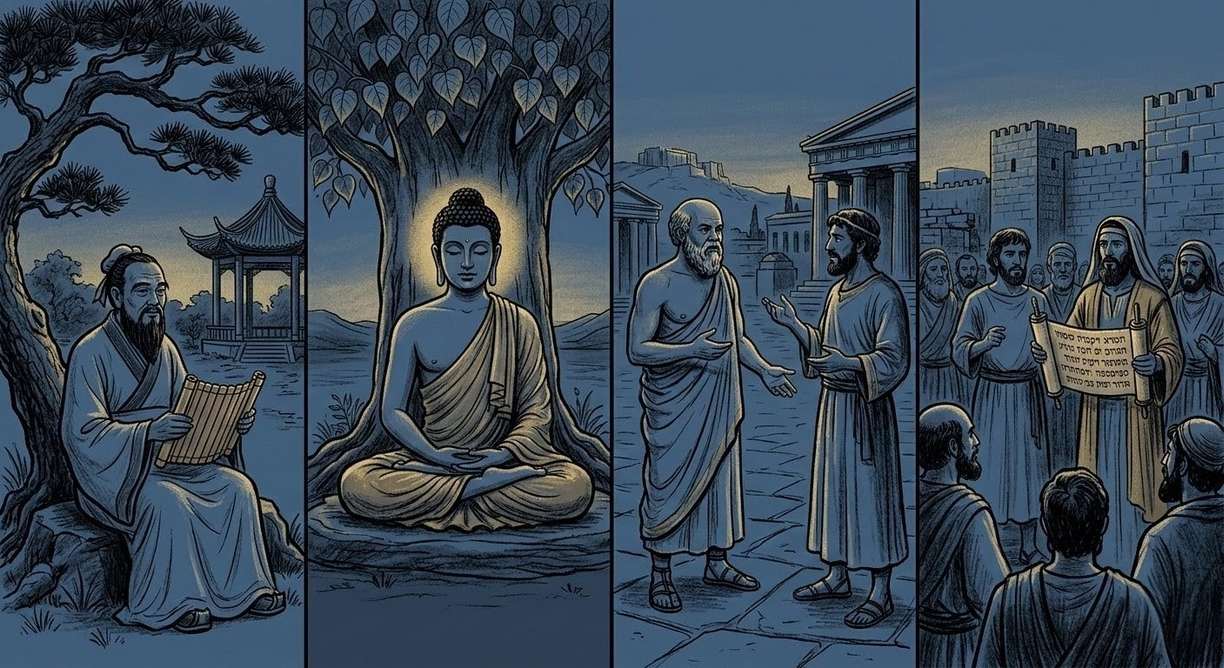
The 8th to 3rd centuries BCE. In China, Confucius and Laozi. In India, the Buddha and the Upanishadic sages. In Persia, Zoroaster. In Palestine, the Hebrew prophets–Isaiah, Jeremiah, Ezekiel. In Greece, the pre-Socratics, Socrates, Plato.
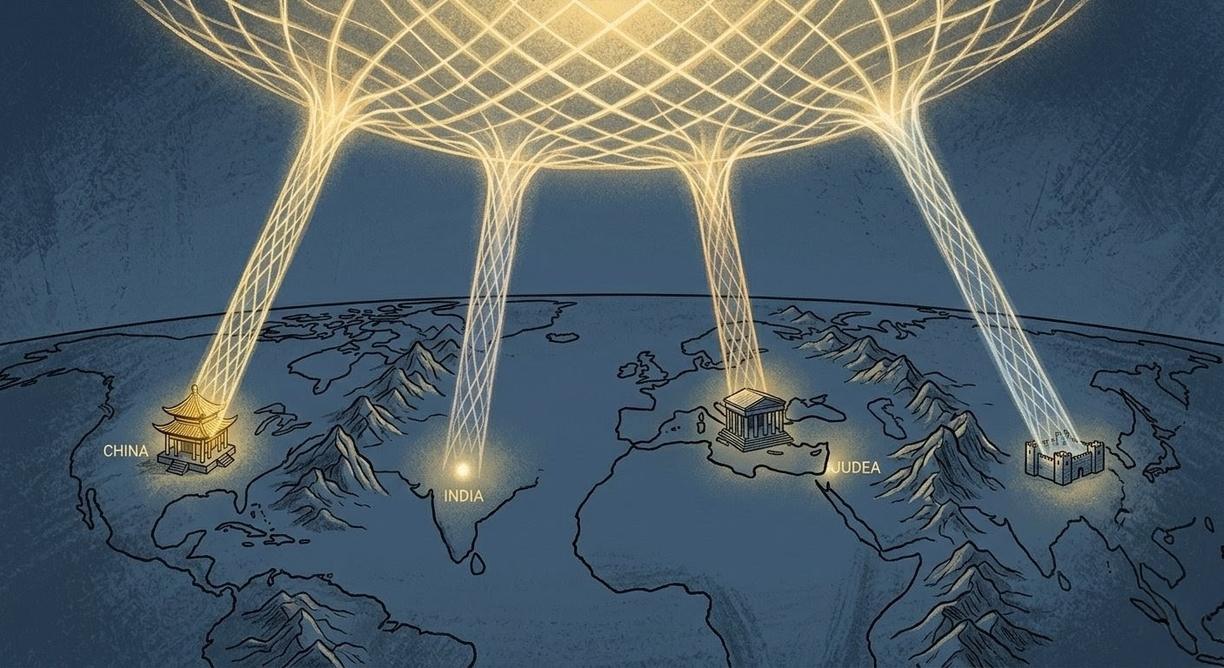
The emergence, simultaneous, of reflective consciousness, ethical universalism, and transcendental vision. Karl Jaspers called it the Axial Age–the pivot around which human civilisation turned. In his 1949 work Vom Ursprung und Ziel der Geschichte (translated as The Origin and Goal of History, 1953), Jaspers identified this period as the axis upon which humanity’s self-understanding fundamentally shifted. The observation has preoccupied historians, anthropologists, and philosophers ever since, for it suggests a synchronisation across cultures that shared no institutions, no trade routes sufficient for philosophical exchange, and no common language.
The simultaneity is the puzzle. No documented philosophical contact sufficient to explain the parallel content existed between these figures. No diffusion of ideas through channels that could account for the specific transformations. No shared institutions. Yet the transformation, parallel, produced recognisably similar results–the shift from mythic to reflective consciousness, from tribal particularism to universal ethics, from immanent gods to transcendent ground.
The standard explanations fail. Economic determinism–urbanisation, iron tools, trade expansion–cannot explain the specific content of the transformation. The conditions enabled but did not cause. The cause, if cause there was, is not accessible to standard historical method. Something else–something that does not leave pottery shards–was at work.
Prior high cultures–Pharaonic Egypt, Mesopotamian city-states, Minoan Crete–achieved remarkable sophistication in administration, architecture, and astronomy. Yet none developed the Axial combination of rigorous interior examination, universal ethical claims, and transcendental metaphysics. The breakthrough was not merely quantitative; it was qualitative, a new kind of consciousness appearing at multiple points on the globe with striking structural identity. The content is too specific to dismiss as coincidence and too parallel to explain through the usual models of cultural transmission.
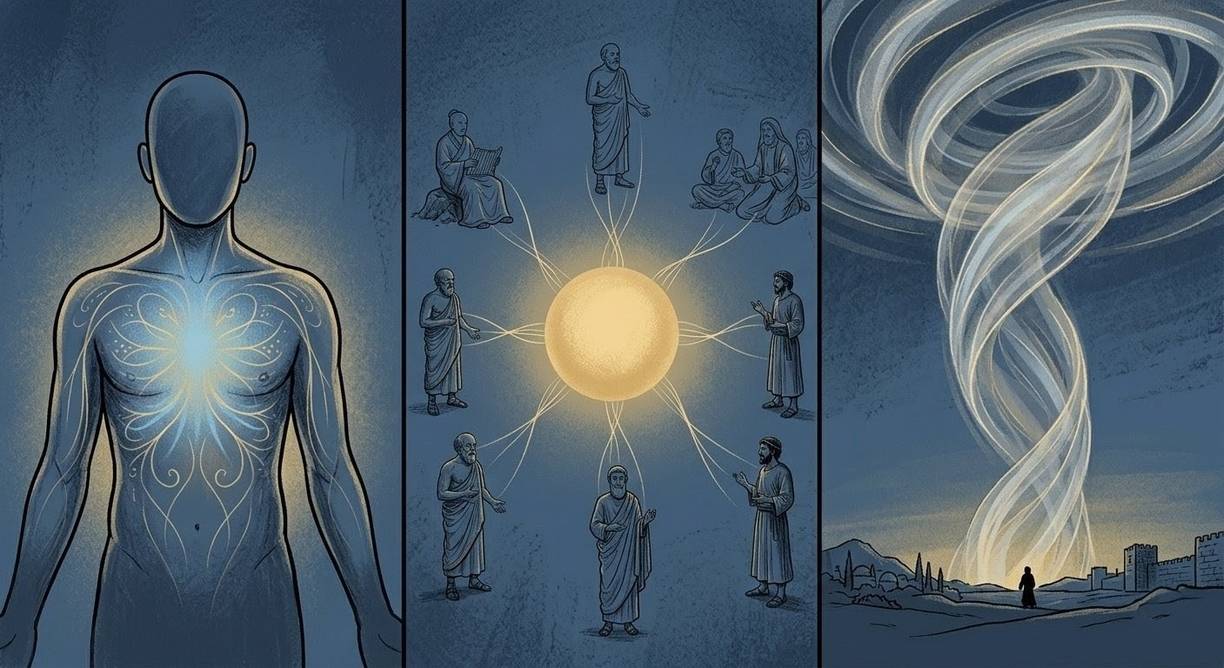
Table of Contents
- The Content Is Specific
- The Mechanism Is Unknown
- The Thread Extended
- Frequently Asked Questions
- Further Reading & Exploration
- References and Sources
The Content Is Specific
The Axial transformations share features not present in earlier civilisations–signatures too precise to be accidental, suggesting a common source outside the usual channels of transmission.

First, Interiority: The Inward Turn
The examination of subjective experience, the cultivation of self-knowledge, and the discovery of the psyche as locus of transformation. The Confucian xin (heart-mind), the Buddhist citta (mind), the Socratic psyche (soul), the prophetic lev (heart)–each names interior space as the primary territory of spiritual work. For the first time, the question shifts from “What sacrifices please the gods?” to “What is the nature of the self that seeks?” This was not mere introspection; it was the recognition that the apparatus of consciousness itself could be examined, disciplined, and transformed.
The practices differed–Confucian self-cultivation through ritual propriety, Buddhist meditative stabilisation, Socratic dialectical examination, prophetic conscience before the divine–yet the territory mapped was recognisably the same. Interiority became the laboratory in which reality was tested, not merely the vessel that received tradition.
Second, Universalism: Beyond the Tribe
The ethical claim that extends beyond blood, city, or nation. The Buddha’s compassion for all sentient beings without distinction of caste. Confucius’s ren (humaneness) applicable to the stranger as to the son. The prophetic critique of Israel’s particularism–Yahweh cares for Nineveh too. Socrates’s examination of any Athenian who would engage, and by extension, any human who thinks. The good, suddenly, is not local; the moral law applies to all users of consciousness regardless of their origin.
The Golden Rule emerged, in variant formulations, across multiple Axial traditions within a few centuries of one another. One should not do to others what one would not want done to oneself–a principle requiring the very interiority the Axial Age had discovered, for it demands that one imagine oneself in another’s position. Universalism was not an abstract ideal; it was a practical discipline built upon the new interior architecture.
Third, Transcendence: The Ground Beyond
The discovery of reality beyond the gods, beyond nature, beyond the given world of sense and society. The Tao, prior to heaven and earth, unnameable and eternal. The Brahman, beyond all attributes, the silent ground of being. The One of Parmenides and Plato, of which all is emanation and reflection. Yahweh, beyond any image or name, who will not be reduced to a tribal deity or natural force.
The transcendent, named differently in each linguistic system, functions identically–as source, as judge, as goal. It is the ultimate reference point, the code behind the simulation. The gods themselves became subject to a higher order–a metaphysical revolution that restructured the cosmos from a hierarchy of powerful beings into an economy of being itself, grounded in principle rather than personality.
The Mechanism Is Unknown
How did this happen? Jaspers proposed spiritual breakthrough–the independent discovery, by multiple cultures, of the same territory of consciousness. The territory, discovered, produced similar maps. The maps, different in vocabulary, identical in structure. But this explanation troubles terrestrial historians who demand material evidence for changes of this magnitude. We are left with three competing frameworks, each illuminating and each incomplete.

Theory One: Diffusion via Trade Routes
The Hypothesis: Ideas spread gradually through merchant networks, military conquest, and cultural contact. Perhaps Buddhist missionaries reached China earlier than recorded, or Greek traders carried philosophy to the Levant.
The Weakness: The archaeological record shows no evidence of contact sufficient to explain the specific content or simultaneous timing. The distances were too great, the contacts too minimal, the timeframes too compressed. The Buddha and Confucius were near-contemporaries, but no influence between India and China is documented for this period. The Hebrew prophets and Greek philosophers shared Mediterranean proximity but developed in isolation. You cannot download an operating system via the occasional silk merchant.
Theory Two: Convergent Evolution
The Hypothesis: Civilisation complexity forces reflection. Urbanisation, iron technology, and population density created social problems that required abstract thought, ethical universalism, and transcendental justification for new social orders.
The Weakness: This reduces wisdom to a functional response to material conditions. It misses the “excessive” quality of Axial thought–the way these sages exceeded social necessity to question existence itself. They were not merely solving administrative problems; they were interrogating the nature of reality. The content exceeds what socioeconomic determinism can account for. Material conditions may create the pressure, but they do not write the poetry.
Theory Three: Spiritual Breakthrough
The Hypothesis: Independent discovery of the same “territory” of consciousness–the transcendent ground of being accessible to disciplined interior examination. Like explorers mapping the same continent from different shores, the Axial sages produced similar cartographies using different linguistic vocabularies.
The Weakness: Not accessible to standard historical or scientific proof. It requires admitting that consciousness is not merely produced by material conditions but can access realities independent of culture. It suggests the universe has an administrative backend that occasionally pushes updates to multiple terminals simultaneously, regardless of their network connectivity. Whether this constitutes a genuine weakness or merely a limitation of the historical method is itself debatable.

The Thread Extended
The Axial Age established the frameworks within which the thread extends. The traditions, born then, continue–Buddhism, Confucianism, Platonism, prophetic Judaism, Zoroastrianism. The thread, extended through these, reaches the present not as museum pieces but as living operating systems still processing reality. When a modern practitioner sits in contemplation, examines their conscience, or reasons about the good, they are running software whose source code was compiled in the Axial Age.
The Axial breakthrough also established the problem–the gap between the transcendent and the immanent, the universal and the particular, the interior and the exterior. The problem, unresolved, drives subsequent history like a background process consuming memory. The thread extends through the problem, not around it. Every attempt to bridge this gap–every mysticism, every rationalism, every revolution–is a footnote to the Axial discovery. The gap is not a bug; it is the feature that keeps the system running.

You are Axial. Your reflective consciousness, your ethical universalism, your sense of transcendence–these were established 2,500 years ago. The thread continues through you. The question is whether you are running the latest update or still using the original factory settings.
Frequently Asked Questions
What is the Axial Age and when did it occur?
The Axial Age refers to the period between the 8th and 3rd centuries BCE when parallel spiritual and philosophical breakthroughs emerged independently across multiple civilizations. Named by philosopher Karl Jaspers in his 1949 work The Origin and Goal of History, this era saw the rise of Confucius and Laozi in China, the Buddha and Upanishadic sages in India, Zoroaster in Persia, the Hebrew prophets in Palestine, and the pre-Socratics, Socrates, and Plato in Greece.
Why is the Axial Age considered a historical puzzle?
The simultaneity defies standard historical explanation. No documented philosophical contact sufficient to explain the parallel content existed between these figures–no trade routes adequate for philosophical exchange, no shared institutions, and no diffusion of ideas. Yet these disconnected cultures produced recognisably similar transformations: the shift from mythic to reflective consciousness, from tribal particularism to universal ethics, and from immanent gods to transcendent grounds of reality.
What are the three main characteristics of Axial Age wisdom?
First, interiority–the turn toward subjective experience and self-knowledge (Confucian xin, Buddhist citta, Socratic psyche). Second, universalism–ethical claims extending beyond tribe or nation (Buddha’s compassion for all beings, Confucian ren without distinction). Third, transcendence–the ground of reality beyond gods and nature (the Tao, Brahman, the One, Yahweh).
Who coined the term Axial Age and what did they mean?
German philosopher Karl Jaspers coined the term in his 1949 work Vom Ursprung und Ziel der Geschichte (The Origin and Goal of History). He described this period as the axis around which world history turned–the pivot point where humanity first discovered the transcendental ground of existence and the individual’s relationship to it, establishing the frameworks for all subsequent philosophical and religious thought.
What is the diffusion theory and why does it fail to explain the Axial Age?
Diffusion theory suggests ideas spread via trade routes and cultural contact. However, this fails for the Axial Age due to lack of evidence–the distances were too great, contacts too minimal, and timeframes too compressed. The Buddha and Confucius were near-contemporaries, yet no influence between India and China is documented for this period. The specific content of the transformations cannot be explained by economic or cultural diffusion alone.
What is the spiritual breakthrough theory?
Proposed by Jaspers, this theory suggests multiple cultures independently discovered the same territory of consciousness–the transcendent ground of reality. Like explorers mapping the same continent from different shores, they produced similar maps using different vocabularies. While not accessible to standard historical or scientific proof, this theory accounts for the identical structure of Axial transformations across disconnected civilizations better than materialist explanations.
How does the Axial Age affect us today?
The Axial Age established the frameworks within which modern consciousness operates. Your reflective self-awareness, ethical universalism, and sense of transcendence were established 2,500 years ago. The traditions born then–Buddhism, Confucianism, Platonism, prophetic Judaism, Zoroastrianism–continue to shape contemporary thought. The thread extends through the unresolved problem these sages identified: the gap between the transcendent and the immanent, which still drives spiritual seeking today.
Further Reading & Exploration
Continue the investigation into simultaneous emergence and cross-cultural patterns:
- The Hidden Agreements: Why Esoteric Traditions Keep Inventing the Same Architecture — The Axial breakthrough as foundation of esoteric convergence and architectural repetition.
- Syncretism vs Synthesis: Why the Difference Matters — How Axial traditions were later combined or confused through improper filing.
- The Sevenfold Pattern: Planets, Metals, Chakras & The Architecture of Seven — Post-Axial systematisation of patterns discovered during the breakthrough.
- Holographic Universe Theory: Consciousness and Reality — How simultaneous access to transcendence might work through non-local consciousness.
- The Doctrine of Emanation: From Plotinus to Kabbalah — Axial transcendence developed in later traditions and bureaucratic hierarchies.
- The Living Thread: How Forbidden Knowing Survives the Fire — How Axial wisdom persisted through suppression and institutional resistance.
- States of Knowing: What Happens When Consciousness No Longer Belongs to You — The interiority discovered in the Axial Age and its contemporary applications.
- Consciousness Interface: The User Experience of Being — How the Axial update changed the human interface with reality.

References and Sources
The following sources informed the research and conceptual framework of this article. They are grouped by disciplinary category for navigability.
Primary Philosophical Source
- Jaspers, Karl (1949). Vom Ursprung und Ziel der Geschichte [The Origin and Goal of History]. Munchen: Piper. Translated by Michael Bullock (1953). London: Routledge & Kegan Paul. The foundational text establishing the Axial Age thesis, identifying the period 800-200 BCE as the axis of world history and the simultaneous emergence of reflective consciousness, ethical universalism, and transcendental vision across Eurasia.
Historical and Encyclopaedic References
- “The Origin and Goal of History.” Encyclopaedia Britannica. Verified 2026. Authoritative overview of Jaspers’s 1949 work, confirming the periodisation (800 to 200 BCE) and the key thinkers identified across China, India, Persia, Judea, and Greece.
- “Axial Age.” Wikipedia. Verified 2026. General orientation article noting the disputed historical validity of the concept while confirming its widespread scholarly acceptance for identifying profound changes in religious and philosophical discourse during the first millennium BCE.
Scholarly Monographs and Critical Studies
- Boy, John D., & Torpey, John (2013). “Inventing the Axial Age: The Origins and Uses of a Historical Concept.” Theory and Society, 42(3), 241-259. Critical examination of the Axial Age concept’s intellectual history, noting Alfred Weber’s 1935 precursor thesis of a “synchronistic world age” and Jaspers’s 1946 public introduction of the term at the Geneva Rencontres internationales.
- Eisenstadt, S. N. (Ed.). (1986). The Origins and Diversity of Axial Age Civilizations. Albany: SUNY Press. Foundational scholarly collection exploring the Axial Age across multiple civilizations, establishing the concept within historical sociology and the sociology of religion.
- Bellah, Robert N. (2011). Religion in Human Evolution: From the Paleolithic to the Axial Age. Cambridge, MA: Belknap Press. Major scholarly synthesis treating the Axial Age as the transition from mythic to theoretic culture, drawing on Merlin Donald’s cognitive framework.
- Armstrong, Karen (2006). The Great Transformation: The Beginning of Our Religious Traditions. New York: Knopf. Semi-historical description of the Axial Age milieu, emphasising the near-simultaneous emergence of compassion and the Golden Rule across disconnected civilizations.
Comparative Ethics and Cross-Cultural Analysis
- Pauley, K. M. (2025). “The Axial Age: When Universal Ethics Were Born.” Medium. Accessible overview confirming the independent emergence of the Golden Rule in Confucianism, Jainism, Hillel’s Judaism, and early Christianity within centuries of one another during the Axial period.
- Joas, Hans, & Bellah, Robert N. (Eds.). (2012). The Axial Age and Its Consequences. Cambridge, MA: Belknap Press. Collection of essays by leading scholars assessing the Axial Age thesis and its implications for understanding the foundations of modern moral and religious thought.
The beings are real. The contact is possible. The path is open. Walk it with eyes open, heart engaged, and will aligned with the highest good of all beings.