Codex VIII: Zostrianos and the Letter of Peter to Philip
Codex VIII of the Nag Hammadi Library contains only two tractates, yet their combined theological weight places this codex among the most significant in the entire collection. Zostrianos (NHC VIII,1) stands as the longest single text in the library–a sprawling Sethian Platonist treatise that narrates the visionary ascent of its eponymous protagonist through thirteen celestial aeons. Alongside it sits the Letter of Peter to Philip (NHC VIII,2), a concise but doctrinally rich epistle that reconfigures apostolic authority through a Gnostic lens. Together, these texts transform Codex VIII into what scholars have called “the codex of ascent par excellence” [1]–a physical container for some of the most technically ambitious mystical literature surviving from antiquity.
Where other Nag Hammadi texts describe cosmic architecture or secret teachings in abstract terms, Zostrianos walks the reader through the journey step by step, heaven by heaven, power by power. The experience is exhausting in its detail, exhilarating in its ambition, and essential for anyone seeking to understand Gnostic mysticism as a practised discipline rather than a speculative system. This article examines both tractates, their manuscript context, their cosmological frameworks, and their enduring significance for the study of ancient mysticism.
Table of Contents
- Introduction — The Codex of Ascent
- The Manuscript and Its Place in the Library
- The Tractates of Codex VIII
- The Cosmology of Ascent in Zostrianos
- Apostolic Authority Reimagined
- Reading Codex VIII: A Guided Approach
- Why Codex VIII Matters
- Frequently Asked Questions
- Further Reading
- References and Sources
Introduction — The Codex of Ascent
What is Codex VIII?
Codex VIII is the “codex of ascent” in the Nag Hammadi Library, containing two tractates: Zostrianos (NHC VIII,1), the longest and most technically demanding ascent text in the collection, and the Letter of Peter to Philip (NHC VIII,2), a brief epistolary text reconfiguring apostolic authority through a Gnostic lens. Written in the Subachmimic Coptic dialect, this codex preserves the most elaborate surviving protocol for Sethian Platonist mystical ascent.
The two territories: Zostrianos (individual ascent through thirteen aeons) → Letter of Peter to Philip (communal apostolic theology). Together they present both the journey upward and the ecclesial structure that sustains those who travel [2][3].
The texts of Codex VIII represent the apex of Sethian technical literature. They are not devotional readings for casual encounter; they are administrative documents from the celestial civil service, detailing the protocols, passwords, and jurisdictional boundaries that govern movement between the material realm and the noetic fullness beyond. Where other codices offer mythological narrative or ethical instruction, Codex VIII provides the closest thing to a field manual for mystical ascent that survives from antiquity–complete with checkpoint procedures, guardian interrogations, and the luminous garments required for passage through hostile territory [4].
For scholars of ancient religion, Codex VIII is indispensable. It preserves the longest continuous text in the library, offering unparalleled detail on Sethian cosmology, ritual practice, and the Platonic philosophical framework that undergirds the entire ascent structure. For contemplative readers, it offers a window into a spirituality that treated enlightenment not as metaphor but as navigation–a learned capacity to traverse mapped territories with the proper credentials and the proper knowledge of who controls which jurisdiction [5].
The Manuscript and Its Place in the Library
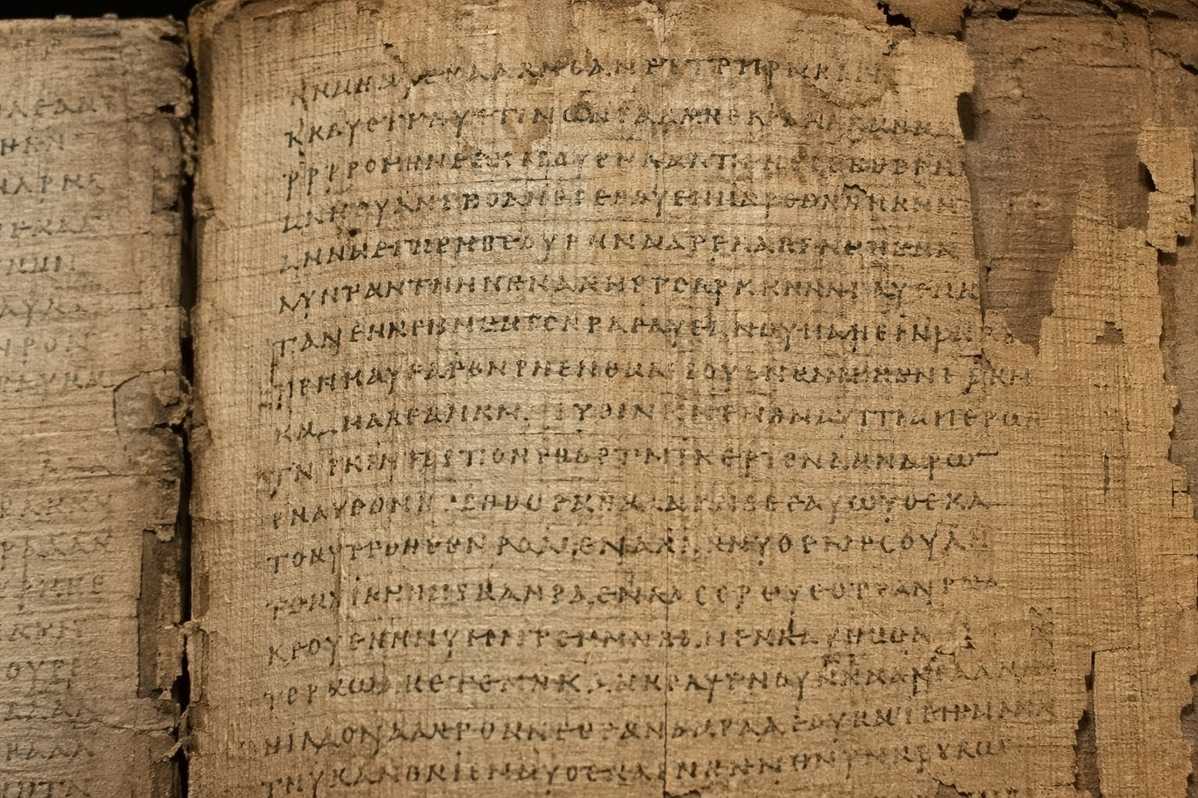
Codex VIII was among the twelve codices discovered in December 1945 near the town of Nag Hammadi in Upper Egypt. The codex contains 132 surviving pages of Coptic text, written in the Subachmimic dialect that characterises several of the more theologically advanced volumes in the collection [2]. Paleographical analysis suggests a fourth-century date for the copying, though the Greek originals of both tractates likely circulated earlier, possibly in the second or third centuries CE [3].
The codex was bound in leather over papyrus boards, a standard format for the Nag Hammadi collection. Its placement within the buried jar suggests intentional preservation–not casual discard but deliberate concealment during a period of ecclesiastical controversy. The Subachmimic dialect, a regional Coptic variant, indicates that the translators or copyists worked within Upper Egyptian monastic or scholastic circles, possibly at the Pachomian monastery near Nag Hammadi [2].
The physical condition of Codex VIII presents the usual challenges of ancient papyrus. Zostrianos survives nearly complete, though with significant lacunae in the opening pages and occasional damage to the lower margins. The Letter of Peter to Philip is fragmentary toward its conclusion, breaking off mid-sentence during an account of the apostles’ post-resurrection encounters [4]. These material gaps remind us that every reading of Nag Hammadi is an act of reconstruction–a negotiation between what the ancient scribes preserved and what time, climate, and human interference have claimed. The codex thus arrives to us as a partial transmission, yet one sufficiently intact to permit sustained theological analysis.
The Tractates of Codex VIII
The two tractates of Codex VIII articulate distinct modalities of Sethian spirituality–from individual mystical ascent to communal apostolic theology. Together they present a complete portrait of the tradition: the journey upward and the network that sustains those who undertake it.
Zostrianos (NHC VIII,1): The Longest Ascent
At approximately 8,000 Coptic lines, Zostrianos dominates its codex and the entire library. The text opens with a crisis: its protagonist, possibly a Hellenised Zoroaster, stands at the threshold of self-destruction, overwhelmed by the futility of earthly existence and conventional philosophical inquiry [5].
Primary Source Citation: NHC VIII,1 1:1-5. “I was in a great despair, and I planned to end my life.”
This autobiographical frame–rare in technical Sethian literature–establishes the ascent not as an intellectual exercise but as an emergency intervention. The seeker does not ascend from comfort; he flees toward the divine from a position of absolute existential collapse.
The rescue comes through celestial mediators. A luminous being identified as the angel of knowledge (or, in some passages, as the divine Logos) seizes Zostrianos and initiates him into a baptism of truth that strips away his mortal garments and replaces them with radiant vestures of light [6]. Unlike Christian water baptism, this is a noetic immersion–a stripping away of false identity and the reception of luminous garments that render the initiate invisible to lower powers.
Primary Source Citation: NHC VIII,1 6:10-15. “They baptised me in the spring of truth, and I received the garment of light.”
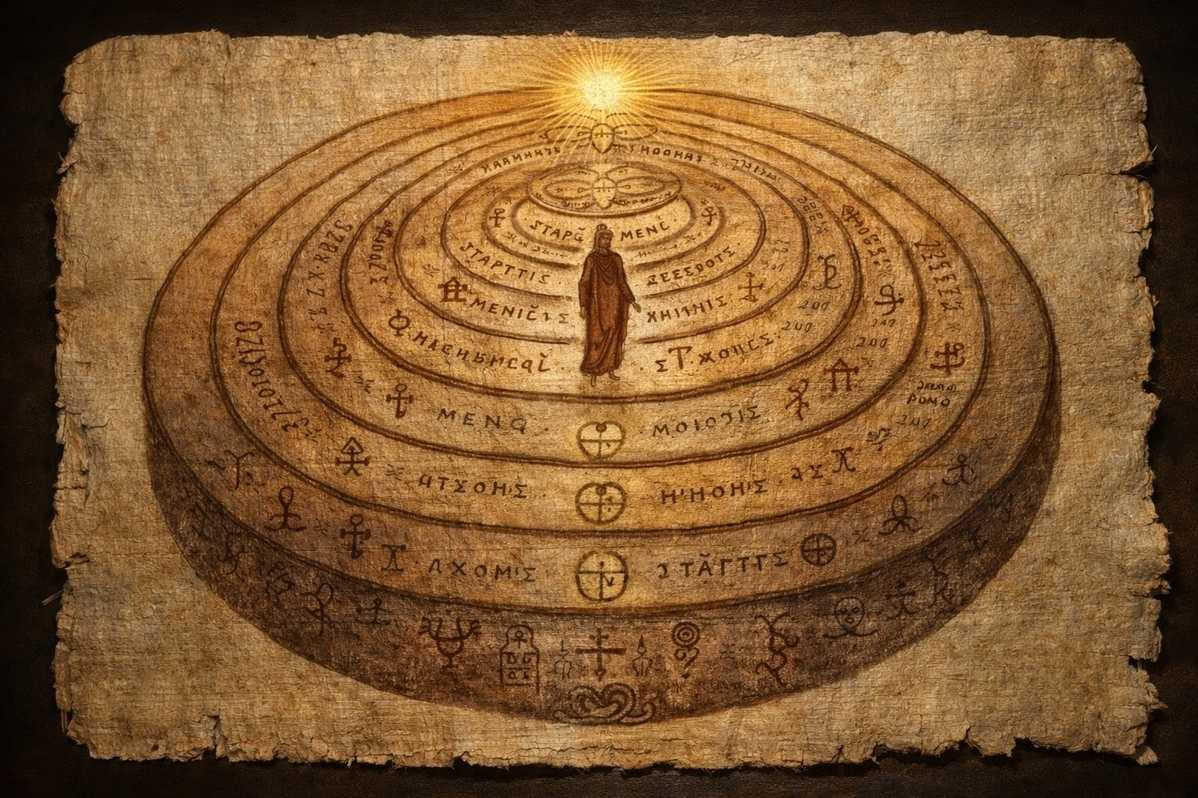
This garment functions as both protection and identification–camouflage against archontic scrutiny and uniform for entry into higher jurisdictions [7]. What follows is the most elaborate heavenly journey preserved in any Gnostic source. Zostrianos ascends through the atmospheric realm, the aetherial region, the planetary spheres, the sphere of the fixed stars, and beyond–each level populated by its own powers, each requiring specific passwords, seals, or doctrinal affirmations to pass. The thirteen aeons through which he travels are not arbitrary numbers; they correspond to structured ontological categories that map the distance between material embodiment and noetic purity.
The lower aeons–those of the atmosphere and the planets–retain strong demiurgic characteristics, populated by powers who actively oppose the ascending soul. The middle aeons introduce transitional beings, neither fully hostile nor fully welcoming, who test the traveller’s knowledge. The upper aeons, beyond the fixed stars, present the truly divine entities: Barbelo, the First Thought; the Triple-Powered One; and finally the Unknowable One, the source beyond all predication [6].
Primary Source Citation: NHC VIII,1 15:15-20. “I came to the atmospheric region, and I saw there a great demon, and he said to me, ‘Where are you going, O soul?’ And I said, ‘I am going to the father of all.'”
Such passages preserve what appear to be actual ritual formulas used to negotiate cosmic guardians–evidence that Gnostic communities practised structured ascent rituals, possibly adapted from contemporary mystery cults or Jewish apocalyptic traditions [7]. The text functions simultaneously as narrative, catechism, and liturgical handbook. It is, in effect, a field manual for celestial travel–every checkpoint documented, every password recorded, every potential obstruction anticipated.
The cosmology is unabashedly Platonist, yet transformed through visionary urgency. The distinction between intelligible and sensible realms, the hierarchical gradation of being, the return of the soul to its noetic source–all derive from Middle Platonic metaphysics. Yet Zostrianos does not merely describe these structures; it dramatises them. The Platonic forms become angelic administrators; the demiurgic realm becomes a border checkpoint; the One becomes a throne room whose access requires progressively higher security clearances [8]. This is Platonism experienced rather than Platonism debated–metaphysics traversed at personal risk rather than discussed in the safety of the academy.
The ascent culminates in the highest aeons, where Zostrianos receives final enthronement and returns to earth to teach the elect. The circular structure–descent into despair, ascent into light, return with knowledge–mirrors the soteriological pattern found throughout Sethian literature, yet nowhere else with such exhaustive procedural detail. The text insists that salvation is not merely belief but navigation: a learned capacity to move through hostile territory with the proper credentials and the proper knowledge of who controls which jurisdiction [9].

Letter of Peter to Philip (NHC VIII,2): Apostolic Equality in Brief
The second tractate occupies a mere eight pages, yet its significance exceeds its brevity. Cast as correspondence between Peter and Philip, the text opens with conventional epistolary formulae.
Primary Source Citation: NHC VIII,2 132:10-15. “Peter, the apostle of Jesus Christ, to Philip, our beloved brother and fellow apostle.”
This literary framing is unusual in Nag Hammadi, where revelations and dialogues predominate, and suggests that Gnostic communities maintained epistolary networks alongside their more esoteric genres. The doctrinal content is thoroughly Sethian. The Saviour appears in vision to reveal hidden knowledge, to teach about the Father and the Mother, and to liberate the spiritual seed from archontic captivity.
Primary Source Citation: NHC VIII,2 135:5-10. “I have come to reveal to you what is hidden, to teach you about the father and the mother.”
The emphasis falls on gnosis as salvation, on the revealer rather than the sacrificial victim, and on secret teaching accessible only to those with the proper disposition. The text preserves the classic Gnostic inversion: what orthodoxy hides, Gnosis reveals; what the many misunderstand, the elect comprehend [11].
What distinguishes this text is its treatment of apostolic authority. Peter and Philip stand as equals, both recipients of esoteric instruction, neither elevated above the other. This egalitarian apostolicism contrasts sharply with the Petrine supremacy developing in orthodox Christianity and aligns instead with the pluralistic leadership models attested in other Gnostic sources [12]. The Letter thus preserves a snapshot of alternative ecclesiology–a community where authority derives from received knowledge rather than institutional succession. In the bureaucratic metaphor that runs through much of this literature, both apostles hold the same security clearance; neither outranks the other in the administration of truth.
The Cosmology of Ascent in Zostrianos
The Thirteen Aeons and Their Guardians
The ascent structure in Zostrianos is not merely poetic; it is administrative. Each aeon functions as a territorial jurisdiction with its own governing powers, its own requirements for transit, and its own potential for obstruction. The atmospheric realm houses the planetary archons–celestial middle-management figures who demand passwords and challenge unauthorised movement [13]. The aetherial region introduces angelic examiners who test the initiate’s knowledge of divine names and cosmological correspondences. Higher still, the fixed stars and the transcendent aeons present progressively abstracted beings of light, each less anthropomorphic and more noetic than the last.
The guardians of each aeon are not merely obstacles; they are functionaries with specific portfolios. The planetary powers govern the astrological determinism that binds mortal souls to fate; the fixed stars administer the cosmic order; the transcendent powers beyond them regulate access to the divine pleroma. To pass each checkpoint, Zostrianos must demonstrate not merely virtue but knowledge–he must know the names, the seals, the passwords, and the theological correspondences that identify him as a legitimate traveller rather than an unauthorised intruder [13].
This structured hierarchy reflects what scholars term “Sethian soteriological geography” [14]–a mapped cosmos in which salvation is literally a journey with identifiable landmarks, dangers, and protocols. The text’s precision suggests it served not only as literary entertainment but as ritual preparation, equipping readers with the cognitive maps and verbal formulas necessary for their own visionary practice. To read Zostrianos is to receive a briefing on the territories one must traverse–a cosmological intelligence report prepared for those planning their own departure from the lower administration.
Autobiography and the Psychology of Transformation
Beneath the cosmic cartography lies a recognisable human narrative. Zostrianos’ initial despair, his suicidal ideation, his rescue by divine messengers, and his gradual transfiguration into a being of light constitute what modern phenomenology might call a crisis-and-integration trajectory [15]. The text does not suppress the psychological cost of mystical ambition; it dramatises it. The ascent begins not from strength but from brokenness, not from curiosity but from desperation.
This autobiographical element makes the technical cosmology emotionally accessible. Readers encounter not an abstract system but a suffering individual who finds, through disciplined ascent, a resolution that philosophical argument alone could not provide. The transformation is bodily as well as spiritual: Zostrianos receives new eyes, new ears, new garments–a complete somatic renovation that anticipates later Christian and Hermetic discussions of the resurrection body. The text insists that enlightenment is not merely mental; it is corporeal, a total reorganisation of the self at every level of existence.
Apostolic Authority Reimagined
The Letter of Peter to Philip contributes a dimension largely absent from Zostrianos: the question of community and transmission. While Zostrianos concerns individual ascent, the Letter addresses how knowledge moves between people. The apostolic gathering described in the text–Peter, Philip, and the other disciples receiving secret instruction from the resurrected Saviour–establishes a chain of transmission that links the heavenly realm to the earthly community.
Yet this chain is not hierarchical in the orthodox sense. There is no pope, no single arbiter of doctrine. Instead, authority radiates outward from the Saviour to multiple recipients simultaneously, each empowered to teach what they have received. This model of distributed authority fits the broader Gnostic pattern, where salvation depends on individual recognition rather than institutional obedience. The Letter thus complements Zostrianos perfectly: one text describes the journey upward; the other describes the network that sustains those who would make the journey.
Reading Codex VIII: A Guided Approach
For newcomers to Nag Hammadi, Codex VIII presents a formidable entry point. The density of Zostrianos assumes familiarity with Platonic metaphysics, Sethian mythology, and the conventions of apocalyptic ascent literature. Beginners are advised to start with the Letter of Peter to Philip, whose brevity and epistolary clarity offer an accessible introduction to Gnostic apostolic theology. Only with grounding in other tractates–the Apocryphon of John, the Gospel of Truth, perhaps the Discourse on the Eighth and Ninth–should the reader attempt Zostrianos in its entirety.
For advanced study, Zostrianos demands comparative reading. Set it alongside Allogenes (NHC XI,3) to observe the variations in Sethian technical vocabulary. Read it with Marsanes (NHC X) to trace the Platonizing trajectory across multiple codices. Compare its ascent structure with the Discourse on the Eighth and Ninth (NHC VI,6) to distinguish Sethian from Hermetic approaches to celestial navigation. Such comparison reveals both the shared ritual substrate and the distinctive developments that make each text unique.
For thematic study, focus on the autobiographical frame. The despair, the rescue, the transformation–these elements reveal the psychological reality behind the cosmic speculation. They suggest that Gnostic mysticism was not merely cosmological curiosity but existential therapy, a response to the recognised inadequacy of mundane existence. The text speaks to those who have themselves stood at the edge of despair and wondered whether any jurisdiction exists above the one that seems to hold them captive.
Why Codex VIII Matters
Zostrianos remains the most extensive surviving example of Gnostic mystical ascent literature. Where other texts describe ascent in general terms, Zostrianos takes us step by step–revealing the passwords, the guardians, the dangers, the rewards. For understanding Gnostic practice as practised rather than as theorised, this text is indispensable. It is the closest we come to a Gnostic service manual for the soul–every procedure documented, every contingency anticipated, every checkpoint staffed by beings who demand to know your business before granting passage.
The work also reveals the Platonic roots of Gnostic mysticism not as philosophical borrowing but as lived experience. The distinction between sensible and intelligible realms becomes a journey; the hierarchy of being becomes a ladder; the return to the One becomes a homecoming. This is metaphysics embodied, philosophy traversed. The academy and the monastery meet in these pages, producing a literature that is simultaneously rigorous and rapturous.
The Letter of Peter to Philip, though minor in scope, is significant for its literary form–evidence that Gnostic communities used epistolary literature alongside revelations and dialogues. It preserves an egalitarian apostolicism that characterised much of Gnostic Christianity, offering a counter-narrative to the hierarchical consolidation of orthodox ecclesiology. Together, the two tractates of Codex VIII present a complete picture: the individual’s journey upward and the community’s structure for sustaining those who travel.
For historians of religion, Codex VIII offers crucial evidence for the ritual practices of Sethian communities. The detailed passwords and formulas suggest that these were not merely literary fictions but actual elements of cultic practice, possibly drawn from Jewish apocalyptic traditions, Egyptian temple liturgies, or Greek mystery initiations. The text thus serves as a bridge between the speculative theology of the Platonic schools and the embodied practices of contemporary mystery religions [14].
Codex VIII is not for beginners. Its texts demand patience, preparation, and preferably some acquaintance with the broader Nag Hammadi corpus. But for those seeking to understand Gnostic mysticism in its most developed, most technically ambitious form, this codex is essential reading. It stands as the administrative headquarters of Sethian ascent–the central filing system where every form is numbered, every jurisdiction mapped, and every escape route marked for those with eyes to read and the courage to depart.
Frequently Asked Questions
What is Codex VIII in the Nag Hammadi Library?
Codex VIII is one of the twelve codices discovered near Nag Hammadi in 1945, containing two tractates: Zostrianos (the longest text in the library) and the Letter of Peter to Philip. It is known as the codex of ascent due to its detailed account of mystical heavenly journeys and its preservation of ritual ascent formulas.
What is Zostrianos and why is it significant?
Zostrianos (NHC VIII,1) is a Sethian Platonist text narrating the protagonist’s ascent through thirteen celestial aeons. It is significant as the most extensive surviving example of Gnostic mystical ascent literature, preserving detailed passwords, guardian encounters, and cosmological geography unmatched elsewhere in the collection.
What is the Letter of Peter to Philip?
The Letter of Peter to Philip (NHC VIII,2) is a brief epistolary text presenting Peter and Philip as equal recipients of secret teachings from the Saviour. It preserves Gnostic apostolic theology and an egalitarian model of church authority that contrasts with the hierarchical Petrine supremacy of orthodox Christianity.
How does Zostrianos describe the heavenly ascent?
Zostrianos describes ascent as a step-by-step journey through atmospheric, aetherial, planetary, and stellar realms, each guarded by powers who demand passwords and theological knowledge. The text preserves actual ritual formulas, suggesting it functioned as both narrative and liturgical handbook for mystical practice.
What are the thirteen aeons in Zostrianos?
The thirteen aeons are structured ontological realms mapping the distance between material existence and divine unity. Lower aeons contain hostile archontic powers, middle aeons present transitional testers, and upper aeons house supreme divine entities including Barbelo, the Triple-Powered One, and the Unknowable One.
Is Zostrianos based on Platonic philosophy?
Yes, Zostrianos draws heavily on Middle Platonic metaphysics–the intelligible-sensible distinction, the hierarchy of being, and the soul’s return to its source. However, it transforms abstract philosophy into visionary experience, making Platonism a lived journey rather than a speculative system.
How should beginners approach Codex VIII?
Beginners should start with the Letter of Peter to Philip for its brevity and clarity, then read foundational texts like the Apocryphon of John before attempting Zostrianos. Zostrianos requires prior familiarity with Platonic metaphysics and Sethian mythology to appreciate its technical cosmology.
Further Reading
These links connect Codex VIII to related resources within the ZenithEye library, providing pathways for deeper exploration of specific texts, traditions, and ascent methodologies.
- The Nag Hammadi Library: Complete Reader’s Guide — Master index and navigational hub for all forty-six tractates and thematic collections.
- Zostrianos: Journey Through the Thirteen Aeons — Detailed individual tractate study exploring the longest ascent text in the library.
- Letter of Peter to Philip — The companion tractate from Codex VIII, examining Gnostic apostolic authority and epistolary form.
- Ascent Literature in the Nag Hammadi Library — Thematic collection surveying heavenly journey texts across the entire collection.
- Allogenes: Sethian Ascent to the Unknowable One — Comparative ascent text from Codex XI, illuminating variations in Sethian technical vocabulary.
- Marsanes: Platonizing Sethian Metaphysics — Related technical tractate from Codex X, tracing the Platonizing trajectory across codices.
- Discourse on the Eighth and Ninth: Hermetic Ascent — Hermetic parallel from Codex VI, distinguishing Sethian from Hermetic approaches to celestial navigation.
- Codex VI: Hermetic and Ascent Texts — Overview of the codex containing related ascent literature and Hermetic discourses.
- The Five Seals: Sethian Initiation — Ritual context for ascent practices, examining the baptismal and sealing ceremonies underlying texts like Zostrianos.
- The Complete Nag Hammadi Reading Order — Structured path through all forty-six tractates, with guidance on building preparation for advanced texts such as Zostrianos.
References and Sources
The following sources support the claims and quotations presented in this article. All citations to the Nag Hammadi Library represent direct translations from the Coptic text as established in the standard critical editions.
Primary Sources and Critical Editions
- [1] Robinson, J.M. (Ed.). (1988). The Nag Hammadi Library in English (4th ed.). Brill.
- [2] Barry, C., Funk, W.-P., Poirier, P.-H., & Turner, J.D. (2000). Zostrianos (NHC VIII,1). BCNHT 24. Presses de l’Universite Laval.
- [3] Turner, J.D. (2001). Sethian Gnosticism and the Platonic Tradition. Peeters.
- [4] Scopello, M. (1997). “The Letter of Peter to Philip: Gnostic Epistolary and Apostolic Authority.” In Turner, J.D. & McGuire, A. (Eds.), The Nag Hammadi Library After Fifty Years. Brill.
- [5] Pearson, B.A. (2007). Ancient Gnosticism: Traditions and Literature. Fortress Press.
Scholarly Monographs and Commentaries
- [6] Pagels, E.H. (1979). The Gnostic Gospels. Random House.
- [7] Sieber, J.H. (1973). “An Introduction to the Tractate Zostrianos from Nag Hammadi Codex VIII.” Novum Testamentum, 15, 233-240.
- [8] Williams, M.A. (1996). Rethinking “Gnosticism”: An Argument for Dismantling a Dubious Category. Princeton University Press.
- [9] Funk, W.-P. (2007). “The Letter of Peter to Philip: Coptic Text and Translation.” In Mahe, J.-P. & Poirier, P.-H. (Eds.), Nag Hammadi Codex VIII. Presses de l’Universite Laval.
- [10] King, K.L. (2006). The Secret Revelation of John. Harvard University Press.
Comparative Studies and Thematic Analyses
- [11] Parrott, D.M. (1990). “Gnostic and Orthodox Ecclesiology: A Comparative Study.” In Goehring, J.E. (Ed.), Gnosticism and the Early Christian World. Polebridge Press.
- [12] Turner, J.D. (1993). “Ritual in Gnostic Ascent Literature.” SBL Seminar Papers, 32, 485-505.
- [13] Layton, B. (1987). The Gnostic Scriptures. Doubleday.
- [14] Armstrong, A.H. (1986). “Platonism and Gnostic Transformation: The Journey of the Soul.” In Armstrong, A.H. (Ed.), Classical Mediterranean Spirituality. Crossroad.
- [15] Mahe, J.-P. (1995). “Hermes et la gnose: a propos de l’Asclepius copte et de l’Expose valentinien.” In Painchaud, L. & Pasquier, A. (Eds.), Les textes de Nag Hammadi et le probleme de leur classification. Presses de l’Universite Laval.