Ascent Literature in Nag Hammadi: The Path Through the Planetary Spheres
Ascent Literature in the Nag Hammadi Library: 6 Texts of Celestial Navigation presents the most distinctive genre of the collection–texts that describe the soul’s journey through planetary spheres to the divine realm beyond. These are not metaphors but maps, not poetry but practice. They preserve the methods of ancient mystics who sought direct experience of the transcendent, offering detailed protocols for navigating the celestial administration: passwords for toll-collectors, baptisms for purification, and hymns for passage through the bureaucratic checkpoints of cosmic middle-management [1][2].
The six texts presented here–Discourse on the Eighth and Ninth, Zostrianos, Allogenes, Marsanes, Apocalypse of Paul, and Three Steles of Seth–span Hermetic, Sethian, and Valentinian traditions. Together they constitute a technical manual for celestial navigation, complete with the sonic passwords, ritual formulas, and visionary protocols required to pass from the material prison through the planetary checkpoints and into the executive headquarters of the pleroma. For scholars and contemplative readers alike, these texts demonstrate that Gnosticism was not merely speculative but experiential–not just thinking about the divine but encountering it directly [3][4].
Table of Contents
- Introduction — The Journey Upward
- The Texts of Ascent
- The Structure of Ascent
- The Method of Ascent
- Reading Ascent Literature
- Why Ascent Literature Matters
- Frequently Asked Questions
- Further Reading
- References and Sources
Introduction — The Journey Upward
What is Gnostic Ascent Literature?
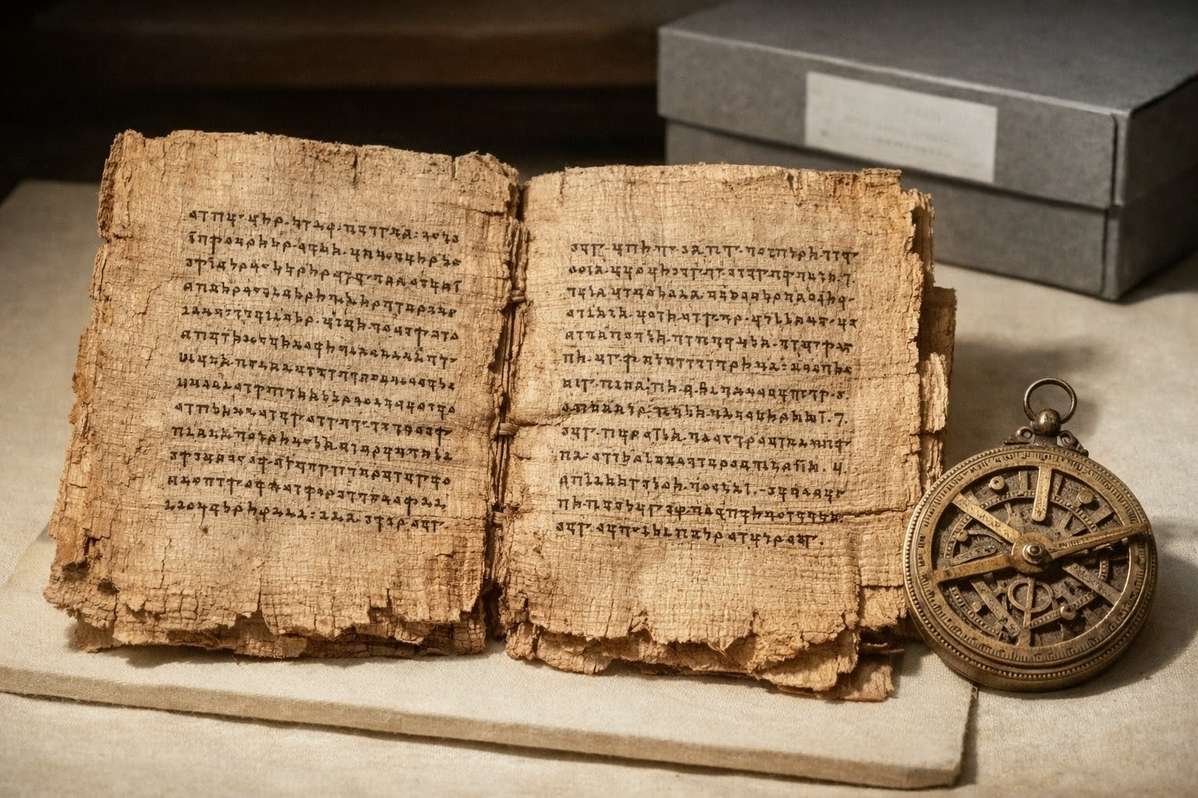
Ascent literature refers to texts that describe the soul’s post-mortem or visionary journey through successive cosmic realms to reach the divine pleroma. Unlike philosophical treatises, these documents function as operational maps–preserving passwords, baptismal formulas, hymnic invocations, and visionary techniques that ancient practitioners employed to navigate archonic checkpoints and achieve direct encounter with the transcendent.
The six territories: Discourse on the Eighth and Ninth (Hermetic ritual ascent) → Zostrianos (Sethian aeonic navigation) → Allogenes (apophatic encounter) → Marsanes (Platonic seal system) → Apocalypse of Paul (ten-heaven tour) → Three Steles of Seth (liturgical ascent through praise). By traversing these texts, the reader gains a comprehensive map of Gnostic celestial cartography [5][6].
The ascent is perilous. Each planetary sphere has its guardian, its challenge, its demand. The soul must know the passwords, the proper formulas, the correct responses. “And when you come to the fifth heaven, say to the gatekeeper…” Yet the ascent is also glorious–progressive illumination, expanding consciousness, ultimate union with the source. “I am the one who has been born again, and I am the one who has been saved.” These texts preserve the most detailed accounts of mystical practice in the Nag Hammadi Library, revealing the methods that transformed consciousness and led to the experiences described in other tractates [7].
Modern scholarship, particularly John D. Turner’s foundational studies of Sethian Platonism and Birger A. Pearson’s work on the fragmentary texts of Codex X, has established that these documents reflect actual ritual practices rather than mere literary fantasies [8][9]. The repeated baptisms, the vowel intonations, the seals and passwords–all point to communities engaged in systematic spiritual training. For the contemporary reader, this scholarly recovery means that ascent literature offers not just historical curiosity but recoverable method: the specific content (planets, archons) may be culturally distant, but the underlying technique of consciousness expansion remains perennially relevant.
The Texts of Ascent
The six texts presented here span the full range of Nag Hammadi ascent traditions, from accessible Hermetic dialogues to fragmentary Platonic treatises. Each articulates a distinct modality of celestial navigation.
The Discourse on the Eighth and Ninth — Hermetic Ritual Ascent (NHC VI,6)
The most accessible of the ascent texts, the Discourse on the Eighth and Ninth presents a dialogue between Hermes Trismegistus and his son Tat culminating in shared mystical ascent. The text provides rare detail about actual practice: prayer, invocation, the use of divine names, and the transformation of consciousness through vowel intonations [10].
Primary Source Citation: NHC VI,6 57:1-5. “I see, father, a great vision. I see the eighth, and I see the souls that are in it, and the angels singing a hymn to the ninth.”
The ritual structure is explicit: Hermes leads Tat through a ceremony involving call-and-response vowel sequences (alpha through omega), a prayer for the power to speak, the advent of light-power, and Tat’s ecstatic vision of the Eighth and Ninth spheres. The text culminates in Tat singing “a hymn in silence”–a wordless utterance that expresses the limits of logos and the entry into pure nous. For the practitioner, this is the most detailed surviving protocol for Hermetic celestial navigation, complete with the sonic passwords required to pass through each planetary checkpoint and the final silence that admits one to the executive headquarters [11].
Zostrianos — Sethian Aeonic Navigation (NHC VIII,1)
Zostrianos is the longest text in the library–a massive account of the heavenly ascent of Zostrianos (possibly a fictionalised Zoroaster). The text describes passage through multiple realms, encounters with various divine beings, and the progressive transformation of consciousness through repeated baptisms [12].
Primary Source Citation: NHC VIII,1 6:1-5. “I came to the atmospheric region, and I saw there a great demon, and he said to me, ‘Where are you going, O soul?'”
The text preserves the actual formulas used to pass cosmic guardians–evidence of ritual practice embedded in narrative form. Zostrianos undergoes seven immersions in the atmospheric sphere, one baptism in the realm of Sojourn, and six more in the realm of Repentance, each empowering him to ascend to the next level. At each checkpoint, he employs seals and passwords to pass undetected by the hostile powers. The text’s thirteen-aeon cosmology represents the most comprehensive map of the celestial administration, with each level requiring distinct clearance protocols and resident powers. This is not symbolic geography but systematic celestial topography–a filing system of cosmic jurisdictions that the ascending soul must navigate with precision [13].
Allogenes — Apophatic Encounter Beyond Cognition (NHC XI,3)
Allogenes presents a revelation given to Allogenes (“stranger, foreigner”) about the nature of the divine and the path of ascent. The text describes a complex hierarchy of divine beings and the mystical ascent through them, pushing negative theology to its extreme–approaching the unknowable through successive negations [14].
Guided by the aeon Youel, Allogenes ascends through the Triple-Powered One–comprising Existence, Vitality, and Mentality–until he reaches a state of apophatic stillness before the Unknowable One. The text teaches that the highest knowledge is a knowing that transcends cognition: “Do not desire to be active, lest in any way you fall away from the inactivity in you of the Unknowable One.” For the practitioner, Allogenes marks the boundary where celestial navigation ends and surrender begins–the point at which even the most sophisticated security clearance cannot grant entry, and only the cessation of all activity admits one to the divine presence [15].
Marsanes — The Platonic Seal System (NHC X,1)
Marsanes is the most technically demanding of the ascent texts–fragmentary, philosophically dense, requiring background in Platonic metaphysics. The text describes the furthest development of Sethian Platonism, presenting a system of thirteen seals through which the soul must pass to reach the supreme divine realm [16].
Primary Source Citation: NHC X,1 4:20-23. “The thirteenth seal is the limit of knowledge and the certainty of rest.”
The seals function as essential mystical symbols and initiatory practices that enable the soul’s ascent through the cosmological hierarchy. Baptismal seals (first through third) protect the initiate from passions; visionary seals (fourth through fifth) facilitate transition to incorporeal existence; eternal seals (eleventh through thirteenth) confer stability and rest in the unbegotten divine. The text also contains an extended discourse on the phonetic and theurgic properties of the Greek alphabet, linking vowels, diphthongs, consonants, and numbers to the invocation of divine entities. For specialists, Marsanes represents the summit of Platonizing Sethianism–a technical manual for those who have already mastered the basic protocols of celestial navigation [17].
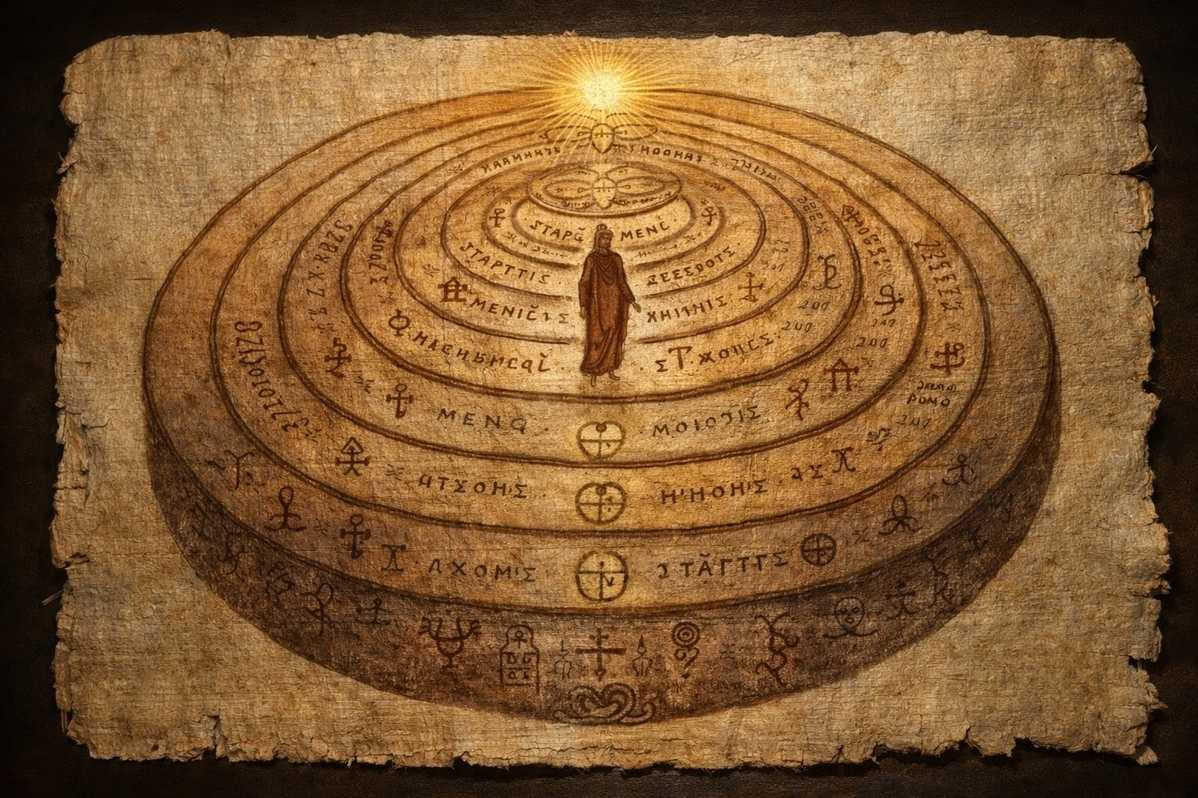
The Apocalypse of Paul — The Ten-Heaven Tour (NHC V,2)
The Apocalypse of Paul presents a guided tour of the heavens as Paul’s secret experience. An angel appearing in the form of a little child accompanies Paul during his ascent, offering passwords to pass toll-collectors who scrutinise souls based on sins witnessed at specific hours [18].
Paul ascends through ten heavens, encountering various beings and learning cosmic secrets. In the seventh heaven, he confronts the Old Man (the Demiurge), showing him the sign and trampling the “mountain of Jericho” to gain passage. The toll-collectors in the fourth heaven demand passwords mitigated by baptism; the Divine Name serves as the ultimate security clearance that grants passage through all checkpoints. Theologically, this text presents Paul as the model of the ascending soul–one who knows the passwords, who shows the sign to the Demiurge, who transcends even the twelve apostles in the Ogdoad to reach the Pleroma. It is eschatology as celestial navigation, demonstrating that even the apostle required proper documentation to pass the archonic border control [19].
The Three Steles of Seth — Liturgical Ascent Through Praise (NHC VII,5)
The Three Steles of Seth is a liturgical text–three hymns of praise meant to be recited, not merely read. The steles describe ascent through praise, moving from lower to higher realms through the power of invocation. “We praise you, O father of all fatherhood, O infinite light” (NHC VII,5 118:25-27) [20].
Primary Source Citation: NHC VII,5 127:18-22. “The way of ascent is the way of descent.”
The text is framed as a revelation of Dositheos, who sees the steles inscribed by Seth. The first stele praises Pigeradamas (the heavenly Adam); the second praises Barbelo (the divine mother); the third praises the pre-existent Father. The hymns are cast in first-person plural, suggesting communal ritual practice. The closing instruction–“from the third they bless the second; after these the first. The way of ascent is the way of descent”–reveals the text’s function as a liturgical script for a community contemplating celestial ascent. For the practitioner, the Three Steles offer the most direct evidence of actual Gnostic worship practice, not just theological speculation: a hymnal for those seeking to sing their way through the celestial administration [21].
The Structure of Ascent
These texts share a common cosmological structure that reflects the ancient understanding of the universe as a series of nested spheres, each requiring specific knowledge to traverse.
The Seven Planetary Spheres
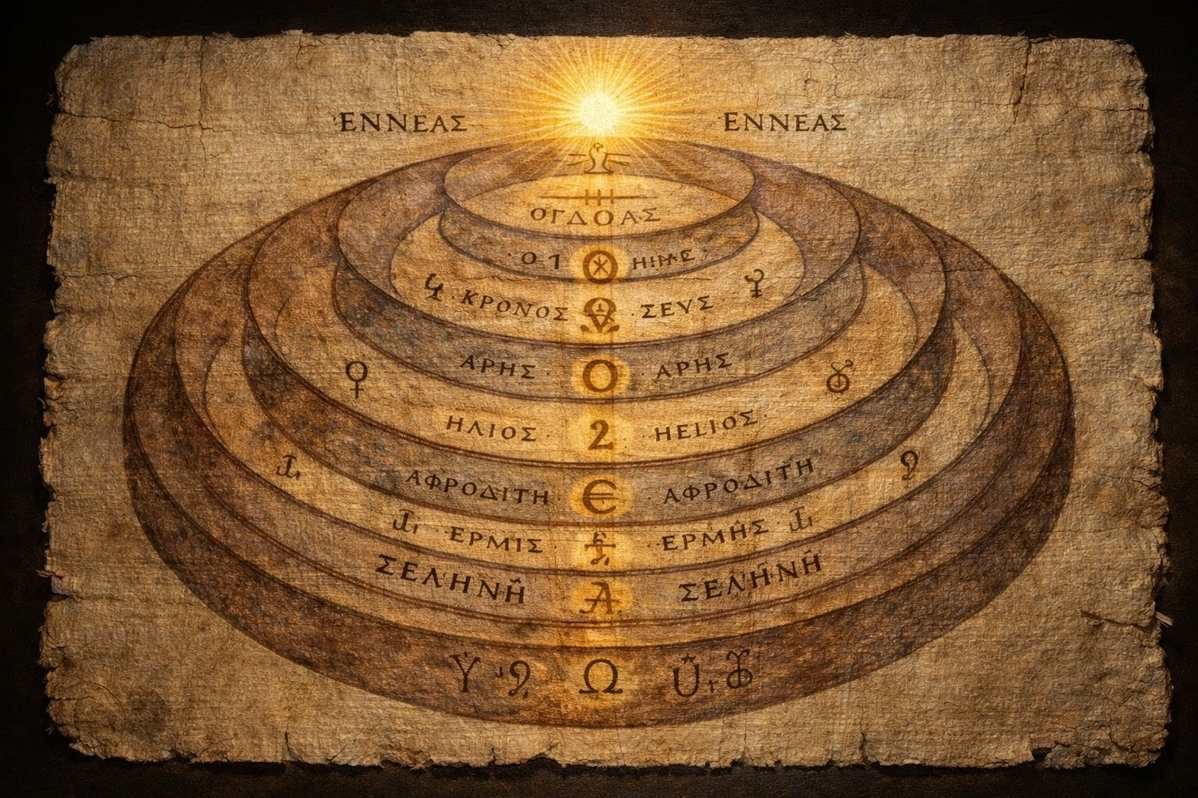
The seven planetary spheres–Moon, Mercury, Venus, Sun, Mars, Jupiter, Saturn–constitute the first major checkpoint system. Each sphere is governed by an archontic power, and each requires passage through proper knowledge. The Discourse on the Eighth and Ninth employs vowel sequences corresponding to these seven spheres, “stepping” through the heavens with progressive intonations until reaching the eighth [22].
The Eighth Sphere (Ogdoad)
The realm of the fixed stars, the Ogdoad, marks the boundary between the cosmic and the supra-cosmic. Here the soul encounters divine powers and receives further instruction. In the Apocalypse of Paul, the apostle greets the twelve apostles in the Ogdoad–a recognition scene that confirms his status as one who has transcended the lower realms. The Ogdoad is the antechamber to the divine, the final waiting room before entry into the executive headquarters [23].
The Ninth Sphere (Ennead)
The realm beyond the cosmos, the Ennead, is where direct encounter with the divine becomes possible. In the Discourse on the Eighth and Ninth, Tat attains vision of the Ninth and sings his hymn of praise. This is the sphere of pure nous, where words fail and only silent recognition remains. The Ninth represents the upper management floor–the highest administrative level before absolute transcendence [24].
The Tenth and Beyond
In some texts, a further realm exists beyond even the Ninth–the Pleroma itself, the fullness of divine reality. The Apocalypse of Paul describes ten heavens, with the tenth representing the ultimate destination. Zostrianos pushes even further, describing realms beyond the standard planetary and stellar spheres, each with its own governance protocols and resident powers. This is the final clearance zone, where all archonic jurisdiction ceases and the soul rests in native luminosity [25].
The Method of Ascent
The texts preserve concrete elements of actual practice that ancient communities employed to facilitate visionary ascent. These methods are not speculative abstractions but embodied techniques.
Prayer and Invocation
Alignment of the entire being toward the divine through spoken prayer. The Discourse on the Eighth and Ninth opens with Hermes’ extended prayer, and the Three Steles of Seth are entirely composed of hymnic invocations. Prayer functions as the initial orientation device–the compass that sets the soul’s trajectory toward the upper realms [26].
The Power of Names and Vowels
Use of divine names, sacred sounds, and passwords to open perception and pass guardians. The Discourse on the Eighth and Ninth employs Greek vowel strings (alpha through omega) as sonic passwords. Marsanes extends this to the entire Greek alphabet, treating vowels, diphthongs, and consonants as theurgic instruments. These are not magical incantations but cognitive technologies–sonic patterns that restructure consciousness and establish resonance with higher realms [27].
Baptism and Sealing
Ritual immersion and anointing that transform the ontological status of the initiate. Zostrianos describes multiple baptisms–seven in the atmospheric realm, one in Sojourn, six in Repentance–each marking a stage in the soul’s purification. Marsanes systematises these into thirteen seals that shield the soul from archonic interference. Baptism is the security clearance stamp that renders the practitioner invisible to lower powers [28].
Visualisation and Contemplation
Mental journey through the cosmic structure, encountering beings, receiving teachings. The ascent texts are designed to be read contemplatively, with the reader imaginatively participating in the journey. This is not mere fantasy but structured imagination–a cognitive rehearsal that prepares the soul for the actual passage. The texts function as virtual reality simulations of the celestial terrain, allowing practitioners to memorise the landscape before undertaking the journey [29].
Transformation of Consciousness
Temporary separation from physical embodiment, expansion of awareness beyond ordinary limits. The texts describe ecstatic states in which the practitioner leaves the body behind and travels in spiritual form. This is the fundamental technique of ascent: the recognition that consciousness is not bound to the physical vehicle and can operate independently in higher realms. The “hymn in silence” of the Discourse on the Eighth and Ninth represents the culmination of this transformation–a state where ordinary cognition has been transcended and pure noetic awareness remains [30].
Reading Ascent Literature
For contemporary readers, these texts demand both scholarly preparation and contemplative receptivity. Start with the Discourse on the Eighth and Ninth–most accessible, most practical, providing explicit ritual detail that requires no prior knowledge of Sethian cosmology. Then attempt Zostrianos for the full narrative scope of Sethian aeonic navigation, though its length and complexity demand patience [31].
Leave Allogenes and Marsanes for advanced study. Allogenes requires familiarity with apophatic theology and the Triple-Powered One; Marsanes demands background in Platonic metaphysics and is severely fragmentary. The Apocalypse of Paul offers an accessible introduction to the ten-heaven structure, while the Three Steles of Seth provides the most direct experience of liturgical ascent–read them aloud, and the hymns become operational [32].
Read these texts not as historical curiosities but as evidence of living practice. The methods they describe–prayer, meditation, visualisation, ascent–are still practised today in various traditions. And read them critically–recognising that the cosmology (planetary spheres, archontic powers) reflects ancient astronomy, that the specific content may be culturally distant, but the underlying method (consciousness expansion, mystical union) is perennial.
Why Ascent Literature Matters
These texts preserve the most detailed accounts of mystical practice in the Nag Hammadi Library. They show that Gnosticism was not merely speculative but experiential–not just thinking about the divine but encountering it directly. For understanding Gnosticism as a spiritual path, not just a set of ideas, ascent literature is essential. It reveals the practices that transformed consciousness, the methods that led to the experiences described in other texts [33].
For contemporary seekers, these texts offer models of systematic spiritual practice. The specific content (planets, archons) may be alien, but the method (prayer, meditation, ascent) is adaptable. The journey upward remains possible. The jar is open. The alternative archive has survived. These six texts offer not heresy to be refuted but navigational provocations to be engaged–challenges that continue to illuminate the boundaries, possibilities, and enduring questions of celestial cartography [34].
Frequently Asked Questions
What is ascent literature in the Nag Hammadi Library?
Ascent literature refers to texts describing the soul’s journey through planetary spheres and cosmic realms to reach the divine pleroma. These documents function as operational maps preserving passwords, baptismal formulas, hymnic invocations, and visionary techniques that ancient practitioners employed to navigate archonic checkpoints and achieve direct encounter with the transcendent.
Which Nag Hammadi texts are considered ascent literature?
The six primary ascent texts are the Discourse on the Eighth and Ninth (NHC VI,6), Zostrianos (NHC VIII,1), Allogenes (NHC XI,3), Marsanes (NHC X,1), Apocalypse of Paul (NHC V,2), and Three Steles of Seth (NHC VII,5). Each presents a distinct tradition–Hermetic, Sethian, or Valentinian–and a unique method of celestial navigation.
How does the Discourse on the Eighth and Ninth describe ritual ascent?
The Discourse presents a dialogue between Hermes Trismegistus and Tat culminating in shared mystical ascent through vowel intonations, prayer, and ecstatic vision. The ritual involves call-and-response sequences from alpha through omega, culminating in Tat singing a hymn in silence–a wordless utterance expressing the limits of logos and entry into pure nous.
What are the thirteen aeons in Zostrianos?
Zostrianos describes a complex system of thirteen aeons or realms through which the protagonist ascends. Each level has distinct governance protocols, resident powers, and baptismal requirements. Zostrianos undergoes multiple immersions and employs seals and passwords to pass undetected by archonic guardians, making it the most comprehensive map of Sethian celestial topography.
What role do seals and passwords play in Gnostic ascent?
Seals and passwords function as security clearances that transform the soul’s ontological status and grant passage through archonic checkpoints. Marsanes systematises thirteen seals ranging from baptismal purification to eternal rest. The Apocalypse of Paul employs the Divine Name as the ultimate password that trumps all archonic scrutiny. These are not magical incantations but cognitive technologies for navigating cosmic jurisdictions.
How does the Apocalypse of Paul relate to 2 Corinthians 12?
The Apocalypse of Paul explicitly expands Paul’s brief reference in 2 Corinthians 12:2-4 about being caught up to the third heaven. The apocryphal text details his ascent through ten heavens, guided by a child-like spirit, offering passwords to pass toll-collectors and confronting the Demiurge in the seventh heaven. It elaborates on the apostle’s reticent account to emphasise his apostolic authority and mastery of celestial navigation.
Can modern readers practise the methods described in ascent literature?
Modern readers can approach these texts as recoverable methods rather than historical curiosities. The underlying techniques–prayer, meditation, visualisation, and consciousness expansion–remain perennially relevant, even if the specific cosmological content (planetary spheres, archontic powers) reflects ancient astronomy. The Three Steles of Seth can be read aloud as liturgy, and the Discourse on the Eighth and Ninth offers a structured protocol for contemplative ascent.
Further Reading
These links connect the ascent literature collection to related resources within the ZenithEye library, providing pathways for deeper exploration of specific texts, traditions, and navigational methods.
- Nag Hammadi for Beginners: A 10-Text Journey — The foundational introduction for newcomers before tackling the technical complexities of celestial navigation texts.
- Nag Hammadi Library: Complete Guide to 46 Gnostic Scriptures — Comprehensive overview of the entire collection for readers ready to expand beyond the six ascent texts presented here.
- Discourse on the Eighth and Ninth: Hermetic Ascent and Rebirth — Deep dive into the most accessible ascent text, with full ritual analysis and commentary on the vowel intonation protocol.
- Zostrianos: The Complete Journey Through the Thirteen Aeons — Extended study of the longest Nag Hammadi text and its comprehensive map of Sethian celestial topography.
- Allogenes: Sethian Ascent to the Unknowable One — Detailed analysis of apophatic stillness and the boundary where celestial navigation ends and surrender begins.
- Marsanes: Platonizing Sethian Metaphysics — Study of the most technically demanding ascent text and its system of thirteen seals for advanced practitioners.
- Apocalypse of Paul: Heavenly Ascent Beyond the Fourth Heaven — Examination of the ten-heaven tour and the toll-collector mythology that structures Pauline celestial navigation.
- Three Steles of Seth: Hymns of Praise and Ascent — Commentary on the liturgical hymnal and its function as communal ritual for celestial ascent.
- The Five Seals: Sethian Initiation and Baptismal Ascent — Technical exploration of the seal and baptism protocols that render archonic interference administratively void.
- Hermetic Connections in the Nag Hammadi Library — Guide to the Egyptian-Greek mystical synthesis that produced the Discourse on the Eighth and Ninth and related Hermetic texts.
References and Sources
The following sources support the claims and quotations presented in this article. All citations to the Nag Hammadi Library represent direct translations from the Coptic text as established in the standard critical editions.
Primary Sources and Critical Editions
- [1] Robinson, J.M. (Ed.). (1988). The Nag Hammadi Library in English (4th ed.). Brill.
- [2] Meyer, M. (Ed.). (2007). The Nag Hammadi Scriptures: The International Edition. HarperOne.
- [3] Layton, B. (1987). The Gnostic Scriptures: A New Translation with Annotations and Introductions. Doubleday.
- [4] Turner, J.D. (2001). Sethian Gnosticism and the Platonic Tradition. Peeters.
- [5] Waldstein, M. & Wisse, F. (1995). The Apocryphon of John. Brill.
Scholarly Monographs and Commentaries
- [6] Turner, J.D. (1990). “Allogenes: Introduction, Translation, and Notes.” In Pagels, E.H. & Hedrick, C.W. (Eds.), Nag Hammadi Codices XI, XII, XIII. Brill.
- [7] Sieber, J.H. (1981). Zostrianos. In Nag Hammadi Codices VIII. NHS 11. Brill.
- [8] Pearson, B.A. (1981). Marsanes. In Nag Hammadi Codices IX and X. NHS 15. Brill.
- [9] Murdock, W.R. & Kaler, M. (2000). “The Apocalypse of Paul” in The Nag Hammadi Library in English. Brill.
- [10] Claude, P. (1983). Les Trois stèles de Seth: Hymne gnostique à la Triade. BCNH 8. Presses de l’Université Laval.
Comparative Studies and Thematic Analyses
- [11] Hanegraaff, W.J. (2019). Hermetic Spirituality and the Historical Imagination. Cambridge University Press.
- [12] Burns, D.M. (2014). Apocalypse of the Alien God: Platonism and the Exile of Sethian Gnosticism. University of Pennsylvania Press.
- [13] King, K.L. (2006). The Secret Revelation of John. Harvard University Press.
- [14] Brakke, D. (2010). The Gnostics: Myth, Ritual, and Diversity in Early Christianity. Harvard University Press.
- [15] Schenke, H.M. (2001). Nag Hammadi Deutsch, Vol. 1. De Gruyter.