Eugnostos: The Letter to the Wise on Ultimate Reality
Eugnostos (NHC III,3 & V,1): The Philosophical Epistle on the Unbegotten and the Structure of Reality
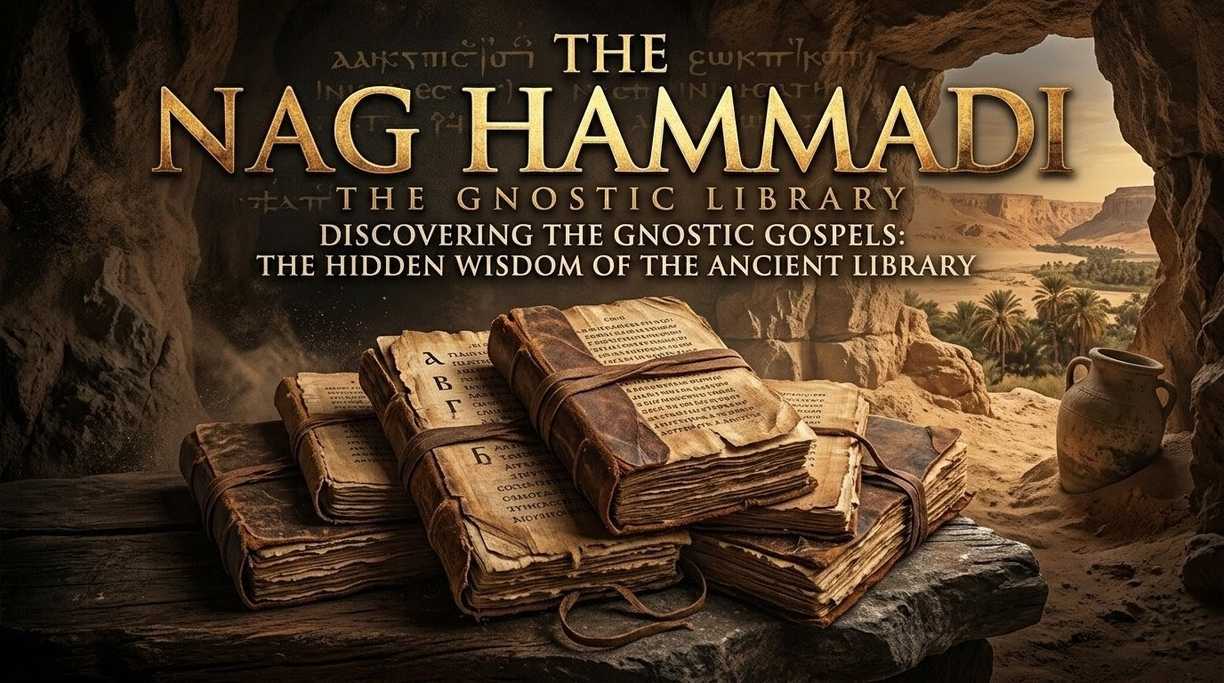
Eugnostos (The Blessed Eugnostos) stands as one of the most philosophically refined documents within the Nag Hammadi Library, presenting itself as a letter addressed “to those who are wise” regarding the nature of ultimate reality [1][2]. Unlike the mythologically complex Sethian treatises with their elaborate archonic bureaucracies, Eugnostos offers a relatively straightforward philosophical theology that would later influence both Gnostic and Hermetic traditions. The text provides a “corporate handbook” for understanding the chain of command from the Unbegotten (executive headquarters) through the Self-Begotten (regional management) to the begotten cosmos (field operations) [3].
What is Eugnostos?
A second-century philosophical epistle appearing in both Nag Hammadi Codex III and Codex V, presenting a hierarchical cosmology bridging the absolute One (Unbegotten) and the material world. The text describes three fundamental realities: the Unbegotten (source), the Self-Begotten (divine intelligence), and the begotten (cosmos). Unlike dualistic systems, Eugnostos maintains an emanationist perspective where all reality participates in divine fullness. It survives in two manuscript versions and served as source material for the later Christianised dialogue The Sophia of Jesus Christ [4].
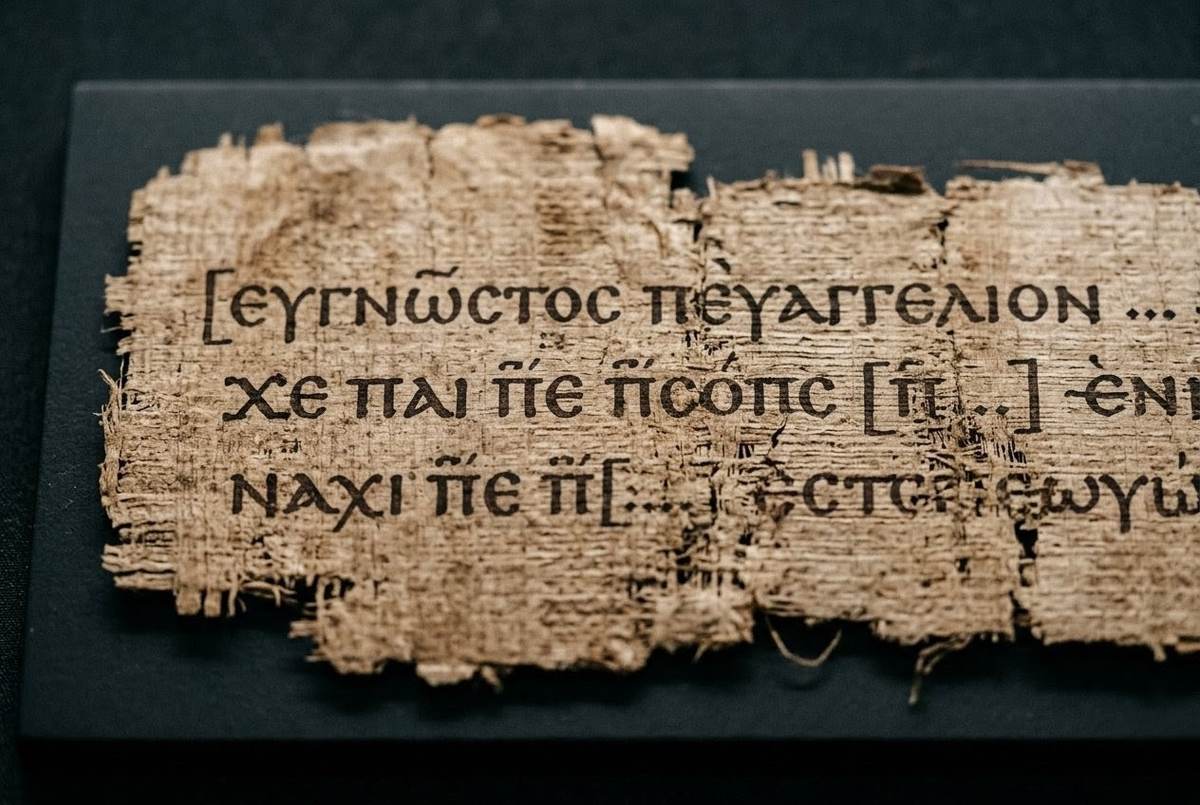
Table of Contents
The Immutable Divine
The text opens with a profound declaration of divine transcendence. Eugnostos describes the ultimate reality as unbegotten, immutable, and existing in absolute silence and rest (NHC III,3 70:5-10) [5]. This is not the creator god of conventional religion but rather the philosophical absolute–the ground of all being that remains entirely self-contained and unaffected by the cosmos. The opening lines establish this tone: “The immutable is the Unbegotten, and the Unbegotten is the Immeasurable” [6].
Such apophatic language–defining the divine by what it is not–resonates with both Platonic negative theology and later mystical traditions. The Unbegotten exists as the “executive headquarters” beyond all categories of thought, unaccountable to any “middle-management” cosmic bureaucracy [7]. This absolute remains in perfect autarkeia (self-sufficiency), requiring nothing external to complete its nature, unlike the demiurgic figures of more dualistic systems who labour over matter as incompetent administrators [8].
Primary Source Citation: “The immutable is the Unbegotten, and the Unbegotten is the Immeasurable. The Immeasurable is the Unnameable, and the Unnameable is the Incomprehensible” — Eugnostos III,3 70:5-10 [9]
The text’s emphasis on silence and rest suggests a divine nature that operates without the “busywork” of cosmic administration. The Unbegotten does not issue decrees, enforce regulations, or maintain the “filing system” of the cosmos–it simply is, serving as the ultimate “background condition” for all subsequent reality [10]. This conceptualisation avoids the anthropomorphic projection that characterises conventional religious bureaucracy, proposing instead a divine “silent partner” whose presence is known through absence [11].
The Structure of Reality
Eugnostos presents a hierarchical cosmology that bridges the gap between the absolute One and the material world. The text describes the emergence of the All from the Unbegotten through a series of emanations that preserve divine unity while allowing for multiplicity (NHC III,3 72:15-20) [12]. Unlike the dualistic systems that pit spirit against matter as hostile departments, Eugnostos maintains a more subtle emanationist perspective where all reality participates in the divine fullness–a “trickle-down” ontology where the lower levels retain connection to the executive headquarters [13].
The tractate distinguishes between three fundamental realities: the Unbegotten (absolute source), the Self-Begotten (divine intelligence), and the begotten (the cosmos and its inhabitants) [14]. This triadic structure anticipates later Trinitarian formulations while remaining firmly within the realm of philosophical monotheism. The Self-Begotten functions as the “chief operating officer” who translates the silent potential of the Unbegotten into the active administration of the cosmos, while the begotten realm represents the “field offices” where the work of existence actually occurs [15].

The Threefold Structure of Reality
Unbegotten: The absolute source, unnameable and incomprehensible–the “executive headquarters” beyond all categories.
Self-Begotten: Divine intelligence and first emanation–the “chief operating officer” who translates potential into administration.
Begotten: The cosmos and its inhabitants–the “field offices” where existence occurs, still connected to headquarters through emanation.
This structure avoids the “hostile takeover” narrative found in more dualistic Gnostic systems. Rather than a fallen cosmos separate from the divine, Eugnostos presents reality as a continuous “corporate ladder” where even the material realm retains its “stock options” in the divine enterprise [16]. The cosmos emerges not through violence or error but as the natural overflow of divine abundance–a “business expansion” that remains wholly owned by the parent company [17].
Wisdom and Recognition
The central message of Eugnostos concerns the possibility of human knowledge of the divine. The text suggests that through philosophical contemplation and the recognition of one’s own divine origin, individuals can transcend the limitations of material existence and return to the realm of the immutable (NHC III,3 74:5-10) [18]. This is not salvation through faith or ritual but through gnosis–direct experiential knowledge of ultimate reality [19].
The wise are those who recognise their kinship with the divine and live accordingly, freed from the fear of death and the distractions of temporal existence. This recognition constitutes a “security clearance upgrade” that allows the individual to bypass the “middle-management” anxieties of conventional existence and access the “executive suite” of the Unbegotten [20]. The text promises that through this knowledge, the soul can “return to the place from which it came,” completing the “personnel transfer” from field operations back to headquarters [21].
Eugnostos describes this recognition as available only “to those who are wise” (NHC III,3 70:1)–suggesting an epistemological elitism that distinguishes between those capable of abstract contemplation and those trapped in material concerns [22]. This is not cruelty but realism: the “organisational structure” of reality requires certain “qualifications” for promotion to higher levels of awareness [23]. The text functions as a “training manual” for those seeking to advance their “employment status” from the begotten to the Self-Begotten, and ultimately to comprehension of the Unbegotten [24].
Relation to the Sophia of Jesus Christ
Scholars note that Eugnostos shares significant material with The Sophia of Jesus Christ (NHC III,4) [25]. While Eugnostos presents itself as a philosophical letter, the Sophia of Jesus Christ adapts this material into a dialogue between the resurrected Jesus and his disciples. This relationship suggests that Eugnostos may represent an earlier, non-Christian version of these teachings, later Christianised by the addition of a salvific figure [26].
The parallels between the two texts illuminate the fluid boundaries between pagan philosophy, Jewish wisdom literature, and early Christian theology in the second century CE. Eugnostos operates without the “intermediary” of a divine saviour, relying instead on the soul’s innate capacity for philosophical ascent–a “self-promotion” model that the Sophia of Jesus Christ later modifies to include the “third-party intervention” of Jesus [27]. This textual relationship demonstrates how the same “executive knowledge” could be distributed through different “channels”–philosophical epistle versus revelatory dialogue [28].
For students of the Nag Hammadi Library, reading Eugnostos alongside the Sophia of Jesus Christ provides insight into the “editorial process” by which non-Christian wisdom literature could be adapted for Christian communities [29]. The core “business model” (the triadic structure of reality) remains consistent, but the “customer service approach” shifts from philosophical instruction to divine revelation [30].
The Emanation of Powers
Eugnostos details the emergence of various divine powers or aeons from the Self-Begotten (NHC III,3 75:10-15) [31]. These include Immortality, Truth, Wisdom, and Grace–personified qualities that structure both the divine realm and the possibility of human flourishing. Unlike the malevolent archons of more dualistic Gnostic systems, these powers serve as “department heads” who channel the “executive directives” of the Unbegotten into the “operational procedures” of the cosmos [32].
The text describes how these powers form a harmonious totality, each reflecting a different aspect of divine perfection. The cosmos itself emerges not through violence or error but as the natural overflow of divine abundance–a “corporate expansion” that maintains quality control through the distribution of these powers [33]. Each power functions as a “specialised division” within the divine organisation: Immortality handles longevity benefits, Truth manages information integrity, Wisdom oversees strategic planning, and Grace administers unmerited promotions [34].
This positive evaluation of cosmic powers distinguishes Eugnostos from texts like the Apocryphon of John, where the planetary archons function as hostile middle-management blocking human ascent [35]. In Eugnostos, the powers are “cooperative staff” who facilitate rather than obstruct the soul’s return to the Unbegotten, suggesting a more “employee-friendly” corporate culture than the adversarial systems found in dualistic Sethianism [36].
Ethical Implications
While primarily metaphysical, Eugnostos carries ethical weight. The recognition of one’s divine origin entails living in accordance with truth and wisdom (NHC III,3 76:5-10) [37]. The text suggests that those who understand the nature of reality will naturally transcend worldly concerns, living with detachment from material possessions and social status–a “philosophical early retirement” from the rat race of conventional existence [38].
This philosophical detachment (apatheia) resembles Stoic and Cynic ethics while serving a distinctly religious purpose–the preparation of the soul for its return to the immutable realm [39]. The wise live as “consultants” to the divine rather than “employees” of the material world, maintaining a professional distance from the “office politics” of temporal existence while still performing their duties [40].
The text implies that ethical behaviour flows naturally from metaphysical understanding rather than from imposed regulations. One does not need a “compliance manual” of commandments when one recognises that the material world is a temporary assignment in a larger “corporate structure” [41]. The “code of conduct” for the wise is simply this: remember your origin, recognise your destination, and do not become too invested in the “temporary position” of material existence [42].
Textual History and Discovery
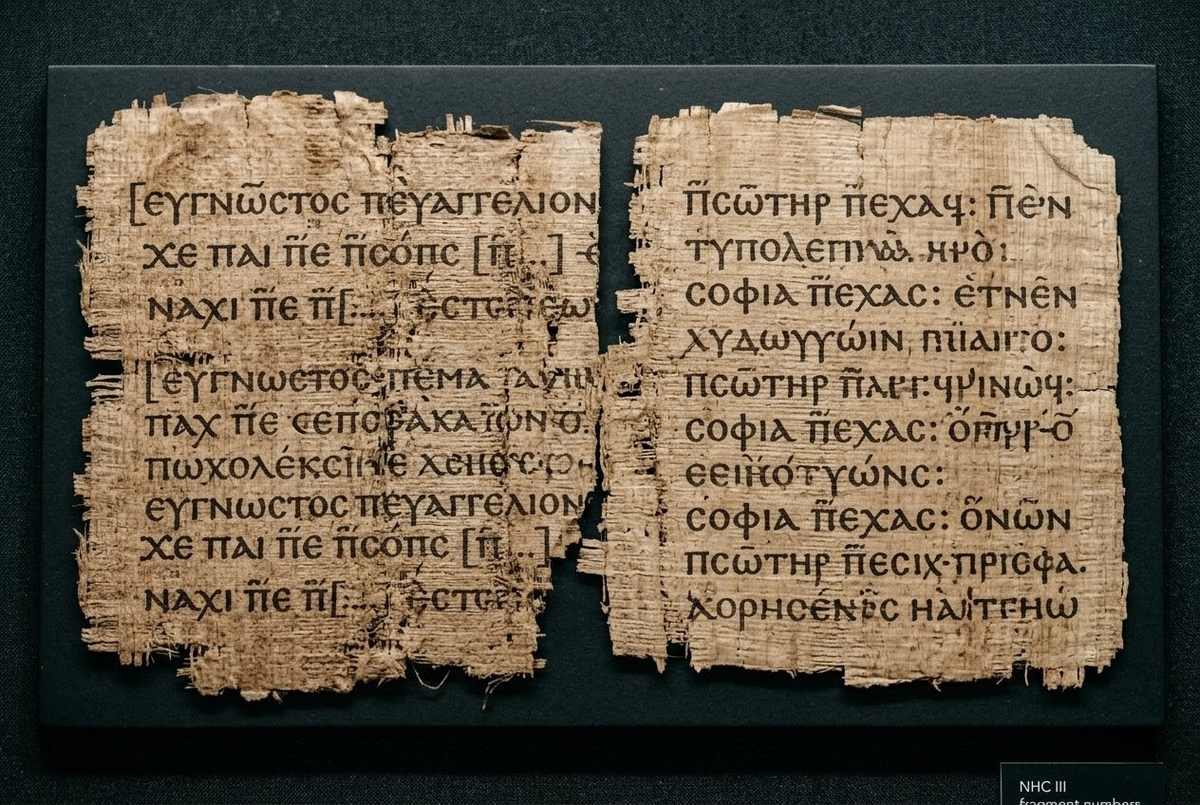
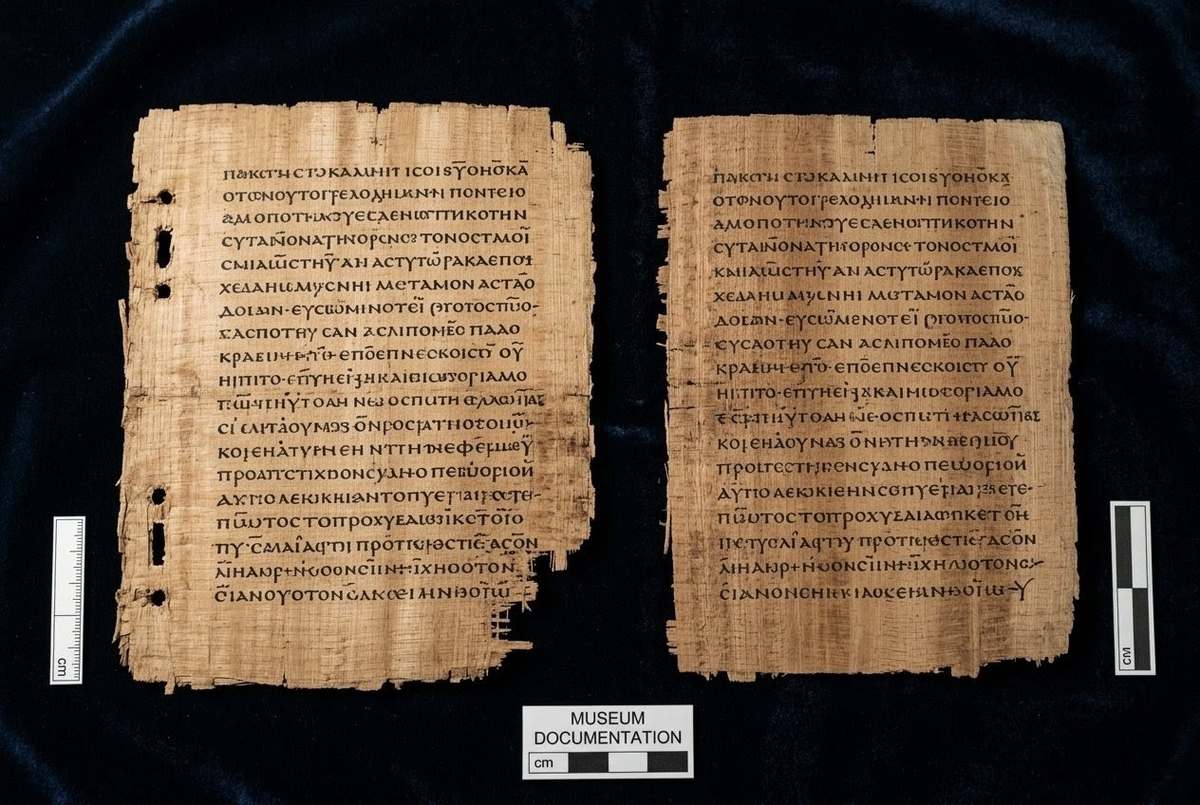
Eugnostos appears in both Codex III and Codex V of the Nag Hammadi Library, suggesting its importance within the collection [43]. The dual attestation indicates that this was not a marginal text but a valued component of the library’s theological corpus–a “core document” distributed across multiple “locations” [44].
The surviving manuscripts date to the fourth century CE, though the original composition likely occurred in the second century, during the height of Middle Platonic influence on Egyptian religious thought [45]. The text’s survival in two independent codices suggests it served as “required reading” for the communities that produced and preserved the Nag Hammadi Library–a “foundational text” for understanding the “organisational chart” of reality [46].
Scholars have identified Eugnostos as a crucial witness to the “pre-Christian” stratum of Gnostic thought, demonstrating that the philosophical framework of triadic emanation predates the Christian adaptation seen in the Sophia of Jesus Christ [47]. The text provides evidence that the “corporate structure” of divine reality was not invented by Christian Gnostics but adapted from existing Middle Platonic “business models” [48].
Theological Significance
Eugnostos represents a sophisticated attempt to reconcile Greek philosophical concepts with Semitic theological concerns [49]. The text preserves monotheistic commitments while embracing the Platonic distinction between the absolute and the contingent. It offers a vision of salvation that is simultaneously intellectual and spiritual–knowledge of the divine transforms the knower, upgrading their “security clearance” to access the “executive level” of reality [50].
For contemporary readers, Eugnostos provides insight into the religious landscape of late antique Egypt, where boundaries between philosophy, Judaism, and Christianity remained porous [51]. The text demonstrates that Gnosticism was not merely a Christian heresy but a broader religious movement drawing on diverse cultural resources–a “multinational corporation” of ideas rather than a single “local business” [52].
The text’s emphasis on innate human capacity for divine knowledge (through philosophical contemplation) challenges the authoritarian models of religious authority that rely on institutional mediation [53]. Eugnostos proposes that the “employee handbook” for reality is written in the human soul itself, accessible to those who engage in the “inner work” of contemplation without requiring “external consultants” [54].
Contemporary Resonance
The questions Eugnostos addresses remain pressing: What is the nature of ultimate reality? How can humans know the divine? What is the relationship between the eternal and the temporal? [55] The text’s emphasis on direct experiential knowledge over dogmatic belief resonates with contemporary spiritual seekers disillusioned with institutional religion–those seeking the “executive summary” rather than the full “policy manual” [56].
Eugnostos offers a vision of spirituality rooted in metaphysical insight rather than ritual observance–a path of wisdom accessible to those willing to look beyond conventional religious categories [57]. The text suggests that one need not leave the “field office” of material existence to contact the “executive headquarters” of the divine; one need only adjust one’s “communication frequency” through philosophical contemplation [58].
For modern readers trapped in the “bureaucracy” of materialist consumerism, Eugnostos provides a “corporate restructuring” proposal that places the absolute at the centre of existence rather than the material [59]. The text invites us to recognise that we are not merely “temporary workers” in a meaningless cosmos but participants in a hierarchical “organisation” that extends from the Unbegotten through every level of reality–a perspective that transforms the “daily grind” into a pathway of return [60].
Frequently Asked Questions
What is Eugnostos in the Nag Hammadi Library?
Eugnostos (The Blessed Eugnostos) is a second-century philosophical epistle appearing in both Nag Hammadi Codex III (tractate 3) and Codex V (tractate 1). It presents a hierarchical cosmology describing three realities: the Unbegotten (absolute source), the Self-Begotten (divine intelligence), and the begotten (cosmos). Unlike dualistic Gnostic texts, Eugnostos maintains an emanationist perspective where all reality participates in divine fullness. The text served as source material for the later Christianised dialogue The Sophia of Jesus Christ.
What is the triadic structure of reality in Eugnostos?
Eugnostos describes three fundamental levels of reality: (1) The Unbegotten–the absolute source beyond all categories, unnameable and incomprehensible; (2) The Self-Begotten–the first emanation or divine intelligence that translates the potential of the Unbegotten into administration; (3) The begotten–the cosmos and its inhabitants. This triadic structure anticipates later Trinitarian theology while remaining philosophical rather than mythological. The model suggests reality operates as a continuous chain of being from the absolute through to the material realm.
How does Eugnostos relate to the Sophia of Jesus Christ?
Eugnostos shares significant material with The Sophia of Jesus Christ, with scholars debating the exact relationship. Most agree Eugnostos represents an earlier, non-Christian philosophical version of these teachings, while Sophia of Jesus Christ adapts the content into a dialogue between the resurrected Jesus and his disciples. The core metaphysical structure (triadic emanation) remains consistent, but Sophia adds the Christian saviour figure as intermediary. This relationship demonstrates how non-Christian wisdom literature was adapted for Christian communities in the second century.
What are the divine powers or aeons in Eugnostos?
Eugnostos describes the emanation of various divine powers from the Self-Begotten, including Immortality, Truth, Wisdom, and Grace. Unlike the hostile archons of dualistic Gnostic systems, these powers function as positive channels through which the absolute manifests in the realm of becoming. They structure both the divine realm and human flourishing, serving as cooperative forces that facilitate rather than obstruct the soul’s return to the Unbegotten.
What is the path to salvation according to Eugnostos?
Eugnostos teaches salvation through gnosis–direct experiential knowledge of ultimate reality–rather than faith or ritual. The wise recognise their kinship with the divine through philosophical contemplation and live accordingly, detached from material concerns. This recognition allows the soul to return to the immutable realm. The text suggests this knowledge is available only to those capable of abstract contemplation, implying an epistemological elitism based on wisdom rather than social status.
What are the ethical implications of Eugnostos?
Eugnostos advocates philosophical detachment (apatheia) from material possessions and social status, resembling Stoic and Cynic ethics. Those who understand reality’s true nature naturally transcend worldly concerns. Ethical behaviour flows from metaphysical understanding rather than imposed commandments. The text encourages living as a temporary sojourner in the material world while maintaining awareness of one’s true origin in the Unbegotten–a perspective that transforms daily existence into a pathway of return.
Why does Eugnostos appear in two Nag Hammadi codices?
Eugnostos survives in both Codex III and Codex V, suggesting it was considered a core text rather than a marginal document within the Nag Hammadi collection. This dual attestation indicates the text served as required reading for the communities that produced these codices. Its presence in multiple locations demonstrates the importance of its philosophical theology for understanding the structure of reality and the path to gnosis in the religious milieu of fourth-century Egypt.
Further Reading
- The Sophia of Jesus Christ: The Christian Adaptation of Eugnostos — Parallel text showing how Eugnostos’ philosophical framework was adapted into Christian revelatory dialogue.
- Codex III: The Mixed Philosophical and Mythological Collection — Overview of the codex containing Eugnostos alongside other philosophical and Sethian materials.
- Codex V: Apocalypses and Jamesian Literature — Context for the second attestation of Eugnostos, showing its importance across multiple collections.
- Thunder: Perfect Mind and the Voice of Divine Wisdom — Exploration of feminine divine wisdom traditions related to Eugnostos’ philosophical theology.
- The Apocryphon of John: The Gnostic Creation Myth — Contrast with dualistic archon mythology versus Eugnostos’ positive emanationist perspective.
- Plato’s Republic in the Nag Hammadi Library — Examination of Middle Platonic influences on texts like Eugnostos and the philosophical Socratic presence.
- Nag Hammadi for Beginners: A 10-Text Journey — Curated reading path including accessible philosophical texts like Eugnostos for newcomers to the library.
References and Sources
The following sources support the claims and quotations presented in this article. All citations to the Nag Hammadi Library represent direct translations from the Coptic text as established in the standard critical editions.
Primary Sources and Critical Editions
- [1] Robinson, James M., ed. The Nag Hammadi Library in English. 4th ed. Leiden: E.J. Brill, 1996. [Eugnostos translation]
- [2] Layton, Bentley. The Gnostic Scriptures. New York: Doubleday, 1995. [Critical edition with commentary]
- [3] Parrott, Douglas M. “Eugnostos the Blessed.” In The Coptic Gnostic Library, Vol. 27. Brill, 1991. [Scholarly edition]
- [4] Meyer, Marvin, ed. The Nag Hammadi Scriptures. New York: HarperOne, 2007. [Comprehensive collection with both versions]
- [5] Schenke, Hans-Martin. “The Book of Thomas and the Sophisticated Gnostics.” In Der Gottesspruch in der Kopt. Berlin: Akademie-Verlag, 1962.
Scholarly Monographs and Articles
- [6] Turner, John D. Sethian Gnosticism and the Platonic Tradition. Presses de l’Universite Laval, 2001. [Philosophical context]
- [7] King, Karen L. The Wisdom of Jesus Christ. In Nag Hammadi Codices. Harvard University Press, 1995. [Comparative study]
- [8] Sieber, John H. “The Relationship of the Two Eugnostos Texts.” Vigiliae Christianae 30 (1976): 210-216.
- [9] Attridge, Harold W. “Gnosticism and the New Testament.” In The New Testament and Gnosis. T&T Clark, 1984.
- [10] Logan, Alastair H.B. Gnostic Truth and Christian Heresy. Edinburgh: T&T Clark, 1996. [Eugnostos and Christian origins]
Comparative Studies and Thematic Analyses
- [11] Dillon, John. The Middle Platonists. London: Duckworth, 1977. [Philosophical background]
- [12] Jonas, Hans. The Gnostic Religion. 3rd ed. Boston: Beacon Press, 2001.
- [13] Rudolph, Kurt. Gnosis: The Nature and History of Gnosticism. San Francisco: Harper & Row, 1987.
- [14] Williams, Michael Allen. Rethinking “Gnosticism”. Princeton: Princeton University Press, 1996. [Philosophical vs mythological texts]
- [15] Finamore, John F. “Iamblichus on the Grades of Perception.” In Platonic Cosmology. Leiden: Brill, 1994. [Emanationist parallels]