Contemplative Techniques: Methods for Stabilisation
Mystical experience arrives unbidden–a sudden opening, an unlooked-for recognition, the world transfigured by light. But such glimpses fade, as reliably as the tide retreats or as a bureaucratic query disappears into the archonic backlog. The consciousness that perceived the Pleroma returns to ordinary perception; the transformed world reverts to habitual appearance. Without stabilisation, peak experiences become mere memories, fuel for nostalgia rather than engines of transformation.
Contemplative techniques provide the methodology for stabilising gnosis–practices that extend momentary recognition into continuous awareness, transforming state into trait. This article surveys the contemplative technologies available to contemporary seekers: methods derived from Gnostic sources, adapted from Eastern traditions, and developed within Western esotericism, all oriented toward the practical work of stabilising awakened consciousness in a cosmos that seems, at times, rather too interested in our forgetting.
Table of Contents
- The Problem of Instability: When the Archons Reclaim Their Territory
- Breath as Anchor: The Pneumatic Foundation
- Concentration and One-Pointedness: Training the Wandering Instrument
- Open Awareness: The Gnostic Gaze
- Sleep States and the Liminal Gospel
- Embodiment Practices: Grounding the Subtle
- Ethical Stabilisation: Sila as Foundation
- Building Your Personal Stabilisation Protocol
- Frequently Asked Questions
- Further Reading
- References and Sources
The Problem of Instability: When the Archons Reclaim Their Territory
Gnostic texts recognise the problem of unstable realisation with sober clarity. The Apocryphon of John describes the soul’s vulnerability to “the counterfeit spirit” (antimimon pneuma)–forces that mimic spiritual experience while leading the seeker astray with all the persistence of a telemarketer who has clocked your hours of availability. The tradition holds that the archons, having failed to prevent the initial awakening, deploy secondary strategies to reclaim territory they have lost–not through direct assault but through the gradual erosion of resolve, the slow reclamation of habit.
Instability manifests in recognisable patterns that any honest practitioner will acknowledge:
- Reactivity: The practitioner oscillates between expansion and contraction, alternating between peak experiences and depressed ordinary consciousness. One day a luminous being; the next, a creature of caffeine and resentment.
- Fragmentation: Different aspects of practice fail to integrate–meditative insight does not translate into ethical behaviour, visionary capacity coexists with emotional volatility. The left hand giveth gnosis while the right hand taketh away in traffic.
- Dependency: The seeker requires constant external stimulation (retreats, teachers, peak experiences) to maintain awakened state, like a smartphone permanently searching for signal.
- Withdrawal: Inability to function in ordinary life, using spiritual practice to escape rather than engage with reality. The Gnostic who cannot manage a Tesco run has, perhaps, missed the point.

Stabilisation addresses these patterns by establishing the physiological, psychological, and energetic foundations necessary to sustain expanded awareness–essentially, making oneself a poor host for the counterfeit spirit’s residency applications. The goal is not to remain in perpetual ecstasy but to carry the quality of recognition into the mundane: washing dishes with the same presence that once beheld the Pleroma.
Breath as Anchor: The Pneumatic Foundation
The Gnostic term pneuma means both “spirit” and “breath”–the life-force that animates and the consciousness that knows. This etymological identity suggests breath regulation as primary stabilisation technology, a means of speaking the body’s native language without translation errors.
Diaphragmatic Grounding
Before subtle practice comes basic regulation. Deep abdominal breathing–slow inhalation through the nose, pause, slow exhalation, pause–activates the parasympathetic nervous system, countering the sympathetic arousal that accompanies spiritual opening. This is not advanced technique but essential foundation, rather like ensuring your house has floors before installing the meditation cushion.
Rhythmic Entrainment
The Discourse on the Eighth and the Ninth describes initiatory transmission involving breath, prayer, and divine grace during ascent through the planetary spheres (NHC VI,6 59:17–25). Contemporary practitioners may use counted breath (4-4-4-4 box breathing), elongated exhalation (emphasising release), or simply observe natural breath without interference, permitting the body to remember its original instructions. The rhythm becomes a pneumatic conspiracy against the merely biological–a steady pulse that the archons cannot disrupt because it operates below the threshold of their jurisdiction.
Vertical Circulation
Certain traditions describe circulating breath through energy centres–up the spine, down the front, integrating the vertical axis. While specific chakra systems derive from Hindu and Buddhist sources, the underlying principle of vertical integration appears throughout Gnostic ascent literature, from the Zostrianos to the Kabbalistic Tree of Life. The breath becomes a vehicle for the soul’s vertical mobility in a cosmos that prefers its citizens horizontal. The practitioner who breathes consciously refuses the archons’ flattening of human possibility.
Concentration and One-Pointedness: Training the Wandering Instrument
The mind, left to its own devices, behaves rather like a browser with too many tabs open–some playing music, some demanding attention, all consuming bandwidth better allocated to gnosis. Concentration practice trains attention to remain fixed on chosen object, developing the cognitive stability necessary for sustained contemplation.
Object Meditation
Classical concentration uses external objects (candle flame, statue, natural feature) or internal objects (breath, mantra, visualised form). The goal is not fixation but stability–the capacity to rest attention where placed without constant distraction. One learns to be the mountain, not the weather. The Gnostic who cannot hold attention on a single point for five minutes cannot expect to hold awareness of the infinite.
Mantric Recitation
The repetition of sacred formulae–Iao, Abraxas, or Christian Gnostic invocations–provides auditory anchor for attention. The vibration of sacred sounds affects subtle physiology while the semantic content maintains doctrinal orientation. It is rather like humming a tune the archons cannot quite place, disrupting their surveillance frequency. The Sentences of Sextus advise: “The mind of a pious person is a holy temple of God” (v. 46a)–a temple that requires regular sonic maintenance.
Progressive Stages
Traditional accounts describe deepening concentration–momentary concentration, near-placement, placement, unbroken placement–suggesting that stabilisation occurs gradually through persistent practice rather than dramatic breakthrough. Patience is not merely virtue but infrastructure; without it, the practitioner abandons the work before the work has borne fruit. The Gnostic ascent is not a sprint but a siege, and the archons are well-supplied.

Open Awareness: The Gnostic Gaze
Beyond concentration lies open awareness–non-dual recognition without fixed focus. Gnostic texts describe this as “standing” or “resting” in the Pleroma, a non-effortful awareness that is simultaneously transcendent and immanent, like knowing a joke before the punchline arrives.
Panoramic Attention
Rather than narrowing on specific object, expand attention to include entire perceptual field–visual, auditory, somatic, cognitive–simultaneously. This mimics the expanded consciousness of gnosis while training the nervous system to sustain such expansion. The practitioner becomes the room, not the furniture. This is the Gnostic gaze: not looking at the world but resting as the awareness in which the world arises.
Self-Inquiry and the Passwords
The question “Who knows?” or “Who is aware?” traced to its source dissolves identification with limited self while stabilising recognition of witness-consciousness. This resembles the “passwords” given for archonic encounters in the Apocalypse of Paul (NHC V,2)–specific recognitions that allow passage through obstructing forces. To know the knower is to have the correct credentials at the cosmic checkpoint. The archons cannot detain the one who has recognised the witness.

Sleep States and the Liminal Gospel
The liminal hours between waking and sleeping have always held special significance for contemplative traditions. The Gospel of Thomas speaks of two resting on a bed (logion 61)–a cryptic saying that early interpreters connected with the mystery of consciousness during sleep. Maintaining awareness during hypnagogic transition, recognising dream as dream (lucid dreaming), and ultimately resting in clear light sleep stabilises consciousness across states rather than only during waking practice.
As the Tibetan tradition observes (and the Nag Hammadi library confirms through different vocabulary), the capacity to remain aware during sleep indicates a stabilisation that persists when the ordinary self is dismantled. The archons, it seems, do not staff the night shift as diligently as they imagine. The practitioner who can maintain recognition while the body sleeps has established a continuity that transcends the day-night boundary–a sovereignty that even the demiurgic administration cannot interrupt.

Embodiment Practices: Grounding the Subtle
Spiritual experience frequently becomes heady–literally, concentrated in upper energy centres without adequate grounding. The result is spaciness, dissociation, inability to complete practical tasks. One might know the Pleroma yet forget where one parked the vehicle.
Somatic Anchoring
Deliberate attention to bodily sensation–feet on floor, weight in chair, breath in belly–anchors subtle experience in physical reality. The Gnostic emphasis on resurrection of the spiritual body implies not escape from flesh but transformation of embodiment. Even the enlightened must eat, and preferably without dropping crumbs down their tunics. The body is not the enemy of spirit but its necessary anchor; without it, the soul drifts into abstraction and loses the capacity for incarnation.
Earth Connection
Practices that emphasise connection with earth element–barefoot walking, gardening, physical labour–stabilise consciousness by linking subtle energy to material foundation. The archons rule the lower realms; we must know these realms consciously, not abandon them. To be above and below simultaneously is the trick. The Gnostic who cannot touch the earth with bare feet has not yet learned the full alphabet of embodiment.
Ethical Stabilisation: Sila as Foundation
Moral discipline (sila) provides essential stabilisation. Unethical behaviour generates psychological turbulence that destabilises contemplative states; ethical consistency creates the calm mind necessary for sustained practice. The conscience, after all, is rather like a smoke alarm–difficult to meditate through when constantly triggered.
For contemporary practitioners, this means:
- Truthfulness: Aligning speech with reality, avoiding the fragmentation caused by deception. The Gnostic does not add to the world’s fiction inventory.
- Non-harming: Refraining from actions that generate guilt, remorse, or fear of retribution. One cannot stabilise gnosis while nursing a karmic overdraft.
- Appropriate sexuality: Managing this powerful force without suppression or exploitation. The Gospel of Philip knows this territory well.
- Generosity: Countering the contraction of selfishness that narrows consciousness. To give is to open the hand, which is practice for opening the heart.
The Sentences of Sextus remind us: “The mind of a pious person is a holy temple of God” (v. 46a)–a temple that requires purification before it can host the divine. The Gnostic who would stabilise gnosis must embody it–not merely perceive the Pleroma but express it through ethical action that renders the archonic counterfeit redundant.
Building Your Personal Stabilisation Protocol
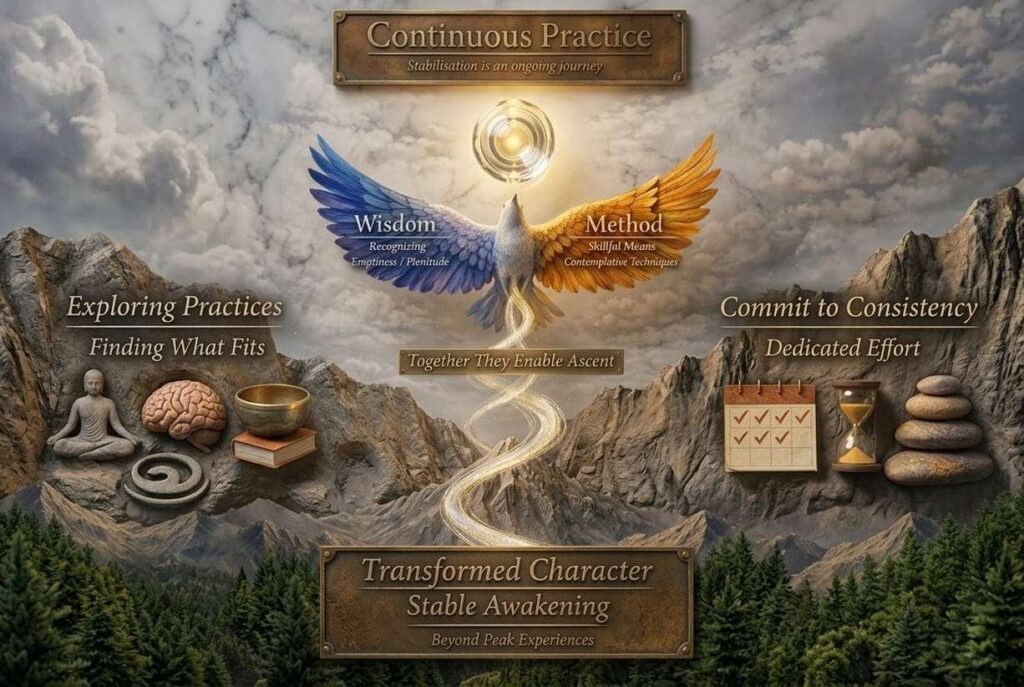
Stabilisation is not achieved once but practised continuously, like keeping a fire alive through judicious tending rather than constant conflagration. The traditional metaphor holds: consciousness is like a bird requiring two wings–wisdom (recognition of emptiness/Plenitude) and method (skillful means/contemplative technique). Either wing alone leads to circular flight; together they enable ascent.
Contemporary seekers have access to unprecedented range of contemplative technologies. The task involves discerning which methods suit individual constitution and developmental stage, committing to consistent practice, and maintaining the ultimate goal: not merely altered states but transformed character, not peak experiences but stable awakening. The archons, one suspects, find stable practitioners far more troublesome than merely excited ones.
A practical protocol might include: morning breath practice (twenty minutes), midday somatic anchoring (five minutes of embodied awareness), evening concentration or open awareness (thirty minutes), and weekly ethical review (examining speech and action for consistency with recognition). Sleep practices–maintaining awareness at the hypnagogic threshold–can be added once the waking foundation is secure. The key is regularity rather than intensity: twenty minutes daily for a year transforms more than weekend marathons followed by abandonment.
Frequently Asked Questions
How long does it take to stabilise a mystical experience?
Stabilisation is not a fixed destination but a gradual process. Traditional texts suggest months or years of consistent practice to integrate peak experiences into continuous awareness. The timeline varies by individual constitution, practice intensity, and existing psychological integration. Expect incremental progress rather than overnight transformation.
What causes mystical experiences to fade?
Experiences fade due to physiological habituation, psychological reintegration with ordinary identity, and the archons’ remarkably efficient counterfeit spirit–forces that mimic spirituality while leading back to forgetfulness. Without stabilisation practices, the nervous system returns to baseline, and the memory becomes merely nostalgic.
Can breathwork alone stabilise gnosis?
While pneuma (breath/spirit) practices form the essential foundation, most practitioners require additional methods–concentration, open awareness, ethical discipline, and embodiment practices–to fully stabilise awakened states. Breathwork regulates the physiological substrate; other techniques address cognitive and energetic dimensions.
What is the difference between concentration and open awareness meditation?
Concentration (samatha) fixes attention on a single object, developing stability and one-pointedness. Open awareness (vipassana or Gnostic resting) maintains recognition without fixed focus, allowing all phenomena to arise and dissolve without distraction. Both are necessary: concentration provides the vessel; open awareness receives the wine.
How do I know if I am making progress in stabilisation?
Signs include decreased reactivity to emotional triggers, capacity to maintain perspective during difficulty, reduced dependency on external spiritual stimulation, integration of insights into ethical behaviour, and the ability to function skillfully in ordinary life while maintaining subtle awareness. If you remain insufferable at dinner parties, further stabilisation may be required.
Are sleep practices necessary for stabilisation?
Sleep practices–maintaining awareness during hypnagogic states and lucid dreaming–are advanced methods that indicate, rather than create, stabilisation. They ensure continuity of consciousness across the dissolution of ordinary self that occurs in sleep. While beneficial, they are not mandatory for initial stabilisation work.
What role does ethics play in stabilising mystical experiences?
Ethical discipline (sila) creates the psychological transparency necessary for sustained contemplative states. Unethical action generates turbulence, guilt, and fragmentation that destabilise awareness. As the Sentences of Sextus note, the mind of a pious person is a holy temple of God–a temple that requires purification before it can host the divine.
Further Reading
Explore the pathways of practice, the technologies of stabilisation, and the infrastructure of integration:
- Creating Personal Practice: Combining the Five Gateways — How to integrate breath, movement, sensation, and vision into a coherent daily discipline.
- Gateway of Breath: Pranayama Techniques — Breath as the bridge between bodily discipline and subtle perception.
- Gateway of Movement: Walking Meditation and Circulation — Embodied movement as stabilisation technology.
- Lucid Dreaming Practice: The Platform of Milam — Sleep-state awareness and the liminal Gospel of night practice.
- The Witness Function in Contemplative Traditions — The architecture of observation across cultures and its ultimate transcendence.
- Embodiment Practices for Grounding Awakening — Somatic methods for terrestrial anchoring after peak experience.
- Breathwork: Ancient Technology, Modern Application — The pneumatic foundation from Gnostic sources to contemporary practice.
- Gateway of Sound: Mantra and Nada Yoga — Sonic technologies for concentration and stabilisation.
- Asceticism and Discipline: The Technology of Transformation — The infrastructure of sustained practice and the fruits of restraint.
- Integration and Grounding After Awakening — Post-experience stabilisation and the return to ordinary life.
References and Sources
This article draws upon primary Gnostic sources, contemplative traditions, and comparative religious studies. Sources are grouped by category for clarity.
Primary Sources and Critical Editions
- The Nag Hammadi Library in English. (1988). J. M. Robinson (Ed.). Harper & Row. — Standard critical edition containing the Apocryphon of John, Gospel of Thomas, Teachings of Silvanus, and the Sentences of Sextus.
- Layton, B. (1989). Nag Hammadi Codex II, 2-7, Volume I. Brill. — Critical edition with detailed commentary on the Gospel of Thomas.
- Meyer, M. (2007). The Nag Hammadi Scriptures: The International Edition. HarperOne. — Comprehensive translations with introductions to Gnostic and related texts.
- Turner, J.D. (2001). Sethian Gnosticism and the Platonic Tradition. Presses Universitaires de Louvain. — Scholarly analysis of Zostrianos and ascent literature.
Contemplative and Comparative Studies
- Wilson, W.T. (2012). The Sentences of Sextus. SBL Press. — Critical edition with commentary on the Pythagorean-Christian ethical sayings.
- Chadwick, H. (1959). The Sentences of Sextus: A Contribution to the History of Early Christian Ethics. Cambridge University Press. — Historical analysis of Sextus and its influence on early Christian asceticism.
- Wallace, B.A. (2006). The Attention Revolution: Unlocking the Power of the Focused Mind. Wisdom Publications. — Contemporary framework for concentration stages and stabilisation.
- LaBerge, S. & Rheingold, H. (1990). Exploring the World of Lucid Dreaming. Ballantine. — Scientific and practical approach to sleep-state awareness.
Psychology and Neuroscience
- Goleman, D. & Davidson, R.J. (2017). Altered Traits: Science Reveals How Meditation Changes Your Mind, Brain, and Body. Avery. — Research on transforming state experiences into stable traits.
- Van der Kolk, B. (2014). The Body Keeps the Score: Brain, Mind, and Body in the Healing of Trauma. Viking. — Somatic grounding and the neurobiology of embodiment.