Plato’s Republic in the Nag Hammadi Library: The Beast Within
The Republic of Plato (NHC VI,5) stands as a peculiar bureaucratic anomaly within the Nag Hammadi archives—the sole pagan philosopher permitted entry to this otherwise sectarian collection. Nestled between Hermetic ascent discourses and Gnostic cosmologies, this excerpt from Book IX (588B-589B) presents the famous allegory of the tripartite soul: a multi-headed beast, a lion, and a man locked in perpetual administrative struggle. That Plato alone achieved visa status among the Christian, Sethian, and Valentinian documents reveals the sophisticated paideia of Gnostic intellectuals—men and women who received standard philosophical training whilst pursuing distinctly religious liberations from the archontic filing system.
Table of Contents
The Pagan Philosopher’s Visa Status
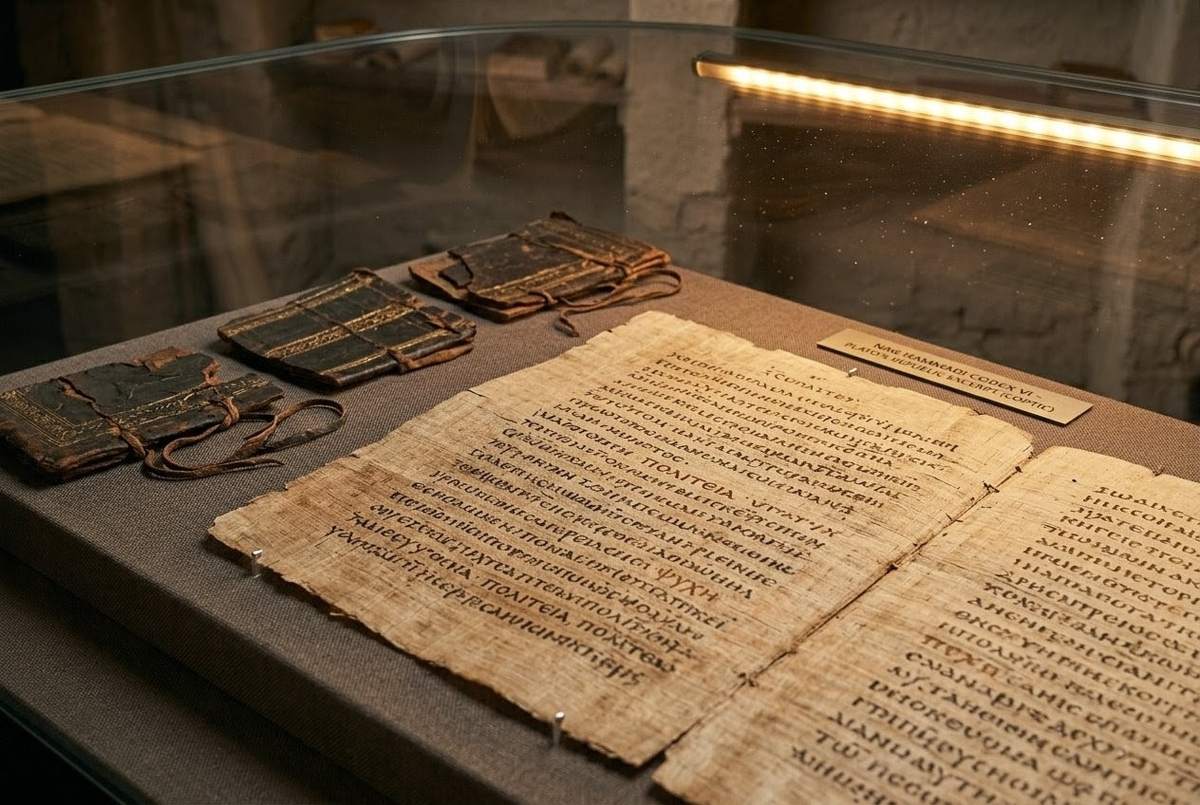
Amidst the Christian, Sethian, and Hermetic texts of the Nag Hammadi library stands a remarkable anomaly: an excerpt from Plato’s Republic (588B-589B). This short passage—the famous image of the tripartite soul as a composite beast—appears in Codex VI alongside Hermetic and Gnostic treatises, raising profound questions about the intellectual world of the library’s compilers. Why would a collection of esoteric Christian texts include the pagan philosopher par excellence?
What is Paideia?
Paideia (Greek: παιδεία) refers to the educational formation and cultural cultivation of the elite in ancient Mediterranean societies. More than mere schooling, paideia encompassed the entire process of intellectual and ethical maturation through engagement with classical literature, philosophy, and rhetoric. For Gnostic teachers, paideia meant training in Platonic dialogues, Stoic ethics, and Aristotelian logic—intellectual capital they subsequently redeployed in the service of distinctly religious soteriologies.
The answer illuminates the educational background (paideia) of Gnostic intellectuals, revealing their participation in broader philosophical culture whilst maintaining distinctively religious commitments. Plato’s presence in the library testifies to the ongoing dialogue between Greek philosophy and Gnostic theology—a dialogue that shaped both traditions. Rather than treating Plato as an enemy or rival, the compilers viewed him as a precursor whose psychological models provided administrative infrastructure for understanding the soul’s stratified departments.
The Tripartite Beast: Republic 588B-589B
The excerpt presents Plato’s allegory of the soul’s three parts with graphic precision that must have resonated viscerally with ancient readers. Socrates asks Glaucon to imagine a composite creature: a multi-headed beast (representing the appetites), a lion (representing the spirited element), and a man (representing reason). When reason rules with administrative competence, the entire creature enjoys harmonious governance; when the beast dominates through chaotic passion, the soul descends into misery and bureaucratic disorder.
The Three Departments of the Soul
This tripartite psychology—reason (logistikon), spirit (thymoeides), and appetite (epithymetikon)—formed the foundation of Platonic ethics across the ancient Mediterranean. The philosopher’s task was to cultivate reason’s dominance, transforming the soul from a disorderly mob into an ordered polity. The image proved memorable, pedagogically effective, and widely cited in ancient ethical instruction from Alexandria to Athens.
Linguistic Variations and Attribution
In the Nag Hammadi version, the text appears with minor linguistic variations reflecting Coptic translation choices, yet maintains substantially identical content to the Greek original. It is preceded by a short title identifying the source: “From Plato’s Republic.” This attribution suggests that the compilers valued the philosophical authority of the text whilst recognising its distinct provenance—a diplomatic acknowledgement that this particular resident hailed from foreign jurisdiction.
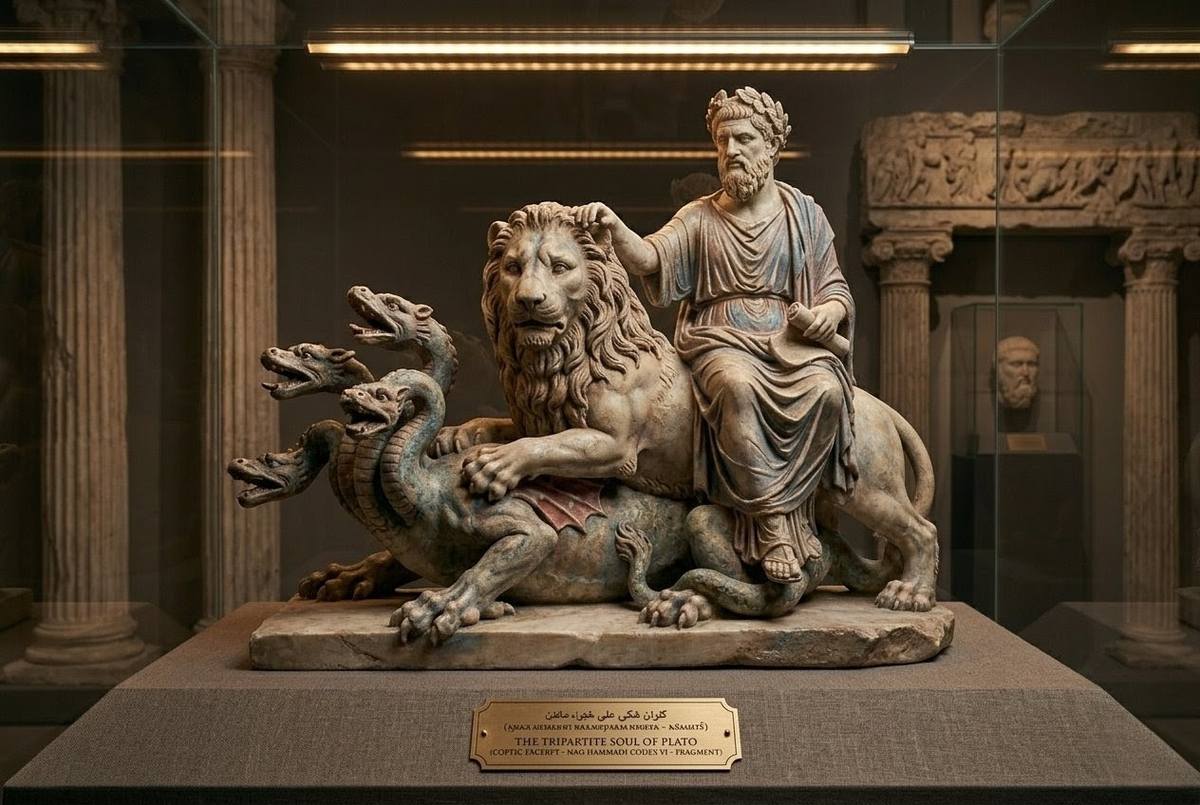
Primary Source Citations: Plato’s Republic 588B-589B appears in Nag Hammadi Codex VI,5 (pp. 48-51). The Coptic translation preserves the tripartite schema of logistikon (reason), thymoeides (spirit), and epithymetikon (appetite), adapting Greek philosophical terminology into Coptic monastic vocabulary. The excerpt appears alongside the Discourse on the Eighth and the Ninth and the Perfect Discourse (Asclepius), suggesting a collector interested in Platonic-Hermetic synthesis.
Paideia and Gnosis: The Educational Formation
The inclusion of Plato reflects the standard educational formation of Gnostic teachers. Men and women who composed and copied these texts had received the conventional paideia of late antiquity—reading Platonic dialogues, memorising key passages, and applying psychological models to ethical problems. Plato was not an enemy but a foundation; not a rival but a precursor whose administrative theories required only minor departmental reorganisation to serve Gnostic soteriology.
Motivations for Selection
Several factors motivated the specific selection of the tripartite soul passage for inclusion in this esoteric collection:
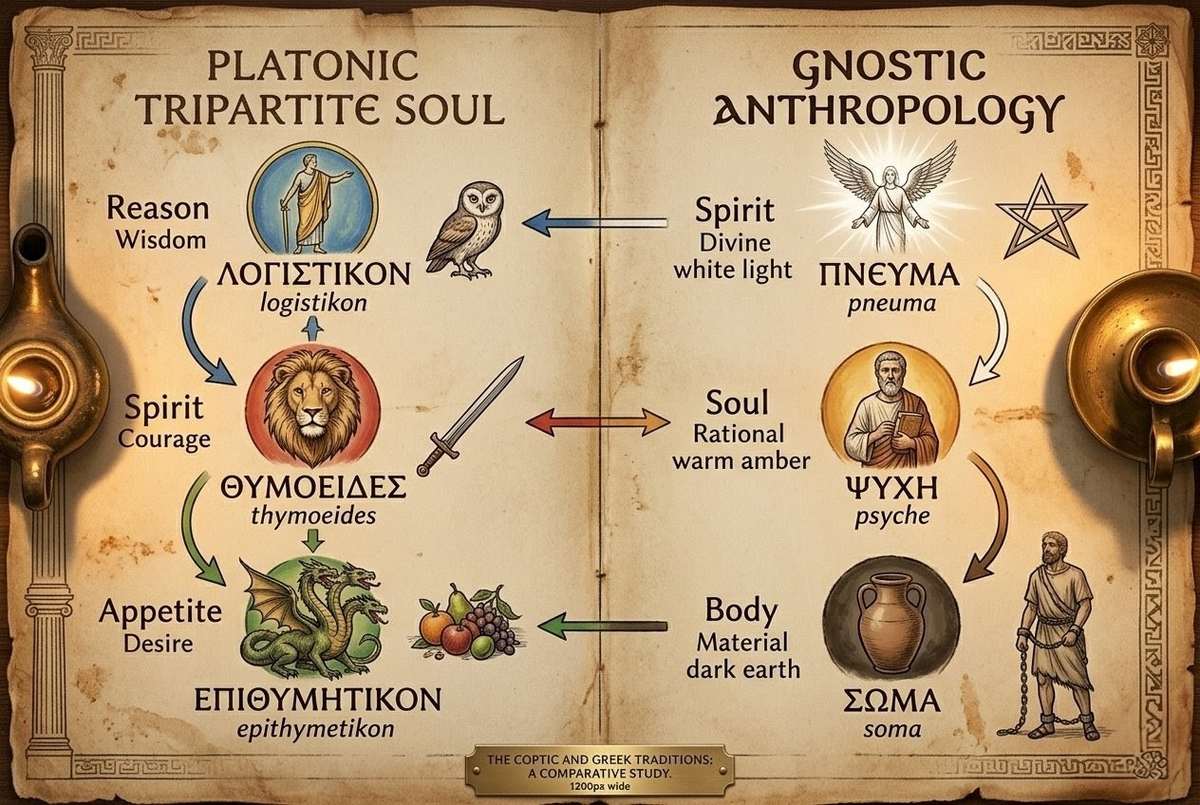
- Anthropological compatibility: The three-part soul resonated structurally with Gnostic divisions between spirit, soul, and flesh, or between pneumatic, psychic, and material natures. The isomorphism suggested Plato had unwittingly glimpsed the Gnostic truth beneath philosophical form.
- Ethical utility: The image provided a powerful pedagogical tool for explaining the struggle against passion and the cultivation of gnosis. Visualising the internal conflict as a beast, a lion, and a bureaucrat proved more effective than abstract theological discourse.
- Prestige association: Citing Plato lent philosophical authority to Gnostic teachings, positioning them within the mainstream of ancient wisdom rather than peripheral eccentricity. If the Republic supported your anthropology, you were conducting serious business.
- Hermetic connections: Codex VI contains multiple Hermetic texts; Hermeticism already appropriated Platonic psychology, making the Republic excerpt a natural companion for those traversing the philosophical-religious interface.

From Platonic Psychology to Gnostic Anthropology
Yet the Republic excerpt does not appear in a philosophical vacuum. Its placement in Codex VI—between Hermetic discourses on knowledge and Gnostic treatises on salvation—suggests that ancient readers interpreted it through distinctly Gnostic lenses. The “beast within” became not merely the appetites but the archontic powers themselves; the “man” representing reason became the spiritual intellect (nous) seeking unauthorised return to the divine Pleroma.
Structural Isomorphisms
Specifically, the tripartite model illuminates Gnostic anthropology with striking clarity. Just as Plato distinguished between the rational soul, the spirited soul, and the bodily appetites, so Gnostics distinguished between the divine spark (pneuma), the animating soul (psychē), and the material body (sōma). The Republic provided philosophical vocabulary and bureaucratic structure for describing this stratified human nature without requiring invention of entirely new administrative categories.
Philosophical Therapy as Spiritual Direction
Moreover, the ethical imperative—to restrain the beast and strengthen the rational element—parallels Gnostic asceticism with remarkable fidelity. The journey from ignorance to gnosis requires disciplining the lower nature, not through hatred of the body (which would constitute poor resource management) but through cultivation of spiritual perception. Plato’s philosophical therapy becomes Gnostic spiritual direction; the cave allegory upgrades to the ascent past planetary spheres. The human department must be reorganised under new management: the nous reports directly to the Pleroma, bypassing archontic middle-management.
The Translation of Terms
The Coptic translation of the Republic excerpt reveals subtle semantic shifts that Gnosticise the text. Where Plato spoke of the soul’s health, the Coptic emphasises salvation; where Greek discussed civic harmony, the Coptic text hints at cosmic restoration. These are not mistranslations but deliberate reinterpretations—administrative procedures updated for a new organisational structure. The soul’s tripartition becomes a map of the human condition under archontic occupation, with the rational element identified as the divine spark temporarily exiled in hostile territory.
The Hermetic Context of Codex VI
Codex VI presents a distinctive profile among the Nag Hammadi collection—less sectarian than Sethian codices, more philosophical than Valentinian collections. Unlike the mythological treatises dominating other volumes, Codex VI contains a curated library of Hermetic and Platonic materials designed for readers navigating the interface between Greek philosophy and Egyptian revelation.
The Codex VI Assemblage
This codex specifically contains:
- The Discourse on the Eighth and the Ninth (NHC VI,6)—Hermetic dialogue on celestial ascent
- The Prayer of Thanksgiving (NHC VI,7)—Hermetic liturgical text
- Scribal notes on the powers of the universe
- The Republic excerpt (NHC VI,5)—the Platonic psychological foundation
- The Perfect Discourse (Asclepius) (NHC VI,8)—extensive Hermetic treatise on cosmic theology
A Philosophical-Religious Synthesis
This assemblage suggests a collector interested in the interface between philosophy and revelation, between pagan wisdom and Hermetic illumination. The Republic excerpt fits this profile perfectly: a philosophical text that, properly interpreted, supports the religious quest for transformation. It provides the psychological prolegomenon to Hermetic ascent—one must understand the soul’s three departments before attempting to navigate the seven planetary spheres or achieve the Eighth and Ninth.
“Plato’s Republic 588B-589B appears in Nag Hammadi Codex VI as the only pagan philosophical text in the library. The excerpt presents the tripartite soul allegory—a multi-headed beast, a lion, and a man—which Gnostic readers interpreted through their own anthropological framework. This inclusion reveals the sophisticated paideia of Gnostic teachers who received standard Platonic education before pursuing esoteric liberation, viewing Plato not as rival but as precursor whose psychology supported Gnostic soteriology.”
Frequently Asked Questions
What is Plato’s Republic doing in the Nag Hammadi Library?
Plato’s Republic appears in Nag Hammadi Codex VI as the only pagan philosophical text in the collection. The excerpt from Book IX (588B-589B) presents the tripartite soul allegory, which resonated with Gnostic anthropology. Its inclusion reveals that Gnostic teachers received standard philosophical education (paideia) and viewed Plato as a precursor whose psychological models supported their soteriological goals.
Which passage of Plato appears in Nag Hammadi Codex VI?
The excerpt from Plato’s Republic Book IX sections 588B-589B appears in Nag Hammadi Codex VI,5. This passage contains the famous allegory of the tripartite soul as a composite creature: a multi-headed beast representing appetite, a lion representing spirit, and a human representing reason. The Coptic translation preserves the Greek philosophical content with minor linguistic adaptations.
What is the tripartite soul theory in Plato’s Republic?
Plato’s tripartite soul theory divides the human soul into three distinct parts: the rational element (logistikon) represented by a human, the spirited element (thymoeides) represented by a lion, and the appetitive element (epithymetikon) represented by a multi-headed beast. Health requires the rational element to govern the others; disorder results when the appetitive beast dominates. This psychological model formed the foundation of Platonic ethics.
How did Gnostics interpret Plato’s tripartite soul?
Gnostic readers interpreted Plato’s tripartite soul through their own anthropological framework, mapping reason to the divine spark (pneuma), spirit to the animating soul (psyche), and the beast to the material body (soma) subject to archontic powers. The allegory provided philosophical vocabulary for describing the struggle between spiritual and material natures, supporting Gnostic ethical instruction for achieving liberation.
What is the paideia of Gnostic teachers?
Paideia refers to the standard educational formation of elite individuals in ancient Mediterranean culture, including training in Platonic dialogues, rhetoric, and ethics. Gnostic teachers possessed this philosophical background before pursuing esoteric religious knowledge. Their inclusion of Plato in the Nag Hammadi Library demonstrates that they viewed Greek philosophy not as rival but as foundation–administrative infrastructure requiring only departmental reorganisation to serve Gnostic soteriology.
What other texts appear in Nag Hammadi Codex VI?
Codex VI contains primarily Hermetic materials alongside the Platonic excerpt: the Discourse on the Eighth and the Ninth (celestial ascent dialogue), the Prayer of Thanksgiving (liturgical text), scribal notes on cosmic powers, and the Perfect Discourse (Asclepius) on Hermetic theology. This assemblage suggests a collector interested in the philosophical-religious interface between Platonic psychology and Hermetic revelation.
Why is the Republic excerpt significant for understanding Gnosticism?
The Republic excerpt is significant because it reveals the sophisticated intellectual formation of Gnostic communities and their dialogue with Greek philosophy. It demonstrates that Gnosticism emerged not from ignorance of classical culture but from deep engagement with it–appropriating Plato’s psychology to describe the struggle between divine spark and material embodiment. This challenges stereotypes of Gnostics as anti-intellectual or purely dissident, showing instead their participation in broader ancient philosophical culture.
Further Reading
To explore the philosophical contexts and related texts:
- The Discourse on the Eighth and the Ninth: Hermetic Ascent and Platonic Cosmology — Explore the Hermetic ascent text from the same codex as the Republic excerpt.
- Marsanes: Platonizing Sethian Metaphysics — Discover how Sethianism appropriated Platonic concepts for its own theological architecture.
- Codex VI: The Hermetic Compendium — Learn about the manuscript context containing the Republic excerpt alongside Hermetic discourses.
- Hermetic Connections in the Nag Hammadi Library — Study the relationship between Hermeticism and Gnosticism that made room for Platonic philosophy.
- The Axial Age: When Wisdom Emerged Simultaneously — Contextualise Platonic philosophy within broader ancient wisdom traditions and cross-cultural patterns.
- Hermetic Spirituality: The Egyptian-Greek Synthesis — Examine the philosophical-religious synthesis that characterised the milieu of Codex VI.
- The Nag Hammadi Library: A Complete Guide to the Gnostic Scriptures — Navigate the full collection including the unique philosophical profile of Codex VI.
- Gnostic Technical Glossary: Key Terms Explained — Understand the anthropological terminology (pneuma, psyche, nous) that connects Platonic and Gnostic thought.
- Codex II: The Crown Jewels of the Library — Compare the philosophical-Hermetic focus of Codex VI with the Sethian-Valentinian dominance of other volumes.
- Sethian and Valentinian Traditions in the Nag Hammadi Library — Understand how Codex VI’s philosophical approach differs from the sectarian theology of other codices.