The Scribal Colophons: The Human Hands Behind the Library
The Scribal Colophons of the Nag Hammadi Library represent the ultimate bureaucratic irony: after navigating the celestial administrations of archons, aeons, and angelic checkpoint officials through thirteen codices of esoteric theology, the modern reader encounters the only signatures that actually matter—those of the copyists who produced the physical books. Preserved at the conclusion of Codices VI and VII, these brief marginal notes—”I have written this, Greetings” and “Pray for me, the sinner”—constitute the sole direct evidence of the human agents who processed the library’s paperwork. They are not merely archaeological curiosities but crucial documentary evidence for dating the collection, understanding its social jurisdiction, and reconstructing the communities that maintained these textual operations. In the Nag Hammadi bureaucracy, the scribes remain the only officials we can identify by name—except, of course, that they remain stubbornly anonymous.
What are Scribal Colophons?
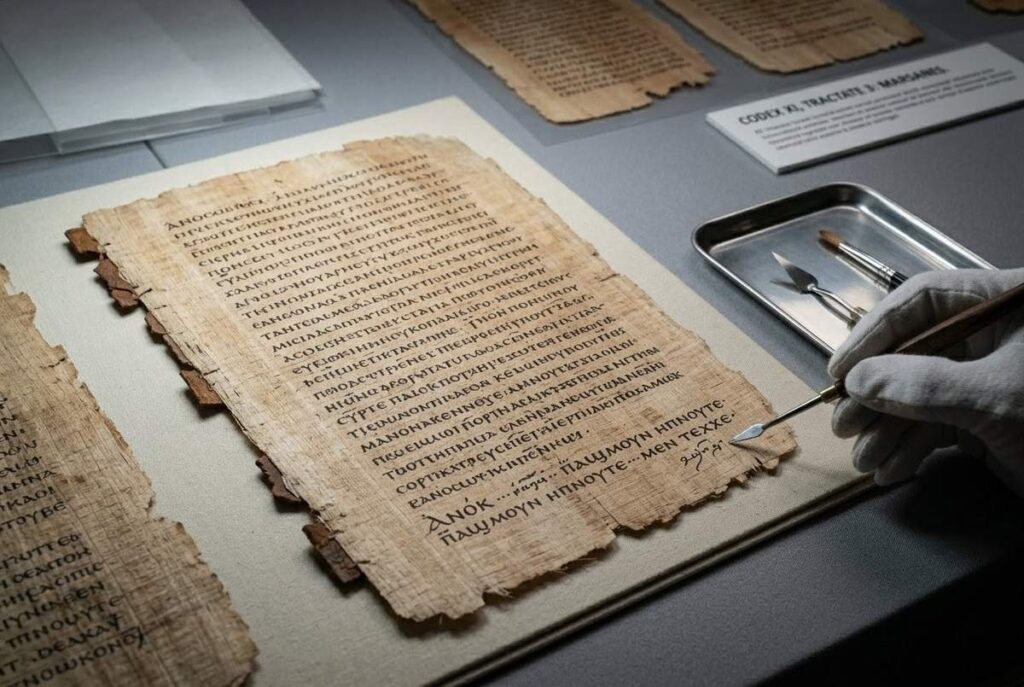
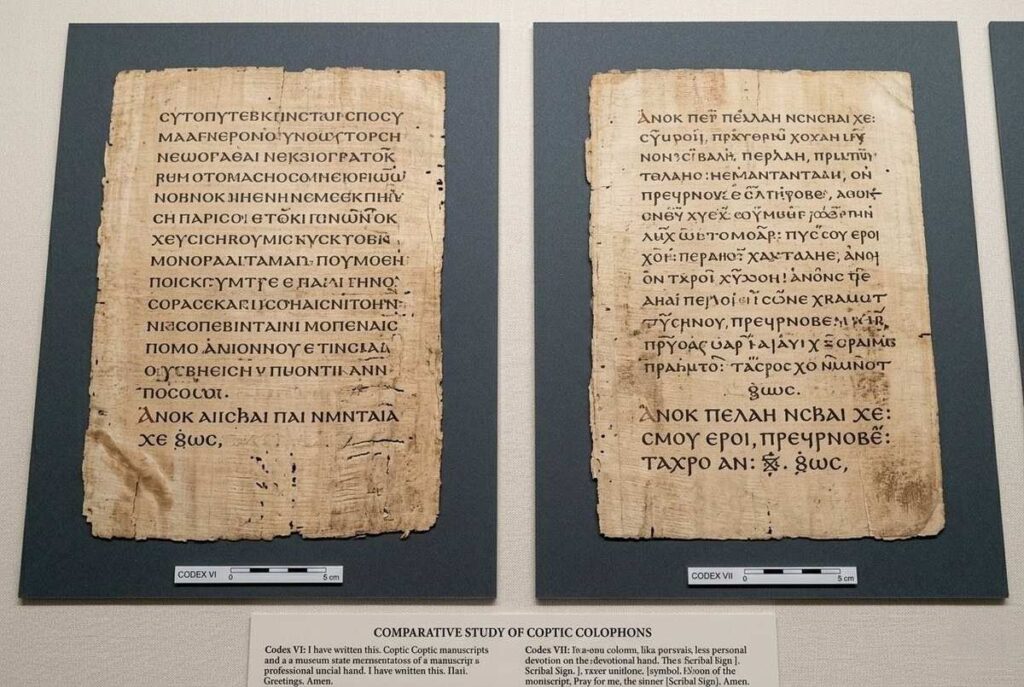
Scribal colophons are brief notes appended to ancient manuscripts by the copyists who produced them, typically containing information about the scribe, the date of copying, the location of production, or petitions for prayers. In the context of the Nag Hammadi Library, colophons appear at the end of Codex VI (“I have written this, Greetings”) and Codex VII (“Pray for me, the sinner who wrote this book”). These formulae provide the only direct documentary evidence of the individuals who physically created the collection. Unlike the anonymous or pseudonymous authorship of the tractates themselves, the colophons represent the actual voices of the 4th-century CE copyists—likely Egyptian monks or professional scribes working in the region of Nag Hammadi. Written in Coptic (Lycopolitan or related sub-dialects) circa 350-400 CE, these notes offer crucial data for palaeographic dating, provenance determination, and understanding the social context of ancient text production. They transform the library from an abstract collection of ideas into material objects produced by specific human labour.
Primary Source Citations: Nag Hammadi Codex VI, colophon following the Asclepius; Nag Hammadi Codex VII, colophon following the Paraphrase of Shem. The Codex VI colophon reads (in Coptic): “I have written this, Greetings” (Coptic: ⲁⲓⲥⲙ̄ ⲙ̄ⲡⲁⲓ̈ ⲭⲁⲓⲣⲉ). The Codex VII colophon reads: “Pray for me, the sinner who wrote this book” (Coptic: ⲡⲣⲟⲥⲉⲩⲝⲁⲥⲑⲉ ⲡⲉⲣⲓ ⲧⲏⲥ ⲁⲙⲁⲣⲧⲓⲁⲥ ⲡⲁ ⲡⲣⲟⲥ ⲡⲉⲧⲥϩⲁⲓ̈ ⲙ̄ⲡϣⲁϫⲉ ⲛ̄ⲧⲉ ⲡⲉⲓ̈ϫⲱⲱⲙⲉ). Palaeographic analysis by James M. Robinson et al. (1975-1995).
The Voice from the Margin
After traversing the profound theological speculations, visionary ascents, and secret teachings of the Nag Hammadi tractates—navigating the complex jurisdictions of archontic toll-collectors and aeonic border controls—the modern reader encounters something jarringly, refreshingly human: the scribal colophons. These are not the voices of mythological revealers or divine emanations, but the signatures of the copyists who produced these ancient books through manual labour.
Preserved at the end of Codices VI and VII, these brief notes provide the only direct evidence of the individuals who created the library. The handwriting, the formulae used, and the placement of the notes reveal the professional practices of ancient scribes and the religious culture of fourth-century Egypt. They remind us that every esoteric system, no matter how transcendent its aspirations, requires material instantiation—someone must process the paperwork, file the papyrus, and stamp the final seal of completion.
From Divine Emanations to Human Hands
The colophons serve as a crucial corrective to the theological sublime of the preceding texts. While the Apocryphon of John describes the complex emanation of the divine Pleroma, and Zostrianos maps the ascent through thirteen aeons, the colophons bring us back to earth—to the sweaty, ink-stained reality of scribal production in Upper Egypt. They represent the final administrative checkpoint in the production chain: the moment when the copyist certifies that the document is complete and ready for filing in the cosmic archive.

The Colophon of Codex VI
At the conclusion of Codex VI—containing the Discourse on the Eighth and Ninth, the Prayer of Thanksgiving, and the Asclepius—a scribal note reads (in translation): “I have written this, Greetings.” This laconic statement, written in the same hand as the preceding texts, identifies the copyist’s role without naming the individual.
The Formula of Professional Detachment
The formula suggests monastic or semi-monastic scribal practice. The “Greetings” (chairein) repurposes the standard epistolary opening as a farewell—a bureaucratic convention indicating completion of service. The self-identification as “I have written” rather than “I have composed” indicates that the scribe understood himself strictly as a copyist rather than an author—a transmitter of tradition rather than an innovator, a filing clerk rather than a policy-maker.
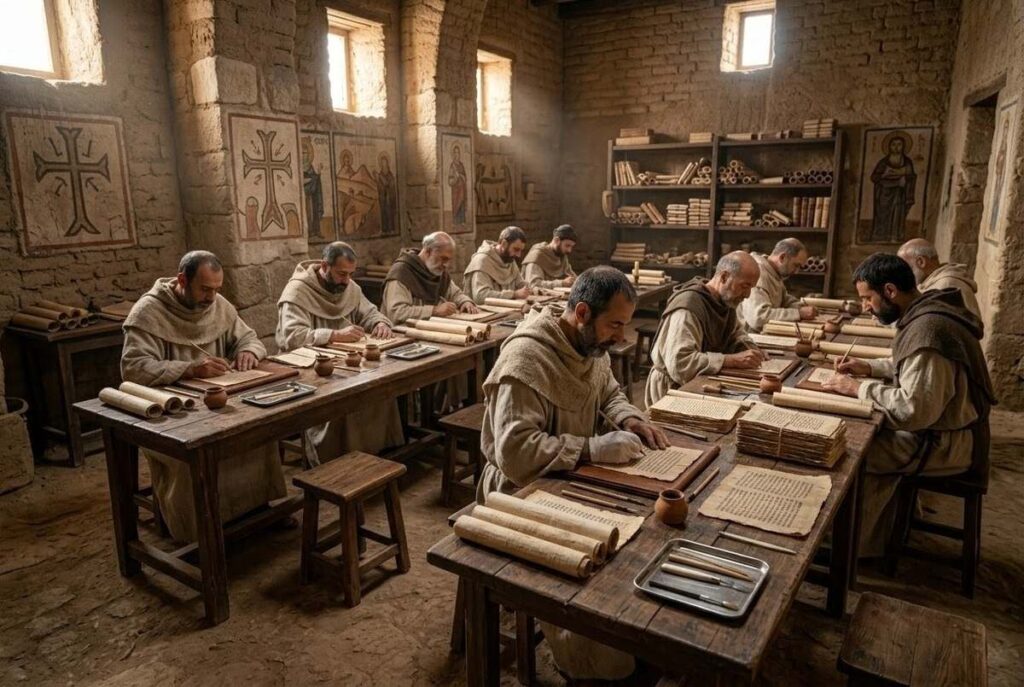
Codicological analysis suggests this scribe was professional or semi-professional. The handwriting is practised, the layout consistent, and the correction of errors minimal (suggesting either confidence or haste). The scribe worked from an exemplar, carefully following its line breaks and pagination in some sections while taking administrative liberties in others. This was competent bureaucratic labour—efficient, unpretentious, and thoroughly processed.
The Colophons of Codex VII
Codex VII preserves more extensive scribal material at the conclusion of the Paraphrase of Shem. Here the scribe writes: “Pray for me, the sinner who wrote this book.” This explicitly Christian formulation reveals the religious identity of the copyist—he was not merely a professional scribe but a believer who understood his work as spiritual service.
Spiritual Labour and Communal Prayer
The request for prayer suggests that the scribe expected the book to be used in a community context, where readers would remember the anonymous copyist in their devotions. This transforms the act of copying from mechanical reproduction to ascesis—spiritual labour meriting intercession. The scribe is not just processing documents; he is performing a religious duty that requires ongoing communal support.
The designation of himself as “the sinner” (hamartolos) reflects Christian humility formulae common in monastic literature. It may indicate that the scribe was a monk or ascetic, or at least someone familiar with monastic scribal conventions. This supports theories that the Nag Hammadi library was produced in or near a Pachomian or similar monastic context—within the bureaucratic structure of organised Egyptian Christianity.
“Pray for me, the sinner who wrote this book.”
— Scribal Colophon, Nag Hammadi Codex VII
Dating and Provenance Evidence
The colophons contribute crucial evidence to scholarly debates about when and where the library was produced. Palaeographic analysis of the handwriting suggests a date range of 350-400 CE for most of the codices—consistent with the period of intense Christian text production in Upper Egypt during the late Pachomian era.
Local Production, Regional Dialects
The Coptic dialect used in the colophons (Lycopolitan or related sub-dialects) points to the region around Nag Hammadi itself. The scribes were likely locals, working in a regional scriptorium or monastic house, rather than imported professionals from Alexandria. This has implications for understanding the library’s function: these were not luxury editions commissioned by wealthy patrons for private libraries, but practical working copies produced relatively quickly for local use—utilitarian paperwork for immediate administrative needs.
The provincial nature of the production explains certain irregularities in the collection: varying quality of papyrus, inconsistent pagination, and the inclusion of fragmentary or damaged exemplars. The library represents a local filing system—a regional archive processing whatever texts were available rather than a carefully curated canonical collection.
The Scribes’ Religious Identity
A persistent question in Nag Hammadi studies concerns the religious affiliation of the scribes. Were they Gnostics copying their own scriptures? Orthodox Christians preserving heterodox texts for refutation? Monks unaware of the theological distinctiveness of their exemplars? The colophons provide tantalising but ultimately ambiguous evidence.
Devout but Unspecified
The colophons suggest devout Christians, but their precise theological orientation remains unclear. The Codex VII prayer formula could be Orthodox, Valentinian, or Sethian—all used similar language of sin and intercession in this period. The lack of polemical marginalia (corrections, condemnations, or refutations) suggests either sympathy with the texts’ contents or professional detachment—the scribe simply processing documents without editorial interference.
The presence of diverse theological materials in the library complicates identification. The scribes may have understood “Gnostic” and “Orthodox” categories differently than modern scholars, or they may have been copying whatever texts were available for a diverse reading community. They could have been Pachomian monks storing a heretical collection for safekeeping, Sethian practitioners preserving their own scriptures, or simply professional scribes fulfilling commissions without theological vetting.
The Bureaucracy of Heterodoxy
What the colophons suggest is that the production of religious texts in fourth-century Egypt operated through practical administrative channels that transcended strict doctrinal boundaries. A scribe could copy the Apocryphon of John in the morning and a canonical gospel in the afternoon, using the same formulae and professional standards for both. The paperwork of heterodoxy looked remarkably like the paperwork of orthodoxy—same hands, same ink, same bureaucratic procedures.
What the Colophons Cannot Tell Us
For all their documentary value, the colophons leave crucial questions unanswered. We do not know:
- The scribes’ names—they remain stubbornly anonymous, identified only by handwriting and formulae
- The exact location of production—beyond general Upper Egypt and the Lycopolitan dialect region
- Whether the scribes understood the theological distinctiveness of the texts they were copying
- The relationship between different scribal hands across the codices—were they the same individuals or a scriptorium of multiple workers?
- Why the library was buried—and thus preserved—leading to its rediscovery in 1945
These silences remind us that the Nag Hammadi library remains, in many ways, an enigma. The colophons provide glimpses of the human agents behind the texts—hands holding pens, voices requesting prayers—but those agents remain shadowy figures, names lost to history, known only by their bureaucratic traces.
The Scribal Colophons ultimately teach us that even the most transcendent spiritual systems require material instantiation—someone must process the paperwork, copy the texts, and file the final documents. These brief marginal notes, requesting prayers and marking completion, transform the Nag Hammadi Library from an abstract collection of Gnostic theology into a tangible archive produced by specific human labour in fourth-century Egypt. The scribes—anonymous, devout, professional—remain the only officials we can identify in this celestial bureaucracy, reminding us that behind every archontic jurisdiction and aeonic checkpoint lies the humble work of human hands: writing, copying, and asking only that we remember them in our prayers.
Frequently Asked Questions
What are the scribal colophons in the Nag Hammadi Library?
The scribal colophons are brief notes appended by copyists at the end of Codex VI (‘I have written this, Greetings’) and Codex VII (‘Pray for me, the sinner who wrote this book’). They provide the only direct evidence of the human scribes who produced the library circa 350-400 CE, offering crucial information for dating the manuscripts and understanding their social context.
What do the Nag Hammadi colophons reveal about the scribes?
The colophons reveal that the scribes were likely Egyptian Christians (possibly monks) working in the Nag Hammadi region during the 4th century CE. The Codex VII scribe identifies himself as a ‘sinner’ requesting prayers, suggesting monastic or devout Christian context. Both scribes appear professional or semi-professional, with practised handwriting and consistent layout, indicating experience in manuscript production.
Were the Nag Hammadi scribes Gnostics or Orthodox Christians?
The scribes’ precise religious identity remains unclear. The colophons use Christian formulae common to both orthodox and heterodox communities of the period. They could have been Pachomian monks, Sethian practitioners, or professional scribes without strong theological investment. The lack of polemical marginalia suggests either sympathy with the texts’ contents or professional detachment from doctrinal concerns.
When were the Nag Hammadi codices written?
Palaeographic analysis of the colophons and manuscript hands suggests a date range of approximately 350-400 CE for most of the codices. This places the production in the late Pachomian period of Egyptian monasticism, during a time of intense Christian text production in Upper Egypt. The Coptic dialect used (Lycopolitan or related sub-dialects) confirms the regional provenance.
Where were the Nag Hammadi manuscripts produced?
The Coptic dialect and provenance evidence point to production in the region around Nag Hammadi itself—Upper Egypt near ancient Chenoboskion. The scribes were likely locals working in a regional scriptorium or monastic house rather than imported professionals from Alexandria. The practical, non-luxury nature of the codices suggests local production for immediate use rather than export.
What is the difference between the Codex VI and VII colophons?
The Codex VI colophon (‘I have written this, Greetings’) is brief and professionally detached, using standard epistolary formulae. The Codex VII colophon (‘Pray for me, the sinner who wrote this book’) is longer, explicitly Christian, and requests communal prayer, suggesting the scribe understood his work as spiritual labour requiring ongoing intercession. These differences may reflect different scribal personalities or institutional contexts.
Why are the scribal colophons important for scholarship?
The colophons provide the only direct evidence of the human agents who produced the library. They offer crucial data for palaeographic dating (350-400 CE), provenance determination (Upper Egypt), and understanding the social context of ancient text production. They transform the library from an abstract collection of ideas into material objects produced by specific labour, revealing the bureaucratic and religious infrastructure of 4th-century Egyptian Christianity.
Further Reading
Explore the material context, codicology, and manuscript evidence of the Nag Hammadi Library:
- The Coptic Gnostic Library: Codicology and Conservation – Study the physical manuscripts, papyrology, and modern scholarly analysis of the collection.
- Nag Hammadi Library Complete Reader’s Guide – Navigate the full corpus including the discovery circumstances and historical context of the collection.
- Timeline of Gnosticism: From Ancient Origins to Modern Discovery – Contextualise the library within the broader history of Gnostic movements and their rediscovery.
- Codex VI: The Hermetic Compendium – Study the manuscript containing the brief professional colophon and its Hermetic tractates.
- Codex VII: Sethian Technical Treatises – Explore the manuscript with the most extensive scribal note requesting prayers.
- The Paraphrase of Shem: Noetic Baptism and the Three Natures – Examine the final tractate of Codex VII, immediately preceding the scribal colophon.
- The Discourse on the Eighth and Ninth: Hermetic Ascent – Study the opening tractate of Codex VI, part of the colophon’s manuscript context.
- The Asclepius: The Perfect Discourse – Explore the final tractate preceding the Codex VI colophon, bridging Hermetic and Egyptian traditions.