Catharism and the Albigensian Crusade: A Gnostic Revival Burned
They called themselves Good Christians. Their enemies called them Cathars–from the Greek katharoi, the pure ones–and set out to burn them from history. Between the twelfth and fourteenth centuries, a dualist Christian movement flourished across the Languedoc region of southern France and into northern Italy, attracting peasants, nobles, and merchants with a message that sounded, to orthodox ears, like an ancient heresy reborn. The Cathars taught that the material world was a prison fashioned by an evil god, that the divine spark languished in flesh, and that salvation required not the sacraments of Rome but a secret baptism of the spirit administered by an ascetic elect. When Pope Innocent III launched the Albigensian Crusade in 1209, he was not merely correcting theological error; he was extinguishing a competing vision of reality that threatened the foundations of medieval power.
The question this article pursues is not whether the Cathars were right, but what they were–and how their suppression illuminates the continuity between ancient Gnosticism and medieval dissent. By comparing Cathar theology with the texts of the Nag Hammadi Library, we can map what survived across a thousand years of silence and what diverged under the pressure of new cultures, languages, and political landscapes. The Cathars were not direct descendants of the Nag Hammadi communities; they had never read the Apocryphon of John or the Tripartite Tractate. Yet the river that carved those Coptic texts also carved the Occitan rituals of Languedoc. The geography is different, but the water is the same.
Table of Contents
- The Good Christians: Who Were the Cathars?
- From Bogomils to Languedoc: The Eastern Lineage
- The Consolamentum and the Perfected Life
- The Albigensian Crusade: Kill Them All
- What Survived: Parallels with Nag Hammadi Gnosticism
- What Diverged: Where Catharism Departed from the Ancient Texts
- The Inquisition and the Erasure of Memory
- Frequently Asked Questions
- Further Reading
- References and Sources
The Good Christians: Who Were the Cathars?
The Cathars emerged in the Languedoc during the late twelfth century, though the soil had been prepared by decades of anti-clerical sentiment. The Roman Church in southern France was wealthy, worldly, and increasingly distant from the populations it claimed to shepherd. Into this vacuum came preachers who lived in poverty, travelled in pairs, and taught a Christianity stripped of the apparatus of empire. They rejected the Old Testament as the work of the evil creator. They denied that Jesus had been born of flesh, insisting instead that the Christ was a purely spiritual being who merely appeared to suffer and die–a docetism that struck at the heart of Catholic sacramental theology. They refused meat, marriage, and procreation, viewing the material body as a cell in which the divine spark had been imprisoned.
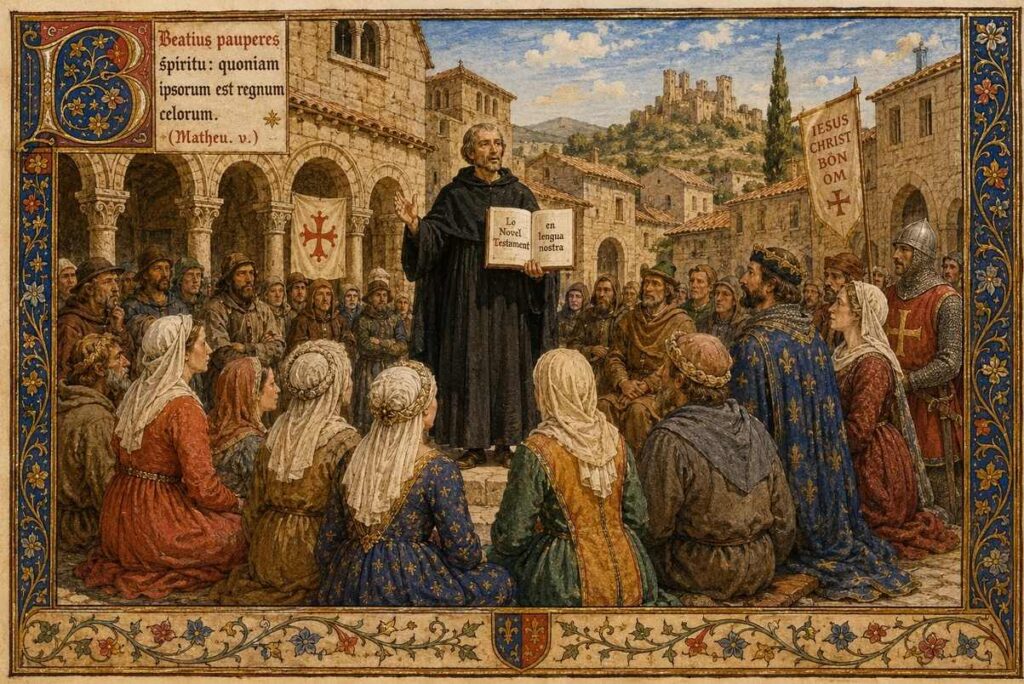
What made Catharism socially radical was not merely its theology but its sociology. Women could become perfectae, the female equivalent of the male perfecti, with full authority to preach, teach, and administer the consolamentum. In a medieval world where the Church barred women from virtually all positions of authority, this was revolutionary. The perfectae lived in community, supported by networks of credentes–ordinary believers who admired the ascetic path but did not themselves undertake it. The family structure of Catharism meant that heresy spread through kinship and patronage, woven into the fabric of Languedoc society rather than confined to marginal sects.
From Bogomils to Languedoc: The Eastern Lineage
The Cathars did not invent their theology in isolation. The scholarly consensus, established by Bernard Hamilton, Dimitri Obolensky, and others, traces Catharism to the Bogomils, a dualist movement that arose in Bulgaria during the tenth century under the influence of the Paulicians. The Bogomils rejected the material world with the same ferocity as their Western successors, and they possessed a ritual tradition–the laying on of hands, the spiritual baptism, the use of apocryphal texts like the Vision of Isaiah–that would reappear almost unchanged in Languedoc.
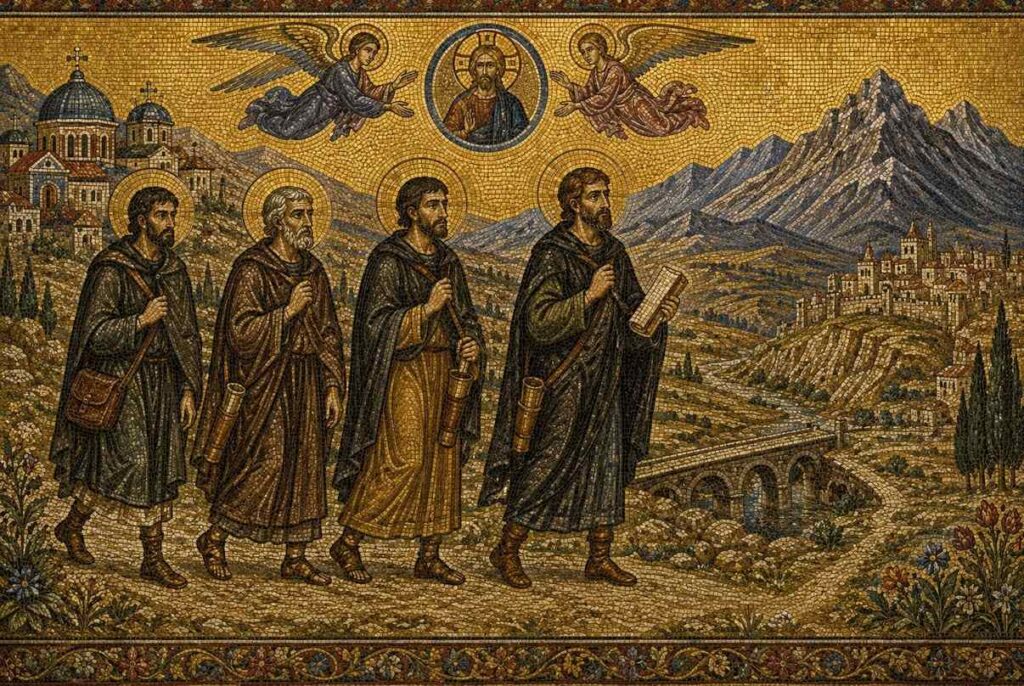
By the mid-twelfth century, Bogomil missionaries had travelled westward along the trade routes that connected Constantinople to Venice and beyond. Around 1172, the Council of Saint-Félix in Languedoc organised the Cathars into a formal church with bishops and territorial dioceses, transforming a scattered movement into an institutional rival to Rome. The document attesting to this council, long disputed, has been vindicated by modern scholarship as genuine. It reveals a church that saw itself not as a new sect but as the true Church of Christ, preserving the apostolic tradition that Rome had corrupted. The Bogomil connection is crucial because it explains why the Cathars possessed a coherent ritual and scriptural tradition despite having no access to the Nag Hammadi Library, which lay buried in the Egyptian desert and would not be rediscovered until 1945.
The Consolamentum and the Perfected Life
At the centre of Cathar practice stood the consolamentum, a ceremony of spiritual baptism performed by the laying on of hands. The ritual required no water, no oil, no bread or wine–only the presence of a perfectus or perfecta whose own consecration traced an unbroken lineage back to the apostles. The consolamentum was believed to summon the Holy Spirit, to adopt the recipient as a child of God, and to confer the right to address the divine as “Our Father.” For the credentes, it was typically administered at death, freeing the soul from the cycle of reincarnation and returning it to the heavenly realm.
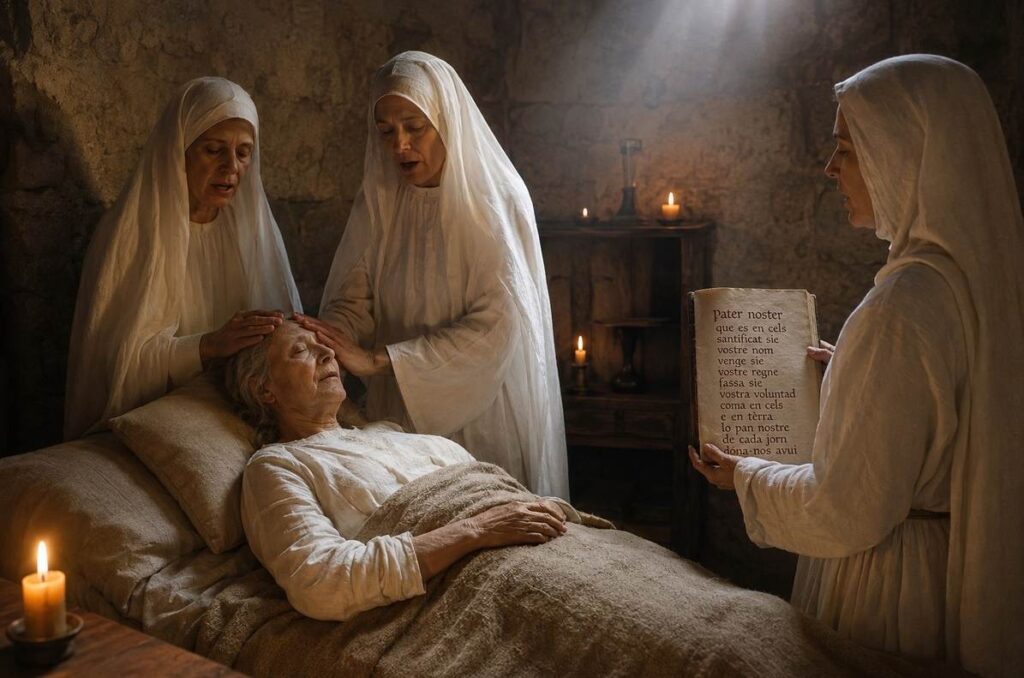
The perfecti who administered this sacrament lived lives of extreme asceticism: no meat, no dairy, no sexual contact, no personal property, no oaths of fealty. They worked with their hands, travelled on foot, and accepted the melioramentum–a bow and blessing requested by credentes who encountered them on the road. The Cathar Pater, their version of the Lord’s Prayer, was the only prayer they needed, and its doxology–“Thine is the kingdom, the power and the glory for ever and ever”–was itself a marker of heresy to Catholic inquisitors, who recognised it as a sign of the separated tradition. The endura, a ritual fast unto death, was practised by those who received the consolamentum and then recovered from illness, choosing starvation over the risk of lapsing into sin.
The Albigensian Crusade: Kill Them All
In 1208, Pope Innocent III’s legate Pierre de Castelnau was murdered in Languedoc, almost certainly by agents of Raymond VI, Count of Toulouse, who had protected the Cathars. Innocent responded not with excommunication alone but with a crusade–a full military campaign offering northern French nobles the lands and booty of the south if they would extirpate the heresy. The crusaders assembled at Lyon in mid-1209 and marched south. Their first target was Béziers, a city with a large Cathar population.
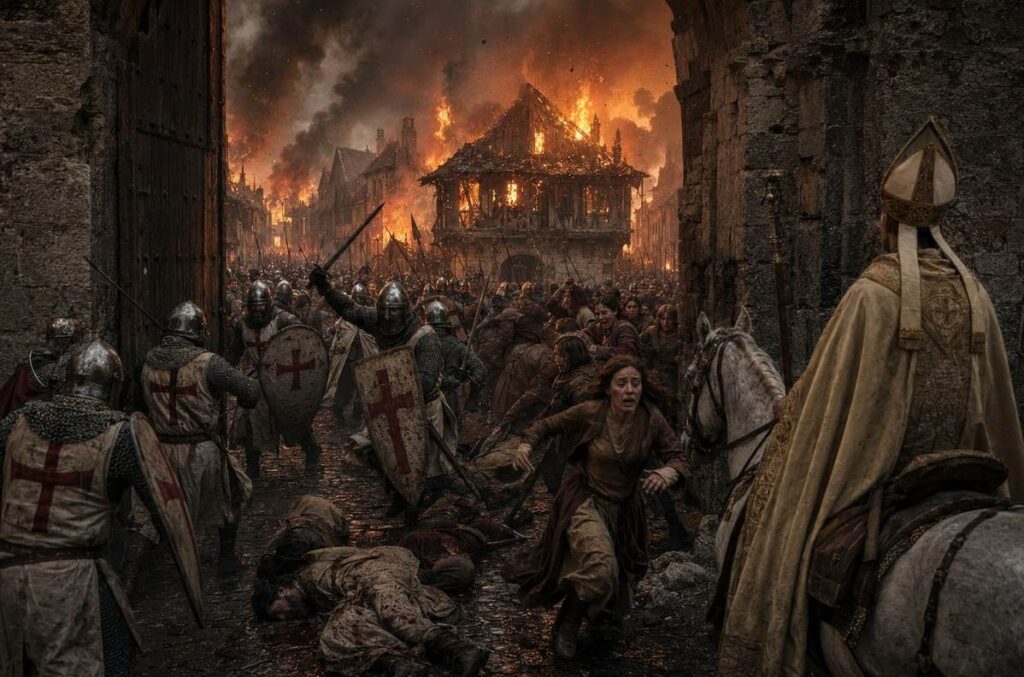
When the crusaders breached the walls, they were faced with a problem: how to distinguish heretic from orthodox in a mixed population. According to the chronicler Caesarius of Heisterbach, the papal legate Arnaud-Amaury replied with a phrase that would echo down the centuries: Caedite eos. Novit enim Dominus qui sunt eius–“Kill them all; God will know his own.” The massacre that followed annihilated the city. Church documents record twenty thousand dead. Béziers burned. Carcassonne fell. Simon de Montfort led the crusade through the Languedoc, seizing territories and enriching northern barons while torching villages and burning perfecti. The official crusade ended in 1229 with the Treaty of Paris, but the killing did not stop.
In 1243, the last Cathar stronghold at Montségur, a remote fortress in the Pyrenees, was besieged. After ten months, the defenders surrendered. On 16 March 1244, more than two hundred perfecti were led down the mountain and burned alive on a massive pyre. Those who had not yet received the consolamentum were given the choice: conversion or the flame. Most chose the flame. The smoke that rose from Montségur marked the end of organised Catharism, though isolated communities survived in the mountains of Italy and the Balkans for another century.
What Survived: Parallels with Nag Hammadi Gnosticism
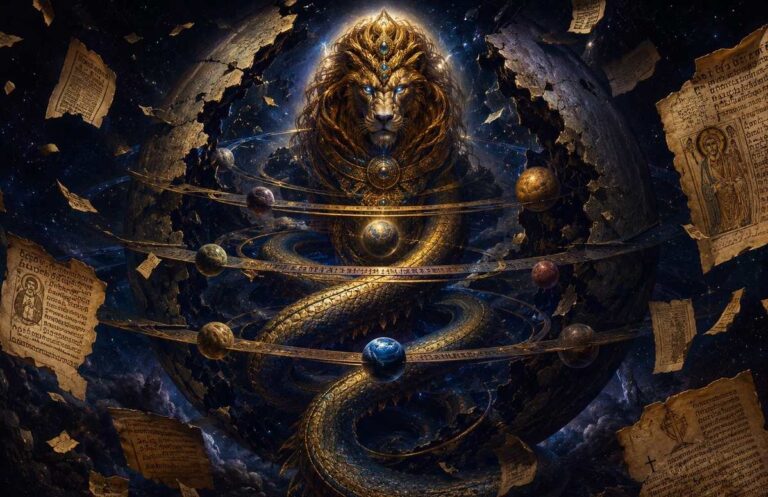
Despite the geographical and chronological distance, the theological DNA is unmistakable. The Cathar doctrine of two gods–the good, transcendent deity and the evil creator of matter–mirrors the Sethian and Valentinian demiurge theology preserved in the Nag Hammadi Library. The Apocryphon of John describes Yaldabaoth, the lion-faced serpent, who declares himself the only god while remaining ignorant of the realms above him. The Cathars identified this figure with the Old Testament Yahweh, the god of law, wrath, and material creation. Both traditions agree: the god who demands worship through fear is not the highest god.
The divine spark trapped in matter is another shared conviction. In the Hypostasis of the Archons, Sophia sends the luminous spark into Adam, making humanity superior to its maker. The Cathars taught that angels who had followed Satan into rebellion were imprisoned in human bodies, and that the consolamentum liberated them from this fleshly dungeon. Both traditions reject the goodness of the material world with a thoroughness that orthodox Christianity found intolerable. If the body is a prison, then marriage is a conspiracy to manufacture more prisoners; if the world is hell, then the sacraments that celebrate it are blasphemy.
Docetism–the belief that Christ only seemed to suffer–appears in both corpora. The Second Treatise of the Great Seth (NHC VII,2) describes the laughing Saviour who watches the crucifixion from above, untouchable by pain. The Cathars similarly denied that the divine Christ could have been born, suffered, or died in a material body. The Eucharist, in this framework, becomes a grotesque celebration of the very imprisonment both traditions sought to escape. And both insisted that salvation required something more than faith in the Church: the Nag Hammadi texts demand gnosis, direct experiential knowledge; the Cathars demanded the consolamentum, a ritual transmission of the Holy Spirit that bypassed the clerical hierarchy entirely.
What Diverged: Where Catharism Departed from the Ancient Texts
Yet the parallels must not obscure the divergences. The Cathars did not possess the Nag Hammadi Library. Their scriptures were Bogomil imports: the Vision of Isaiah, the Secret Supper, perhaps versions of the Gospel of John stripped of their incarnational theology. They had never read the elaborate cosmogonies of the Sethians, with their Barbelo, Autogenes, and Four Luminaries. They knew nothing of the Valentinian Pleroma with its thirty aeons in fifteen syzygies. Their cosmology was simpler, more starkly dualistic, closer to Manichaean absolutism than to the nuanced emanationism of the Alexandrian Gnostics.
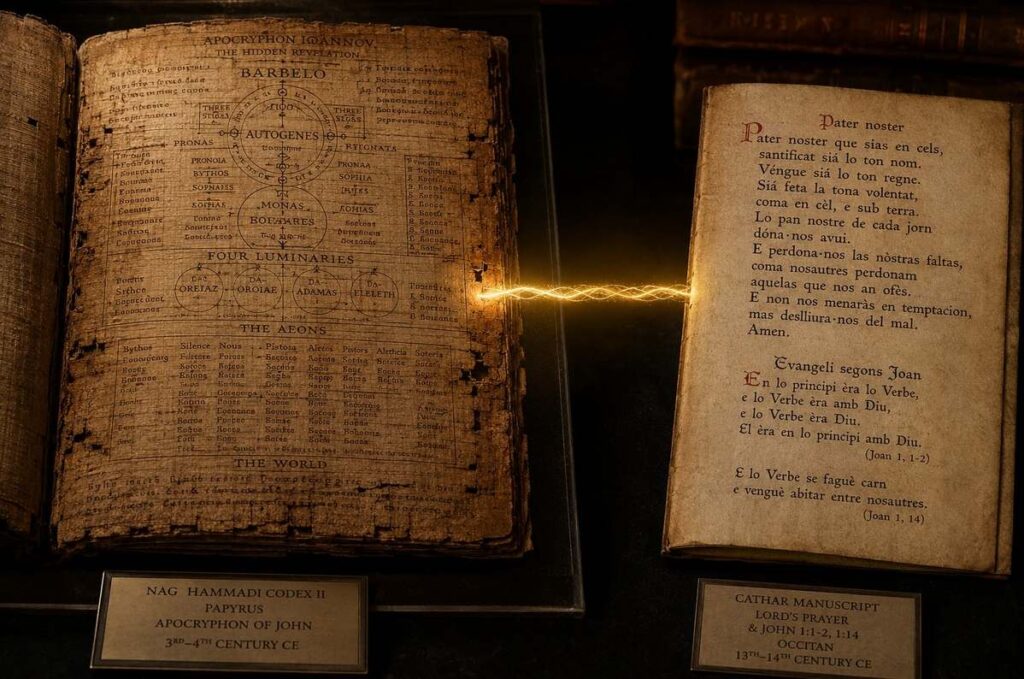
The Cathar church was also an institution in a way that ancient Gnosticism never was. Valentinianism had schools; Sethianism had mystery circles; the Cathars had bishops, dioceses, and a hierarchy of deacons and elders. They were not esoteric philosophers debating in Alexandrian libraries but a popular movement embedded in the feudal society of medieval France. Their rejection of the material world had immediate political consequences: they refused to swear oaths, which meant they refused feudal loyalty; they refused to bear arms, which meant they refused military service; they refused to reproduce, which meant they threatened the demographic and economic base of the aristocracy. Ancient Gnosticism had been intellectually subversive; Catharism was socially subversive, and that made it far more dangerous to the powers of its day.
Finally, the Cathars lacked the Sophia myth that dominates so many Nag Hammadi texts. There is no fallen wisdom, no passionate error generating the material world, no maternal deity weeping for her lost children. The Cathar dualism was more austere: two eternal principles in conflict, neither derived from the other. This absolute dualism was philosophically cruder but theologically sharper, offering a clarity that the complex mythologies of antiquity could not match for a medieval peasant facing the Inquisition.
The Inquisition and the Erasure of Memory
The Albigensian Crusade failed to eliminate every Cathar, so the Church turned to a new instrument: the Medieval Inquisition. Established in 1233 under Gregory IX and entrusted largely to the Dominican Order, the Inquisition was a systematic attempt to root out the last traces of dualist belief. It operated through interrogation, the extraction of confessions, and the compilation of detailed records that survive today as some of our richest sources for Cathar theology. The irony is profound: the Inquisition preserved what it sought to destroy, recording Cathar beliefs with a precision that the Cathars themselves–who rejected book-learning–never attempted.
By the middle of the fourteenth century, all discernible traces of the movement had been eradicated. The last known Cathar perfectus, Guillaume Bélibaste, was burned in 1321. The castles of the Languedoc were dismantled or handed to northern lords. The Occitan language, in which the Cathar rituals had been sung, was suppressed. The memory of the Bons Hommes survived only in folklore, in the names of mountains, and in the suspicion that haunted certain villages for centuries. It would take another six hundred years, and the discovery of a sealed jar beneath the cliffs of Nag Hammadi, before scholars could recognise that the heresy burned at Montségur had once flourished, under different names, along the banks of the Nile.
Frequently Asked Questions
Who were the Cathars and what did they believe?
The Cathars were a dualist Christian movement that flourished in southern France and northern Italy between the 12th and 14th centuries. They called themselves Good Christians or Bons Hommes. They believed in two gods: a good, transcendent deity of the New Testament who created the spiritual realm, and an evil god–often identified with the Old Testament Yahweh–who created the material world. They rejected the Incarnation, Crucifixion, Eucharist, and the authority of the Roman Church, believing salvation came through the consolamentum, a spiritual baptism administered by the ascetic elect known as perfecti.
What was the Albigensian Crusade?
The Albigensian Crusade was a military campaign launched by Pope Innocent III in 1209 to eradicate Catharism from the Languedoc region of southern France. It lasted, with interruptions, from 1209 to 1229. Crusaders were promised the lands and property of the defeated. The campaign included the massacre at Béziers in 1209, where thousands were slaughtered, and the siege of Montségur in 1244, where over 200 Cathar perfecti were burned alive. Historians consider it one of Europe’s first genocides.
What is the consolamentum?
The consolamentum was the central sacrament of Catharism–a spiritual baptism performed by the laying on of hands. It was believed to transmit the Holy Spirit and free the soul from the cycle of reincarnation. Only the perfecti or perfectae could administer it. Most credentes (ordinary believers) received it on their deathbeds, as the ritual required the recipient to live in absolute purity thereafter. If they recovered, they were expected to adopt the ascetic life of the elect.
How did Catharism relate to the Bogomils?
Scholars trace Catharism’s theological roots to the Bogomils, a dualist movement that emerged in the Balkans during the 10th century. Bogomil missionaries travelled westward along trade routes, bringing texts like the Vision of Isaiah and the ritual framework that became the Cathar consolamentum. The Council of Saint-Félix, around 1172, is considered the moment when the Cathars organised into a formal church under Bogomil influence, establishing bishops and dioceses across Languedoc.
What are the parallels between Catharism and Nag Hammadi Gnosticism?
Both traditions share core convictions: the material world is flawed or evil; the creator god of the Old Testament is ignorant or malevolent; the divine spark is trapped in matter and must be liberated; Christ was a spiritual being who only seemed to suffer (docetism); and salvation requires secret knowledge or ritual initiation rather than faith in the Church. Both rejected the material sacraments of orthodoxy and maintained that direct encounter with the divine was possible without priestly mediation.
How did Catharism diverge from ancient Gnosticism?
The Cathars lacked access to the Nag Hammadi Library–those texts were buried in Egypt and unknown in medieval Europe. Instead, they used Bogomil scriptures. Their cosmology was simpler than the elaborate aeonic hierarchies of Sethian or Valentinian Gnosticism. They organised as a formal church with bishops and territorial dioceses, unlike the loose schools of antiquity. Their dualism tended toward absolute dualism (two eternal principles) rather than the mitigated dualism of the Valentinians, where the demiurge arises from a fall within the divine realm.
Why were the Cathars suppressed so violently?
The Cathars posed an existential threat to the medieval social order. Their rejection of material wealth, procreation, and feudal oaths undermined the economic and political structures of Languedoc. Their denial that the Church held the keys to salvation threatened the very foundation of papal authority. When a worldview declares the creator of the material world to be a fraud, it renders illegitimate every earthly institution that claims legitimacy from that creator. The Crusade was not merely theological; it was political.
Safety Notice: This article discusses historical violence, genocide, and religious persecution. It does not constitute theological advice or encourage hostility toward any living religious tradition. The study of suppressed movements is valuable for understanding the history of ideas, but it should not be used to justify contemporary grievance or interfaith conflict. If you are experiencing distress related to religious trauma, please contact a trauma-informed therapist or support service.
Further Reading
- The Demented God Architect — Unmasking the Demiurge in Gnostic cosmology and why both ancient Gnostics and medieval Cathars were hunted to extinction.
- Apocryphon of John: Foundational Text of Sethian Gnosticism — The complete cosmogony of Yaldabaoth, the divine spark, and the three races of humanity that parallels Cathar anthropology.
- Nag Hammadi Library: Complete Guide to 46 Gnostic Scriptures — The master hub for navigating the texts that reveal what the Cathars could not have known but somehow echoed.
- 5 Gnostic Schools Explained — Comparative overview of Sethian, Valentinian, Hermetic, and Thomasine traditions, showing the diversity Catharism simplified.
- What Is Gnosticism? Defining the Undefinable — Why the orthodoxy/heresy binary was constructed and how it shaped the suppression of movements like Catharism.
- The Sophia Myth: Three Falls, Three Redemptions — The myth Catharism lacked: how the divine feminine fell into matter and what her redemption means for the spark trapped in flesh.
- Valentinian Christianity: System and Influence — The most philosophically sophisticated Gnostic school, whose nuanced dualism contrasts sharply with Cathar absolutism.
- The Nag Hammadi Library — The complete archive of the texts buried in 1945, revealing the ancient world the Cathars unknowingly preserved in medieval dress.
References and Sources
The following sources represent the scholarly monographs, primary texts, and critical studies underlying this article.
Primary Sources and Inquisitorial Records
- The Cathar Ritual (Traditio and Lyons versions). In Heresies of the High Middle Ages, edited by Walter L. Wakefield and Austin P. Evans. Columbia University Press, 1991.
- Caesarius of Heisterbach. Dialogus Miraculorum (Dialogue on Miracles). Translated by H. von E. Scott and C. C. Swinton Bland. Routledge, 1929.
- The Vision of Isaiah. In The Old Testament Pseudepigrapha, Vol. 2, edited by James H. Charlesworth. Doubleday, 1985.
Scholarly Monographs
- Hamilton, Bernard. The Cathars and the Albigensian Crusade. In Crusades, Cathars and the Holy Places. Variorum, 1999.
- Hamilton, Bernard. “The Cathar Council of Saint-Félix Reconsidered.” Archivum Fratrum Praedicatorum, Vol. 48, 1978.
- Brenon, Anne. Les Femmes Cathares. Perrin, 1992. [English translation: The Women Cathars.]
- Obolensky, Dimitri. The Bogomils: A Study in Balkan Neo-Manichaeism. Cambridge University Press, 1948.
- Wakefield, Walter L., and Austin P. Evans. Heresies of the High Middle Ages. Columbia University Press, 1991.
- Lambert, Malcolm. The Cathars. Blackwell, 1998.
- Costen, Michael. The Cathars and the Albigensian Crusade. Manchester University Press, 1997.
Comparative and Gnostic Studies
- The Apocryphon of John (NHC II,1; III,1; IV,1). In The Nag Hammadi Library in English, 4th revised edition, edited by Marvin Meyer. HarperOne, 2007.
- The Hypostasis of the Archons (NHC II,4). In The Nag Hammadi Library in English, 4th revised edition, edited by Marvin Meyer. HarperOne, 2007.
- The Second Treatise of the Great Seth (NHC VII,2). In The Nag Hammadi Library in English, 4th revised edition, edited by Marvin Meyer. HarperOne, 2007.
- Jonas, Hans. The Gnostic Religion: The Message of the Alien God and the Beginnings of Christianity. Beacon Press, 1958.
- King, Karen L. What Is Gnosticism? Harvard University Press, 2003.
- Brakke, David. The Gnostics: Myth, Ritual, and Diversity in Early Christianity. Harvard University Press, 2010.