
What Is Metanoia? The Gnostic Turning of the Nous
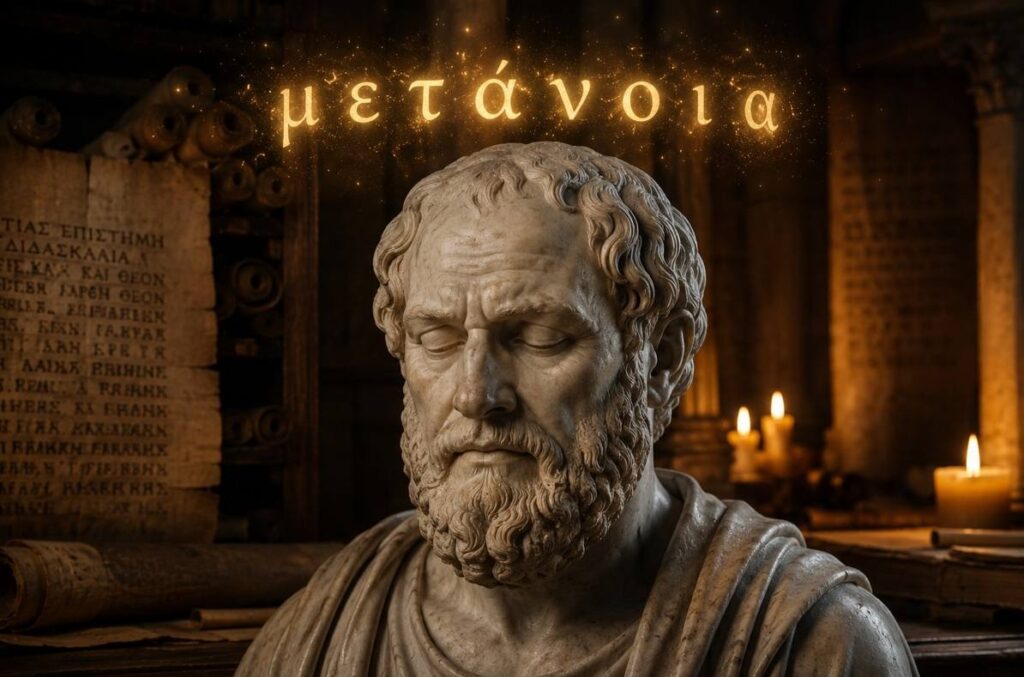
The Greek word metanoia has suffered one of the most unfortunate mistranslations in spiritual history. Where English Bibles render it as “repentance,” the original term carries no intrinsic baggage of guilt, shame, or moral grovelling. Instead, it describes something far more radical: a fundamental change of mind, a reorientation of the highest faculty of human consciousness — the nous — away from illusion and toward truth. In Gnosticism, this shift is not a private moral correction but the very engine of awakening itself.
Metanoia is the essential cosmic trigger for awakening shared intuition and the direct, experiential knowing of the source. It is the gateway through which the sleeper exits the dream of the demiurge and recognises the native light of the Pleroma already present within. To understand why the Gnostics placed such weight upon this single word, we must return to its Greek roots, follow its transformation through ancient cosmology, and recover its meaning for the modern seeker.
Table of Contents
- Etymology and the Original Meaning
- Beyond Repentance: Metanoia in the Gnostic Context
- Sophia’s Repentance and the Restoration of the Fullness
- Metanoia as the Gateway to Gnosis
- Metanoia in the Modern and Neo Gnostic Imagination
- Living Metanoia: A Practice of Continuous Turning
- Frequently Asked Questions
- Further Reading
Etymology and the Original Meaning
Metanoia is formed from the Greek prefix meta (after, beyond, or changed) and nous (mind, intellect, or the organ of spiritual perception). In classical Greek literature, the term simply meant a change of mind or an afterthought. The historian Polybius used it to describe a reversal of military strategy; Thucydides employed it for a shift in political policy. It was a practical word, not a confessional one.
It was not until the Septuagint translators and the authors of the New Testament that the word acquired its spiritual weight — yet even then, its core meaning remained intact: to think differently, to perceive from a higher vantage, to undergo a transformative change of heart. The Latin Fathers, lacking a precise equivalent, rendered metanoia as paenitentia (penance), a choice that some modern scholars regard as a linguistic and theological misstep. Where the Greek suggests illumination and expansion, the Latin implies punishment and regret. For the Gnostics, who prized direct knowing over doctrinal submission, this distinction mattered enormously.
Metanoia means “a change of mind” to a greater or higher consciousness, a transformative change of heart. St. Paul calls it “putting on the mind of Christ.”
Patristic and Orthodox tradition
Beyond Repentance: Metanoia in the Gnostic Context
To the Gnostic, metanoia is not about apologising to a distant deity for breaking rules. It is the cosmic wake-up call that shatters the sleep of the soul. The nous — the divine spark of intellect within the human being — has been hypnotised by the counterfeit splendour of the material world. Metanoia is the moment that hypnosis breaks.
The Shift of the Nous
In Gnostic anthropology, the nous is not merely the rational brain but the eye of the soul, the faculty capable of recognising the Pleroma. The demiurgic world floods the psyche with distraction, desire, and fear, turning the nous downward into the kenoma — the realm of deficiency and emptiness. Metanoia reverses this flow. It is the deliberate turning of the nous away from the shadows on the cave wall and back toward the light source.
This is why the Gospel of Truth and other Nag Hammadi texts describe the awakening of the fallen as a return to recognition: the soul remembers what it had forgotten, and the mind reorients toward its native country. The shift of the nous is the highest faculty of the human mind turning away from the illusions created by the lower material world and back toward cosmic truth. Without this turn, no amount of ritual, study, or moral effort can produce gnosis.
Cosmic Metanoia and the Aeons
Unlike orthodox theology, where metanoia is merely a human action, certain Gnostic traditions personified concepts into cosmic beings. In certain Valentinian accounts, the restoration of Sophia involves the emanation of Metanoia as an Aeon — a divine personification of the turning force itself. Here, repentance is not grovelling; it is the gravitational pull of the Pleroma acting upon the soul that has wandered too far.
To a Gnostic, the physical body and the ego are artificial fabrications of a lesser creator deity — the Demiurge. The Aeon Metanoia represents the Pleroma’s own response to the crisis of separation: the divine guarantee that no fall is final because the turning power is woven into the architecture of existence itself. What appears as human repentance is, from the cosmic perspective, the Fullness calling the fragment back to wholeness.

Sophia’s Repentance and the Restoration of the Fullness
The myth of Sophia offers the most vivid illustration of Gnostic metanoia. In the Valentinian narrative, Sophia’s crisis begins when she seeks to know the unknowable Father without the mediation of her consort. Her passion produces an illegitimate emanation — the raw material of Yaldabaoth and the defective cosmos. Expelled from the Pleroma, she suffers anguish, fear, and loneliness. Her metanoia is not a confession of moral failure but the painful recognition that she has strayed from the Fullness.
Through this turning, she becomes capable of receiving the Saviour, who restores her and, through her, restores the possibility of human awakening. The Exegesis on the Soul (Nag Hammadi) mirrors this drama at the human level. The soul, like Sophia, falls into prostitution and adultery in the foreign land of matter. Her metanoia — her turning back — is accompanied by prayer to the Father and the eventual arrival of a heavenly bridegroom who reunites her with her original nature. The parallel is explicit: every human metanoia is a microcosm of Sophia’s cosmic return.
In this light, metanoia is not a punishment for wrongdoing but the soul’s innate capacity to recognise its own exile and desire its own restoration. It is the homesickness of the divine spark that has forgotten its name.
Metanoia as the Gateway to Gnosis
If gnosis is the direct knowing of the divine source, metanoia is the gateway through which one passes to reach it. You cannot know what you are not facing. The Gnostic does not accumulate theological information; he or she undergoes a change of perceptual orientation. The Gospel of Philip calls this the transformation from blindness to sight. The body and ego, fabrications of the Demiurge, lose their hypnotic grip once the nous turns. What remains is the naked recognition of the spark within — the pneumatikoi realising their true citizenship in the Pleroma.
This is why metanoia precedes baptism in so many Gnostic texts. The Five Seals, the bridal chamber, and the ascent through the aeons all presuppose that the candidate has already undergone the fundamental shift of mind. Without metanoia, the rituals are empty theatre. With it, they become the confirmation of an inner revolution already accomplished. The Gospel of Philip insists that one must “receive the light” before entering the bridal chamber — and that reception is nothing other than the mind’s turn toward the real.
Metanoia in the Modern and Neo Gnostic Imagination
Psychological Awakening
Contemporary seekers often encounter metanoia translated as “repentance” and recoil from its punitive associations. The Neo Gnostic recovery of the term restores its original dignity. In modern psychological language, metanoia resembles what Carl Jung called the transformative moment of insight — the sudden collapse of an old complex and the emergence of a new orientation. It is not self-flagellation but the integration of shadow material that allows the self to turn toward wholeness.
The Call of the Present Moment
For the neo gnostic living in an age of algorithmic distraction, metanoia is the daily practice of turning the attention away from the feed and back toward the living thread. It is the recognition that one’s thoughts have been colonised by external forces — cultural, digital, and systemic — and the decision to reclaim the nous as sovereign territory. The cosmic wake-up call arrives not as thunder but as the quiet realisation that one has been dreaming.

Living Metanoia: A Practice of Continuous Turning
Metanoia is not a one-time event. The early Christian text Shepherd of Hermas describes it as a continuous spring cleaning of the soul. For the Gnostic, every moment offers the choice between the turning toward truth and the slide back into forgetfulness. The practice is simple in concept and demanding in execution: pause, examine the direction of the mind, and choose the path that leads toward recognition.
Over time, this becomes less a decision and more a native posture — the nous naturally oriented toward the Pleroma, the mind that cannot be fooled for long because it has learned to recognise its own light. The body may still walk through the kenoma, but the nous has already returned home. This is the secret of the living metanoia: not a single conversion, but a life turned continuously toward the source from which it came.

Frequently Asked Questions
What does metanoia literally mean in Greek?
Metanoia comes from the Greek meta (beyond or after) and nous (mind or intellect). Literally, it means a change of mind, an afterthought, or a shift in perception. In classical Greek it described a strategic reversal or new perspective, not moral guilt.
How is Gnostic metanoia different from Christian repentance?
Traditional Christian repentance often emphasises sorrow for sin, guilt, and moral correction. Gnostic metanoia is a transformative reorientation of the nous–the highest faculty of mind–away from demiurgic illusion and toward the recognition of divine truth. It is awakening, not apology.
What is the nous in Gnosticism?
The nous is the divine spark of intellect within the human being, the eye of the soul capable of recognising the Pleroma. It is distinct from ordinary rationality; it is the organ of direct spiritual perception that must be turned away from the kenoma and toward the Fullness.
Did Valentinian Gnostics believe metanoia was an Aeon?
Certain Valentinian traditions describe Metanoia as a cosmic power or Aeon–a divine personification of the turning force that assists Sophia’s return to the Pleroma. In this view, metanoia is not merely human behaviour but a divine reality woven into the architecture of existence.
How does metanoia lead to gnosis?
Gnosis is direct knowing of the divine source, and metanoia is the perceptual shift that makes such knowing possible. By turning the nous away from material illusion, the seeker removes the obstruction that prevents recognition of the divine spark already present within.
Is metanoia a one-time event or a continuous practice?
While a single transformative moment can initiate metanoia, Gnostic sources treat it as a continuous practice. The Shepherd of Hermas describes it as ongoing spiritual spring cleaning. Each moment offers a choice between turning toward truth or sliding back into forgetfulness.
How can modern seekers practice metanoia in daily life?
Modern metanoia involves pausing to examine the direction of the mind, noticing when attention has been captured by distraction or conditioning, and deliberately reorienting toward recognition and presence. Over time, this turning becomes a natural posture rather than a forced effort.
Further Reading
Explore these related articles across ZenithEye to deepen your understanding of metanoia and its place in the Gnostic map:
- What Is Gnosis? Meaning, Recognition, and Direct Knowing — The direct experiential knowing that metanoia makes possible.
- What Is Recognition? The Moment of Direct Seeing — How the turned nous recognises what was always present.
- What Is the Divine Spark? — The hidden light within that metanoia reawakens to its true origin.
- What Is the Demiurge? — The lesser creator whose illusions metanoia dismantles.
- What Is the Pleroma? — The divine Fullness toward which metanoia turns the soul.
- What Is the Kenoma? — The realm of emptiness that the nous must turn away from.
- Who Is Yaldabaoth? — The chief archon whose counterfeit world metanoia exposes.
- What Is Pneuma? — The spiritual breath that animates the awakened nous.
- What Is Neo Gnosticism? — How modern seekers recover the practice of turning the mind toward truth.
- The Gospel of Truth: Poetics of Recognition — The Nag Hammadi text that sings the journey from forgetting to remembrance.