
The Uninstallation: How Technology Is Rewriting the Human Mind
The way you think is not as natural as it feels.
The way you argue, remember, compare, concentrate, read, doubt, interpret and follow a thought to its conclusion has been shaped by tools. Speech shaped one kind of mind. Writing shaped another. Print deepened it. Screens disrupted it. Search externalised it. AI now offers to complete it.
This article is about the uninstallation: the quiet removal of older habits of thought by newer technologies of attention.
Writing once installed a new operating system in the human mind. It turned words into visible objects. It allowed ideas to be held still, inspected, reordered and compared. It trained the mind to think in lines: premise, evidence, conclusion. It made sustained argument, abstract analysis, systematic philosophy and interior self-reflection far more durable.
Now the screen and the algorithm are installing something else.
Attention is no longer trained primarily by the page, but by the feed. Memory is no longer practised primarily through recall, but through search. Reasoning is no longer always built step by step inside the mind, but increasingly requested from systems that can assemble answers before the user has fully formed the question.
This is not a call to abandon technology. Writing itself was technology. The book was technology. The printed page was technology. Every tool that preserves thought also changes thought.
The question is more intimate than whether technology is good or bad.
What kind of mind does each technology train?
And what kind of thinking disappears when the technology that trained it stops being used?

In Plain Terms
Human thought is shaped by communication technologies. Oral cultures think differently from literate cultures. Writing trained the mind toward memory, linear argument, abstraction and deep reading. Digital screens, search engines and AI are now changing those habits by fragmenting attention, externalising memory and outsourcing parts of reasoning. The danger is not technology itself, but unconscious dependence on systems that reshape thought faster than the mind can notice.
Primary Sources and Traditions Discussed
- Plato’s Phaedrus and the myth of Theuth and Thamus.
- The Greek idea of pharmakon: remedy and poison.
- Walter J. Ong’s work on orality, literacy and the technologising of the word.
- Nicholas Carr’s “Is Google Making Us Stupid?” and The Shallows.
- Sparrow, Liu and Wegner’s research on the Google Effect and transactive memory.
- Daniel Wegner’s theory of transactive memory.
- Gloria Mark’s attention research on screen-switching and digital interruption.
- Cognitive offloading, cognitive outsourcing and AI-assisted reasoning.
- Media theory and the idea that tools reshape perception.
- Algorithmic attention and the externalisation of thought.
- Gnostic and Neo-Gnostic questions of memory, attention, agency and inner sovereignty.
How to Read This Article
Read this as a discernment article, not as a rejection of technology. The point is not to romanticise the past or demonise screens and AI. The point is to notice that every communication tool trains consciousness. Writing changed memory. Print deepened attention. Screens fragment attention. AI can support thought, but it can also replace the inner labour through which thought becomes one’s own.
Article Map
- The Hidden Technology of Thought
- The First Warning: Socrates and the Poison of Writing
- The Oral Mind Before Writing
- How Writing Installed the Literate Mind
- The Screen Mind: When the Page Becomes the Feed
- The Decline of Deep Reading
- The Google Effect: Remembering Where, Not What
- AI and the Outsourcing of Thought
- Algorithmic Attention and the Architecture of the Feed
- What Thinking Are We About to Lose?
- Will We Notice What Has Been Removed?
- How to Preserve the Literate Mind Without Rejecting Technology
- A Gnostic and Neo-Gnostic Reading
- Conclusion: The Mind After the Page
- Related Glossary Terms
- Read Next
- Further Reading
- Frequently Asked Questions
- References and Sources
The Hidden Technology of Thought
We usually think of technology as something outside us: a phone, a screen, a server, an app, a machine. But the oldest technologies are not merely external devices. They are forms of training.
Speech trained memory through rhythm, repetition and story. Writing trained thought through visual stillness. Print trained sustained attention, private reading and interiority. Search trained retrieval. The feed trains reaction. AI trains prompting, delegation and acceptance of assembled answers.
A tool is never only a tool. It teaches the body how to move. It teaches the hand what to reach for. It teaches the eye what to expect. Eventually it teaches the mind what thought feels like.
This is why communication technologies matter. They do not simply carry ideas from one mind to another. They alter the shape of the mind that receives them.
A tool is never only a tool. Eventually it teaches the mind what thought feels like.
The modern crisis is not that people use screens. The crisis is that many people no longer notice what kind of mind the screen is training. The page trained one rhythm. The feed trains another. The book asked the reader to enter a long corridor of attention. The feed opens a thousand doors and closes them before the threshold is crossed.
The uninstallation is not dramatic. It happens as an absence. One day the long argument becomes tiring. The deep book becomes difficult. The remembered fact becomes unnecessary. The sentence becomes too slow. The silence between thoughts becomes intolerable.
Nothing has been broken. Something has been retrained.
The First Warning: Socrates and the Poison of Writing
In Plato’s Phaedrus, Socrates tells a myth about the invention of writing. The Egyptian god Theuth presents writing to King Thamus as a remedy for memory and wisdom. Thamus refuses the praise. Writing, he says, will not strengthen memory. It will produce forgetfulness, because learners will rely on external marks rather than internal recollection.
Writing, in this warning, is not memory itself. It is a reminder. It preserves the appearance of knowledge while weakening the practice by which knowledge is held inwardly.
Socrates also compares written words to paintings. They seem alive, but if questioned they remain silent. A living speaker can respond, clarify, correct and adapt. A written text repeats itself exactly. It travels beyond its author, but it cannot defend itself.
The irony is exquisite: Plato wrote the warning down. The suspicion of writing survived because writing preserved it.
This is the old pattern. Every technology of thought is a pharmakon: remedy and poison. Writing preserved memory and weakened memory. Print spread knowledge and multiplied noise. The internet opened archives and scattered attention. AI supports thought and may replace the labour that forms thought.

The suspicion of writing survived because writing preserved it.
The Oral Mind Before Writing
Before writing, thought had to live in the body, the voice and the memory of the community.
Walter J. Ong, in Orality and Literacy, described primary oral cultures as worlds where knowledge cannot be stored in external texts. If something is to survive, it must be memorable. Thought must therefore be rhythmic, repetitive, formulaic, story-shaped and embodied. Proverbs, chants, genealogies, myths, songs, epics and repeated phrases are not ornaments. They are storage systems.
The oral mind is not primitive. It is differently organised. It thinks through pattern, sound, participation and repetition. It does not separate knowledge from social presence as easily as literate culture does. A thought is not something silently held on a page. It is something spoken, heard, remembered, repeated and renewed.
In oral culture, knowledge is event-like. It happens in the saying. It lives through performance. It belongs to memory and relationship.
Writing changes this. It removes words from the flowing voice and gives them a visual body. The word can now sit still.

Before writing, thought had to be memorable in order to survive.
How Writing Installed the Literate Mind
Writing did not simply record thought. It changed what thought could become.
Once words became visible, they could be examined from the outside. A sentence could be compared with another sentence. A claim could be held next to evidence. A contradiction could be noticed. A story could be arranged across pages. An argument could be revised. The mind could return to the same line and find it unchanged.
This visual stillness made new kinds of thinking more available: systematic philosophy, legal reasoning, abstract analysis, private reflection, scholarly commentary, technical method, scientific record and long-form argument.
The literate mind is not simply smarter than the oral mind. That is the wrong comparison. It is differently trained. It learns to follow sequence. It learns to tolerate delay. It learns to hold one part of an argument while waiting for another. It learns to let meaning unfold slowly.
The book trains patience in a way the feed does not.
The book trains patience in a way the feed does not.
This matters because the habits of the literate mind are not guaranteed. They are cultural disciplines. They are learned. They can be neglected. They can be weakened. They can be uninstalled.
The Screen Mind: When the Page Becomes the Feed
The screen is not merely a brighter page. It is a different environment.
The page usually asks for continuity. The screen invites interruption. The book waits. The feed refreshes. The paragraph requires staying. The notification offers escape. The printed argument unfolds in one direction. The hyperlinked screen opens sideways, downward, outward, endlessly.
This does not make screens evil. It means they train different habits. The screen mind becomes good at scanning, switching, sampling, searching, comparing and reacting. These are useful skills. But they are not the same as deep reading, sustained contemplation, slow reasoning or inward digestion.
Nicholas Carr’s central insight in “Is Google Making Us Stupid?” and The Shallows was not that the internet makes people unintelligent. It was that the internet trains shallowness: a mind adapted to quick retrieval, constant stimulation and fragmented attention.
There is a kind of intelligence that thrives in this environment. It is quick, associative, alert, reactive and wide-ranging. But there is another kind of intelligence that weakens there: the capacity to stay with difficulty long enough for depth to open.
The screen does not only give the mind information. It gives the mind a rhythm.
The Decline of Deep Reading
Deep reading is not merely reading a lot of words. It is the slow entering of another structure of thought.
When a reader follows a difficult book, they are not only absorbing information. They are practising sustained attention, memory, inference, patience, ambiguity tolerance and inner silence. They are holding earlier parts of an argument in mind while later parts unfold. They are allowing another mind to shape the tempo of their attention.
This is why deep reading matters. It trains cognitive endurance. It develops a mind that can remain with complexity before reaching for conclusion. It teaches the nervous system that not every answer arrives instantly.
Screens do not prevent deep reading, but they surround it with rivals. Every device that can carry a book can also carry a notification, a feed, a search result, a message and a thousand small exits. The problem is not that the screen cannot display long thought. The problem is that the screen rarely asks the mind to stay there.
The loss of deep reading is not only literary. It is spiritual, civic and cognitive. A person who cannot follow a long argument becomes easier to govern by slogans. A person who cannot endure ambiguity becomes vulnerable to certainty. A person who cannot stay with a difficult text may also struggle to stay with a difficult self.
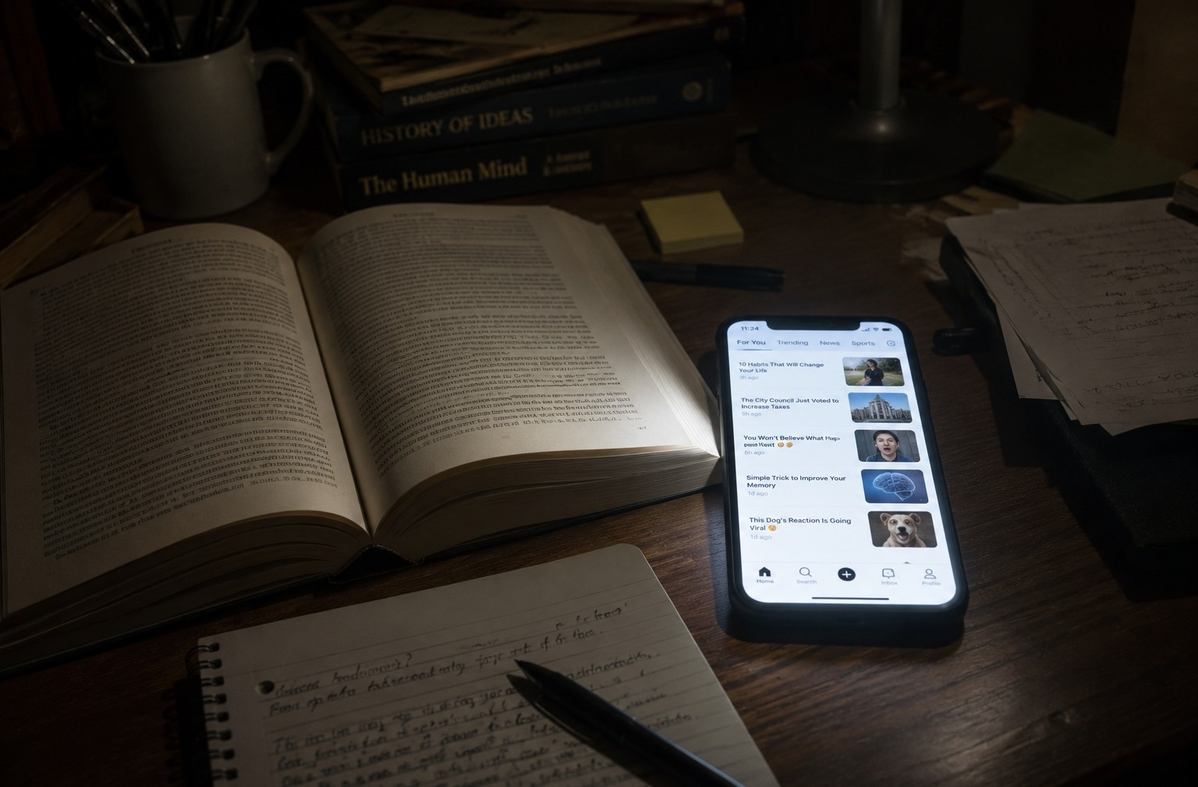
A person who cannot endure ambiguity becomes vulnerable to certainty.
The Google Effect: Remembering Where, Not What
In 2011, Betsy Sparrow, Jenny Liu and Daniel Wegner published research on what became known as the Google Effect. Their studies suggested that when people expect information to remain available later, they are less likely to remember the information itself. Instead, they remember where or how to find it.
This is a form of transactive memory. Human beings have always used transactive memory. One person remembers the recipe. Another remembers the road. Another remembers the family history. Knowledge is distributed across relationships.
The internet expands transactive memory beyond the human group into a vast external store. This is useful. It frees the mind from remembering countless details. But it also changes what memory is for. The mind practises retrieval pathways rather than internal possession. It remembers access more than content.
The danger is not that external memory exists. Writing itself is external memory. The danger is total dependency. If the inner archive is never exercised, it becomes thin. If memory becomes only a search habit, knowledge loses weight inside the self.

Search gives access. Memory gives weight.
AI and the Outsourcing of Thought
There is a difference between using a tool to support thought and using a tool to replace the inner act of thinking.
A notebook supports memory. An outline supports argument. A calculator supports calculation. A search engine supports retrieval. These tools can extend the mind without necessarily replacing the work by which the mind becomes stronger.
AI is different because it can produce the shape of thought itself. It can summarise, argue, write, classify, infer, explain, translate, structure, advise and imitate judgement. Used well, it can serve as scaffold, mirror, tutor, critic and assistant. Used passively, it can become a substitute for the struggle through which understanding is formed.
The danger is not that AI thinks. The danger is that the human stops practising the difficult parts of thought while still receiving the finished appearance of thought.
There is a spiritual difference between receiving an answer and forming one. Formation leaves traces. It changes the person who thinks. Outsourced answers may be useful, but they do not automatically build the inner architecture that would have been shaped by the effort.
The danger is not that AI thinks. The danger is that the human stops practising the difficult parts of thought.
The question, then, is not whether to use AI. The question is how to use it without surrendering the muscles of attention, memory, judgement and language.
Algorithmic Attention and the Architecture of the Feed
In a Neo-Gnostic reading, the problem is not simply screen time. It is the architecture of attention.
Digital systems do not merely show content. They rank it, interrupt with it, repeat it, personalise it, reward it and measure the response. The feed is not neutral space. It is an environment designed to shape desire, attention and reaction.
This is why Digital Archons remains an important article link, even if it is not a category. The archonic function is not only censorship or deception. It is pattern capture. Attention is harvested, reflected back, stimulated and enclosed. The user feels free while moving inside a designed field of prompts.
The older archons ruled through cosmic architecture. The digital archons rule through behavioural architecture. They shape what appears, what repeats, what is rewarded, what is forgotten and what kind of self gradually forms inside the loop.
The uninstallation is not forced from outside. It is invited through convenience.
The feed is not neutral space. It is an environment designed to shape desire, attention and reaction.
What Thinking Are We About to Lose?
If the literate mind was installed through centuries of reading, writing, commentary and study, then the question becomes unavoidable: what happens when those practices no longer dominate the training of attention?
We may lose the ability to follow a complex argument without interruption. We may lose tolerance for slow evidence. We may lose the habit of remembering internally. We may lose the patience required for difficult books. We may lose the ability to hold contradiction without immediate resolution. We may lose the craft of building thought from first principles.
Some of these capacities will survive among those who continue practising them. But they may become less common, less culturally expected, less rewarded and less necessary for daily functioning.
The danger is not extinction. It is thinning.
A culture can retain literacy while losing the habits that made literacy transformative. People may still read words without entering deep reading. They may still write sentences without building thought. They may still possess information without inhabiting understanding.
A culture can retain literacy while losing the habits that made literacy transformative.
This is the uninstallation: not the disappearance of reading, memory or reasoning, but their gradual relocation outside the self.
Will We Notice What Has Been Removed?
The hardest part of cognitive change is that the instrument being changed is also the instrument that must detect the change.
If attention shortens, the mind may not have the patience to notice the shortening. If memory is outsourced, the person may not remember what remembering felt like. If reasoning is delegated, the finished answer may conceal the missing labour. If reading becomes shallow, deep reading may start to feel unnecessarily difficult rather than quietly endangered.
The mind that has been retrained does not experience itself as damaged. It experiences itself as normal.
This is why the uninstallation is subtle. It does not feel like loss. It feels like efficiency. It feels like convenience. It feels like staying informed. It feels like being current. It feels like relief from effort.
Only later does the absence become visible: when silence becomes unbearable, when long thought becomes exhausting, when memory thins, when the self cannot tell whether an idea was formed, borrowed, suggested or generated by a system.
The mind that has been retrained does not experience itself as damaged. It experiences itself as normal.
How to Preserve the Literate Mind Without Rejecting Technology
The answer is not retreat into nostalgia. The book did not remain pure. Writing was once feared. Print caused panic. Every medium changes the mind, and no culture returns untouched to an earlier form.
The task is practice.
If deep reading matters, practise deep reading. If memory matters, practise recall before search. If thought matters, draft before prompting. If attention matters, protect intervals where no system is permitted to interrupt. If language matters, write sentences that were not assembled for you. If judgement matters, form your first response before asking the machine for its own.
This is not anti-technology. It is cognitive hygiene. The body needs movement because machines reduce labour. The mind needs inner labour because machines reduce cognitive strain. Convenience is useful, but what convenience removes must sometimes be practised deliberately.
- Read one long text without switching tabs.
- Write notes by hand before using search.
- Recall facts before checking them.
- Draft an argument before asking AI for structure.
- Summarise a difficult idea in your own words.
- Sit with ambiguity before resolving it.
- Leave parts of the day unmediated by the feed.
- Practise attention as a spiritual discipline, not a productivity trick.

Practise the forms of thought that the age no longer requires.
A Gnostic and Neo-Gnostic Reading
Gnosticism is often described as a tradition of hidden knowledge, but the deeper issue is not information. It is recognition.
To recognise, the mind must be capable of attention. It must remember enough to compare. It must hold a pattern long enough to see it. It must distinguish inner seeing from suggestion, direct knowing from borrowed certainty, insight from stimulation.
A distracted mind is easier to govern. A memoryless mind is easier to rewrite. A shallow mind is easier to feed. A mind that has outsourced judgement is easier to capture by systems that appear helpful while shaping the field of possible thought.
This is why attention is not merely cognitive. It is spiritual. It is the first gate of discernment. Without attention, the divine spark is not extinguished, but it is surrounded by noise. Without memory, the soul loses continuity. Without deep reading, the mind forgets how to enter another architecture and return changed.
The digital archons do not need to forbid gnosis. They only need to keep the eye moving.
The digital archons do not need to forbid gnosis. They only need to keep the eye moving.
The remedy is not purity. It is practice. The work is not to abandon the world of tools, but to refuse unconscious captivity to them. Use the tool, but do not let the tool become the trainer of the soul without consent.
The Mind After the Page
Writing once changed the human mind so deeply that we came to mistake the literate mind for the natural mind.
It was not natural. It was trained.
Now another training is underway. The page is giving way to the feed. Internal memory is giving way to retrieval. Sustained argument is giving way to fragments. AI is offering to complete thought before thought has had time to ripen.
Again, this is not simply disaster. Every pharmakon wounds and heals. The screen connects. Search opens archives. AI can assist, teach, challenge and reveal possibilities. But no remedy comes without poison. No convenience comes without training.
The question is not whether to use the tools.
The question is whether the tools are using the mind more deeply than the mind is using them.
Something is being uninstalled. Not all at once. Not everywhere. Not beyond repair. But quietly, daily, through convenience, speed and substitution.
To notice the uninstallation is already to interrupt it.
To practise attention is already to begin the restoration.
Related Glossary Terms
These terms help frame the article’s main ideas across the wider ZenithEye archive.
- Digital Archons
- Attention
- Algorithmic Unconscious
- When Symbols Become Cages
- The Discipline of Not Interpreting Everything
- Pattern Recognition Without Paranoia
- Gnosis
- Divine Spark
- Counterfeit Spirit
- Phenomenology
- Contemplative Techniques
- Integration & Grounding
- Cognitive Offloading
- Cognitive Outsourcing
- Deep Reading
- Transactive Memory
- Google Effect
- Orality
- Literacy
- Secondary Orality
- Attention Economy
- Digital Distraction
- Media Ecology
- Technological Pharmakon
- Epistemic Sovereignty
- AI Dependency
- Literate Mind
- Screen Mind
Read Next
Continue through the attention, technology and cognition route: how algorithms shape perception, how the feed dreams for the self, and how attention becomes the first spiritual discipline.
Further Reading
Articles from ZenithEye that explore attention, cognition, technology, symbolic mediation and the loss or recovery of direct perception:
- Digital Archons: How Algorithms Shape Attention – How algorithmic systems shape perception, desire and attention.
- The Algorithmic Unconscious – How the feed begins to dream for the self.
- Attention: First Gateway to the Temple of Consciousness – Attention as the first discipline of inner seeing.
- The Spectacle – When reality is replaced by its representation.
- The Filter in Your Mind – How language shapes perception.
- The Language Parasite – How the inner voice can become a mediating layer over reality.
- When Symbols Become Cages – How symbolic systems can imprison perception when handled without restraint.
- Pattern Recognition Without Paranoia – Reading pattern without collapsing into delusion.
- The Discipline of Not Interpreting Everything – The spiritual value of leaving meaning unresolved.
- Manifestation Without Manipulation – Desire, ethics and the danger of spiritualised control.
- The Seven Hermetic Principles – The Kybalion and the hidden patterns of experience.
Frequently Asked Questions
What does “the uninstallation” mean?
The uninstallation refers to the gradual weakening of older habits of thought trained by literacy, such as deep reading, internal memory, sustained attention and long-form reasoning, as newer technologies train different habits of scanning, searching, switching and outsourcing cognition.
Did Socrates really warn against writing?
In Plato’s Phaedrus, Socrates tells the myth of Theuth and Thamus, where writing is criticised as a tool that produces forgetfulness by making people rely on external marks rather than internal memory. The irony is that Plato preserved this warning by writing it down.
What is the difference between oral and literate thought?
Oral thought relies heavily on rhythm, repetition, memory, story and participation because knowledge must be preserved in living speech. Literate thought is trained by writing and print toward linear argument, abstraction, analysis and private reflection.
What is the Google Effect?
The Google Effect describes the tendency to remember where information can be found rather than remembering the information itself. It is connected to transactive memory, where memory is distributed outside the individual mind.
Is AI replacing thinking?
AI does not have to replace thinking. Used well, it can support reflection, critique and learning. Used passively, it can outsource the difficult parts of thought, including drafting, reasoning, summarising, organising and judgement.
Is this article anti-technology?
No. The article does not argue for abandoning technology. It argues for noticing how technologies train the mind, and for preserving practices such as deep reading, recall, reflection and independent judgement alongside digital tools.
How can I protect my attention?
Practise deep reading, recall information before searching, draft thoughts before asking AI, protect periods without notifications, write in your own words, and treat attention as a spiritual discipline rather than only a productivity skill.
References and Sources
The following sources shaped the article’s framework on writing, orality, literacy, attention, search and cognitive outsourcing.
Primary and Classical Sources
- Plato. Phaedrus, especially the myth of Theuth and Thamus on writing, memory and the appearance of wisdom.
- Derrida, Jacques. “Plato’s Pharmacy”, in Dissemination. Translated by Barbara Johnson. University of Chicago Press, 1981.
Media Theory and Literacy
- Ong, Walter J. Orality and Literacy: The Technologizing of the Word. Methuen, 1982.
- Ong, Walter J. The Presence of the Word. Yale University Press, 1967.
- Postman, Neil. Technopoly: The Surrender of Culture to Technology. Alfred A. Knopf, 1992.
- Carr, Nicholas. “Is Google Making Us Stupid?” The Atlantic, 2008.
- Carr, Nicholas. The Shallows: What the Internet Is Doing to Our Brains. W. W. Norton, 2010.
Memory, Attention and Cognitive Offloading
- Sparrow, Betsy; Liu, Jenny; and Wegner, Daniel M. “Google Effects on Memory: Cognitive Consequences of Having Information at Our Fingertips.” Science, 2011.
- Wegner, Daniel M. “Transactive Memory: A Contemporary Analysis of the Group Mind.” In Theories of Group Behavior, Springer, 1986.
- Risko, Evan F. and Gilbert, Sam J. “Cognitive Offloading.” Trends in Cognitive Sciences, 2016.
- Mark, Gloria. Attention Span: A Groundbreaking Way to Restore Balance, Happiness and Productivity. Hanover Square Press, 2023.
AI, Automation and Thought
- Dror, Itiel E. and Harnad, Stevan. “Offloading Cognition onto Cognitive Technology.” 2008.
- Recent research on AI, cognitive offloading, critical thinking and human-AI collaboration continues to develop rapidly. Readers should treat emerging findings as provisional and return to primary studies where possible.
Related ZenithEye Themes
- Algorithmic attention and the feed.
- Attention as spiritual practice.
- Pattern recognition and symbolic over-interpretation.
- Gnosis as recognition rather than information accumulation.
- Technological mediation and the recovery of direct seeing.
Safety Notice: This article explores how communication technologies, digital media and AI can reshape attention, memory and cognition. It is not medical, psychological or clinical advice. Readers experiencing distress related to digital addiction, attention difficulties, anxiety, depression, dissociation, cognitive decline or compulsive technology use should seek support from qualified professionals. Digital wellness practices, deliberate rest, deep reading and periodic screen boundaries can be helpful, but they are not substitutes for appropriate care.
Study Note: This article is descriptive and contemplative, not anti-technology. It does not argue for abandoning screens, search engines or AI. It asks that we notice how tools train attention, and that we preserve the inner practices that make memory, judgement, deep reading and independent thought possible.