
The Unsaid: How Conversation Actually Works
There is something about human conversation that almost nobody talks about, because talking about it means exposing the quiet machinery that makes conversation possible.
Here it is: literal meaning is rarely the whole message.
Someone says, “I’m fine,” and you hear the tiredness behind it. Someone writes, “Okay,” and the full stop feels colder than the word. Someone pauses before answering, and the pause speaks before the sentence arrives. Someone says, “They seem happy,” and the word seem opens a hidden door.
Conversation does not happen only in words. It happens in gaps, timing, hesitation, tone, gesture, shared history, context, silence and everything both people know but do not say.
This article is about that invisible architecture. Not how communication appears to work on the surface, but how it actually works beneath the spoken line.
Once you notice the gap between what is said and what is meant, ordinary conversation becomes a different world.
In Plain Terms
The unsaid is the meaning that travels beside, beneath or around literal speech. It includes implication, tone, silence, body language, timing, context and shared understanding. In philosophy of language, this is often studied through implicature: meaning that is communicated without being directly stated. Human conversation works because people do not only decode words. They infer what the words are doing.
Primary Sources and Traditions Discussed
- H. P. Grice and the cooperative principle.
- Grice’s four conversational maxims: Quantity, Quality, Relation and Manner.
- Conversational implicature and conventional implicature.
- Flouting and violating conversational maxims.
- Pragmatics and the study of meaning in context.
- Digital communication, punctuation, emojis and inferred tone.
- Ludwig Wittgenstein and the limits of language.
- Silence as communication rather than absence.
- Nonverbal communication, body language and emotional tone.
- Gnostic and Neo-Gnostic questions of hidden meaning, surface appearance and recognition.
How to Read This Article
Read this as a guide to discernment, not suspicion. The unsaid is not always deception. Often it is tact, care, hesitation, context, politeness or emotional complexity. The aim is not to decode every silence as a secret message, but to recognise that literal speech is only one layer of human communication.
Article Map
- The Invisible Contract
- Grice and the Cooperative Principle
- The Four Conversational Maxims
- Implicature: Meaning in the Gap
- Flouting, Violating and Saying Without Saying
- Digital Communication: When the Gap Becomes a Canyon
- Silence: What Cannot Be Said
- The Body Speaks Beside the Words
- A Gnostic and Neo-Gnostic Reading
- Useful Implication and Distorted Implication
- Practice: Listening for the Gap
- Conclusion: Once You Hear the Unsaid
- Related Glossary Terms
- Read Next
- Further Reading
- Frequently Asked Questions
- References and Sources
The Invisible Contract
Every conversation runs on an invisible contract.
When people speak, they do not merely exchange words. They enter a shared field of assumptions. Each person assumes, unless given reason not to, that the other is contributing something relevant, meaningful and roughly suited to the situation.
This is why ordinary speech works at all. If someone asks, “Can you pass the salt?” they are not usually asking whether your hand is physically capable of moving the salt. They are making a request. The literal sentence asks about ability. The actual meaning asks for action.
No one explains this every time. No one pauses to say, “Please infer the practical intention behind my grammatical question.” Human beings simply understand. They live inside a shared architecture of implication.
The invisible contract makes conversation efficient. It lets people say less than they mean and still be understood. It allows tact, humour, irony, politeness, warning, affection and restraint. It also creates the possibility of confusion, manipulation and projection.
The unsaid is powerful because everyone is already listening for it.
The unsaid is powerful because everyone is already listening for it.
Grice and the Cooperative Principle
The philosopher H. P. Grice gave one of the clearest accounts of this hidden architecture. In his 1975 essay “Logic and Conversation”, Grice described the cooperative principle: the idea that speakers normally contribute to a conversation in ways that fit the accepted purpose of the exchange.
This does not mean people are always kind, truthful or morally cooperative. Grice was not writing a sermon. He was describing how meaning works. Even arguments rely on cooperation at some level. Even sarcasm relies on shared understanding. Even a lie relies on the listener expecting truthfulness as a default.
Conversation works because people assume that speech is not random. If someone says something apparently irrelevant, unclear, too detailed, too vague or obviously false, the listener searches for why. That search generates meaning.
The cooperative principle is the quiet engine beneath ordinary speech. It is why the listener does not simply hear the sentence. They hear the reason the sentence was chosen.
Human communication is not only semantic. It is pragmatic. Meaning depends not only on what the words mean in a dictionary, but on what they are doing in a particular moment between particular people.
The listener does not simply hear the sentence. They hear the reason the sentence was chosen.
The Four Conversational Maxims
Grice described four conversational maxims. These are not strict rules. They are working expectations, the ordinary defaults that allow speakers and listeners to infer meaning efficiently.
- Quantity: give as much information as is needed, but not more than is needed.
- Quality: try to say what is true, and do not claim what you lack evidence for.
- Relation: be relevant to the conversation.
- Manner: be clear, orderly and avoid unnecessary obscurity.
If someone asks, “How was the meeting?” and you reply, “Well, the coffee was good,” you have not directly answered. But the answer may still be perfectly clear. You have said something relevant by appearing not to. The listener hears the gap: the meeting was not good, or at least not worth praising.
This is the genius of the maxims. Their power is not only in being followed. Their power is in what happens when they are bent, stretched, withheld or apparently broken.
Meaning floods into the breach.

The breach is not always a failure of communication. Sometimes it is the communication.
Implicature: Meaning in the Gap
Grice called this hidden layer implicature.
Implicature is meaning that is communicated without being explicitly stated. It arises from context, shared knowledge, social expectation and the listener’s assumption that the speaker is contributing meaningfully to the exchange.
Someone asks, “Are you coming tonight?” You answer, “I have an early start.” Literally, you have said something about tomorrow morning. Actually, you have probably declined the invitation. The refusal is not in the words. It is in the relation between the words and the context.
Someone asks, “Do you like the new design?” You say, “It’s bold.” The word is positive on the surface. But depending on tone, pause and relationship, it may mean: I do not like it, but I am trying not to be rude.
This is not necessarily deception. Often it is care. Human beings use implication because directness can be too blunt for the delicacy of social life. The unsaid lets people protect dignity, signal caution, soften refusal, test safety, preserve relationship and communicate uncertainty without forcing everything into the open.
The real message is often not hidden behind the words. It is carried by the space the words leave open.

The real message is often not hidden behind the words. It is carried by the space the words leave open.
Flouting, Violating and Saying Without Saying
Grice’s maxims can be followed, flouted or violated.
To flout a maxim is to break it openly in a way the listener is meant to notice. Sarcasm is often a flouting of Quality. If rain is pouring sideways and someone says, “Lovely weather,” the listener does not assume the speaker is confused. The obvious falsehood signals the real meaning.
Irony, understatement and poetic language work this way. They invite the listener into the gap. The speaker trusts the listener to recognise the surface as surface and infer the deeper meaning.
To violate a maxim is different. A violation is hidden. The speaker breaks the expectation while trying to prevent the listener from noticing. This is where implication becomes deception. The difference between flouting and violating is the difference between inviting someone into the gap and hiding the gap from them.
There is also a quieter form: saying exactly enough, but no more. A person may answer truthfully and still withhold the emotional truth. They may obey the maxims and still communicate distance, caution or discomfort through what they do not include.
That is why conversation is so subtle. Meaning does not only appear when rules are broken. Meaning also appears in the exact way they are obeyed.
Meaning does not only appear when rules are broken. Meaning also appears in the exact way they are obeyed.
Digital Communication: When the Gap Becomes a Canyon
Digital communication does not remove implicature. It intensifies it.
In face-to-face conversation, meaning travels through tone, breath, posture, eye contact, facial movement, pace and silence. In text, most of those signals vanish. The remaining clues become overloaded: punctuation, timing, capital letters, emojis, reaction icons, typing indicators, message length and whether someone replies at all.
“Okay” is not the same as “Okay.” The full stop may feel final, cold or irritated depending on the relationship. “Sure” can be agreement, resignation or offence. “Fine” can mean fine, or it can mean the opposite. An ellipsis can suggest hesitation, doubt, reluctance, warning, sadness or passive aggression.
The fewer cues a medium provides, the more the reader must infer. This is why digital communication can feel emotionally loud even when the words are small. The mind rushes into the gaps and begins reconstructing tone from fragments.
Sometimes it reconstructs accurately. Sometimes it projects.
This is why discernment matters. Reading between the lines is not the same as inventing what was never there. The unsaid must be heard with humility. The gap contains meaning, but it also contains the listener’s fear, history and expectation.
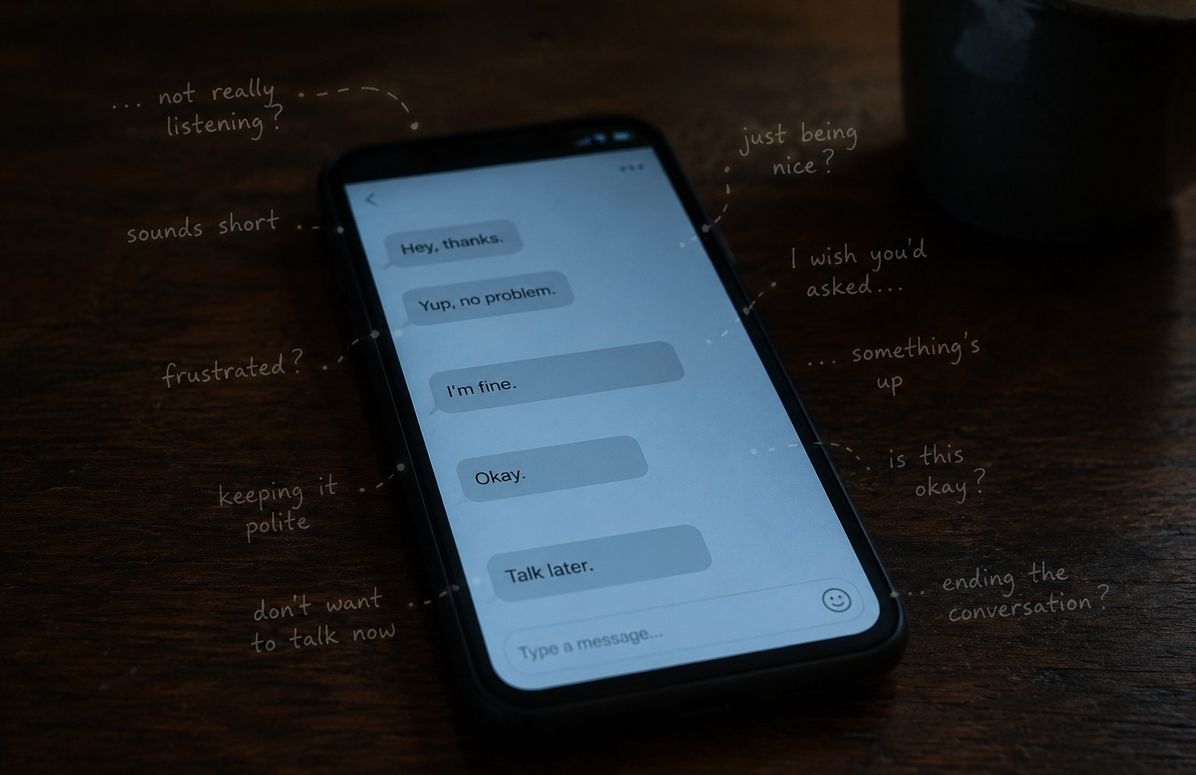
The gap contains meaning, but it also contains the listener’s fear, history and expectation.
Silence: What Cannot Be Said
There is another form of the unsaid: silence.
Silence is not always absence. Sometimes it is refusal. Sometimes it is respect. Sometimes it is grief, shock, love, fear, reverence, exhaustion or recognition. Sometimes silence is the only form precise enough for what is happening.
Ludwig Wittgenstein’s famous closing line in the Tractatus Logico-Philosophicus says, “Whereof one cannot speak, thereof one must be silent.” The sentence is often quoted as if it were merely austere. But it points to a boundary: not everything meaningful can be captured by propositional language.
Grice shows that meaning exceeds words through implication. Wittgenstein shows that meaning can exceed words through silence. Between them is a central truth of human communication: speech is not the whole of meaning.
There are moments when explanation would reduce what is present. A hand placed on the table. A pause after bad news. Two people sitting together after an apology. A look that says more than a paragraph could safely hold.
The unsaid is not always hidden because someone is withholding. Sometimes it is unsaid because saying it would make it smaller.

Sometimes the unsaid remains unsaid because saying it would make it smaller.
The Body Speaks Beside the Words
Conversation is never only verbal. The body speaks beside the words.
Tone can soften or sharpen the same sentence. A pause can invite, warn or accuse. A smile can reassure, conceal or perform. A glance away can signal thoughtfulness, shame, avoidance or fatigue. The meaning depends on context and relationship.
This is why literal transcripts are often poor records of real conversation. They preserve words while stripping away the living field in which those words occurred. They cannot fully capture the temperature of the room, the history between the speakers, the moment of hesitation, the breath before the answer or the body’s refusal to support the sentence.
A person may say, “I’m happy for you,” while their body contracts. Another may say nothing at all, but move closer. One statement is verbally generous but bodily conflicted. The other is verbally empty but relationally full.
This does not mean the body is always truthful and words are always false. Bodies can perform too. People can misread posture and tone. But the body is part of the conversation whether or not anyone admits it.
The mouth speaks sentences. The body speaks conditions.
The mouth speaks sentences. The body speaks conditions.
A Gnostic and Neo-Gnostic Reading
From a Gnostic perspective, the unsaid matters because surface language rarely exhausts reality.
The literal sentence is the visible layer. Beneath it are motive, fear, desire, history, restraint, shame, tenderness, defence and recognition. To hear only the literal is to remain at the surface. To hear the unsaid is to begin sensing the deeper architecture of the exchange.
This is not a licence for suspicion. Gnosis is not paranoia. Discernment does not mean inventing hidden meanings everywhere. It means recognising that appearances are partial and that truth often arrives indirectly.
The counterfeit spirit can also speak through implication. Manipulative omission, strategic ambiguity and plausible deniability all live in the same gap. A person can say nothing technically false while still steering another person away from truth.
But the gap can also carry love. It can carry mercy. It can carry respect for what is too delicate to expose too quickly. The unsaid is not automatically dark. It is simply powerful.
Gnosis begins when the surface stops exhausting the meaning.
Gnosis begins when the surface stops exhausting the meaning.
Useful Implication and Distorted Implication
The unsaid is not one thing. It can clarify, protect, conceal, connect or manipulate. Discernment means learning the difference.
| Form | How It Sounds or Appears | What It Can Communicate | Where It Becomes Dangerous |
|---|---|---|---|
| Direct speech | “I cannot come tonight.” | Clarity, boundary, practical information. | Can become blunt when care is needed. |
| Implicature | “I have an early start.” | Refusal, hesitation or context without direct confrontation. | Can become confusing when clarity is required. |
| Silence | A pause, no answer, sitting together. | Grief, respect, uncertainty, recognition or refusal. | Can become avoidance, punishment or erasure. |
| Body language | Posture, glance, tone, movement. | Emotional state beside the words. | Can be misread or projected onto. |
| Digital cue | Ellipsis, full stop, emoji, delay. | Tone, hesitation, humour, distance or warmth. | Can trigger over-interpretation with little evidence. |
| Strategic ambiguity | “We’ll see.” | Politeness, uncertainty or keeping options open. | Can become manipulation if used to avoid honesty. |
| Manipulative omission | Technically true but incomplete speech. | Control of what the listener can infer. | Can mislead while preserving plausible deniability. |
Practice: Listening for the Gap
Listening for the unsaid is not mind-reading. It is disciplined attention.
- Hear the literal words. Begin with what was actually said. Do not skip the surface.
- Notice the context. Who is speaking, where, when, under what pressure and in what relationship?
- Notice what was not said. Was something avoided, softened, delayed or qualified?
- Notice tone and rhythm. Did the body, voice or timing support the words or pull against them?
- Check your inference. Is this meaning supported by evidence, or is it being supplied by fear, memory or projection?
- Ask gently when needed. “When you say that, do you mean…?” can rescue a conversation from imagined certainty.
- Let silence remain silence. Not every gap needs decoding. Some silence deserves respect.
The best listening is neither literal-minded nor suspicious. It is spacious. It allows words, body, context and silence to appear together before rushing to a verdict.
To hear the unsaid well, you must also hear yourself: your assumptions, your fear, your longing, your old wounds and your desire to be certain.
Listening for the unsaid is not mind-reading. It is disciplined attention.

Conclusion: Once You Hear the Unsaid
Conversation is not a simple exchange of sentences.
It is a layered event. Words carry literal meaning. Context bends it. Tone colours it. Silence deepens it. The body complicates it. Shared history charges it. The listener completes it by inference.
This is why two people can hear the same sentence and receive different messages. They are not only hearing words. They are hearing relationship.
Once the architecture becomes visible, ordinary speech becomes richer and stranger. You begin to hear the qualifier, the pause, the careful omission, the unnecessary detail, the sudden change of subject, the silence that is full, the silence that is empty, the body that says what the mouth cannot.
This can make the world feel more complex. It can also make it more honest. Surface speech stops pretending to be the whole event. The unsaid steps forward as part of the conversation.
The task is not to decode everyone. The task is to listen more truthfully.
Because the deepest meaning is not always spoken.
Sometimes it waits in the space the words leave open.
Related Glossary Terms
These terms help frame the article’s main ideas across the wider ZenithEye archive.
- The Filter in Your Mind
- The Language Cage
- The Language Parasite
- Recognition
- Gnosis
- When Symbols Become Cages
- The Discipline of Not Interpreting Everything
- Pattern Recognition Without Paranoia
- The Spectacle
- Mental Plane
- Attention
- Phenomenology
- Symbol & Encryption
- Implicature
- Cooperative Principle
- Gricean Maxims
- Pragmatics
- Subtext
- Literal Meaning
- Implied Meaning
- Conversational Meaning
- Flouting Maxims
- Violating Maxims
- Digital Communication
- Nonverbal Communication
- Body Language
- Silence
- Reading Between the Lines
- Philosophy of Language
Read Next
Continue through the language and perception route: from linguistic filters into vocabulary cages, inner speech, hidden meaning, symbolic capture and direct recognition.
Further Reading
Articles from ZenithEye that continue the themes of language, meaning, attention, symbolic interpretation and direct seeing:
- The Filter in Your Mind – How linguistic relativity shapes what reality the mind becomes fluent at seeing.
- The Language Cage – How inherited words can become limits in self-description and perception.
- The Language Parasite – How the inner voice can become mistaken for the self.
- The Spectacle – How representation can replace direct encounter with reality.
- The Mental Plane Explained – Where thought, language and perception intersect.
- The Spiritual Practice of Attention – Attention as the first discipline of inner seeing.
- What Is Recognition? – Direct seeing beneath constructed filters.
- States of Knowing – What happens when consciousness detaches from ordinary filters.
- You Are Not What Happened to You – How narrative identity writes the self.
- Pattern Recognition Without Paranoia – Discernment without turning every pattern into threat.
Frequently Asked Questions
What is implicature?
Implicature is meaning that is communicated without being directly stated. It arises from context, shared assumptions and the listener’s expectation that the speaker is contributing meaningfully to the conversation.
What is Grice’s cooperative principle?
Grice’s cooperative principle is the idea that people in conversation normally contribute in ways suited to the accepted purpose of the exchange. It is not a moral rule, but a description of how meaning is inferred in ordinary communication.
What are Grice’s four conversational maxims?
The four maxims are Quantity, Quality, Relation and Manner. Quantity means giving enough information, Quality means trying to be truthful, Relation means being relevant and Manner means being clear and orderly.
What is the difference between flouting and violating a maxim?
Flouting a maxim means openly bending or breaking it so the listener can infer a deeper meaning, as in irony or sarcasm. Violating a maxim means secretly breaking it in order to mislead. Flouting invites inference; violating hides deception.
Why is digital communication so easy to misread?
Digital communication removes many cues such as tone, facial expression, posture and timing. As a result, punctuation, emojis, delays and message length carry more implied meaning, which makes projection and misunderstanding more likely.
Is silence a form of communication?
Yes. Silence can communicate grief, respect, refusal, love, uncertainty, exhaustion or recognition. It is not always absence. Sometimes silence is the most precise form available for what cannot yet be said.
Can reading the unsaid become unhealthy?
Yes, if it becomes suspicion or projection. Discernment means noticing context, tone and omission while also checking your inference. The unsaid should be approached with humility, not certainty.
References and Sources
The following sources shaped the article’s framework on implicature, conversation, silence, pragmatics and the hidden architecture of meaning.
Pragmatics and Philosophy of Language
- Grice, H. P. “Logic and Conversation.” In Syntax and Semantics 3: Speech Acts, edited by Peter Cole and Jerry L. Morgan. Academic Press, 1975.
- Grice, H. P. Studies in the Way of Words. Harvard University Press, 1989.
- Davis, Wayne A. “Implicature.” Routledge Encyclopedia of Philosophy. Taylor and Francis, 1998.
- Horn, Laurence R. and Ward, Gregory, eds. The Handbook of Pragmatics. Blackwell, 2006.
- Levinson, Stephen C. Pragmatics. Cambridge University Press, 1983.
Silence, Limits of Language and Meaning
- Wittgenstein, Ludwig. Tractatus Logico-Philosophicus. 1921.
- Wittgenstein, Ludwig. Philosophical Investigations. 1953.
- Research and commentary on silence as communication, philosophical silence and the limits of propositional language.
- Studies of nonverbal communication, paralanguage, gesture, tone and emotional expression.
Digital Communication and Inference
- Research on pragmatics in online text-based communication, including punctuation, emojis, timing and platform-specific norms.
- Studies of ambiguity, politeness, sarcasm and inference in digital conversation.
- Research on nonverbal cue loss and reconstruction of tone in computer-mediated communication.
Related ZenithEye Themes
- Language as perceptual filter.
- Inner speech and the voice in the head.
- Symbolic conditioning and the architecture of perception.
- Gnosis as recognition beneath surface appearance.
- Discernment without paranoia.
Safety Notice: This article explores the architecture of human communication, implication, silence and inference. It is not psychological, clinical or relationship advice. Readers experiencing distress related to social anxiety, communication difficulties, paranoia, obsessive interpretation, trauma responses or interpersonal conflict should seek support from a qualified professional. The aim is discernment, not suspicion.
Study Note: This article treats the unsaid as a normal part of communication, not as proof that every silence hides a secret. Human beings communicate through words, tone, context, body and omission. The task is not to decode everyone, but to listen with more precision, humility and presence.