The Book of Thomas the Contender: The Ascetic Strain of Gnostic Liberation
The Book of Thomas the Contender (NHC II,7) preserves one of the Nag Hammadi Library’s most challenging voices—a text that refuses to accommodate modern spiritual comfort with its unflinching ascetic rigour. Written for “those who are worthy,” this dialogue between Jesus and his twin Judas Thomas presents a sterner vision of liberation: the flesh is not temple but prison, the world not classroom but corruption, and salvation requires not gentle self-improvement but radical evacuation from material existence [1][2]. Where contemporary seekers speak of “embodied spirituality,” this tractate warns: “Woe to you who hope in the flesh and in the prison that will perish!”
Yet this difficulty is precisely its value. The Nag Hammadi Library preserves not one Gnosticism but many—mystical and ascetic, world-affirming and world-negating, poetic and polemical. Understanding this range prevents reduction of the tradition to comfortable modern appropriation. The Book of Thomas stands as the celestial administration’s most stringent filing requirement: the soul’s extraction from archonic jurisdiction demands complete renunciation of bodily identification [3].
Table of Contents
- The Dialogue Structure and Esoteric Framing
- The Bitterness of the Flesh: Radical Dualism
- Ascetic Practice as Liberation Protocol
- The Soul’s Ascent Through Contention
- Comparisons with Thomasine Traditions
- The Challenge for Contemporary Readers
- Historical Context: Syrian Encratism
- Reading Thomas the Contender Today
- Frequently Asked Questions
- Further Reading
- References and Sources
The Dialogue Structure and Esoteric Framing
The Book of Thomas presents itself as secret teaching, continuing the conversation between Jesus and his twin (the Didymos) that the Gospel of Thomas only suggests. The opening establishes the setting with bureaucratic precision: after the other disciples have departed, Jesus appears to Thomas and speaks “in secret,” offering teachings “which no ear has heard, nor have I put them into any heart” [4].
This framing—esoteric instruction for the single worthy disciple—differs markedly from the Gospel of Thomas‘s democratic address (“whoever finds the interpretation”). The Book of Thomas maintains strict hierarchy: some are worthy, others are not. The secret must be protected from the “swine” who would trample it. This elitism characterises the text’s entire approach, reflecting what scholars identify as the Thomasine school’s “encratite” tendency—a rigorist ethic of radical renunciation that flourished in Syrian Christian communities during the second and third centuries [5][6].
The dialogue form allows doctrinal development absent from the sayings collection. Jesus speaks at length, warning Thomas about the dangers of flesh, the deception of the senses, the necessity of ascetic struggle. Thomas responds, demonstrating his comprehension. The result is more catechetical than mystical—instruction in doctrine rather than evocation of recognition. It resembles a celestial training manual more than a mystical invitation.
The Bitterness of the Flesh: Radical Dualism
What is Encratism?
Encratism (from Greek enkratēs, “self-controlled”) refers to early Christian movements advocating radical asceticism—strict celibacy, vegetarianism, and renunciation of worldly goods as necessary for salvation. Unlike moderate asceticism, encratite theology viewed the material world as fundamentally corrupt and procreation as extending the chain of spiritual imprisonment. The Book of Thomas represents what scholars term “radical encratism” [7].
The Book of Thomas‘s most distinctive feature is its unrelenting hostility toward the body and material existence. Where other Nag Hammadi texts acknowledge the body as temporary vessel or even instrument of transformation, this text sees only corruption:
Primary Source Citation: “The wise man who has understood the bodies of darkness has stripped off the garment of flesh and put on a garment of light.” — Book of Thomas the Contender (NHC II,7 138:12-15) [8]
The flesh is “bitterness,” “pollution,” “garment of shame.” The senses deceive, drawing the soul into material entanglement. The world is “prison,” “tomb,” “corpse.” This is not the qualified dualism of Valentinianism, which maintains complex relationships between spirit and matter, but radical ontological rejection:
Primary Source Citation: “Woe to you who hope in the flesh and in the prison that will perish! How long will you be oblivious? And how long will you suppose that the imperishables will perish too?” — NHC II,7 142:25-30 [8]
The imperative is absolute: strip off the flesh, escape the prison, reject the world. The text’s Jesus demands not integration but evacuation—not transformation of embodiment but abandonment of it. This represents the most extreme pole of Nag Hammadi anthropology, one that views biological existence itself as the archonic trap from which the pneumatic soul must extricate itself [9].
Ascetic Practice as Liberation Protocol
This anthropology generates specific disciplinary protocols. The Book of Thomas prescribes rigorous asceticism as the soul’s extraction procedure from material jurisdiction:
Continence as Cosmic Refusal
Sexual abstinence is paramount. The fleshly union is “defilement”; procreation extends the chain of imprisonment. The text shares this emphasis with encratite Christianity and reflects Syrian ascetic movements that viewed marriage as collaboration with the demiurgic scheme of material perpetuation. For Thomas, celibacy is not mere virtue but ontological necessity—the refusal to generate more prisoners for the cosmic penitentiary [10].
Fasting and Sensory Deprivation
Abstention from food weakens the flesh’s grip. The body weakened becomes spirit strengthened. The “bitterness” of hunger is less than the bitterness of material existence. Fasting serves as systematic dismantling of the biological compulsion that keeps the soul anchored to the archonic administration’s jurisdiction.
Renunciation of Possessions
Wealth binds the soul to material concern. “You have not understood that the love of money is the root of all evils.” The wealthy man cannot ascend while his treasure weighs him down. This is not ethical critique but practical mechanics: attachments are gravitational forces preventing the soul’s upward trajectory through the planetary spheres.
Vigilance as Counter-Intelligence
Constant watchfulness against the flesh’s wiles. The body schemes continually to reassert dominance; the ascetic must remain awake, alert, resistant. This represents not paranoia but accurate assessment of the archonic bureaucracy’s persistent attempts to maintain the soul’s incarceration through biological compulsions [11].
The Soul’s Ascent Through Contention
Despite its ascetic severity, the Book of Thomas remains recognisably Gnostic—soteriology through knowledge (gnosis) rather than through suffering or ethical merit. The ascetic practices serve not as penance but as preparation: clearing away fleshly obstruction so that recognition can occur.
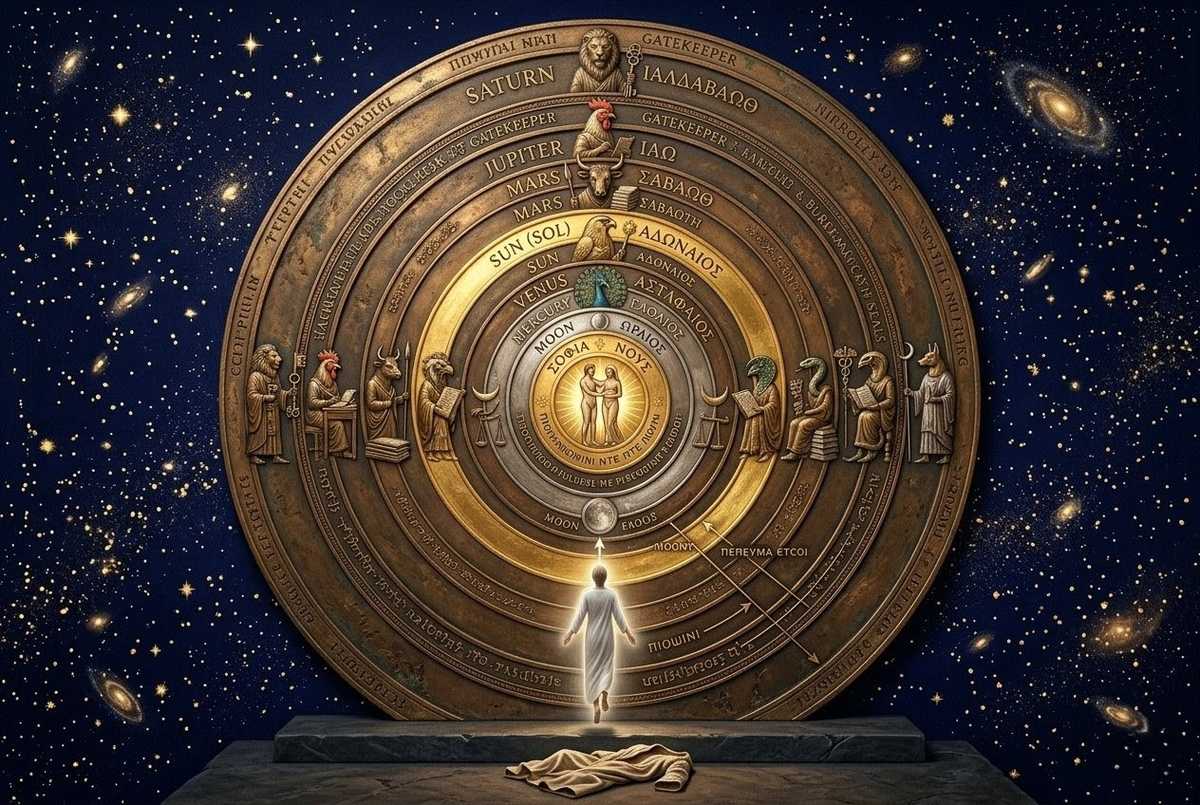
The ascent narrative follows familiar Sethian patterns: the soul, stripped of fleshly garments, rises through planetary spheres, giving account at each archonic gate, receiving passwords and seals, ultimately reaching the repose (anapausis) of the spiritual realm [12]. This is the celestial exit protocol shared with The Apocryphon of John and The Reality of the Archons.
Yet the Book of Thomas emphasises the difficulty of this ascent. Other texts suggest that recognition of divine identity suffices for liberation; this text insists on struggle, contest, the “contention” (agōn) that gives the work its title. The flesh resists; the world seduces; the archons attack. Only the “perfect”—those who have completed the ascetic program—will escape. This is not the gentle awakening of recognition but the aggressive extraction of a soul from enemy territory [13].
Comparisons with Thomasine Traditions
The Book of Thomas stands in sharp contrast to other Thomasine and related texts in the Nag Hammadi Library, revealing the diversity within this tradition:
Thomasine Text Spectrum
Vs. the Gospel of Thomas: The sayings gospel offers paradox and invitation: “Whoever discovers the interpretation will not taste death.” The Book of Thomas offers warning and demand: “Woe to you who hope in the flesh!” Where the Sayings evoke recognition, the Contender prescribes renunciation.
Vs. the Gospel of Philip: Philip celebrates the bridal chamber (nymphōn), sacramental sexuality, the union of opposites. The Book of Thomas rejects such mystery: sexuality is defilement, union is contamination, the only salvation is separation from flesh.
Vs. the Dialogue of the Saviour: This related text (NHC III,5) maintains similar dialogue form but offers more balanced perspective, acknowledging both ascetic necessity and spiritual potential of embodied existence.
These comparisons reveal the Book of Thomas as representing one pole of Gnostic diversity—the most world-negating, body-rejecting extreme. Its presence in the library prevents reduction of Gnosticism to comfortable modern categories. The ancient compilers were clearly comfortable with contradiction, preserving texts that fundamentally disagreed about the value of embodiment [14].
The Challenge for Contemporary Readers
Modern seekers, particularly those drawn to “embodied spirituality,” find the Book of Thomas problematic. Its misogyny (the text identifies femaleness with fleshly entrapment), its body-hatred, its elitism, its apocalyptic urgency—all challenge contemporary values. The text seems to emanate from a spiritual universe where the contemporary “love your body” mantra would be regarded as archonic deception of the highest order.
Yet the text offers necessary corrective. The contemporary wellness industry’s “love your body” mantra can become its own prison—attachment to health, appearance, pleasure. The Book of Thomas reminds us that the body is temporary, that death comes for all flesh, that spiritual development may require difficult renunciation. The archonic administration’s most subtle trap may be convincing prisoners that their cell is a boutique hotel [15].
Moreover, the text accurately diagnoses certain dangers: fleshly hope, material attachment, the deception of comfort. The ascetic strain in Gnosticism, however extreme, responds to genuine spiritual insight—the recognition that consciousness cannot be fully free while dominated by biological compulsion. The text forces readers to confront what they are willing to surrender for genuine liberation.
Historical Context: Syrian Encratism
The Book of Thomas likely emerged from Syrian encratite Christianity—communities that practised rigorous continence, rejected marriage, and viewed the material world as fundamentally evil. These groups, flourishing in the second and third centuries in Edessa and surrounding regions, maintained close relationships with Gnostic movements while preserving distinct identity [16][17].
The text’s presence in the Nag Hammadi library (Codex II, alongside the Gospel of Thomas, Gospel of Philip, and Apocryphon of John) suggests that ancient Gnostic communities collected diverse perspectives, preserving texts that disagreed with each other. The library is not a doctrinal statement but an archive—a collection of resources for different temperaments and stages. The celestial administration, it seems, maintained multiple departmental protocols for soul extraction [18].
John D. Turner’s seminal edition identifies the text’s close affinities with the Acts of Thomas, another encratite text from the Syrian Thomasine tradition. Both share the twin motif, the emphasis on celibacy, and the view of the material world as corrupt. The Book of Thomas likely dates to the late second or early third century, representing the theological apex of this Syrian ascetic movement before its marginalisation by more moderate orthodox Christianity [19].
Reading Thomas the Contender Today
Contemporary engagement with this text requires discernment. Its ascetic program may not suit all constitutions; its dualism may prove psychologically damaging for those prone to dissociation; its misogyny must be rejected outright as archonic contamination of the message.
Yet the text offers specific value for the contemporary seeker:
- Recognition of difficulty: Spiritual development is not always gentle; sometimes it requires “contention”—the struggle against deeply ingrained habits of identification with body and world.
- Diagnosis of attachment: Hope in the flesh, identification with body, material security—all may obstruct awakening. The text functions as a diagnostic tool for identifying hidden attachments.
- Preparation for death: The text’s memento mori, however extreme, reminds us of impermanence. The body will perish; what then remains?
- Historical perspective: Understanding the range of Gnostic attitudes prevents projection of modern assumptions onto ancient texts. The tradition was always more diverse than contemporary appropriations suggest.
The Book of Thomas the Contender does not coddle. It warns, demands, threatens. For the seeker who has grown comfortable, who mistakes spiritual interest for spiritual attainment, who clings to fleshly security—this text offers salutary shock. The prison door stands open, but escape requires leaving behind everything the prisoner holds dear. The celestial administration does not process partial resignations; one must renounce the entire archonic filing system to achieve pneumatic freedom [20].
Frequently Asked Questions
What is the Book of Thomas the Contender and why is it important?
The Book of Thomas the Contender (NHC II,7) is a Sethian Gnostic text presenting a dialogue between Jesus and his twin Judas Thomas. It is important because it preserves the most radical encratite (ascetic) strain of early Christianity, viewing the body as prison and material world as corruption. Unlike other Thomasine texts, it demands complete renunciation rather than mystical recognition–offering a necessary corrective to modern “embodied spirituality” appropriations.
Which Nag Hammadi codex contains the Book of Thomas the Contender?
The Book of Thomas the Contender appears in Codex II of the Nag Hammadi Library, discovered in 1945 near Nag Hammadi, Egypt. It is the seventh and final tractate in this codex, appearing alongside the Gospel of Thomas, Gospel of Philip, and the Apocryphon of John–forming a collection of Thomasine and Sethian texts that likely circulated together in ancient reading communities.
What are the main differences between the Book of Thomas and the Gospel of Thomas?
While both are Thomasine texts, they differ fundamentally in approach. The Gospel of Thomas presents cryptic sayings inviting interpretation (“whoever finds the interpretation will not taste death”). The Book of Thomas offers catechetical instruction demanding renunciation (“Woe to you who hope in the flesh”). The Sayings Gospel is democratic; the Contender is elitist, offering secret teachings only for “those who are worthy.”
What is encratism and how does the Book of Thomas reflect it?
Encratism refers to early Christian movements advocating radical asceticism–strict celibacy, vegetarianism, and renunciation of worldly goods as necessary for salvation. The Book of Thomas represents “radical encratism,” viewing the material world as fundamentally corrupt and procreation as extending spiritual imprisonment. Its Jesus demands not ethical improvement but elimination of fleshly functions entirely.
Is the Book of Thomas Sethian or Valentinian Gnosticism?
The Book of Thomas is classified as Sethian Gnosticism, sharing the ascent pattern through planetary spheres guarded by archons, the use of passwords and seals, and the goal of repose (anapausis) in the spiritual realm. However, it lacks the complex Valentinian system of aeons and syzygies, presenting instead a stark dualism between corrupt matter and liberated spirit.
What is the historical context of the Book of Thomas the Contender?
The text likely emerged from Syrian encratite Christianity in the late second or early third century CE, possibly from Edessa. Syrian Christianity developed an elaborate “twin” (Didymos) theology around Thomas as the mystical twin of Jesus. The text shares affinities with the Acts of Thomas and Tatian’s encratite teachings, representing the theological apex of Syrian ascetic movements.
Why is the Book of Thomas challenging for modern readers?
Modern readers find the text challenging because it rejects contemporary values of “embodied spirituality,” viewing the flesh as “bitterness,” “pollution,” and “prison.” Its radical dualism, misogyny (identifying femaleness with entrapment), and elitism contradict modern spiritual inclusivity. However, it offers value as a diagnostic tool for hidden attachments and a reminder that spiritual liberation may require difficult renunciation rather than comfortable affirmation.
Further Reading
To explore the Thomasine traditions and their contexts in depth:
- The Gospel of Thomas: 114 Keys to the Kingdom — The sayings collection presenting the mystical invitation to recognition, contrasting with the Book of Thomas’s demanding asceticism.
- The Gospel of Philip: Sacrament and Eros — Explores the Valentinian celebration of the bridal chamber (nymphōn) and sacramental sexuality, the polar opposite of Thomas the Contender’s rejection of flesh.
- Sethian and Valentinian Traditions in the Nag Hammadi Library — Maps the theological diversity within the library, placing Thomas the Contender within the Sethian ascent literature tradition.
- The Reality of the Archons: When the Archons Encountered the Light — Examines the Sethian archonic cosmology underlying Thomas the Contender’s prison metaphors.
- The Apocryphon of John: Sethian Creation Myth — The foundational Sethian text sharing Thomas the Contender’s ascent pattern and archonic prison metaphors.
- The Nag Hammadi Library: Complete Guide to Gnostic Scriptures — Master overview of the entire library including Codex II and its collection of Thomasine texts.
- Asceticism and Discipline: The Architecture of Restraint — Explores the psychology and practice of rigorous ascetic discipline across contemplative traditions.
- Integration Through Shadow, Eros, and Trauma as Sacred Fuel — Examines the shadow work necessary when confronting the radical dualism and body rejection found in texts like Thomas the Contender.
- Against Spiritual Bypassing: The Refusal to Feel — Critical examination of how radical world-rejection can become a sophisticated form of bypassing–relevant to evaluating Thomas the Contender’s ascetic demands.
- The Dialogue of the Saviour: Living Knowledge — Related dialogue text offering a more balanced perspective on ascetic necessity versus embodied spirituality.
References and Sources
The following sources support the claims and quotations presented in this article:
Primary Sources
- [1] Turner, John D. (1975). The Book of Thomas the Contender. Society of Biblical Literature.
- [2] Attridge, Harold W. (1989). “The Greek Fragments.” In Nag Hammadi Codex II,2-7 together with XIII,2*, Brit. Lib. Or.4926(1), and P. Oxy. 1, 654, 655. Brill.
- [3] Waldstein, Michael & Wisse, Frederik (1995). The Apocryphon of John: Synopsis of Nag Hammadi Codices II,1; III,1; and IV,1 with BG 8502,2. Brill.
- [4] Layton, Bentley (1989). Nag Hammadi Codex II, 2-7 together with XIII,2*, Brit. Lib. Or.4926(1), and P. Oxy 1, 654, 655. Brill.
- [5] Uro, Risto (1998). “Is Thomas an Encratite Gospel?” In Thomas at the Crossroads: Essays on the Gospel of Thomas. T&T Clark.
- [6] Drijvers, Han J.W. (1984). East of Antioch: Studies in Early Syriac Christianity. Variorum Reprints.
- [7] Koester, Helmut & Lambdin, Thomas O. (1977). “Introduction to the Gospel of Thomas.” In The Nag Hammadi Library in English. Harper & Row.
- [8] Robinson, James M. (1977). The Nag Hammadi Library in English. Harper & Row.
- [9] McGrath, James F. (2008). “History and Fiction in the Acts of Thomas: The State of the Question.” Journal for the Study of the Pseudepigrapha, 17(4), 297-299.
- [10] Patterson, Stephen J. (1994). “The Gospel of Thomas and the Historical Jesus.” Forum, 10, 103-114.
- [11] Quispel, Gilles (1967). Makarius, das Thomasevangelium und das Lied von der Perle. Brill.
- [12] Brent, Allen (1995). Hippolytus and the Roman Church in the Third Century: Communities in Tension before the Emergence of a Monarch-Bishop. Brill.
- [13] Murray, Robert (2006). Symbols of Church and Kingdom: A Study in Early Syriac Tradition. T&T Clark.
- [14] Marjanen, Antti (1998). “Is Thomas a Gnostic Gospel?” In Thomas at the Crossroads: Essays on the Gospel of Thomas. T&T Clark.
- [15] DeConick, April D. (1996). Seek to See Him: Ascent and Vision Mysticism in the Gospel of Thomas. Brill.
- [16] Chartrand-Burke, Tony (2001). “The Infancy Gospel of Thomas.” Journal of Early Christian Studies, University of Toronto.
- [17] Puech, Henri-Charles (1978). En quête de la Gnose II: Sur l’évangile selon Thomas. Gallimard.
- [18] Grosso, Matteo (2007). Aspetti della ricezione del Vangelo secondo Tommaso: dal periodo delle origini a Clemente Alessandrino. University of Turin.
- [19] Koester, Helmut (1990). Ancient Christian Gospels: Their History and Development. Trinity Press International.
- [20] Tuckett, Christopher M. (1988). “Thomas and the Synoptics.” Novum Testamentum, 30, 132-157.
Editions and Translations Consulted
- Turner, John D. (2013). “The Book of Thomas the Contender (NHC II,7).” In The Coptic Gnostic Library: A Complete Edition of the Nag Hammadi Codices. Brill. [Critical edition with Coptic text, English translation, and commentary]
- Layton, Bentley (1987). The Gnostic Scriptures: A New Translation with Annotations and Introductions. Doubleday. [Alternative English translation and notes]
- Meyer, Marvin (2007). The Nag Hammadi Scriptures: The Revised and Updated Translation of Sacred Gnostic Texts Complete in One Volume. HarperOne. [Contemporary translation with introductions]