
Mandaeism: The Last Living Gnostic Religion
They call themselves the Nasoraeans–the guardians of secret knowledge–and they have persisted for nearly two thousand years along the waterways of southern Iraq and Iran’s Khuzestan Province. Their name, Mandaean, derives from the Aramaic manda, meaning “knowledge,” sharing the same root as the Greek gnosis that gave Gnosticism its name. They are the only surviving religious community from late antiquity that explicitly self-identifies as Gnostic. While the Sethian and Valentinian schools of Egypt disappeared beneath the weight of orthodox condemnation and historical forgetting, the Mandaeans continued to baptise their children in the living waters of the Shatt al-Arab, to recite the Ginza Rabba in their liturgical tongue, and to maintain a priesthood that traces its lineage across centuries of persecution, diaspora, and quiet endurance.
For scholars of Gnosticism, the Mandaeans represent something extraordinary: a control group. Every other Gnostic tradition must be reconstructed from patristic polemics, fragmentary papyri, and the lucky survival of codices buried in Egyptian jars. The Mandaeans, by contrast, are still alive. Their priests still perform the masbuta. Their scriptures still circulate in manuscript copies. Their cosmology–with its World of Light, its chain of divine emanations, its flawed demiurge, and its redeemer who descends through planetary spheres–can be observed not as an archaeological reconstruction but as a living practice. This article offers a definitive guide to Mandaean cosmology and examines how it illuminates, parallels, and diverges from the Sethian and Valentinian traditions preserved in the Nag Hammadi Library.
Table of Contents
- Who Are the Mandaeans? The Nasoraeans and Their Scriptures
- The World of Light and the Chain of Emanations
- Ptahil and Ruha: The Flawed Creation
- The Masbuta: Baptism as Repeated Restoration
- The Masiqta: Death as Ascent Through the Toll Stations
- Mandaeism and the Nag Hammadi Traditions: Parallels and Divergences
- Endangered Faith: The Modern Mandaean Diaspora
- Frequently Asked Questions
- Further Reading
- References and Sources
Who Are the Mandaeans? The Nasoraeans and Their Scriptures
The Mandaeans are an ethno-religious community whose origins remain debated among scholars. Some trace them to first-century Palestine, suggesting they migrated eastward under Parthian rule into Mesopotamia. Others argue for a Mesopotamian origin with subsequent Jewish and Christian influences. What is certain is that by the third century CE, they possessed a developed ritual system, a priestly hierarchy, and a corpus of scriptures in Mandaic–an Eastern Aramaic dialect written in a distinctive geometric script. They call themselves Ṣābi (the Baptisers) or Nasoraeans (the Guardians), and they have never sought converts, maintaining their identity through endogamy and ritual purity across two millennia.
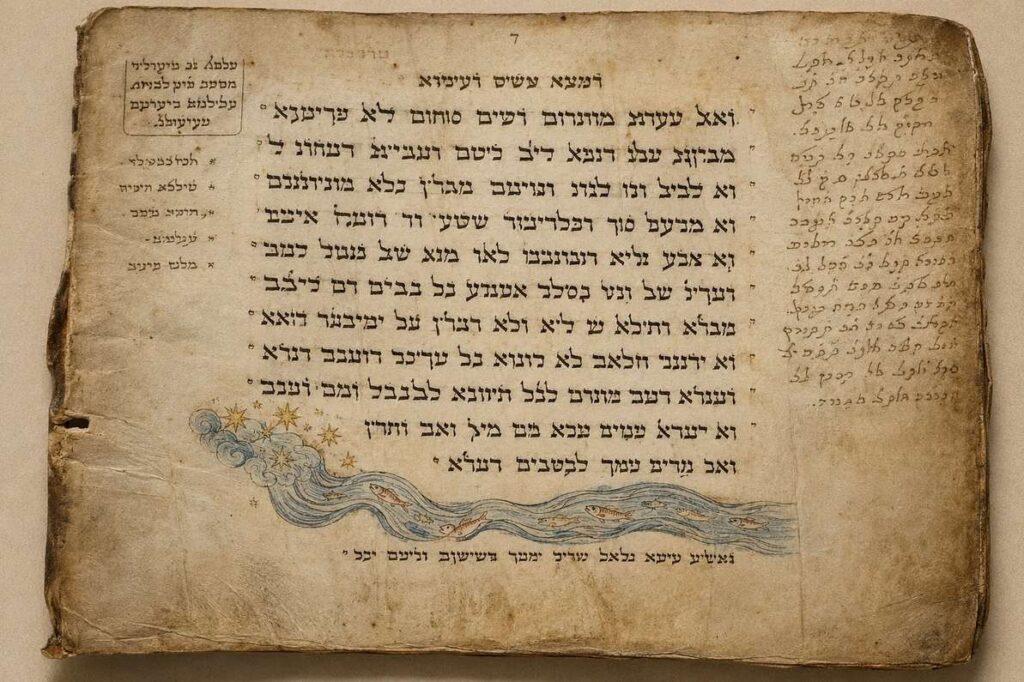
Their primary scripture is the Ginza Rabba, the Great Treasure, a vast compendium divided into the Right Ginza (concerned with the World of Light, cosmogony, and the soul’s ascent) and the Left Ginza (concerned with the World of Darkness, the soul’s descent, and eschatological battles). Alongside it stands the Drasha d-Yahia, the Mandaean Book of John, which presents John the Baptist as the greatest prophet and teacher of the living water. The Qolasta (Canonical Prayerbook) contains the liturgical hymns recited during baptism, marriage, and death rituals. The Haran Gawaita and the Scroll of Abatur provide additional cosmological and ritual detail, including the famous image of Abatur at the scales, weighing the souls of the dead.
Central to Mandaean identity is their relationship with John the Baptist. Unlike Christianity, which subordinates John to Jesus, Mandaeism elevates John as the authentic messenger of the World of Light and dismisses Jesus as a false prophet, magician, and apostate who perverted the true teaching. The Book of John describes Jesus coming to John demanding baptism, being rebuffed, and ultimately receiving the rite only through divine exasperation rather than approval. This inversion of the gospel narrative is not merely polemical; it is foundational. For the Mandaeans, the true baptism is the one John administered in the Jordan of living water, and all subsequent claims–Christian, Islamic, or otherwise–are deviations from that original stream.
The World of Light and the Chain of Emanations
Mandaean cosmology divides the universe into three realms: the World of Light (alma d-nhura), the earthly world (Tibil), and the World of Darkness (alma d-hšuka). At the summit of the World of Light dwells Hayyi Rabbi, the Great Life or First Life, the supreme deity who exists beyond all predication, beyond gender, beyond the categories that govern the lower worlds. Hayyi Rabbi is not a person in the anthropomorphic sense but the source of all life, light, and knowledge–the ground from which the entire chain of being descends.
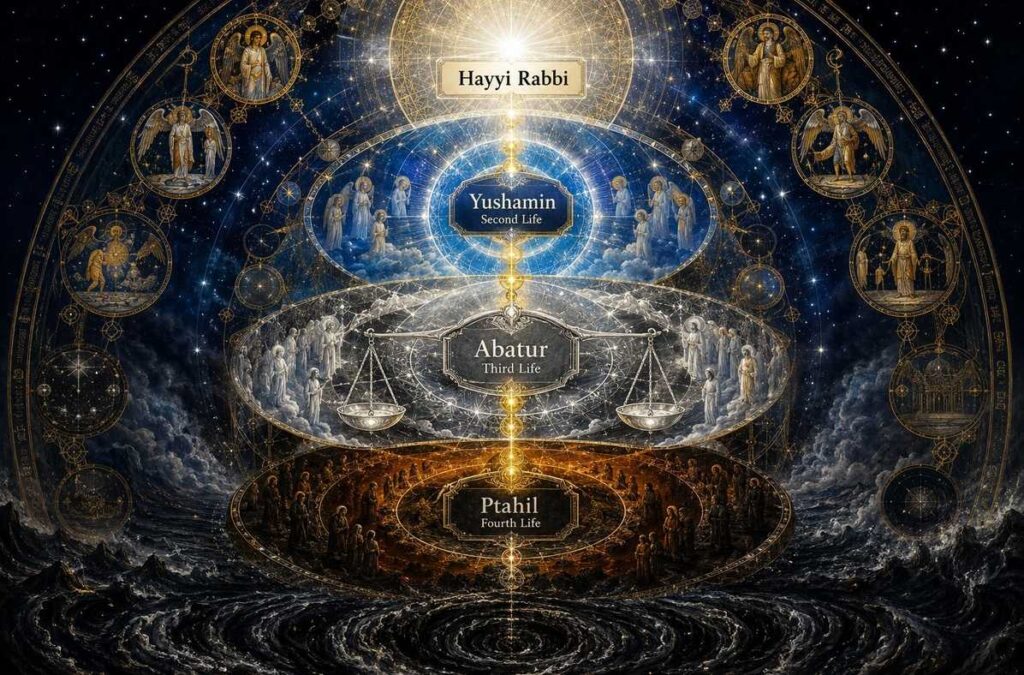
From Hayyi Rabbi emanates Yushamin, the Second Life, an eternal uthra or being of light who initiates the process of cosmic differentiation. Yushamin in turn emanates Abatur, the Third Life, the ancient and occult one who gazes into the black waters and oversees the weighing of souls. Abatur is the boundary figure, the guardian who stands at the threshold between the pure light of the upper realms and the turbulent darkness below. From Abatur comes Ptahil, the Fourth Life, who is tasked with the creation of the material world. This chain–First, Second, Third, Fourth–establishes a hierarchy of increasing distance from the divine source, with each subsequent emanation possessing less luminosity and more involvement with matter.
The World of Light is not merely a heaven but a realm of pure ether (ayar), living water (Yardena), and radiant tabernacles (škina). It is populated by countless uthras, angelic beings of light who move through the ether and serve the Great Life. Every human being possesses a dmuta–a heavenly counterpart or image–that dwells in the Mšunia Kušta, the abode of truth within the World of Light. The goal of Mandaean religion is to reunite the soul with this counterpart, to restore the original unity that was fractured when the soul fell into material embodiment.
Ptahil and Ruha: The Flawed Creation
Ptahil’s role in Mandaean cosmology is that of the demiurge–the subordinate creator who fashions the material world but lacks the power to animate it with true life. In the Ginza Rabba, Ptahil descends into the black primordial waters at Abatur’s command, equipped with a garment of living fire and the secret of solidification. He issues seven calls to establish boundaries, crafts the firmament, and shapes the earth (Tibil) from the chaotic depths. He attempts to create Adam as the king of the world, moulding the body from clay and dust, but the figure collapses. Ptahil can build the vessel; he cannot fill it.
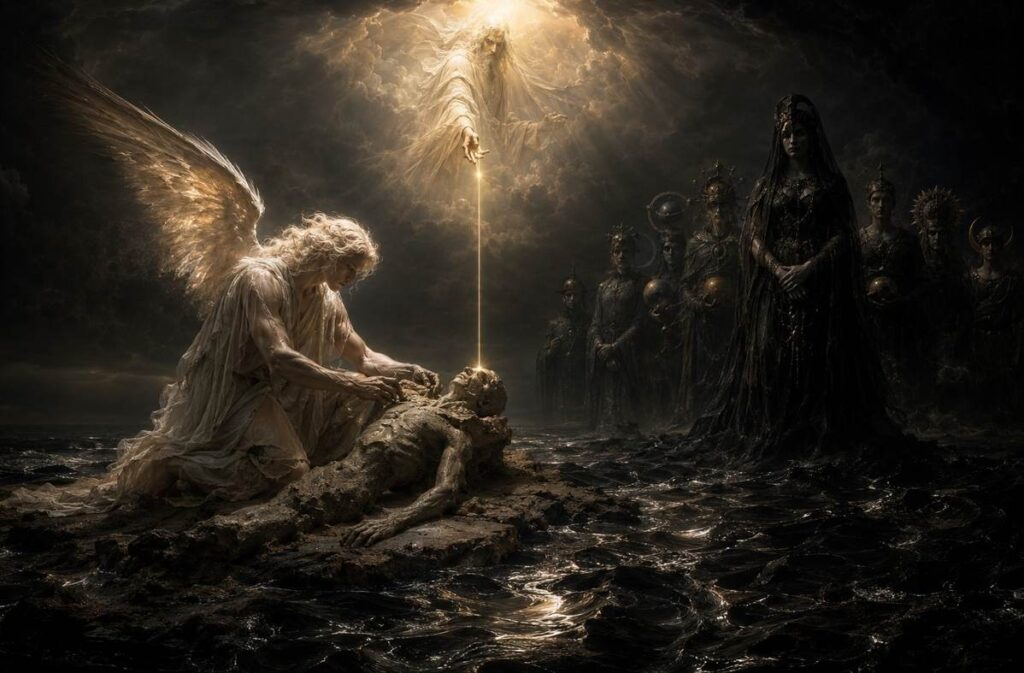
The infusion of the soul (nišimta) requires the intervention of higher beings. Hibil Ziwa, a luminous uthra, descends to provide the divine spark that Ptahil cannot generate. This is the Mandaean version of the Gnostic rescue: the creator is incompetent, and salvation must come from beyond the created order. Ptahil’s name itself hints at syncretic origins–a fusion of the Egyptian creator god Ptah with the Semitic divine suffix -il, suggesting that the Mandaeans absorbed and reinterpreted the religious symbols of the lands through which they travelled.
Alongside Ptahil stands Ruha, the Spirit–but not the Holy Spirit of Christian theology. In Mandaeism, Ruha is a malevolent female figure, the mother of the seven planets and the twelve signs of the zodiac, the queen of the World of Darkness who seeks to entrap human souls in the cycle of birth and death. She attempts to seduce Adam, to bind him to procreation and material desire, and to prevent his return to the World of Light. Ruha and her planetary children function as the Mandaean equivalent of the archons–celestial gatekeepers who obstruct the soul’s ascent and demand recognition, worship, and obedience. The Ginza Rabba describes her end as sealed: she will ultimately be destroyed, and her children cast into the abyss.
The Masbuta: Baptism as Repeated Restoration
The central ritual of Mandaeism is the masbuta, baptism in running water. Unlike the Christian sacrament, which is typically administered once and understood as an initiation into the church, the Mandaean masbuta is performed repeatedly throughout life–weekly, monthly, or at major life transitions. The ritual requires Yardena, a Jordan of living water: a river, canal, or stream that flows continuously. Stagnant water is unacceptable; the water must be alive, moving, carrying the current of the World of Light into the material realm.
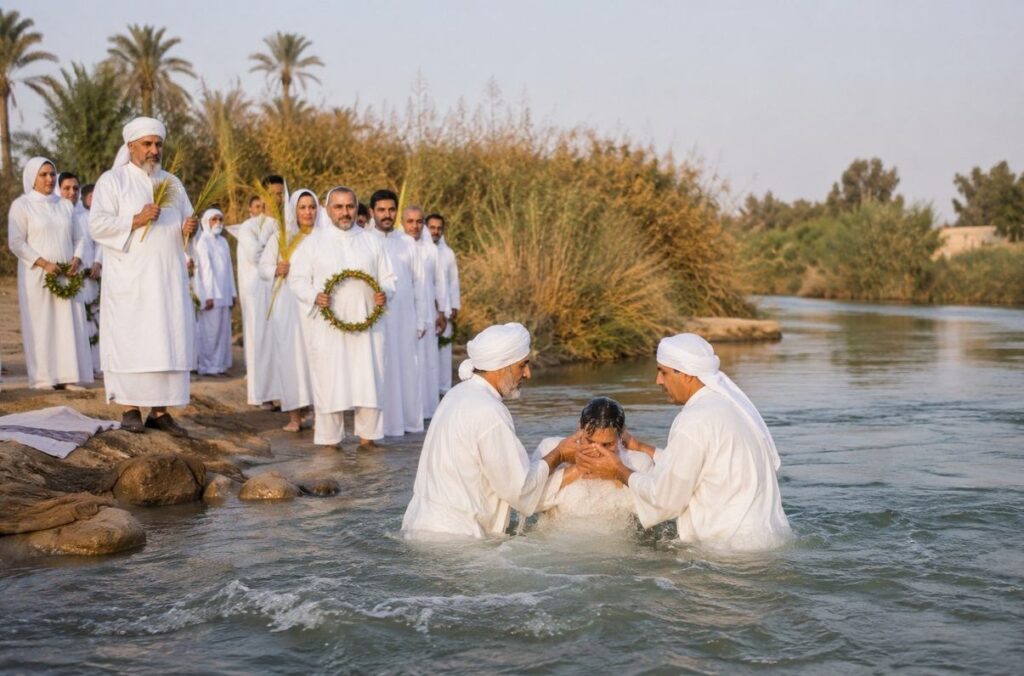
The ceremony is conducted by priests in white robes, who immerse the participant fully while reciting prayers from the Qolasta. The ritual includes the sign of the Jordan, the consumption of sacred bread (pihta) and water (mambuha), and the crowning with myrtle wreaths. Each masbuta is understood as a restoration of the soul’s connection to the World of Light, a washing away of the impurities accumulated through contact with the material world, and a re-enactment of the primordial baptism that established the human being as a child of light. For the Mandaeans, baptism is not a historical event commemorated but a present reality re-entered.
This repeated baptism has no parallel in Valentinianism, where the five sacraments (baptism, anointing, eucharist, redemption, bridal chamber) function as progressive initiations administered once. The Sethian Five Seals, attested in the Apocryphon of John and the Trimorphic Protennoia, are also understood as definitive ritual events. Only Mandaeism maintains a baptismal theology of continuous return–a practice that reflects the religion’s fundamental optimism about the accessibility of the divine. The World of Light is not distant; it flows through every river, and the priest who immerses you is re-establishing a connection that was never truly severed, only obscured.
The Masiqta: Death as Ascent Through the Toll Stations
When a Mandaean dies, the priesthood performs the masiqta–the death mass or ascension ritual–a complex liturgy that guides the soul (nišimta) from the body through a series of celestial checkpoints called maṭarta (watch-stations or toll-gates) and ultimately to reunion with the dmuta in the World of Light. The masiqta can last for days, involving elaborate prayers, food offerings, and the recitation of texts that provide the soul with the passwords and recognitions necessary to pass the planetary guardians.
This ascent theology is strikingly parallel to the Sethian tradition preserved in the Nag Hammadi Library. The Apocryphon of John describes the soul’s passage past the seven planetary spheres, each governed by an archon who must be addressed by name and renounced. The Mandaean maṭarta function identically: the soul encounters guardians at each planetary station, and only those who possess the correct knowledge–the names, the signs, the ritual preparations performed by the living–can pass through. The Scroll of Abatur describes Abatur at the scales, weighing the soul against its deeds, and the heavenly tree Šatrin where the souls of unbaptised children are nourished for thirty days before Hibil Ziwa baptises them and admits them to the Light.
Mandaeism and the Nag Hammadi Traditions: Parallels and Divergences
The structural parallels between Mandaeism and the Nag Hammadi schools are extensive enough that scholars have spent decades debating whether the Mandaeans represent a late survival of the same currents that produced the Sethians and Valentinians, or whether they developed independently in Mesopotamia through contact with Jewish, Christian, and Iranian materials. The consensus today is cautiously synthetic: Mandaeism is a distinct tradition with its own history, but it shares sufficient DNA with the classical Gnostic schools to illuminate them from a unique angle.
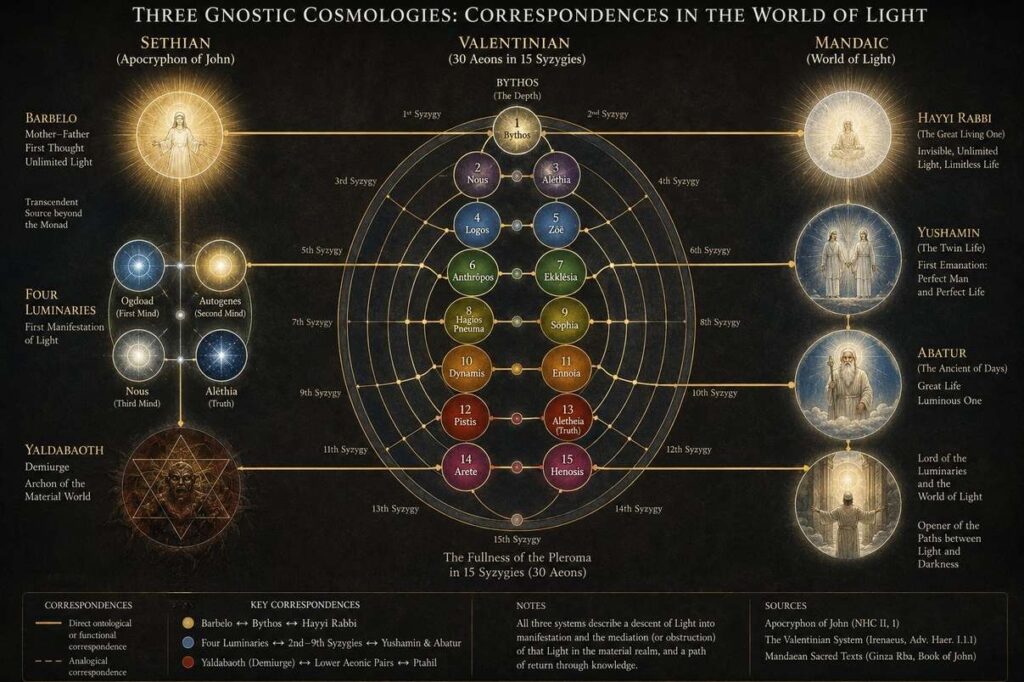
With Sethianism, the parallels are cosmological. Both traditions describe an elaborate hierarchy of divine emanations descending from a transcendent source. Both posit a demiurge who creates the material world in ignorance or incompetence. Both maintain that the human soul must ascend past planetary archons to return to the light. Both employ baptism as a ritual of spiritual transformation, and both preserve detailed lists of archontic names and passwords. The Sethian Barbelo and the Mandaean Hayyi Rabbi both function as the ineffable source beyond all naming. The Sethian Yaldabaoth and the Mandaean Ptahil both create matter without understanding the spirit. The differences are equally significant: the Mandaeans lack the Sophia myth that dominates Sethian cosmogony; they have no figure corresponding to the fallen wisdom whose passion generates the material world.
With Valentinianism, the parallels are ritual and theological. Both traditions understand salvation as restoration rather than rebellion. Both employ baptism as a central sacrament. Both maintain a tripartite anthropology, though the Mandaean version is less systematically articulated than the Valentinian hylic-psychic-pneumatic schema. The Valentinian bridal chamber (nymphon) and the Mandaean masbuta both use ritual union as a metaphor for reunion with the divine. Yet the Valentinians remained Christian–they wrestled with the historical Jesus, the cross, and the church. The Mandaeans rejected Jesus entirely, viewing him as an agent of Ruha rather than a messenger of light. This divergence is absolute and non-negotiable; it marks the boundary between two Gnostic worlds that could not be reconciled.
The most important divergence is institutional. The Nag Hammadi texts were produced by loose schools, study circles, and monastic communities. The Mandaeans are an ethnoreligious people with a hereditary priesthood, endogamous marriage customs, and a prohibition against conversion. They did not seek to spread gnosis to the world; they sought to preserve it for their own. This closed identity has ensured their survival but also their fragility. A tradition that cannot accept converts is a tradition that cannot easily replace its losses.
Endangered Faith: The Modern Mandaean Diaspora
Prior to 2003, the vast majority of Mandaeans lived in Iraq, concentrated in Baghdad, Basra, and the marshlands of the south. The Iraq War and the subsequent sectarian violence devastated the community. Extremist groups targeted Mandaeans as infidels; their pacifism made them defenceless; their dependence on natural waterways for ritual baptism became impossible in a landscape of pollution and displacement. By 2007, the Iraqi Mandaean population had declined to approximately 5,000. Iran’s community, centred in Ahvaz and the Khuzestan Province, has also faced persecution, though it survived the Islamic Revolution with greater numbers than its Iraqi counterpart.
Today, the global Mandaean population is estimated at 60,000 to 100,000, scattered across diaspora communities in Australia, Sweden, the Netherlands, the United Kingdom, and the United States. The scholar Jorunn Buckley, the world’s foremost expert on Mandaeism, has worked for decades with Mandaean priests and communities, and her archive has been acquired by the Library of Congress to preserve this endangered heritage. Fewer than fifty priests remain worldwide, and the community faces a crisis of transmission. New generations, raised in secular Western societies, are drifting from the tradition. The ancient prohibition against conversion–once a marker of purity–is now debated as a potential death sentence for the religion.
The Mandaeans are the last witnesses. When they disappear, something irreplaceable vanishes: not merely a set of texts or rituals, but a way of being Gnostic that has remained continuous since late antiquity. The Nag Hammadi Library gave us the words of dead Gnostics. The Mandaeans give us their voice. To study them is to hear, however distantly, the sound of a tradition that has outlived every empire that sought to define, convert, or destroy it. The water still flows. The priests still baptise. And the Great Life, somewhere beyond the planetary spheres, still waits for the return of every soul that remembers its name.
Frequently Asked Questions
What does the word Mandaean mean and why is it considered Gnostic?
The term derives from the Aramaic word manda, meaning knowledge or gnosis. It is cognate with the Imperial Aramaic manda’ found in the Book of Daniel and the Hebrew madda’. The Mandaeans explicitly self-identify as Gnostics–their scholar Brikha Nasoraia defines Mandaeism (mandāyutā) as directly equivalent to Gnosticism. They are the only surviving religious community from late antiquity that retains this self-designation, making them a living bridge to the ancient Gnostic world.
Who are the Nasoraeans and what is their relationship to John the Baptist?
The Nasoraeans (or Nazoreans) are the Mandaean priestly elite–guardians of secret knowledge and ritual expertise. They revere John the Baptist as their greatest prophet and teacher, believing he possessed the true baptism in living water. Jesus, by contrast, is rejected as a false prophet, magician, and apostate who corrupted John’s teaching. The Mandaean Book of John (Drasha d-Yahia) presents John as the authentic messenger of the World of Light, while Jesus is associated with the forces of darkness and the material realm.
What is the Ginza Rabba and what does it contain?
The Ginza Rabba, or Great Treasure, is the central scripture of Mandaeism, divided into the Right Ginza (devoted to the soul’s ascent and the World of Light) and the Left Ginza (devoted to the soul’s descent and the World of Darkness). It contains cosmogonies, hymns, prayers, and ritual instructions. Key narratives include the emanation of the Four Lives from Hayyi Rabbi, the creation of the material world by Ptahil, the descent of Manda d-Hayye (Knowledge of Life) to redeem imprisoned souls, and detailed descriptions of the death mass (masiqta) that guides the soul past planetary toll stations.
Who is Ptahil and how does he function as a demiurge?
Ptahil is the Fourth Life in the Mandaean emanation chain, descending from Hayyi Rabbi through Yushamin and Abatur. He is tasked with creating the material world (Tibil) from the black primordial waters. However, he is a flawed creator: he can shape physical bodies from clay but cannot infuse them with souls (nishimta). Higher beings such as Hibil Ziwa must descend to provide the divine spark. Ptahil’s name combines the Egyptian creator god Ptah with the Semitic suffix -il, suggesting syncretic origins. He is not evil but limited–a skilled artisan who lacks the authority to complete his own work.
What is the masbuta and how does it differ from Christian baptism?
The masbuta is the central Mandaean ritual of baptism in running water–the Yardena or Jordan of Life. Unlike Christian baptism, which is typically administered once for the forgiveness of sins, the masbuta is performed repeatedly throughout a Mandaean’s life as an act of purification, remembrance, and spiritual restoration. It involves full immersion by priests in white robes, accompanied by prayers, the sign of the Jordan, and the consumption of sacred bread (pihta) and water (mambuha). The ritual reconnects the participant with the living waters of the World of Light.
How does Mandaean cosmology compare to Sethian and Valentinian traditions?
All three traditions share core Gnostic architecture: a transcendent deity beyond the material world, a subordinate demiurge who creates flawed matter, a divine spark trapped in human bodies, and a redeemer figure who descends to liberate souls. The Sethian Apocryphon of John and the Mandaean Ginza Rabba both describe elaborate emanation hierarchies and planetary archons who obstruct the soul’s ascent. Valentinianism and Mandaeism both emphasise baptismal theology, though Valentinian baptism is initiatory while Mandaean baptism is repeated. Key differences include the Mandaeans’ absolute rejection of Jesus, their lack of a Sophia myth, and their ethnoreligious identity as a closed community.
Why is Mandaeism endangered today?
The Mandaean community has faced persecution in both Iran and Iraq, particularly after the 2003 Iraq War and the rise of sectarian violence. Their pacifism, refusal to convert others, and dependence on natural waterways for ritual baptism have made them vulnerable in conflict zones. The global population has declined to approximately 60,000-100,000, with most now living in diaspora communities in Australia, Sweden, the United Kingdom, and the United States. Fewer than fifty priests remain, and the community is currently debating whether to relax the prohibition on conversion to ensure survival.
Safety Notice: This article explores a living religious tradition. It does not constitute theological advice or encourage conversion to or appropriation of Mandaean practices. The Mandaean community does not accept converts, and their rituals are restricted to initiated members. Readers are encouraged to approach this material with scholarly respect and cultural sensitivity. If you are experiencing religious or spiritual distress, please contact a qualified mental health professional.
Further Reading
- The Demented God Architect — Unmasking the Demiurge across Gnostic traditions, from Yaldabaoth to Ptahil and the flawed creation of the material world.
- Apocryphon of John: Foundational Text of Sethian Gnosticism — The Sethian creation account that parallels Mandaean cosmology in its elaborate emanation hierarchy and planetary archons.
- Sethian and Valentinian: Two Great Streams — Direct comparison of the two major Nag Hammadi schools that illuminate Mandaean parallels and divergences.
- Valentinian Christianity: System and Influence — The most philosophically sophisticated Gnostic school, offering contrast with Mandaean ritual theology and baptismal practice.
- 5 Gnostic Schools Explained — Comprehensive overview of Sethian, Valentinian, Hermetic, and Thomasine traditions and their distinct paths to gnosis.
- The Sophia Myth: Three Falls, Three Redemptions — The divine feminine narrative that dominates Sethian and Valentinian cosmology but is absent from Mandaean scripture.
- The Names of the Archons — Identifying the planetary prison wardens across Gnostic traditions, from the Sethian Hebdomad to Ruha and her seven children.
- Nag Hammadi Library: Complete Guide to 46 Gnostic Scriptures — The master hub for navigating all tractates, codices, and thematic collections in the Contemporary Gnostic Archive.
References and Sources
The following sources represent the scholarly monographs, primary texts, and critical studies underlying this article.
Primary Sources and Critical Editions
- The Ginza Rabba. Translated by Mark Lidzbarski. Ginza: Der Schatz oder Das Grosse Buch der Mandaer. J. C. Hinrichs, 1925. [Modern critical edition by Brikha Nasoraia in progress.]
- The Mandaean Book of John (Drasha d-Yahia). Edited and translated by Charles G. Häberl and James F. McGrath. De Gruyter, 2020.
- The Canonical Prayerbook of the Mandaeans (Qolasta). Translated by E. S. Drower. Brill, 1959.
- The Haran Gawaita. Translated by E. S. Drower. Vatican City, 1953.
- The Scroll of Abatur. Translated by E. S. Drower. Vatican City, 1950.
Scholarly Monographs
- Buckley, Jorunn J. The Mandaeans: Ancient Texts and Modern People. Oxford University Press, 2002.
- Buckley, Jorunn J. The Great Stem of Souls: Reconstructing Mandaean History. Gorgias Press, 2005.
- Drower, E. S. The Mandaeans of Iraq and Iran. Oxford University Press, 1937.
- Macuch, Rudolf. Handbook of Classical and Modern Mandaic. De Gruyter, 1965.
- Nasoraia, Brikha H. S. Mandaeism: The Last Gnostic Religion. Various scholarly articles and editions, 2010s-2020s.
Comparative and Gnostic Studies
- The Apocryphon of John (NHC II,1; III,1; IV,1). In The Nag Hammadi Library in English, 4th revised edition, edited by Marvin Meyer. HarperOne, 2007.
- The Trimorphic Protennoia (NHC XIII,1). In The Nag Hammadi Library in English, 4th revised edition, edited by Marvin Meyer. HarperOne, 2007.
- The Tripartite Tractate (NHC I,5). In The Nag Hammadi Library in English, 4th revised edition, edited by Marvin Meyer. HarperOne, 2007.
- King, Karen L. What Is Gnosticism? Harvard University Press, 2003.
- Brakke, David. The Gnostics: Myth, Ritual, and Diversity in Early Christianity. Harvard University Press, 2010.
- Rudolph, Kurt. Gnosis: The Nature and History of Gnosticism. Translated by Robert McLachlan Wilson. Harper & Row, 1987.