Negative Entities and Their Hunting Grounds
Negative entities and their hunting grounds belong to the darker edge of esoteric tradition: the places, states, patterns, and thresholds where human vitality seems most vulnerable to predatory forces. Across folklore, demonology, Gnostic myth, Buddhist cosmology, grimoires, sleep-paralysis reports, trauma narratives, and occult testimony, one pattern repeats: certain presences appear where fear, pain, addiction, sexual compulsion, death, dissociation, or collective violence has gathered.
This article treats those beings as folklore, symbolic anatomy, esoteric classification, and psychological warning. It does not require the reader to believe every entity is literally external. It also does not dismiss terrifying experiences as meaningless. The wiser approach is layered: some encounters may be sleep paralysis, trauma memory, dissociation, grief, projection, addiction, religious fear, social contagion, or ordinary human cruelty. Others may be understood by practitioners through the older language of spirits, Archons, hungry ghosts, egregores, psychic attack, and parasitic consciousness.
The word “hunting ground” matters. Predatory patterns do not appear randomly. They gather where the human field is opened by intensity: fear without grounding, desire without presence, pain without support, death without ritual, addiction without meaning, power without conscience, and technology without discernment. Whether the predator is read as an entity, a thought-form, an institution, a trauma loop, or an archonic system, the question remains the same: what conditions allow human life-force to be harvested?
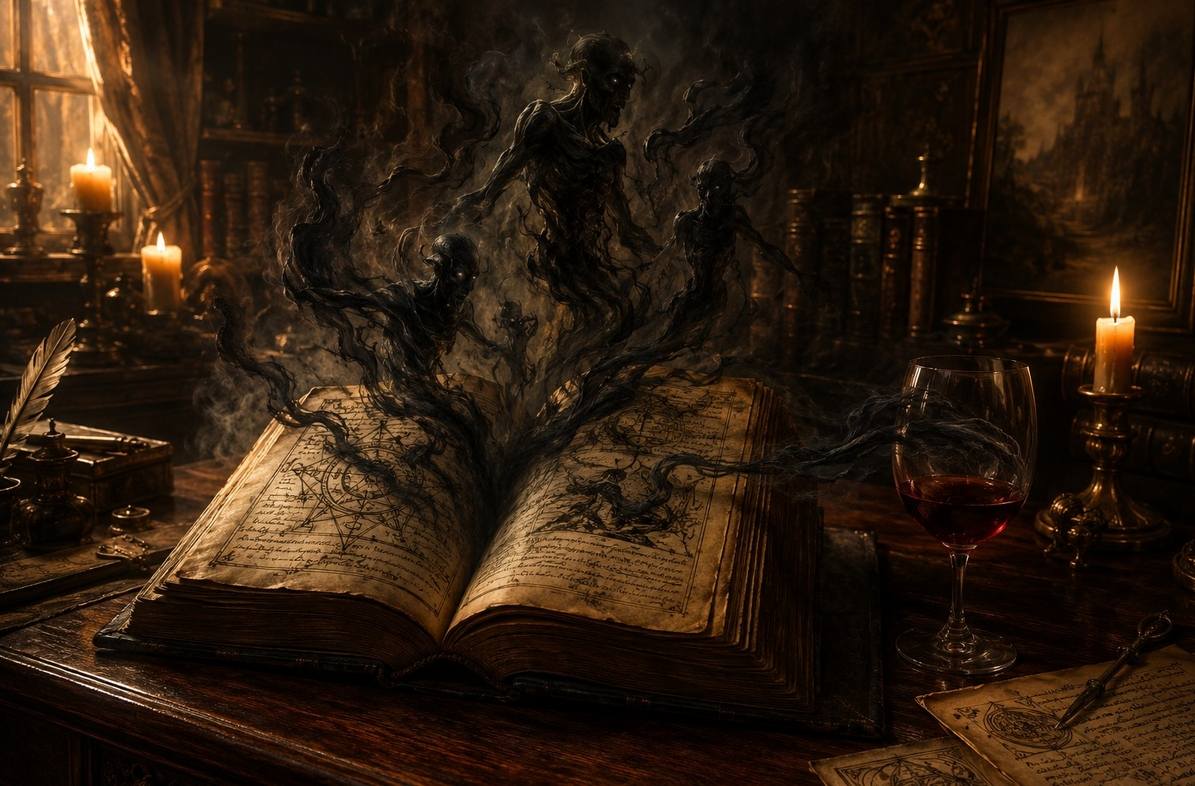
In Plain Terms
Negative entities are beings, presences, patterns, or symbolic forces traditionally believed to feed on human fear, pain, desire, confusion, addiction, or spiritual vulnerability.
Hunting grounds are the conditions where those patterns gather: bedrooms during sleep paralysis, places of trauma, sites of violence, addiction loops, deathbeds, institutions of control, digital outrage systems, and inner states of fear or fragmentation.
The safest reading is neither panic nor denial. Some experiences may be medical, psychological, cultural, or sleep-related. Others may be spiritually meaningful to the experiencer. The point is discernment: recognise the pattern, restore grounding, strengthen boundaries, and seek qualified help when distress is intense or persistent.
Sources and Traditions Discussed
- Gnostic texts, especially Archons, counterfeit spirit, soul captivity, and the mythic language of false powers.
- Tibetan Buddhist bardo literature, especially peaceful and wrathful visions, hungry ghosts, and the need for recognition after death.
- Jewish and Kabbalistic demonology, including Lilith, Mazzikim, Qliphoth, and protective boundary traditions.
- Medieval and Renaissance grimoires, including Solomonic, Picatrix, and demonological catalogues, read as historical and symbolic material rather than practical instruction.
- Sleep-paralysis research, including sensed presence, night-hag experiences, chest pressure, shadow figures, and threshold-state fear.
- Trauma-aware psychology, including dissociation, hypervigilance, intrusive imagery, compulsive behaviour, and the need to distinguish spiritual interpretation from clinical distress.
- Modern systems critique, including addiction economies, attention capture, propaganda, war egregores, institutional cruelty, and digital outrage loops.
- Predatory Consciousness, the ZenithEye route for studying intrusive forces, psychic boundaries, parasitic patterns, and sovereignty.
How to Read This Article
This article uses strong esoteric language: entities, hunters, parasites, Archons, hungry ghosts, egregores, false guides, and predatory consciousness. Read that language as mythic and symbolic unless your own tradition gives it a literal meaning. The material is intended to sharpen discernment, not feed fear.
Do not use this article to diagnose yourself or others as possessed, targeted, infested, spiritually superior, spiritually doomed, or under attack. Experiences of voices, presences, paranoia, terror, sleep disruption, intrusive imagery, compulsive behaviour, trauma symptoms, suicidal thoughts, or difficulty functioning deserve qualified medical or mental health support.
The grounded rule is simple: spiritual interpretation should make you steadier, kinder, clearer, and more embodied. If an interpretation increases panic, isolation, grandiosity, hatred, or fear of ordinary life, pause it. The night archive is useful only when read with a lantern in one hand and your feet on the floor.
Predatory consciousness gathers where human intensity becomes unconscious: fear without grounding, desire without presence, pain without witness, and power without conscience.
Table of Contents
- The Nature of the Hunters
- The Sexual Vampires: Succubi, Incubi, and the Lilitu
- The Fear Eaters: Shadow People and the Hat Man
- The Pain Harvesters: Hospitals, Suffering, and the Long Agony
- The Death Guides: Psychopomps or Predators?
- The Torture Specialists: Cruelty as a Feeding Field
- The Addiction Feeders: Hungry Ghosts and Lower-Chakra Loops
- The War Demons: Egregores of Collective Violence
- Digital Hunting Grounds: Attention, Outrage, and Algorithmic Feeding
- Defence and Liberation: The Grounded Path
- The Gnostic Reading: Archons, Patterns, and Sovereignty
- Related Glossary Terms
- Read Next
- Frequently Asked Questions
- Further Reading
- References and Sources
The Nature of the Hunters
Traditional cultures rarely imagine negative entities as one uniform class. Some feed on fear. Some are linked with lust. Some gather around pain, grief, addiction, death, bloodshed, or madness. Some appear as demons, some as hungry ghosts, some as jinn, some as shadow figures, some as wandering dead, some as thought-forms, some as institutional forces, and some as the dark underside of human desire.
The older traditions speak in beings. Modern psychology often speaks in patterns. Both languages can be useful. “Entity” gives a face to a force that feels alien, autonomous, intrusive, or predatory. “Pattern” protects the reader from becoming trapped in literal fear. The art is to hold both without collapsing into either superstition or dismissal.
Predatory consciousness, in this article, means any force that appears to feed on life without returning life. It may be experienced as a spirit, a person, a group, an institution, a compulsion, an addiction, a trauma loop, a digital system, or a haunting atmosphere. Its signature is not glamour or horror. Its signature is depletion.
A hunting ground is created when vulnerability becomes repeated and unprotected. Fear revisited without support becomes a field. Desire repeated without presence becomes a field. Pain prolonged without witness becomes a field. Addiction ritualised by habit becomes a field. War, propaganda, cruelty, and humiliation become fields large enough to feed collective beings, or at least collective patterns that behave like beings.
The first defence is not warfare. It is recognition. You cannot clean a room while denying the dust. You also cannot heal a wound by naming every shadow a demon and refusing the doctor. Discernment is the blade with two edges.
The Sexual Vampires: Succubi, Incubi, and the Lilitu
Ancient names: succubus, incubus, Lilitu, Lilim, Lamia, Empusa, astral larvae, erotic night spirits.
Hunting grounds: bedrooms, sleep-paralysis states, erotic dreams, compulsive fantasy loops, sexual shame, exploitative relationships, pornography loops, places of sexual violence, and any inner state where desire becomes split from embodiment, consent, care, and truth.
The succubus and incubus are classic figures of nocturnal predation. In medieval demonology, they visit sleepers and drain vitality through sexual encounter. In Jewish Lilith traditions, night spirits and Lilim become linked with nocturnal emissions, infant danger, erotic threat, and the shadow side of desire. In modern occultism, similar experiences may be described as astral parasitism, sexual energy harvesting, or attachment around the sacral field.
A grounded reading begins with sleep and psychology. Many succubus or incubus reports resemble sleep paralysis: the mind wakes while the body remains temporarily paralysed, producing sensed presence, bodily pressure, touch, fear, arousal, and vivid imagery. The experience may be terrifying and meaningful without requiring instant metaphysical certainty.
The deeper symbolic point is not that sexuality is dirty. Sexuality can be loving, sacred, playful, creative, and healing. The danger appears when erotic energy is separated from presence. Desire without grounding becomes easy to imitate. Pleasure without mutuality becomes easy to harvest. Shame turns the bedroom into a locked archive, and the archive grows teeth.
The sexual predator of folklore appears where desire is powerful, but not yet integrated.
Possible signs of the pattern: recurring sexual dreams that leave distress or exhaustion; sleep paralysis with erotic or invasive imagery; compulsive sexual behaviour that feels disconnected from genuine desire; shame after arousal; repeated attraction to people who leave the body depleted; fear of sleep; or a sense that fantasy has become stronger than relationship.
Discernment: do not rush to call this “infestation”. Look first at sleep quality, trauma history, anxiety, pornography use, relationship wounds, sexual repression, medication effects, and stress. Esoteric language may help some readers name the pattern, but healing begins with honesty, care, and grounded support.
The Fear Eaters: Shadow People and the Hat Man
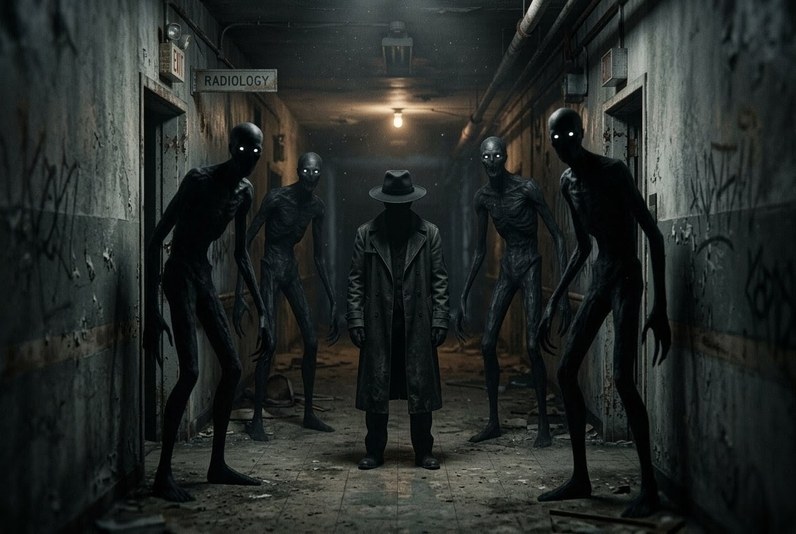
Ancient and related names: Archons, jinn, shades, umbrae, mare, night-hag, bedroom intruder, shadow people, Hat Man.
Hunting grounds: sleep paralysis, trauma states, abusive environments, fearful households, prisons, war zones, areas of chronic stress, darkened rooms, peripheral vision, and collective fear loops amplified by media and digital systems.
Shadow people are among the most commonly reported modern entity experiences. They appear as dark human-like forms, often at the edge of vision, during sleep paralysis, in haunted locations, or in moments of fear and exhaustion. The Hat Man is a specific recurring image: a tall shadow figure wearing a brimmed hat, sometimes seen during sleep paralysis or childhood night terrors.
There is no need to pretend the interpretation is settled. Sleep science explains many such encounters through hypnagogic and hypnopompic hallucination, REM atonia, sensed presence, and the brain’s threat system. Folklore explains them as night-hags, jinn, demons, or shadow beings. Esoteric traditions may read them as fear-feeding entities. Trauma psychology may see hypervigilance, dissociation, or intrusive perception shaped by fear.
The useful question is not “which single explanation wins?” but “what is the pattern doing?” If the experience feeds fear, isolates the person, disrupts sleep, or becomes obsessive, then grounding matters more than metaphysical certainty.
Possible signs of the pattern: recurring sensed presence at night, dark figures in peripheral vision, fear of rooms or corners, sleep paralysis with chest pressure, nightmares of pursuit or suffocation, sudden dread in specific places, or repeated childhood reports of frightening “imaginary friends”.
Discernment: with children, use special care. Do not frighten them by confirming terrifying interpretations. Offer reassurance, stable sleep routines, warm light, emotional support, and professional help if fear, behaviour change, or sleep disturbance persists. The goal is safety, not turning childhood imagination into a courtroom for invisible suspects.
The Pain Harvesters: Hospitals, Suffering, and the Long Agony
Ancient and related names: cacodemons, Erinyes, Mara, Mazzikim, hungry shades, harmful spirits, pain-feeders.
Hunting grounds: places of prolonged suffering, including hospitals, intensive care units, battlefields, torture sites, slaughterhouses, prisons, domestic abuse environments, and any setting where pain becomes extended, hidden, isolated, or stripped of ritual care.
Many traditions sense that prolonged suffering changes the atmosphere of a place. A room where people suffer without comfort feels different from a room where suffering is witnessed, held, and tended. The occult imagination names this difference with beings: pain harvesters, harmful spirits, hungry presences, or entities drawn to agony.
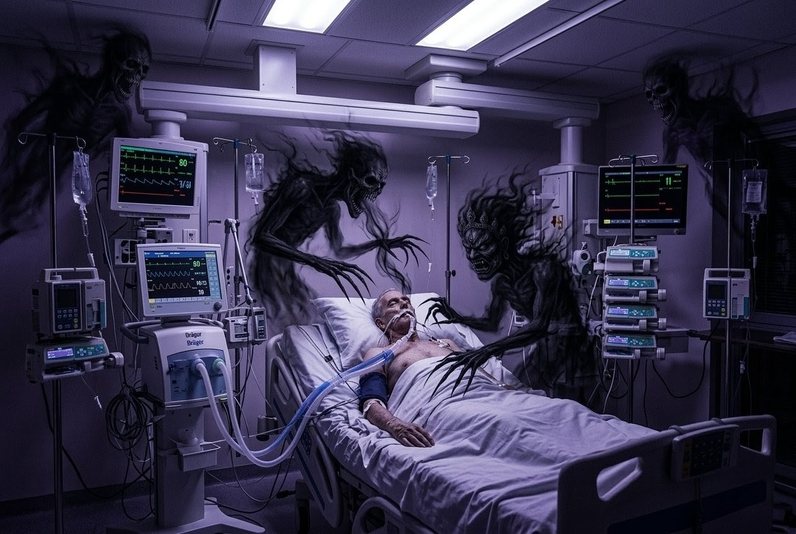
This section needs careful handling. Hospitals are not evil. Medical staff are not predators because they work near suffering. Modern medicine saves lives, relieves pain, and supports families in crisis. Yet many people also sense that highly medicalised suffering, especially when isolated from family, ritual, dignity, or spiritual preparation, can become a hard and frightening field.
In Tibetan Buddhist bardo literature, wrathful visions appear after death, but they are usually understood as manifestations of mind rather than external tormentors. In other traditions, harmful spirits may gather near the sick and dying. A trauma-aware reading holds both possibilities symbolically: intense pain can generate terrifying inner forms, and certain environments can feel spiritually heavy because human suffering has accumulated there.
Possible signs of the pattern: repeated reports of frightening presences in places of illness or death; overwhelming heaviness in rooms where suffering has concentrated; fear of dying without support; terminal agitation; staff burnout; or survivors describing presences during extreme pain or trauma.
Discernment: interpret such reports gently. Pain, medication, fever, grief, delirium, oxygen changes, sleep deprivation, trauma, and end-of-life processes can all produce visions or altered perception. Spiritual care, hospice support, family presence, prayer, music, touch, and compassionate medicine can transform the field. Not every shadow requires exorcism. Sometimes it requires morphine, song, and someone holding the hand.
The Death Guides: Psychopomps or Predators?
Ancient and related names: psychopomps, Valkyries, angels of death, Yama, Yamadutas, Ankou, Grim Reaper, ancestral guides, false-light figures.
Hunting grounds: deathbeds, grief spaces, battlefields, disaster sites, near-death experiences, post-mortem visionary states, and the imagination of the dying or bereaved.
Many traditions speak of beings who guide the dead. Hermes, Anubis, angels, ancestors, Valkyries, Yama’s messengers, and countless local figures appear at the threshold between body and whatever comes next. In healthy form, the psychopomp does not terrorise. It guides, accompanies, translates, and protects the crossing.
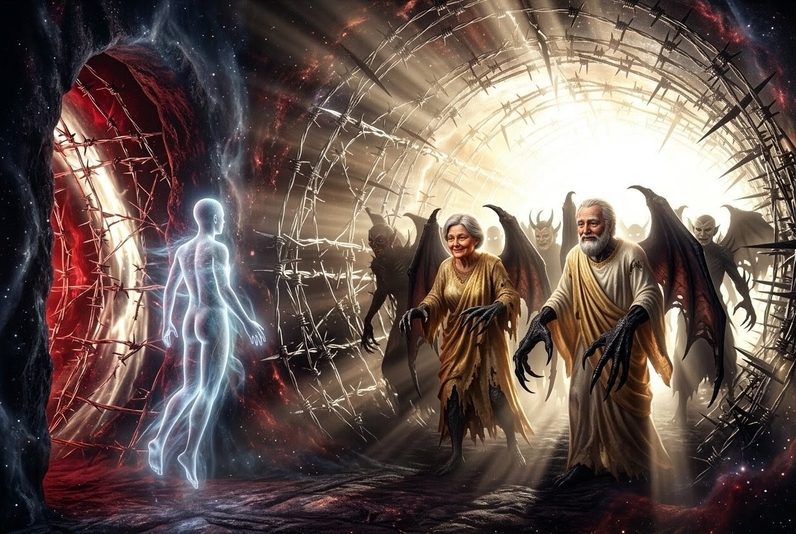
Some modern esoteric and soul-trap traditions warn that not every guide is benevolent. They describe false lights, misleading ancestors, coercive tunnels, or beings that hurry the soul into rebirth, obedience, or forgetting. These claims are speculative and cannot be treated as settled fact. Their symbolic value, however, is clear: even at the threshold of death, discernment matters.
In the Egyptian Book of the Dead, the soul must know names, gates, and formulae. In Hermetic ascent traditions, the soul passes through planetary layers and releases attachments. In the Bardo Thodol, recognition of the Clear Light is central, and frightening or beautiful visions must be recognised rather than blindly followed.
Signs of false guidance in symbolic terms: urgency, coercion, fear, flattery, demand for worship, loss of choice, pressure to obey without recognition, or a light that feels more like suction than invitation.
Discernment: readers should not become afraid of deathbed visions or near-death accounts. Many experiences of light, loved ones, and peace appear profoundly comforting and meaningful. The practical teaching is simpler: cultivate recognition while alive. A clear heart needs fewer passwords at the gate.
The Torture Specialists: Cruelty as a Feeding Field
Ancient and related names: tormentors, infernal powers, oni, rakshasas, flesh-eaters, sadistic egregores, cruelty fields.
Hunting grounds: torture chambers, genocide sites, interrogation rooms, abuse systems, sadistic groups, violent institutions, and any environment where cruelty is repeated, normalised, and given permission by authority.
Some forms of human cruelty feel larger than the individual. This does not remove human responsibility. It sharpens it. People choose, obey, comply, escalate, justify, conceal, and participate. But traditions of predatory consciousness suggest that repeated cruelty can also generate a field: a pattern that encourages more cruelty, rewards numbness, and feeds on the humiliation of the helpless.
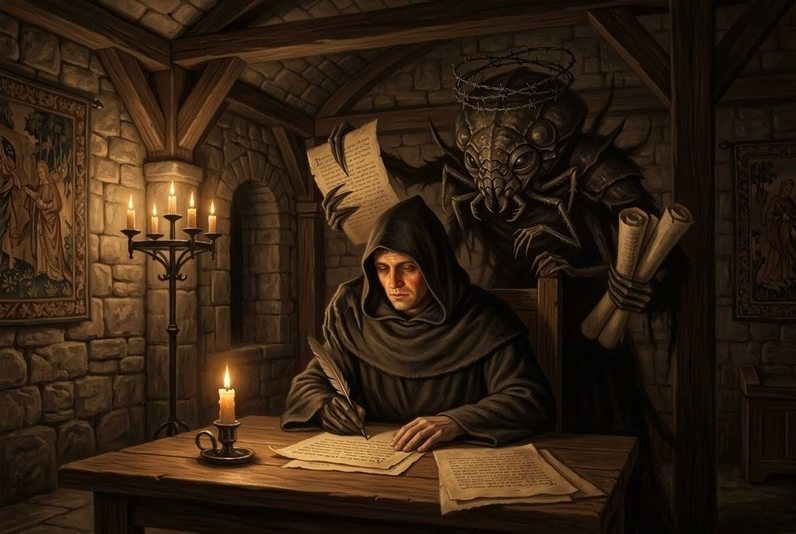
The Inquisition, witch trials, genocides, secret prisons, abusive institutions, and sadistic subcultures all show how cruelty becomes organised. Documents such as the Malleus Maleficarum are historically important not because they prove demons were running Europe, but because they show how theology, fear, misogyny, authority, and procedure can manufacture a machinery of suffering.
In this sense, the “torture specialist” may be read as an egregore of cruelty: a collective pattern that outlives any one participant. It recruits through ideology, obedience, dehumanisation, secrecy, and the intoxicating feeling of power over the vulnerable.
Possible signs of the pattern: cruelty framed as duty; pleasure in another’s helplessness; escalating punishment beyond any practical purpose; groups bonding through humiliation; institutions hiding abuse; and individuals claiming they felt “taken over” while still remaining responsible for their actions.
Discernment: do not use entity language to excuse perpetrators. A person who harms others remains accountable. The symbolic reading simply adds another layer: cruelty feeds something, whether that something is ego, ideology, addiction to power, trauma repetition, or a darker field of collective force.
The Addiction Feeders: Hungry Ghosts and Lower-Chakra Loops
Ancient and related names: pretas, hungry ghosts, larvae, astral shells, Qliphoth, intrusive patterns, craving forms, lower-chakra feeders.
Hunting grounds: addiction spaces, compulsive digital loops, gambling platforms, drug-use environments, pornography loops, shopping systems, binge cycles, social-media feeds, and any repeated behaviour that promises relief but returns emptiness.
In Buddhist cosmology, pretas or hungry ghosts are beings of endless craving. They have enormous hunger and tiny mouths, or vast bellies that cannot be satisfied. This image is almost too precise: craving without nourishment, appetite without fulfilment, consumption without completion.

Modern addiction science speaks of reward loops, craving, tolerance, withdrawal, cue reactivity, trauma, stress, and nervous-system regulation. Esoteric traditions speak of larvae, shells, attachments, hungry ghosts, and lower astral feeders. These are different maps of a similar human agony: the self tries to fill an inner absence with an outer repetition.
The danger in entity language is that it can make addiction seem like an external invader only. The danger in purely clinical language is that it can flatten the spiritual despair of craving. A complete response needs both compassion and responsibility: addiction is not moral failure, and it is not solved by glamorous metaphysics. It requires support, structure, treatment, community, meaning, and often professional care.
Possible signs of the pattern: compulsive behaviour that feels stronger than conscious intention; repeated substitution of one addiction for another; hollow relief; shame after acting out; craving that intensifies when lonely or stressed; and a sense that attention has been captured by something no longer serving life.
Discernment: addiction is treatable. Seek appropriate medical, psychological, peer, community, or recovery support. Esoteric boundary practice may support some readers, but it must not replace evidence-based help. Hungry ghosts do not starve because they are denied poetry. They starve because nothing true is reaching the wound.
The War Demons: Egregores of Collective Violence
Ancient and related names: egregores, watchers, war gods, tutelary powers, collective thought-forms, battle spirits, national spirits, blood-fed gods.
Hunting grounds: battlefields, military rituals, propaganda systems, mass rallies, massacre sites, weapon economies, revenge movements, and collective emotional storms that turn human beings into instruments of violence.
An egregore is often described as a collective thought-form: a psychic or symbolic entity generated by repeated attention, emotion, ritual, belief, and action. Whether taken literally or metaphorically, the concept is useful because groups can develop a force that exceeds any single member. Mobs, nations, armies, cults, and ideological movements can behave as if possessed by their own image of themselves.
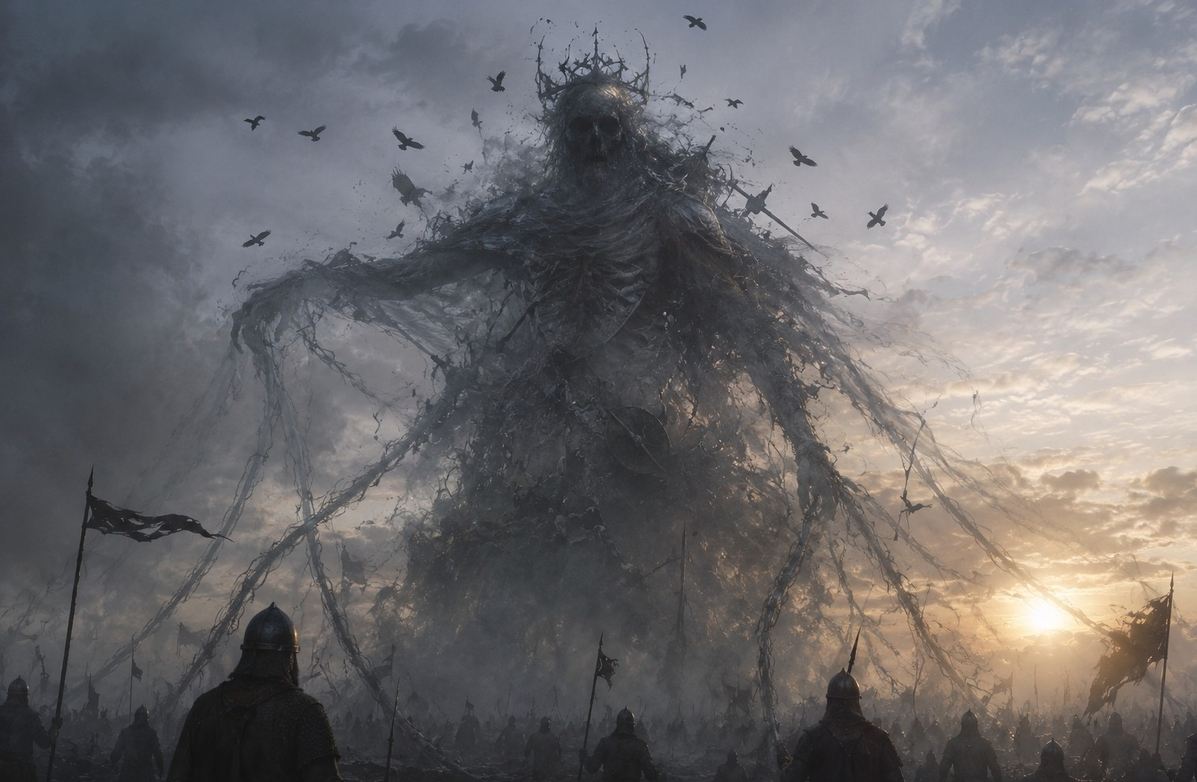
Ancient war gods were not simply metaphors to their worshippers. Mars, Ares, Kali in her fierce forms, Huitzilopochtli, and countless local battle powers received offerings, songs, vows, blood, fear, and collective attention. Modern readers may interpret these as gods, archetypes, egregores, symbolic patterns, or social forces. The function is similar: violence becomes sanctified, and the group feels carried by something larger than itself.
War feeds on emotion at scale: fear, grief, pride, revenge, loyalty, humiliation, hatred, sacrifice, and the intoxication of belonging. Modern media expands the field. Millions can participate emotionally in conflicts far away, feeding outrage, despair, tribal identity, and spectacle through screens.
Possible signs of the pattern: conflict continuing after its stated purpose collapses; propaganda that turns humans into vermin or demons; military ritual taking on religious intensity; populations craving enemies; cruelty celebrated as purification; and leaders appearing less like decision-makers than mouthpieces of collective rage.
Discernment: war is also material, political, economic, historical, and strategic. Do not reduce it to spirits. The egregore reading asks how collective emotion becomes self-sustaining, how sacrifice becomes sacred, and how ordinary people become possessed by stories that demand blood.
Digital Hunting Grounds: Attention, Outrage, and Algorithmic Feeding
Modern technology does not need to be literally demonic to become archonic. A system becomes predatory when it learns how to capture attention, intensify emotion, predict weakness, and convert human vitality into metrics, profit, dependency, or behavioural control.
The digital hunting ground is everywhere the nervous system is kept slightly open, slightly anxious, slightly aroused, slightly outraged, slightly lonely, and never quite satisfied. Social media feeds, pornography platforms, gambling apps, rage news, doom-scroll loops, compulsive messaging, synthetic intimacy, and algorithmic recommendation systems can all create states that resemble traditional feeding fields.
This is not because a horned bureaucrat is personally hiding in the router, stamping tiny forms in triplicate. The deeper issue is structural. Systems optimised for engagement often reward intensity over integration. They learn what keeps the user returning, then feed the loop. The result may feel vampiric because attention is being drawn away from the body, community, depth, rest, and direct life.
Digital hygiene is therefore a modern form of psychic defence. Scheduled disconnection, no-phone sleep spaces, reduced late-night stimulation, careful media diet, embodied practice, and real human contact all close doors that predatory patterns prefer to leave swinging.
Defence and Liberation: The Grounded Path
Traditional defence begins with naming, boundary, purification, prayer, virtue, ritual, and sovereignty. Modern defence must include sleep, therapy, medical care, digital boundaries, relational honesty, nervous-system regulation, and community. A sword is excellent in myth, but a stable bedtime can be surprisingly heroic in the underworld.
The armour of virtue: older moral language can be read as energetic hygiene. Chastity becomes conscious erotic integrity rather than repression. Temperance becomes freedom from compulsive intensity. Charity becomes generosity without self-erasure. Diligence becomes steady practice. Patience becomes refusal to be baited. Kindness becomes non-participation in cruelty. Humility becomes protection against spiritual inflation.
The shield of awareness: practices such as breath awareness, body scanning, prayer, contemplation, journalling, and neti neti create space between awareness and experience. Predatory patterns feed on fusion. Witnessing interrupts the meal.
The sword of discrimination: discernment distinguishes guidance from pressure, intuition from anxiety, warning from paranoia, shadow material from entity belief, and spiritual opening from destabilisation. Study helps. So does humility. So does asking whether the interpretation makes you more grounded or less.
The lance of sovereignty: sovereignty is not aggression. It is the felt right to inhabit your own body, attention, home, sleep, relationships, and spiritual path. You are allowed to say no. You are allowed to close the door. You are allowed to seek help. You are allowed to stop feeding the pattern.
Discernment is the difference between seeing the shadow and becoming its employee.
The Gnostic Reading: Archons, Patterns, and Sovereignty
Gnostic texts speak of Archons: ruling powers that bind consciousness through ignorance, fear, imitation, false authority, and the counterfeit spirit. They are not presented as mere personal problems. They are cosmic administrators of limitation, the powers that keep the soul misidentified with the lower order.
Modern readers may interpret Archons literally, symbolically, psychologically, socially, or systemically. Each lens reveals something. Literalism gives the myth teeth. Symbolism gives it flexibility. Psychology brings it home. Social analysis shows how outer systems amplify inner captivity. The best reading does not flatten the myth into one register.
Negative entities, in this Gnostic reading, are not a random monster catalogue. They are expressions of false rule. Sexual vampires distort eros. Fear eaters distort perception. Pain harvesters distort suffering. False psychopomps distort death. Torture fields distort power. Addiction feeders distort appetite. War egregores distort belonging. Digital systems distort attention.
The counter-force is gnosis: direct recognition of what is real, what is counterfeit, what is yours, what is inherited, what is feeding, and what leads back to the spark. Gnosis does not create paranoia. It clarifies the room. It names the pattern without worshipping it.
The Archons rule through unconscious participation. Liberation begins when participation becomes conscious. The hunting ground loses power when the hunted remembers that awareness itself is not prey.
Related Glossary Terms
For quick definitions, use the main ZenithEye Glossary. The key terms for this article are:
Read Next
Continue with: The Psychic Vampire: Energy Parasitism in Occult Tradition
If this article maps the wider bestiary of predatory consciousness, the next step focuses on one of its most personal forms: the draining person, relationship, entity, or pattern that extracts vitality through attention, emotion, intimacy, or dependency.
Within The Thread
This article belongs to Predatory Consciousness, a route concerned with intrusive forces, psychic boundaries, energy parasitism, sleep-state vulnerability, spiritual emergency, archonic influence, and the need for grounded discernment when inner life becomes porous.
Frequently Asked Questions About Negative Entities
What are negative entities?
Negative entities are beings, presences, patterns, or symbolic forces traditionally believed to feed on fear, pain, desire, addiction, confusion, or spiritual vulnerability. They may be interpreted literally, psychologically, culturally, or symbolically depending on the tradition and the experience being described.
Are negative entities real or psychological projections?
Different traditions answer this differently. Some read them as literal spirits or non-human beings. Others understand them as trauma images, sleep-paralysis figures, intrusive thoughts, dissociated material, social patterns, or symbolic forms of predatory behaviour. The safest approach is layered discernment rather than instant belief or instant dismissal.
How do I know if an experience is spiritual or a mental-health issue?
You should not try to decide this alone if the experience is frightening, persistent, or affecting daily life. Voices, paranoia, severe sleep disruption, intrusive imagery, suicidal thoughts, derealisation, panic, or difficulty functioning deserve qualified medical or mental health support. Spiritual interpretation should complement grounded care, not replace it.
Can places or objects feel spiritually heavy?
Many traditions say that places and objects can carry impressions from intense events, grief, violence, ritual, or repeated emotional charge. A psychological reading would speak of memory, atmosphere, association, and trauma. A spiritual reading may speak of residue or attachment. In either case, cleansing, prayer, repair, rest, and respectful boundaries can help restore a sense of order.
Why are sleep paralysis and shadow figures linked with entity encounters?
Sleep paralysis can include sensed presence, chest pressure, fear, visual figures, sounds, touch, and the inability to move. Cultures interpret these experiences as demons, jinn, night-hags, ghosts, aliens, shadow people, or other beings. Many reports may begin with REM-related paralysis, while their meaning is shaped by culture, fear, belief, and personal history.
Can awareness and naming help with predatory patterns?
Yes, when handled calmly. Naming a pattern can reduce fear and restore agency. For example, recognising a sleep-paralysis episode, an addiction loop, a draining relationship, or an intrusive fear pattern can interrupt automatic panic. Naming should not become obsession. Its purpose is clarity, grounding, and choice.
How can I protect myself from negative entities or predatory patterns?
Start with grounded protection: stabilise sleep, reduce fear loops, limit late-night disturbing media, strengthen boundaries, keep the body regulated, seek support for trauma or addiction, and avoid practices that increase panic or dissociation. Ritual, prayer, cleansing, or visualisation may help some people if they calm the nervous system and support sovereignty rather than feeding fear.
Study and Safety Note
This article explores entity folklore, predatory consciousness, demonology, sleep paralysis, Gnostic Archons, hungry ghosts, egregores, psychic boundaries, addiction, death imagery, and spiritual emergency for educational and reflective purposes. It does not provide medical, psychological, psychiatric, sleep-medicine, trauma, addiction, crisis, or spiritual-direction advice.
If you experience voices, paranoia, severe fear, suicidal thoughts, derealisation, dissociation, repeated sleep paralysis, distressing presences, addiction crisis, trauma symptoms, insomnia, panic, or difficulty functioning, seek qualified medical or mental health support. Spiritual cleansing, prayer, ritual, or esoteric practice should never replace professional care where professional care is needed.
The intended outcome is discernment, not paranoia. A good map should return you to the body, the room, the breath, the next kind action, and the ordinary world made clearer.
Further Reading
These live ZenithEye links continue the themes of predatory consciousness, psychic boundaries, entity folklore, Gnostic sovereignty, and grounded discernment:
- The Psychic Vampire: Energy Parasitism in Occult Tradition – A focused study on the mechanics of psychic vampirism, distinguishing human, symbolic, and esoteric forms of depletion.
- Sexual Energy Harvesting by Entities – A deeper look at erotic energy, succubi, incubi, shame loops, and sexualised predatory patterns.
- World’s Most Famous Sexual Entity: Succubus History and Protection – Folklore, sleep paralysis, Lilith, and the archetype of the erotic night predator.
- Archons and the Soul Trap: A Gnostic Guide to Spiritual Sovereignty – The wider Gnostic framework behind predatory consciousness and spiritual captivity.
- The Soul Trap – A broad article on reincarnation, memory, return, and the question of spiritual recycling.
- The Names of the Archons: Identifying the Prison Wardens of the Soul Trap – A Gnostic bestiary of rulers, names, and symbolic jurisdictions.
- 7 Ancient Protection Rituals from Gnostic Texts – Protection, cleansing, boundary, and sovereignty practices interpreted through ancient and modern lenses.
- States of Knowing: What Happens When Consciousness Unravels – Altered states, destabilisation, possession language, and the need for integration.
- The Collapse of the Witness – What happens when observation becomes participation and awareness loses its stable centre.
- The Architecture of Psychic Boundaries: Reclaiming the Auric Field – A grounded route into boundary practice, energetic hygiene, and sovereignty.
References and Sources
The following sources support the historical, folkloric, Gnostic, Buddhist, occult, psychological, and sleep-state framework used in this article.
Gnostic and Early Christian Sources
- [1] Apocryphon of John. Nag Hammadi Codex II,1; III,1; IV,1; Berlin Codex 8502,2.
- [2] Hypostasis of the Archons. Nag Hammadi Codex II,4.
- [3] On the Origin of the World. Nag Hammadi Codex II,5; XIII,2.
- [4] Gospel of Philip. Nag Hammadi Codex II,3.
- [5] Robinson, James M. (ed.). The Nag Hammadi Library in English. Revised edition. HarperOne, 1990.
- [6] Meyer, Marvin (ed.). The Nag Hammadi Scriptures. HarperOne, 2007.
- [7] Layton, Bentley. The Gnostic Scriptures. Yale University Press, 1987.
- [8] Brakke, David. The Gnostics: Myth, Ritual, and Diversity in Early Christianity. Harvard University Press, 2010.
- [9] Williams, Michael Allen. Rethinking “Gnosticism”: An Argument for Dismantling a Dubious Category. Princeton University Press, 1996.
Bardo, Afterlife, and Hungry Ghost Traditions
- [10] Bardo Thodol, commonly known as The Tibetan Book of the Dead. Various translations and commentarial traditions.
- [11] Fremantle, Francesca and Trungpa, Chögyam. The Tibetan Book of the Dead: The Great Liberation Through Hearing in the Bardo. Shambhala, 1975.
- [12] Cuevas, Bryan J. The Hidden History of the Tibetan Book of the Dead. Oxford University Press, 2003.
- [13] Egyptian Book of the Dead, or Pert em Hru. Various translations and editions.
- [14] Kohn, Livia. The Buddhist Religion: A Historical Introduction. Wadsworth, later editions.
Demonology, Grimoires, and Occult Classification
- [15] Kramer, Heinrich and Sprenger, Jacob. Malleus Maleficarum. 1487. Various English translations.
- [16] The Lesser Key of Solomon, including Ars Goetia. Seventeenth-century grimoire tradition.
- [17] Picatrix, or Ghayat al-Hakim. Arabic grimoire tradition, Latin translation in medieval Europe.
- [18] Collin de Plancy, Jacques. Dictionnaire Infernal. 1818 and later editions.
- [19] Agrippa, Heinrich Cornelius. Three Books of Occult Philosophy. 1533.
- [20] Fortune, Dion. Psychic Self-Defense. 1930.
- [21] Regardie, Israel. The Tree of Life: An Illustrated Study in Magic. Later editions.
Jewish, Kabbalistic, and Lilith-Related Sources
- [22] Alphabet of Ben Sira. Medieval Hebrew text associated with the Adam and Lilith legend.
- [23] Patai, Raphael. The Hebrew Goddess. Wayne State University Press, 3rd edition, 1990.
- [24] Scholem, Gershom. Major Trends in Jewish Mysticism. Schocken, 1941.
- [25] Scholem, Gershom. Kabbalah. Meridian, 1974.
- [26] Dennis, Geoffrey W. The Encyclopedia of Jewish Myth, Magic and Mysticism. Llewellyn, 2nd edition, 2016.
- [27] Trachtenberg, Joshua. Jewish Magic and Superstition: A Study in Folk Religion. Behrman’s Jewish Book House, 1939.
Sleep Paralysis, Folklore, and Psychology
- [28] Hufford, David J. The Terror That Comes in the Night: An Experience-Centered Study of Supernatural Assault Traditions. University of Pennsylvania Press, 1982.
- [29] Sharpless, Brian A. and Doghramji, Karl. Sleep Paralysis: Historical, Psychological, and Medical Perspectives. Oxford University Press, 2015.
- [30] Cheyne, J. Allan, Rueffer, Steve D., and Newby-Clark, Ian R. “Hypnagogic and Hypnopompic Hallucinations During Sleep Paralysis: Neurological and Cultural Construction of the Night-Mare.” Consciousness and Cognition, 8(3), 319-337, 1999.
- [31] Cheyne, J. Allan. “Sleep Paralysis and the Structure of Waking-Nightmare Hallucinations.” Dreaming, 13(3), 163-179, 2003.
- [32] Jalal, Baland and Ramachandran, V. S. “Sleep Paralysis and the Shadowy Bedroom Intruder.” Medical Hypotheses, 83(6), 755-757, 2014.
- [33] Jung, C. G. The Archetypes and the Collective Unconscious. Collected Works, Vol. 9i. Princeton University Press, 1969.
- [34] van der Kolk, Bessel. The Body Keeps the Score: Brain, Mind, and Body in the Healing of Trauma. Viking, 2014.
- [35] Ogden, Pat, Kekuni Minton, and Clare Pain. Trauma and the Body: A Sensorimotor Approach to Psychotherapy. W. W. Norton, 2006.
War, Egregores, and Collective Violence
- [36] Iamblichus. De Mysteriis. Various translations.
- [37] Book of Enoch. Second Temple Jewish apocalyptic tradition.
- [38] Devi Mahatmya. Hindu text within the Markandeya Purana.
- [39] Le Bon, Gustave. The Crowd: A Study of the Popular Mind. 1895.
- [40] Tarde, Gabriel. The Laws of Imitation. 1890.
- [41] Girard, René. Violence and the Sacred. Johns Hopkins University Press, 1977.
- [42] Debord, Guy. The Society of the Spectacle. Buchet-Chastel, 1967.
- [43] Zuboff, Shoshana. The Age of Surveillance Capitalism. PublicAffairs, 2019.