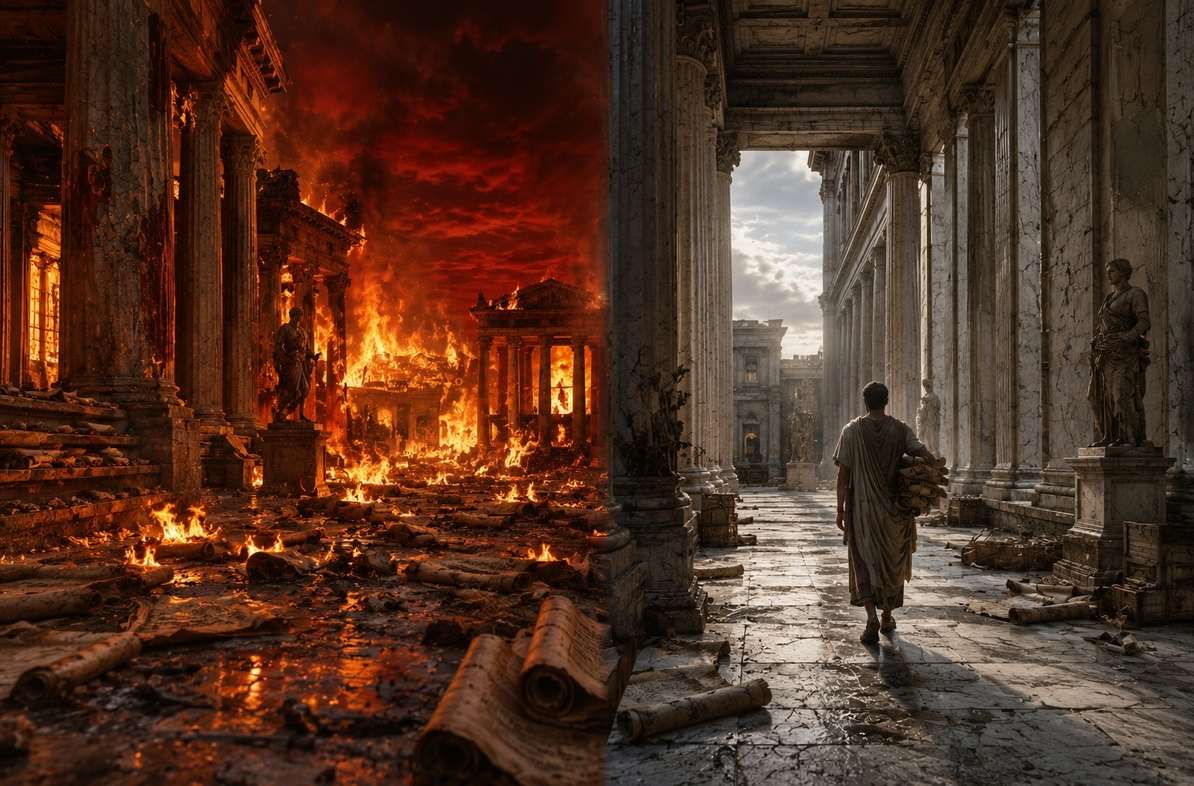
The Burning of the Library of Alexandria: What Actually Happened in 48 BCE
The story is familiar. Julius Caesar, besieged in Alexandria, orders the ships in the harbour burned. The fire spreads. The Library of Alexandria, greatest centre of learning in the ancient world, is destroyed. Four hundred thousand scrolls reduced to ash. The loss, incalculable. The tragedy, complete.
The story is also mostly wrong.
The fire of 48 BCE happened. Caesar, in his Civil War commentary, admits to burning the ships in the harbour to block escape. The fire, driven by wind, spread to parts of the city. Whether it reached the Library is disputed. The ancient sources are contradictory: Plutarch claims the great library was destroyed; Dio Cassius reports that dockside warehouses of books burned; Seneca mentions 40,000 books lost; yet Caesar’s lieutenant Hirtius remarks that Alexandria is “almost completely secure against fire” because its buildings are masonry, not timber. The modern certainty is projection.
What is certain is this: the Library of Alexandria was not destroyed in a single day. Its decline was slower, more complex, more instructive for those who track the survival and loss of knowledge. The fire was an episode in a long fade, not the finale.
Table of Contents
- What Actually Happened in 48 BCE?
- The Library in 48 BCE
- The Slow Decline
- The Serapeum and the Last Scholars
- Why the Legend Persists
- The Thread Continues
- Frequently Asked Questions
- Further Reading
- References and Sources
What Actually Happened in 48 BCE?
In the summer of 48 BCE, Julius Caesar pursued Pompey to Alexandria and became entangled in the dynastic struggle between Cleopatra VII and her brother Ptolemy XIII. Besieged in the royal quarter by Egyptian forces, Caesar ordered the ships in the harbour burned to prevent their capture by the enemy. The fire spread–driven by the Etesian winds that blow inland from the Mediterranean in late August–and consumed parts of the dockyards, granaries, and neighbouring buildings.
The ancient accounts diverge sharply on what burned. Plutarch, writing in the early second century CE, states that the fire “spread from the dockyards and destroyed the great library.” Dio Cassius, writing a century later, reports that “the docks and the storehouses of grain among other buildings were burned, and also the library, whose volumes, it is said, were of the greatest number and excellence.” But Seneca, the Stoic philosopher writing around 49 CE, mentions only that “forty thousand books were burned at Alexandria”–a figure that may refer to a warehouse deposit rather than the main collection.
Most tellingly, Aulus Hirtius, Caesar’s lieutenant who continued the Alexandrian War narrative, interjects an unexpected observation: “Alexandria is almost completely secure against fire; the buildings have no carpentry or timber, and are composed of masonry constructed in arches and roofed with rough-cast or flag-stones.” This reads like a tacit apology–an attempt to counter accusations that the city had burned, and by implication, that the Library had been damaged. If the Library had been utterly destroyed, Hirtius would hardly have needed to reassure his readers that the city was fireproof.
Modern scholars generally agree that if books were lost, they were likely volumes stored in dockside warehouses (apothekai) awaiting cataloguing or export–not the curated holdings of the Mouseion itself. The main library probably survived, albeit possibly damaged. The daughter library, the Serapeum, certainly survived. The institution, in other words, persisted.
The Library in 48 BCE
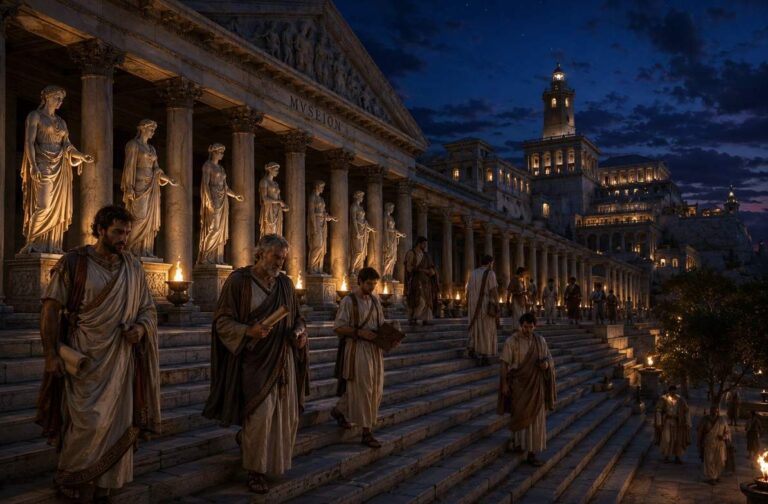
The Library was not a single building. It was an institution–the Musaeum, or Temple of the Muses, established by Ptolemy I Soter in the early third century BCE. The collection, built through acquisition and aggressive copying, was distributed across multiple locations:
- The Main Library: Located in the Brucheion quarter near the palace complex, housing the curated collection and the scriptorium.
- The Serapeum: The “daughter library,” situated in a different part of the city, attached to the temple of Serapis and accessible to the public.
- Ancillary Sites: Storage facilities, reading rooms, and the private collections of resident scholars who formed part of the intellectual ecosystem.
The collection in 48 BCE was already diminished from its peak. The Ptolemaic dynasty, which had funded the Library’s growth, was in decline. Acquisitions had slowed after the expulsion of scholars under Ptolemy VIII in 145 BCE. The scholars, though still present, were fewer than in the Library’s heyday under Ptolemy II and III. The institution was not what it had been–and this partial diminishment is what allowed it to survive the fire. A smaller target is harder to hit.
The Slow Decline
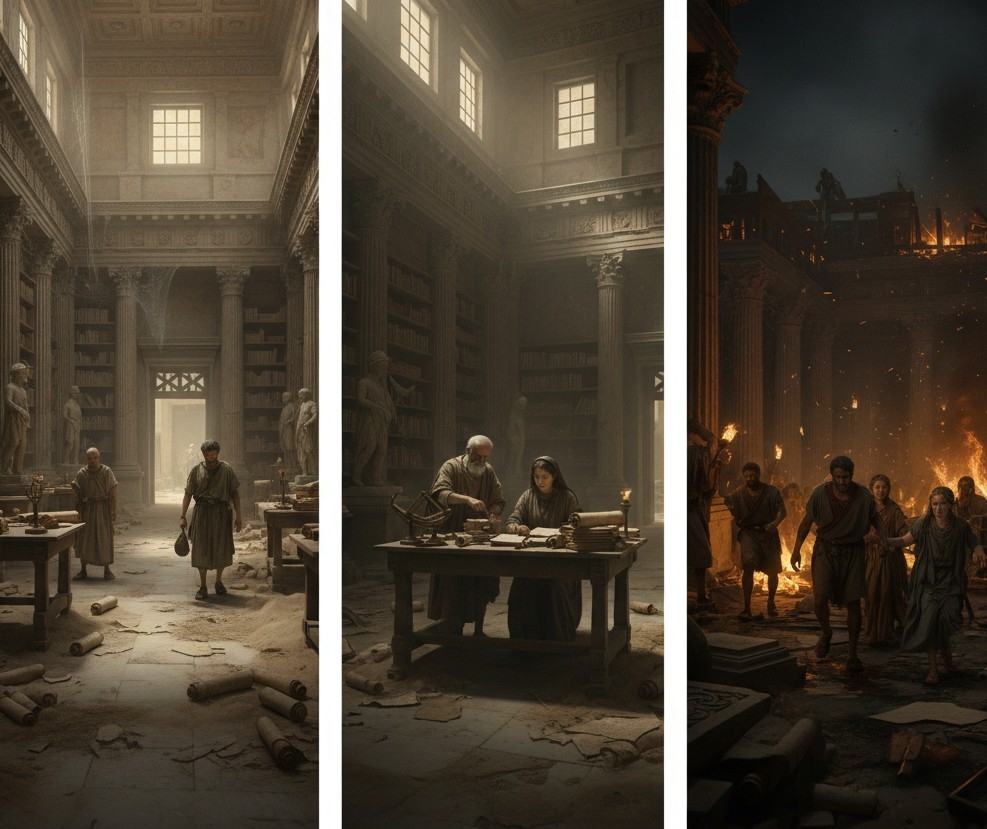
The Library’s true destruction was not dramatic. It was administrative–a death by a thousand budget cuts. The Ptolemaic dynasty ended with Cleopatra’s death in 30 BCE. Egypt became a Roman province. The Roman emperors, Augustus and his successors, were less interested in the Library’s maintenance than the Ptolemies had been. Patronage became uneven, intermittent, and finally negligible.
The Turning Point: 145 BCE
The decisive blow came not from Rome but from within. Around 145 BCE, Ptolemy VIII Euergetes II expelled all foreign scholars from Alexandria as part of a succession struggle against his brother. Among the exiles was Aristarchus of Samothrace, the most eminent critic of his generation and head librarian, who fled to Cyprus and died soon after. The position of head librarian, once reserved for scholars of international reputation, was thereafter awarded to political cronies.
When the scholars dispersed, they carried books with them. Even if they did not, the texts had been standardised and copied by this time, and would have existed in private libraries and other intellectual centres such as Athens, Pergamon, and Rhodes. The concentration had ended; the dispersal had begun. Alexandrian scholarship became a memory long before the buildings fell.
Roman Neglect and Physical Decay
During the Roman period, the pattern continued:
- Funding Diminished: The financial lifeblood of the institution was restricted. Caracalla is recorded as stopping the Mouseion’s funding entirely in 215 CE after punishing Alexandria with a massacre.
- Acquisitions Stopped: New knowledge ceased to flow into the archives. The Ptolemaic acquisition system–purchase, copying, seizure, and coercion–had no Roman equivalent.
- Scholarly Diaspora: The scholars, no longer supported by royal stipends, dispersed to other centres. Athens, Pergamon, Rhodes, and later Constantinople absorbed the intellectual capital that Alexandria had concentrated.
The collection, neglected, deteriorated. Papyrus, an organic material, decays without careful storage, climate control, and regular recopying. The scrolls, once damaged, were not replaced. The knowledge, both oral and written, was not transmitted. The Library died not in fire but in indifference–the gradual withdrawal of the resources that had sustained it.
Aurelian, Diocletian, and the Physical End
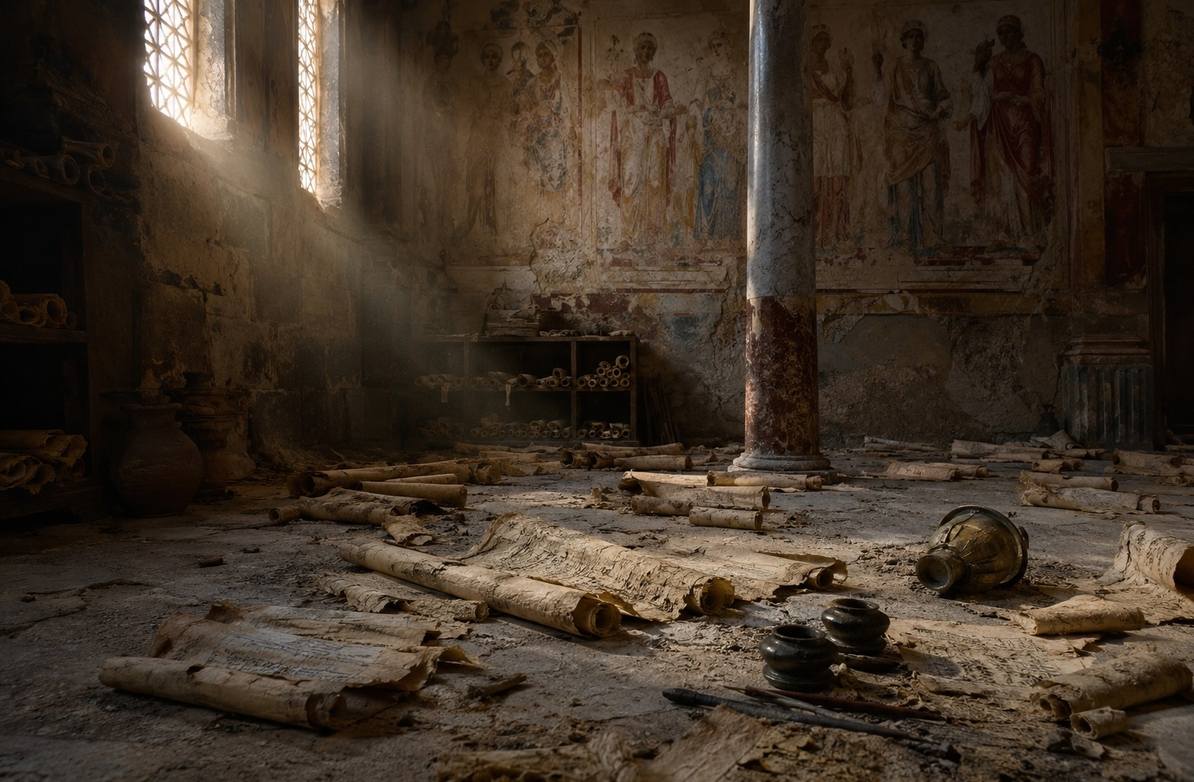
The physical structures endured into the third century CE, but the institution within them had already expired. In 272 CE, the emperor Aurelian retook Alexandria from Zenobia of Palmyra and destroyed the Brucheion quarter–the district that had housed the main library. Ammianus Marcellinus records that Alexandria “lost the greater part of the district called Bruchion.” If any library buildings survived until this point, they were likely demolished then.
In 297 CE, Diocletian levelled that same section of the city during his own siege. By then, however, Alexandrian scholarship was already a memory. Whatever great work had gone on in the city had been taking place elsewhere since sometime after 145 BCE. The thread had already been extended through other hands.
The Serapeum and the Last Scholars
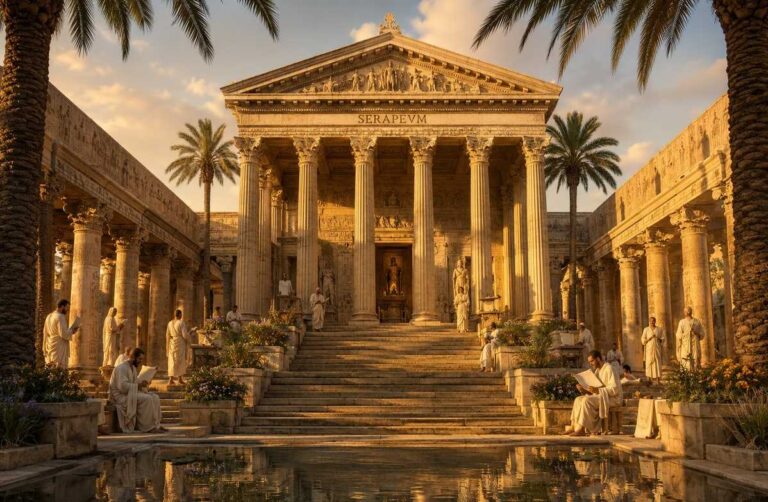
The Serapeum–the daughter library–persisted longer than the main institution. Established by Ptolemy III Euergetes as a public counterpart to the royal Mouseion, it housed popular works, religious texts, and a broader collection accessible to citizens and students. It was destroyed in 391 CE, during the Christian destruction of pagan temples under Bishop Theophilus.
The last scholars associated with the Alexandrian intellectual tradition worked there in the late fourth century. Theon of Alexandria, mathematician and astronomer, produced commentaries on Euclid and Ptolemy that preserved Greek mathematical knowledge at a time when original research had given way to editorial preservation. His daughter, Hypatia, would inherit this environment–a world where preserving earlier knowledge had become an intellectual task in itself. Theon is described in the tenth-century Suda as “the man from the Mouseion,” though by his time the original institution was likely long gone, and the title may have been an honorific rather than a literal affiliation.
The destruction of the Serapeum in 391 CE was targeted and complete. But the Library was already a shadow. The fire finished what centuries of neglect had begun. The daughter outlived the mother by centuries, demonstrating that accessibility and distributed storage are more resilient than elite concentration.
Why the Legend Persists
Why does the single-catastrophe story persist? Because it is usable. The burning of the Library of Alexandria serves as a cautionary tale–the vulnerability of knowledge to violence, the fragility of civilisation, and the cost of war. The story is invoked to warn against contemporary threats to libraries, education, and cultural preservation. It provides a villain (Caesar), a moment (48 BCE), and a moral (war destroys culture).
The true story is less dramatic but more disturbing. Knowledge is not lost only to fire. It is lost to indifference, to withdrawal of support, and to the slow erosion of the institutions that sustain it. The Library of Alexandria died not because Caesar burned it, but because no one cared enough to maintain it. The fire is dramatic. The neglect is invisible. The neglect is more dangerous.
The fire was the excuse. The neglect was the cause.
We prefer villains to systems. A single arsonist is easier to comprehend than a century of budgetary decay. The myth of the burning library gives us someone to blame. The reality of the fading library forces us to confront our own complicity in the neglect of knowledge.
The Thread Continues
The Library’s loss was real. The texts destroyed–whether by fire or decay–are gone. The knowledge they contained, unrecovered. The thread, cut in this place, had to extend elsewhere–through monasteries, through Islamic translation movements, through Byzantine scholars, and through the scattered copies that survived in other libraries.
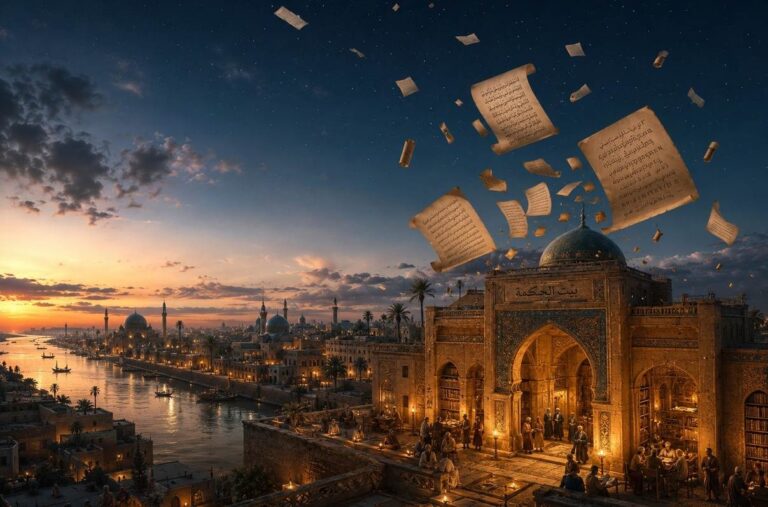
The House of Wisdom in Baghdad, the Toledo School of Translators, the scriptoria of medieval Europe–each was a daughter library, learning from the mother’s mistakes. They adopted more distributed and sustainable models, ensuring that the thread could survive the fall of any single empire.
But the thread persists in a more immediate sense. The recognition that knowledge requires active maintenance–funding, attention, transmission–is the lesson of the Library’s slow death. You maintain the thread not by preventing catastrophe but by continuous care–the daily attention that preserves, the regular practice that extends, and the institutional commitment that outlasts individual lives. The Library of Alexandria, properly mourned, teaches this. The thread continues through your recognition.
Frequently Asked Questions
Did Julius Caesar really burn the Library of Alexandria?
Probably not–at least not intentionally, and not completely. Caesar admits in his Civil War commentary that he burned ships in Alexandria’s harbour in 48 BCE to prevent their capture, and the fire spread to nearby buildings. However, ancient sources contradict each other on whether the Library itself was damaged. Plutarch claims the great library was destroyed; Dio Cassius says dockside warehouses of books burned; Seneca mentions 40,000 books lost. Hirtius, Caesar’s lieutenant, oddly insists that Alexandria is fireproof because its buildings are masonry. Modern scholars generally believe that if books were lost, they were likely volumes in storage warehouses awaiting cataloguing, not the main curated collection. The Library survived as an institution after 48 BCE.
When was the Library of Alexandria actually destroyed?
The most probable explanation is not a single date but a long decline driven by loss of patronage. The turning point came around 145 BCE when Ptolemy VIII expelled foreign scholars. The main library’s district was destroyed by Aurelian in 272 CE and levelled again by Diocletian in 297 CE. The daughter library, the Serapeum, survived until 391 CE when Christian mobs destroyed it. By the 7th century Arab conquest, there was little remaining to burn. The thread was starved over centuries, not severed in a day.
How many books did the Library of Alexandria hold?
Ancient sources claim figures as high as 700,000 scrolls, but modern scholars consider this hyperbolic. More reliable estimates place the collection between 40,000 and 400,000 scrolls, depending on counting methodology. Seneca’s mention of 40,000 books burned in 48 BCE likely refers to a specific warehouse deposit rather than the entire collection. The exact number remains unknown because Callimachus’ catalogue, the Pinakes, has not survived.
What was the Serapeum and how did it differ from the main library?
The Serapeum was a daughter library established by Ptolemy III Euergetes in a different quarter of Alexandria, attached to the temple of Serapis. Unlike the main library in the Brucheion quarter, which was restricted to scholars with royal patronage, the Serapeum was public–accessible to citizens and students. It housed popular works and religious texts. The Serapeum outlived the main library by centuries, surviving until its destruction by Christian mobs in 391 CE. Its longevity demonstrates that distributed, accessible storage is more resilient than elite concentration.
Who were the last scholars of the Library of Alexandria?
Theon of Alexandria, mathematician and astronomer, is the last known scholar associated with the Mouseion tradition. He produced commentaries on Euclid and Ptolemy in the late fourth century CE that preserved Greek mathematical knowledge when original research had declined. His daughter Hypatia inherited this environment and became one of the last great figures of Alexandria’s ancient intellectual tradition. Theon is described in the tenth-century Suda as ‘the man from the Mouseion,’ though by his time the original institution was likely already a memory, and the title may have been honorific.
Why do people still believe the Library was destroyed in a single fire?
The single-catastrophe narrative is more usable than the complex truth. It provides a clear villain (Caesar), a specific moment (48 BCE), and a moral lesson (war destroys culture). The reality–a century of budget cuts, political instability, scholarly diaspora, and gradual decay–is harder to narrate and harder to prevent. We prefer identifiable villains to systemic neglect because villains can be defeated, while neglect requires continuous vigilance. The myth persists because it comforts us with the illusion that knowledge loss is exceptional and dramatic, rather than ordinary and incremental.
What lessons does the Library’s decline offer for today?
The Library of Alexandria demonstrates that knowledge requires active maintenance–funding, attention, organisation, and transmission. Centralised, state-dependent institutions are vulnerable to political change. Distributed, accessible models are more resilient. The Ptolemies built through concentration; later transmission centres–monastic scriptoria, the House of Wisdom in Baghdad, the Toledo School of Translators–survived through dispersion. The lesson is not merely to prevent catastrophe but to cultivate continuous care: the daily attention that preserves, the regular practice that extends, and the institutional commitment that outlasts individual lives.
Further Reading
Continue exploring the history of knowledge preservation and the thread that extends through institutional collapse:
- The Library of Alexandria: What Was Lost, What Survived & Why It Matters — The mother library and the specific texts that vanished or persisted.
- The Ptolemaic Acquisition System: How the Library of Alexandria Was Built — The bureaucratic infrastructure that created the collection before it faded.
- The Serapeum: Alexandria’s Daughter Library — How the public daughter outlived the elite mother through adaptation.
- The House of Wisdom: Baghdad’s Translation Movement — Where the scholars dispersed and the thread extended into the Islamic Golden Age.
- The Living Thread: How Forbidden Knowing Survives the Fire — The pattern of suppression and survival across history.
- Nag Hammadi: The Burial and Resurrection of Gnostic Texts — Burial as an alternative to burning, and the 1945 discovery that changed everything.
- The Cathars: A Clean Church Without Property — Medieval suppression of direct knowing and the thread’s survival through heresy.
- The Transformation After Mystical Experience — Integration and the return to ordinary life after non-ordinary states.
- States of Knowing: What Happens When Consciousness No Longer Belongs to You — The broader context of threshold states and the architecture of perception.
- The Thread That Binds: Five Gateways to Direct Knowing — The thread extends through recognition, not merely through books.
References and Sources
Sources are grouped by category for clarity. No in-text citation numbers are used, per The Thread editorial protocol.
Primary Ancient Sources
- Caesar, G. J. Civil Wars, III.111. (Admits burning ships in Alexandria’s harbour, 48 BCE.)
- Hirtius, A. The Alexandrian War, I. (Notes Alexandria is “almost completely secure against fire”; buildings are masonry.)
- Plutarch. Life of Caesar, XLIX.6. (Claims fire “spread from the dockyards and destroyed the great library.”)
- Dio Cassius. Roman History, XLII.38.2. (Reports dockyards, granaries, and library warehouses burned.)
- Seneca the Younger. On the Tranquility of the Mind, IX.5. (Mentions 40,000 books burned at Alexandria.)
- Strabo. Geography, XVII.1.8-9. (Describes the Mouseion as part of the royal palaces, visited c. 24 BCE.)
- Ammianus Marcellinus. History, XII.15. (Records Aurelian’s destruction of the Brucheion quarter, 272 CE.)
Scholarly Monographs and Critical Studies
- Canfora, L. (1987). The Vanished Library: A Wonder of the Ancient World. University of California Press.
- Casson, L. (2001). Libraries in the Ancient World. Yale University Press.
- Bagnall, R. S. (2002). Alexandria: Library of Dreams. Proceedings of the American Philosophical Society, 146(4), 348-362.
- Hatzimichali, M. (2013). The Library of Alexandria: A Myth? In Ancient Libraries (pp. 363-376). Cambridge University Press.
Online Encyclopaedic References
- World History Encyclopedia. (2023). Library of Alexandria. (On decline through loss of patronage and Ptolemy VIII’s expulsion of scholars.)
- Encyclopaedia Romana: Greece. The Great Library of Alexandria. University of Chicago. (Detailed analysis of ancient sources and their contradictions.)