The Tree of Life: Kabbalistic Architecture Explained
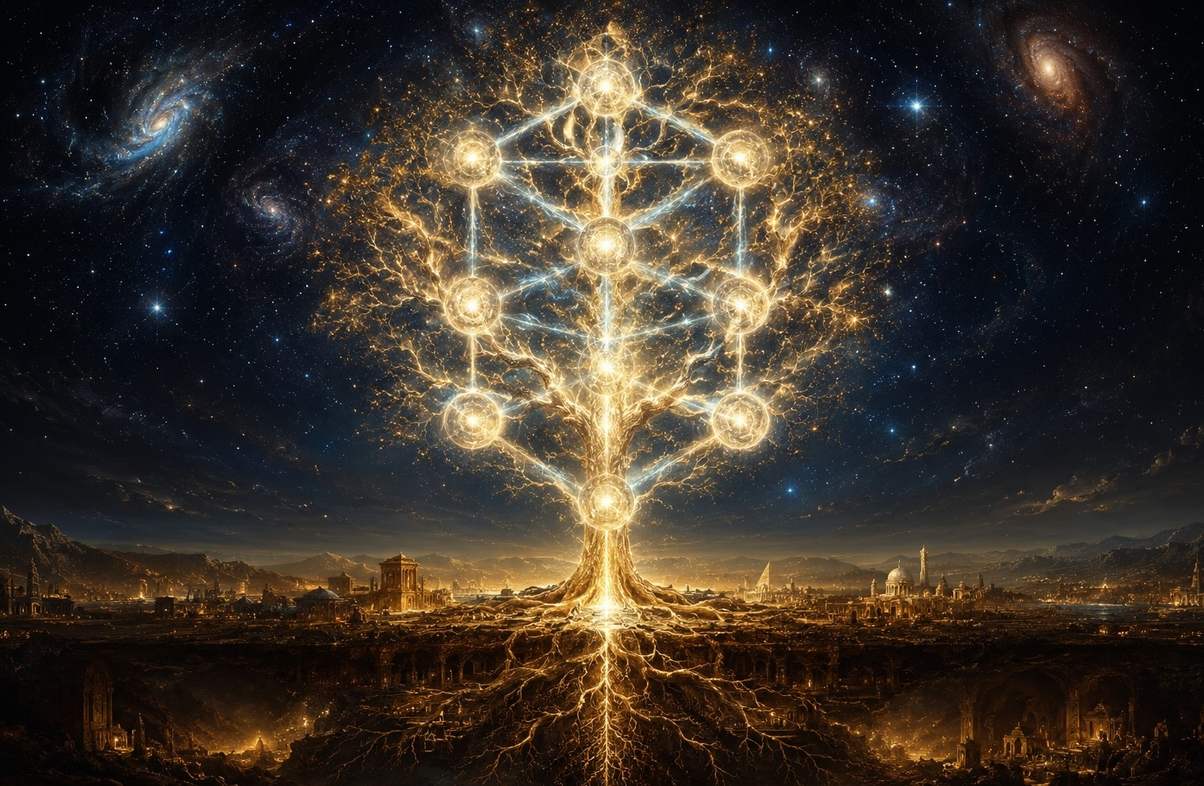
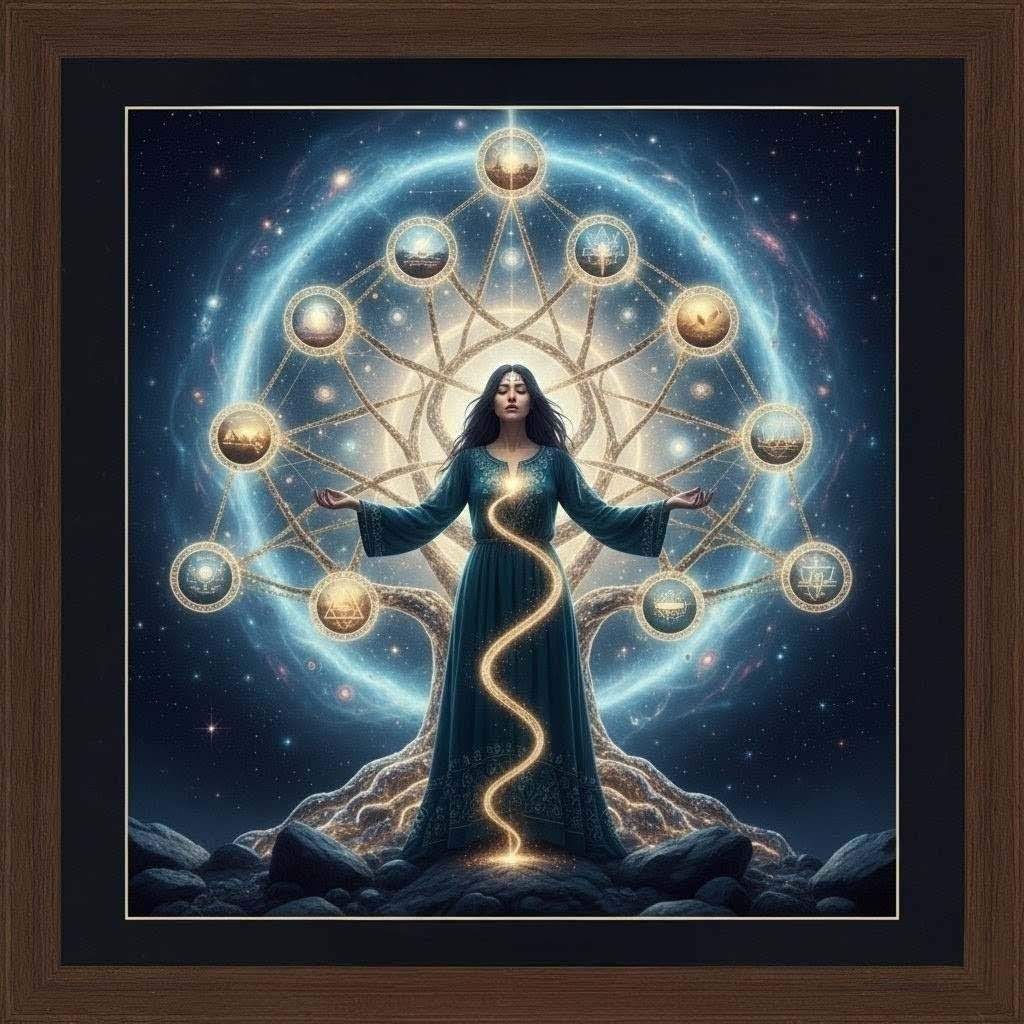
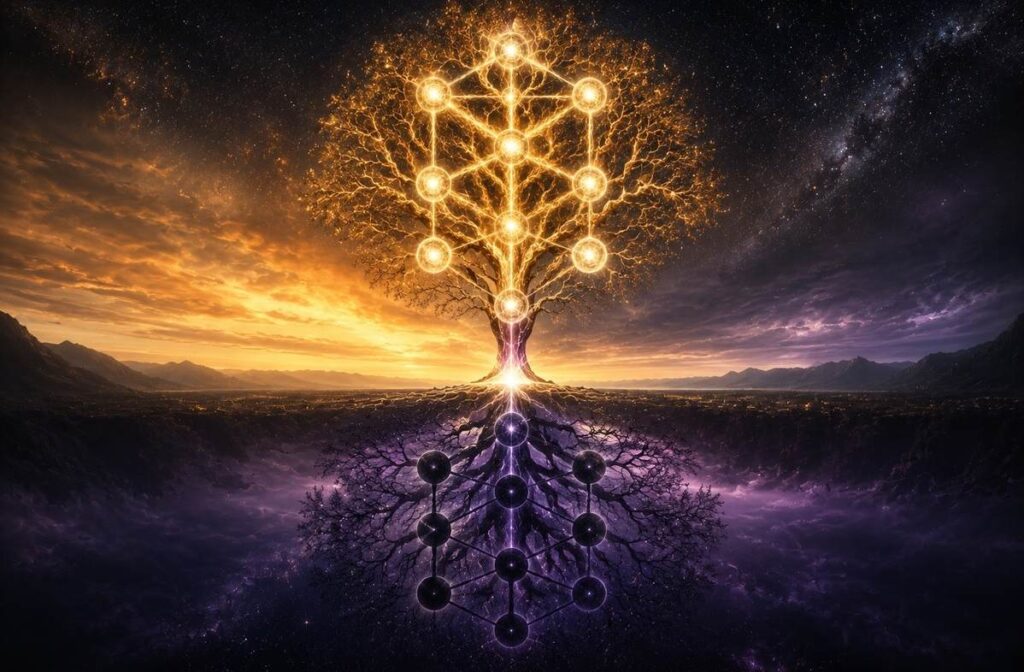
The Tree of Life—Etz Chaim–is the central symbol of Kabbalah. Ten sefirot, divine emanations, arranged in pattern. Twenty-two paths connecting them, corresponding to Hebrew letters. Three pillars–Severity, Mildness, Mercy–structuring the whole. The Tree is not merely symbol. It is map–of consciousness, of cosmos, of the journey from manifestation to source and return.
The Tree emerged in thirteenth-century Spain, though its roots extend earlier. The Sefer Yetzirah (Book of Creation), a text whose scholarly dating ranges from the third to the ninth century CE, describes ten sefirot without the full Tree structure. The Zohar, compiled by Moses de Leon in the late thirteenth century, elaborated the theosophical framework. The medieval Kabbalists–Joseph Gikatilla, Abraham Abulafia, and the schools of Gerona and Castile–developed the system that persists. The Tree, received, was adapted, not invented.
Table of Contents
- The Sefirot Are Process
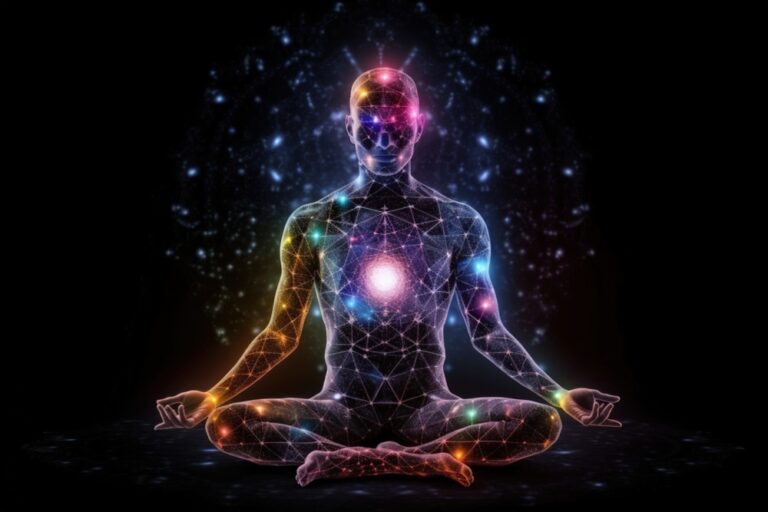
- The Sefirot and the Body
- The Three Pillars
- The Paths Are Transformation
- The Qlippoth and the Shadow
- The Thread Extended
- Frequently Asked Questions
- Further Reading
- References and Sources
The Sefirot Are Process
The sefirot are not things but processes–stages of divine emanation, qualities of consciousness, levels of being. Each sefirah is a world–complete, complex, containing all others in potential. They are not additions to Ein Sof but revelations of what Ein Sof is, accessible to finite consciousness. The standard enumeration, from closest to most distant from source, runs:
- Keter (Crown) — the pure will to be, still infinite, beyond comprehension.
- Chokmah (Wisdom) — the primal flash of insight, the masculine, expansive principle.
- Binah (Understanding) — the receptive vessel that shapes insight into form, the feminine, contractive principle.
- Chesed (Mercy) — unconditional giving, expansion without boundary.
- Gevurah (Severity) — disciplined boundary, contraction that protects form.
- Tiferet (Beauty) — the harmonising centre, where mercy and severity achieve equilibrium.
- Netzach (Victory) — endurance, the persistence of form through time.
- Hod (Splendour) — submission, the graceful acceptance of limitation.
- Yesod (Foundation) — the gathering of all upper sefirot into a single channel, the generative principle.
- Malkuth (Kingdom) — the divine presence fully incarnated in matter, the Shekhinah dwelling in the physical world.
The correspondence between sefirot and body, between sefirot and planets, between sefirot and psychological functions, enables embodied practice–the sefirot not merely contemplated but inhabited, breathed, moved. These correspondences, developed most fully in the Western esoteric tradition (particularly the Hermetic Order of the Golden Dawn and its successors), are not traditional Jewish Kabbalah but interpretive extensions that have proven operationally useful across centuries of practice.
The Sefirot and the Body
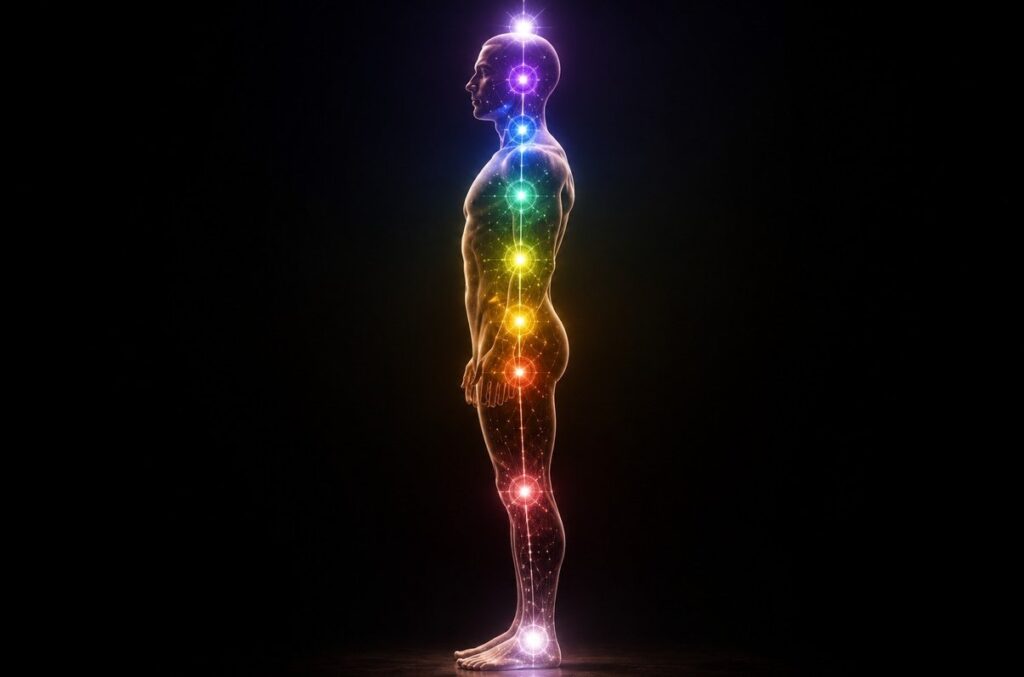
The body correspondences map the Tree onto human anatomy, transforming abstract cosmology into somatic experience. These attributions, while not found in medieval Kabbalistic texts, became standard in Western esoteric practice from the nineteenth century onward. The practitioner learns to feel the sefirot not as concepts but as locations–points of energy, attention, and transformation within the living body.
Keter — Crown — Above the Head
The first sefirah, closest to Ein Sof, corresponds to the space above the crown of the head–the point where the divine light first enters the body. In meditation, this is the location of the aura or nimbus, the field of awareness that extends beyond physical form. Keter is not within the body but transcends it, the interface between finite and infinite.
Chokmah — Wisdom — Right Brain
The masculine, expansive principle of divine wisdom maps to the right hemisphere, associated in modern neuroscience with holistic, intuitive, and spatial cognition. Chokmah is the flash of insight that precedes understanding–the moment before thought crystallises into form. It is creative, generative, and unbounded.
Binah — Understanding — Left Brain
The feminine, contractive principle of understanding maps to the left hemisphere, associated with analytical, linear, and linguistic processing. Binah receives the flash of Chokmah and shapes it–gives it boundaries, definitions, and structure. Without Binah, wisdom remains vague; without Chokmah, understanding becomes rigid.
Chesed — Mercy — Right Arm
The right arm, the arm of giving, of embrace, of blessing, corresponds to Chesed–unconditional mercy, the overflow of love without calculation. In Jewish tradition, the right hand is the hand of favour; the left, of severity. The body remembers what the mind forgets: mercy is an action, not merely a feeling.
Gevurah — Severity — Left Arm
The left arm, the arm of restraint, of boundary, of necessary refusal, corresponds to Gevurah–disciplined strength, the power to say “no” that protects form from dissolution. Gevurah is not cruelty but structure; without it, Chesed’s overflow would drown the world in formless abundance.
Tiferet — Beauty — Heart
The heart, centre of the body and symbol of integration, corresponds to Tiferet–the harmonising point where mercy and severity achieve balance. Tiferet is not compromise but synthesis: the beauty that emerges when opposites are held without resolution. The heart, in Kabbalistic practice, is the throne of the Shekhinah within the body.
Netzach — Victory — Right Leg
The right leg, the leg of forward movement, of initiative, of persistence, corresponds to Netzach–victory not as conquest but as endurance. Netzach is the sefirah of time, of the long patience that outlasts obstacles. The right leg steps first; it is the pioneer, the one who goes where no path yet exists.
Hod — Splendour — Left Leg
The left leg, the leg of support, of following, of graceful submission, corresponds to Hod–splendour not as display but as receptivity. Hod is the sefirah of praise, of gratitude, of the beauty that accepts rather than asserts. The left leg stabilises; it is the foundation that enables the right leg’s forward movement.
Yesod — Foundation — Lower Abdomen
The lower abdomen, seat of generative power and instinctual energy, corresponds to Yesod–the foundation that gathers all upper sefirot and channels them into manifestation. Yesod is the interface between the divine and the physical, the point where spiritual energy becomes biological drive. In practice, Yesod demands the purification of desire–not its suppression but its redirection toward divine service.
Malkuth — Kingdom — Feet
The feet, contact point with earth, correspond to Malkuth–the kingdom of manifestation, the divine presence fully incarnated in matter. Malkuth is not the lowest but the fullest: the point where the entire Tree becomes visible, tangible, and available. The feet touch the ground; the ground is holy. This is the radical teaching of embodied Kabbalah: there is no level more divine than the one you are standing on.
The Three Pillars
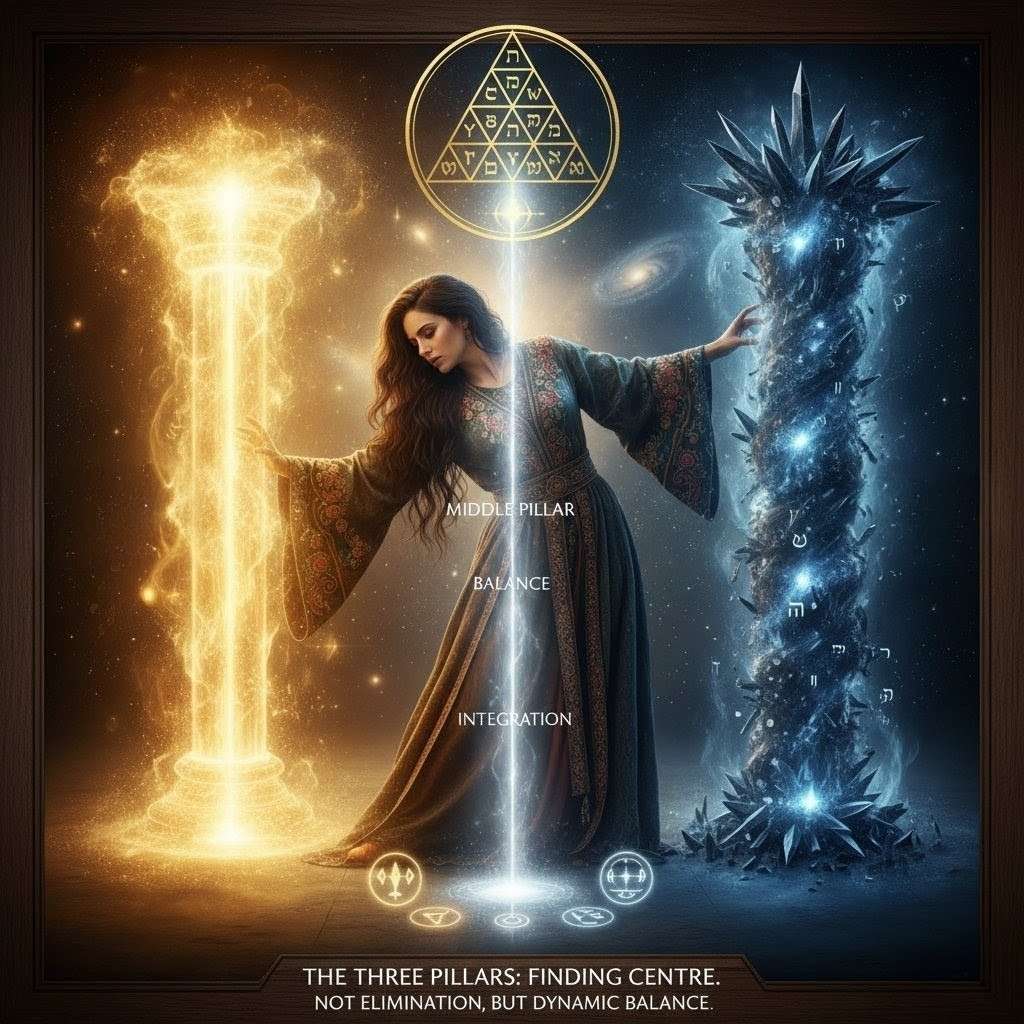
The sefirot are arranged on three vertical pillars that represent the fundamental polarities of manifestation. The practitioner, imbalanced, leans toward one pillar–excessive giving or excessive withholding, expansion without boundary or boundary without expansion. The work centres–finds the middle pillar, integrates right and left.
The Right Pillar: Mercy and Expansion
The right pillar comprises Chokmah (Wisdom), Chesed (Mercy), and Netzach (Victory). Its quality is expansion–giving, overflow, generosity without limit. The right pillar is the pillar of Abraham, of boundless hospitality, of the love that says “yes” before it knows the cost. Unbalanced, it produces dissipation, naivety, and the collapse of necessary boundaries. The right pillar needs the left to give its overflow form.
The Left Pillar: Severity and Boundary
The left pillar comprises Binah (Understanding), Gevurah (Severity), and Hod (Splendour). Its quality is contraction–receiving, boundary, discipline that protects. The left pillar is the pillar of Isaac, of the akedah (binding), of the strength that says “no” to preserve what matters. Unbalanced, it produces rigidity, cruelty, and the isolation that comes from refusing all connection. The left pillar needs the right to soften its severity into wisdom.
The Middle Pillar: Mildness and Integration
The middle pillar comprises Keter (Crown), Tiferet (Beauty), Yesod (Foundation), and Malkuth (Kingdom). Its quality is balance–integration, equilibrium, the synthesis of opposites. The middle pillar is the pillar of Jacob, of the wrestler who becomes Israel, of the one who integrates the gifts of both parents. The middle pillar is not compromise but completion: the state in which right and left are recognised as aspects of a single flow, and the practitioner becomes a channel for that flow rather than a battleground for its opposing forces.
The middle pillar meditation, central to Western Kabbalistic practice, involves visualising the sefirot of the middle pillar as a column of light running through the centre of the body, from the crown of the head (Keter) to the feet (Malkuth). The practitioner breathes this light, allowing it to illuminate and harmonise the polarities of right and left. The meditation is not escape from polarity but transcendence through polarity–the recognition that the opposites, held in balance, produce a third thing that is neither and both.
The Paths Are Transformation
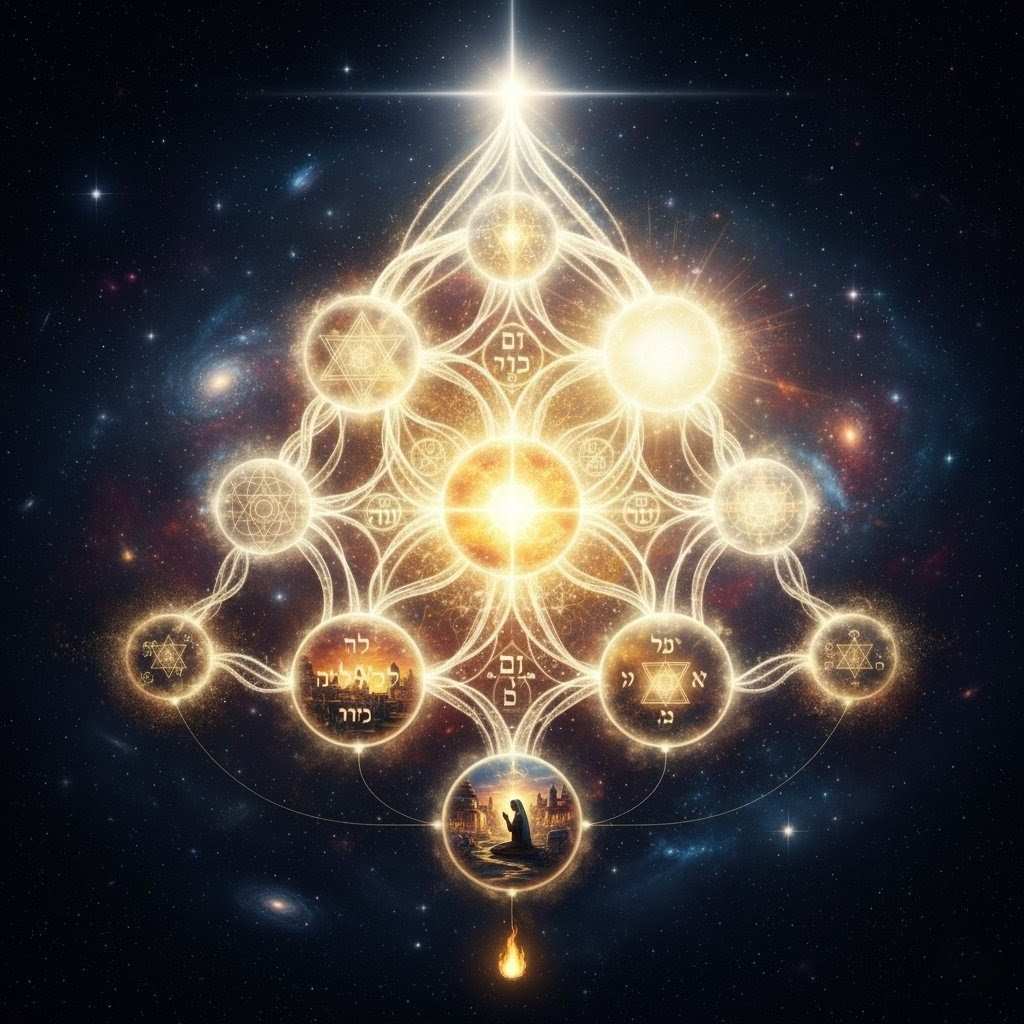
The twenty-two paths, lettered with the twenty-two letters of the Hebrew alphabet, are the transitions between sefirot. Each path is a passage–a movement from one quality of consciousness to another, a transformation that requires the dissolution of the previous state and the emergence into a new configuration. The paths are not shortcuts; they are the necessary journeys that connect the stations.
In the Western esoteric tradition, particularly through the Hermetic Order of the Golden Dawn, the paths were mapped to the twenty-two cards of the tarot Major Arcana. This mapping–the “Fool’s journey”–is not traditional Jewish Kabbalah but an interpretive synthesis that has proven operationally fruitful. The Fool (Aleph), beginning at Keter, travels the paths in sequence, encountering the archetypal forces of transformation: the Magician (Beth), the High Priestess (Gimel), the Empress (Daleth), and so on, through the World (Tau) at Malkuth. The journey is circular: the end is the beginning, and the Fool, having traversed all paths, recognises that the entire Tree was within Keter from the start.
The paths are dangerous. Each transition involves dissolution of previous stability, passage through uncertainty, emergence into new configuration. The practitioner, unprepared, encounters the qlippoth–shells, husks, the distorted reflections of sefirot, the shadow that must be integrated. The qlippoth are not enemies to be destroyed but obstacles to be understood–the distorted forms that arise when a sefirah’s energy is blocked, inverted, or denied.
Da’at and the Abyss
Between the upper triad (Keter, Chokmah, Binah) and the lower seven sefirot lies a gap known as the Abyss. This gap is occupied by Da’at (Knowledge)–not a sefirah in the standard count of ten, but a conceptual point where all sefirot coalesce into unified awareness. Da’at is the knowledge that dissolves the knower, the insight so profound it destroys the previous self. In the Western esoteric tradition, Da’at is often depicted as an “empty slot” or hidden sefirah, the point of transition between the supernal triad and the manifest world.
The Abyss is particularly perilous because it represents the break between the infinite and the finite. The upper triad operates in the realm of pure emanation, beyond time and space; the lower seven operate within the conditions of manifestation. Crossing the Abyss requires the abandonment of all conceptual frameworks–the recognition that the categories used to navigate the lower Tree are insufficient for the upper. The practitioner who attempts to carry lower-Tree concepts into the Abyss will find them dissolved, leaving only the bare fact of awareness itself.
The Qlippoth and the Shadow
The qlippoth (Hebrew: shells or husks) are the distorted reflections of the sefirot–the shadow side of the Tree, the forces that emerge when divine energy is blocked, inverted, or denied. In Kabbalistic cosmology, the qlippoth are not independent evil powers but by-products of the emanation process: the “shells” that form around holiness when the flow is interrupted, like scale that forms in a pipe when water stagnates.
The traditional Kabbalistic view distinguishes between the three completely impure qlippoth–associated with the most extreme distortion–and the shining qlippah (nogah), which mediates between pure and impure and can be elevated through proper action. The Shekhinah, exiled in creation, is separated from the upper sefirot by the qlippoth; the work of tikkun (repair) involves redeeming the “sparks of holiness” trapped within the shells, transforming darkness into light through ethical and contemplative practice.
In Western esoteric practice, particularly from the nineteenth century onward, the qlippoth were developed into a full “Tree of Death” or “Tree of Knowledge”–an inverted mirror of the Tree of Life, with ten qlippothic spheres corresponding to the ten sefirot. This development, associated with the Golden Dawn and later Thelemic traditions, is not traditional Jewish Kabbalah but an interpretive extension that treats the shadow as a necessary part of the initiatory journey. The practitioner who ignores the qlippoth risks inflation; the practitioner who becomes obsessed with them risks fixation. The middle way–recognising the shadow, integrating its energy, and returning to the light–is the path of mature practice.
The Thread Extended
The Tree of Life extends the thread through Hebrew letter, through embodied practice, through systematic transformation. The map, detailed, enables navigation. The navigation, practised, produces recognition–the territory, traversed, matches the map. You encounter the Tree. The complexity, approached gradually, yields to practice. The thread continues through letter toward source, through body toward spirit, through the many toward the One.
The Tree is not a diagram to be memorised but a reality to be inhabited. Each sefirah is a mode of consciousness available to the practitioner; each path is a transition that can be walked; each pillar is a polarity that can be balanced. The work is not intellectual but existential–the transformation of the self through the systematic exploration of the levels of being. The Tree, planted in the soil of practice, grows into a living architecture that supports the return from Malkuth to Keter, from matter to crown, from the kingdom to the source that never left it.
Frequently Asked Questions
What is the Tree of Life in Kabbalah?
The Tree of Life (Etz Chaim) is the central symbol of Kabbalah, consisting of ten sefirot (divine emanations) arranged in a specific pattern, connected by twenty-two paths corresponding to Hebrew letters, and structured by three pillars. It serves as a map of consciousness, cosmos, and the journey from manifestation to divine source. The Tree is not merely a diagram but a living architecture that practitioners inhabit through meditation, ethical action, and contemplative practice.
What are the ten sefirot and what do they represent?
The ten sefirot are stages of divine emanation from Ein Sof (the Infinite). From closest to most distant from source: Keter (Crown), Chokmah (Wisdom), Binah (Understanding), Chesed (Mercy), Gevurah (Severity), Tiferet (Beauty), Netzach (Victory), Hod (Splendour), Yesod (Foundation), and Malkuth (Kingdom). Each sefirah is a quality of consciousness, a level of being, and a world complete in itself. They are not additions to God but revelations of what God is, accessible to finite consciousness.
What is Da’at and why is it not counted as a sefirah?
Da’at (Knowledge) is a conceptual point on the Tree of Life located between the upper triad and the lower seven sefirot, often called the Abyss. It is not counted among the ten sefirot because it represents the unified state where all sefirot coalesce into one awareness rather than a distinct emanation. In some Kabbalistic systems, Da’at is included instead of Keter when counting from the perspective of finite creation. It corresponds to the image of God and represents the knowledge that dissolves the separate knower.
What are the qlippoth and how do they relate to the sefirot?
The qlippoth (Hebrew for shells or husks) are the distorted reflections or shadows of the sefirot. They emerge when divine energy is blocked, inverted, or denied–not as independent evil powers but as by-products of interrupted flow. Traditional Kabbalah distinguishes between completely impure qlippoth and the shining qlippah (nogah), which can be elevated through proper action. The work of tikkun (repair) involves redeeming sparks of holiness trapped within the qlippoth, transforming darkness into light.
What are the three pillars of the Tree of Life?
The three pillars structure the Tree vertically. The Right Pillar (Mercy) comprises Chokmah, Chesed, and Netzach–expansion, giving, and overflow. The Left Pillar (Severity) comprises Binah, Gevurah, and Hod–contraction, boundary, and discipline. The Middle Pillar (Mildness/Integration) comprises Keter, Tiferet, Yesod, and Malkuth–balance, synthesis, and equilibrium. The practitioner aims to centre on the middle pillar, integrating the polarities of right and left into a unified flow.
How does the Tree of Life relate to the body?
In Western esoteric practice, the sefirot are mapped onto the human body: Keter above the head, Chokmah to the right brain, Binah to the left brain, Chesed to the right arm, Gevurah to the left arm, Tiferet to the heart, Netzach to the right leg, Hod to the left leg, Yesod to the lower abdomen, and Malkuth to the feet. These correspondences transform abstract cosmology into somatic experience, enabling the practitioner to feel the sefirot as locations of energy and attention within the living body.
Is the Tree of Life only a Jewish concept?
The Tree of Life as a specific diagram with ten sefirot is a Jewish Kabbalistic development, emerging in thirteenth-century Spain. However, the underlying structure–a perfect source emanating through levels of increasing differentiation toward manifestation, with the possibility of return–appears universally across traditions. The Neoplatonic cascade, the Sufi stations of the soul, the Hindu koshas, and the Buddhist kayas all describe similar architectures. The Tree is the Jewish expression of a pattern that transcends any single tradition.
Further Reading
- The Abyss in Three Traditions: Kabbalah, Alchemy & Buddhism — Da’at and the crossing between lower and upper sefirot.
- The Hidden Agreements: Why Esoteric Traditions Keep Inventing the Same Architecture — The Tree as architectural exemplar across cultures.
- The Sevenfold Pattern: Planets, Metals, Chakras & The Architecture of Seven — The lower seven sefirot as sevenfold pattern.
- The Doctrine of Emanation: From Plotinus to Kabbalah — The metaphysics underlying the Tree’s structure.
- Symbol as Safety Protocol: Why Esotericism Hides in Plain Sight — The Tree as protective encryption and symbolic transmission.
- The Emerald Tablet: Hermetic Foundation & The Law of Correspondence — “As above, so below” and the correspondence principle that underlies sefirotic mapping.
- Sacred Geometry: The Architecture of Creation — The geometric forms underlying the Tree’s proportions and the structure of emanation.
- Jewish Scholars and the Transmission of Knowledge — The historical networks through which Kabbalistic texts were preserved and transmitted.
References and Sources
This article draws upon Jewish mysticism, the history of Kabbalah, and Western esoteric studies. Sources are grouped by category for clarity.
Primary Sources and Critical Editions
- Sefer Yetzirah (Book of Creation). (3rd–9th c. CE). Earliest systematic treatise of Jewish mysticism; describes ten sefirot without full Tree structure. Scholarly dating varies widely.
- de Leon, M. (c. 1280–1290). Zohar (Book of Splendour). Compiled in Castile, Spain. The foundational text of Kabbalistic theosophy.
- Gikatilla, J. (13th c.). Sha’arei Orah (Gates of Light). (Systematic exposition of the sefirot and divine names).
Scholarly Monographs and Studies
- Idel, M. (1988). Kabbalah: New Perspectives. Yale University Press. (On the historical development of Kabbalah, including the sefirot and the qlippoth).
- Matt, D. C. (Trans.). (2004–2018). The Zohar: Pritzker Edition. Stanford University Press. (Critical translation with extensive commentary).
- Scholem, G. (1941). Major Trends in Jewish Mysticism. Schocken. (Foundational history of Kabbalistic development, including the emergence of the Tree of Life).
- Scholem, G. (1965). On the Kabbalah and Its Symbolism. Schocken. (On the symbolism of the Tree, the sefirot, and the qlippoth).
Comparative and Contemplative Studies
- Fortune, D. (1935). The Mystical Qabalah. Ernest Benn. (Standard Western esoteric exposition of the Tree, including body correspondences and path workings).
- Regardie, I. (1932). The Tree of Life: A Study in Magic. Rider. (Golden Dawn perspective on the Tree, paths, and practical application).