
The Gateway of Breath: Pranayama Techniques for Altered States
The breath is the first gateway because it is always already here: intimate, ordinary, physiological, symbolic, and strangely sovereign. It runs by itself when attention is elsewhere, yet it can also be entered consciously. In that single fact, the body offers a doorway. The automatic can become voluntary. The unconscious rhythm can become practice. The life-process that usually hums beneath awareness can be brought into the light.
Pranayama, from prana, life force or vital breath, and ayama, extension, expansion, or regulation, is the yogic discipline of working consciously with breath. In traditional contexts, pranayama is not merely relaxation. It is a method for shaping attention, regulating the nervous system, refining energy, preparing meditation, and altering the ordinary relationship between body, mind, and awareness.
This article explores five major pranayama techniques often discussed in yogic and contemporary practice: Nadi Shodhana, Kapalabhati, Bhastrika, Kumbhaka, and Ujjayi. It treats them as powerful practices that require proportion, preparation, and respect. Breath can calm the body, sharpen attention, open altered states, and reveal subtle perception. It can also destabilise when forced, overdone, or practised without regard for health, trauma, anxiety, sleep, or cardiovascular reality.
In Plain Terms
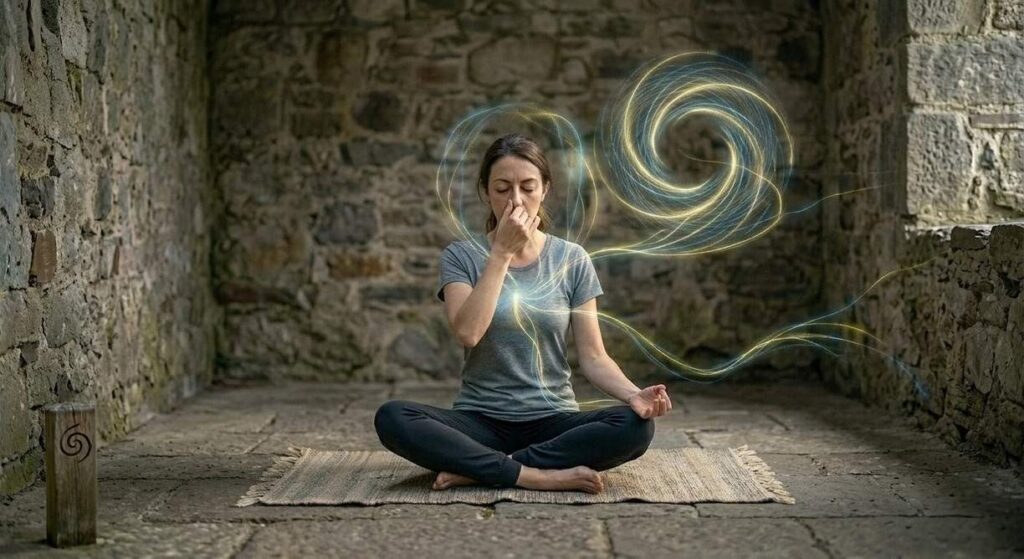
Pranayama is the yogic practice of consciously shaping the breath through rhythm, nostril flow, sound, pause, depth, pace, and attention.
Breath changes state because respiration is closely linked with the autonomic nervous system, attention, arousal, heart rhythm, body sensation, emotion, and perceived safety.
The safe approach is gradual. Begin with gentle breath awareness, natural nasal breathing, lengthened exhalation, and simple alternate nostril breathing without strain. Leave forceful breathing and retention for appropriate guidance, health screening, and stable practice conditions.
Sources and Traditions Discussed
- Hatha Yoga traditions, especially pranayama, nadis, prana, kundalini, posture, purification, and meditative preparation.
- Hatha Yoga Pradipika, a major classical text on breath practice, subtle channels, retention, and the preparation of the yogic body.
- Gheranda Samhita and Shiva Samhita, traditional texts discussing purification, posture, mudra, breath, meditation, and subtle anatomy.
- Patanjali’s Yoga Sutras, especially the place of pranayama within the wider eight-limbed discipline of yoga.
- The Five Gateways, the ZenithEye practice route in which breath is treated as the first accessible gateway into direct knowing.
- Modern physiology, especially respiration, vagal tone, heart rate variability, carbon dioxide sensitivity, arousal, and autonomic regulation.
- Trauma-aware and nervous-system-informed practice, especially caution around panic, dissociation, hyperventilation, breath retention, and forced intensity.
- Gnostic symbolic reading, where breath becomes a practical way of interrupting automaticity, reclaiming attention, and making unconscious pattern visible.
How to Read This Article
This article discusses breath practices that can alter bodily state, mood, perception, and attention. Read it as educational and reflective, not as personalised medical, psychological, or breathwork instruction.
Gentle breath awareness may be accessible for many readers, but forceful practices, rapid breathing, and breath retention are not suitable for everyone. People with cardiovascular conditions, high blood pressure, pregnancy, respiratory illness, panic attacks, trauma-related breath sensitivity, seizure history, fainting risk, dissociation, severe anxiety, unstable mental health, or recent surgery should seek qualified guidance before attempting stronger techniques.
The measure of good breath practice is not intensity. It is steadiness. A useful practice should leave you clearer, more embodied, more regulated, and more capable of ordinary life. If breathwork produces distress, stop and return to natural breathing, grounding, water, food, rest, and appropriate support.
The breath is the thread between body and awareness. Pull it gently, and it becomes a path. Force it, and the path becomes a warning.
Table of Contents
- The Foundations Are Necessary
- The Physiology of Conscious Breathing
- The Five Techniques
- 1. Nadi Shodhana: Balancing the Currents
- 2. Kapalabhati: The Skull-Shining Breath
- 3. Bhastrika: The Bellows Breath
- 4. Kumbhaka: The Breath Pause
- 5. Ujjayi: The Oceanic Sustainer
- Contraindications and Precautions
- The Sequencing Matters
- The Thread Extended
- The Gnostic Reading: Breath and Conscious Choice
- Related Glossary Terms
- Read Next
- Frequently Asked Questions
- Further Reading
- References and Sources
The Foundations Are Necessary
Traditional yoga does not present pranayama as an isolated trick. Breath practice belongs inside a wider container: posture, ethics, diet, sleep, restraint, attention, purification, teacher guidance, and the gradual preparation of body and mind. The breath may be immediate, but that does not make all breathwork automatically simple.
Asana, stable posture, gives the body a vessel. Yamas and niyamas, ethical foundations and observances, give practice psychological and relational integrity. Shatkarma, purification practices in hatha yoga, belong to a traditional context and should not be copied casually. The deeper principle is clear: the more powerful the practice, the more important the container.
Modern seekers are often trained by digital life to expect immediate results: press, swipe, breathe intensely, feel something, label it awakening. This impatience is understandable, but it is not always wise. Breathwork can produce rapid shifts in sensation, emotion, arousal, and perception. Without preparation, those shifts may be mistaken for spiritual progress when they are actually nervous-system activation.
The foundation is not there to delay the seeker. It is there to protect the work. The breath opens doors in the body. A good foundation ensures that what enters has somewhere stable to land.
The Physiology of Conscious Breathing
Modern physiology gives a grounded way to understand why breath practice is so potent. Breathing is both automatic and voluntary. It is regulated by brainstem processes, shaped by emotion and posture, and available to conscious modulation. When breath changes, the whole organism receives the message.
Slow, steady breathing can influence the autonomic nervous system, especially through respiratory sinus arrhythmia, vagal tone, heart rhythm, and the balance between sympathetic activation and parasympathetic recovery. This does not mean every breath technique is calming. Some practices down-regulate. Others activate. Some may do both in sequence.
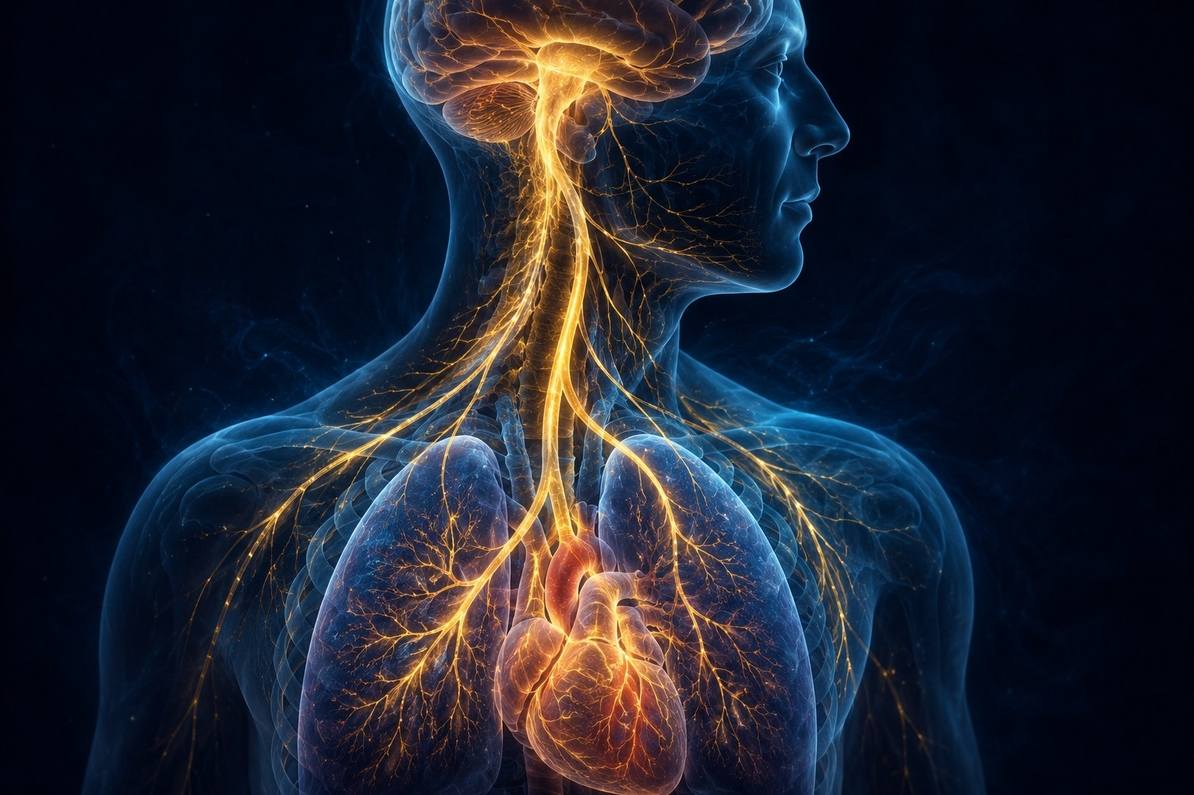
The vagus nerve, a major pathway of parasympathetic regulation, is often discussed in relation to slow breathing and embodied safety. This language should be used carefully. A single breath technique does not magically heal the nervous system. But breathing rhythm, posture, exhalation length, sound, and attention can influence the body’s perception of threat, rest, and readiness.
Heart Rate Variability as a Biomarker
Heart rate variability, or HRV, describes variation in the time between heartbeats. It is often used as one measure of autonomic flexibility. Higher HRV is sometimes associated with better regulatory capacity, while lower HRV may be associated with stress, illness, anxiety, depression, or reduced adaptability. Context matters. HRV is a useful signal, not a spiritual scoreboard.
Slow breathing, HRV biofeedback, and certain pranayama-style practices have been studied for their effects on autonomic regulation. The practical takeaway is modest but valuable: steady breath can help train the body towards regulation. It is not proof that every traditional claim is scientifically verified. It is evidence that breath sits very close to the switches of state.
This is why pranayama requires care. If slow breathing can shift regulation, rapid breathing and retention can also shift regulation, sometimes strongly. The doorway opens both ways. Calm can enter. So can activation.
The Five Techniques
The following five techniques are often used or discussed in yogic, hatha yoga, and modern breathwork contexts. They are not random breathing exercises. Each has a different energetic, psychological, and physiological profile.
Read the practical notes as orientation, not as a full training manual. Strong pranayama belongs with guidance, especially when it involves force, speed, retention, or altered-state intention.
1. Nadi Shodhana: Balancing the Currents
Nadi Shodhana, often translated as alternate nostril breathing or channel purification, is one of the gentler and most widely used pranayama methods. In yogic subtle anatomy, it is said to balance ida and pingala, the lunar and solar currents, preparing the central channel, sushumna, for steadier practice.
In modern terms, alternate nostril breathing may support attentional steadiness, slow respiration, and a shift towards calmer autonomic regulation. Strong claims about hemisphere balancing should be treated cautiously. The traditional symbolism remains useful, but it should not be forced into simplified brain science.
A gentle version involves closing one nostril, breathing in, switching sides, breathing out, then continuing in a balanced rhythm. Beginners should practise without retention. The breath should remain smooth, quiet, and unstrained. If the practice creates anxiety, air hunger, dizziness, or pressure, stop and return to natural breathing.
2. Kapalabhati: The Skull-Shining Breath
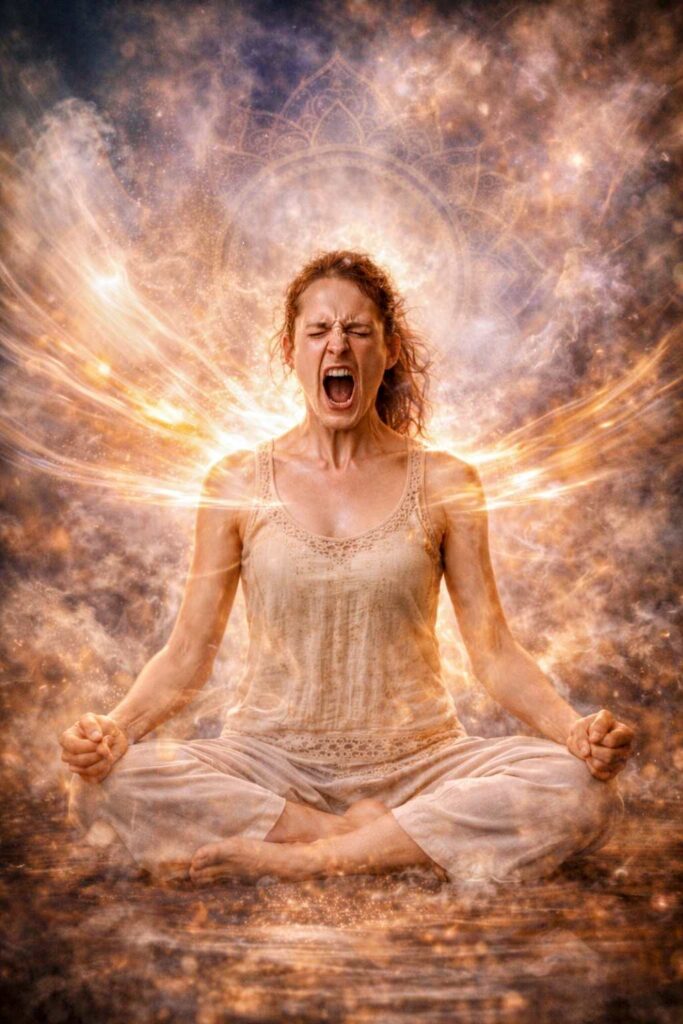
Kapalabhati, often translated as skull-shining breath, involves repeated active exhalations with passive inhalations. It is traditionally classified among cleansing practices and is commonly used as an activating breath. The abdomen pumps on the exhale, and the inhalation returns without force.
Kapalabhati can feel clearing, energising, heating, and mentally brightening. That is precisely why caution matters. It is not a relaxation practice in the ordinary sense. It can increase arousal, pressure, dizziness, or discomfort if performed too quickly, too intensely, too long, or by someone for whom the technique is unsuitable.
Readers with high blood pressure, cardiovascular disease, hernia, pregnancy, active panic symptoms, respiratory conditions, seizure history, recent surgery, or significant health concerns should avoid this practice unless cleared and guided by a qualified professional. The safer principle is simple: do not use forceful breath to override the body.
3. Bhastrika: The Bellows Breath
Bhastrika, bellows breath, is more forceful than Kapalabhati because both inhalation and exhalation are active. The image is a bellows feeding an internal fire. In traditional language, this may be linked with agni, heat, purification, vitality, and preparation for deeper energetic work.
Bhastrika can produce rapid activation: heat, tingling, strong energy, altered perception, emotional release, or intensity in the body. These effects should not be romanticised. Strong sensation is not the same as spiritual integration. Sometimes it is simply sympathetic activation, changes in blood gases, or a nervous system being pushed too hard.
This technique is not a beginner default. It should be approached only with stable foundations, careful instruction, and clear contraindication awareness. People with cardiovascular conditions, high blood pressure, pregnancy, panic disorder, respiratory illness, seizure risk, trauma flooding, dissociation, or unstable mental health should avoid forceful bellows-style practice unless appropriately guided.
4. Kumbhaka: The Breath Pause
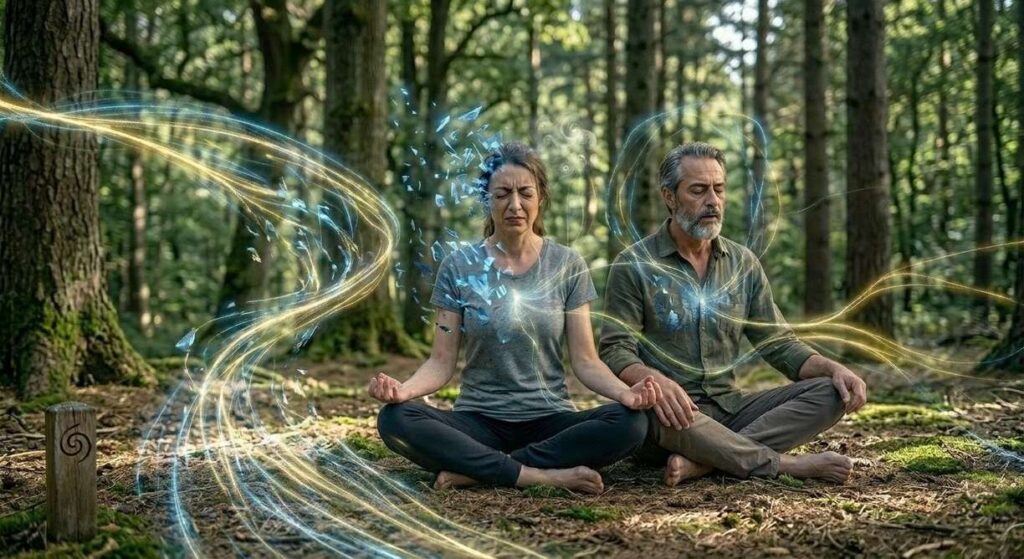
Kumbhaka means breath retention or suspension. It may occur after inhalation, antara kumbhaka, or after exhalation, bahya kumbhaka. Traditional pranayama often treats retention as powerful because the pause changes the relationship between breath, mind, energy, and attention.
The pause can reveal something important: much of ordinary thought is carried by rhythm, urgency, and unconscious movement. When the breath becomes still for a short, comfortable moment, attention may also become still. But this stillness must never be forced. A retained breath should feel spacious, not trapped.
Kumbhaka is advanced compared with simple breath awareness. It can affect blood pressure, carbon dioxide levels, anxiety, and bodily perception. It is not suitable for everyone, especially people with high blood pressure, heart disease, pregnancy, panic disorder, respiratory illness, fainting risk, recent surgery, seizure history, or significant health vulnerabilities. Beginners should not add retention to pranayama without guidance.

5. Ujjayi: The Oceanic Sustainer
Ujjayi, often translated as victorious breath, involves a gentle narrowing at the back of the throat, creating a soft ocean-like sound as the breath moves. It is widely used in yoga practice because it helps lengthen respiration, focus attention, regulate pace, and keep awareness anchored in sound and sensation.
Ujjayi can be grounding when gentle. The sound gives the mind an object. The breath becomes audible enough to guide attention but quiet enough not to become performance. It can be used during posture practice, seated meditation, or simple settling, provided it remains easy and non-strained.
The throat should not be clenched. The face should remain soft. The breath should not become theatrical or harsh. Properly used, Ujjayi is less a display of control than a quiet thread through the body: breath, sound, attention, and movement kept in one field.
Contraindications and Precautions
Pranayama can be supportive when applied judiciously, but it is not automatically safe in every form for every person. The gentler techniques and the stronger techniques should be clearly distinguished. Slow breath awareness is not the same as rapid bellows breath. A natural pause is not the same as prolonged retention.
Cardiovascular and Respiratory Conditions
Forceful breathing and retention may be unsafe for people with hypertension, coronary artery disease, arrhythmias, recent heart events, fainting risk, or significant cardiovascular concerns. People with asthma, chronic obstructive pulmonary disease, breathlessness, respiratory sensitivity, or recent respiratory illness should approach pranayama cautiously and seek appropriate medical advice.
A simple rule is useful: if breath practice produces chest pain, severe breathlessness, palpitations, faintness, intense pressure, or fear, stop. Return to natural breathing. Sit or lie down safely. Seek medical support if symptoms are severe, unusual, or persistent.
Pregnancy, Anxiety, and Trauma Sensitivity
Pregnancy requires special caution with retention, forceful breathing, overheating, pressure, and strong abdominal pumping. Breath should remain gentle, natural, and medically appropriate.
Readers with anxiety, panic, trauma-related breath sensitivity, dissociation, or a history of feeling trapped by breath practices should begin with external grounding rather than strong pranayama. Feel the feet. Look around the room. Walk slowly. Let breath be natural. For some nervous systems, being told to control the breath can initially increase threat rather than reduce it.
When to Stop Immediately
Stop immediately if you experience dizziness, chest pain, palpitations, severe headache, tunnel vision, numbness, panic, dissociation, shaking that feels unsafe, or a sense that you cannot return to ordinary breathing. These are not signs that you should push harder. They are signs to pause, ground, and reassess.
Spiritual maturity includes listening when the body says no. Breath is a gateway, not a command.
The Sequencing Matters
Breath techniques should not be combined randomly. Traditional practice often moves from preparation towards subtlety: posture, grounding, simple awareness, balancing, gentle regulation, then more advanced methods only when appropriate. The modern temptation is to begin with intensity because intensity produces noticeable effects. That does not make it the best starting point.
A safer contemporary sequence begins simply:
- First: natural breath awareness with no control.
- Second: lengthened exhalation, kept soft and comfortable.
- Third: gentle nasal breathing or Ujjayi without strain.
- Fourth: simple Nadi Shodhana without retention.
- Only later: stronger practices, if suitable, guided, and grounded.
The purpose of sequencing is not spiritual bureaucracy. It is intelligent pacing. A system that has learned safety through small steps can open more deeply without being shocked. A system pushed too quickly may produce symptoms, not transformation.
After any breath practice, return deliberately. Feel the body. Notice the room. Drink water. Walk if needed. Avoid jumping immediately into screens, arguments, driving, or complex tasks after intense practice. Integration begins with the next ordinary action.
The Thread Extended
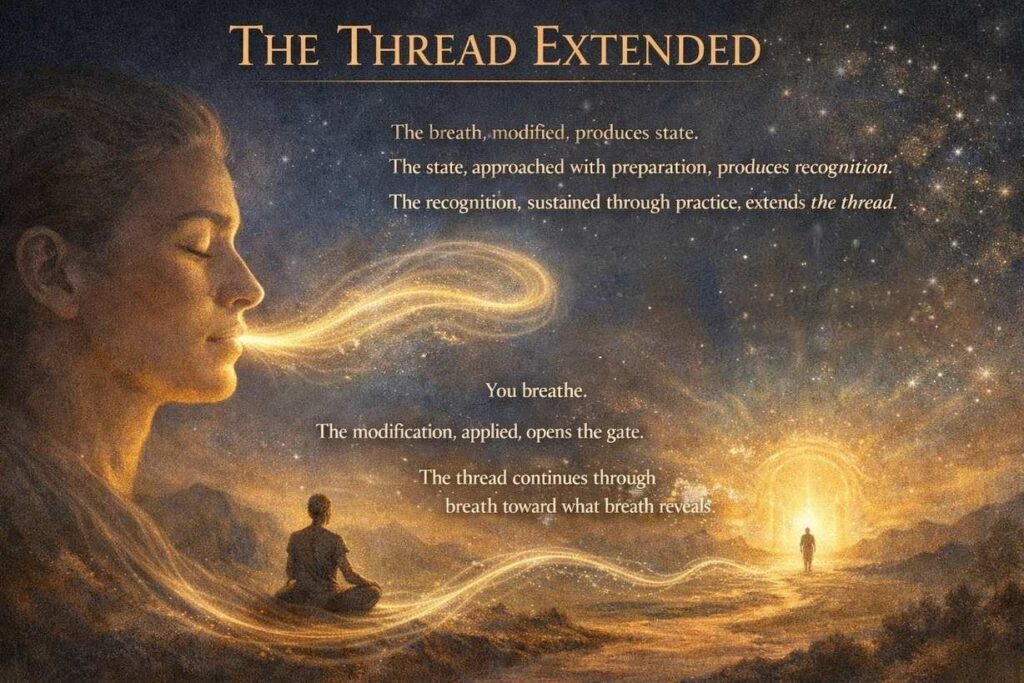
The breath, modified gently and intelligently, produces state. State, approached with preparation, may support recognition. Recognition, sustained through practice and integration, extends the thread. This is why breath is the first of the Five Gateways: it is immediate, embodied, accessible, and deeply linked with the living interface between body and awareness.
But the breath is not a shortcut around life. It does not replace ethics, sleep, food, relationship, medical care, therapy, grounding, or humility. It is a doorway into deeper participation. The practitioner learns to pause the automatic, feel the body, regulate intensity, and recognise that attention can enter the most ordinary processes and find hidden depth there.
You breathe. Usually, life does it for you. In pranayama, you meet that process consciously. The meeting is the gateway. What opens beyond it depends on preparation, discernment, and the willingness to return from altered state into ordinary life with greater clarity.
The Gnostic Reading: Breath and Conscious Choice
Gnostic understanding often speaks of human beings living under false rule: asleep, distracted, governed by imitation, pulled by forces they do not recognise. In a symbolic reading, automatic breath becomes a useful image. Life continues, but awareness may be absent. The body breathes. The person reacts. The pattern repeats.
Pranayama interrupts automaticity. It does not do so by rejecting the body, but by entering it. The breath becomes known. The rhythm becomes chosen. The nervous system becomes part of practice rather than background machinery. The practitioner discovers that freedom begins in very small places: one exhale, one pause, one refusal to let impulse govern the next action.
This is where breath meets gnosis. Direct knowing is not only an idea. It must descend into timing, posture, speech, sensation, emotion, and response. A person who can feel the breath before reacting has already opened a gap in the old order. That gap is small, but it is real.
The Gnostic danger is to mistake intensity for liberation. Breathwork can create dramatic sensations, visions, heat, pressure, tremor, bliss, fear, or spaciousness. None of these automatically prove awakening. The deeper test is whether practice makes the person more honest, embodied, ethical, grounded, compassionate, and free from compulsion.
The breath is not an escape from incarnation. It is one of the simplest ways to inhabit incarnation consciously.
Related Glossary Terms
For quick definitions, use the main ZenithEye Glossary. The key terms for this article are:
Read Next
Continue with: The Gateway of Sound: Mantra and Nada Yoga
If breath is the first gateway into regulated state and subtle awareness, sound is the next natural deepening. Mantra and Nada Yoga carry breath into vibration, listening, resonance, and the contemplative use of voice as a stabilising thread.
Within Practice & Method
This article belongs to The Five Gateways and Contemplative Techniques, the Practice & Method route where breath, sensation, sound, vision, movement, and silence become practical entrances into direct knowing.
Frequently Asked Questions About Pranayama and the Gateway of Breath
What is pranayama?
Pranayama is the yogic practice of consciously shaping the breath through rhythm, pace, nostril flow, sound, depth, and sometimes pause. In traditional yoga, pranayama prepares meditation, regulates prana, steadies attention, and affects the relationship between body, mind, and awareness.
Is pranayama safe for beginners?
Gentle breath awareness, natural nasal breathing, lengthened exhalation, and simple alternate nostril breathing without retention may be accessible for many beginners. Forceful breathing, rapid breathing, and breath retention are not beginner defaults and may be unsafe for some people. Anyone with health concerns should seek qualified guidance.
Which pranayama technique should beginners start with?
Most beginners should start with natural breath awareness, relaxed nasal breathing, lengthened exhalation, or gentle Nadi Shodhana without retention. The aim is steadiness, not intensity. Kapalabhati, Bhastrika, and Kumbhaka should be treated as stronger practices requiring preparation and caution.
What is Nadi Shodhana?
Nadi Shodhana is alternate nostril breathing, traditionally used to balance ida and pingala, the lunar and solar subtle channels. In modern terms, it may support slow respiration, attentional steadiness, and autonomic regulation. Beginners should practise gently and avoid breath retention unless properly guided.
Why can breathwork cause dizziness or panic?
Breathwork can change oxygen and carbon dioxide balance, arousal, heart rhythm, interoception, and the body’s sense of safety. Rapid breathing, forceful breathing, and retention can trigger dizziness, tingling, panic, dissociation, or pressure in sensitive people. Stop immediately if symptoms become uncomfortable or frightening.
Who should avoid forceful pranayama or breath retention?
People with high blood pressure, cardiovascular disease, respiratory conditions, pregnancy, seizure history, fainting risk, panic disorder, trauma-related breath sensitivity, dissociation, unstable mental health, or recent surgery should avoid forceful pranayama and breath retention unless cleared and guided by qualified professionals.
How does pranayama relate to altered states?
Pranayama can alter state by changing respiration, autonomic regulation, attention, body sensation, arousal, and perceived safety. Some techniques calm the body, while others activate it. Altered states should not be chased for their own sake. The deeper aim is stable awareness, integration, and conscious relationship with body and mind.
How does breathwork relate to Gnostic practice?
In a Gnostic symbolic reading, breathwork interrupts automaticity. The breath normally runs in the background, just as many patterns of thought and reaction run unconsciously. Pranayama brings one automatic process into awareness, creating a small but powerful gap where attention, choice, and direct knowing can enter.
Study and Safety Note
This article explores pranayama, breathwork, altered states, subtle body practice, nervous-system regulation, and Gnostic symbolism for educational and reflective purposes. It does not provide medical, psychological, psychiatric, trauma, respiratory, cardiovascular, pregnancy, meditation-instruction, or spiritual-direction advice.
Kapalabhati, Bhastrika, and Kumbhaka may be unsuitable for people with high blood pressure, cardiovascular disease, respiratory conditions, pregnancy, seizure history, fainting risk, panic disorder, trauma-related breath sensitivity, dissociation, unstable mental health, recent surgery, or other health concerns. Seek qualified guidance before attempting strong breath practices.
If breath practice produces dizziness, chest pain, palpitations, panic, severe headache, dissociation, confusion, involuntary movements, insomnia, emotional flooding, suicidal thoughts, or inability to function, stop immediately and seek appropriate professional support.
Further Reading
These ZenithEye links continue the themes of breath, subtle body practice, nervous-system regulation, sound, sensation, and integration:
- The Gateway of Sound: Mantra and Nada Yoga – The next gateway in the sequence, carrying breath into vibration, mantra, listening, and resonance.
- Breathwork: Ancient Technology, Modern Application – The physiological mechanisms underlying pranayama and conscious breathing.
- The Thread That Binds: Five Gateways to Direct Knowing in an Age of Noise – The complete gateway system and the place of breath within the sequence.
- The Gateway of Sensation: Body Scan and Somatic Awareness – Grounding through sensation, interoception, and somatic awareness before stronger breathwork.
- The Subtle Body: Mapping the Energy Anatomy of Human Consciousness – The subtle anatomy context for prana, nadis, chakras, and kundalini.
- Nervous System Regulation: The New Meditation – Neuroscience of vagal tone, HRV, regulation, and embodied spirituality.
- States of Knowing: What Happens When Consciousness No Longer Belongs to You – Altered states, threshold experience, spiritual destabilisation, and integration.
- Contemplative Techniques: Methods for Stabilisation – Integrating breathwork into a wider contemplative practice.
- Integration and Grounding After Awakening – Returning energetic and altered-state experience into ordinary life.
- Kundalini Phenomena: Physiology and Awakening – Energy activation phenomena and physiological integration.
- The Kundalini Emergency: When the Serpent Power Overwhelms the Vessel – A grounded look at intense kundalini-related experiences and spiritual emergency.
- Asceticism and Discipline: The Technology of Transformation – Preparation, restraint, and ethical foundations for deeper practice.
References and Sources
The following sources support the traditional yogic, physiological, contemplative, and safety framework used in this article.
Primary Sources and Traditional Texts
- [1] Svatmarama. Hatha Yoga Pradipika. Various translations, including Swami Muktibodhananda, Yoga Publications Trust.
- [2] Gheranda Samhita. Classical hatha yoga text on purification, posture, mudra, breath, meditation, and samadhi.
- [3] Shiva Samhita. Classical hatha yoga text discussing subtle anatomy, prana, chakras, and yogic practice.
- [4] Patanjali. Yoga Sutras, especially the placement of pranayama within the eight-limbed path.
- [5] Saraswati, Swami Satyananda. Asana Pranayama Mudra Bandha. Yoga Publications Trust.
- [6] Mallinson, James and Singleton, Mark. Roots of Yoga. Penguin Classics, 2017.
Yoga, Pranayama, and Subtle Body Studies
- [7] Feuerstein, Georg. The Yoga Tradition: Its History, Literature, Philosophy and Practice. Hohm Press, 1998.
- [8] Samuel, Geoffrey. The Origins of Yoga and Tantra: Indic Religions to the Thirteenth Century. Cambridge University Press, 2008.
- [9] White, David Gordon. The Alchemical Body: Siddha Traditions in Medieval India. University of Chicago Press, 1996.
- [10] Eliade, Mircea. Yoga: Immortality and Freedom. Princeton University Press, 1958.
- [11] Avalon, Arthur, Sir John Woodroffe. The Serpent Power. Luzac, 1919.
- [12] Iyengar, B. K. S. Light on Pranayama. Crossroad, 1981.
Breath, Physiology, and Nervous-System Research
- [13] Jerath, Ravinder, Edry, John W., Barnes, Vernon A., and Jerath, Vandna. “Physiology of Long Pranayamic Breathing: Neural Respiratory Elements May Provide a Mechanism That Explains How Slow Deep Breathing Shifts the Autonomic Nervous System.” Medical Hypotheses, 67(3), 566-571, 2006.
- [14] Pal, G. K., et al. “Effect of Slow Breathing on Sympathovagal Balance.” Indian Journal of Medical Research, 2004.
- [15] Telles, Shirley, et al. Studies on unilateral nostril breathing and autonomic or cerebral effects in yoga research literature.
- [16] Lehrer, Paul and Gevirtz, Richard. “Heart Rate Variability Biofeedback: How and Why Does It Work?” Frontiers in Psychology, 5, 756, 2014.
- [17] Shaffer, Fred and Ginsberg, J. P. “An Overview of Heart Rate Variability Metrics and Norms.” Frontiers in Public Health, 5, 258, 2017.
- [18] Zaccaro, Andrea, et al. “How Breath-Control Can Change Your Life: A Systematic Review on Psycho-Physiological Correlates of Slow Breathing.” Frontiers in Human Neuroscience, 2018.
- [19] Russo, Marc A., Santarelli, Danielle M., and O’Rourke, Dean. “The Physiological Effects of Slow Breathing in the Healthy Human.” Breathe, 13(4), 298-309, 2017.
- [20] Streeter, C. C., et al. “Effects of Yoga on the Autonomic Nervous System, Gamma-Aminobutyric-Acid, and Allostasis in Epilepsy, Depression, and Post-Traumatic Stress Disorder.” Medical Hypotheses, 78(5), 571-579, 2012.
- [21] Brown, Richard P. and Gerbarg, Patricia L. The Healing Power of the Breath. Shambhala, 2012.
Meditation, Trauma, and Integration
- [22] Kabat-Zinn, Jon. Full Catastrophe Living. Delacorte, 1990.
- [23] van der Kolk, Bessel. The Body Keeps the Score: Brain, Mind, and Body in the Healing of Trauma. Viking, 2014.
- [24] Ogden, Pat, Minton, Kekuni, and Pain, Clare. Trauma and the Body: A Sensorimotor Approach to Psychotherapy. W. W. Norton, 2006.
- [25] Treleaven, David A. Trauma-Sensitive Mindfulness: Practices for Safe and Transformative Healing. W. W. Norton, 2018.
- [26] Payne, Peter, Levine, Peter A., and Crane-Godreau, Mardi. “Somatic Experiencing: Using Interoception and Proprioception as Core Elements of Trauma Therapy.” Frontiers in Psychology, 2015.
- [27] Grof, Stanislav and Grof, Christina. Spiritual Emergency: When Personal Transformation Becomes a Crisis. Tarcher, 1989.
- [28] Lindahl, Jared R., et al. “The Varieties of Contemplative Experience: A Mixed-Methods Study of Meditation-Related Challenges in Western Buddhists.” PLOS ONE, 12(5), 2017.
Gnostic and Comparative Context
- [29] Robinson, James M. (ed.). The Nag Hammadi Library in English. Revised edition. HarperOne, 1990.
- [30] Meyer, Marvin (ed.). The Nag Hammadi Scriptures. HarperOne, 2007.
- [31] Layton, Bentley. The Gnostic Scriptures. Yale University Press, 1987.
- [32] Brakke, David. The Gnostics: Myth, Ritual, and Diversity in Early Christianity. Harvard University Press, 2010.
- [33] King, Karen L. What Is Gnosticism?. Harvard University Press, 2003.
- [34] Williams, Michael Allen. Rethinking “Gnosticism”: An Argument for Dismantling a Dubious Category. Princeton University Press, 1996.