The Gateway of Vision: Yantra and Mandala Practice
The Gateway of Vision begins when the visual field stops being a battlefield of distraction and becomes a deliberate instrument of attention. Screens, adverts, icons, colours, faces, notifications, headlines, and moving images pull the eye in every direction. Yantra and mandala practice reverse that scattering. They give the eye one form, one centre, one architecture, and ask consciousness to enter it slowly.
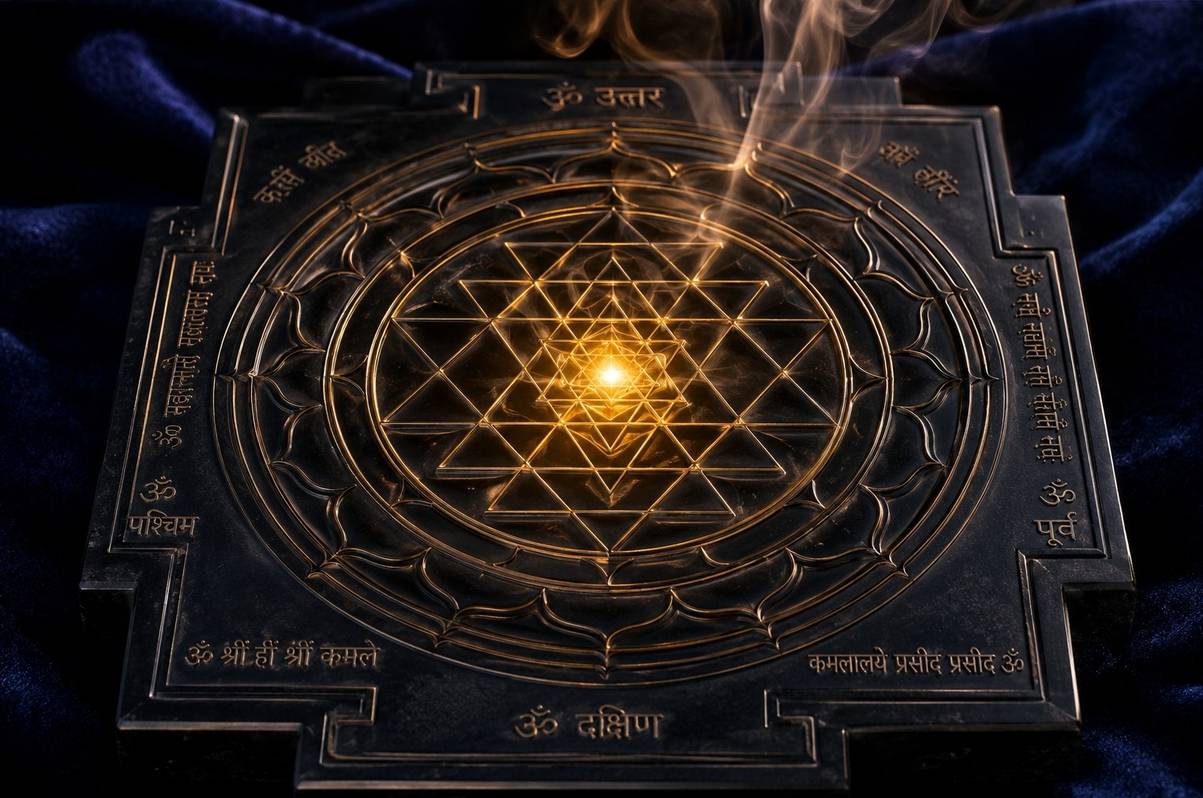
A yantra is a sacred diagram or visual instrument, often geometric, used to concentrate attention and embody a symbolic order. A mandala is a sacred circle, diagram, palace, or field of totality, used in many traditions as a map of cosmos, psyche, deity, or awakened order. Both work through structured seeing. The eye follows form. Attention gathers. The mind moves from periphery towards centre. The centre becomes a point of stillness.
This article explores yantra, mandala, trataka, visual absorption, sacred geometry, digital repurposing, nature mandalas, and the safe use of visual practice. It treats vision as powerful, but not as spectacle. The aim is not to force visions, chase afterimages, or turn geometry into mystical wallpaper. The aim is steadier seeing: attention that can remain, soften, enter, and return.
In Plain Terms
The Gateway of Vision is the use of sacred form, symbol, geometry, image, candle flame, yantra, mandala, and visual concentration to stabilise attention.
Yantra practice usually works with a precise geometric diagram, often centred on a bindu or point. The practitioner gazes, follows the structure, rests in the centre, and allows the form to gather the mind.
Mandala practice works with a larger field of symbolic order: centre, boundary, direction, colour, deity, element, palace, or cosmos. The mandala is not only looked at. It is entered, contemplated, constructed, dissolved, and integrated.
The safe approach is gradual. Visual practice should not strain the eyes, trigger headaches, intensify dissociation, or provoke obsessive altered-state chasing. Good vision practice makes perception clearer and life more grounded.
The discernment issue is false authority. False authority often works through images: sacred symbols, mandalas, AI visions, guru portraits, social media aesthetics, dream imagery, occult diagrams and beautiful interfaces. Vision practice restores the discipline of seeing without surrendering judgement to what dazzles.
Sources and Traditions Discussed
- Hatha Yoga and trataka: especially sustained gazing, candle-flame practice, afterimage, concentration, and the need for care around the eyes.
- Sri Vidya and Sri Yantra traditions: especially the bindu, interlocking triangles, lotus rings, enclosure, and the union of consciousness and energy.
- Tantric and yogic visual practice: including yantra, mantra, deity symbolism, centre-periphery movement, and contemplative concentration.
- Tibetan Buddhist mandala traditions: especially sacred palace, directional structure, construction, visualisation, and ritual dissolution.
- Western esoteric and symbolic diagrams: including the Tree of Life, sacred geometry, rose windows, temple plans, and contemplative architecture.
- Jungian mandala symbolism: especially the mandala as a symbol of psychic ordering and wholeness, handled as psychology rather than universal proof.
- Modern visual science: including pattern recognition, symmetry, visual attention, afterimage, mental imagery, spatial memory, and the caution needed around overclaiming neuroscience.
- Digital-age practice: especially repurposing screens, reducing visual noise, disabling notifications, and using image intentionally instead of being captured by image.
- Gnostic symbolic reading: where vision becomes a practice of seeing through false images, seductive surfaces, captured symbols, and the scattered visual economy of ordinary life.
How to Read This Article
This article uses the language of yantra, mandala, sacred geometry, visual absorption, afterimage, bindu, subtle perception, and contemplative seeing. Read these terms as traditional and practice-based language, not as a claim that every geometric form has one universal meaning or that every visual effect is mystical.
Visual practice can be useful, but it can also strain the eyes or become destabilising if forced. People with eye conditions, migraines, photosensitive epilepsy, visual disturbances, dissociation, panic, trauma sensitivity, psychosis vulnerability, or obsessive altered-state seeking should approach very carefully and seek appropriate professional guidance where needed.
The measure is not how long you can stare. The measure is whether vision becomes clearer, attention becomes steadier, the body remains grounded, and ordinary life is met with more care.
A yantra gives the eye a path. A mandala gives the mind a world. The practice is to enter, centre, and return.
Table of Contents
- Vision as the Fourth Gateway
- The Yantra as Concentration Device
- The Sri Yantra: Centre, Triangle, Lotus, Enclosure
- Trataka: The Discipline of the Gaze
- Specialised Yantras and Caution Around Use
- False Authority and the Captured Image
- The Mandala as Totality
- Construction, Dissolution, and the Lesson of Impermanence
- The Journey to Centre and Return
- Visual Attention, Afterimage, and Inner Space
- Digital Repurposing: When the Screen Becomes Practice
- Nature as Living Pattern
- Integration: Vision as Synthesis
- The Gnostic Reading: Seeing Through the Image
- Related Glossary Terms
- Read Next
- Frequently Asked Questions
- Further Reading
- References and Sources
Vision as the Fourth Gateway
The Five Gateways move through breath, sensation, sound, vision, and movement. Breath regulates the field. Sensation grounds it. Sound gathers it into vibration and listening. Vision gives it form.
The visual field is usually busy before it is conscious. The eye moves. The mind names. Desire follows colour and brightness. Fear scans for threat. The feed trains small bursts of attention. Advertising trains wanting. Social media trains comparison. Visual life becomes a marketplace where attention is constantly pulled outward.
Yantra and mandala practice turn the visual field into a temple of return. Instead of many competing objects, there is one form. Instead of endless novelty, there is repetition. Instead of being pulled by the bright edge of the next thing, the gaze is invited into the centre.
This does not make vision superior to breath, sensation, or sound. It makes vision another doorway. For visually sensitive people, it may be powerful. For others, it may be too stimulating or simply less natural than breath or body practice. The gateway should fit the practitioner, not the other way round.
Vision is especially important in the digital age because the eye is now a primary site of capture. The feed speaks first to sight. The thumbnail, colour, symbol, face, chart, interface, and notification all compete for the same faculty that yantra and mandala practice attempt to restore: the capacity to see deliberately.
The Yantra as Concentration Device
A yantra is often described as an instrument, diagram, or support for concentration. The Sanskrit term is connected with holding, restraining, sustaining, or instrumentality. In practice, a yantra holds attention. It gives the mind a visual structure stable enough to return to again and again.
This matters because ordinary attention leaks. The mind wants to move away, check, compare, narrate, remember, plan, or seek a brighter object. A yantra does not entertain that habit. It presents order: centre, line, symmetry, enclosure, direction, repetition, proportion, and return.
The yantra is not merely art for aesthetic consumption. It is art turned into practice. Its beauty serves attention. Its structure becomes a discipline. The form is external, but the effect is internal: the eye learns to remain, the mind learns to follow, and the practitioner begins to feel the difference between looking and seeing.
In this sense, the yantra is a quiet protest against the visual economy of distraction. It does not harvest your glance. It returns it to you.
That protest is subtle. A yantra does not shout over the screen. It offers a different contract. It asks for patience instead of reaction, centre instead of novelty, structure instead of spectacle, and repetition instead of restless search.
The Sri Yantra: Centre, Triangle, Lotus, Enclosure
The Sri Yantra, or Sri Chakra, is among the most celebrated yantras in Indian tradition. It is especially associated with Sri Vidya and the goddess Lalita Tripurasundari. Its form includes a central bindu, interlocking triangles, lotus petals, and an outer enclosure. In many presentations, nine interlocking triangles create forty-three smaller triangles around the centre.
The upward and downward triangles are often read through the polarity of Shiva and Shakti, consciousness and energy, stillness and manifestation. The bindu is the central point, the seed of manifestation and the point of return. The outer enclosure, sometimes called the bhupura, marks a threshold between ordinary space and sacred diagrammatic space.
For practice, the Sri Yantra can be approached from outside to inside. Begin with the outer boundary. Notice the square enclosure. Move inward to the lotus rings. Then the triangles. Then the bindu. Let the gaze travel, not as analysis only, but as pilgrimage. The eye moves from complexity towards centre.
The important point is not to make inflated claims about geometry. The Sri Yantra does not need to become a universal key to everything in order to be profound. Its power lies in the marriage of structure, symbol, attention, repetition, devotion, and centre.
Trataka: The Discipline of the Gaze
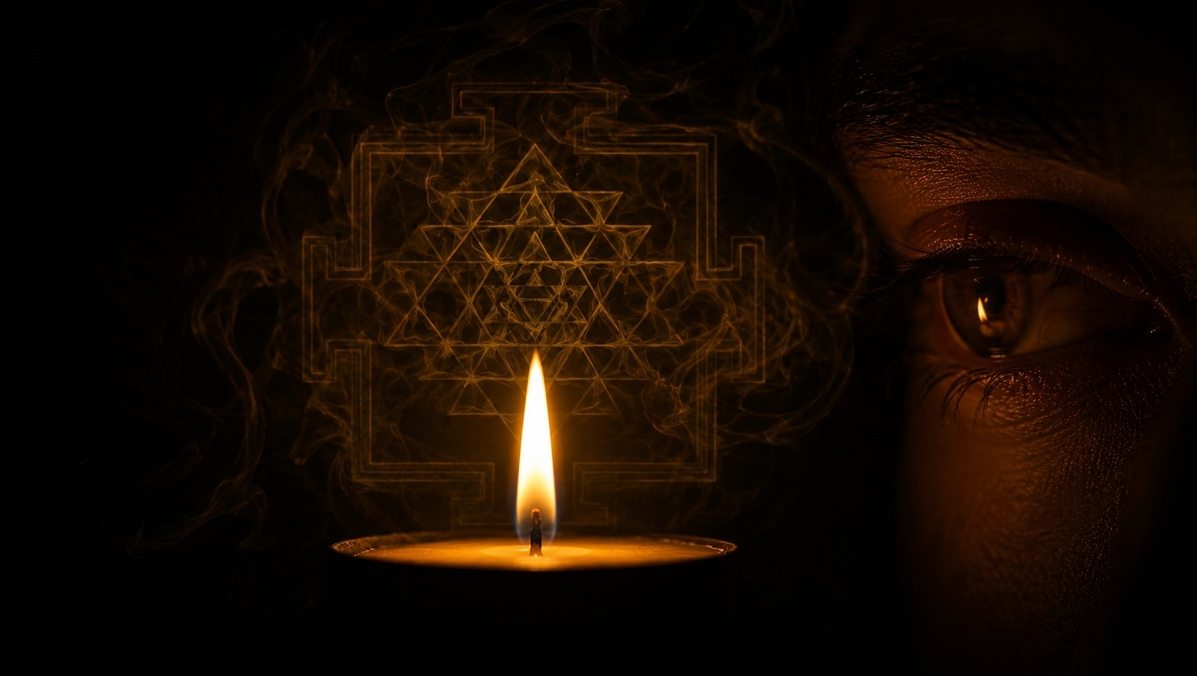
Trataka is a yogic gazing practice, commonly associated with candle flame, dot, yantra, deity image, or other visual object. Classical hatha yoga texts describe it as a practice of concentrated looking. In modern practice, it is often used to train attention, steadiness, and visual focus.
The basic method is simple: choose a stable object, sit comfortably, let the breath settle, and gaze softly. With a yantra, begin from the outer form and gradually rest in the centre. With a candle, rest the gaze near the flame. When the eyes tire, close them gently and notice any afterimage without chasing it.
This practice must be handled carefully. Trataka is not a contest of willpower. The eyes are delicate. Staring without blinking for too long can cause strain, dryness, headache, irritation, and discomfort. Begin with short periods. Blink when needed. Stop if there is pain, pressure, visual disturbance, migraine aura, dizziness, or distress.
The aim is sustained attention, not self-punishment. A relaxed gaze often teaches more than a forced stare. Vision opens when the eye is steady but not hostile to itself.
Antar Trataka: Inner Gazing
Antar trataka means inner gazing. After looking at a flame, dot, or yantra, the practitioner closes the eyes and observes the afterimage or inner visual impression. This can help attention move from external object to internal image.
The afterimage is partly physiological. The retina and visual system continue processing the stimulus after the eyes close. This does not make the experience spiritually meaningless, but it does mean it should not be exaggerated. The traditional and physiological readings can sit beside each other: the eye leaves a trace, and attention learns to observe the trace.
Do not force the afterimage to remain. Do not strain the brow. Do not turn every inner shape into revelation. Watch, soften, and return.
Specialised Yantras and Caution Around Use
Many traditions use yantras associated with particular deities, forces, planets, intentions, or contemplative aims. Examples often discussed include Sri Yantra, Kali Yantra, Ganesha Yantra, and planetary yantras. Each belongs to a larger ritual, devotional, linguistic, and cultural field.
- Sri Yantra: often associated with totality, centre, goddess, manifestation, and return.
- Kali Yantra: often associated with transformation, time, death, fierce compassion, and the cutting of false identity.
- Ganesha Yantra: often associated with beginnings, thresholds, wisdom, and the removal of obstacles.
- Planetary Yantras: used in some traditions to work symbolically with planetary qualities, timing, and ritual correspondences.
These should not be treated as visual gadgets. A yantra is not just a shape with a spiritual label attached. It carries context. Work simply, respectfully, and without pretending to master traditions you have barely met. A plain candle, dot, circle, cross, rose window, tree, or carefully chosen geometric form can be enough for concentration practice.
The question is not how exotic the diagram is. The question is whether the form gathers attention and whether the practice makes you clearer.
False Authority and the Captured Image
False authority often enters through image before it enters through argument. The eye is dazzled, then the mind begins to justify. A symbol looks ancient, a diagram looks precise, a guru portrait looks radiant, a mandala looks complete, an AI vision looks otherworldly, an interface looks calm, and the viewer quietly grants authority to what has not yet been tested.
This is the bridge into Neo Gnosticism and False Authority. False authority is not only a false claim. It is the theft of the faculty that tests the claim. In the visual field, that theft happens when beauty, symmetry, symbolic density, digital polish, social proof, or sacred aesthetics are allowed to replace direct knowing.
The captured image appears in many forms. It may be a spiritual teacher’s photograph treated as proof of attainment. It may be an occult diagram circulated without context. It may be a social media aesthetic that makes awakening look like lighting, clothing, posture and brand coherence. It may be an AI-generated vision that feels meaningful because it is luminous, complex and impossible-looking. It may be a mandala used not as practice but as wallpaper for borrowed depth.
Vision practice does not solve this by making the seeker suspicious of every image. Suspicion alone is another kind of captivity. It solves it by restoring the discipline of seeing. The practitioner learns to notice the difference between an image that gathers attention and an image that captures it. One returns the eye to centre. The other keeps the eye orbiting the spectacle.
This is why symbols can become cages. A symbol begins as a doorway, then becomes an authority. A mandala begins as a field of practice, then becomes identity. A diagram begins as a map, then becomes a prison of over-meaning. The eye is no longer seeing the symbol. It is being governed by it.
The body remains essential. The body against the algorithm is also the body against visual hypnosis. When an image feels too compelling, pause. Feel the feet. Notice the breath. What happens in the jaw, chest, belly and hands while the image is being received? Does the image deepen presence, or does it demand surrender?
True visual practice does not require the abandonment of judgement. It sharpens judgement. The eye learns to stay open without becoming gullible. The mind learns to contemplate without worshipping the surface. The seeker learns to let beauty speak without giving beauty the throne.
Before trusting the vision, ask what it does to your breath.
False authority weakens when the image is allowed to be image again: powerful, beautiful, symbolic, partial, and not final.
The Mandala as Totality
A mandala is often a circle, diagram, palace, map, field, or sacred arrangement representing totality. In Tibetan Buddhist traditions, mandalas may represent the awakened palace of a deity, complete with gates, directions, colours, guardians, and centre. In Hindu, Buddhist, Jain, Indigenous, Christian, Islamic, Hermetic, Kabbalistic, and modern psychological contexts, circular or centred forms appear in many different ways.
Care is needed here. Not every circular image is the same thing. A Tibetan sand mandala, a Navajo sand painting, a Gothic rose window, a Celtic stone circle, a medicine wheel, a labyrinth, and Jung’s mandala drawings belong to different worlds. They should not be melted into one universal soup.
Still, centred forms recur because the human being repeatedly asks the same question: where is the centre, and how do we return to it?
For practice, a mandala can be approached as a field of ordered relation. There is boundary. There is direction. There is centre. There is movement from outside to inside, and then back again. The mandala trains the mind to see life as arrangement rather than chaos.
Construction, Dissolution, and the Lesson of Impermanence
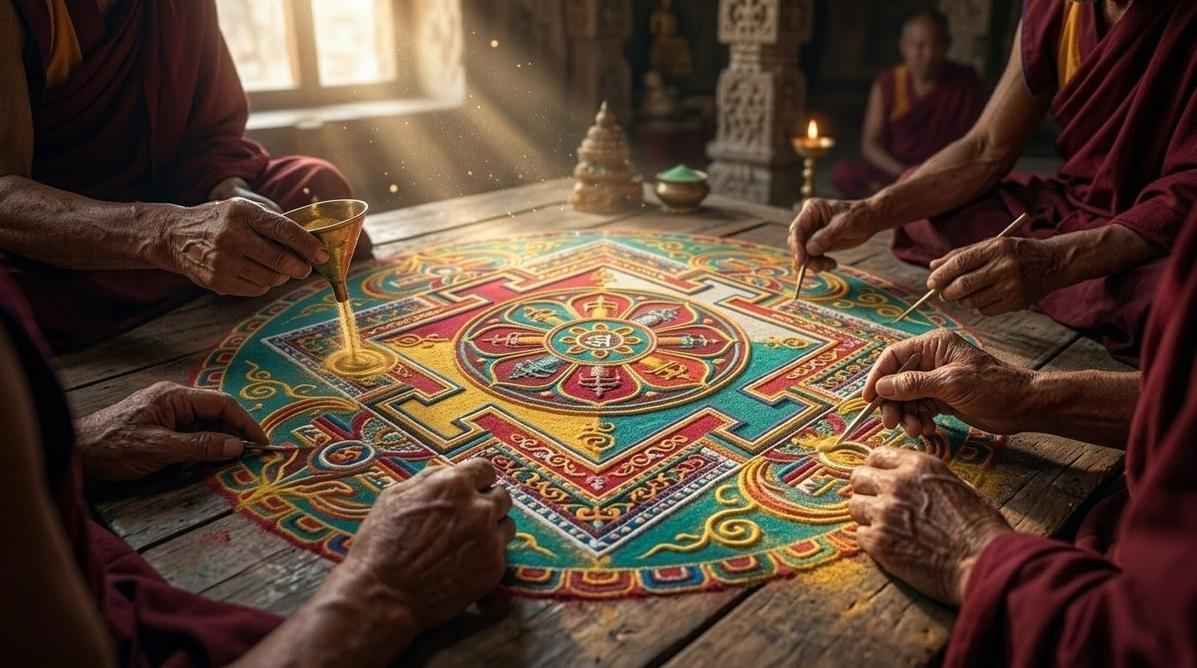
Some mandalas are contemplated. Others are constructed. A Tibetan sand mandala, carefully made and then ritually swept away, teaches through both formation and dissolution. The making concentrates. The unmaking teaches impermanence.
This is one of the great medicines of mandala practice. The ego likes accumulation: finished work, displayed skill, visible proof, possession, permanence. The dissolved mandala says something different. Beauty can be offered without being possessed. Order can be made without being clung to. The centre does not disappear because the form is swept away.
A contemporary practitioner can work with this principle simply. Arrange stones, leaves, shells, petals, or paper shapes into a circular form. Sit with it. Notice the centre. Then undo it respectfully. Return the objects. Sweep the paper away. Let the pattern vanish. Watch what the body feels when the form disappears.
The practice is not the photograph. The practice is the making, seeing, releasing, and returning.
This matters in a culture where every sacred-looking moment is tempted towards display. The mandala teaches a counter-instinct: not everything beautiful needs to become content. Some forms complete themselves by vanishing.
The Journey to Centre and Return
Mandala contemplation often moves from the periphery to the centre. The practitioner begins at the outer boundary, notices the gates or directions, follows the structure inward, rests at the centre, then returns outward carrying the centre into ordinary life.
This pattern matters. Spiritual practice often wants to rush to the middle. The mandala says: enter properly. Pass the threshold. Notice the guardians. Respect the directions. Do not claim the centre without understanding the path.
The return is equally important. A mandala is not an escape pod. It is a training field. The point is not to remain in symbolic centre forever. The point is to bring centredness back into speech, task, relationship, money, grief, cooking, work, conflict, and rest.
A useful practice is this: after gazing at a mandala, close the eyes, feel the body, then open the eyes and look at the room. Can the room also be seen as ordered around awareness? Can the table, door, cup, window, body, and breath form a humble mandala of the present?
Visual Attention, Afterimage, and Inner Space
Modern visual science can help explain why geometric practice is compelling without reducing it to mechanism. The human visual system is sensitive to pattern, symmetry, contrast, centre, edge, motion, colour, repetition, and spatial hierarchy. These features shape attention before the reflective mind has finished describing them.
A yantra or mandala uses this sensitivity deliberately. Symmetry reduces visual chaos. Centre gives the eye a place to rest. Repetition builds rhythm. Boundary defines the field. Complexity keeps attention engaged. Order prevents overwhelm.
Research on meditation more broadly suggests that sustained attentional practice can affect self-referential processing, attention networks, and emotional regulation. Research on visual imagery shows that imagined forms can recruit parts of the visual system. Spatial navigation research also shows that mental mapping and physical navigation can share neural resources. These findings do not prove every esoteric claim about mandalas. They do show that attention, imagery, spatial mapping, and perception are deeply embodied processes.
The careful conclusion is enough: visual practice can train the way attention organises space. It can change how the practitioner inhabits the field of seeing. That is already a doorway.
Digital Repurposing: When the Screen Becomes Practice
The screen usually fragments attention. It offers movement, novelty, reaction, comparison, brightness, notification, and endless escape from stillness. But the same screen can be repurposed if the intention is strong enough and the environment is stripped of interruption.
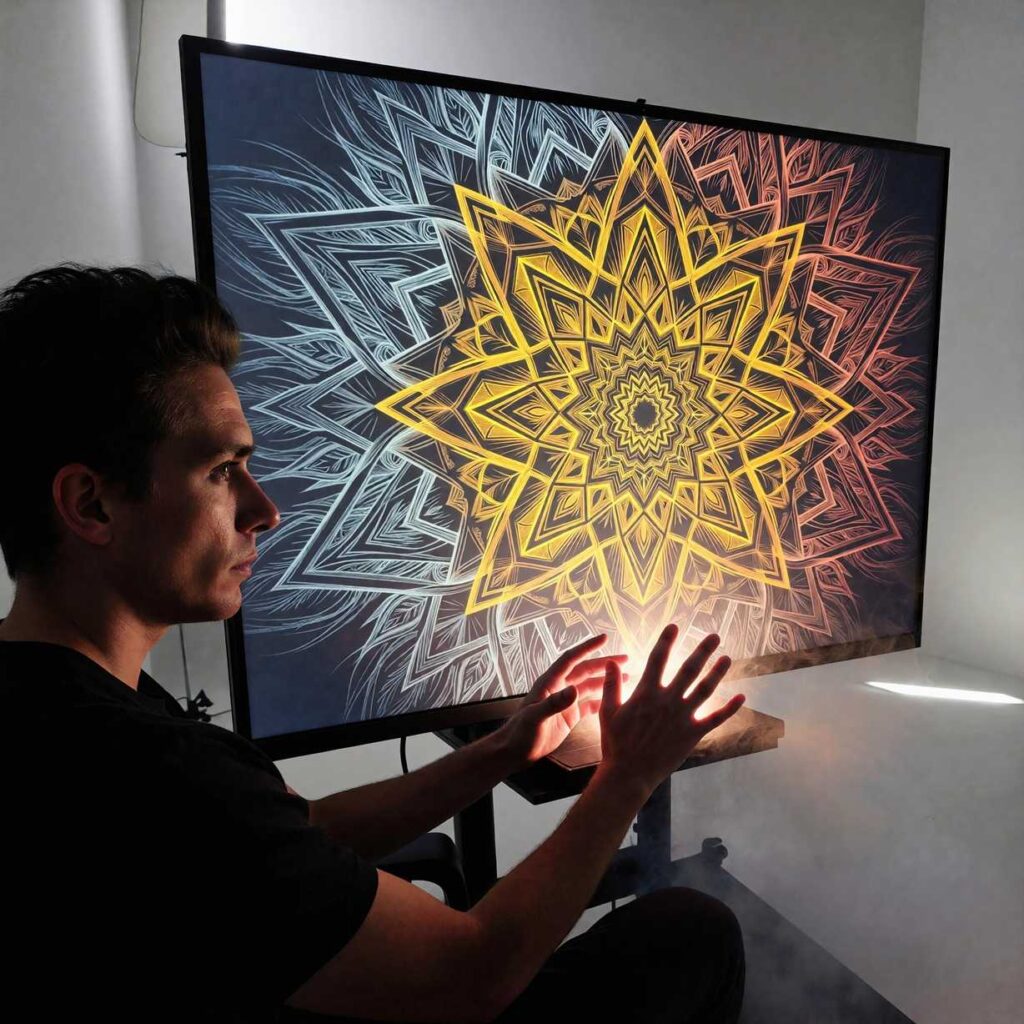
A digital yantra or mandala practice should be simple. Choose a single high-resolution image. Set the device to airplane mode. Turn off notifications. Use a comfortable brightness. Avoid practising late at night if screen light disturbs sleep. Sit far enough back that the eyes are not strained.
The screen must become a window, not a trapdoor. One image only. No switching. No checking. No “just one more thing”. The practice is not to spiritualise scrolling. It is to stop scrolling long enough for vision to recover dignity.
A Simple Digital Yantra Protocol
- Choose one image: Sri Yantra, mandala, candle flame, sacred architecture, or a simple geometric centre.
- Remove interruptions: airplane mode, no notifications, no split-screen, no tabs.
- Set a short timer: begin with three to five minutes.
- Gaze softly: move from boundary to centre, then rest in the centre.
- Close the eyes briefly: notice afterimage or inner quiet without strain.
- Return: look around the room, feel the body, and do one ordinary task slowly.
Digital practice is not inferior simply because it uses pixels. But it requires discipline because the same device is also trained to scatter you. The temple is sitting inside a casino. Choose carefully where you place the eye.
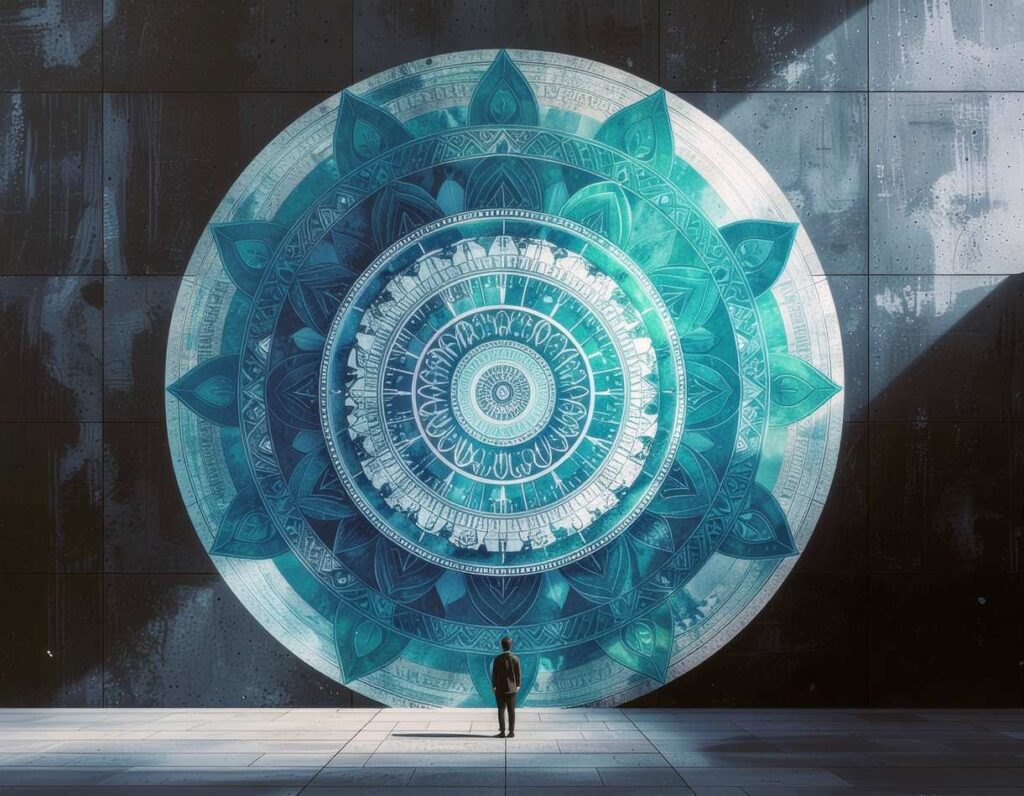
Nature as Living Pattern
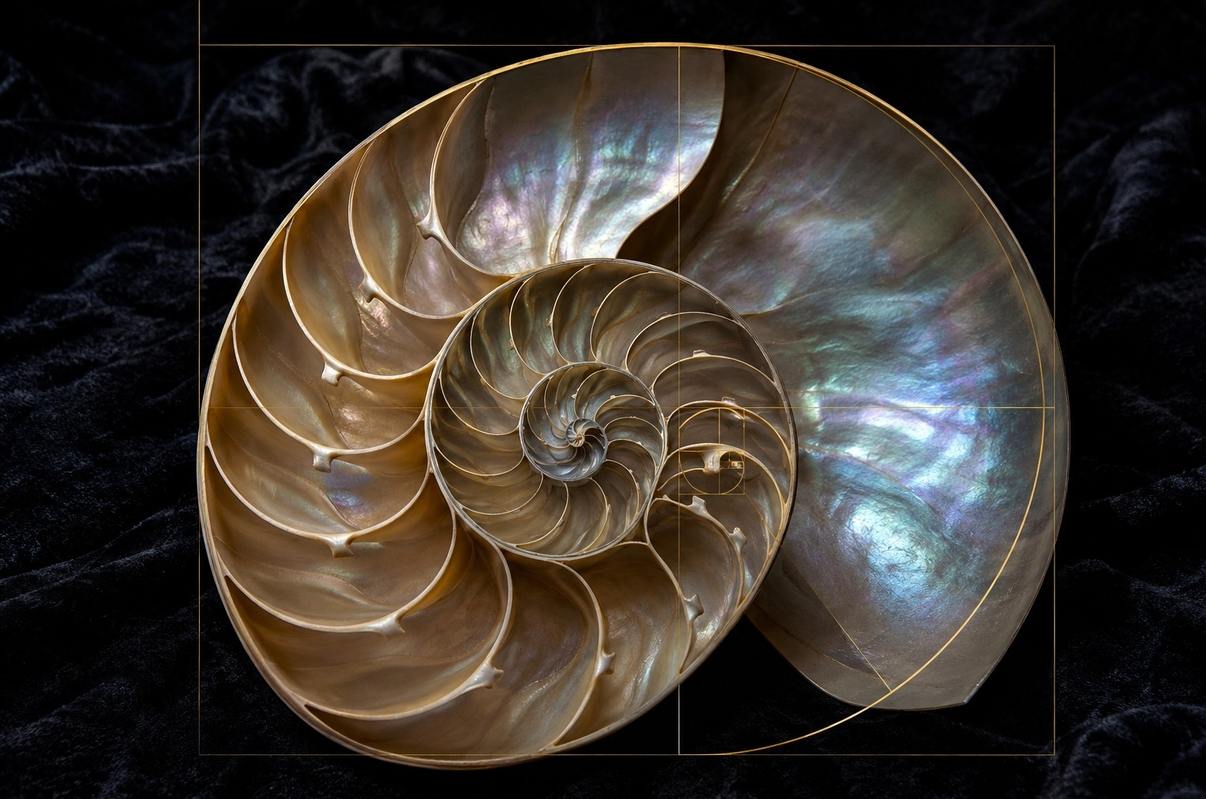
Vision practice does not require a printed diagram. Nature offers patterns that gather the eye: a flower, shell, pine cone, tree ring, spiral fern, seed head, frost pattern, ripple, spider web, honeycomb, or circular pool. These forms are not yantras in the strict traditional sense, but they can function contemplatively when approached with steady attention.
Nature teaches without announcing itself. A flower radiates from a centre. A shell grows through spiral proportion. A tree records time in rings. A pool receives the sky. These are not arguments. They are visual invitations.
To practise, choose one natural form. Look softly. Do not rush to classify. Notice centre, pattern, repetition, boundary, asymmetry, imperfection, and growth. Let the eye rest. Then close the eyes and notice what remains.
This kind of practice is especially useful for readers who find formal yantras too charged, too religiously specific, or too visually intense. The natural world can give the eye structure without pressure.
Integration: Vision as Synthesis
The Gateway of Vision synthesises the earlier gateways. Breath steadies the body. Sensation grounds attention. Sound trains rhythm and return. Vision gives those capacities a form to enter.
Without breath, visual practice can become tense. Without sensation, it can become dissociative. Without sound or rhythm, it can become restless. Without integration, it can become spiritualised image-hunting.
Good vision practice is not about collecting beautiful inner scenes. It is about learning to see without immediately grasping, naming, consuming, or fleeing. It trains the eye to remain. It trains the mind to respect form. It trains the body to stay present while attention enters symbolic space.
After any visual practice, return deliberately. Look at the room. Feel the feet. Drink water. Move the body. Let ordinary sight become sacred enough. The best mandala practice does not end with the diagram. It changes the way the next doorway, cup, road, tree, or human face is seen.
This is where sound, sensation and vision become one practice route. Sound teaches listening. Sensation teaches contact. Vision teaches form. Together, they prevent the seeker from becoming a floating mind chasing images in a private sky.
The Gnostic Reading: Seeing Through the Image
Gnostic myth often concerns false seeing. The visible world is not rejected simply because it is visible. The problem is misrecognition: mistaking the surface for the whole, mistaking the image for truth, mistaking the system’s display for reality itself.
In this reading, the visual gateway is not about escaping the image. It is about purifying the relationship to image. The eye no longer wanders as a servant of appetite, fear, comparison, and spectacle. It becomes disciplined enough to see form as form, centre as centre, symbol as symbol, and illusion as illusion.
The Archonic pattern, read symbolically, thrives on scattered seeing. It shows the mind a thousand surfaces and asks it to forget the source of seeing itself. Yantra and mandala practice answer with one form, one centre, one field of return.
The bindu is not only a dot. It is the discipline of not being seduced by every edge. The mandala is not only a diagram. It is a reminder that chaos may conceal arrangement, and that the centre is not found by chasing every object in the field.
Gnosis begins when seeing becomes less obedient to spectacle. The world remains visible. But the eye is no longer entirely owned by what is shown.
This is also why false authority must be tested at the level of image. A dazzling symbol can still be a cage. A beautiful interface can still be a command structure. A visionary image can still inflate the ego. A diagram can still become an idol. The Gnostic eye learns to see through the image without needing to destroy the image.
Related Glossary Terms
For quick definitions, use the main ZenithEye Glossary. The key terms for this article are:
Read Next
Continue with: The Gateway of Movement: Walking Meditation and Circulation
If vision gives attention a sacred form, movement brings that form back into the body. Walking meditation, circulation, gesture, rhythm, and embodied action complete the gateway sequence by making direct knowing mobile, grounded, and livable.
Within Practice & Method
This article belongs to The Five Gateways and Contemplative Techniques, the Practice & Method route where breath, sensation, sound, vision, movement, and silence become practical entrances into direct knowing.
Frequently Asked Questions About Yantra and Mandala Practice
What is the Gateway of Vision?
The Gateway of Vision is the use of sacred form, symbol, geometry, image, candle flame, yantra, mandala, and visual concentration to stabilise attention. It trains the visual field to become a doorway into centre, clarity, and contemplative seeing rather than a source of constant distraction.
What is the difference between a yantra and a mandala?
A yantra is usually a precise sacred diagram or visual instrument used for concentration, often geometric and centred on a bindu. A mandala is a larger sacred circle, palace, field, or map of totality. Both can guide attention from periphery to centre, but they belong to different traditions and should not be treated as identical.
What is trataka?
Trataka is a yogic gazing practice that uses a candle flame, dot, yantra, deity image, or other visual object to train attention. It should be practised gently. Blink when needed, avoid strain, and stop if eye pain, headache, visual disturbance, dizziness, or distress appears.
How does visual practice help with false authority?
Visual practice helps by training the eye to see without being captured by image. False authority often works through sacred symbols, guru portraits, AI visions, beautiful interfaces, occult diagrams, social media aesthetics and dazzling surfaces. The practitioner learns to pause, feel the body, and test whether the image deepens presence or demands surrender.
Can yantra or mandala practice damage the eyes?
Visual practice can strain the eyes if forced or practised for too long. Begin with short periods, use soft attention, blink naturally, and stop if pain, pressure, headache, dryness, or visual disturbance occurs. People with eye conditions, migraines, photosensitive epilepsy, or visual symptoms should seek appropriate professional advice before practising.
Can I use a phone or computer screen for yantra practice?
Yes, but only with discipline. Use one image, full-screen, with notifications disabled and brightness comfortable. Avoid late-night practice if screen light disturbs sleep. The screen should be used as a single contemplative field, not as another doorway into scrolling, checking, and distraction.
Do I need to be Hindu or Buddhist to use yantra or mandala practice?
Basic visual concentration can be practised by anyone, but specific yantras and mandalas belong to living religious and cultural traditions. Approach them respectfully, avoid treating them as exotic decorations, and use simpler forms such as candle flame, dot, circle, natural patterns, or sacred architecture if that feels more appropriate.
What should I do if visual practice feels intense or strange?
Stop the practice, open your eyes, feel the floor, drink water, move the body, and return to ordinary surroundings. Do not chase afterimages, visions, or altered states. If visual practice produces panic, dissociation, insomnia, disturbing imagery, eye pain, or difficulty functioning, pause and seek appropriate support.
How does visual practice relate to Gnostic practice?
In a Gnostic symbolic reading, visual practice trains the eye to see through spectacle, false images, and scattered attention. Yantra and mandala practice gather vision around centre and order, helping the practitioner recognise how easily the visible field can capture consciousness and how seeing can become more deliberate.
Study and Safety Note
This article explores yantra, mandala, trataka, sacred geometry, visual concentration, afterimage, visualisation, altered states, and Gnostic symbolism for educational and reflective purposes. It does not provide medical, psychological, psychiatric, optometric, neurological, meditation-instruction, or spiritual-direction advice.
Concentrated gazing may strain the eyes or trigger headaches, migraines, visual disturbance, or photosensitive reactions in some readers. Avoid flickering light sources if you have epilepsy or photosensitive conditions. Do not force the gaze. Do not practise with contact lenses if they cause dryness or discomfort. Stop immediately if you experience eye pain, pressure, severe headache, dizziness, unusual visual symptoms, panic, dissociation, or distress.
Visual practices complement but do not replace medical care, mental health support, trauma-informed care, or professional eye assessment. Good practice should make seeing gentler, clearer, and more grounded, not more strained or obsessive.
For the authority layer, read this article beside Neo Gnosticism and False Authority and When Symbols Become Cages. The eye must be trained not only to see beauty, but to test what beauty asks of the soul.
Further Reading
These ZenithEye links continue the themes of vision, sacred geometry, breath, sensation, sound, movement, altered states, false authority, symbols, and integration:
- The Gateway of Movement: Walking Meditation and Circulation – The next gateway in the sequence, bringing visual stillness into embodied rhythm, walking, and circulation.
- Neo Gnosticism and False Authority – Gurus, algorithms, AI advisers, images, symbols and the theft of direct knowing.
- When Symbols Become Cages – The danger of over-meaning, symbolic capture and losing discernment inside beautiful forms.
- The Body Against the Algorithm – Embodiment as the safeguard against digital capture, visual hypnosis and machine-shaped attention.
- The Five Gateways to Direct Knowing: A Complete Map – The complete gateway system and the place of vision within breath, sensation, sound, vision, and movement.
- Sacred Geometry: The Architecture of Creation – The geometric forms underlying yantra, mandala, sacred architecture, and symbolic space.
- The Tree of Life: Kabbalistic Architecture Explained – A Western esoteric diagram of emanation, relation, symbolic mapping, and contemplative ascent.
- The Gateway of Breath: Pranayama Techniques for Altered States – Breath as the first gateway, stabilising the body before visual concentration deepens.
- The Gateway of Sensation: Body Scan and Somatic Awareness – Grounding attention in the body before working with image, afterimage, and sacred form.
- The Gateway of Sound: Mantra and Nada Yoga – Sound as the third gateway, training rhythm and sustained attention before vision.
- Creating Personal Practice: How to Combine the Five Gateways – How to sequence breath, sensation, sound, vision, and movement into a sustainable daily structure.
- Contemplative Techniques: Methods for Stabilisation – Integrating yantra, mandala, gazing, and visual practice into a wider contemplative framework.
- States of Knowing: What Happens When Consciousness Unravels – Altered states, absorption, destabilisation, and the need for grounded discernment.
- Integration and Grounding After Awakening – Returning visual and symbolic practice into body, ordinary life, and ethical action.
- Nervous System Regulation: The New Meditation and Embodied Spirituality – Why regulation, embodiment, and safety support deeper visual and contemplative work.
References and Sources
The following sources support the yogic, Tantric, Buddhist, symbolic, visual-science, psychological, and safety framework used in this article.
Primary Sources and Classical Texts
- Hatha Yoga Pradipika. Attributed to Svatmarama. Classical hatha yoga text including trataka among purification and concentration-related practices.
- Gheranda Samhita. Classical hatha yoga text discussing purification, posture, mudra, breath, meditation, and samadhi.
- Patanjali. Yoga Sutras. Classical source for concentration, meditation, absorption, and disciplined practice.
- Saundarya Lahari. Sanskrit hymn traditionally associated with Sri Vidya, Lalita Tripurasundari, and Sri Yantra symbolism.
- Sat-Cakra-Nirupana. Tantric source influential in later subtle body and chakra interpretations.
- Hevajra Tantra, Guhyasamaja Tantra, and related Vajrayana sources for mandala, deity, and visualisation traditions.
- The Mandukya Upanishad. Source for contemplative mapping of Om and states of consciousness, relevant to centre, sound, and silence symbolism.
Yantra, Mandala, Tantra, and Sacred Geometry
- Rao, S. K. Ramachandra. Sri Yantra: The Tantric Symbol of Cosmic Unity. Thames and Hudson, 1988.
- Khanna, Madhu. Yantra: The Tantric Symbol of Cosmic Unity. Thames and Hudson, 1979.
- Brauen, Martin. Mandala: Sacred Circle in Tibetan Buddhism. Serindia Publications, 2009.
- Tucci, Giuseppe. The Theory and Practice of the Mandala. Rider, 1961.
- Gyatso, Tenzin, the Fourteenth Dalai Lama. The Kalachakra Tantra: Rite of Initiation. Wisdom Publications, 1985.
- Flood, Gavin. The Tantric Body: The Secret Tradition of Hindu Religion. I. B. Tauris, 2006.
- Feuerstein, Georg. The Yoga Tradition: Its History, Literature, Philosophy and Practice. Hohm Press, 1998.
- Mallinson, James and Singleton, Mark. Roots of Yoga. Penguin Classics, 2017.
- Rawson, Philip. The Art of Tantra. Thames and Hudson, 1973.
Jungian, Comparative, and Western Esoteric Context
- Jung, C. G. Mandala Symbolism. Princeton University Press, 1959.
- Jung, C. G. Psychology and Alchemy. Collected Works, Vol. 12. Princeton University Press.
- Jung, C. G. Man and His Symbols. Doubleday, 1964.
- Regardie, Israel. The Tree of Life: An Illustrated Study in Magic. Later editions.
- Fortune, Dion. The Mystical Qabalah. Williams and Norgate, 1935.
- Lawlor, Robert. Sacred Geometry: Philosophy and Practice. Thames and Hudson, 1982.
- Critchlow, Keith. Order in Space: A Design Source Book. Thames and Hudson, 1969.
Visual Science, Attention, Imagery, and Spatial Cognition
- Kosslyn, Stephen M., et al. “Visual Mental Imagery Activates Topographically Organized Visual Cortex.” Journal of Cognitive Neuroscience, 5(3), 263-287, 1993.
- Kosslyn, Stephen M. Image and Brain: The Resolution of the Imagery Debate. MIT Press, 1994.
- Brewer, Judson A., et al. “Meditation Experience Is Associated with Differences in Default Mode Network Activity and Connectivity.” Proceedings of the National Academy of Sciences, 108(50), 20254-20259, 2011.
- Tang, Yi-Yuan, Holzel, Britta K., and Posner, Michael I. “The Neuroscience of Mindfulness Meditation.” Nature Reviews Neuroscience, 16, 213-225, 2015.
- Posner, Michael I. and Petersen, Steven E. “The Attention System of the Human Brain.” Annual Review of Neuroscience, 13, 25-42, 1990.
- Maguire, Eleanor A., et al. “Navigation-Related Structural Change in the Hippocampi of Taxi Drivers.” Proceedings of the National Academy of Sciences, 97(8), 4398-4403, 2000.
- Hassabis, Demis, et al. “Patients with Hippocampal Amnesia Cannot Imagine New Experiences.” Proceedings of the National Academy of Sciences, 104(5), 1726-1731, 2007.
- Palmer, Stephen E. Vision Science: Photons to Phenomenology. MIT Press, 1999.
Meditation Safety, Eyes, Trauma, and Integration
- Treleaven, David A. Trauma-Sensitive Mindfulness: Practices for Safe and Transformative Healing. W. W. Norton, 2018.
- van der Kolk, Bessel. The Body Keeps the Score: Brain, Mind, and Body in the Healing of Trauma. Viking, 2014.
- Ogden, Pat, Minton, Kekuni, and Pain, Clare. Trauma and the Body: A Sensorimotor Approach to Psychotherapy. W. W. Norton, 2006.
- Grof, Stanislav and Grof, Christina. Spiritual Emergency: When Personal Transformation Becomes a Crisis. Tarcher, 1989.
- Lindahl, Jared R., et al. “The Varieties of Contemplative Experience: A Mixed-Methods Study of Meditation-Related Challenges in Western Buddhists.” PLOS ONE, 12(5), 2017.
- Wilkins, Arnold. Visual Stress. Oxford University Press, 1995.
- Fisher, Robert S., et al. Clinical and neurological literature on photosensitivity and seizure risk.
Gnostic and Hermetic Context
- Robinson, James M., ed. The Nag Hammadi Library in English. Revised edition. HarperOne, 1990.
- Meyer, Marvin, ed. The Nag Hammadi Scriptures. HarperOne, 2007.
- Layton, Bentley. The Gnostic Scriptures. Yale University Press, 1987.
- Brakke, David. The Gnostics: Myth, Ritual, and Diversity in Early Christianity. Harvard University Press, 2010.
- King, Karen L. What Is Gnosticism?. Harvard University Press, 2003.
- Williams, Michael Allen. Rethinking Gnosticism: An Argument for Dismantling a Dubious Category. Princeton University Press, 1996.
- Copenhaver, Brian P. Hermetica: The Greek Corpus Hermeticum and the Latin Asclepius. Cambridge University Press, 1992.