The Gospel of Thomas: 114 Keys to the Kingdom
The Gospel of Thomas (Nag Hammadi Codex II,2) represents the most audacious filing error in the history of Christian bureaucracy — a complete collection of 114 secret sayings (logia) attributed to Jesus, stripped of every narrative convenience, miracle, passion account, and resurrection spectacle. Unlike the canonical gospels with their elaborate administrative protocols (birth narratives, trial transcripts, execution reports), Thomas offers only the raw, unexplained data: the sayings themselves, demanding immediate interpretation without institutional mediation [1]. “Whoever finds the interpretation of these sayings will not experience death” — not through faith in a crucified saviour, but through direct experiential knowledge (gnosis) that rewrites the soul’s classification from mortal to living. Composed likely in the mid-to-late first century CE, this is Christianity reduced to its administrative minimum, circulating for sixteen centuries beneath the official filing system before its rediscovery in 1945.
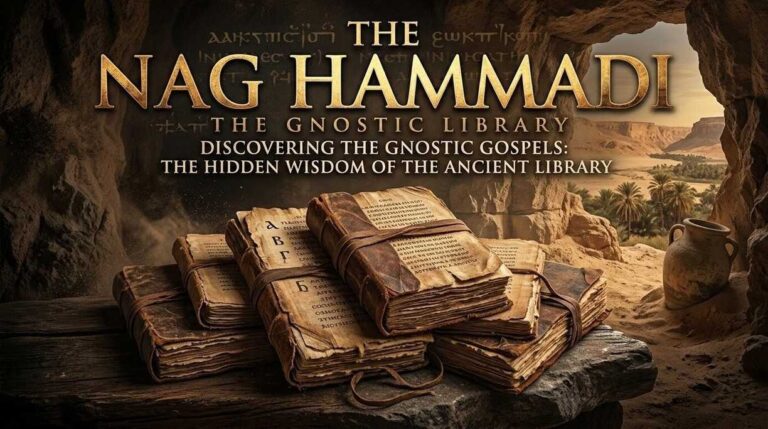
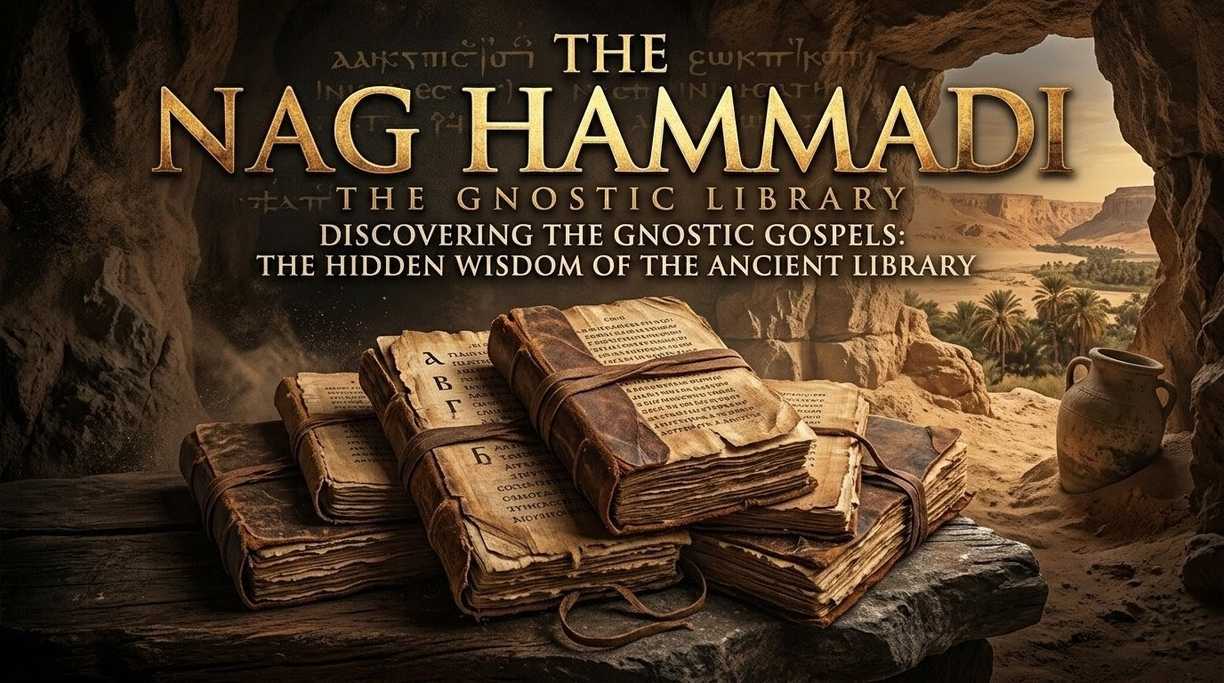
Unlike the mythological narratives of the Apocryphon of John or the liturgical protocols of the Three Steles of Seth, Thomas operates as a practical wisdom manual, drawing upon Jewish sapiential traditions and early Christian prophecy while adapting them for a direct address that bypasses priestly mediation entirely [2]. The text addresses the reader as a seeker capable of immediate recognition — emphasising wakefulness, self-knowledge, and the reversal of ordinary perception as the path to spiritual incorruption. In the diverse bureaucracy of the Nag Hammadi library, Thomas serves as the intelligence brief: less concerned with cosmic restructuring than with the immediate transformation of the perceiving subject [3].
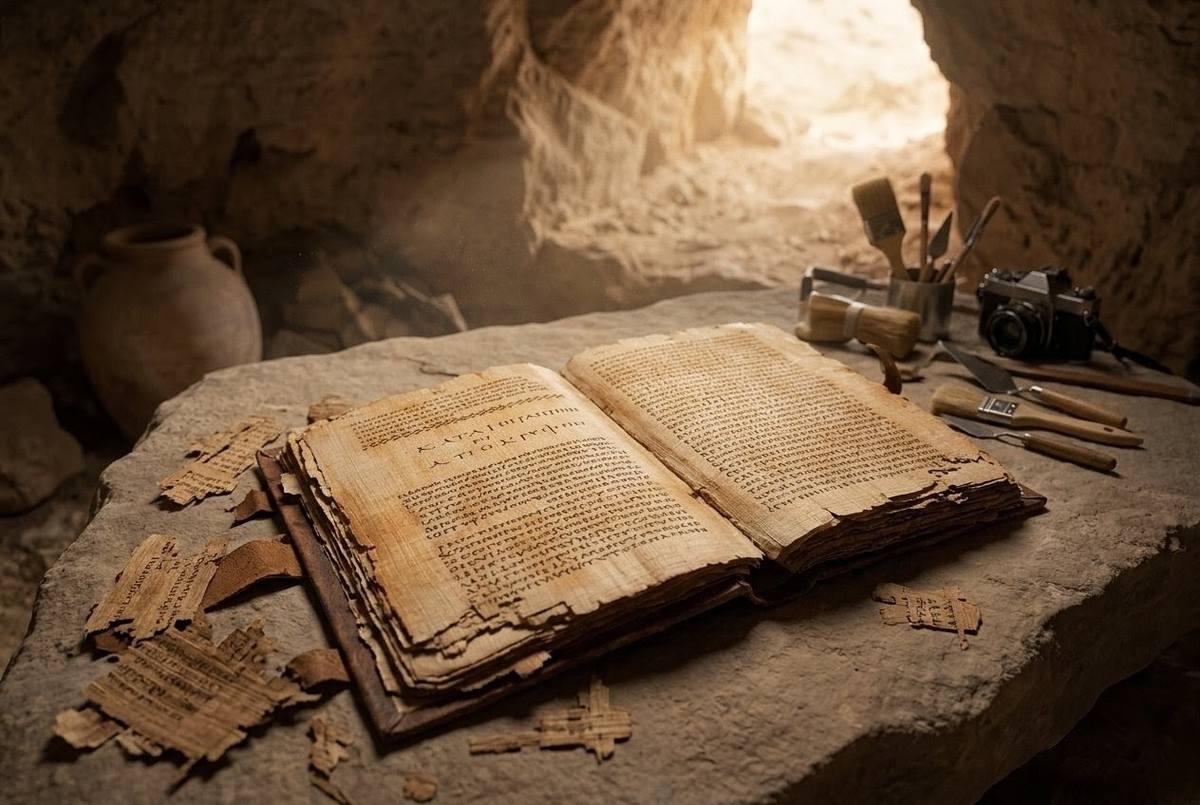
Table of Contents
- The Anti-Gospel: Stripped to Essence
- What Is the Gospel of Thomas?
- The Twin Who Understood
- The Oxyrhynchus Fragments: Early Evidence
- The Sayings: A Thematic Guide
- The Kingdom Is Here
- Self-Knowledge as Salvation
- The Reversal of Values
- The Solitary Path
- Thomas and the Canonical Gospels
- How to Read Thomas
- Why Thomas Matters
- Frequently Asked Questions
- Further Reading
- References and Sources
The Anti-Gospel: Stripped to Essence
No miracles. No passion. No resurrection narrative. No Sermon on the Mount, no parables of seeds and soils, no cleansing of the temple, no trial before Pilate, no empty tomb. The Gospel of Thomas is Christianity stripped to its administrative minimum: the sayings of Jesus, demanding interpretation, offering no bureaucratic certainty — only the promise that understanding transforms existence [1].
Primary Source Citation: NHC II,2 32:1-10: “These are the secret sayings which the living Jesus spoke and which Didymos Judas Thomas wrote down. And he said, ‘Whoever finds the interpretation of these sayings will not experience death.'” [1]
This opening prologue establishes the text’s radical premise: salvation comes not through faith in Christ’s death and resurrection — the standard protocol of orthodox Christianity — but through understanding (gnosis) his secret teachings. The kingdom is not a future event scheduled for apocalyptic release, but a present reality available to those who can perceive it. Death is not the enemy to be defeated through sacrificial atonement, but the illusion to be dispelled through recognition of one’s true status [4].
Thomas is the most famous text in the Nag Hammadi Library, the most widely translated, the most debated by scholars, and the most beloved by contemporary seekers. It is also the most accessible — requiring no background in Gnostic cosmology, no familiarity with Sethian mythology, no patience for Valentinian technicalities. Just the sayings, raw and unexplained, waiting for the interpreter who can unlock their transformative data [3].
What Is the Gospel of Thomas?
The Gospel of Thomas Defined
The Gospel of Thomas (Coptic: Pēuaggelion Pkata Thomas; Greek: Evangelion kata Thōman) is a non-canonical sayings gospel discovered in 1945 at Nag Hammadi, Egypt. Containing 114 logia (sayings) attributed to Jesus and compiled circa 50-100 CE, it lacks narrative framework, miracles, or passion accounts. The text is framed as secret teachings given to Didymos Judas Thomas (the Twin), discovered in three Greek fragments at Oxyrhynchus (P.Oxy. 1, 654, 655) and one complete Coptic version in Nag Hammadi Codex II. It represents an independent trajectory of early Christian wisdom literature focused on immanent kingdom realisation rather than apocalyptic expectation [1].
Term appears in: Nag Hammadi Codex II,2; Papyrus Oxyrhynchus 1, 654, 655; circa 50-100 CE composition.
The Twin Who Understood
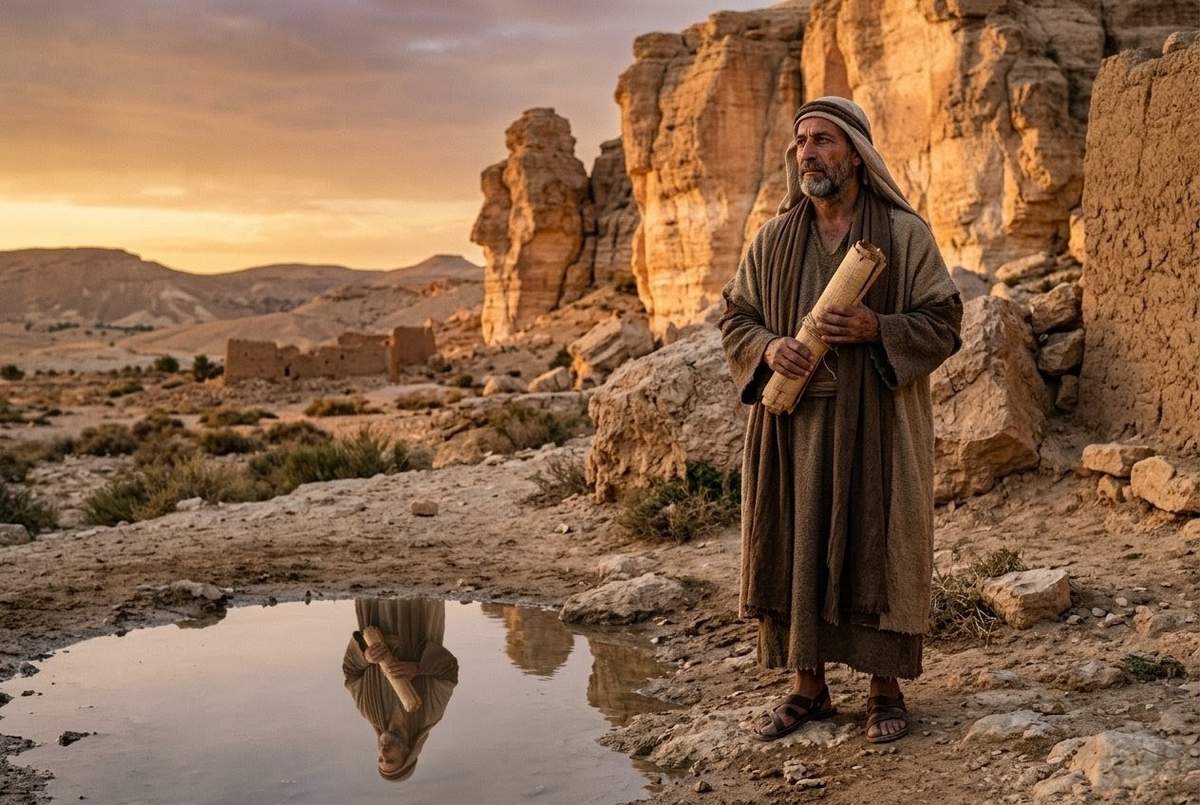
The text claims to preserve secret teaching given to Thomas, the twin (didymos in Greek, t’om in Aramaic — both meaning “twin”), who understood what the other disciples missed. “I am not your master,” Jesus tells Thomas in one of the final sayings, “because you have drunk, you have become drunk from the bubbling spring which I have measured out.” This is the gospel’s promise: not submission to hierarchical authority, but direct access to the source — the disciple who grasped the inner meaning rather than waiting for the official summary [5].
Who Was Didymos Judas Thomas?
Didymos Judas Thomas (Greek: Didymos = Twin; Aramaic: T’oma = Twin) is the legendary author-recipient of the Gospel of Thomas. According to the text, he is the “twin” who understood Jesus’ secret teachings while the other disciples misunderstood. In Saying 13, Jesus acknowledges Thomas’s primacy: “I am not your master… you have become drunk from the bubbling spring which I have measured out.” This establishes Thomas not as the doubting apostle of John’s Gospel, but as the privileged recipient of esoteric knowledge — the intimate who accessed what others could not perceive [5].
Scholars debate whether Thomas represents an independent tradition parallel to the canonical gospels or a later development dependent upon them. The text was likely composed in Greek in the mid-to-late first century, then translated into Coptic (the version in Nag Hammadi Codex II) and Syriac. Fragments exist in Greek from Oxyrhynchus, Egypt, dating to the early second century — archaeological evidence that this underground text circulated beneath the official channels [6].
The Oxyrhynchus Fragments: Early Evidence
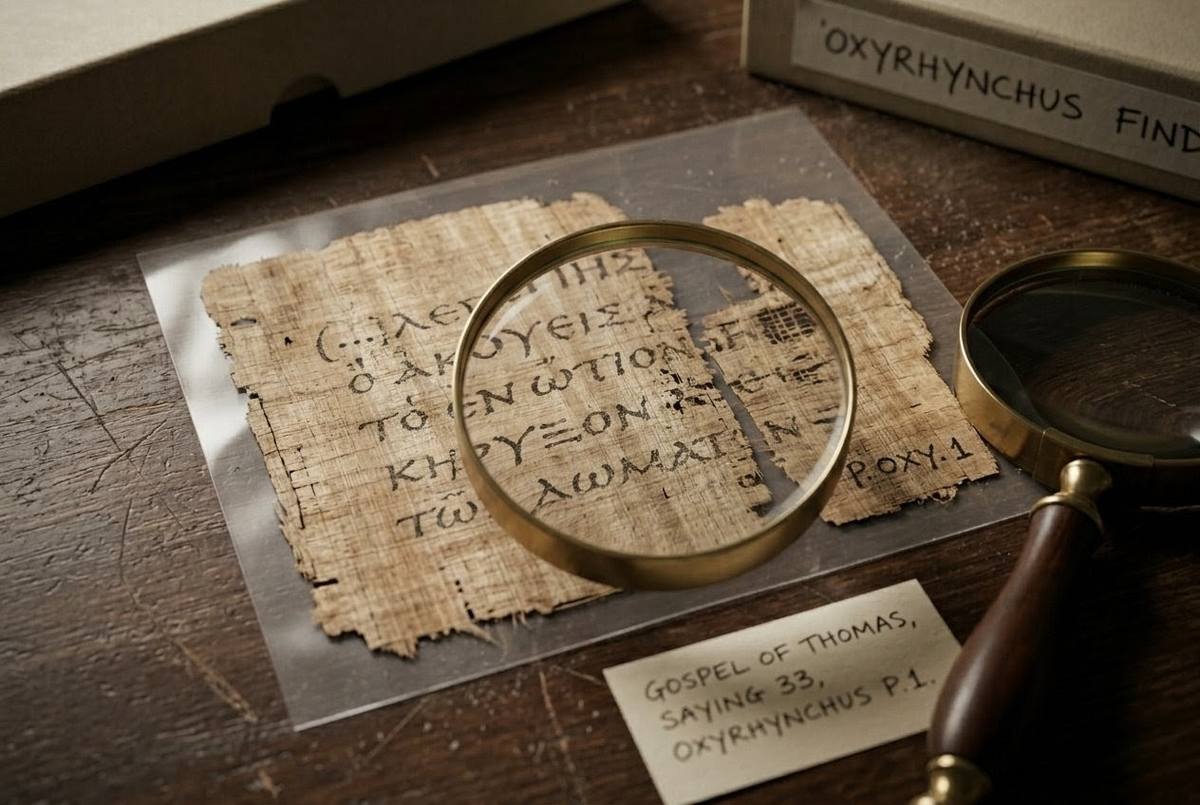
Before the complete Coptic version emerged at Nag Hammadi, three Greek papyrus fragments from Oxyrhynchus (P.Oxy. 1, 654, 655) preserved portions of Thomas. Dating to the early second century (c. 150-250 CE), these fragments confirm the text’s antiquity and widespread circulation. Significantly, the Greek versions show slight variations from the Coptic, suggesting the sayings remained fluid oral tradition rather than fixed scripture — exactly what one expects from a wisdom collection rather than a narrative gospel with authorised versions [6].
Discovery in the Discarded Records
The Oxyrhynchus fragments were discovered by Grenfell and Hunt between 1897 and 1904 in the ancient rubbish dumps of the city, buried beneath layers of administrative paperwork and discarded records. That the Gospel of Thomas survived in such company — among tax receipts and census records — seems appropriate for a text concerned with stripping away institutional mediation to reveal the raw data of transformation. The celestial message was filed alongside the most mundane municipal procedures, waiting for rediscovery [7].
Primary Source Citation: NHC II,2 32:1-10 (Prologue); NHC II,2 33:1-5 (Saying 3); NHC II,2 44:1-5 (Saying 13); NHC II,2 49:1-5 (Saying 22); NHC II,2 70:1-3 (Saying 70); NHC II,2 71:1-3 (Saying 75). Papyrus Oxyrhynchus 1, 654, 655 preserve Greek fragments circa 150-250 CE, showing textual variation that confirms fluid transmission [1][6].
The Sayings: A Thematic Guide
Thomas is not systematic. It does not develop arguments or build to conclusions. But patterns emerge for those who read slowly, repeatedly, with attention — like studying an ancient document until the redactions become legible through sheer persistence [4].
The Kingdom Is Here
Primary Source Citation: NHC II,2 33:1-5: “The kingdom is inside of you, and it is outside of you. When you come to know yourselves, then you will become known, and you will realise that it is you who are the sons of the living father.” [1]
Saying 113 completes the thought: “The kingdom of the father is spread out upon the earth, and men do not see it.” Against the apocalyptic expectation of a future kingdom descending from on high, Thomas insists on immanence. The divine is not elsewhere, not later, not after death. It is here, now, hidden in plain sight, visible to those who have eyes to see — the ones who can read the text without needing the hermeneutical key [4].
Self-Knowledge as Salvation
Primary Source Citation: NHC II,2 70:1-3: “If you bring forth what is within you, what you bring forth will save you. If you do not bring forth what is within you, what you do not bring forth will destroy you.” [1]
Saying 67 adds: “One who knows all but is lacking in oneself is utterly lacking.”
The gnosis that saves is self-knowledge — not intellectual accumulation but the bringing forth of what is hidden, the realisation of one’s true identity as a child of the living father. This is not academic theology; it is archaeological excavation of the psyche, retrieving the divine spark from beneath layers of historical accretion [8].
The Reversal of Values
Primary Source Citation: NHC II,2 22:1-5: “When you make the two into one, and when you make the inner like the outer and the outer like the inner, and the upper like the lower, and when you make male and female into a single one… then you will enter the kingdom.” [1]
Saying 29 delights in logical reversal: “If the flesh came into being because of spirit, it is a wonder. But if spirit came into being because of the body, it is a wonder of wonders.” Thomas inverts ordinary perception. The first shall be last, the outside shall be inside, the male and female shall be unified. These are not moral instructions but metaphysical pointers — indications that ordinary perception inverts reality like a form filed upside-down [4].

Jesus as Guide, Not Object of Worship
Saying 13: “I am not your master. Because you have drunk, you have become drunk from the bubbling spring which I have measured out.” Saying 108 extends this: “Whoever drinks from my mouth will become like me. I myself shall become that person, and the hidden things will be revealed to that person.”
Jesus is the guide to the source, not the source itself. The goal is not worship but identification — becoming like Jesus through drinking from the same spring, achieving the same consciousness. The teacher points to the exit; he is not the exit. The saviour provides the documents; he does not read them for you [5].
The Solitary Path
What Is the Monachos?
Monachos (Greek: monachos) translates as “solitary,” “single one,” or “unified.” In the Gospel of Thomas (Saying 75), it refers not to monastic withdrawal but to the state of being singular, unified, or undivided — one who has integrated the divided self. The monachos “enters the bridal chamber” alone, indicating that spiritual marriage (unity) is achieved through internal reconciliation rather than external relationship. It is the state of having a single coherent identity, not multiple conflicting personas [9].
Saying 16 warns: “Perhaps people think that I have come to cast peace upon the world, and they do not know that I have come to cast divisions upon the earth.” Saying 55 demands: “Whoever does not hate his father and his mother cannot become a disciple to me.” Saying 75 concludes: “Many are standing at the door, but it is the solitary who will enter the bridal chamber.”
Thomas is not a gospel of community. It demands radical separation from conventional life, from family ties, from social identity — separation even from the orthodox Christian community with its own bureaucratic requirements. The monachos — the solitary, the single one, the unified — enters where the many cannot, bypassing the crowd through internal integration [9].
Thomas and the Canonical Gospels
Approximately half of Thomas’s sayings have parallels in Matthew, Mark, and Luke. Some are nearly identical; others show significant variation that illuminates the fluidity of early Christian tradition [10].
Textual Parallels and Variations
Saying 9 (the sower) parallels Matthew 13:3-9 but lacks the allegorical interpretation. Thomas gives the parable raw, without explaining what the soils represent — allowing the metaphor to breathe without editorial framework, trusting the reader to find the interpretation rather than providing the official commentary [10].
Saying 33 (lamp on a lampstand) appears in Mark 4:21, but Thomas adds: “For there is nothing hidden which will not become manifest, nor buried which will not be raised.” The saying becomes a promise of revelation, not just a warning about publicity — a shift from caution to eschatological confidence [6].
Saying 54 (the poor) blesses “the poor” where Matthew 5:3 blesses “the poor in spirit.” Thomas may preserve an earlier, more radical version — or may represent a different theological emphasis entirely, one that values actual poverty over spiritualised middle-class comfort [10].
The relationship is complex. Thomas is not simply a source for the canonical gospels or a derivative of them. It represents an independent stream of tradition, perhaps earlier in some cases, perhaps developing in parallel, perhaps shaped by different community concerns. The synoptic gospels built cathedrals with institutional foundations; Thomas left the blueprints for private construction [11].
How to Read Thomas
Do not read Thomas quickly. Do not read it once. This is a text designed for rumination, for slow digestion, for the gradual opening of perception — like reviewing an ancient manuscript until the patterns emerge from apparent chaos [4].
Practices of Attentive Reading
Read it aloud. The sayings have rhythmic qualities, poetic structures, that emerge only in vocalisation. Read it with others, comparing interpretations, arguing about meanings — like analysts debating the true significance of limited intelligence. Read it alone, in silence, letting the strange phrases work on your unconscious, bypassing the rational censor that demands conventional acceptance [8].
Do not seek to harmonise Thomas with the canonical gospels. Let it stand on its own, with its own voice, its own radical perspective. Do not reduce it to a system. It resists systematisation by design — it is the raw data, not the processed report [4].
And do not imagine that understanding Thomas intellectually is the point. The opening prologue promises that whoever finds the interpretation will not taste death — not whoever finds the correct exegesis. The interpretation is experiential, transformative, not merely cognitive. You must become the saying, not just analyse it [5].
Why Thomas Matters
In an age of religious dogmatism and spiritual consumerism alike, Thomas offers something rare: direct access without intermediary. No church required. No priest necessary. No creed to recite. Just the sayings, and the willingness to be changed by them. It is not safe, this text. It will undermine your assumptions about Christianity, about salvation, about what Jesus taught and what his followers made of his teaching. It will challenge the authority of institutions that claim exclusive access to truth — the ultimate insurrection against the spiritual middle-management [3].
But for those who have sensed that there is more to the tradition than orthodoxy admits, that the living Jesus speaks still to those who can hear — Thomas is a gift buried for sixteen centuries beneath the historical record, now unearthed, offering what it promised: the secret sayings, waiting for interpretation by the solitary who can read between the lines [12].
Frequently Asked Questions
What is the Gospel of Thomas?
The Gospel of Thomas is a non-canonical sayings gospel containing 114 logia (sayings) attributed to Jesus, discovered in 1945 at Nag Hammadi, Egypt. Written in Coptic but likely composed in Greek circa 50-100 CE, it lacks narrative framework, miracles, or passion accounts, focusing instead on secret teachings that promise salvation through understanding (gnosis) rather than faith in Christ’s death.
How does the Gospel of Thomas differ from the Bible?
Unlike the four canonical gospels (Matthew, Mark, Luke, John), Thomas contains no miracles, no birth narrative, no crucifixion, and no resurrection accounts. It consists solely of 114 sayings attributed to Jesus, emphasizing direct experiential knowledge (gnosis) and the immanent kingdom over apocalyptic expectation or sacrificial theology.
Who wrote the Gospel of Thomas?
The text is attributed to Didymos Judas Thomas (the Twin), a figure distinct from the doubting Thomas of John’s Gospel. According to the prologue, Thomas recorded the secret sayings of the living Jesus. Modern scholars debate authorship, with most viewing it as a collection of sayings compiled by an early Christian community in Syria or Egypt during the mid-to-late first century.
What are the 114 sayings of Thomas?
The 114 sayings (logia) are brief teachings attributed to Jesus, ranging from cryptic paradoxes (‘When you make the two into one… then you will enter the kingdom’) to direct instructions about self-knowledge. Approximately half parallel the canonical gospels; the other half are unique to Thomas, emphasizing the kingdom as present reality, the unity of opposites, and the solitary path to spiritual awakening.
Is the Gospel of Thomas Gnostic?
While discovered with Gnostic texts at Nag Hammadi, Thomas lacks the elaborate cosmology (demiurge, aeons, pleroma) typical of Gnosticism. It represents a wisdom tradition focused on immediate recognition of the kingdom. Some scholars classify it as proto-Gnostic or simply early Christian; others view it as a distinct trajectory emphasizing gnosis (knowledge) over faith.
What does ‘the kingdom is within you’ mean in Thomas?
Saying 3 states ‘The kingdom is inside of you, and it is outside of you,’ emphasizing immanence over apocalypse. This means the divine reality is immediately present, not located in a future heaven or afterlife. To ‘find the interpretation’ is to recognise one’s true identity as a child of the living father, here and now, dispelling the illusion of separation.
Where was the Gospel of Thomas found?
The complete Coptic version was discovered in 1945 at Nag Hammadi, Egypt, in Codex II of the Nag Hammadi Library. Earlier Greek fragments (P.Oxy. 1, 654, 655) were found at Oxyrhynchus, Egypt, dating to the early second century, confirming the text’s antiquity and circulation prior to the canonical gospel dominance.
Further Reading
These links connect the Gospel of Thomas to related resources within the ZenithEye library, offering contexts from codicology to contemplative practice.
- Codex II: The Crown Jewels — The context of Thomas within its Nag Hammadi codex alongside Philip and the Apocryphon of John.
- The Gospel of Philip — Another sayings collection, more sacramental, more explicitly Valentinian, from the same codex.
- The Gospel of Thomas: Complete Commentary — Line-by-line analysis of all 114 sayings with detailed exegesis.
- Contemporary Gnostic Experiences — Why Thomas speaks to modern seekers in the digital age.
- What is Gnosticism? — The scholarly framework for understanding Thomas’s relationship to Gnostic traditions.
- Nag Hammadi Library: The Complete Reader’s Guide — The master index for navigating all forty-six tractates.
- Sayings Gospels in Nag Hammadi — Thomas, Philip, and the broader wisdom tradition of early Christianity.
- The Book of Thomas the Contender — Explore the “twin” motif further in this related Nag Hammadi text.
- The Apocryphon of John — Compare Thomas’s wisdom sayings with the elaborate cosmology of this Sethian text.
- The Nag Hammadi Library: A Complete Guide to the Gnostic Scriptures — Comprehensive navigation of the entire collection.
References and Sources
The following sources support the claims and quotations presented in this article. All citations to the Nag Hammadi Library represent direct translations from the Coptic text as established in the standard critical editions.
Primary Sources and Critical Editions
- [1] Layton, B. (1987). The Gnostic Scriptures: A New Translation with Annotations and Introductions. Doubleday. [Annotated translation of Gospel of Thomas with theological analysis]
- [2] Robinson, J.M. (Ed.). (1990). The Nag Hammadi Library in English (3rd rev. ed.). HarperSanFrancisco. [Standard critical edition establishing codex designations and Coptic text references]
- [3] Meyer, M.W. (Ed.). (2007). The Nag Hammadi Scriptures: The International Edition. HarperOne. [Contemporary accessible translation with scholarly introduction to NHC II,2]
- [4] Attridge, H.W. (1985). Nag Hammadi Codex II,2-7: Volume 1. Brill. [Critical edition of the Coptic text with translation and commentary]
- [5] Plisch, U.-K. (2008). The Gospel of Thomas: Original Text with Commentary. De Gruyter. [Critical edition with detailed philological analysis]
Scholarly Monographs and Commentaries
- [6] Patterson, S.J., Robinson, J.M., & Bethge, H.-G. (1998). The Fifth Gospel: The Gospel of Thomas Comes of Age. Trinity Press International. [Comprehensive scholarly assessment of Thomas’s place in early Christianity]
- [7] Valantasis, R. (1997). The Gospel of Thomas. Routledge. [Thematic commentary on the 114 sayings with ritual and social context]
- [8] DeConick, A.D. (2007). Recovering the Original Gospel of Thomas: A History of the Gospel and Its Growth. T&T Clark. [Diachronic analysis of the sayings’ development and redaction]
- [9] Gathercole, S. (2014). The Gospel of Thomas: Introduction and Commentary. Brill. [Detailed verse-by-verse commentary with extensive bibliography]
- [10] Koester, H. (1990). Ancient Christian Gospels: Their History and Development. SCM Press. [Comparative analysis of Thomas and the canonical gospel traditions]
Comparative Studies and Thematic Analyses
- [11] Pagels, E. (2003). Beyond Belief: The Secret Gospel of Thomas. Random House. [Thematic study of Thomas’s theology in relation to early Christian diversity]
- [12] Uro, R. (Ed.). (1998). Thomas at the Crossroads: Essays on the Gospel of Thomas. T&T Clark. [Collection of essays on Thomas’s relationship to Q, synoptics, and Gnosticism]
- [13] Arnal, W.E. (2001). Jesus and the Village Scribes: Galilean Conflicts and the Setting of Q. Fortress Press. [Historical and sociological context for sayings gospel traditions]
- [14] Dunderberg, I. (2008). Beyond Gnosticism: Myth, Lifestyle, and Society in the School of Valentinus. Columbia University Press. [Comparative study placing Thomas within broader early Christian movements]
- [15] King, K.L. (2003). What Is Gnosticism? Harvard University Press. [Critical historiography relevant to Thomas’s classification debates]