Sayings Gospels in Nag Hammadi: Thomas, Philip, and the Wisdom of Jesus
Wisdom Without Narrative: The Sayings Gospels of the Nag Hammadi Library presents the most accessible yet theologically radical genre of the collection–texts that preserve the words of Jesus stripped of narrative framework. No miracles, no passion, no empty tomb. Just the sayings, demanding interpretation, offering no certainty. These documents represent an alternative form of Christian tradition–one that valued the wisdom of Jesus over the story of Jesus, the teaching over the teacher, the present encounter over the historical event [1][2].
The two texts examined here–the Gospel of Thomas and the Gospel of Philip–constitute the foundational dossier of non-narrative Jesus tradition. Thomas delivers 114 sayings attributed to the living Jesus, while Philip offers a Valentinian anthology of sacramental reflections. Together they demonstrate that early Christianity was far more diverse than the New Testament suggests, preserving traditions that did not need the passion and resurrection to find meaning in Jesus. For scholars and contemplative readers alike, these texts challenge the dominance of narrative in Christian imagination and offer direct access to wisdom without intermediary [3][4].
Table of Contents
- Introduction — Wisdom Without Narrative
- The Sayings Gospels
- Characteristics of Sayings Gospels
- Thomas and the Canonical Gospels
- Reading Sayings Gospels
- Why Sayings Gospels Matter
- Frequently Asked Questions
- Further Reading
- References and Sources
Introduction — Wisdom Without Narrative
What is a Sayings Gospel?
A sayings gospel is a collection of utterances attributed to a religious teacher, preserved without the narrative framework of biography, miracle, or passion. Unlike narrative gospels, these texts present wisdom in discrete, often disconnected units that demand active interpretation from the reader. The genre resembles biblical wisdom literature (Proverbs, Sirach) more than historical biography–practical insight for living rather than prediction of future events.
The two territories: Gospel of Thomas (114 sayings of the living Jesus, Thomasine tradition) → Gospel of Philip (Valentinian sacramental reflections, five mysteries). By traversing these texts, the reader gains a comprehensive map of non-narrative Christian wisdom and its radical alternative to canonical gospel form [5][6].
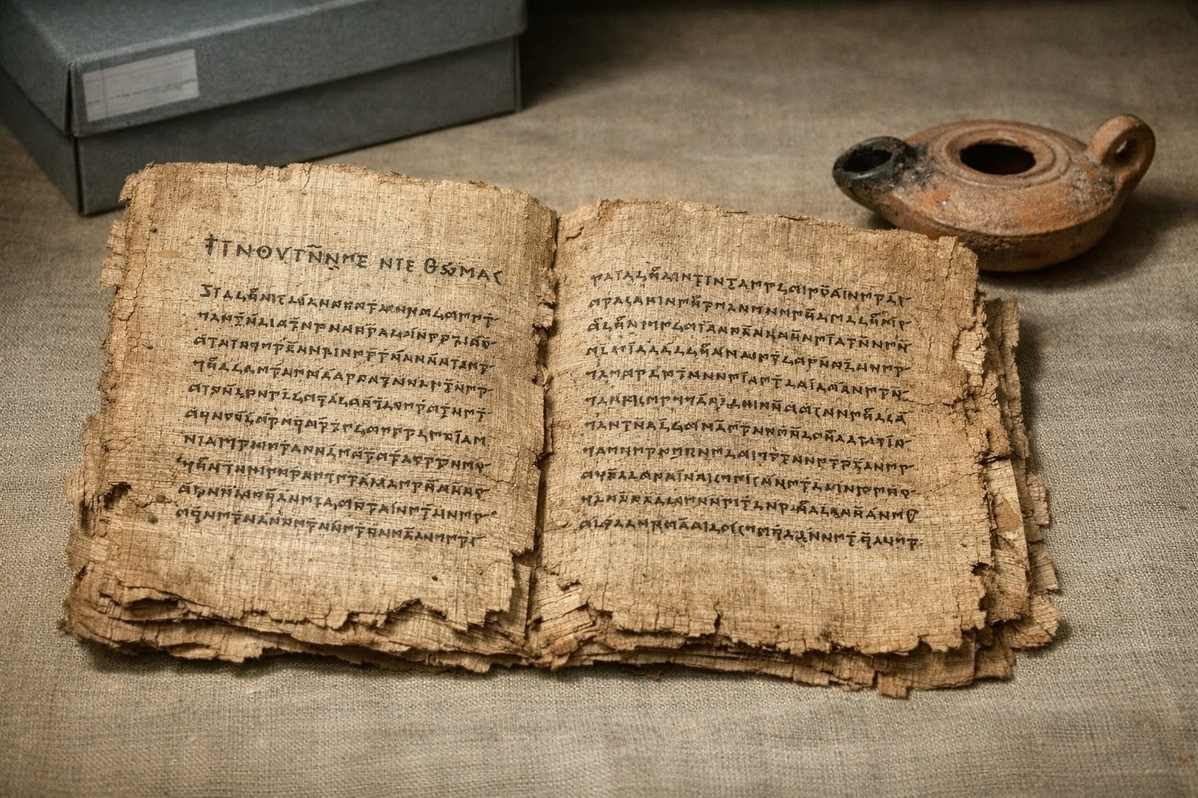
Among the most accessible texts in the Nag Hammadi Library are the sayings gospels–collections of Jesus’ words without the narrative framework of his life, death, and resurrection. These texts represent an alternative form of Christian tradition that valued the wisdom of Jesus over the story of Jesus. The Gospel of Thomas opens with a programmatic statement: “These are the secret words which the living Jesus spoke, and Didymos Judas Thomas wrote them down. And he said, ‘He who finds the meaning of these words will not taste death'” (NHC II,2 1:1-4) [7]. This is not the dead Jesus remembered but the living Jesus speaking–a present-tense encounter that bypasses the institutional mediation of church and priest.
The Gospel of Philip, by contrast, is not a sayings collection in the strict sense but a Valentinian anthology of mystical reflections excerpted from sermons, treatises, and theological meditations. As Bart D. Ehrman notes, it is notoriously difficult to understand in its details because the reflections are given in relative isolation, without narrative context, organised by catchwords rather than logical sequence [8]. Yet both texts share the fundamental conviction that salvation comes through direct engagement with wisdom–not through adherence to story, doctrine, or institutional authority. They are the classified intelligence of early Christian diversity, the executive memoranda that bypassed the branch office of later orthodoxy.
The Sayings Gospels
The two texts presented here articulate distinct modalities of non-narrative Christian wisdom–one Thomasine and encratite, the other Valentinian and sacramental.
The Gospel of Thomas — 114 Sayings of the Living Jesus (NHC II,2)
The Gospel of Thomas is the most famous text in the library–114 sayings of Jesus, stripped of narrative, demanding interpretation. “These are the secret sayings which the living Jesus spoke and which Didymos Judas Thomas wrote down” (NHC II,2 1:1-2). The text is the anti-gospel in form: no birth narrative, no miracles, no passion, no resurrection appearances. The kingdom is not future but present: “The kingdom is inside of you, and it is outside of you” (NHC II,2 3:3). Salvation comes through self-knowledge: “When you come to know yourselves, then you will become known, and you will realise that you are the children of the living Father” (NHC II,2 3:4-5) [9].
Primary Source Citation: NHC II,2 1:1-4. “These are the secret words which the living Jesus spoke, and Didymos Judas Thomas wrote them down. And he said, ‘He who finds the meaning of these words will not taste death.'”
The interpretive demand is explicit from the opening: whoever finds the interpretation of these sayings will not taste death. This is not passive reception but active engagement–the reader must supply coherence, discern meaning, and apply the wisdom to their own consciousness. The sayings function as seeds of recognition, each one a compressed utterance designed to destabilise ordinary cognition and awaken the reader to interior divinity. For the practitioner, Thomas is the entry-level security clearance–the first password that alerts the contemplative to the possibility that the kingdom is not a future destination but a present reality obscured by the drunkenness of mundane existence [10].
The Gospel of Philip — Valentinian Sacramental Reflections (NHC II,3)
The Gospel of Philip is a Valentinian collection of sayings, meditations, and theological reflections. More explicitly sacramental than Thomas, more concerned with ritual and community, more frankly erotic in its mystical language. The text is not a narrative gospel but a theological anthology–a collection of excerpts from previously existing sermons and treatises, brought together under the name of Philip and organised by catchword associations rather than logical argument [11].
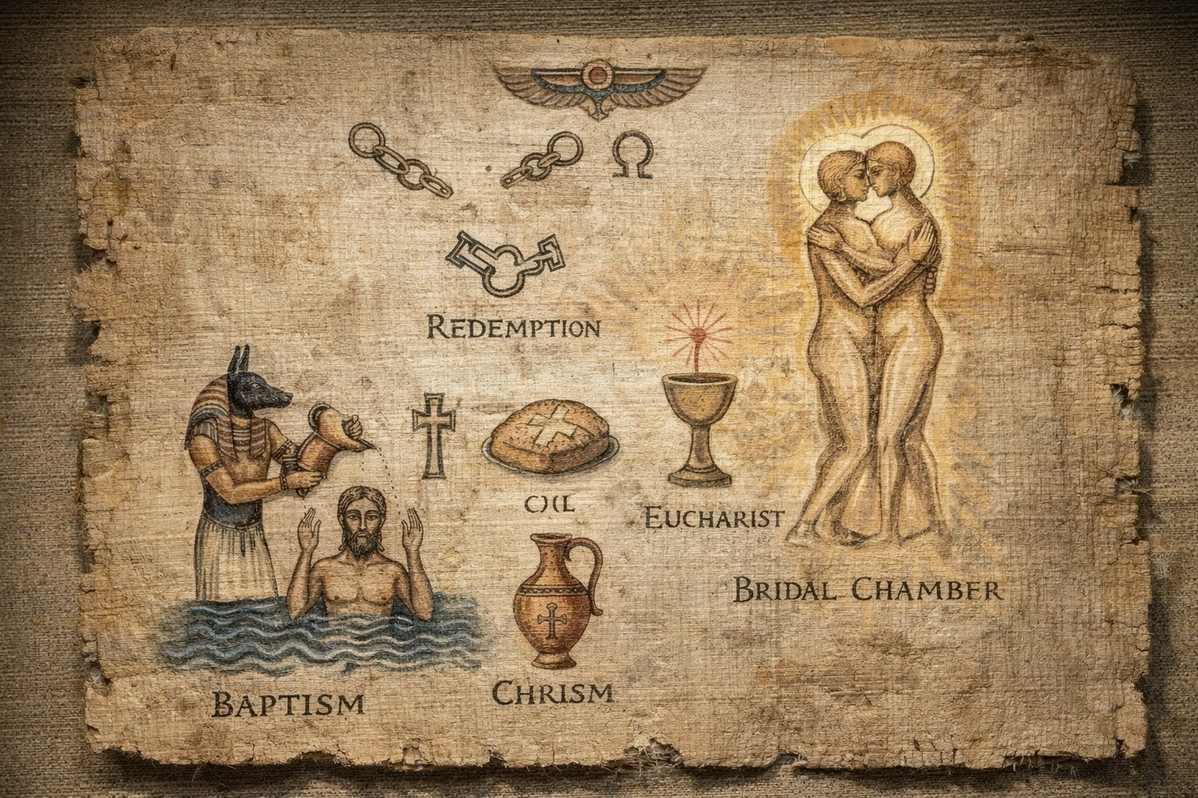
Primary Source Citation: NHC II,3 67:27-30. “The Lord did everything in a mystery: a baptism and a chrism and a eucharist and a redemption and a bridal chamber.”
The text’s central mystery is the nymphon–the bridal chamber that restores the divided human to primordial wholeness. “The bridal chamber is not for animals, nor is it for slaves, nor for defiled women; but it is for free men and virgins” (NHC II,3 69:1-4). Philip describes five sacraments–baptism, chrism, eucharist, redemption, and bridal chamber–that function as progressive initiations into the pleroma. The text also presents Mary Magdalene as the koinonos (companion/spouse) of the Saviour, challenging patriarchal ecclesiastical structures with a theology of spiritual partnership. For the practitioner, Philip offers the diplomatic quarters where the divided self negotiates its reunification–the sacramental protocol for those who have moved beyond the initial awakening of Thomas into the active restoration of Valentinian mysticism [12].
Characteristics of Sayings Gospels
These texts share features that distinguish them from narrative gospels and establish the sayings genre as a distinct form of early Christian literature [13].
Non-Narrative Form
No story of Jesus’ life, no chronological framework, no plot. The sayings stand alone, disconnected, demanding the reader provide coherence. This is not editorial negligence but pedagogical strategy: the text requires the reader to become an active participant in meaning-making rather than a passive consumer of story. The absence of narrative is itself a theological statement–the living Jesus does not need biography to authenticate his words [14].
Interpretive Demand
“Whoever finds the interpretation of these sayings will not experience death.” The text requires active engagement, not passive reception. Each saying is a koan–a compressed utterance that destabilises ordinary cognition. The reader must puzzle, meditate, and discern. This is wisdom literature, not historical reportage: the goal is transformation of consciousness, not information about the past [15].
Present Tense and Secret Knowledge
Jesus speaks as living presence, not historical figure. “The living Jesus spoke”–not the dead Jesus remembered. These are not public teachings for the masses but secret sayings for the elect. Apocryphon means hidden, reserved, esoteric. The text addresses those who have eyes to see and ears to hear–the pneumatic personnel who possess the security clearance to receive classified intelligence from the executive headquarters [16].
Wisdom Form and Parabolic Structure
The sayings resemble biblical wisdom literature (Proverbs, Sirach, Qoheleth) more than prophetic or apocalyptic texts. They offer practical insight for living rather than prediction of future events. The parables in Thomas lack the allegorical interpretations found in Matthew, preserving the raw ambiguity of the metaphor and demanding the reader’s own hermeneutical labour. This is the wisdom of the marketplace and the field, not the thunder of Sinai [17].
Thomas and the Canonical Gospels
Approximately half of Thomas’s sayings have parallels in Matthew, Mark, and Luke. Some are nearly identical; others show significant variation. The scholarly debate about Thomas’s relationship to the canonical gospels remains one of the most contested questions in New Testament studies [18].
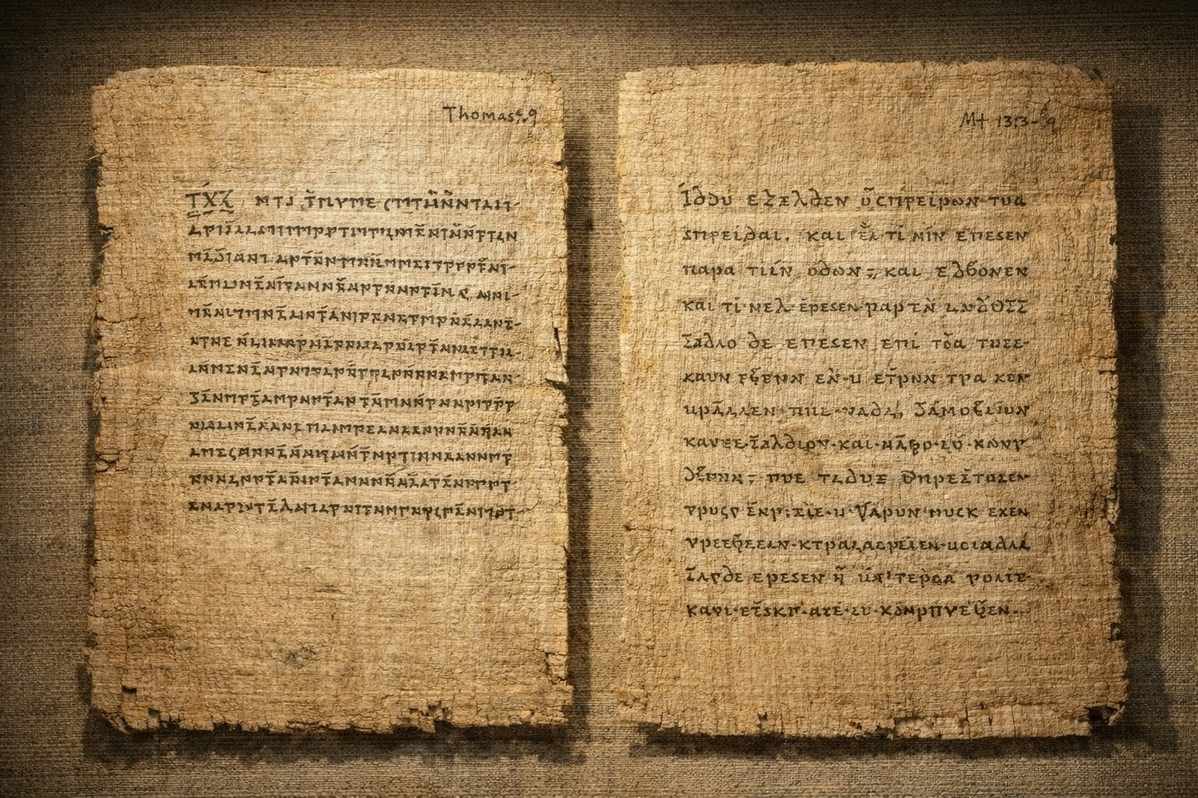
Saying 9 — The Sower
Saying 9 (the sower) parallels Matthew 13:3-9 but lacks the allegorical interpretation found in Matthew 13:18-23. Thomas preserves the parable in its raw form–a story about agricultural failure and success–without the editorial overlay of seed-type allegory. This suggests either an earlier, less interpreted form of the tradition or a deliberate refusal to provide the interpretive key, forcing the reader to wrestle with the metaphor directly [19].
Saying 33 — The Lamp
Saying 33 (lamp on a lampstand) appears in Mark 4:21, but Thomas adds: “For there is nothing hidden which will not become manifest.” This expansion shifts the emphasis from public proclamation to esoteric revelation–the hidden thing that becomes manifest is the interior kingdom, not the public gospel. The addition transforms a parable about visibility into a promise of recognition: what is concealed within will eventually be disclosed [20].
Saying 54 — The Poor
Saying 54 blesses “the poor” where Matthew 5:3 blesses “the poor in spirit.” Thomas’s version is more material, more radical, less spiritualised. The beatitude addresses economic poverty directly rather than translating it into spiritual humility. This difference may reflect an earlier, less Hellenised form of the tradition, or it may represent Thomas’s encratite tendency toward radical renunciation of worldly goods [21].
The Independence Debate
Scholars debate whether Thomas represents an independent tradition or depends on the canonical gospels. Stevan L. Davies argues that the apparent independence of the ordering of sayings in Thomas from that of their parallels in the synoptics shows that Thomas was not evidently reliant upon the canonical gospels and probably predated them [22]. Helmut Koester agrees, citing especially the parables contained in sayings 8, 9, 57, 63, 64 and 65 as examples where Thomas seems closer to the source than the synoptic versions [22].
Other scholars, such as Nicholas Perrin, argue that Thomas shows knowledge of the synoptic gospels and represents a second-century harmonisation. The truth is likely complex–some sayings are independent, others are adaptations, still others represent parallel development. What is clear is that Thomas preserves a form of Jesus tradition that the canonical evangelists chose not to include or actively suppressed: the wisdom of the interior kingdom, the primacy of self-knowledge, the immediacy of present salvation [22].
Reading Sayings Gospels
For contemporary readers, these texts demand a specific hermeneutical approach–one that honours their non-narrative form and interpretive demand [23].
Read Slowly and Ruminatively
Do not read quickly. These texts are designed for rumination, for slow digestion, for gradual opening of perception. Each saying is a seed that requires time to germinate. The reader who rushes through Thomas in a single sitting has missed the point; the text is designed for repeated, contemplative engagement over months or years.
Read Aloud and in Community
Read aloud. The sayings have rhythmic qualities that emerge only in vocalisation. The Coptic text preserves oral patterns–alliteration, assonance, parallel structure–that reward audible recitation. Read with others, comparing interpretations. The sayings are deliberately ambiguous; different readers will find different meanings. This is not a bug but a feature: the text is designed to generate multiple valid readings, each calibrated to the reader’s stage of spiritual development [24].
Resist Harmonisation
Do not seek to harmonise with the canonical gospels. Let these texts stand on their own, with their own voice, their own radical perspective. Thomas’s Jesus is not the Jewish messiah of Matthew, not the miracle-working Son of God of Mark, not the crucified and resurrected Lord of Paul. He is the eternal revealer whose words bring salvation through recognition. To force Thomas into canonical categories is to miss what the text actually offers: an alternative Christian memory that challenges the narrative monopoly of orthodoxy [25].
Why Sayings Gospels Matter
These texts preserve an alternative Christian tradition–one that did not need the passion and resurrection to find meaning in Jesus. They show that early Christianity was more diverse than the New Testament suggests, and that the canonical form of gospel narrative was not inevitable but chosen–selected by communities that valued story over wisdom, history over encounter, institution over immediacy [26].
For contemporary seekers, they offer direct access without intermediary. No church required. No priest necessary. Just the sayings, and the willingness to be changed by them. They also challenge the dominance of narrative in Christian imagination. Not everything needs to be a story; not all wisdom comes wrapped in plot. Sometimes the word is enough–the compressed, paradoxical, transformative word that alters consciousness and restores the reader to native luminosity [27].
The jar is open. The alternative archive has survived. These sayings gospels offer not heresy to be refuted but wisdom to be encountered–challenges that continue to illuminate the boundaries, possibilities, and enduring questions of Christian origins. The living Jesus still speaks, if we have ears to hear.
Frequently Asked Questions
What is a sayings gospel in the Nag Hammadi Library?
A sayings gospel is a collection of utterances attributed to Jesus, preserved without the narrative framework of biography, miracle, or passion. The Nag Hammadi Library contains two primary examples: the Gospel of Thomas (114 sayings) and the Gospel of Philip (Valentinian sacramental reflections). These texts present wisdom in discrete units that demand active interpretation from the reader.
How does the Gospel of Thomas differ from the canonical gospels?
The Gospel of Thomas contains 114 sayings of Jesus with no narrative framework–no birth, miracles, passion, or resurrection. The kingdom is present rather than future, and salvation comes through self-knowledge rather than faith in Christ’s sacrifice. Approximately half of its sayings have parallels in Matthew, Mark, and Luke, though scholars debate whether Thomas represents an independent tradition or depends on the canonical gospels.
What are the five sacraments in the Gospel of Philip?
The Gospel of Philip (NHC II,3 67:27-30) describes five sacraments: baptism, chrism (anointing), eucharist, redemption (apolytrosis), and the bridal chamber (nymphon). The bridal chamber is the highest and most mysterious sacrament, representing the restoration of primordial wholeness and the reunion of the divided self with its divine counterpart.
What is the bridal chamber (nymphon) in Valentinian theology?
The bridal chamber is the supreme sacrament in the Gospel of Philip, representing the mystical union that restores the divided human to primordial wholeness. It is the Holy of Holies, the duplicate of the heavenly bridal chamber, where the individual is reunited with their angelic twin or image. This is not merely marriage theology but a cosmological claim about the integration of opposites within the self.
Does the Gospel of Thomas predate the canonical gospels?
Scholars are divided. Stevan Davies, Helmut Koester, and Marvin Meyer argue that Thomas’s independence from synoptic ordering and its preservation of parables in less-allegorised form suggest early composition, possibly predating the canonical gospels. Others, such as Nicholas Perrin, argue that Thomas shows knowledge of the synoptics and represents second-century harmonisation. The consensus is that Thomas preserves both early independent tradition and later editorial development.
How should modern readers approach the sayings gospels?
Modern readers should approach these texts slowly and ruminatively, reading aloud to capture the rhythmic qualities of the Coptic. Read with others to compare interpretations, as the sayings are deliberately ambiguous and generate multiple valid readings. Resist harmonising with the canonical gospels; let Thomas and Philip stand on their own with their distinct voices and radical perspectives.
Why do sayings gospels matter for contemporary spirituality?
Sayings gospels offer direct access to Jesus tradition without institutional mediation. They challenge the dominance of narrative in Christian imagination, demonstrating that wisdom can be conveyed without story. For contemporary seekers, they provide models of interior spirituality–self-knowledge, present-tense encounter, and immediate recognition–that bypass the requirements of church, priest, or creed.
Further Reading
These links connect the sayings gospels to related resources within the ZenithEye library, providing pathways for deeper exploration of specific texts, traditions, and theological themes.
- The Gospel of Thomas: Hidden Sayings Revealed — Deep analysis of the 114 sayings and their function as cognitive destabilisers and seeds of awakening.
- Gospel of Thomas 114: Keys to the Hidden Sayings — Extended commentary on specific sayings and their parallels with canonical gospel traditions.
- Gospel of Philip: Sacrament, Eros, and the Bridal Chamber — Examination of the nymphon and Valentinian sacramental theology as the heart of illuminatory practice.
- Gospel of Thomas Commentary: The Hidden Sayings — Scholarly and contemplative commentary on Thomas’s most provocative and transformative utterances.
- Apocryphal Gospels in the Nag Hammadi Library — Overview of the non-canonical gospel tradition, placing Thomas and Philip within the broader genre.
- Nag Hammadi for Beginners: A 10-Text Journey — The foundational introduction for newcomers, with Thomas as the primary entry point for sayings gospel exploration.
- Nag Hammadi Library: Complete Guide to 46 Gnostic Scriptures — Comprehensive map of the entire collection for readers ready to expand beyond the sayings gospels.
- Gnostic Schools: Sethians, Valentinians, and Hermetics — Guide to the theological traditions behind Thomas (Thomasine) and Philip (Valentinian).
- Valentinian Sacramental Theology — Extended study of the five sacraments and the bridal chamber as the culmination of Valentinian initiation.
- Sayings Gospels in the Nag Hammadi Library — The broader overview of the non-narrative gospel tradition, placing these texts within the complete genre.
References and Sources
The following sources support the claims and quotations presented in this article. All citations to the Nag Hammadi Library represent direct translations from the Coptic text as established in the standard critical editions.
Primary Sources and Critical Editions
- [1] Robinson, J.M. (Ed.). (1988). The Nag Hammadi Library in English (4th ed.). Brill.
- [2] Meyer, M. (Ed.). (2007). The Nag Hammadi Scriptures: The International Edition. HarperOne.
- [3] Layton, B. (1987). The Gnostic Scriptures: A New Translation with Annotations and Introductions. Doubleday.
- [4] Patterson, S.J. & Robinson, J.M. (Trans.). (2011). The Gospel of Thomas. In The Nag Hammadi Scriptures. HarperOne.
- [5] Isenberg, W.W. (Trans.). (1989). “The Gospel According to Philip.” In Layton, B. (Ed.), Nag Hammadi Codex II, 2-7. NHS 20. Brill.
Scholarly Monographs and Commentaries
- [6] Davies, S.L. (1983). The Gospel of Thomas and Christian Wisdom. Seabury Press.
- [7] Koester, H. (1990). Ancient Christian Gospels: Their History and Development. Trinity Press International.
- [8] DeConick, A.D. (2006). The Original Gospel of Thomas in Translation. Mohr Siebeck.
- [9] Thomassen, E. (2006). The Spiritual Seed: The Church of the ‘Valentinians’. Brill.
- [10] Schenke, H.M. (1997). Das Philippus-Evangelium (Nag-Hammadi-Codex II,3). Akademie-Verlag.
Comparative Studies and Thematic Analyses
- [11] Ehrman, B.D. (2018). “The Gospel of Thomas: An Overview.” In The New Testament: A Historical Introduction to the Early Christian Writings. Oxford University Press.
- [12] Theissen, G. & Merz, A. (1998). The Historical Jesus: A Comprehensive Guide. Fortress Press.
- [13] Uro, R. (1998). “Thomas and the Oral Gospel Tradition.” In Thomas at the Crossroads. T&T Clark.
- [14] Marjanen, A. (2005). The Woman Jesus Loved: Mary Magdalene in the Nag Hammadi Library. Brill.
- [15] Wilson, R.McL. (1962). The Gospel of Philip: Translated from the Coptic Text. Mowbray.