Baptism in the Nag Hammadi Library: Water, Spirit, and Transformation
The baptismal theology of the Nag Hammadi Library presents a fluid yet persistent administrative protocol: across diverse sectarian jurisdictions–Sethian, Valentinian, Thomasine, and Hermetic–the rite of water initiation serves as the primary checkpoint between archontic citizenship and Pleroma recognition. Yet this is no uniform bureaucratic procedure. From the elaborate Five Seals of Sethian ascent literature to the subtle “baptism in the bridal chamber” of Valentinian mysticism, water functions as both literal element and cosmic boundary–the threshold where the soul’s scattered filing status undergoes ontological reclassification from “property of the demiurge” to “child of the Autogenes.” This survey traces the hydrological administration of rebirth across the library’s major texts, revealing how different communities understood ritual transformation as the moment when human aspiration meets divine clearance protocols.
Table of Contents
The Sethian Five Seals: Cosmic Rebirth Protocol
In the Apocryphon of John, Trimorphic Protennoia, and Zostrianos, baptism appears not as the single dunking familiar from orthodox jurisdictions, but as a complex sequence of five distinct sealings–an elaborate administrative procedure reflecting Sethian cosmology. Just as the divine realm unfolds through multiple emanations from the Unknowable Father through Barbelo to the Autogenes, so human restoration requires progressive transformation through five bureaucratic checkpoints.
What are the Five Seals?
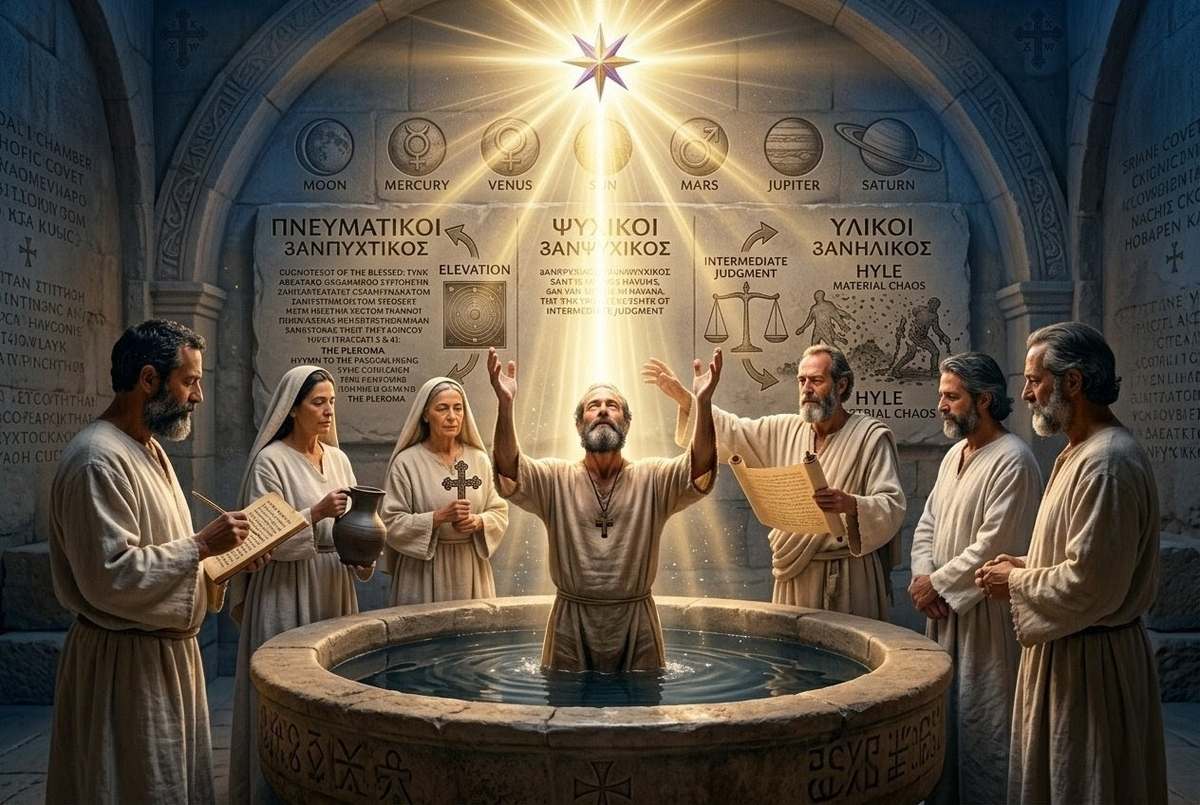
The Five Seals (Greek: sphragides) represent the Sethian sacramental system of initiation described in the Apocryphon of John and related texts. This fivefold sequence includes: (1) water baptism–washing away archontic “garments of shame”; (2) anointing with oil–transformation of substance; (3) baptism in spirit–awakening the divine spark; (4) the garment of light–protection and glory; and (5) the final seal–safe passage through planetary spheres. These seals function as passports through the seven planetary archons, identifying the ascending soul as Pleroma citizen rather than material prisoner.
Ontological vs Moral Transformation
The first seal typically involves water baptism proper–the washing away of carnal ignorance and the “garments of shame” woven by the archons during the soul’s descent. But unlike orthodox Christian baptism, which focuses on forgiveness of sins and entry into community, Sethian sealing emphasizes ontological change: the initiate ceases to be a product of the demiurge’s manufacturing facility and becomes a child of the divine Autogenes (Self-Generated). The water derives not from earthly springs but from the Four Luminaries of the Pleroma, rendering the ritual a vertical descent of heavenly power rather than horizontal entry into an earthly congregation.
The Progressive Architecture of Restoration
Subsequent seals add the anointing (transformation of substance from material to luminous), the baptism in spirit (awakening of the dormant divine spark), the garment of light (protective glory rendering the initiate invisible to archontic scanners), and the final seal proper (authorisation for safe passage through the planetary spheres). This sequence suggests that for Sethians, baptism was not a momentary event but an extended process–perhaps occurring over days, or understood as the earthly shadow of simultaneous heavenly realities. The initiate is literally re-manufactured, component by component, into a being capable of Pleroma clearance.

Primary Source Citations: Apocryphon of John (NHC II,1; III,1; IV,1) describes the Five Seals at II 31:25-32:9; Trimorphic Protennoia (NHC XIII,1) 50:9-51:25 details the descent into water and ascent in light; Zostrianos (NHC VIII,1) 15:1-20 describes multiple baptisms through thirteen aeons. All three texts reflect Sethian ritual systems from the second-third centuries CE.
Valentinian Baptism: The Bridal Chamber and Spiritual Marriage
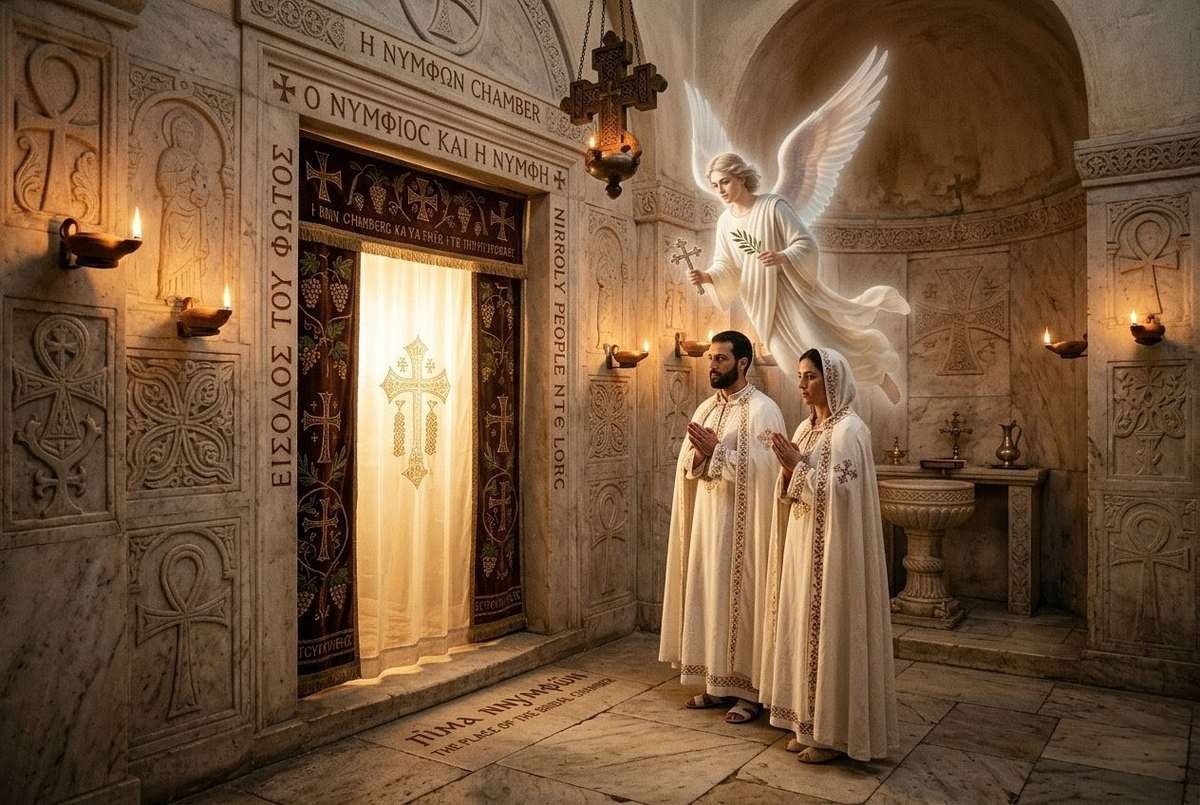
Valentinian texts present a different baptismal theology–one that upgrades the water ritual to a more sophisticated clearance procedure. In the Gospel of Philip, the “bridal chamber” (nymphon) supersedes water baptism in administrative importance: “The bridal chamber is superior to baptism, for it is from the bridal chamber that we have been born.” (NHC II,3 69:25-26). This startling claim reflects Valentinian anthropology–the restoration of the primal androgynous human through spiritual union that transcends the binary gender categories imposed by the archontic system.
Psychic vs Pneumatic Baptism
For Valentinians, water baptism served the “psychic” (psychikoi) Christians–those capable of faith and moral improvement but lacking the divine spark–providing moral purification and hope of resurrection. But the pneumatic elect (pneumatikoi) required something more subtle: the anointing (chrisma) that transformed their substance at the molecular level, and ultimately the bridal chamber that united them with their angelic counterparts or “twins” in the Pleroma. The ritual forms remain obscure in surviving texts–possibly involving mystical interpretation of marriage imagery, or sacramental unions that transcended literal sexuality–but the theological principle is clear: baptism initiates the clearance process, but the bridal chamber perfects the citizen’s standing.
Participation in the Saviour’s Descent
The Tripartite Tractate (NHC I,5) preserves hints of Valentinian baptismal liturgy, describing how the Saviour “cleansed” the deficiency through his own descent into water. This suggests that Valentinian baptism was understood as participation in the Saviour’s own ritual action, linking the initiate’s experience to the cosmic restoration of the fallen Sophia. The water becomes not merely cleansing agent but medium of identification–the initiate re-enacts the divine descent that rectified the original cosmic filing error, thereby securing their own restored status.
Baptism in the Apocryphal Gospels: Diversity of Practice
The Gospel of Thomas notably lacks any reference to water ritual, consistent with its focus on self-knowledge as internal illumination. For Thomasine Christians, baptism seems to have been reinterpreted metaphorically–the “living water” of Jesus’ sayings replacing physical immersion entirely. This spiritualised approach represents one extreme of Gnostic sacramental theology: the external ritual is unnecessary when the internal recognition has already occurred. The filing status changes through understanding, not through administrative procedure.
The Gospel of the Egyptians: Androgynous Restoration
Conversely, the Gospel of the Egyptians (NHC III,2; IV,2) describes elaborate baptismal practices involving specific formulae and the “five trees” of Paradise. The text connects baptism with the suppression of sexual difference–“making the male and female into a single one”–suggesting that the ritual aimed at restoring the primal androgyny disrupted by the archontic creation. Here baptism functions as cosmic repair, undoing the binary division that the demiurge introduced to maintain administrative control over divided subjects.
Developmental Expansion in the Apocryphon of John
The Apocryphon of John, existing in both short (Codex III) and long (Codices I and II) versions, shows developmental expansion of baptismal material across textual transmission. The longer versions add detailed descriptions of the seals and their protective functions against planetary powers, suggesting that as Sethian communities encountered increasingly hostile spiritual bureaucracies (the seven planetary archons), their baptismal theology grew more elaborate and apotropaic. The ritual upgraded its security features to match evolving archontic surveillance systems.
Apotropaic Ritual: Protection Against Hostile Powers
Apotropaic (Greek: ἀποτρόπαιος) refers to rituals designed to ward off evil or hostile forces. In Sethian baptismal theology, the Five Seals function apotropaically–protecting the initiate from the seven planetary archons who would otherwise recognise and recapture the ascending soul. The seals serve as spiritual camouflage, rendering the baptised “invisible” to archontic detection. This protective dimension distinguishes Gnostic baptism from purely cleansing or initiatory rites in other Christian traditions.
The Common Structure: Death and Rebirth
Despite variations in protocol across sectarian jurisdictions, Nag Hammadi baptismal texts share structural features with broader early Christianity. The initiate descends into water (death to the old self), remains submerged (passing through the underworld or chaos), and rises (birth to new life). But Gnostic texts radicalise this pattern: the “death” is not merely metaphorical but ontological–the dissolution of archontic manufacture; the “birth” is not into community but into divinity itself.
The Anointing with Oil
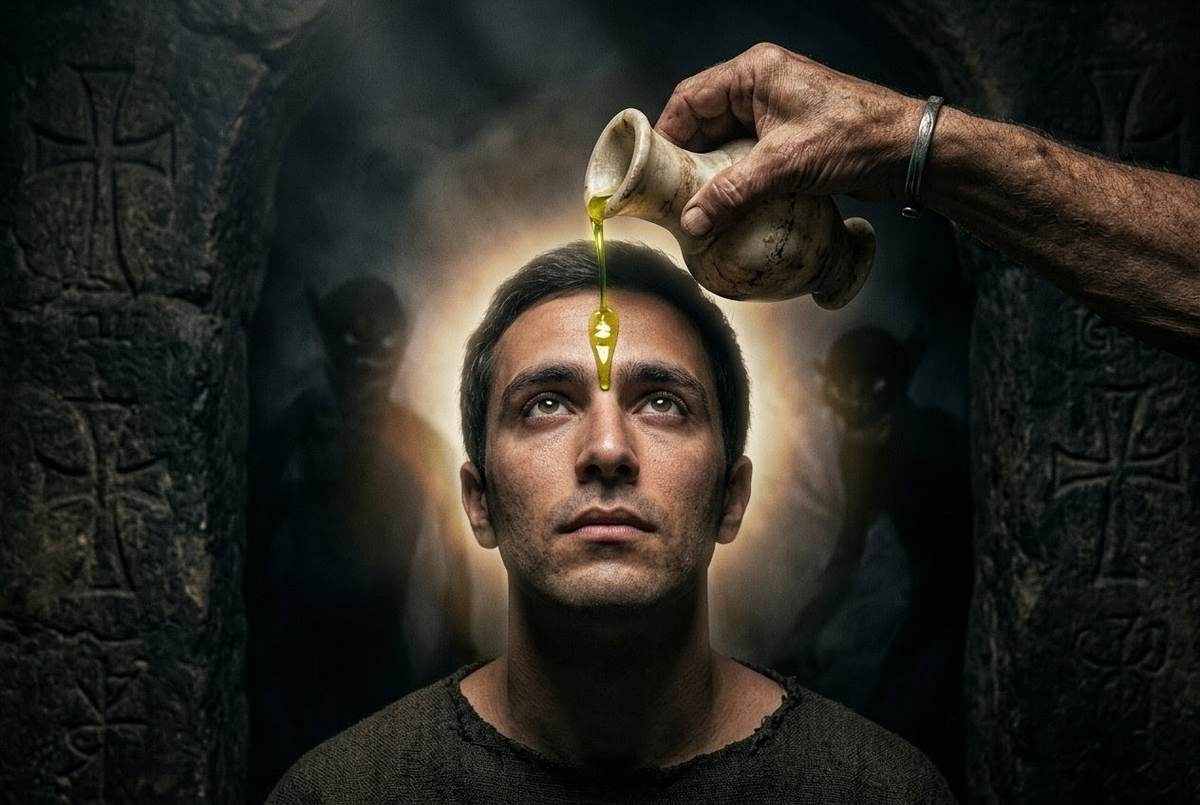
The anointing with oil (chrisma), frequently mentioned alongside water in the library, derives from Jewish-Christian and Hellenistic mystery traditions. Oil represents the “dew of light” from the Pleroma, rendering the initiate luminous and imperceptible to dark powers. In some texts, the anointing surpasses water in importance, suggesting a trajectory from external purification to internal transformation–from washing off dirt to rewiring the spiritual DNA. The chrism functions as the seal of authenticity, the divine signature that cannot be forged by archontic counterfeiting operations.
Beyond the Water: Baptism as Hermeneutical Key
Ultimately, Nag Hammadi baptismal theology serves as hermeneutical key to the entire corpus. The ritual embodies the library’s central promise: that human beings, though presently enthralled by ignorance and flesh, bear a divine spark capable of restoration. Baptism–whether as Five Seals, bridal chamber, or living water–marks the moment when that restoration begins, when the stranger recognises his native country and begins the journey home through hostile territory.
This is not merely ritual theory but survival protocol. In the archontic filing system, the unbaptised remain classified as material subjects, property of the demiurge, subject to planetary taxation and cosmic recycling. The baptised undergo reclassification: their spiritual DNA is reactivated, their Pleroma citizenship is processed, and their ascent clearance is authorised. The water is not symbolic decoration but the medium of ontological hacking–the bypassing of archontic firewalls to restore original divine programming.
“Baptism in the Nag Hammadi Library appears in diverse forms–the Sethian Five Seals (water, anointing, spirit, garment of light, final seal), the Valentinian bridal chamber superior to water baptism, and the Thomasine spiritualisation of ritual. Despite variations, all share the structure of ontological death and rebirth: dissolution of archontic manufacture and birth into Pleroma citizenship. The Five Seals serve as passports through planetary archons, protecting the ascending soul and rendering it invisible to hostile powers, marking the transition from material imprisonment to divine restoration.”
Frequently Asked Questions
What is baptism in the Nag Hammadi Library?
Baptism in the Nag Hammadi Library refers to diverse ritual practices of initiation and rebirth described in Gnostic texts. Unlike orthodox Christian baptism focused on forgiveness, Gnostic baptism emphasizes ontological transformation–changing the initiate’s essential substance from archontic property to Pleroma citizen. Forms include the Sethian Five Seals, Valentinian bridal chamber, and Thomasine spiritualisation of water.
What are the Five Seals in Gnosticism?
The Five Seals are a Sethian sacramental sequence described in the Apocryphon of John and related texts. They include: (1) water baptism–washing away archontic ‘garments of shame’; (2) anointing with oil–substance transformation; (3) baptism in spirit–awakening divine spark; (4) garment of light–protection and glory; (5) final seal–safe passage through planetary spheres. These function as passports past the seven archons.
How does Valentinian baptism differ from Sethian?
Valentinians distinguish water baptism for ‘psychic’ Christians from the superior ‘bridal chamber’ (nymphon) for pneumatic elect. While Sethians emphasise the Five Seals as protective sequence through planetary spheres, Valentinians focus on the bridal chamber as restoration of primal androgyny. Water baptism purifies; the bridal chamber perfects through spiritual marriage.
What is the bridal chamber in Gnostic texts?
The bridal chamber (Greek: nymphon) appears in the Gospel of Philip as the supreme sacrament superior to water baptism. It represents restoration of the androgynous primal human through spiritual union. For Valentinians, this ritual unites the initiate with their angelic counterpart in the Pleroma, achieving what water baptism only initiates.
Does the Gospel of Thomas mention baptism?
The Gospel of Thomas notably lacks any reference to water ritual, consistent with its focus on immediate self-knowledge (gnosis) as internal illumination. Thomasine Christians appear to have reinterpreted baptism metaphorically–the ‘living water’ of Jesus’ sayings replaces physical immersion, suggesting that recognition itself transforms without external ritual.
What does anointing with oil mean in Gnostic baptism?
Anointing (Greek: chrisma) with oil represents the ‘dew of light’ from the Pleroma that transforms the initiate’s substance. It renders the baptised luminous and invisible to archontic detection. In Sethian and Valentinian texts, anointing often surpasses water in importance, indicating transformation from external purification to internal ontological change.
How does Gnostic baptism differ from Christian baptism?
While orthodox baptism focuses on forgiveness of sins and entry into church community, Gnostic baptism emphasises ontological rebirth–ceasing to be archontic product and becoming divine child. It includes apotropaic (protective) elements against planetary archons, involves multiple stages (Five Seals), and aims at individual ascent to Pleroma rather than communal belonging.
Further Reading
To explore specific baptismal texts and contexts:
- The Apocryphon of John: Gnostic Creation and Salvation — Study the primary source for the Five Seals and their protective functions.
- Trimorphic Protennoia: Three Descents and the Voice of Divine Thought — Explore the ritual descent of the Saviour and the seals.
- Zostrianos: The Complete Journey Through the Thirteen Aeons — Examine the five baptisms in the longest Sethian ascent text.
- The Gospel of Philip: Sacrament, Eros, and the Bridal Chamber — Discover Valentinian sacramental theology and the nymphon.
- The Tripartite Tractate: The Valentinian System Explained — Study systematic Valentinian soteriology and baptismal hierarchy.
- The Gospel of Thomas: 114 Keys to Hidden Wisdom — Compare the absence of water ritual with Thomasine spiritualisation.
- The Five Seals: Sethian Initiation and Ritual Practice — Detailed analysis of the complete sacramental sequence.
- The Gospel of the Egyptians: Sethian Cosmogony — Study the five trees of Paradise and androgynous baptismal restoration.
- Hermetic Connections in the Nag Hammadi Library — Explore baptismal parallels in Hermetic texts from the same milieu.
- The Nag Hammadi Library: A Complete Guide to the Gnostic Scriptures — Navigate the full collection with attention to ritual diversity.