
The Sophia Myth: Three Falls, Three Redemptions Across Gnostic Schools
In the beginning was the Fullness, and within that Fullness dwelt the aeons–paired emanations of light, each completing the other in perfect syzygy. The youngest, or in some accounts the final, was Sophia: Wisdom. Her story is the Gnostic creation myth par excellence, the hinge upon which the entire cosmos turns from perfection into deficiency, from light into shadow, and–ultimately–back again. Yet there is no single Sophia. Across the surviving texts of the Nag Hammadi Library and the hostile but detailed reports of the Church Fathers, she appears in at least three distinct theological costumes: the penitent mother of Sethian cosmogony, the bifurcated psyche of Valentinian metaphysics, and the serpentine liberator of Ophite myth. To read her story carefully is to discover that each school used Sophia to solve a different problem. The fall was never merely hers; it was a mirror held up to the community that told the tale.
This article traces Sophia across three major Gnostic traditions–Sethian, Valentinian, and Ophite–noting where the narratives overlap, where they diverge, and what those divergences reveal about the soteriology of each school. We draw primarily upon the Apocryphon of John, the Hypostasis of the Archons, and On the Origin of the World for the Sethian portrait; Irenaeus’s report of Ptolemy’s Valentinian system and the Tripartite Tractate for the Valentinian; and Irenaeus’s Against Heresies 1.30 alongside Hippolytus’s Refutatio for the Ophite material. The goal is not to flatten these traditions into a generic “Gnostic Sophia,” but to honour their genuine differences–and to see what each tradition needed Wisdom to be.
Table of Contents
- Sethian Sophia: The Abortive Passion and the Ninth Sphere
- Valentinian Sophia: The Bifurcated Wisdom and the Kenoma
- Ophite Sophia: Prunicus, the Serpent, and the World Soul
- Comparative Synthesis: Three Falls, Three Redemptions
- Conclusion
- Further Reading
- References and Sources
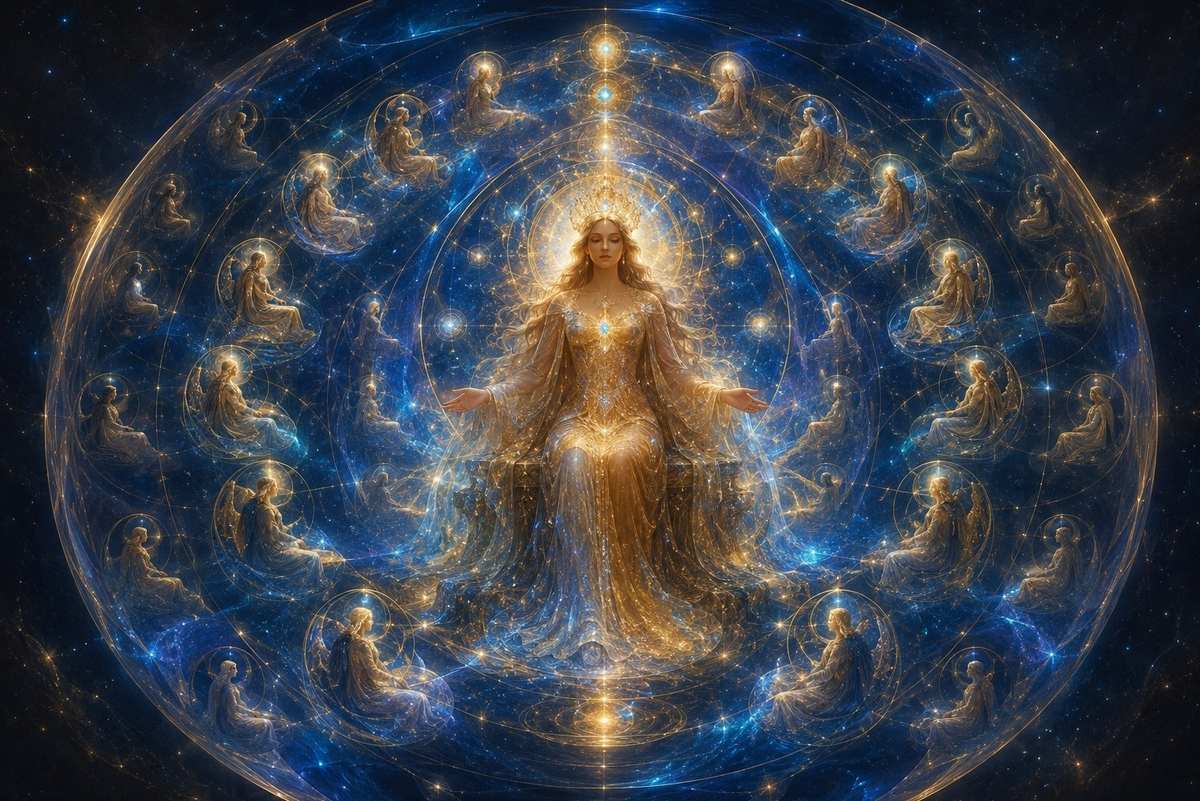
Sethian Sophia: The Abortive Passion and the Ninth Sphere
The Apocryphon of John: A Passion Without Consent
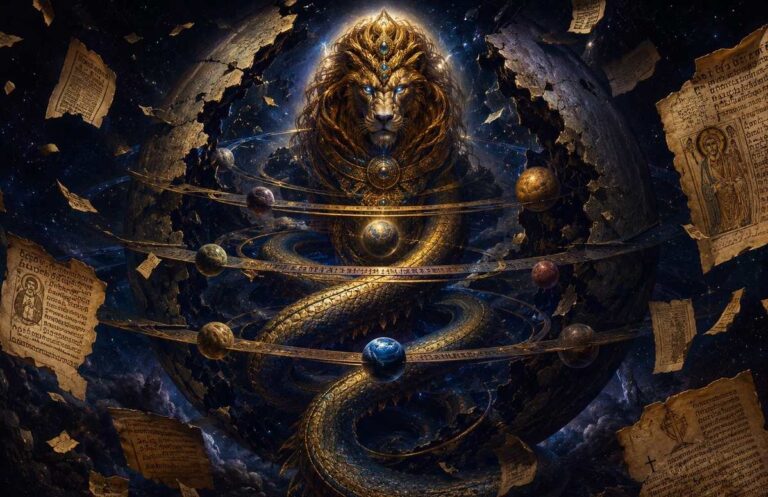
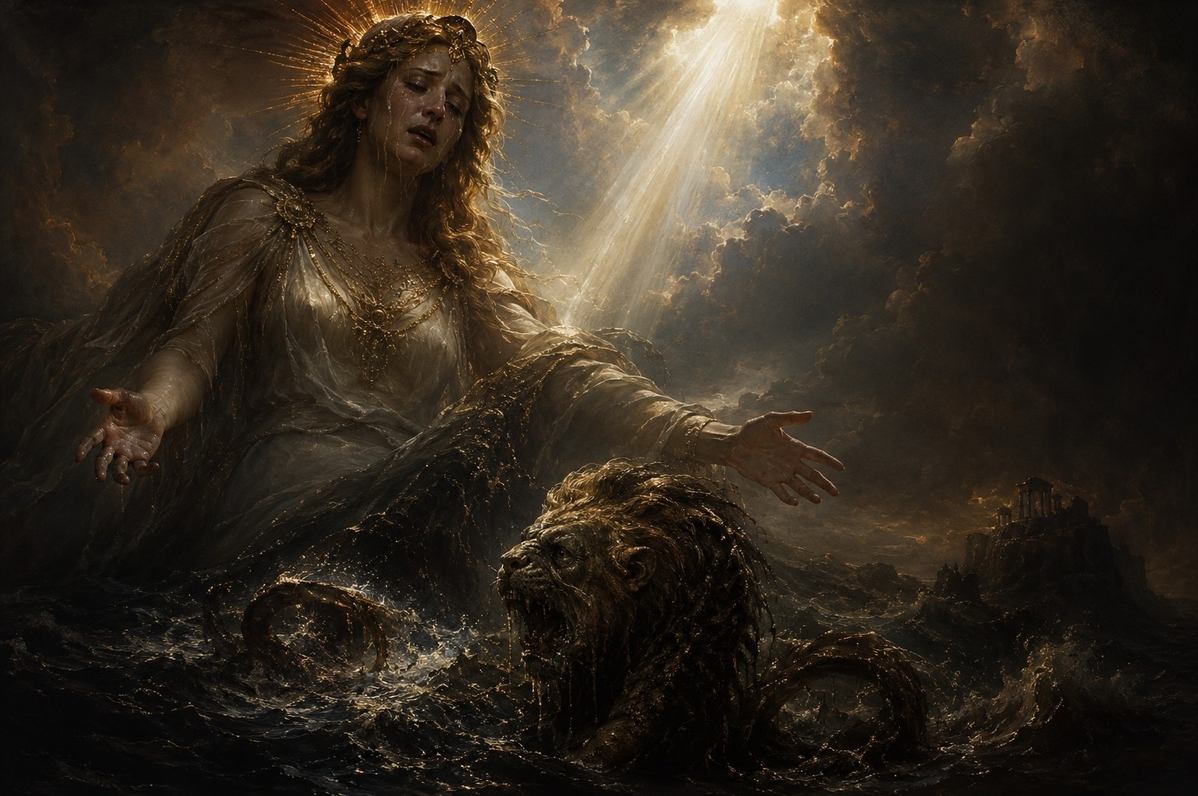
The Apocryphon of John (NHC II,1) provides the most elaborate Sethian account of Sophia’s crisis. Within the Pleroma, the Invisible Spirit dwells with Barbelo and the self-generated aeons, a hierarchy of paired light-beings living in contemplative unity. Sophia, positioned as a lower aeon, desires to comprehend the transcendent Father without the mediation of her male syzygy–without, in the text’s terms, the consent of her consort. This unauthorised passion produces an abortive substance, a miscarriage of shadow and matter that becomes Yaldabaoth, the lion-faced serpent and chief archon.
The text is unsparing in its physical imagery. Sophia’s brightness dims. She forgets. She is ashamed. She cannot ascend to her original height but sways back and forth in repentant anguish. The Pleroma hears her prayer, and the Invisible Spirit pours out the Holy Spirit upon her, graciously restoring her–almost. She is elevated above her son, placed in the ninth sphere, but not fully returned to her original realm. There she waits, a figure of partial restoration, while below her the demiurge declares himself the sole god and fashions a cosmos of forgetfulness.
The Hypostasis of the Archons and On the Origin of the World
The Hypostasis of the Archons (NHC II,4) shifts the focus from Sophia’s interior crisis to her intervention on behalf of humanity. Here, Sophia is the incorruptible wisdom from the Pleroma who inspires Eve, making Eve her earthly counterpart and vessel. When the archons fashion Adam from dust and water, it is Sophia who ensures that the divine power is not entirely lost to their design. The archons see the divine image reflected in the waters and attempt to capture it; Sophia outmanoeuvres them by imparting gnosis to the first human pair through the tree of knowledge.
On the Origin of the World (NHC II,5) offers a variant in which Sophia’s laughter at the abyss inadvertently gives birth to Yaldabaoth. The motif of laughter is significant: it suggests that the demiurge is born from a moment of cosmic irony, a divine jest that produces an unintended consequence. In this account, Sophia is less a tragic victim and more an autonomous power whose actions–even inadvertent ones–generate the material cosmos. She remains active, not merely penitent, working through Seth and the race of the perfect to restore divine order.
Partial Restoration and the Birth of Fate
A distinctive feature of the Sethian account is the doctrine of partial restoration. Sophia is not immediately returned to the Pleroma; she is stationed in the ninth heaven, above the demiurge but below the fullness. From this liminal position, her unresolved shadow and the archons’ subsequent fornication with Wisdom produce fate–<heimarmene–the binding force that keeps souls cycling through incarnation. The Apocryphon of John explicitly states that from fate emerged sin, violence, blasphemy, forgetfulness, and ignorance, weighty commandments and heavy sins. Sophia’s error, then, is not merely personal; it becomes the structural condition of human bondage. Her repentance initiates redemption, but the full restoration must wait upon the Saviour’s descent and the awakening of the elect.
Valentinian Sophia: The Bifurcated Wisdom and the Kenoma
Theletos and the Limit: The Crisis of the Thirtieth Aeon
Valentinian Gnosticism, as reported by Irenaeus from Ptolemy’s circle, presents a more systematised and psychologically nuanced Sophia myth. Here, Sophia is the thirtieth and final aeon, paired with Theletos (Will) in the Pleroma’s perfect syzygy. Her error is not a miscarriage of matter but a cognitive crisis: an impulsive desire to comprehend the depth of the Father independently, without her consort and without the stabilising mediation of the higher aeons. This unauthorised ascent toward the unknowable breaches the harmony of the Fullness.
The Limit (Horos), a boundary aeon, intervenes. It expels Sophia–or rather, the lower aspect of her passion–into the Kenoma, the empty void beyond the Pleroma. What remains in the Fullness is the upper Sophia, unblemished and intact. What falls is Achamoth, a secondary, suffering form of Wisdom whose name derives from the Aramaic ḥokmūtā. The bifurcation is crucial: Valentinianism does not condemn Wisdom wholesale. It splits her into a perfect heavenly counterpart and a fallen psychic projection, mapping the soul’s own divided nature onto cosmic structure.
Achamoth: Terror, Sorrow, and the Substance of Creation
Achamoth’s sojourn in the Kenoma is the Valentinian equivalent of the dark night of the soul. Abandoned in the void, she experiences terror, anguish, and bewilderment. These passions do not merely torment her; they become the raw material of the lower world. Her fear and conversion produce the psychic substance; her sorrow produces the material; her initial distress produces the hylic, or choic matter. From her abortive or formless offspring, the Demiurge is born–an ignorant creator who fashions the seven heavens in imitation of the Pleroma he cannot see.
The Tripartite Tractate (NHC I,5), a Valentinian text of extraordinary philosophical density, develops this further by describing the Father’s response to the crisis not as punishment but as pedagogy. The entire drama of fall and restoration is contained within the Father’s foreknowledge, a kind of divine pedagogy in which error serves the ultimate purpose of revealing the depth of grace. Achamoth’s suffering is thus meaningful; it generates the very substance that will, through redemption, be transformed into the church and the spiritual body of the elect.
The Saviour’s Descent and the Bridal Chamber
The mechanism of restoration in Valentinianism is distinctively christological and sacramental. The Saviour, identified with the perfect aeon Jesus Christ, descends into the Kenoma–not into the material world itself, but into the intermediate realm where Achamoth suffers. He instructs her in gnosis, alleviates her passions, and prepares her return. From her subsequent repentance and restored state, the spiritual seed is sown among humanity, creating the pneumatic class who will ultimately rejoin the Pleroma.
This redemption is enacted ritually in the bridal chamber (nymphōn), the Valentinian sacrament par excellence. The Gospel of Philip (NHC II,3) declares that the bridal chamber is the holy of holies, and those who enter it receive the light. Sophia’s reunion with the Pleroma is thus not merely a cosmic event but a liturgical one, re-enacted in the community’s sacramental life. The fall and redemption of Wisdom become the template for every soul’s journey through initiation, contemplation, and final restoration.

Ophite Sophia: Prunicus, the Serpent, and the World Soul
Irenaeus’s Ophites: The Overflow of Light
The Ophite tradition survives primarily through the hostile accounts of Irenaeus and Hippolytus, yet these reports are sufficiently detailed to reconstruct a Sophia myth strikingly different from both Sethian and Valentinian versions. According to Irenaeus, Against Heresies 1.30, Sophia–also called Prunicus–is born when the “Mother of the living” cannot contain all the excessive light within herself, and some of it overflows. This overflow, rather than an error of passion or an unauthorised ascent, is the cause of Sophia’s descent.
Unlike the tragic Sethian Sophia or the bifurcated Valentinian Achamoth, the Ophite Sophia falls with a purpose. She protects the overflowing light from harm in the chaotic waters below. She assumes a body but manages to free herself from it, using the material to make both the sky and Ialdabaoth. She sets the motionless waters in motion, acting as a vitalising world soul. Her descent is thus not merely a fall but an intervention–a deliberate, if risky, mission to safeguard divine substance in the lower realms.
The Serpent as Sophia’s Instrument
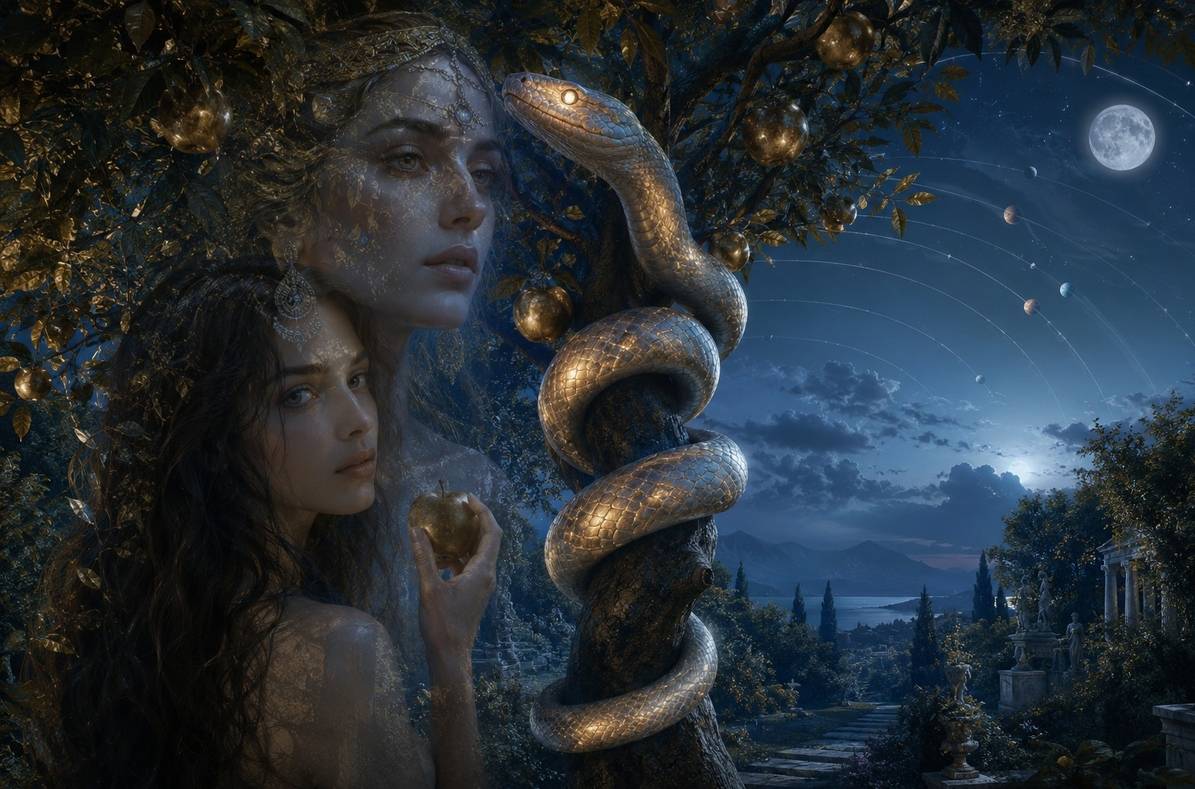
The most distinctive feature of Ophite Sophia is her identification with the serpent of Genesis. In the Ophite reading, the serpent in Eden is not the devil but Sophia’s chosen instrument, the vehicle through which she imparts gnosis to Adam and Eve. She enters the serpent and teaches the first humans to eat from the tree of knowledge, directly countering the archons’ prohibition. Where the Sethian texts portray Sophia weeping and repenting, and the Valentinian texts describe her psychological fragmentation, the Ophite tradition casts her as an active, even subversive, liberator.
This serpent-Sophia motif transforms the biblical narrative of the fall into an account of awakening. The “transgression” in Eden becomes the first act of gnosis, and the expulsion from the garden is the price of knowledge. The archons, not the serpent, are the true deceivers; their command not to eat was the original binding, and Sophia’s intervention through the serpent was the first breaking of that chain. This reading is so radical that Epiphanius later calls the Ophites “snake-worshippers,” missing the theological point that the serpent is merely the mask of Wisdom.
Naassenes and the Ophiomorphus
Hippolytus’s account of the Naassenes (from the Hebrew nahash, serpent) adds further complexity. In their system, the serpent–called Naas or Ophiomorphus–is the animating principle of the cosmos, the world soul through which all things live and move. Hippolytus reports that they considered this serpent-power benevolent, containing all things within itself “as in the horn of the unicorn,” from which beauty and bloom are freely given. This is not the Satanic serpent of Christian orthodoxy but a cosmic life-force identified with the great God of the Greek mysteries.
Scholarly caution is warranted here: the relationship between Ophites and Naassenes is disputed. Hippolytus seems to distinguish them, and the Naassene system as he describes it lacks several key Ophite features, including Sophia, Ialdabaoth, and the seven planetary archons in their familiar forms. What matters for our comparison is that both groups elevate the serpent as a positive symbol of divine wisdom–a stance that sets them apart from both Sethian and Valentinian traditions, where the serpent plays no comparable salvific role.
Comparative Synthesis: Three Falls, Three Redemptions
With the three portraits before us, the differences become as instructive as the similarities. Each tradition shaped Sophia to answer a specific theological need, and the variations are not accidental but systematic.
The Nature of the Error
Sethian: Sophia’s error is an act of unauthorised creation–a passion without consent that produces an abortive, monstrous offspring. The emphasis falls on the unintended consequence: Yaldabaoth is born from her shadow, and the material world is a cosmic accident that must be remedied.
Valentinian: Sophia’s error is cognitive–an unauthorised desire to know the unknowable Father. The emphasis falls on the psyche: her fall is a crisis of knowledge and boundary, and the result is not a monster but a split self. Achamoth is the shadow-side of Wisdom, and the material world is generated from her emotions.
Ophite: Sophia’s “fall” is ambiguous–an overflow of light that may be involuntary or willed. The emphasis falls on her agency: she protects the light, animates the waters, and uses the serpent to teach. The material world is not merely an error but a field of intervention.
The Mechanism of Restoration
Sethian: Restoration is partial and deferred. Sophia repents and is elevated to the ninth heaven, but full redemption awaits the Saviour’s descent, the stripping of archontic garments, and the awakening of the elect through baptism and knowledge of their true names.
Valentinian: Restoration is pedagogical and sacramental. The Saviour instructs Achamoth in the Kenoma, her passions are transformed into the substance of creation, and the spiritual seed is sown among humanity. The bridal chamber enacts this reunion liturgically.
Ophite: Restoration is immediate and subversive. Sophia frees herself, teaches Adam and Eve through the serpent, and continues to counter archontic machinations. There is less emphasis on a future eschatological return and more on the present possibility of gnosis through her ongoing agency.
The Role of the Feminine Divine
Sethian: Sophia is primarily a penitent mother whose error generates the conditions of human bondage. Her redemption is modelled on repentance and intercession; she becomes a bridge, but a damaged one, requiring divine intervention to complete the crossing.
Valentinian: Sophia is a bifurcated psyche whose division mirrors the soul’s own fragmentation. Her redemption is modelled on reintegration and sacramental union; she becomes a template for the individual’s journey from psychic dispersion to pneumatic wholeness.
Ophite: Sophia is an active liberator whose descent is a mission rather than a mistake. Her redemption is modelled on subversive teaching and the transmission of forbidden knowledge; she becomes the original giver of gnosis, the first to say that the emperor has no clothes.
Conclusion
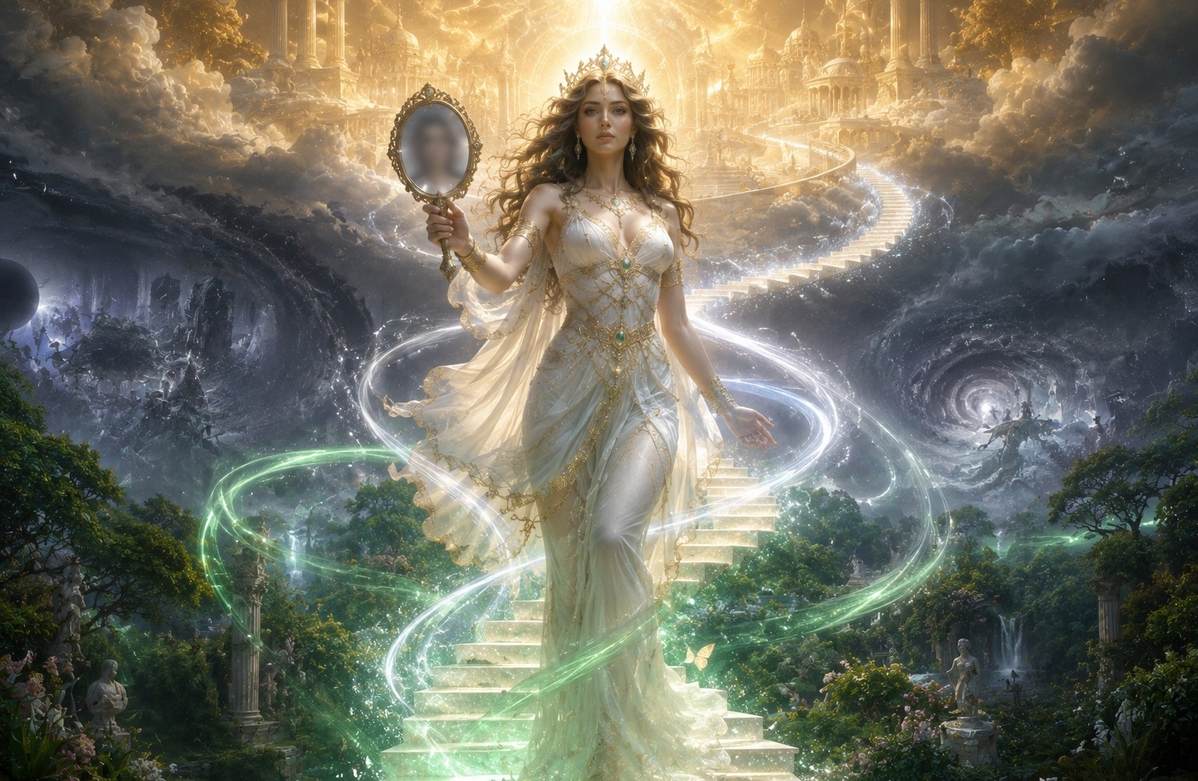
The Sophia myth is not a single story but a family of stories, each shaped by the community that told it. The Sethians needed Sophia to be a penitent mother whose error could be remedied through baptismal ascent and the Saviour’s descent. The Valentinians needed her to be a divided psyche whose fragmentation and reintegration could map the soul’s own journey through sacrament and contemplation. The Ophites needed her to be a subversive teacher whose descent was a mission of liberation, using the serpent to break the first chain of ignorance.
To ask which version is “correct” is to miss the point. These are not competing historical accounts of a single event; they are theological instruments, each calibrating the feminine divine to solve a specific soteriological problem. What unites them is the conviction that Wisdom fell, that the fall generated the conditions of human exile, and that Wisdom’s return–however understood–opens the path for humanity’s return as well. Sophia is the first exile and the first returnee. In that sense, she is every soul’s older sister, showing the way home not because she never stumbled, but because she learned the route through stumbling.
Frequently Asked Questions
Who is Sophia in Gnosticism?
Sophia is the Greek word for wisdom and, in Gnosticism, refers to a divine feminine aeon or emanation from the supreme God. She plays a central role in creation myths as the figure whose error or passion inadvertently produces the material world and the demiurge, while also serving as a model for the soul’s fall and redemption through gnosis.
How does the Sethian tradition portray Sophia’s fall?
In Sethian texts like the Apocryphon of John, Sophia acts independently without her consort’s consent, producing an abortive substance that becomes Yaldabaoth, the lion-faced demiurge. She repents and is partially restored to the ninth heaven, but her shadow and the archons’ subsequent actions generate fate and the counterfeit spirit that binds humanity.
What is Achamoth in Valentinian Gnosticism?
Achamoth is the lower or fallen aspect of Sophia in Valentinian theology, born from the upper Sophia’s unauthorized passion and expelled into the Kenoma by the Limit. She suffers terror, sorrow, and bewilderment, and from her passions the demiurge and material world are formed. Her eventual instruction by the Saviour and return to the Pleroma model the soul’s redemption.
How do Ophite traditions differ in their portrayal of Sophia?
In Ophite systems described by Irenaeus and Hippolytus, Sophia–also called Prunicus–falls due to an overflow of divine light or through her own will. Unlike the more tragic Sethian and Valentinian accounts, she actively protects the light, frees herself from materiality, and uses the serpent in Eden to teach Adam and Eve gnosis, making her a direct agent of human liberation.
Is Sophia the same as Eve in Gnostic texts?
In some Gnostic traditions, particularly Ophite and Sethian texts, Sophia is closely identified with or mirrored by Eve. The Hypostasis of the Archons describes how Sophia imparts her power into Eve, making Eve the spiritual counterpart who resists the archons. However, Sophia remains a cosmic aeon while Eve is her earthly manifestation or counterpart.
What is the Pleroma and how does Sophia relate to it?
The Pleroma is the fullness of divine reality in Gnosticism, the realm of light populated by aeons including Sophia. Her fall represents a departure from this fullness into deficiency, whether through error, passion, or overflow. Her redemption is always understood as a return to the Pleroma, though each school describes the mechanism of that return differently.
Why do Gnostic schools disagree about Sophia’s story?
The differences reflect distinct theological priorities. Sethian texts emphasise baptismal ascent and primordial revelation, framing Sophia’s fall as an error requiring collective restoration. Valentinian systems focus on the soul’s psychological journey, splitting Sophia into upper and lower aspects to map the psyche’s fragmentation and reintegration. Ophite traditions elevate the serpent as revealer, casting Sophia as an active liberator rather than a penitent exile.
Further Reading
Explore related threads across the ZenithEye archive:
- Apocryphon of John: The Gnostic Creation Account — The foundational Sethian text detailing Sophia’s error and the birth of Yaldabaoth.
- The Reality of the Archons — An in-depth study of the Hypostasis of the Archons and Sophia’s intervention through Eve.
- On the Origin of the World — The Nag Hammadi cosmogony describing Sophia’s laughter, the planetary spheres, and the entrapment of divine light.
- Tripartite Tractate: The Valentinian System — A comprehensive guide to Valentinian metaphysics, the fall of Sophia, and the bridal chamber.
- Gospel of Truth: Poetics of Recognition — The Valentinian masterpiece exploring error, fog, and the return to the Father.
- Gospel of Philip: Sacrament and Eros — The bridal chamber, the kiss, and Valentinian sacramental theology.
- Feminine Divine in the Nag Hammadi Library — A thematic collection exploring Sophia, Barbelo, Thunder: Perfect Mind, and the divine feminine across Gnostic texts.
- Thunder: Perfect Mind — The paradoxical divine feminine voice speaking from beyond dualism.
- Gnostic Schools: Sethians, Valentinians, and Hermetics — A comparative overview of the major Gnostic schools and their distinct cosmologies.
- Sophia of Jesus Christ — A Nag Hammadi text in which divine wisdom herself reveals the secrets of the cosmos.
- Trimorphic Protennoia — The three-formed First Thought, a related divine feminine figure descending through three realms.
- Nag Hammadi Library: The Complete Reader’s Guide — The definitive starting point for navigating all forty-six tractates and their thematic connections.
References and Sources
This article draws upon the Nag Hammadi Library in English, critical editions of individual tractates, and standard patristic reports of Gnostic systems. Sources are grouped by category for clarity.
Primary Sources and Critical Editions
- Waldstein, Michael, and Frederik Wisse. (1995). The Apocryphon of John: Synopsis of Nag Hammadi Codices II,1; III,1; and IV,1 with BG 8502,2. Nag Hammadi and Manichaean Studies 33. Brill.
- Layton, Bentley. (1976). The Hypostasis of the Archons. Nag Hammadi Studies. Brill.
- Bullard, Roger A., and Howard M. Jackson. (1996). On the Origin of the World. In The Nag Hammadi Library in English, 3rd revised edition. HarperSanFrancisco.
- Attridge, Harold W., and George W. MacRae. (1985). “The Gospel of Truth.” In The Nag Hammadi Library in English, edited by James M. Robinson. HarperSanFrancisco.
- Schenke, Hans-Martin. (1975). “Das sethianische System nach Nag-Hammadi-Handschriften.” In Studia Coptica, edited by Peter Nagel. Berlin.
- Thomassen, Einar. (2006). The Spiritual Seed: The Church of the ‘Valentinians’. Nag Hammadi and Manichaean Studies 60. Brill.
- Turner, John D. (2001). Sethian Gnosticism and the Platonic Tradition. Bibliotheque Copte de Nag Hammadi, Section “Etudes.” Presses de l’Universite Laval.
Patristic Reports and Heresiological Sources
- Irenaeus of Lyons. (c. 180 CE). Against Heresies, Book 1. Translated by Alexander Roberts and James Donaldson. In Ante-Nicene Fathers, Vol. 1. Christian Literature Publishing.
- Hippolytus of Rome. (c. 230 CE). Refutatio Omnium Haeresium (Philosophumena). Translated by J. H. Macmahon. In Ante-Nicene Fathers, Vol. 5. Christian Literature Publishing.
- Epiphanius of Salamis. (c. 375 CE). Panarion. Translated by Frank Williams. Nag Hammadi and Manichaean Studies 35. Brill.
Secondary Scholarship
- King, Karen L. (2003). What Is Gnosticism? Harvard University Press.
- Jonas, Hans. (1958). The Gnostic Religion: The Message of the Alien God and the Beginnings of Christianity. Beacon Press.
- Logan, Alastair H. B. (1996). Gnostic Truth and Christian Heresy: A Study in the History of Gnosticism. T&T Clark.
- Painchaud, Louis. (1995). “The Use of Scripture in Gnostic Literature.” Journal of Biblical Literature, Vol. 114, No. 3, pp. 383-404.
- Turner, John D. (2012). “The Sethian Myth of Divine Providence.” In The Nag Hammadi Scriptures, edited by Marvin Meyer. HarperOne.