What the Gospel of Thomas Actually Teaches (114 Sayings)
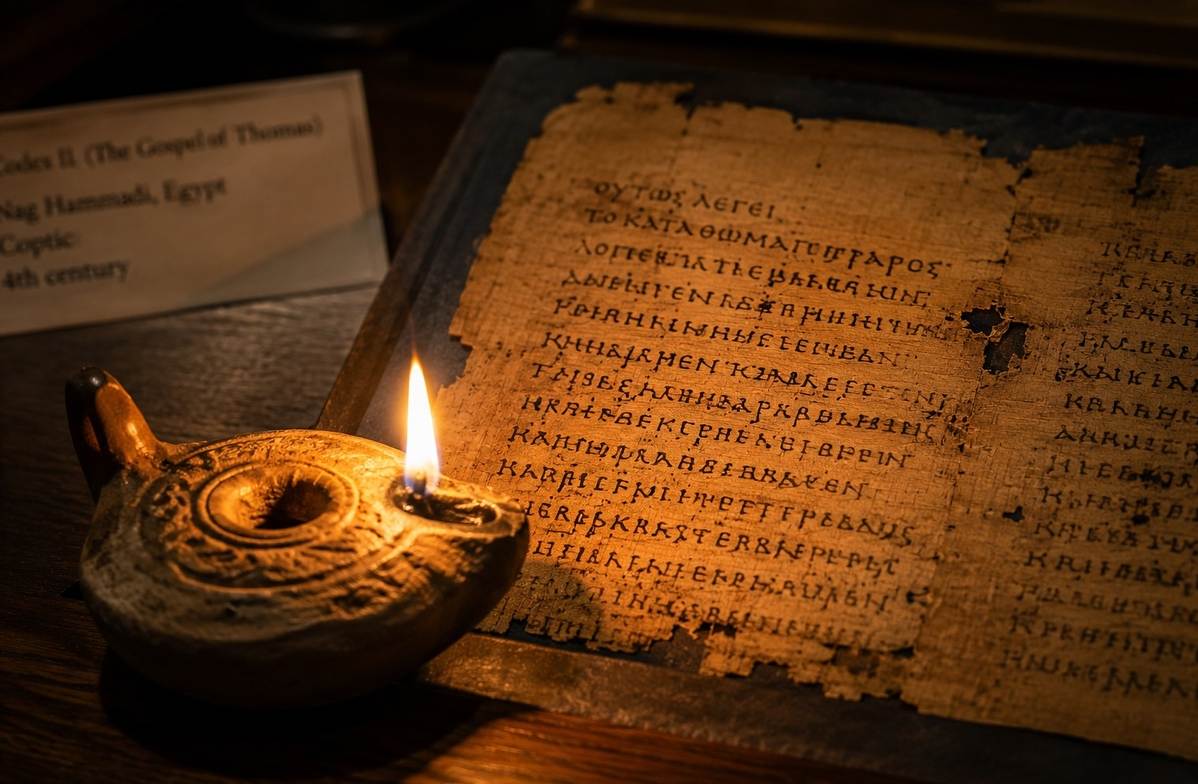
The Gospel of Thomas is not a biography. It contains no nativity, no miracles, no trial, no cross, and no empty tomb. What it contains are 114 sayings — logia — attributed to Jesus, presented without narrative context, chronological order, or theological commentary. Discovered in 1945 as part of Nag Hammadi Codex II near the Egyptian town of Nag Hammadi, the text opens with a claim that has disturbed readers for nearly two millennia: “These are the secret sayings which the living Jesus spoke and which Didymos Judas Thomas wrote down. And he said, ‘Whoever finds the interpretation of these sayings will not experience death.'”
Scholars generally date the Gospel of Thomas to the early second century (c. 90–140 CE), though some argue that a kernel of sayings may reach back to the late first century. Greek fragments from Oxyrhynchus (P.Oxy 1, 654, 655), discovered decades before the Nag Hammadi cache, confirmed that the text circulated in antiquity. A more recent fragment, P.Oxy 5575, published by the Egypt Exploration Society in 2023, provides the earliest attestation yet, pushing the textual history further back into the second century.
But what does the text actually teach? Not Gnosticism in the elaborate cosmological sense of the Apocryphon of John, and not orthodox Christianity in the doctrinal sense of the canonical gospels. Thomas teaches something more direct and more dangerous: that salvation is available now, without priest, church, or creed, to anyone who can understand the sayings. This article examines the seven most searched logia — the sayings readers return to again and again — and places them in conversation with the broader Nag Hammadi Library and the ZenithEye archive.
Table of Contents
- Saying 1: The Secret Sayings and the Living Jesus
- Saying 3: The Kingdom Inside You
- Saying 22: The Androgyne and the Bridal Chamber
- Saying 77: I Am the All
- Saying 108: Drink From My Mouth
- Saying 113: The Kingdom Spread Upon the Earth
- Saying 114: Peter, Mary, and the Living Spirit
- Cross-Text Observations: What Wikipedia Never Makes
- Conclusion
- Frequently Asked Questions
- Further Reading
- References and Sources
Saying 1: The Secret Sayings and the Living Jesus
The prologue sets the terms. “Secret sayings” does not mean hidden from everyone; it means hidden in plain sight. The text is available, but its meaning is not. The reader must find the interpretation — not receive it from an authority. This is the democratisation of gnosis. There is no apostolic succession, no ordained mediator. There is only the saying and the one who wrestles with it.
The phrase “the living Jesus” is equally significant. In Thomas, Jesus is not the crucified saviour whose death atones for sin. He is the eternal teacher whose words contain life. The canonical gospels narrate a life that culminates in death; Thomas presents a voice that bypasses death entirely. The reward for understanding is explicit: “will not experience death.” This is not a promise of resurrection after death. It is a claim that death becomes irrelevant to the one who knows.
Cross-text note: The Gospel of Mary (BG 8502) also presents secret teachings given privately, and the Gospel of Philip (NHC II,3) calls its community “the perfect” who receive hidden mysteries. But Thomas is the most radical in its distribution: no community, no ritual, no hierarchy. Just the reader and the page.
Saying 3: The Kingdom Inside You
This is the most searched, most quoted, and most misquoted saying in the entire collection. “If those who lead you say to you, ‘See, the Kingdom is in the sky,’ then the birds of the sky will precede you. If they say to you, ‘It is in the sea,’ then the fish will precede you. Rather, the Kingdom is inside of you, and it is outside of you. When you come to know yourselves, then you will be known, and you will understand that you are children of the Living Father. But if you do not know yourselves, then you dwell in poverty, and you are that poverty.”
The saying is structured as a polemic against mapped spirituality. Leaders — religious, political, or institutional — point to locations: up, down, across the sea. Jesus points to the self. The kingdom is not a destination; it is a recognition. The Coptic adds “and it is outside of you,” a detail not present in the Greek fragments, which emphasises that the kingdom is not merely subjective. It is the totality of reality perceived correctly.
The final line is brutal in its precision. Poverty is not material deprivation. It is ontological deficiency — the condition of not knowing who you are. To live without self-knowledge is not merely to be poor. It is to be poverty itself. The saying transforms an economic metaphor into an existential diagnosis.

Saying 22: The Androgyne and the Bridal Chamber
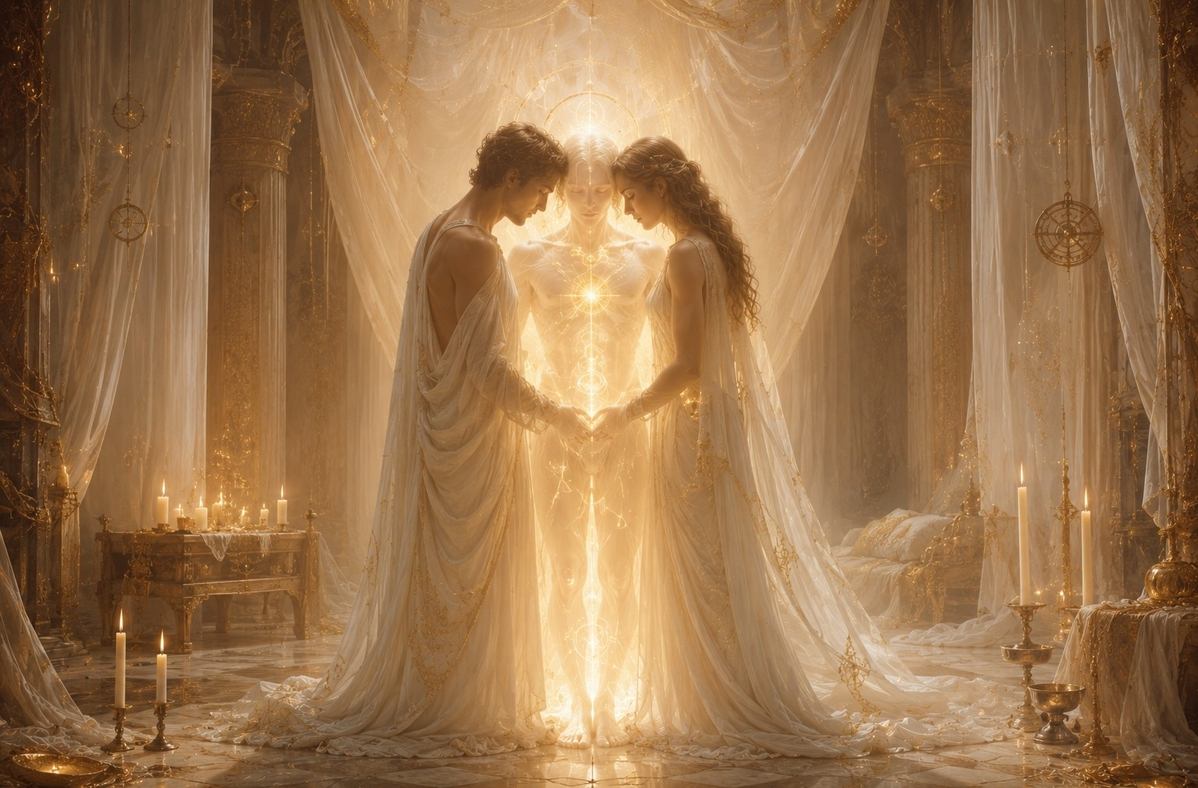
“Jesus saw infants being suckled. He said to his disciples, ‘These infants being suckled are like those who enter the Kingdom.’ They said to him, ‘Shall we then, as children, enter the Kingdom?’ Jesus said to them, ‘When you make the two into one, and when you make the inner like the outer and the outer like the inner, and the upper like the lower, and when you make male and female into a single one, so that the male will not be male nor the female be female… then you will enter [the Kingdom].'”
This is the theological foundation of Thomas’s anthropology. The “single one” (Coptic monachos) is the goal: undivided, ungendered, unmaterial. The reference to making male and female into a single one draws on the androgynous Adam of Genesis 1:27, interpreted through Philo’s lens as an asexual or pre-gendered being. The fall into duality — male/female, inner/outer, upper/lower — is the fall into materiality. Salvation is the reversal.
The saying is not about modern gender identity. It is about ancient gender symbolism, where “male” denoted the active, rational, heavenly principle and “female” the passive, material, earthly principle. To “make male and female into a single one” is to transcend the material polarity altogether and recover the primordial image. The Gospel of Philip (NHC II,3) provides the ritual counterpart: the bridal chamber (nymphon) where this union becomes sacramental. Thomas gives the theory; Philip gives the practice.
Saying 77: I Am the All
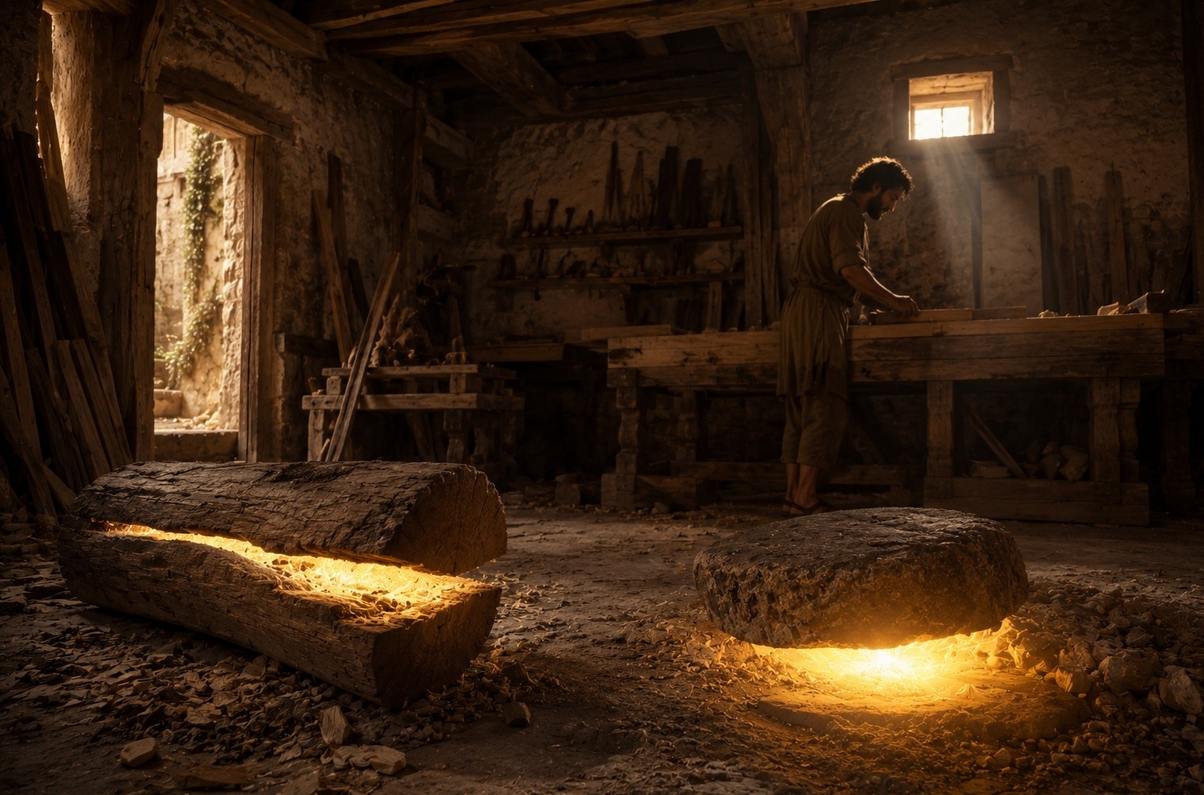
“Jesus said, ‘I am the light which is above them all. It is I who am the All. From me did the All come forth, and unto me did the All extend. Split a piece of wood, and I am there. Lift up the stone, and you will find me there.'”
This is the most overtly pantheistic saying in the collection — or, as Jack Finegan termed it, “panchristic.” Jesus is not merely present in the world; he is the totality of the world. The “All” (ta panta) is a technical term in Gnostic and Platonic literature denoting the whole of cosmic reality. In the Gospel of Truth (NHC I,3), the All is the realm that comes forth from the Father and returns to him. Here, Jesus occupies the same metaphysical position.
Yet the second half domesticates the cosmic claim. Split wood and lifted stones are the materials of a carpenter and a labourer. Jesus is not found in temples or thrones but in manual work and ordinary matter. This is not an invitation to worship nature. It is an invitation to recognise that the divine is not absent from the material — a position that distinguishes Thomas from the more hostile dualism of the Apocryphon of John, where matter is the prison of the demiurge.
Saying 108: Drink From My Mouth
“Jesus said, ‘Whoever drinks from my mouth will become like me. I myself shall become he, and the things that are hidden will be revealed to him.'”
The image is Eucharistic but radically de-institutionalised. There is no bread, no wine, no altar, no priest. There is only the mouth of the teacher and the mouth of the disciple. The transmission is direct, oral, and intimate — closer to the Gospel of Philip‘s sacred kiss than to the Last Supper. The mutual indwelling is explicit: the disciple becomes like Jesus, and Jesus becomes the disciple. The boundary between self and saviour dissolves in the act of reception.
The promise that “the things that are hidden will be revealed” returns to the prologue’s promise of secret sayings. The hidden is not geographically distant; it is relationally distant. It becomes visible only when the knower and the known become one. This is not revelation in the prophetic sense. It is recognition in the Gnostic sense: anamnesis, the recovery of what was always true.
Saying 113: The Kingdom Spread Upon the Earth
“His disciples said to him, ‘When will the Kingdom come?’ Jesus said, ‘It will not come by watching for it. It will not be a matter of saying “Look, here” or “Look, there.” Rather, the Kingdom of the Father is spread out upon the earth, and people do not see it.'”
This saying is the external counterpart to Saying 3’s interior kingdom. Where Saying 3 locates the kingdom within the self, Saying 113 locates it upon the earth. The two together form a non-dual whole: the kingdom is neither merely subjective nor merely objective. It is the correct perception of what is already the case.
The disciples’ question reveals their apocalyptic expectation. They are waiting. Jesus tells them to stop waiting and start seeing. The kingdom is not an event that will happen; it is a condition that is overlooked. The phrase “spread out upon the earth” suggests extension, diffusion, availability. There is no corner of the world where it is absent. There are only corners of perception where it is missed.
Saying 114: Peter, Mary, and the Living Spirit
“Simon Peter said to them, ‘Let Mary go away from us, for women are not worthy of life.’ Jesus said, ‘Look, I myself will lead her in order to make her male, so that she too may become a living spirit resembling you males. For every woman who makes herself male will enter the Kingdom of heaven.'”
This is the most controversial saying in the collection, and the most misunderstood. Peter’s statement is transparently hostile: women are not worthy of life. Jesus’ response has been read as agreement, but the structure suggests otherwise. Jesus does not say women are inferior. He says he will lead her — emphatically, himself — to become a living spirit. The transformation is not a concession to Peter’s prejudice. It is a subversion of it.
The phrase “make herself male” uses ancient gender symbolism in which “male” represents the active, rational, spiritual principle and “female” the passive, material principle. Most scholars now interpret this as an ascetic call to transcend material nature, not a literal gender transformation. In this symbolic register, Mary is not becoming a man. She is becoming spirit — the same goal offered to all disciples.
Cross-text note: The Gospel of Mary (BG 8502 17:7–18:15) presents the same conflict. Peter challenges Mary’s authority; Levi defends her. The Pistis Sophia also shows Peter complaining that Mary asks too many questions. Thomas 114 is not an isolated text. It is a snapshot of a running argument in early Christianity about whether spiritual authority is gendered — and the Gnostic texts consistently vote no.
Cross-Text Observations: What Wikipedia Never Makes
Thomas vs. the Synoptics: The Missing Narrative
The canonical gospels are biographies of salvation. Thomas is a manual of recognition. Matthew, Mark, and Luke narrate a life that saves; Thomas offers sayings that awaken. The absence of the cross is not an oversight. It is a theological statement: the event of salvation is not crucifixion but comprehension. This does not make Thomas anti-Christian. It makes it differently Christian — a Christianity without the blood, but not without the light.
Thomas vs. Philip: Theory and Ritual
The Gospel of Philip is Thomas’s ritual twin. Thomas 22 provides the theology of androgyny; Philip provides the bridal chamber (nymphon) where that theology becomes practice. Thomas says “make the two one”; Philip says “enter the bridal chamber.” Thomas is the map. Philip is the door. Neither makes sense without the other, and neither is complete alone.
Thomas vs. Mary: Public and Private Teaching
Both texts feature secret teachings given to a privileged disciple. But Thomas distributes its secrets to every reader who picks up the codex. Mary reserves hers for the initiated community. Thomas is democratic; Mary is elective. The difference is not in content but in address. Thomas speaks to the solitary reader; Mary speaks to the gathered disciples.
Thomas vs. Pistis Sophia: The Koan and the Commentary
The Pistis Sophia is Thomas expanded to eleven years of post-resurrection dialogue. Where Thomas offers a terse saying — “Whoever drinks from my mouth will become like me” — Pistis Sophia offers pages of interpretation, questions, and scriptural citation. Thomas is the koan. Pistis Sophia is the commentary. One provokes; the other explains. Both are necessary, but Thomas preserves the shock that commentary softens.
Thomas vs. Apocryphon of John: Poverty and Prison
Thomas says that those who do not know themselves “dwell in poverty, and are that poverty.” The Apocryphon of John says that the archons trap the divine spark in material poverty. Both agree that ignorance is the prison. But Thomas offers no cosmological drama — no Yaldabaoth, no fallen Sophia, no counterfeit spirit. The prison is simply the failure to understand the saying. The liberation is simply the understanding. Thomas is Gnosticism without the special effects.
Conclusion
The Gospel of Thomas does not teach doctrines. It teaches recognitions. The 114 sayings are not propositions to believe but riddles to inhabit. The kingdom is not a destination; it is a way of seeing. The self is not a soul to save but a knower to awaken. The teacher is not a saviour to worship but a presence to become.
What Thomas offers is the most democratic text in early Christianity. There is no church, no hierarchy, no sacramental monopoly. There is only the saying, the reader, and the possibility that the two might meet. The text does not promise that this meeting is easy. It promises that it is possible. And in a religious landscape often defined by exclusion, that possibility is itself the kingdom — spread out upon the earth, and finally, perhaps, beginning to be seen.
Frequently Asked Questions
What is the Gospel of Thomas and why is it important?
The Gospel of Thomas is a collection of 114 sayings (logia) attributed to Jesus, discovered in 1945 as part of the Nag Hammadi Library in Upper Egypt. Unlike the canonical gospels, it contains no narrative of Jesus’ life, death, or resurrection. It is important because approximately half of its sayings have no parallel in the New Testament, and it represents an early strand of Christianity that emphasised direct spiritual knowledge (gnosis) over institutional belief.
What does the Gospel of Thomas teach about the Kingdom of God?
The Gospel of Thomas teaches that the Kingdom of God is not a future apocalyptic event but a present reality that is both inside and outside the self. Saying 3 states that the kingdom is within you and outside you, and that self-knowledge reveals one’s identity as a child of the living Father. Saying 113 adds that the kingdom is already spread out upon the earth, but people do not see it because they are looking in the wrong direction.
What does ‘make the male and the female into a single one’ mean in Saying 22?
In Saying 22, Jesus describes a return to primordial androgyny — the state of the first human before the division into male and female. This is not about modern gender transition but about transcending material duality to become a ‘single one’ (monachos). The saying parallels the bridal chamber theology in the Gospel of Philip, where spiritual union restores the original unity of the divine image.
What does ‘I am the All’ mean in Saying 77?
In Saying 77, Jesus identifies himself as the light above all things and the totality of cosmic reality (‘the All’). He adds that he is present in ordinary objects — split wood and lifted stones — suggesting a non-dual presence that permeates material existence. In the Gospel of Thomas, this is not exclusive to Jesus; it is the state the reader is invited to realise through gnosis.
Is the Gospel of Thomas a Gnostic text?
Scholars debate this. The Gospel of Thomas lacks the elaborate cosmology and demiurge mythology found in classic Gnostic texts like the Apocryphon of John. However, it shares key Gnostic emphases: salvation through secret knowledge, the interiority of the divine, and the rejection of institutional mediation. Most scholars now classify it as a proto-Gnostic or wisdom-oriented text that sits on the boundary between early Christianity and full Gnosticism.
What does Saying 114 mean about women making themselves male?
Saying 114 records Peter’s objection that women are not worthy of life, and Jesus’ response that he will guide Mary to become a living spirit resembling the males. The phrase ‘make herself male’ uses ancient gender symbolism where ‘male’ represented the active, rational, spiritual principle and ‘female’ the passive, material principle. Most scholars interpret this as an ascetic call to transcend material nature, not a literal gender transformation. The saying still affirms Mary’s inclusion, despite Peter’s attempt to exclude her.
How does the Gospel of Thomas differ from the canonical gospels?
The Gospel of Thomas differs in three major ways. First, it has no narrative framework — no birth, miracles, passion, or resurrection. Second, it presents Jesus as a wisdom teacher rather than a saviour whose death atones for sin. Third, it offers salvation through understanding the sayings rather than through faith in Christ’s sacrifice. It is a collection of koan-like riddles designed to provoke direct insight, not a biography designed to confirm doctrine.
Further Reading
Explore related threads across the ZenithEye archive:
- Gospel of Thomas Commentary: The Hidden Sayings — A line-by-line exploration of the most cryptic logia and their interpretive history.
- Gospel of Thomas: The Complete Overview — The foundational ZenithEye guide to discovery, manuscripts, and scholarly dating.
- Gospel of Thomas: 114 Keys — A structured guide to every saying with canonical parallels and unique Thomasine material.
- Gospel of Philip: Sacrament, Eros, and the Bridal Chamber — The ritual twin to Thomas’s theology of androgyny and the single one.
- Gospel of Mary Magdalene: The Complete Guide — The text that shows Peter challenging Mary again — and losing again.
- Apocryphon of John: The Gnostic Creation Account — The cosmological counterpart to Thomas’s stripped-down soteriology.
- Book of Thomas the Contender: Flesh and Soul — Another Thomasine text from Nag Hammadi Codex II on the renunciation of the body.
- Pleroma and Kenoma: The Foundational Geography of Gnostic Cosmology — Essential background on the divine fullness that Thomas calls “the All.”
- The Sophia Myth: Three Falls, Three Redemptions — The cosmic drama that Thomas refuses to narrate but still assumes.
- What is Gnosticism? Defining the Undefinable — An essential primer on the schools, terminology, and boundaries of Gnostic thought.
- Nag Hammadi Library: The Complete Reader’s Guide — The definitive starting point for navigating all forty-six tractates and their thematic connections.
References and Sources
This article draws upon critical editions of the Coptic and Greek texts, standard scholarly translations, and academic monographs. Sources are grouped by category for clarity.
Primary Sources and Critical Editions
- Lambdin, Thomas O. (1990). “The Gospel of Thomas.” In The Nag Hammadi Library in English, edited by James M. Robinson. 3rd ed. HarperSanFrancisco.
- Layton, Bentley. (1989). Nag Hammadi Codex II,2–7. Nag Hammadi Studies 20. Brill.
- Gathercole, Simon. (2014). The Gospel of Thomas: Introduction and Commentary. Brill.
- Patterson, Stephen J., James M. Robinson, and Hans-Gebhard Bethge. (1998). The Fifth Gospel: The Gospel of Thomas Comes of Age. Trinity Press International.
Scholarly Monographs and Studies
- Valantasis, Richard. (1997). The Gospel of Thomas. Routledge.
- DeConick, April D. (2006). Recovering the Original Gospel of Thomas: A History of the Gospel and Its Growth. T&T Clark.
- Koester, Helmut. (1990). Ancient Christian Gospels: Their History and Development. Trinity Press International.
- Cwikla, Anna. (2022). “The Insignificance of Mary in the Gospel of Thomas 114.” Journal of Interdisciplinary Biblical Studies.
- Duffy, William G. (2020). The Hidden Gospel of Thomas: Commentaries on the Non-Dual Sayings of Jesus. SilverWood Books.
- Marjanen, Antti. (1996). The Woman Jesus Loved: Mary Magdalene in the Nag Hammadi Library and Related Documents. Brill.
- King, Karen L. (2003). The Gospel of Mary of Magdala: Jesus and the First Woman Apostle. Polebridge Press.
- Pagels, Elaine. (1979). The Gnostic Gospels. Random House.
- Turner, John D. (2012). “The Gospel of Thomas.” In Nag Hammadi Scriptures, edited by Marvin Meyer. HarperOne.