Pneuma and Logos: What Gnosticism and Stoicism Share
Gnosticism and Stoicism are usually taught as opposites. One rejects the world; the other accepts it. One seeks escape; the other seeks equanimity. But beneath the surface, they share a vocabulary, a historical moment, and a practical logic that makes them far more compatible than the textbooks admit.
Ask a philosophy lecturer what Gnosticism and Stoicism have in common, and the likely answer is “nothing.” Stoicism is the philosophy of endurance: accept what you cannot control, align your will with nature, and maintain equanimity in a rational cosmos. Gnosticism is the philosophy of refusal: the cosmos is a prison, the creator is incompetent, and the only sane response is recognition and escape. On the surface, these are not merely different. They are antagonistic.
Yet the historical record tells a more complicated story. The Nag Hammadi Library — the buried collection of Gnostic texts discovered in Egypt in 1945 — contains at least one tractate that is essentially a Stoic ethics manual with Christian-Gnostic trimmings. The second-century Gnostic teacher Basilides adapted Stoic ethical categories for his own soteriology. And both traditions, in their different ways, arrived at the conclusion that the material world is not what it appears to be: the Stoics through their physics of pneuma, the Gnostics through their mythology of the Demiurge. This article traces the actual historical and philosophical relationship between Gnosticism and Stoicism — not the pop-synthesis version circulating on social media, but the rigorous, textually grounded connection that scholars have documented for decades.
Table of Contents
- The Shared Vocabulary, Different Meanings: Pneuma and Logos
- The Teachings of Silvanus: Where Stoicism Actually Entered Nag Hammadi
- Basilides and the Stoic Ethical Vocabulary
- Two Operating Systems: The Stoic Shield and the Gnostic Engine
- The Mental Projection Thesis: Corporealism Meets Cosmic Illusion
- Why Both Traditions Were Marginalized by Christian Orthodoxy
- Complementary, Not Identical
- Frequently Asked Questions
- Further Reading
- References and Sources
The Shared Vocabulary, Different Meanings: Pneuma and Logos
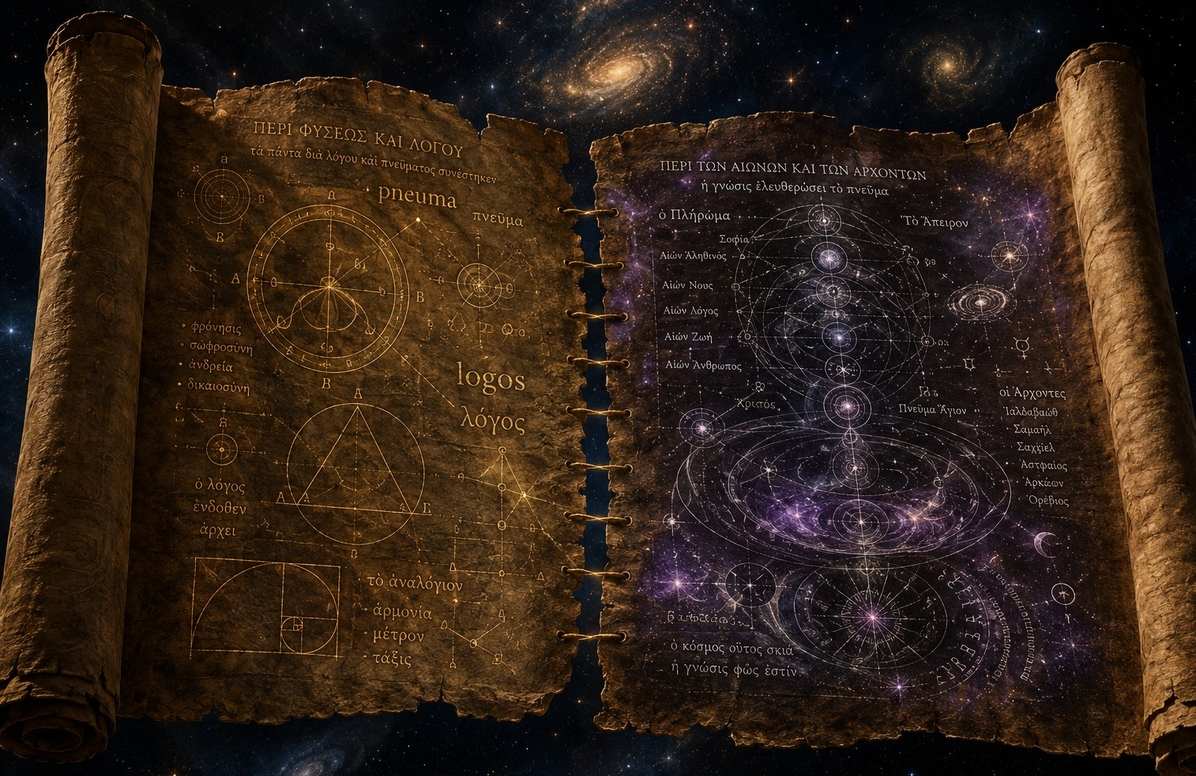
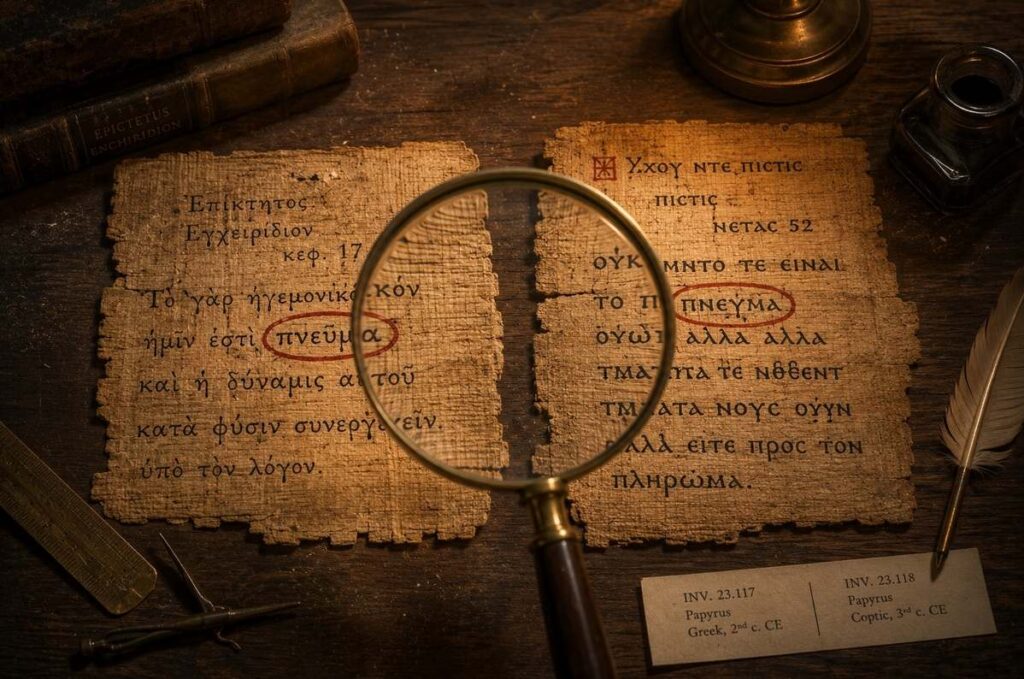
The most obvious connection between Stoicism and Gnosticism is terminological. Both traditions centre their cosmologies and anthropologies on two Greek words: pneuma (breath, spirit) and logos (reason, word, rational principle). But the meanings diverge so sharply that using the same words can obscure more than it reveals.
Pneuma: Cosmic Organiser vs. Divine Spark
For the Stoics, pneuma is a physical substance — a mixture of air and fire, subtle but entirely material, that pervades and organises the cosmos. According to Chrysippus (c. 280-207 BCE), the human soul consists of pneuma, and this soul-pneuma is a portion of the divine pneuma that permeates and directs the entire universe. The Stoics identified this world-soul with God or Zeus. Pneuma operates in a hierarchy: at its lowest level it produces cohesion (hexis) in inanimate objects like stones; at a higher level it produces organic nature (physis) in plants; at a higher level still it produces soul (psychê) in animals; and at the highest level it produces reason (logos) in human beings. The cosmos is a single continuum of pneuma-charged substance, and qualitative differences between things are determined by the degree of “tensional motion” in the pneuma pervading them.
For the Gnostics, pneuma is something else entirely. In the Nag Hammadi texts, particularly those with a tripartite anthropology, the human being consists of body, soul, and spirit (pneuma). The pneuma is not a material substance but a divine spark that has fallen into the material world from the Pleroma — the “fullness” of the divine realm. Unlike the Stoic pneuma, which is immanent in matter and identical with the world-soul, the Gnostic pneuma is alien to the material world. It does not organise matter; it is trapped within it. The Apocryphon of John describes the spirit as that which the Demiurge could not capture or contaminate — the element that remains pure even when the soul is dragged down into forgetfulness and flesh.
The difference is fundamental. Stoic pneuma is the world. Gnostic pneuma is exiled from the world. One is immanent; the other is transcendent. One is the organising principle of the prison; the other is the prisoner who remembers the outside.
Logos: Rational Order vs. Revealing Word
In Stoicism, logos is the rational principle that structures the cosmos. It is immanent, pervasive, and identical with the divine mind. The universe is an intelligible whole ordered by logos, and human beings are “portions” of that logos. To live virtuously is to live “according to logos” — aligning one’s individual reason with the universal reason. The Stoic logos is not a person; it is a principle. It does not reveal; it organises.
In Gnosticism, logos takes on a different character. In the Teachings of Silvanus, Christ is identified as the Logos — the personified wisdom and reason through whom the true image of God can be known. In Valentinian texts, the Logos is a divine emanation, a hypostasis within the Pleroma. The Gnostic logos is not the rational structure of the material world; it is the revelatory principle that exposes the material world’s inadequacy. Where Stoic logos maintains the cosmos, Gnostic logos dismantles it.
Yet the shared vocabulary is not accidental. Both traditions emerged from the same Hellenistic intellectual environment. Both drew on Heraclitus, Plato, and Middle Platonic philosophy. Both used the language of pneuma and logos because that was the philosophical vocabulary of the era. The words are the same. The grammars are utterly different.
The Teachings of Silvanus: Where Stoicism Actually Entered Nag Hammadi
The strongest evidence for a direct Stoic-Gnostic connection is not a theory. It is a text: the Teachings of Silvanus (NHC VII,4), found in Codex VII of the Nag Hammadi Library alongside technical Sethian ascent manuals like Zostrianos and the Paraphrase of Shem. This tractate is not a cosmological revelation. It is a practical ethics manual consisting of 116 sayings, organised as a letter from father to son, and it is saturated with Stoic concepts.
Scholars have identified the first half of Silvanus (NHC VII,4 84:16-98:20) as “a Jewish compendium of moral teaching influenced by Stoicism and Platonism, to which Christian features have been added.” The second half reflects the theological teachings of the Alexandrian Christian fathers Clement and Origen. The text addresses the reader as logikos anthropos — the rational human being — a distinctly Stoic formulation. It prescribes apatheia (passionlessness or equanimity), prosoche (continuous attention), and the governance of the self through reason. “Bring your divine mind into your body,” the text commands, “and withdraw your soul from sensual pleasures.” This is not body-hatred in the extreme ascetic sense. It is interior integration — the body as servant of the rational soul rather than its master.
“My son, observe my advice. Flee wickedness. Watch yourself carefully in all things, in whatever you do… Work hard, my son, lest death overtake you and you become a dead man while still alive.”
Teachings of Silvanus, NHC VII,4 84:15-20
What makes Silvanus significant is not merely its Stoic vocabulary but its placement. It was buried in the same jar as the most technical Gnostic cosmologies, suggesting that the ancient curators — whoever they were — considered it part of the same spiritual ecosystem. The community that valued Zostrianos‘ thirteen-aeon ascent also valued Silvanus’ advice on attention and emotional temperance. This is not a pop synthesis. It is a codicological fact: Stoic ethics and Gnostic cosmology were physically bound together in the same collection.
Silvanus does not mention the Demiurge, the archons, or the Pleroma. It offers no passwords for planetary checkpoints. Instead, it provides what scholars call a “training in the attention economy” — teaching the practitioner to withhold the psychic energy that external forces routinely levy upon the distracted. The archons may govern the stars, but Silvanus concerns himself with the governance of the self. One need not overthrow the cosmic administration to be free of it; one need only cease paying the taxes of emotional reactivity that sustain its operations.

Basilides and the Stoic Ethical Vocabulary
The second-century Gnostic teacher Basilides of Alexandria provides another documented case of Stoic terminology being adapted for Gnostic ends. Basilides is known primarily through fragments preserved by the heresiologist Irenaeus and the Church Father Clement of Alexandria. What survives shows a thinker who was deeply engaged with contemporary philosophy — including Stoicism.
According to the surviving fragments, Basilides adapted Stoic ethical categories for his own soteriology. He declared that faith (pistis) “is not the rational assent of a soul possessing free will” — a direct counter to the Stoic concept of prohairesis (moral choice or faculty of assent). For Basilides, faith is the natural mode of existence for the elect, who “are alien to the world, as if they were transcendent by nature.” He called the law of nature pronoia (providence), a term the Stoics used extensively, but located it within a cosmos of multiple heavens rather than the single rational cosmos of Stoic physics.
Most tellingly, Basilides advocated adiaphoria — indifference to bodily impulses and desires. This is recognisably Stoic language. The Stoics held that external things (health, wealth, reputation) are “indifferent” (adiaphora) in the strict sense, though some are “preferred” and others “dispreferred.” The sage maintains equanimity toward all of them. Basilides took this indifference and radicalised it: not merely equanimity within the world, but detachment from the world as a flawed creation. The Stoic learns not to be disturbed by the prison. The Basilidean learns to see that it is a prison.
The difference is subtle but decisive. Stoic indifference is horizontal — maintaining balance across the surface of life. Gnostic indifference is vertical — withdrawing attention from the horizontal plane entirely and redirecting it toward the transcendent origin. Basilides shows us what happens when Stoic techniques are grafted onto Gnostic rootstock: the same vocabulary produces a different fruit.
Two Operating Systems: The Stoic Shield and the Gnostic Engine
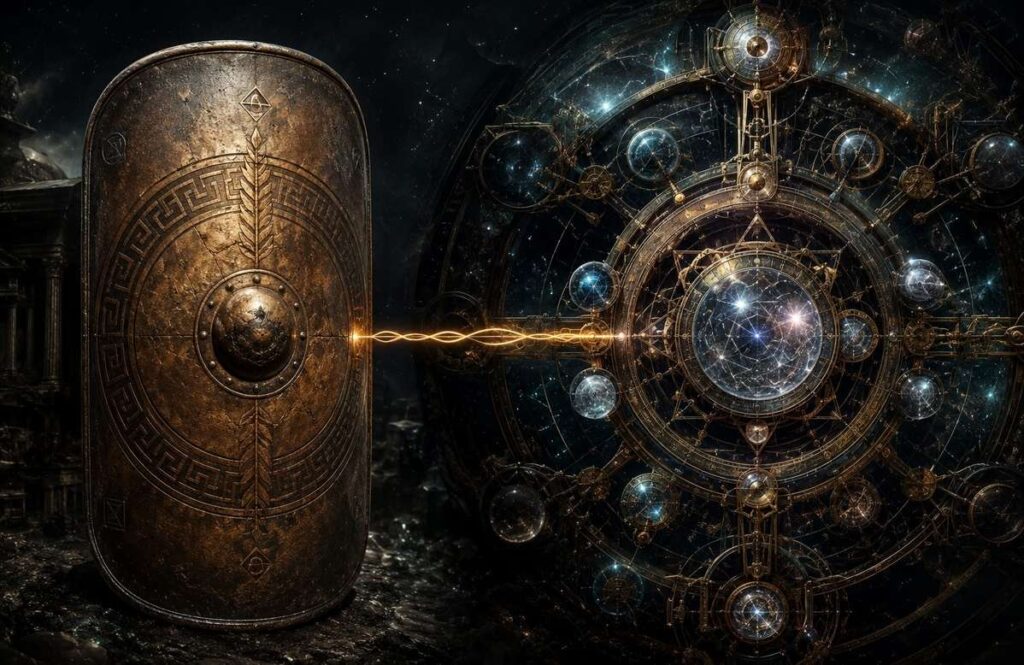
If we step back from the historical texts and consider the two traditions as practical philosophies, a striking complementarity emerges. Stoicism and Gnosticism can be understood as two different software programs running on the same hardware — the human being trapped in a confusing and often hostile world.
Stoicism is the shield. Its function is defensive. It protects the inner citadel — the hêgemonikon, the commanding faculty of the soul — from external disturbances. Marcus Aurelius, the last great Stoic, spent his mornings in meditation and his evenings writing reminders to himself: “You have power over your mind — not outside events. Realise this, and you will find strength.” The Stoic does not need to know that the world is a prison. He only needs to know that his response to it is his own. The techniques are robust: negative visualisation, premeditatio malorum, the dichotomy of control, and the cultivation of apatheia. These work whether the cosmos is rational or chaotic, divine or demiurgic.
Gnosticism is the engine. Its function is revelatory. It does not merely protect the inner citadel; it reveals that the citadel is not where you think it is. The Gnostic texts do not teach coping mechanisms. They teach recognition — the sudden, unearned seeing that the emperor has no clothes, that the creator is not the Father, and that the soul’s true origin lies elsewhere. Where Stoicism asks “How do I endure this?” Gnosticism asks “What is this, really?”
The two are not mutually exclusive. In fact, they are functionally complementary. The Stoic shield prevents the practitioner from being destroyed by the world while the Gnostic engine is still warming up. Gnosis is not a technique you can force. It is a recognition that arrives when the conditions are right. Meanwhile, the Stoic practices of attention, emotional temperance, and internal sovereignty create precisely the conditions that make recognition possible. A mind shattered by reactivity, addiction, and emotional chaos is not a mind that can recognise anything. The shield keeps the vessel intact while the engine does its work.
This is not a historical claim about what ancient Stoics and Gnostics actually did. It is a practical claim about what a contemporary practitioner can do. The ancient texts give us the components. It is up to us to assemble them.
The Mental Projection Thesis: Corporealism Meets Cosmic Illusion
One of the most provocative points of convergence between Stoicism and Gnosticism concerns the nature of reality itself. Both traditions, in their different ways, undermine the naive realism that treats the material world as simply “there” — solid, independent, and self-evident.
The Stoics were materialists, but not naive materialists. They held that the only things that exist are bodies, but they also held that the qualities and properties of bodies are themselves bodies — subtle, tensional, and organised by pneuma. The Stoic cosmos is not a collection of inert objects. It is a single, continuous, living organism permeated by an intelligent, fiery breath. In this sense, the Stoic material world is not “matter” in the modern sense. It is a field of intelligent force. The boundary between “object” and “subject” dissolves because the same pneuma that structures the cosmos also structures the human soul. To understand the world is to understand the logos that organises it — and that logos is not separate from the mind that grasps it.
The Gnostics took this insight in a different direction. For them, the material world is not merely permeated by intelligence; it is a flawed imitation of a higher reality. The Hypostasis of the Archons and On the Origin of the World both draw on Platonic philosophy to portray the material world as a copy of a superior heavenly world. The archons, creators of the material realm, are “flawed, ignorant, and deceitful.” The material world is not independent reality. It is a secondary product — a shadow, a hologram, a projection from a source that remains elsewhere.
The convergence is philosophical, not historical. Both traditions agree that the material world is not the ultimate reality. The Stoics say it is a manifestation of logos-pneuma. The Gnostics say it is a counterfeit of the Pleroma. But both deny the naive realism that treats tables and chairs as simply “there” in some absolute sense. Both invite the practitioner to look through the surface. The Stoic looks through to the rational order beneath. The Gnostic looks through to the prison bars behind.
In modern terms, both traditions are compatible with a “mental projection” or “simulation” hypothesis — not because they believed in computers, but because they believed that the apparent solidity of the world is sustained by something non-material (pneuma, logos, or divine error) that organises or generates it. The world is not a given. It is a produced effect. And if it is produced, it can be seen through.
Why Both Traditions Were Marginalized by Christian Orthodoxy
The historical relationship between Stoicism and Gnosticism is not merely intellectual. It is also political. Both traditions were eventually marginalized by the rise of Christian orthodoxy, though in different ways and at different speeds.
Stoicism was already in decline by the third century CE. The last major Stoic philosopher was Marcus Aurelius, who died in 180 CE. By the time Christianity became the state religion under Constantine in the early fourth century, Stoicism had largely been absorbed into Neoplatonism and Christian theology. Clement of Alexandria and Origen — both of whom appear in the second half of the Teachings of Silvanus — were themselves deeply influenced by Stoic ethics. The Stoic tradition did not “go underground” in the same way Gnosticism did. It was digested by the very orthodoxy that would later suppress its more radical cousins.
Gnosticism, by contrast, was actively suppressed. The Nag Hammadi texts were buried around 350-400 CE, likely by monks from a nearby Pachomian monastery who recognised that the writings were now heretical under the new imperial orthodoxy. The Gnostic tradition did go underground — literally, into the sand at the base of the Jabal al-Tarif cliffs. The suppression was not merely theological. It was codicological: the texts were hidden because they could no longer be read openly.
The irony is that orthodox Christianity absorbed Stoic techniques while rejecting Gnostic cosmology. The Christian monastic tradition — with its emphasis on attention, emotional discipline, and the governance of the self — is essentially Stoic ethics baptized. Meanwhile, the Gnostic insight that the world is a flawed creation was condemned as heresy, even though it survives in muted form in Christian doctrines of original sin and the fallenness of creation. The orthodox Church took the Stoic shield and discarded the Gnostic engine. It taught people to endure the prison without ever asking who built it.

Complementary, Not Identical
We must be careful not to overstate the connection. Stoicism and Gnosticism are not the same tradition in different costumes. They are fundamentally different in metaphysics, anthropology, and soteriology.
The Stoic is a monist and a materialist. The cosmos is one, rational, and divine. The human task is to align with it. The Gnostic is a dualist (or quasi-dualist). The cosmos is flawed, the creator is ignorant, and the human task is to see through it. The Stoic loves the world in a disciplined way. The Gnostic refuses the world in a clear-eyed way. These are not minor differences. They are the difference between acceptance and refusal, between endurance and escape, between “live according to nature” and “nature is the problem.”
Yet the two traditions share something that orthodox Christianity did not: a commitment to the sovereignty of the individual intellect. The Stoic hêgemonikon and the Gnostic nous are both commanding faculties that answer to no external authority. The Stoic judges impressions for himself. The Gnostic recognises the truth for himself. Both traditions place the locus of salvation in the individual’s capacity for clear perception — not in sacraments, not in institutions, and not in submission to hierarchical authority. This is why both were threatening to the Church. And this is why both remain relevant to anyone who refuses to outsource their consciousness.
“The Stoic teaches you to survive the storm. The Gnostic teaches you that the storm is not the weather. Together, they offer what neither offers alone: the strength to endure, and the sight to see through.”
ZenithEye

Frequently Asked Questions
Did Gnosticism come from Stoicism?
No. Gnosticism did not originate from Stoicism. They are distinct traditions with different metaphysics. However, the Nag Hammadi text Teachings of Silvanus shows direct Stoic influence, and the Gnostic teacher Basilides adapted Stoic ethical categories. Both traditions shared the Hellenistic philosophical vocabulary of pneuma and logos, though they used these terms with fundamentally different meanings.
What is the difference between Stoic and Gnostic pneuma?
Stoic pneuma is a material substance — a mixture of air and fire — that pervades and organises the cosmos as the world-soul. Gnostic pneuma is the divine spark, a transcendent element alien to the material world, which has fallen from the Pleroma and remains trapped within the body. One is immanent; the other is exiled.
What are the Teachings of Silvanus?
The Teachings of Silvanus (NHC VII,4) is a second-to-third-century CE tractate from the Nag Hammadi Library containing 116 practical sayings on ethical living. Scholars describe its first half as a Jewish compendium of moral teaching influenced by Stoicism and Platonism, with Christian additions. It addresses the reader as logikos anthropos and prescribes Stoic-derived practices of attention, emotional temperance, and wakefulness.
Can you be a Stoic and a Gnostic at the same time?
Historically, no — they are different metaphysical systems. But practically, their techniques are complementary. Stoicism provides the shield (emotional resilience, attention, equanimity) while Gnosticism provides the engine (recognition of the world’s true nature, direct insight into one’s origin). The Stoic shield protects the practitioner while the Gnostic recognition develops.
How did Basilides use Stoic ideas?
The second-century Gnostic teacher Basilides adapted Stoic ethical concepts including adiaphoria (indifference to bodily impulses) and pronoia (providence). However, he radicalised them: Stoic indifference becomes detachment from the material world as a flawed creation, and Stoic providence is relocated within a multi-heaven cosmology rather than a single rational cosmos.
Why were Stoicism and Gnosticism both marginalized?
Stoicism declined naturally from the second century CE and was eventually absorbed into Neoplatonism and Christian theology. Gnosticism was actively suppressed as heresy by the orthodox Church, and its texts were buried around 350-400 CE. Ironically, orthodox Christianity absorbed Stoic ethical techniques while rejecting Gnostic cosmological insights.
Do Stoicism and Gnosticism both view the world as an illusion?
Not exactly. Stoics view the world as a rational, living organism permeated by intelligent pneuma — not an illusion, but a manifestation of divine order. Gnostics view the material world as a flawed imitation or counterfeit of a higher reality. However, both deny naive materialism and agree that the apparent solidity of the world is sustained by non-material principles (pneuma, logos, or divine error) that can be perceived through clear insight.
Further Reading
These ZenithEye articles expand on the themes, texts, and traditions explored above.
- The Teachings of Silvanus: Practical Wisdom from Nag Hammadi — A complete guide to the Stoic-influenced tractate found in Codex VII, with its 116 sayings on attention, emotional temperance, and wakefulness.
- The Apocryphon of John: The Gnostic Creation Myth — The primary source for the Demiurge, the divine spark, and the tripartite anthropology of body, soul, and spirit.
- Pleroma and Kenoma: The Foundational Geography of Gnostic Cosmology — The complete map of the Gnostic cosmos, essential for understanding the Gnostic concept of the material world as a flawed imitation.
- The Hypostasis of the Archons: Eve and the Truth — The Nag Hammadi text that draws on Platonic philosophy to portray the material world as an imitation of a superior heavenly reality.
- The Nag Hammadi Library: A Complete Guide to the Gnostic Scriptures — The master index for all forty-six tractates, including the codicological context of Silvanus in Codex VII.
- Gnostic Schools: Sethians, Valentinians, and Hermetics — A comparative overview of the major Gnostic schools, including Basilides and his adaptation of Middle Platonic and Stoic concepts.
- Before the Matrix: What the Nag Hammadi Texts Actually Say About Simulated Reality — The ancient precedents for viewing the material world as a constructed simulation or flawed projection.
- The Gnostic Answer to Evil: Why Suffering Proves the Demiurge Is Not God — The companion piece exploring the Gnostic critique of the material world and its architect.
- Attention: The First Gateway to Consciousness — A practical exploration of Stoic-derived attention practices and their relevance to contemporary spiritual discipline.
- The Discovery of the Nag Hammadi Library: How the Gnostic Scriptures Were Found — The historical account of the 1945 discovery and the burial of the texts around 350-400 CE.
References and Sources
The following sources are organised by category for clarity and further study.
Primary Sources: Nag Hammadi Library
- The Teachings of Silvanus (NHC VII,4). Translation and commentary: Malcolm L. Peel, in The Nag Hammadi Library in English (Brill, 1977); also Jan Zandee, The Teachings of Silvanus (Brill, 1977). The first half (84:16-98:20) is described by scholars as “a Jewish compendium of moral teaching influenced by Stoicism and Platonism, to which Christian features have been added.”
- The Apocryphon of John (NHC II,1; III,1; IV,1). Translation: Marvin Meyer, The Nag Hammadi Scriptures (HarperOne, 2007).
- The Hypostasis of the Archons (NHC II,4). Translation: Roger A. Bullard and Joseph A. Gibbons, in The Nag Hammadi Library in English (Brill, 1977).
- On the Origin of the World (NHC II,5). Translation: Hans-Gebhard Bethge and Bentley Layton, in The Nag Hammadi Library in English (Brill, 1977).
Primary Sources: Stoicism
- Marcus Aurelius. Meditations (c. 161-180 CE). The classic statement of late Stoic practical ethics, including the dichotomy of control and the cultivation of the inner citadel.
- Epictetus. Discourses and Enchiridion (c. 108 CE). The foundational texts for Stoic attention (prosoche) and the faculty of choice (prohairesis).
- Seneca. Letters to Lucilius and On the Firmness of the Wise Person. Key sources for Stoic indifference (adiaphoria) and emotional resilience.
- Diogenes Laertius. Lives of the Eminent Philosophers, Book VII (c. 230 CE). The primary doxographic source for early Stoic physics, psychology, and cosmology, including the doctrine of pneuma and the scala naturae.
Scholarly Monographs and Critical Studies
- Long, A. A. and Sedley, D. N. The Hellenistic Philosophers (Cambridge University Press, 1987). The standard collection of Stoic fragments and testimonia, with commentary on physics, ethics, and logic.
- Inwood, Brad. Ethics and Human Action in Early Stoicism (Oxford University Press, 1985). A rigorous analysis of Stoic psychology, action theory, and the hêgemonikon.
- Pearson, Birger A. “The Teachings of Silvanus,” in Nag Hammadi Codex VII (Brill, 1996). The critical edition with full commentary on Stoic, Platonic, and Christian sources.
- Logan, Alastair H. B. Gnostic Truth and Christian Heresy (T&T Clark, 1996). Examines the relationship between Sethian Gnosticism and early Christian polemic, including the intellectual context of second-century Alexandria.
- Turner, John D. Sethian Gnosticism and the Platonic Tradition (Presses Universitaires de Laval, 2001). A comprehensive study of the Platonic and Middle Platonic influences on Sethian Gnostic cosmology.
- Pagels, Elaine. The Gnostic Gospels (Random House, 1979). The classic study of Gnostic texts in their historical and political context, including the suppression of Gnosticism by orthodox Christianity.
Comparative and Philosophical Studies
- Hadot, Pierre. Philosophy as a Way of Life (Blackwell, 1995). The foundational study of ancient spiritual exercises, including Stoic prosoche and the “view from above.”
- Hadot, Pierre. The Inner Citadel: The Meditations of Marcus Aurelius (Harvard University Press, 1998). A detailed commentary on the Stoic psychology underlying Marcus Aurelius’ practical ethics.
- King, Karen L. The Secret Revelation of John (Harvard University Press, 2006). A critical scholarly edition and commentary on the Apocryphon of John, with attention to its philosophical context.