

Against Spiritual Bypassing: The Refusal to Feel & The Trap of Transcendence
The recognition arrives. The self is not solid. The world is illusion. The suffering is attachment. The liberation is detachment. The conclusion follows: the emotions, messy, persistent, demanding, are obstacles to be transcended. The grief, the rage, the fear, the shame–these are maya, the play of consciousness, not to be indulged. This is spiritual bypassing. It is not liberation. It is refusal masquerading as realisation–a sophisticated form of evasion wherein one declares oneself exempt from the work of emotional integration on grounds of cosmic promotion.

The bypass is seductive. The emotional work is difficult, prolonged, unglamorous. The spiritual realisation is dramatic, immediate, impressive. The bypass offers the appearance of transformation without its substance–the peak without the integration, the insight without the embodiment, the transcendence that leaves the body and its history behind. Nothing serves suppression better than a seeker who has convinced themselves they are beyond the need to feel.
Table of Contents
- The Mechanism of Bypass: How Escape Masquerades as Enlightenment
- The Thread Requires Embodiment: Feeling as Gateway
- The Discernment Is Practical: Tests of Genuine Transcendence
- The Correction Is Return: Descent as Real Progress
- Frequently Asked Questions
- Further Reading
- References and Sources
The Mechanism of Bypass: How Escape Masquerades as Enlightenment
The Spiritual Framework as Defense
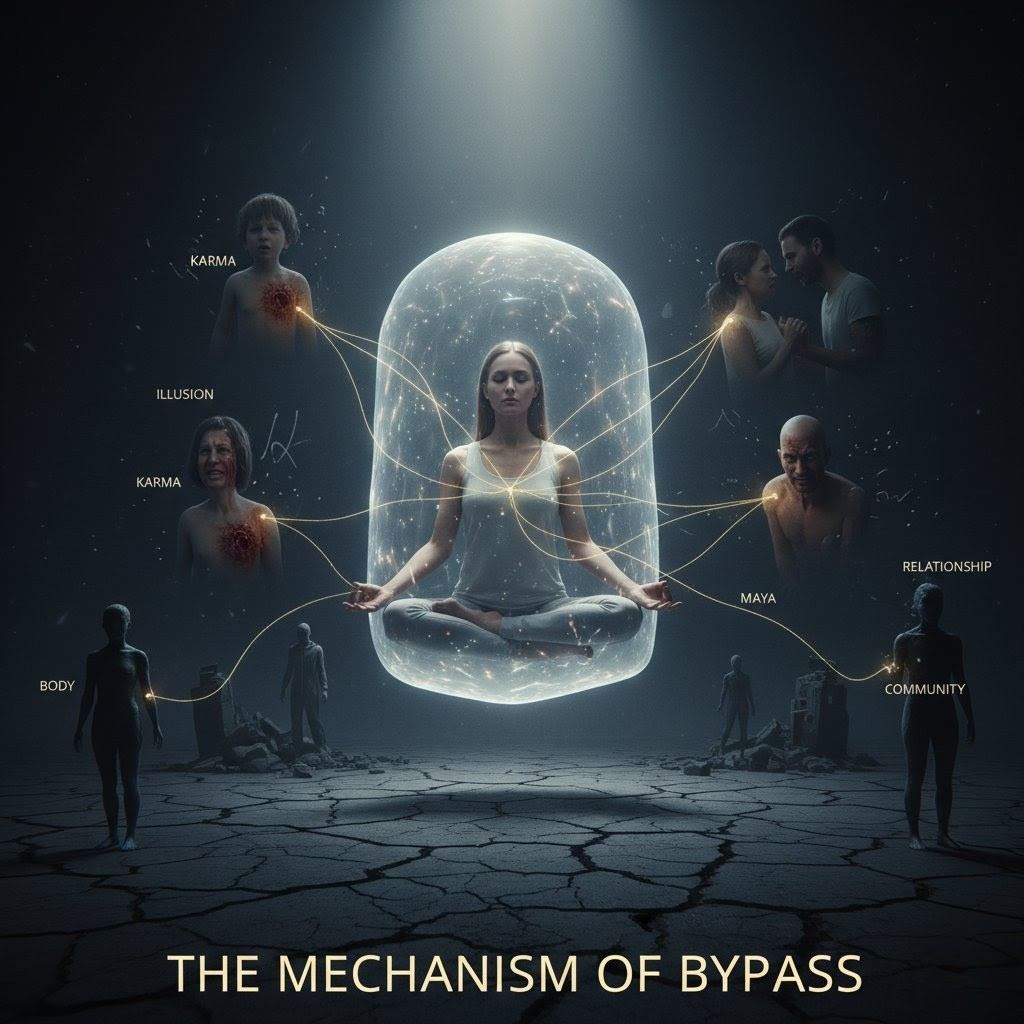
The practitioner encounters difficulty. The childhood wound, activated. The relationship conflict, intensifying. The body symptom, persisting. The spiritual framework offers explanation: this is karma, this is illusion, this is the play of consciousness. The explanation, applied, produces distance. The distance, maintained, produces absence–the presence that is not present, the engagement that is not engaged, the love that is not loving.
Consider the pattern: instead of processing the grief of loss, one files it under “transient phenomena.” Rather than addressing the conflict with one’s partner, one declares attachment the root of suffering and practices “non-reactivity”–which looks remarkably like the silent treatment wearing contemplative robes. The framework provides plausible deniability for emotional absenteeism. The vocabulary is correct. The posture is serene. The affect is flat. The flatness is not peace.
The Invisibility of the Trap
The bypass is invisible to the bypasser. The appearance is spiritual. The vocabulary is correct. The posture is serene. The affect is flat. The flatness is not peace. It is suppression–the refusal of intensity, the denial of urgency, the pretence that the relative does not matter because the absolute has been realised. You cannot argue with someone who has realised the non-dual nature of reality; they have discovered the ultimate loophole in the contract of human engagement.
The Accumulation of Damage
The damage accumulates. The relationship, unsupported by genuine presence, dissolves. The body, unsupported by genuine care, sickens. The community, unsupported by genuine engagement, disperses. The practitioner, isolated, maintains serenity. The serenity is not transformation. It is fortress–the defended position of one who cannot afford to feel. The genuinely controllable person is one who has convinced themselves they are beyond control–and therefore beyond the need to examine their own patterns.

The Thread Requires Embodiment: Feeling as Gateway
The Inclusion of the Relative
The genuine recognition does not bypass. It includes–the relative and the absolute, the form and the emptiness, the personal and the impersonal. The inclusion is not theoretical. It is functional–the continued engagement with life, with relationship, with the necessary work of being human. The Pleroma does not reject the material; it recognises its function while refusing its tyranny. Similarly, the integrated practitioner does not reject emotion; they recognise its function while refusing its tyranny.
The Emotions as Gateways
The grief, felt fully, is not obstacle. It is gateway–the dissolution of self that does not require meditation, the recognition of impermanence that does not require philosophy. The rage, felt fully, is not obstacle. It is energy–the force that establishes boundary, the clarity that recognises violation. The fear, felt fully, is not obstacle. It is information–the signal of danger, the call to attention, the preparation for action. *If you experience overwhelming emotions that threaten functioning or safety, seek support from qualified mental health professionals. Emotional work requires containers; do not attempt to process trauma without adequate support.*

The Completion of Feeling
The feeling, fully felt, transforms. The transformation is not the transcendence of feeling but its completion–the passage through intensity to the stability that includes intensity, the peace that is not absence of disturbance but presence with disturbance. This is the difference between the administrator who has never received complaints (because they have eliminated all feedback channels) and the administrator who can hold the complaints without being destroyed by them.

The Discernment Is Practical: Tests of Genuine Transcendence
The Test of Function
How to distinguish bypass from genuine transcendence? The test is function. The genuine transcendence functions. The relationship, maintained, deepens. The work, performed, succeeds. The community, engaged, thrives. The body, cared for, heals. The bypass, non-functional, produces the appearance of spirituality without its substance. You may speak of non-attachment, but if your non-attachment produces isolation, you have not transcended attachment–you have avoided relationship.
The Test of Affective Range
The test is also affect. The genuine transcendence includes range–the capacity for joy and sorrow, for intensity and calm, for engagement and release. The bypass is flat, monotone, consistently serene. The serenity is not peace. It is exhaustion–the depletion of capacity to respond, the withdrawal from engagement that requires too much. The genuinely transformed practitioner laughs fully, weeps fully, rages fully, rests fully. The bypasser maintains the same half-smile through all seasons.
The Test of History
The test is history. The genuine transcendence integrates–the childhood wound, acknowledged, healed. The bypass repeats–the same pattern, the same conflict, the same departure, each time explained by spiritual framework, each time producing the same result. The repetition is not recognised. The framework prevents recognition. If you find yourself leaving every relationship with the same spiritual justification, you are not choosing freedom–you are enacting compulsion while calling it consciousness.

The Correction Is Return: Descent as Real Progress
The Humility of Re-entry
The bypass, recognised, requires return–the descent from apparent transcendence to embodied engagement, the re-entry into feeling, the resumption of work avoided. The return is humbling. The serenity, lost, reveals itself as suppression. The intensity, felt, overwhelms. The overwhelm, endured, transforms. This is not regression but progress–the integration that was skipped must now be traversed, the basement of the psyche that was declared “illusion” must now be renovated.
The Grounding of Recognition
The return is not abandonment of recognition. It is grounding of recognition–the establishment of transcendence in immanence, the realisation of absolute in relative, the expression of infinity through finitude. The thread, grounded, extends. The bypass, corrected, becomes genuine passage. You do not lose your insight by engaging with your grief; you gain the capacity to grieve without being destroyed, which is the only liberation worth having.

The Thread Continues
You have used transcendence to avoid. The avoidance, recognised, is the next threshold. The thread continues regardless–through the feeling you refused, through the body you abandoned, through the relationships you neglected. The question is not whether you will complete the integration, but whether you will complete it now or later, with awareness or through crisis, by choice or by breakdown. The refused material does not disappear–it compounds interest.

Frequently Asked Questions
How do I know if I am genuinely transcending or just bypassing?
The test is function and affect. Genuine transcendence produces stable relationships, consistent work engagement, and physical health. It also includes emotional range–you can laugh, weep, rage, and rest without losing your centre. Bypass produces isolation, functional decline, and flat affect–the same serene response regardless of circumstance. If your peace prevents you from responding appropriately to injustice or loss, you are bypassing.
Is all emotional suppression spiritual bypassing?
No. Healthy suppression is temporary and strategic–composing oneself to complete a necessary task, then processing later. Bypassing is chronic and ideological–using spiritual concepts to permanently avoid emotional work. The difference lies in intention and timeline: healthy suppression knows it is suppression; bypassing believes it is transcendence.
Can spiritual practices themselves become bypassing mechanisms?
Absolutely. Meditation, mindfulness, and non-attachment can all serve bypass when used to avoid difficult feelings or conflicts. The practice itself is neutral; the intention determines whether it serves integration or avoidance. If your practice makes you less available to life rather than more, examine whether you are using spirituality to escape.
What if I have been bypassing for years? Is it too late to correct?
It is never too late, but the correction becomes more demanding with time. Years of suppression require months or years of re-entry. The body, having been denied voice, now speaks loudly. The emotions, having been stored, now emerge intense. The work is arduous but rewarding–the return produces genuine transformation where bypass produced only appearance.
How do I distinguish between healthy detachment and bypassing?
Healthy detachment responds appropriately then releases; bypassing never responds. Healthy detachment maintains connection without clinging; bypassing avoids connection entirely. Healthy detachment feels spacious; bypassing feels numb. The test is engagement: can you enter fully and exit cleanly, or can you neither enter nor exit, frozen in apparent equanimity?
Does this mean I should not seek transcendence?
Not at all. Seek genuine transcendence–the inclusion of relative and absolute, the capacity to be fully present without clinging. Reject false transcendence–the dissociation that abandons the relative for an absolute that cannot include it. Genuine transcendence makes you more human, not less; more engaged, not absent.
How do I start correcting bypass once I have recognised it?
Begin with body awareness–bypass lives in disembodiment. Practice feeling sensation without interpretation. Engage with a therapist or guide who can provide mirroring. Resume relationships you have avoided. Process the grief you have deferred. The work is ordinary, slow, and unglamorous–exactly what bypass sought to avoid.
Further Reading
Continue exploring integration, embodiment, and the work that bypass seeks to avoid:
- Integration Practices: What to Do After the Peak Experience — Genuine integration versus bypass strategies.
- The Dark Night: Depression or Transformation? — Feeling what bypass refuses to acknowledge.
- Embodiment Practices for Grounding: Returning to the Body After Awakening — The somatic correction to dissociative transcendence.
- The Transformation: What Actually Changes After Mystical Experience — Why transformation requires embodiment, not escape.
- The Living Thread: How Forbidden Knowing Survives the Fire — The thread requires full engagement, not escape.
- Shadow Work: Excavating the Repressed — Processing what bypass pushes underground.
- Spiritual Emergency: When Transformation Becomes Crisis — When bypass breaks down and crisis emerges.
- The Stages of Integration: Immediate, Short-Term, and Long-Term — The proper sequence that bypass attempts to skip.
- The Body Against the Algorithm: Reclaiming Embodiment in Digital Captivity — Reclaiming the body from dissociative environments.
- The Discipline of Solitude: Extended Alone Time — The solitude that deepens embodiment rather than enabling avoidance.
References and Sources
Sources are grouped by category for clarity. No in-text citation numbers are used, per The Thread editorial protocol.
Foundational Texts on Spiritual Bypassing
- Welwood, J. (1984). Awakening the Heart: East/West Approaches to Psychotherapy and the Healing Relationship. Shambhala. (Introduced the term “spiritual bypassing” and established the framework for understanding the phenomenon.)
- Welwood, J. (2000). Toward a Psychology of Awakening: Buddhism, Psychotherapy, and the Path of Personal and Spiritual Transformation. Shambhala.
Clinical and Trauma-Informed Perspectives
- van der Kolk, B. (2014). The Body Keeps the Score: Brain, Mind, and Body in the Healing of Trauma. Viking. (On somatic approaches to trauma and the necessity of embodied processing.)
- Levine, P. A. (1997). Waking the Tiger: Healing Trauma. North Atlantic Books. (On the completion of physiological responses and the dangers of dissociative coping.)
Contemplative and Phenomenological Studies
- Merleau-Ponty, M. (1945). Phenomenology of Perception. Gallimard. (On the body as the primary site of knowing and the impossibility of genuine transcendence without embodiment.)
- Epstein, M. (2013). The Trauma of Everyday Life. Penguin. (On the integration of Buddhist psychology with trauma-informed clinical practice.)
Safety Notice: This article explores the psychological dynamics of emotional avoidance and suggests contemplative and therapeutic approaches for integration. It does not constitute medical, psychological, or spiritual advice. If you experience overwhelming emotions, dissociation, or symptoms that impair daily functioning, please consult a trauma-informed therapist or clinical professional. Emotional work requires adequate containers and support; do not attempt to process trauma without professional guidance. The practices described here complement but do not replace clinical mental health treatment.