The Gateway of Sensation: Body Scan and Somatic Awareness
The body is always present. The attention, usually elsewhere–planning, remembering, imagining–can be returned to sensation. The return, deliberate, produces presence. The presence, sustained, produces integration. The integration, completed, extends the thread. The gateway of sensation is the second of five, accessible to all, requiring no belief, only attention.
Somatic awareness is not relaxation. It is attentiveness–the directed focus on physical sensation without attempt to change it. The sensation, observed, reveals pattern. The pattern, recognised, releases. The release produces transformation not through effort but through recognition.
Table of Contents
- The Body Scan Is Systematic
- The Neuroscience of Interoception
- Somatic Awareness Extends Beyond Scan
- The Obstacles Are Specific
- Somatic Awareness and the Nervous System
- The Thread Extended
- Frequently Asked Questions
- Safety Notice
- Further Reading
- References and Sources

The Body Scan Is Systematic
Origins and Lineage
The technique, popularised by Jon Kabat-Zinn’s Mindfulness-Based Stress Reduction, derives from Buddhist vipassana and yogic nyasa. The practitioner, lying or sitting, directs attention sequentially through body–feet, legs, pelvis, abdomen, chest, back, shoulders, arms, hands, neck, face, head. Each region, attended, reveals sensation: pressure, temperature, vibration, pain, ease, tension, release.
The body scan did not originate in a laboratory. Its roots reach into the satipatthana sutta, where the Buddha instructs practitioners to contemplate the body internally, externally, and both, recognising impermanence in every aggregate. The yogic tradition of nyasa–literally, “to place”–directs awareness and mantra into specific body regions, transforming the physical form into a sacred geography. Kabat-Zinn’s innovation was not the technique but the secular frame: removing doctrinal requirements so that the method could travel into hospitals, schools, and corporate boardrooms without religious baggage. The thread, once more, changed clothing to survive.
The Method: Sequential Attention
The attention is curious, not judging. The sensation, however unpleasant, is observed without reaction. The observation, sustained, produces change–not through manipulation but through awareness itself. The body, attended, relaxes. The mind, focused on sensation, stills. The stillness, prolonged, produces altered state.
The sequence matters. Beginning at the feet establishes grounding–the practitioner descends before ascending, rooting attention in the extremities that contact earth. Moving upward through legs and pelvis encounters the body’s emotional basin, where stress commonly pools. The abdomen and chest reveal the respiratory rhythm that the first gateway has already calmed. The shoulders and neck carry the armour of occupational stress. The face, often overlooked, holds micro-tensions that reflect the mind’s continuous commentary. By the time attention reaches the crown, the practitioner has traversed a complete cartography of embodied experience.

The Neuroscience of Interoception
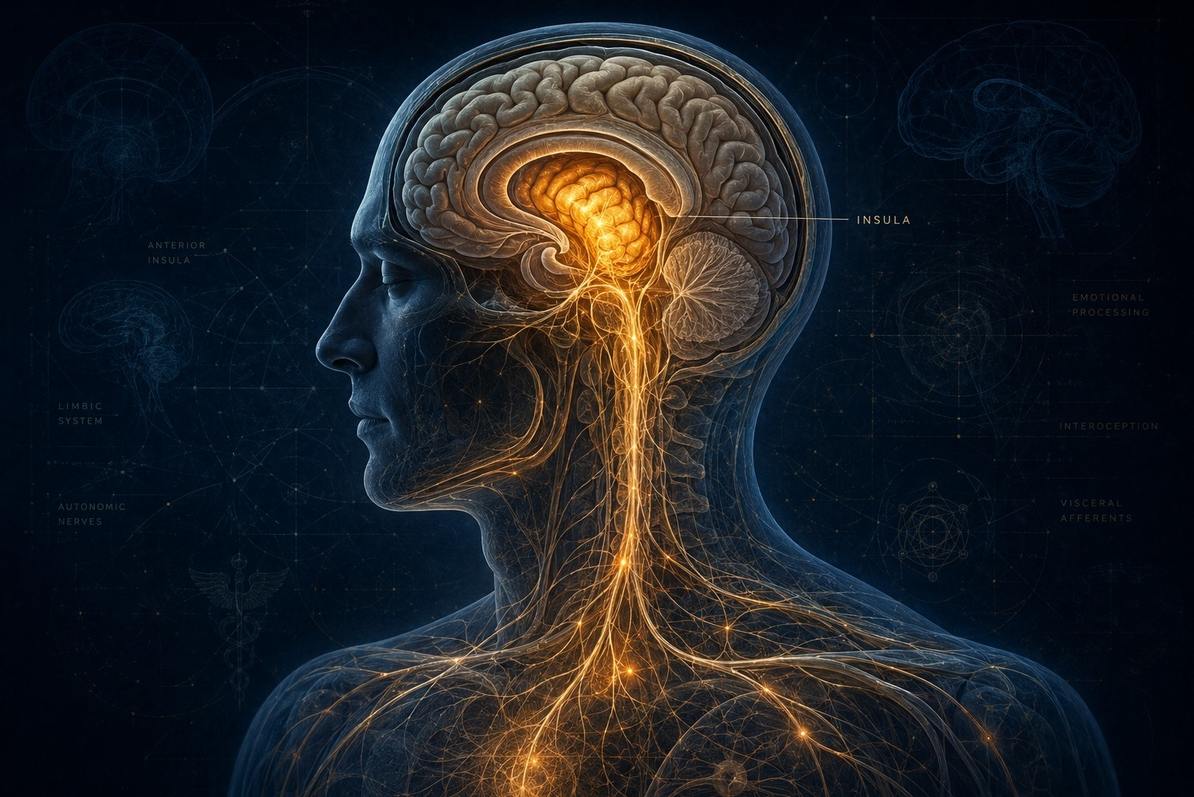
What the contemplative traditions discovered through practice, neuroscience has mapped through imaging. Interoception–the sense of the internal body–is not a metaphor. It is a measurable faculty with specific neural correlates. The posterior insula cortex processes visceral sensation, mapping the body’s internal state into conscious awareness. Research suggests that individuals with greater interoceptive accuracy show enhanced emotional regulation and more precise discrimination between internal signals and external noise.
The body scan, practised regularly, appears to strengthen interoceptive pathways. Attention, directed repeatedly to specific regions, increases neural representation of those regions in the somatosensory cortex–a process analogous to the cortical remapping observed in musicians and athletes. The body literally becomes more known to the brain. What was vague becomes distinct. What was unconscious becomes available. The gateway of sensation is not merely psychological; it is neuroplastic.
Somatic Awareness Extends Beyond Scan
Continuous Embodied Presence
The body scan is formal practice. Somatic awareness is continuous–the maintenance of attention to physical sensation throughout daily activity. Walking, the feet contact ground. Eating, taste and texture register. Working, posture and tension are noted. The awareness, continuous, produces embodied presence–the person here, now, in flesh, not dissociated into thought or fantasy.
This continuity interrupts what might be called the default mode of dissociation–the habitual withdrawal of attention from body into digital environment, narrative memory, or speculative future that characterises contemporary consciousness. The body remains; the attention absconds. Somatic awareness is the persistent recall of attention to its proper station. It is not a technique applied in sessions. It is a stance maintained across the day.

The Habit of Return: Cues and Transitions
The extension requires reminders–bells, apps, environmental cues, the decision to check in with body at transitions. The reminders, established, become habit. The habit, ingrained, produces continuous somatic awareness without deliberate effort. The practitioner uses doorways, elevators, the beginning and end of tasks, the pause before checking devices, as triggers for a three-second body check. The cumulative effect is profound. A hundred brief returns per day outweigh a single hour of formal practice in terms of integration–the transfer of meditative capacity into lived experience.
The transition is the ideal cue because it already exists in the architecture of the day. The body, habitually ignored during task execution, can be noticed at the moment of task completion. The standing up from the chair. The closing of the laptop. The setting down of the cup. Each transition becomes a mini-gateway, a micro-practice that keeps the thread alive between formal sessions.

The Obstacles Are Specific
Blankness and Dissociation
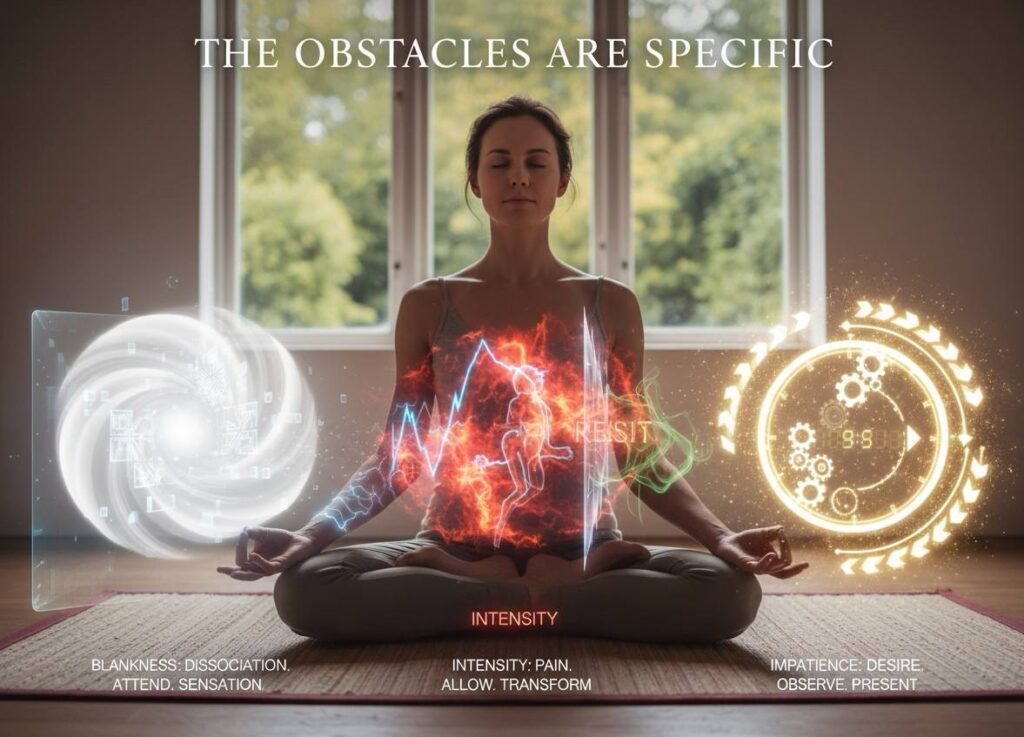
The practitioner encounters blankness–regions of body without sensation, numb, absent. The blankness is not failure but information–the dissociation that is normative in contemporary life, the withdrawal of attention from body into digital or mental environment. The blankness, attended patiently, gradually yields to sensation. The yield is not forced; it is invited. The attention, resting in the absent region, waits like light on soil, and gradually something germinates.
Intensity and Traumatic Charge
The practitioner encounters intensity–pain, discomfort, emotional charge held in tissue. The intensity, resisted, amplifies. The intensity, allowed, transforms. The transformation is not elimination of sensation but change in relationship–from enemy to be defeated to phenomenon to be known. Somatic practitioners observe that the body stores what the mind cannot process; the scan becomes a gentle archaeology, uncovering what was buried not to disturb but to integrate.
Impatience and the Goal-Oriented Mind
The practitioner encounters impatience–the desire to finish, to achieve, to get somewhere else. The impatience, observed, reveals the goal-oriented mind that somatic awareness dissolves. The dissolution, allowed, produces the present-moment awareness that is the gateway’s fruit. The body scan has no destination. The feet are not a starting line; the crown is not a finish. Each region is the whole territory, and the attention that rushes toward completion misses the point entirely.
Somatic Awareness and the Nervous System
Bottom-Up Regulation
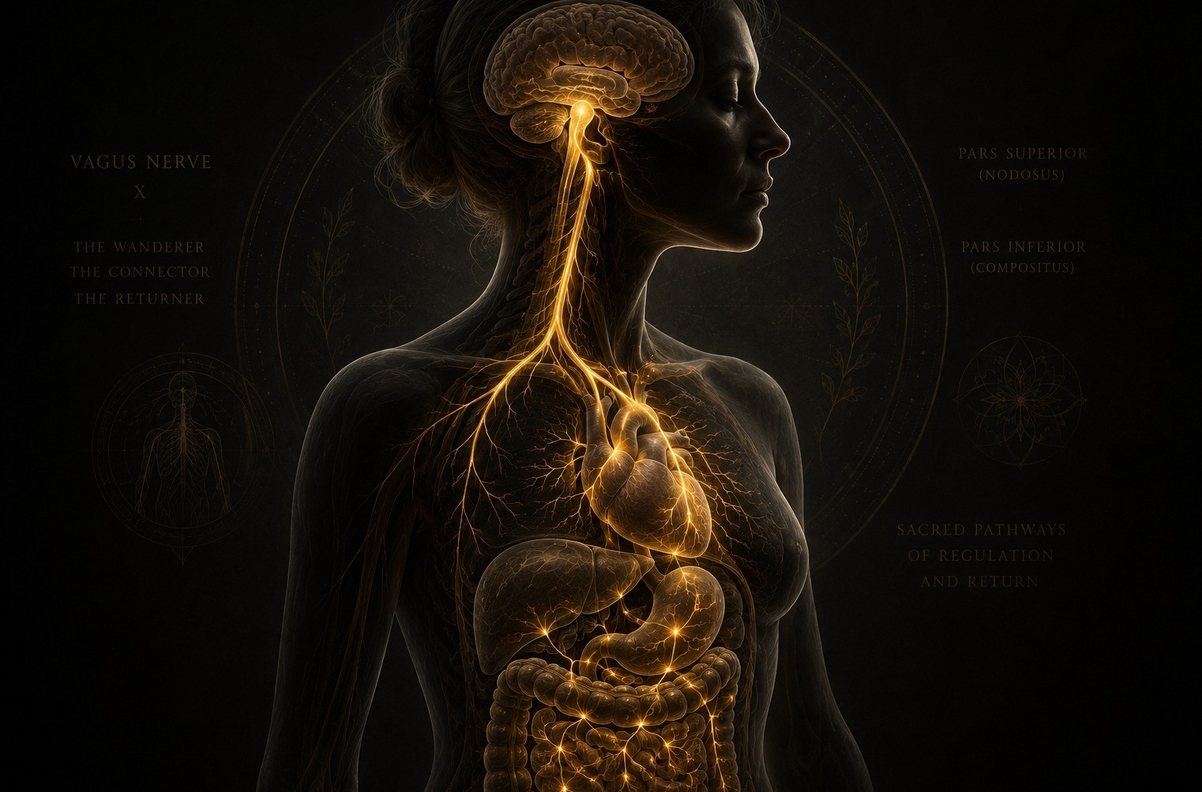
Somatic awareness operates through bottom-up regulation–the direction of influence from body to brain rather than from cognition to body. Rather than telling yourself to calm down, you attend to sensation, and the attending itself shifts autonomic tone. The vagus nerve, the primary parasympathetic pathway, responds to slow, diaphragmatic breathing and to the safety signals generated by grounded body awareness. The body scan, by directing attention to feet and legs before the more emotionally reactive torso and head, may leverage this neurophysiology, establishing somatic safety before encountering intensity.
This is why the gateway of sensation follows the gateway of breath. The breath, calmed, primes the vagus. The sensation, attended, confirms the safety. Together they produce the neuroceptive state–the brain’s reading of the body’s safety–that makes deeper work possible. Without this foundation, attention to sensation can trigger defensive arousal rather than integration. The sequence is not arbitrary. It is neurobiological.
The Thread Extended
From Sensation to Integration
The sensation, attended, grounds. The grounding, sustained, enables what dissociation prevents–direct knowing, integration, transformation. The gateway of sensation is second because it requires first gateway’s preparation–the breath, calmed, enables attention to sensation without overwhelm. The breath establishes the container; the sensation fills it. Without the container, the intensity of somatic experience can flood rather than nourish.
The Gateway Sequence
The five gateways form a progressive architecture. Breath calms the system. Sensation anchors attention in the body. Sound opens the auditory field. Vision stabilises the mental image. Movement integrates the whole into action. Each gateway prepares the next. The practitioner who rushes to movement without establishing somatic presence moves from dissociation into activity, reinforcing rather than interrupting the pattern of absence. The practitioner who establishes sensation first carries embodied presence into every subsequent practice. The thread, grounded in flesh, cannot be severed by thought.
You feel. The attention, directed, opens the gate. The thread continues through sensation toward what sensation reveals.

Frequently Asked Questions
What is the difference between body scan and somatic awareness?
The body scan is formal practice–a systematic technique where attention moves sequentially through body regions (feet to head) in a dedicated session. Somatic awareness is continuous–maintaining attention to physical sensation throughout daily activity (walking, eating, working). The body scan builds capacity; somatic awareness applies that capacity to life. Both produce embodied presence, but the scan is the training ground while continuous awareness is the integration.
How long should a body scan practice last?
Begin with 10-15 minutes for a complete scan from feet to head. As capacity develops, extend to 30-45 minutes for more detailed exploration of each region. The quality of attention matters more than duration–a 10-minute scan with genuine curiosity surpasses an hour of mechanical checking. Jon Kabat-Zinn’s MBSR protocol uses 45-minute scans, but accessibility is key; even 5 minutes of systematic attention produces benefit.
Why do I feel numb or blank in certain body areas?
Blankness indicates dissociation–the withdrawal of attention from body into mental or digital environment that is normative in contemporary life. These dead zones are not failures but information about where consciousness has abandoned the flesh. The response is patient, non-judgmental attention–not forcing sensation, but remaining present to the absence. Gradually, with sustained attention, blood flow and neural activation return, and sensation emerges.
Can somatic awareness help with anxiety and trauma?
Yes, with caution. Somatic awareness grounds dissociated consciousness in the body, which stabilises anxiety. However, trauma is held in tissue; attending to sensation can release emotional charge unexpectedly. For trauma histories, proceed slowly, avoid intense body scans initially, and consider working with a somatic therapist. The intensity, when it arises, must be allowed rather than resisted–but you must have resources to contain what emerges.
How do I maintain somatic awareness during busy workdays?
Use transitions as cues–doorways, elevators, beginning or end of tasks, the pause before checking devices. Set reminders (bells, apps, environmental triggers) until habit forms. Start with one activity (drinking tea, walking to transport) and expand gradually. The goal is not continuous perfect attention but frequent return to sensation. Even momentary embodiment interrupts the dissociation that is default mode in digital culture.
What is interoception and why does it matter for spiritual practice?
Interoception is the sense of the internal body–the brain’s capacity to read signals from viscera, muscles, and skin. Neuroscience links interoceptive accuracy to emotional regulation and self-awareness. For spiritual practice, interoception matters because it transforms vague feeling into precise knowing. The body scan strengthens interoceptive pathways, making the practitioner more accurate in discerning genuine interior guidance from anxiety or projection.
How does the gateway of breath prepare for the gateway of sensation?
The breath gateway calms the autonomic nervous system and primes the vagus nerve before attention turns to sensation. Without this preparation, body scanning can trigger defensive arousal rather than integration. The breath establishes a container of safety; the sensation fills it. This sequence–calm first, explore second–follows neurobiological logic and prevents the practitioner from being overwhelmed by intensity before capacity is established.
Safety Notice
Safety Notice: This article explores somatic awareness practices that can release stored emotional tension and traumatic charge. It does not constitute medical, psychological, or spiritual advice. If you have a history of trauma or experience overwhelming sensations during practice, please consult a trauma-informed somatic therapist or clinical professional. Somatic awareness complements but does not replace clinical mental health treatment. Proceed slowly, avoid forcing sensation in numb or intensely painful regions, and prioritise stability over depth.
Further Reading
- The Thread That Binds: Five Gateways to Direct Knowing in an Age of Noise — The five gateways and how sensation fits the progressive sequence.
- The Gateway of Breath: Pranayama Techniques — The first gateway that calms the nervous system before sensation is explored.
- The Gateway of Movement: Walking Meditation and Circulation — The fifth gateway that integrates somatic presence into action.
- Nervous System Regulation: The New Meditation — Polyvagal theory and bottom-up approaches to embodied spirituality.
- Neuroception and the Felt Sense: Spiritual Discernment — How the body reads safety and threat before the mind decides.
- The Body Against the Algorithm: Reclaiming Embodiment — The political and spiritual necessity of somatic awareness in digital culture.
- Contemplative Techniques: Methods for Stabilising Gnosis — Integrating somatic awareness into a complete contemplative framework.
- Integration and Grounding: Embodying the Received Tradition — Somatic approaches to stabilising expanded awareness after peak experiences.
- States of Knowing: What Happens When Consciousness No Longer Belongs to You — The altered states that somatic practice can produce when attention is sustained.
- Creating Personal Practice: Combining the Gateways — How to sequence breath, sensation, sound, vision, and movement into a daily architecture.
References and Sources
The following sources inform the practical and neuroscientific framework of this article.
Primary Sources and Practice Manuals
- Kabat-Zinn, Jon. (1990). Full Catastrophe Living. Delta. — The foundational MBSR manual including the 45-minute body scan protocol.
- Satipatthana Sutta (Digha Nikaya 22) — Classical Buddhist discourse on the four foundations of mindfulness, including contemplation of the body.
- Muktibodhananda, Swami. (1985). Hatha Yoga Pradipika. Bihar School of Yoga. — Traditional source for nyasa and the placement of awareness in body regions.
Scholarly Monographs
- Craig, A.D. (Bud). (2002). “How do you feel? Interoception: the sense of the physiological condition of the body.” Nature Reviews Neuroscience, 3(8), 655-666. — Seminal paper mapping interoception to the posterior insula cortex.
- Critchley, Hugo D., et al. (2004). “Neural systems supporting interoceptive awareness.” Nature Neuroscience, 7(2), 189-195. — fMRI study linking interoceptive accuracy to anterior insula and anterior cingulate activity.
- Levine, Peter A. (2010). In an Unspoken Voice: How the Body Releases Trauma and Restores Goodness. North Atlantic Books. — Clinical framework for understanding somatic release and the body’s role in trauma processing.
- van der Kolk, Bessel. (2014). The Body Keeps the Score. Viking. — Comprehensive study of trauma’s somatic imprint and the therapeutic role of body-based awareness.
Comparative and Practice Studies
- Porges, Stephen W. (2011). The Polyvagal Theory: Neurophysiological Foundations of Emotions, Attachment, Communication, and Self-Regulation. W. W. Norton. — The neurobiological basis for bottom-up regulation through vagal tone and embodied safety.