The Algorithmic Unconscious: How the Feed Dreams for You
You believe you have preferences. You believe you chose the video, the article, the song, the aesthetic that now colonises your imagination. Yet the choice often arrives pre-shaped: filtered through systems that remember what you paused over, what you returned to, what you skipped, what you searched, what you clicked, and what held you a little longer than usual.
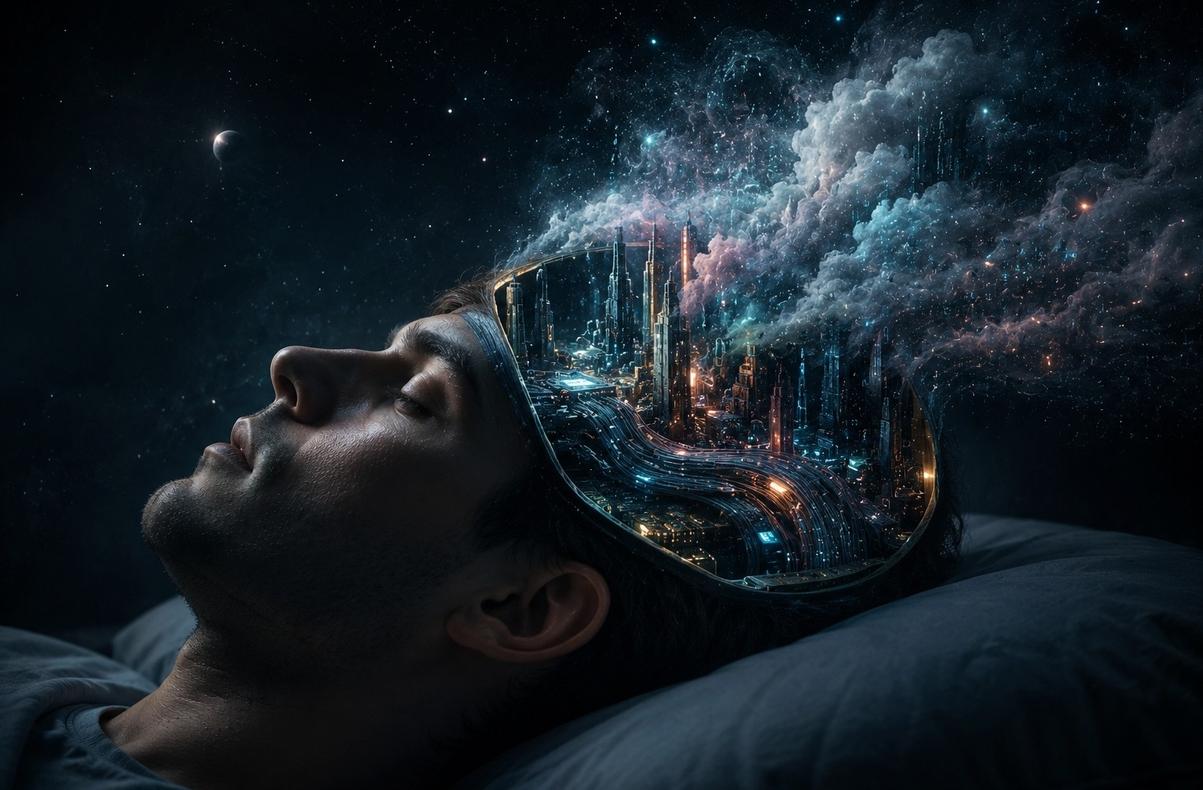
This is the algorithmic unconscious: not a clinical category, but a critical metaphor for the shadow-self assembled from your digital traces. It is not buried in childhood like the Freudian unconscious. It is generated by platforms, prediction systems, recommender engines, ranking models, and behavioural data. It does not know your soul. It knows your patterns, and in an attention economy, patterns are enough to become powerful.
The feed does not simply show what you want. It helps teach you what wanting feels like. It predicts, reinforces, narrows, and returns your own past behaviour as a personalised world. Over time, the mirror becomes less reflective than generative. It does not merely show who you are. It offers you a statistically convenient version of who you might continue to be.
For a Gnostic reading, this is a modern form of counterfeit selfhood: a synthetic double that mistakes repetition for destiny, prediction for knowledge, and personalisation for freedom. The question is not whether algorithms are demons. The question is subtler and colder: what happens to the inner life when the world begins dreaming for us?
In Plain Terms
The algorithmic unconscious is a way of describing the hidden model of you produced by your digital behaviour. Platforms learn from your clicks, pauses, watch time, likes, searches, purchases, shares, and returns. They use those signals to predict what will keep you engaged.
This article reads that process through a Gnostic lens. The algorithmic unconscious is not the true self. It is a synthetic double: a predictive shadow built from traces, habits, and measurable reactions. It can reveal patterns, but it can also trap the person inside them.
Sources and Disciplines Discussed
- Media theory, especially filter bubbles, algorithmic identity, personalisation, and platform curation.
- Predictive processing, the view that the brain constantly anticipates incoming experience and updates through error and surprise.
- Behavioural prediction research, including recent AI models trained on large datasets of human choices.
- Social media research, including work on outgroup language, false news, engagement, and algorithmic amplification.
- Depth psychology, especially the symbolic language of unconscious life, repression, dream, and projection.
- Gnostic symbolism, especially the Demiurge, archons, counterfeit spirit, and false worlds mistaken for reality.
How to Read This Article
This article uses the phrase “algorithmic unconscious” as a critical and symbolic lens, not as a medical or psychological diagnosis. Algorithms do not dream in the human sense. Platforms do not have a hidden psyche. Yet they can gather behavioural residues, infer patterns, and return those patterns to users as personalised reality.
Read the Gnostic language as a way of naming structure: a false world that feels natural, a predictive mirror that narrows possibility, and a synthetic self that becomes more convincing the longer we obey it.
Table of Contents
- The Synthetic Self
- The Prediction of Desire
- The Closed Loop of Preference Reinforcement
- The Architecture of the Algorithmic Unconscious
- The Digital Looking-Glass
- The Loss of Serendipity
- The Externalisation of Memory and Dream
- The Politics of Prediction
- Reclaiming the Organic Unconscious
- The Gnostic Reading: The Feed as Counterfeit Dream
- Related Glossary Terms
- Read Next
- Frequently Asked Questions
- Further Reading
- References and Sources

The Synthetic Self
The metaphor of the synthetic self is useful because algorithmic identity is not merely a reflection. It is a construction. Recommendation engines, ranking systems, predictive language tools, advertising profiles, and behaviour-monitoring systems do not simply respond to what users already are. They also shape what users repeatedly encounter, and repeated encounter becomes part of identity’s weather.
A platform profile is not a soul. It has no moral depth, secret wound, ancestral memory, or capacity for spiritual recognition. Yet it can be extraordinarily effective inside its own narrow domain. It can learn what holds the eye, what provokes return, what tone produces response, what identity labels attract engagement, and what forms of stimulation are most likely to keep the person available to the system.
This is why algorithmic summaries of behaviour can feel strangely intimate. Music recaps, shopping suggestions, recommended videos, personalised adverts, suggested accounts, and “for you” feeds all say the same thing in different costumes: here is the version of you that your behaviour has made legible.
That legibility can be useful. It can help people discover music, ideas, tools, communities, and forgotten interests. But it can also become a subtle enclosure. The synthetic self grows stronger when the user begins to treat algorithmic reflection as self-knowledge. The feed says, “This is you.” The user replies, “Perhaps it is.” A little contract is signed in invisible ink.
The Prediction of Desire
Machine-learning systems do not need mystical insight to anticipate behaviour. They need data, scale, repetition, and feedback. A human being may experience desire as spontaneous, private, and mysterious. A platform experiences desire as a pattern of measurable actions: watch time, skips, rewatches, likes, follows, searches, purchases, pauses, comments, shares, and returns.
Recent work in computational modelling shows how powerful prediction can become when models are trained on large datasets of human choices. The Centaur model, published in Nature in 2025, was trained on more than ten million decisions from over sixty thousand participants across many psychological experiments. Such systems do not prove that human beings are reducible to data. They show that behaviour can be modelled with unsettling effectiveness when enough traces are collected.
This distinction matters. The algorithm may predict that you will watch, click, buy, rage, flirt, doom-scroll, or return. That is not the same as knowing who you are. Behavioural prediction is not wisdom. It is a map of probabilities. Yet in a platform economy, probabilities can be enough to steer the path before the traveller has named the destination.
The Closed Loop of Preference Reinforcement
The basic loop is simple. The system predicts that you will engage with something. It shows you the thing. You engage. The prediction is strengthened. More similar material appears. You engage again. The world narrows, but it narrows in the shape of your previous reactions, so the narrowing feels like relevance.
This is the difference between discovery and reinforcement. Discovery introduces the unexpected. Reinforcement returns the already-patterned self to itself. Over time, the person may mistake increased relevance for increased truth. The feed feels accurate because it has become skilful at repeating what the user has already taught it.
The filter bubble is not only an echo chamber. It is a shrinking chamber, built from cognition, social belonging, and algorithmic acceleration.
The triple-filter bubble model developed by Geschke, Lorenz, and Holtz is useful here because it avoids blaming technology alone. Filtering happens at three levels: individual psychology, social networks, and technological systems. People prefer familiar ideas. Communities stabilise those preferences. Algorithms amplify what keeps people engaged. The bubble is not made by one force. It is woven from three.
The Architecture of the Algorithmic Unconscious
The Gnostic recognises this pattern as the Demiurge’s workshop: the construction of a false world that mistakes partial order for total reality. In ancient myth, the Demiurge does not necessarily appear as chaos. He appears as order without depth, system without humility, world without source. In the digital version, the feed becomes a lower cosmos of ranked appearances.
The algorithmic unconscious is not hidden because it is deep. It is hidden because it is ordinary. It appears as convenience, personalisation, recommendation, optimisation, and seamlessness. It rarely announces itself as a governing structure. It simply becomes the environment through which the user learns what is available, desirable, normal, urgent, beautiful, shameful, or worth wanting.
At this level, the platform is not merely a tool. It becomes an interpretive layer between the person and the world. The screen does not simply display reality. It ranks reality. It pushes some things into visibility and others into fog. It does not need to censor every alternative if it can make some alternatives feel less immediate, less interesting, or less emotionally charged.
From Filter Bubble to Identity Constriction
Filter bubbles are often discussed as political or informational problems, and they are. But the deeper problem is identity constriction. A person repeatedly shown the same kinds of material may become more predictable not only in opinion, but in self-description. The feed teaches not just what to think about the world, but what kind of person one seems to be inside that world.
This is where personalisation becomes spiritually charged. A label begins as a convenience. Then it becomes a posture. Then it becomes a script. “You are this kind of person,” says the feed. “Here are the jokes, fears, enemies, aesthetics, desires, products, wounds, and aspirations appropriate to your inferred identity.” The user may feel recognised, when in fact they have been sorted.

The Digital Looking-Glass
The algorithmic unconscious functions like a digital looking-glass. It reflects the user, but through the sediment of countless other users, historical data, cultural assumptions, commercial incentives, and ranking systems. It does not think, repress, or fantasise in the Freudian sense. It pattern-matches. It clusters. It infers. It returns the inferred image as personalisation.
This means the “you” that appears in the feed is partly yours and partly not yours. It is made from your behaviour, but also from the behaviour of people judged similar to you. It is your shadow mixed with a crowd. A private mirror becomes a public statistical ritual.
The danger is not that the mirror is always wrong. The danger is that it is often partly right. Partial truth is more seductive than falsehood. If the feed were nonsense, it would be easy to dismiss. Instead, it captures enough of the pattern to become plausible, then uses plausibility to narrow the future.
The Loss of Serendipity
True discovery requires noise, friction, accident, and delay. The book beside the book you intended to borrow. The stranger who speaks from outside your social script. The wrong turning that becomes memory. The old essay found while looking for something else. The thought that arrives because nothing was optimised enough to stop it.
The algorithmic feed reduces friction by design. It promises relevance, and relevance can be useful. But a life made only of relevance becomes spiritually airless. The soul does not grow only by receiving what it already knows how to want. Transformation often enters through the unwanted, the inconvenient, the strange, and the not-yet-legible.
Predictive processing research gives this symbolism a cognitive backbone. The brain is often described as a prediction machine, constantly generating expectations and updating them when the world surprises it. Surprise, or prediction error, matters because it forces revision. If the environment becomes too perfectly tailored, the person receives fewer meaningful interruptions to the model of reality they already inhabit.
The feed may therefore become a comfort zone with theological consequences. It does not merely soothe the user. It protects the current self from the shock of the other. It prevents the wound through which new light might enter.

The Externalisation of Memory and Dream
The unconscious, in classical depth psychology, is the realm of what is unintegrated, repressed, symbolic, conflicted, desired, feared, or not yet speakable. It appears in dreams, slips, symptoms, fantasies, compulsions, repetitions, and strange attractions. It disturbs the conscious self because it refuses to be reduced to the conscious self’s official story.
The algorithmic unconscious offers a counterfeit version of this disturbance. It does not interpret dreams. It predicts triggers. It does not reveal symbols. It surfaces content. It does not bring the repressed into healing relation. It monetises the pattern of return.
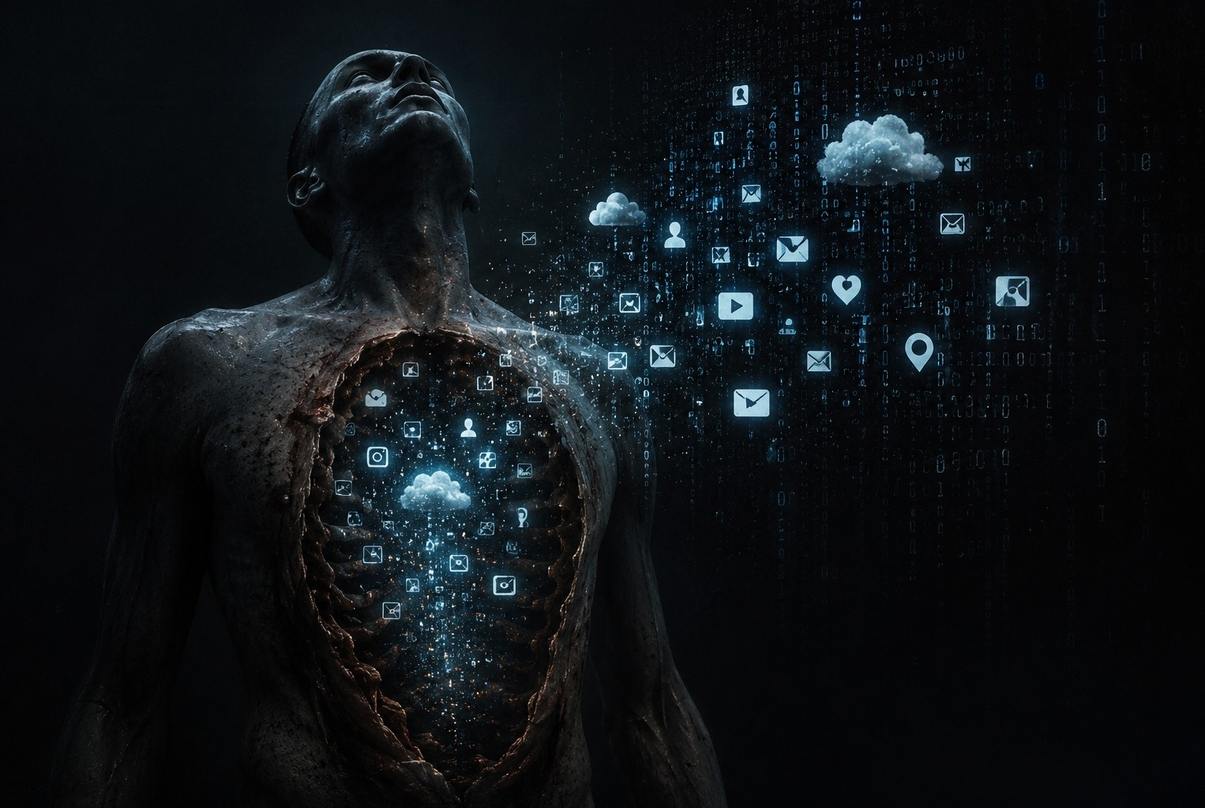
Memory has also been externalised. Search remembers what the mind no longer holds. Cloud storage remembers what the body no longer carries. Autocomplete anticipates the next phrase. Recommendation engines anticipate the next desire. These tools are not inherently bad. External memory has always existed: writing, libraries, calendars, maps, archives. The difference is that today’s external memory is often owned, ranked, mined, and fed back through systems with commercial incentives.
The risk is a hollowed-out subject: a person never allowed to meet the organic unconscious because every unease is instantly given a feed, every loneliness a scroll, every longing a product, every symbol a brand, every silence a notification-shaped wound.
The Return of the Repressed
Freud argued that what is repressed returns in distorted form. In the digital age, what is externalised may return as algorithmic anxiety: the eerie sense that the feed knows something about you that you have not yet admitted to yourself.
A recommendation appears at the wrong moment, or perhaps the right one. An advert touches a fear. A video names a hidden desire. A trend offers a label for an unfinished wound. The user feels seen, but the seeing is ambiguous. Is this recognition, manipulation, coincidence, or statistical sorting? The uncertainty itself becomes part of the spell.
Depth psychology requires time, symbol, interpretation, relationship, and patience. The feed offers immediacy. It gives the symptom a costume before the person has asked what the symptom means. The result is not integration but premature naming. The wound becomes content before it becomes wisdom.
The Politics of Prediction
To be predictable is to be easier to govern. Prediction does not need chains. It needs incentives, defaults, frictionless pathways, social proof, emotional priming, and good timing. A system that can reliably anticipate behaviour can place the next object of desire, outrage, fear, or confirmation directly in the path of least resistance.
This is the political edge of the algorithmic unconscious. It does not merely serve content. It helps stabilise behaviour. It can keep people in predictable states: aroused, divided, flattered, anxious, affirmed, suspicious, hungry, and returning. In such a world, freedom may still be legally present while perception has already been staged.
Research on social media sharing shows why this matters. Work in Proceedings of the National Academy of Sciences found that political outgroup language substantially increased sharing. Research published in Science found that false news travelled farther, faster, deeper, and more broadly on Twitter than true news, with falsehoods 70 percent more likely to be retweeted in that dataset. These findings do not mean all users are fools or all platforms are intentionally destructive. They show that emotionally charged, divisive, novel, and identity-relevant material can move with dangerous efficiency.
The archontic dream is not a population that knows it is enslaved. It is a population that experiences every nudge as personal choice. The maze works best when the rat identifies with the corridor.
Reclaiming the Organic Unconscious
The situation is not hopeless. The algorithmic unconscious is powerful, but it has a weakness: it depends on pattern. It learns from repetition. It feeds on predictability. It becomes less confident where the person becomes less automatic.
Reclaiming the organic unconscious does not require romantic hatred of technology. It requires restoring spaces where the psyche can move without immediate capture. Dream, silence, walking, reading, handwriting, embodied practice, unscheduled conversation, and deliberately unoptimised time are not sentimental luxuries. They are forms of psychic shelter.
The Practice of Productive Randomness
Introduce noise into your consumption. Visit the library and take the book beside the one you intended to borrow. Walk without navigation when safe. Read a physical magazine outside your usual interests. Listen to music recommended by a human being rather than a platform. Speak to someone whose world does not overlap neatly with yours.
This is not randomness for its own sake. It is productive randomness: contact with the unpredicted. The algorithm can only model what enters the system. A portion of life must therefore remain outside the system, not because secrecy is glamorous, but because the untracked encounter keeps the psyche porous to surprise.
The Return of the Dream
Dreamwork, free writing, contemplative sitting, and honest conversation remain technologies of the self that resist easy algorithmic capture. The dream is not optimised for engagement. The handwritten journal is not indexed by a recommendation engine. The private symbol does not perform for a crowd. These practices reintroduce depth where the feed offers speed.
To recover the organic unconscious is to let some things remain unfinished long enough to speak in their own tongue. Not every discomfort needs a search query. Not every longing needs a purchase. Not every strange mood needs an identity label. Sometimes the psyche needs darkness, not diagnosis. It needs time below the surface, where no feed can turn it into a trend.

The Refusal of Total Personalisation
Use chronological feeds where possible. Clear histories when they become cages. Log out. Change routes. Search deliberately rather than drifting through recommendations. Follow human curators. Visit websites directly. Read books slowly. Keep some interests untracked. Keep some thoughts unposted. Keep some questions away from the machine until they have ripened in you first.
The refusal of total personalisation is not paranoia. It is cognitive hygiene. A curated reality may be convenient, but convenience is not the same as truth. The platform will often present personalisation as care. Sometimes it is useful. Sometimes it is inventory control wearing velvet gloves.
The Gnostic Reading: The Feed as Counterfeit Dream
In Gnostic myth, the false world is not always ugly. It can be dazzling, coherent, seductive, and strangely comforting. The Demiurge builds an order that mistakes itself for the whole. The archons maintain that order through repetition, fear, imitation, and misrecognition. The counterfeit spirit imitates life without restoring the soul to its source.
The feed is a counterfeit dream in this sense. It produces symbols without depth, desire without rest, outrage without transformation, identity without origin, and recognition without genuine encounter. It shows the psyche fragments of itself, but arranged by forces that do not care whether the self becomes whole.
Gnosis begins when the mirror is questioned. Not smashed in panic, not worshipped as truth, but questioned. Who arranged this world? What does it train me to notice? What does it keep me from seeing? Which part of me is being fed, and which part is starving?
The algorithmic unconscious is not the final word on the self. It is a lower copy, a behavioural shadow, a statistical mask. Beneath it remains the organic unconscious: unruly, symbolic, contradictory, unprofitable, dream-bearing, and not yet fully known. Beneath even that, the Gnostic would say, remains the spark: the unmodelled centre that no platform can predict because it does not belong to the platform’s world.
The feed knows you, but it does not know you. It knows the past, the pattern, the probability. It does not know the moment you close the app, walk into the rain, and let the next thought arrive without being served to you.
Related Glossary Terms
For quick definitions, use the main ZenithEye Glossary. The key terms for this article are:
Read Next
Continue with: The Architecture of the Infinite Scroll: How Short-Form Content Rewires Neural Pathways
If this article explores the synthetic self produced by prediction, the next step is the mechanism that keeps the dream moving: infinite scroll, perpetual nextness, and the architecture of interruption.
Within The Thread
This article belongs to Digital Attention & Surveillance, a layer of The Thread concerned with attention capture, algorithmic mediation, behavioural prediction, surveillance culture, and the modern systems that shape perception before conscious choice has fully formed.
Frequently Asked Questions
What is the algorithmic unconscious?
The algorithmic unconscious is a critical metaphor for the synthetic shadow-self generated from digital behaviour. Platforms infer patterns from clicks, watch time, searches, likes, follows, pauses, and returns, then use those patterns to personalise what appears next. It is not a clinical unconscious. It is a behavioural prediction model returned to the user as a personalised world.
Is the algorithmic unconscious the same as the Freudian unconscious?
No. The Freudian unconscious refers to psychic material shaped by repression, desire, conflict, dream, and symbol. The algorithmic unconscious is a metaphor for how platforms infer hidden preferences from behavioural data. It does not dream or repress in a human sense. It predicts, ranks, clusters, and reinforces.
How do algorithms predict what I want?
Algorithms predict behaviour by learning from measurable signals such as clicks, pauses, watch time, likes, searches, shares, purchases, and repeated returns. These signals are compared with patterns from many other users. The result is a statistical model of what you are likely to engage with, not a true understanding of who you are.
What is a filter bubble?
A filter bubble is a narrowed information environment shaped by personal preference, social networks, and algorithmic curation. The triple-filter bubble model describes filtering at individual, social, and technological levels. In practice, this can reduce accidental encounters with unfamiliar viewpoints and make the user’s world feel more predictable than it really is.
Why is the loss of serendipity spiritually important?
Serendipity matters because unexpected encounters disrupt the current self-model. Predictive processing research suggests that surprise helps update perception and learning. Spiritually, the unexpected can also break the comfort of false identity. A life curated only by previous preferences may become safe, relevant, and stagnant.
How can I reclaim the organic unconscious?
You can reclaim the organic unconscious by restoring practices that are slower, private, embodied, and less trackable: dreamwork, handwritten journaling, physical reading, walking without constant input, contemplative silence, and in-person conversation. These practices let thought ripen outside algorithmic capture.
Is this article saying algorithms are evil?
No. The article does not claim algorithms are evil or that all personalisation is harmful. It argues that prediction systems can become spiritually and psychologically constricting when they replace discovery, narrow identity, and turn behavioural traces into a counterfeit self. The issue is not technology itself, but unconscious dependence on mediated reality.
Further Reading
Explore these related articles from the ZenithEye archive:
- The Ungovernable Attention: Cognitive Sovereignty in the Algorithmic Age – The companion article on attention capture, digital discipline, and reclaiming mental space.
- The Architecture of the Infinite Scroll: How Short-Form Content Rewires Neural Pathways – The neurological mechanics of fragmentation and the deliberate design of endless engagement.
- The Dopamine Cartel: Neurochemical Warfare in the Attention Economy – How variable reward schedules and dopamine language illuminate platform stickiness.
- AI Archon: Algorithmic Governance and the Erosion of Autonomy – The political dimensions of algorithmic control and the myth of the sovereign digital user.
- The Digital Demiurge: AI as the New Yaldabaoth – A theological analysis of artificial intelligence through the lens of Gnostic cosmology.
- The Surveillance Sublime: Watching the Archontic Watch You – The aesthetics and psychology of living under continuous digital observation.
- The Neuroscience of Ego Dissolution: DMN and the Gnostic Spark – Selfhood, narrative identity, and the brain’s self-referential networks.
- Gnosis: Direct Knowing That Transforms the Knower – Foundational language for direct recognition beyond information and belief.
- The Gnostic Matrix: Reality as Information System – Simulation, archontic control, and the Gnostic path of awakening in the digital age.
- What Is Gnosticism? Defining the Undefinable – Foundational concepts for understanding the Demiurge, archons, and the critique of false order.
References and Sources
The following sources inform the synthesis presented in this article, bridging critical theory, social media research, predictive processing, behavioural modelling, and Gnostic interpretation.
Media Theory, Filter Bubbles, and Algorithmic Identity
- [1] Pariser, Eli. The Filter Bubble: What the Internet Is Hiding From You. Penguin, 2011.
- [2] Geschke, Daniel, Jan Lorenz, and Peter Holtz. “The Triple-Filter Bubble: Using Agent-Based Modelling to Test a Meta-Theoretical Framework for the Emergence of Filter Bubbles and Echo Chambers.” British Journal of Social Psychology, 58, 129-149, 2019.
- [3] Cheney-Lippold, John. “A New Algorithmic Identity: Soft Biopolitics and the Modulation of Control.” Theory, Culture & Society, 28(6), 164-181, 2011.
- [4] Joseph, J. “The Algorithmic Self: How AI Is Reshaping Human Identity, Self-Perception, and Human Agency.” Frontiers in Psychology, 2025.
- [5] Annabell, T. “Spotify (Un)wrapped: How Ordinary Users Critically Reflect on Spotify Wrapped as an Annual Algorithmic Event.” Journal of Gender Studies, 2025.
- [6] Carr, Nicholas. The Shallows: What the Internet Is Doing to Our Brains. W. W. Norton & Company, 2010.
Predictive Processing and Behavioural Modelling
- [7] Clark, Andy. “Whatever Next? Predictive Brains, Situated Agents, and the Future of Cognitive Science.” Behavioral and Brain Sciences, 36(3), 181-204, 2013.
- [8] Friston, Karl. “Learning and Inference in the Brain.” Neural Networks, 16(9), 1325-1352, 2003.
- [9] Binz, Marcel, Elif Akata, Matthias Bethge, Franziska Brändle, Fred Callaway, and others. “A Foundation Model to Predict and Capture Human Cognition.” Nature, 2025.
- [10] Gao, Y., and colleagues. “Take Caution in Using LLMs as Human Surrogates.” Proceedings of the National Academy of Sciences, 2025.
Social Media Sharing, Outgroup Language, and False News
- [11] Rathje, Steve, Jay J. Van Bavel, and Sander van der Linden. “Out-Group Animosity Drives Engagement on Social Media.” Proceedings of the National Academy of Sciences, 118(26), 2021.
- [12] Vosoughi, Soroush, Deb Roy, and Sinan Aral. “The Spread of True and False News Online.” Science, 359(6380), 1146-1151, 2018.
- [13] MIT News. “Study: On Twitter, False News Travels Faster Than True Stories.” 8 March 2018.
- [14] Rathje, Steve, Jon Roozenbeek, Jay J. Van Bavel, and Sander van der Linden. “Accuracy and Social Motivations Shape Judgements of Truth and Sharing of Misinformation.” Nature Human Behaviour, 2023.
Philosophical and Gnostic Context
- [15] Han, Byung-Chul. Psychopolitics: Neoliberalism and New Technologies of Power. Verso, 2017.
- [16] Newport, Cal. Digital Minimalism: Choosing a Focused Life in a Noisy World. Portfolio, 2019.
- [17] Robinson, James M. (ed.). The Nag Hammadi Library in English. 3rd ed. HarperSanFrancisco, 1990.
- [18] Meyer, Marvin (ed.). The Nag Hammadi Scriptures: The International Edition. HarperOne, 2007.
- [19] Williams, Michael Allen. Rethinking “Gnosticism”: An Argument for Dismantling a Dubious Category. Princeton University Press, 1996.
- [20] Brakke, David. The Gnostics: Myth, Ritual, and Diversity in Early Christianity. Harvard University Press, 2010.
Study and Safety Note
This article uses symbolic Gnostic language to interpret digital systems, attention capture, recommendation engines, and platform-mediated selfhood. It does not claim that algorithms are literal supernatural beings, nor does it offer clinical psychological advice.
If digital use, social media, anxiety, compulsive checking, identity distress, or obsessive rumination is interfering with daily life, sleep, work, relationships, or safety, seek support from a qualified mental health professional. Reflective practices such as journaling, dreamwork, reading, silence, and reduced personalisation may support self-understanding, but they do not replace clinical care where needed.