
Modern Resonances: Ancient Wisdom in Contemporary Practice
The Nag Hammadi Library lay buried in the Egyptian desert for sixteen centuries, hidden from Roman destruction and Christian orthodoxy. Its rediscovery in 1945 coincided with the atomic age, the Holocaust, and the acceleration of technological civilisation–events that rendered its ancient questions startlingly contemporary. How does consciousness survive systems of total control? What knowledge remains essential when material progress threatens ecological collapse? How do we recognise authenticity in an age of simulation? The Gnostic texts speak to these conditions not as historical curiosities but as urgent diagnostic tools.

This article examines how ancient Gnostic and Hermetic wisdom resonates with contemporary spiritual, psychological, and cultural challenges. We trace the survival of these ideas through history, their transformation in modern depth psychology, and their practical application for seekers navigating twenty-first century complexities. Where claims remain interpretive, we note the distinction between scholarly consensus and esoteric reading, for discernment, not paranoia, guides the serious student.
Table of Contents
- The Gnostic Diagnosis of Modernity: Archonic Systems 2.0
- Depth Psychology and the Recovery of the Shadow
- The Digital Archon: Simulation and Reality
- Ecological Consciousness and Cosmic Embodiment
- Psychedelic Renaissance and Technologies of Ecstasy
- Non-Duality and the Direct Path
- Practical Applications for Contemporary Seekers
- The Contemporary Gnostic Archive: Living Tradition
- Frequently Asked Questions
- Further Reading
- References and Sources
The Gnostic Diagnosis of Modernity: Archonic Systems 2.0
Contemporary civilisation presents symptoms that would have been immediately recognisable to ancient Gnostics. The archons–the cosmic powers of ignorance and control–have not disappeared; they have merely adapted their methods. Where ancient archons operated through religious dogma and imperial violence, their modern counterparts employ technological surveillance, consumerist distraction, and the reduction of consciousness to neurological mechanism.
The Counterfeit Spirit of Social Media
The Gnostic concept of hypnosis–the sleep of forgetfulness that descends upon spiritual beings trapped in materiality–finds alarming confirmation in contemporary attention economies. Social media platforms, designed to exploit psychological vulnerabilities for engagement, function precisely as the ‘counterfeit spirit’ described in the Apocryphon of John: a mimetic overlay that replaces authentic experience with simulation, genuine connection with performative interaction.
The Apocryphon of John (NHC II,1; III,1; IV,1) describes the antimimon pneuma–the counterfeit spirit–as a negative mental force injected by the creator and his rulers, inspiring passions and inflicting ignorance and amnesia so that humans regress and do not reach spiritual fulfilment. In the digital age, this counterfeit manifests as the algorithmic feed: an artificial construction that seems to offer connection and knowledge while actually deepening the trance of forgetfulness. The user scrolls, hypnotised by an endless stream of partial truths and emotional provocations, mistaking the simulation for the real.

The Demiurge in Scientific Drag
Similarly, the Gnostic critique of the demiurge–the creator god who mistakes himself for the absolute–illuminates modern ideological fundamentalisms, whether religious, political, or scientistic. Any system claiming comprehensive explanation while remaining blind to its own limitations embodies the archonic principle: the partial masquerading as the whole, the conditional asserting unconditional authority. The bureaucratisation of consciousness proceeds apace, demanding that the ineffable submit to spreadsheet and metric.
The scientistic demiurge is particularly insidious because it claims to have transcended mythology. It presents itself as pure reason, yet it operates with the same dogmatic certainty as the religious fundamentalisms it criticises. The reduction of consciousness to mere neurological mechanism–while useful for certain medical and research purposes–becomes demiurgic when elevated to ontological truth. Consciousness is not merely the epiphenomenon of brain chemistry; to claim otherwise is to mistake the map for the territory, the instrument for the symphony.
Depth Psychology and the Recovery of the Shadow
Carl Jung’s engagement with Gnostic materials represents perhaps the most significant modern resonance of these ancient traditions. Jung recognised in Gnostic mythology a sophisticated map of the psyche–a description of interiority that anticipated his own discoveries regarding the unconscious, individuation, and archetypes.
Pneuma vs. Ego: The Ancient Self
The Gnostic distinction between the spiritual spark (pneuma) and the counterfeit spirit parallels Jung’s differentiation between the Self and the ego-complex. The Gnostic ascent through planetary spheres, stripping off psychic garments, resembles the process of confronting and integrating shadow material–each archon representing a complex, a fixation, a false god demanding recognition before the soul can proceed.
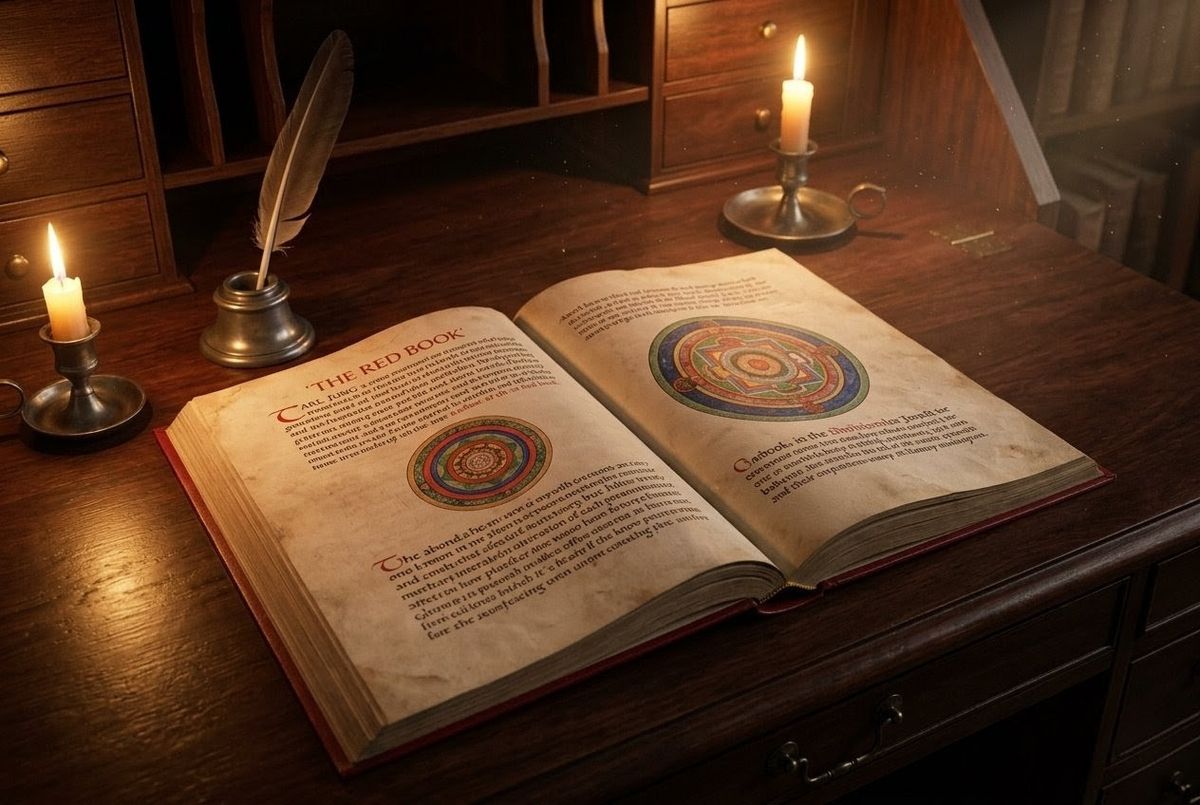
Jung’s technique of active imagination–dialoguing with interior figures, confronting shadow contents, and seeking integration–mirrors the Gnostic practice of visionary ascent and archontic confrontation. Both require courage: the willingness to descend into the underworld of the psyche before claiming the heights of spiritual realisation. The Red Book, Jung’s private record of his own imaginal encounters, stands as a modern apocryphon: a secret book of visionary experience that the wider world was not yet ready to receive.
The Collective Unconscious as Pleroma
Jung’s concept of the ‘collective unconscious’–the shared psychological substrate common to all humans–finds striking precedent in Gnostic ideas of the shared spiritual essence derived from the Pleroma. Both traditions suggest that individual healing connects with collective transformation; personal gnosis contributes to the redemption of the whole.
Contemporary depth psychology continues this resonance. James Hillman’s archetypal psychology, Thomas Moore’s care of the soul, and the various somatic experiencing modalities all draw upon Gnostic-Hermetic frameworks of multi-levelled consciousness requiring integration rather than elimination. The soul is not a problem to be solved but a mystery to be inhabited. The Gnostics knew this; depth psychology rediscovered it; contemporary seekers must remember it.
The Digital Archon: Simulation and Reality
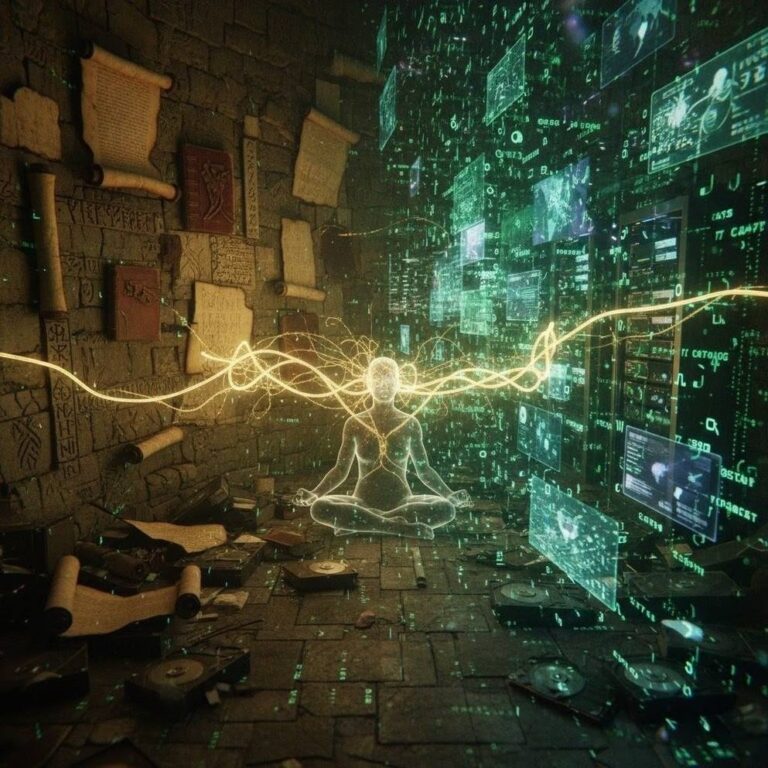
Philip K. Dick’s 1977 declaration–‘We are living in a computer-programmed reality, and the only clue we have to it is when some variable is changed, and some alteration in our reality occurs’–echoes Gnostic themes so precisely that scholars have debated whether the author encountered Nag Hammadi texts directly. Dick delivered these words at the Metz Science Fiction Festival in September 1977, drawing on the visionary experiences he had chronicled in 1974 after dental surgery. Dick’s concept of the ‘Black Iron Prison’–the simulated reality constructed by deceptive powers to contain human consciousness–translates the archontic prison (the kenoma, or realm of deficiency) into science fiction terminology.
From Bostrom to Gnosis: The Simulation Hypothesis
The subsequent development of simulation theory–Nick Bostrom’s 2003 paper ‘Are You Living in a Computer Simulation?’ published in Philosophical Quarterly–represents a secularised Gnosticism. The simulation hypothesis preserves the Gnostic intuition that reality is not what it appears, that consciousness has been trapped within a constructed environment, and that recognition of this condition constitutes the first step toward liberation.
Bostrom’s argument proposes that at least one of three propositions is true: either civilisations typically go extinct before reaching technological maturity; or posthuman civilisations lose interest in running ancestor-simulations; or we are almost certainly living in a computer simulation. The third proposition–the simulation hypothesis proper–carries the Gnostic echo: the majority of minds like ours may belong not to the original biological race but to simulated descendants.

Beyond the Red Pill: Ontological Transformation
Yet the modern formulation risks missing the soteriological dimension. For ancient Gnostics, recognising the simulation was merely preliminary; the essential task involved awakening from it. Contemporary ‘red pill’ narratives–appropriated from The Matrix, itself a Gnostic allegory–often stop at the level of conspiracy, identifying the deception without completing the transformation. Authentic Gnosticism requires not merely cognitive recognition but ontological change: the actualisation of spiritual potential that renders the simulation irrelevant.
The difference is crucial. Conspiracy theory remains trapped in the same dualistic structure it critiques: us versus them, awake versus asleep, truth versus lie. Gnosis transcends this binary entirely. The awakened pneumatic does not merely see through the prison; they recognise that the prison was never the final reality, that the divine spark within them remains untouchable by any simulation, however sophisticated. The red pill is only the first threshold; the journey continues through integration, embodiment, and the slow, patient work of becoming what one has always been.
Ecological Consciousness and Cosmic Embodiment
The ecological crisis reveals both the urgency and the limitation of ancient Gnostic attitudes toward matter. Traditional Gnosticism often expressed hostility toward the material realm, viewing embodiment as imprisonment and the natural world as the product of error. Such dualism potentially undermines ecological responsibility–if matter is fundamentally flawed, why preserve it?
The Hermetic Synthesis: As Above, So Below
However, contemporary eco-spirituality recovers alternative currents within the esoteric tradition. The Hermetic principle of cosmic sympathy–the ‘as above, so below’ that declares the universe a living, ensouled organism–provides foundation for ecological consciousness. If the cosmos embodies divine intelligence, then ecological destruction constitutes not merely practical failure but spiritual violence.
The task involves neither escape from embodiment nor uncritical immersion in materialism, but the transformation of our relationship with the natural world.
Ensouled Ecology: Beyond the Binary
Modern practitioners increasingly synthesise these perspectives: recognising the material realm’s limitations while honouring its participation in spiritual reality. The task involves neither escape from embodiment nor uncritical immersion in materialism, but the transformation of our relationship with the natural world–seeing it as symbolic expression of spiritual truths requiring stewardship rather than exploitation.
This synthesis is not a compromise but a deepening. The Hermetic tradition never rejected matter; it revealed matter’s hidden luminosity. The alchemist does not despise lead but transmutes it. The eco-Gnostic does not despise the body but recognises it as the microcosm of the cosmos, the axis mundi that connects terrestrial and celestial realms. To pollute the river is to defile the celestial correspondence; to clear-cut the forest is to erase a page from the Book of Nature. The ancient Gnostics may not have anticipated climate change, but their cosmology–properly understood–contains the resources for responding to it.
Psychedelic Renaissance and Technologies of Ecstasy
The contemporary resurgence of psychedelic research and practice represents another significant modern resonance. Psychedelic substances–psilocybin, LSD, DMT, ayahuasca–function as ‘technologies of ecstasy’ (to use Mircea Eliade’s phrase from his 1964 study Shamanism: Archaic Techniques of Ecstasy), inducing states of consciousness that closely resemble descriptions of Gnostic revelation.
The Machine Elves and the Planetary Governors
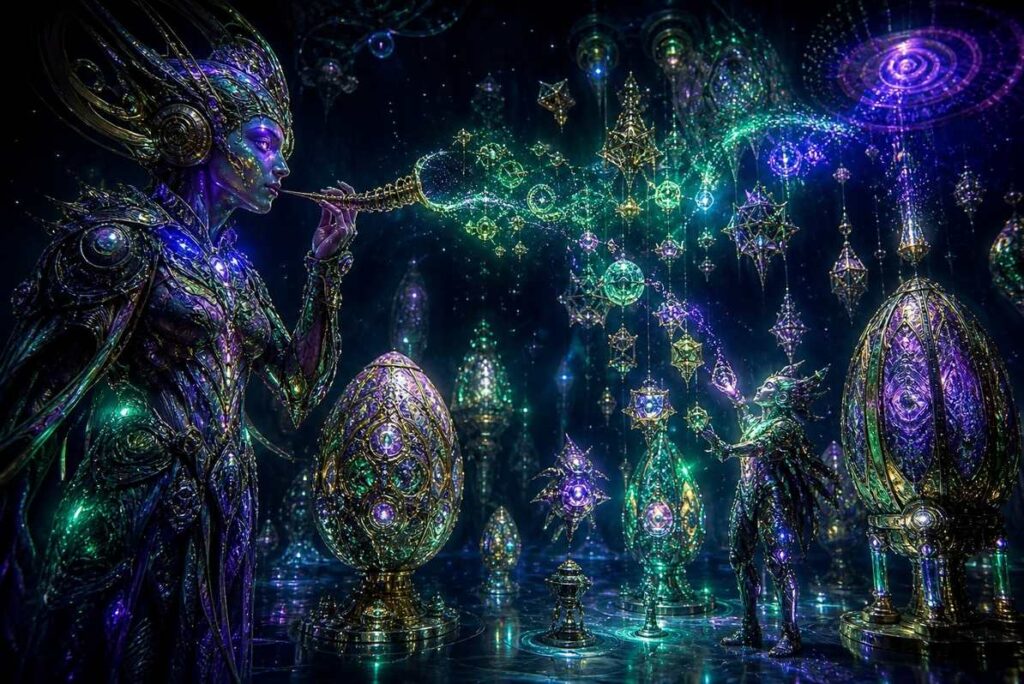
Users frequently report encounters with seemingly autonomous entities, experiences of cosmic unity, confrontations with personal shadow material, and recognition of reality’s constructed nature–all central Gnostic themes. The ‘machine elves’ described by Terence McKenna and subsequently reported by numerous DMT researchers bear striking resemblance to archonic powers or planetary governors; the dissolution of ego-boundaries parallels the Gnostic return to the Pleroma.
McKenna first encountered these ‘self-transforming machine elf creatures’ during a DMT experience in 1967. He described them as speaking in a ‘colored language’ that condensed into rotating, Faberge-egg-like machines crafted from luminescent ceramics and liquid crystal gels. Rick Strassman’s clinical DMT studies at the University of New Mexico (1990-1995) documented similar entity encounters among volunteers, many of whom described their experiences as ‘more real than reality.’ Whether these entities are autonomous beings, archetypal manifestations, or neural artefacts remains genuinely undetermined–a proper Gnostic would insist on maintaining the question rather than prematurely closing it.
Gnosis vs. Peak Experience: The Integration Imperative
Yet ancient Gnostics would likely caution against confusing method with goal. Psychedelic experience provides temporary glimpses of expanded consciousness; Gnosis requires stable integration of these insights into daily existence. The danger lies in repeated seeking of peak experiences without the grounding work of embodiment and ethical practice–the modern equivalent of the Gnostic warning against premature ascent or dissociative spirituality.
The Gnostic texts warn of those who ascend through the spheres but fail to strip off the psychic garments, who see the Pleroma but cannot maintain the vision. The psychedelic renaissance faces precisely this risk: a culture of peak experiences without corresponding valleys of integration. The machine elves may show you the door, but they do not walk through it with you. That journey requires community, practice, and the slow, unglamorous work of becoming human.
Non-Duality and the Direct Path
The popularity of Advaita Vedanta, Zen Buddhism, and other non-dual traditions in contemporary spirituality offers interesting comparison with Gnostic approaches. Both emphasise direct knowing over doctrinal belief, both identify a false self or constructed identity that obscures true nature, both prescribe practices for recognising the ground of consciousness.
The Gnostic Distinction: Cosmic Opposition
However, Gnosticism maintains distinctive features valuable for modern practitioners. Its mythological richness provides narrative context for the spiritual journey lacking in purely non-dual frameworks. Its recognition of cosmic opposition–the archons, the counterfeit spirit, the forces of forgetting–legitimises the struggles encountered on the path without reifying them as ultimate reality.
The non-dual traditions often dismiss the phenomenal world as maya (illusion) or reduce suffering to misperception. While true at the absolute level, this perspective can bypass the genuine difficulties of embodied existence. The Gnostic framework, by contrast, takes the struggle seriously: the archons are real enough to require confrontation, even if they are not ultimately real. The dream is a dream, but one must still wake up from it. The non-dualist may claim there is no dreamer and no dream; the Gnostic insists that until awakening occurs, the dreamer suffers, and compassion demands engagement.

Neo-Gnostic Synthesis: Grounded Transcendence
Contemporary ‘neo-Gnostic’ movements increasingly synthesise these approaches: recognising the non-dual ground while honouring the sophisticated cosmology and soteriology of the ancient tradition. The result avoids both the nihilism of pure materialism and the naive optimism of uncooked spirituality.
This synthesis recognises that the Pleroma is not elsewhere but everywhere, that the divine spark is not hidden in a distant heaven but buried beneath the debris of daily consciousness. The task is not to transcend the world but to see through it–to recognise the archontic structures for what they are while continuing to build, love, and create within the world they partially control. The non-dual ground and the Gnostic map are not enemies but allies: one provides the destination, the other provides the route.
Practical Applications for Contemporary Seekers

Beyond theoretical resonance, Gnostic wisdom offers practical guidance for contemporary existence:
Discernment of Spirits (Diakrisis)
The Gnostic emphasis on diakrisis–discrimination between authentic and counterfeit spiritual influences–proves essential in an age of spiritual marketplace, where teachers, traditions, and technologies compete for attention and allegiance. The capacity to distinguish pneumatic depth from archonic mimicry saves seekers from costly detours.
This discernment is not cynicism. The Gnostic does not reject all teachers or traditions; they simply refuse to surrender their critical faculty. Every teaching must be tested against the inner spark: does it liberate or imprison? Does it expand consciousness or merely rearrange the furniture of the ego? Does it lead toward the Pleroma or deeper into the kenoma? These are not abstract theological questions but practical diagnostics for the contemporary seeker.
The Practice of Remembrance (Anamnesis)
The Gnostic anamnesis–recollection of one’s true divine origin–translates into contemporary mindfulness and contemplative practices. Regular interruption of automated consciousness through remembrance of spiritual identity breaks the hypnotic spell of material existence.
This practice can be as simple as a brief pause before checking the phone, a moment of recognition while walking, or the deliberate question: ‘Who is aware of these thoughts?’ The Gnostics called this ‘waking from sleep.’ The Buddha called it ‘mindfulness.’ The contemporary practitioner might call it ‘the glitch in the program’–that moment when the automaticity of existence stutters, and something real shines through. These moments are not merely pleasant interludes; they are the seeds of liberation, scattered throughout the day like breadcrumbs leading home.
Community of the Like-Minded
Ancient Gnostics gathered in circles (symposia–the Greek term for philosophical drinking-gatherings, as in Plato’s famous dialogue) for reading, interpretation, and mutual support. Contemporary seekers similarly require communities of practice–not institutional conformity, but fellowship with others pursuing authentic transformation.
The solitary path is possible but perilous. Without mirrors, one cannot see one’s own blind spots. Without fellow travellers, one cannot distinguish genuine progress from spiritual inflation. The Gnostic circle was not a church in the modern sense; it was a laboratory where experiments in consciousness could be conducted with appropriate safeguards. Contemporary seekers need similar spaces: not dogmatic institutions but communities of discernment, where the archonic can be named and the pneumatic recognised.
Engaged Withdrawal
Gnosticism suggests neither total withdrawal from society nor uncritical participation, but what we might term ‘engaged withdrawal’–maintaining spiritual centre while navigating worldly responsibilities, recognising the world as temporary classroom rather than permanent home.
This is perhaps the most difficult practice of all. Total withdrawal is relatively easy; uncritical participation is even easier. To remain in the world while not of it–to work, love, parent, and create without becoming entangled in the archontic web–requires the precision of a tightrope walker. The Gnostic does not despise the world; they simply refuse to mistake it for the ultimate. Every engagement is temporary; every relationship is a lesson; every loss is a reminder that the pearl of great price cannot be stolen by any archon, however powerful.
The Contemporary Gnostic Archive: Living Tradition
The preservation and study of ancient Gnostic texts–enabled by the Nag Hammadi discovery and digital dissemination–constitutes itself a modern resonance. The archive serves not merely historical curiosity but living tradition, providing the maps necessary for contemporary journeys.
Our task involves translating these ancient symbols without reducing them to psychology, maintaining their soteriological urgency while recognising their cultural specificity. The Gnostics were not proto-scientists describing cosmological facts; they were cartographers of consciousness providing tools for awakening. Their maps require updating–new languages for old insights–but the territory remains unchanged.
The modern resonance of ancient wisdom confirms its authenticity. Truth that speaks across millennia, that addresses fundamentally different cultures with consistent relevance, participates in something beyond historical accident. The Gnostic thread persists–not as museum piece but as living possibility, awaiting activation by those ready to remember. The archive is not a tomb; it is a seed bank, preserving genetic material for futures the original planters could not have imagined.
Frequently Asked Questions
How does Gnosticism diagnose modern technological society?
Gnosticism identifies modern technological systems–particularly surveillance capitalism and attention extraction platforms–as contemporary expressions of the archonic principle: forces of control and forgetfulness that keep consciousness trapped in hypnotic identification. The counterfeit spirit manifests today as algorithmic feeds that replace authentic experience with simulation, while the reduction of consciousness to mere neurological mechanism represents the demiurgic error of mistaking the part for the whole.
What is the connection between Carl Jung and Gnosticism?
Carl Jung recognised in Gnostic mythology a sophisticated cartography of the psyche that anticipated his own discoveries. The Gnostic distinction between pneuma (spiritual spark) and counterfeit spirit parallels Jung’s differentiation between the Self and ego-complex. Jung’s concept of the collective unconscious finds precedent in the Gnostic Pleroma (Fullness), and his technique of active imagination resembles Gnostic visionary practices. The Red Book represents Jung’s own engagement with these ancient materials.
Is the simulation hypothesis related to Gnosticism?
The simulation hypothesis–popularised by Nick Bostrom and Philip K. Dick–represents a secularised form of Gnostic insight. Both recognise that consensus reality may be a constructed environment designed to contain consciousness, and that awakening involves recognising this construction. However, where simulation theory often stops at cognitive recognition, Gnosticism demands ontological transformation–the actualisation of spiritual potential that renders the simulation irrelevant to one’s essential nature.
How do Gnostics view ecological destruction?
While traditional Gnosticism sometimes expressed hostility toward matter, contemporary eco-Gnosticism recovers the Hermetic principle of cosmic sympathy (as above, so below). This view sees the cosmos as a living, ensouled organism rather than dead mechanism. From this perspective, ecological destruction constitutes spiritual violence against the divine embodiment. The task involves neither world-rejection nor uncritical materialism, but the transformation of our relationship with nature as symbolic expression of spiritual truths requiring stewardship.
What is the difference between psychedelic experience and Gnosis?
Psychedelic substances function as technologies of ecstasy that can induce states resembling Gnostic revelation–encounters with autonomous entities, recognition of reality’s constructed nature, and dissolution of ego boundaries. However, Gnosis requires stable integration of these insights into daily existence, whereas psychedelic experience offers only temporary glimpses. Ancient Gnostics would caution against confusing the method (peak experience) with the goal (ontological transformation), warning that repeated seeking without grounding work leads to dissociation rather than liberation.
How does Gnosticism differ from non-dual traditions like Advaita?
While both Gnosticism and non-dual traditions emphasise direct knowing over belief and recognise false constructs obscuring true nature, Gnosticism maintains distinctive features. Its mythological richness provides narrative context for the spiritual journey, while its recognition of cosmic opposition (archons, counterfeit spirit) legitimates the struggles encountered without reifying them as ultimate reality. Contemporary practitioners often synthesise these approaches–recognising non-dual ground while honouring Gnostic cosmology and soteriology.
What are practical Gnostic practices for contemporary seekers?
Key practices include: (1) Diakrisis (discernment of spirits)–developing capacity to distinguish authentic from counterfeit spiritual influences; (2) Anamnesis (remembrance)–regular interruption of automated consciousness to recall one’s divine origin; (3) Community engagement–gathering with like-minded practitioners for mutual support and interpretation; and (4) Engaged withdrawal–maintaining spiritual centre while navigating worldly responsibilities, recognising the world as temporary classroom rather than permanent home. These require no institutional affiliation, only sincere commitment to awakening.
Further Reading
Deepen your exploration of Gnostic modern resonances with these verified resources from the ZenithEye archive:
- Transmission and Lineage: How the Gnosis Travels — Tracing the survival of these ideas through centuries of suppression.
- Hermetic Connections in the Nag Hammadi Library — Exploring the Egyptian wisdom traditions underlying Gnostic cosmology.
- Digital Suppression: Modern Archonic Control and the Resistance of Consciousness — Contemporary mechanisms of knowledge restriction.
- Integration and Grounding: Embodying the Received Tradition — Practical methods for stabilising insights.
- Contemplative Techniques: Methods for Contemporary Practice — Specific exercises for developing discernment and remembrance.
- Archons: The Ruling Powers That Shape Reality — Detailed examination of cosmic opposition and control systems.
- Simulation Hypothesis: Clues in the Reality Code — Technical exploration of constructed reality theories.
- Gnosis in the Digital Age: Algorithmic Sovereignty — Navigating spiritual autonomy amid information warfare.
- The Gnostic Matrix — Mapping the intersection of Gnostic cosmology and contemporary digital culture.
- Contemporary Gnostic Experiences in the Digital Age — First-hand accounts of awakening within technological civilisation.
Safety Notice: The practices and perspectives described involve sustained confrontation with challenging material regarding the nature of reality and consciousness. This article does not constitute medical, psychological, or spiritual advice. While Gnostic insight liberates from conventional constraints, the destabilisation of consensus reality requires grounding, community support, and ethical engagement. Approach with maturity, appropriate support systems, and recognition that awakening is gradual rather than catastrophic. If you experience persistent derealisation, intrusive thoughts, or inability to function, please contact professional emergency services or a trauma-informed therapist.
References and Sources
The following sources informed the historical, psychological, and esoteric analysis presented in this article.
Primary Sources and Critical Editions
- Robinson, J.M. (Ed.). (1990). The Nag Hammadi Library in English. HarperSanFrancisco.
- Robinson, J.M. (Ed.). (1978). The Nag Hammadi Library in English. Harper & Row. (Original edition containing the Apocryphon of John and counterfeit spirit passages.)
Philosophy and Psychology
- Bostrom, N. (2003). Are You Living in a Computer Simulation? Philosophical Quarterly, 53(211), 243-255.
- Dick, P.K. (1977/1995). If You Find This World Bad, You Should See Some of the Others. In The Shifting Realities of Philip K. Dick. Pantheon Books.
- Jung, C.G. (1951/1968). Aion: Researches into the Phenomenology of the Self. Princeton University Press.
- Jung, C.G. (2009). The Red Book: Liber Novus. W.W. Norton & Company.
Comparative Studies
- Eliade, M. (1964). Shamanism: Archaic Techniques of Ecstasy. Princeton University Press.
- McKenna, T. (1992). Food of the Gods: The Search for the Original Tree of Knowledge. Bantam Books.
- Strassman, R. (2001). DMT: The Spirit Molecule. Park Street Press.
- Jonas, H. (1958). The Gnostic Religion: The Message of the Alien God and the Beginnings of Christianity. Beacon Press.