The Concept of Our Great Power: Apocalypse of Divine Light
The Concept of Our Great Power (NHC VI,4) occupies a singular position within the Nag Hammadi Library as an apocalyptic tractate that maps salvation history through three successive aeons rather than through the vertical ascent narratives typical of Sethian visionary literature [1]. Preserved in fourth-century Coptic translation on pages 36 through 48 of Codex VI, the text presents a “horizontal” eschatology focused on temporal transformation–from the aeon of flesh through the psychic aeon to the final imperishable aeon–rather than spatial navigation through planetary spheres [6]. Composed originally in Greek during the second or third century CE and subsequently revised with Christian additions in the fourth century, the tractate synthesises Jewish biblical traditions, Stoic cosmological frameworks, and early Christian doctrine to produce a distinctive vision of cosmic dissolution and restoration [7].
For scholars of ancient religion, the Concept offers crucial evidence for the fluid boundaries between Gnosticism, Christianity, and Jewish apocalypticism in Roman Egypt; for the contemporary reader, it presents a stark vision of history as administrative process–three successive jurisdictions of flesh, soul, and fire, each progressively dissolving the material encumbrances that separate spirit from source [8]. This article examines the manuscript context, the tripartite aeonic structure, the Christian interpolations, the doctrine of final conflagration, and the enduring scholarly debates about the text’s classification and provenance [10].
Table of Contents
- What Is the Concept of Our Great Power?
- The Manuscript and Its Context
- The Three Aeons of Salvation History
- The Flood as Type and Limit
- The Christian Interpolations
- Final Conflagration and Restoration
- Theological Context and Classification
- Why the Concept Matters
- Frequently Asked Questions
- Further Reading
- References and Sources
What Is the Concept of Our Great Power?
What is the Concept of Our Great Power?
The Concept of Our Great Power (NHC VI,4) is an apocalyptic tractate from the Nag Hammadi Library describing the history of the world in three fundamental stages: the aeon of the flesh (from creation to Noah’s flood), the psychic aeon (the present age of sin and impurity), and the imperishable aeon (the final restoration inaugurated by cosmic conflagration). The Great Power functions as speaker and revealer, communicating to listeners the nature of these aeons and the means of surviving their dissolution. Preserved in Codex VI alongside Hermetic, Platonic, and Christian materials, the text represents a composite work–a Jewish-Christian apocalypse lightly tinged with Gnostic themes, subsequently interpolated with Christian additions reflecting fourth-century theological controversies [1][6].
The text opens with an invitation to know the “great Power” (dunamis), promising that those who achieve this knowledge will become invisible and immune to fire: “He who will know our great Power will become invisible, and fire will not be able to consume him. But it will purge and destroy all of your possessions” [1]. This opening establishes the text’s central concern: knowledge of the Power grants protection during the cosmic dissolution that concludes the psychic aeon. The Power is not merely a philosophical abstraction but an active administrative force operating through history to separate the imperishable from the perishable [8].
The manuscript itself occupies pages 36,1 through 48,15 of Codex VI, written in a dialect situated between Subachmimic and Sahidic Coptic, characteristic of the mid-fourth century Nile Valley [6]. The text exhibits clear signs of composite authorship: a non-Christian Jewish apocalypse forming the base layer (pages 36-40, 43, 45-48), interrupted by Christian additions describing the ministry, death, and resurrection of Jesus (pages 40-43), followed by prophecies of eschatological tribulation including an “archon of the west” and an imitating Antichrist (pages 43-45) [7]. This layered structure has led scholars to debate whether the text represents a unified composition or a redacted anthology of related apocalyptic traditions [9].
Primary Source Citation: NHC VI,4 36:3-37:5. “He who will know our great Power will become invisible, and fire will not be able to consume him. But it will purge and destroy all of your possessions. For everyone in whom my form will appear will be saved.” Translation: Frederik Wisse and Francis E. Williams, The Nag Hammadi Library in English, ed. James M. Robinson, 4th rev. ed. (Leiden: Brill, 1996).
The Manuscript and Its Context
Codex VI: The Philosophical Compendium
The Concept occupies the fourth position in Codex VI, a manuscript that functions as an anthology of diverse religious and philosophical materials rather than a sectarian dossier [6]. Preceding it are the Acts of Peter and the Twelve Apostles (VI,1), Thunder: Perfect Mind (VI,2), and the Authoritative Teaching (VI,3); following it are a fragment of Plato’s Republic (VI,5), the Discourse on the Eighth and the Ninth (VI,6), the Prayer of Thanksgiving (VI,7), and the Asclepius (VI,8) [6]. This curatorial arrangement reveals a community interested in the breadth of Mediterranean spirituality–apostolic romance, divine paradox, soul allegory, apocalyptic history, Platonic psychology, Hermetic mysticism, and liturgical prayer–without apparent concern for modern theological boundaries [9].
The presence of the Concept alongside explicitly Hermetic materials raises questions about its theological milieu. While the text employs apocalyptic imagery and aeonic periodisation typical of Jewish-Christian literature, its emphasis on divine invisibility and fire immunity aligns with broader Nag Hammadi concerns about spiritual protection during cosmic dissolution [8]. The codex thus reveals a readership comfortable with philosophical syncretism–a community that sought to understand the end of history whether it was narrated by Hermes Trismegistus, the apostle Peter, or an anonymous Jewish-Christian apocalyptist [10].
Composite Authorship and Redaction
Scholarly analysis indicates that the Concept is a composite text rather than a unified composition [7]. The base layer presents a Jewish apocalypse describing three aeons and a final conflagration; the Christian additions insert a “man who knows the Great Power” identified as Jesus, who speaks in parables, opens the gates of heaven, and puts to shame the ruler of Hades [1]. The nature of his flesh “could not be seized” by the archons–a docetic formulation paralleled in the Second Treatise of the Great Seth (NHC VII,2) and the Apocalypse of Peter (NHC VII,3) [7].
Further Christian additions describe an “archon of the west” who may represent the emperor Julian the Apostate (361-363 CE), suggesting that the extant version derives from the period shortly after Julian’s death [7]. The reference to “Anomoeans” (a fourth-century Arian heresy) in the text provides a terminus post quem for the final redaction, confirming that the manuscript was actively revised to address contemporary theological controversies [7]. This redactional history transforms the Concept from a static ancient text into a living document–a work that fourth-century readers modified to align with their own eschatological expectations [9].
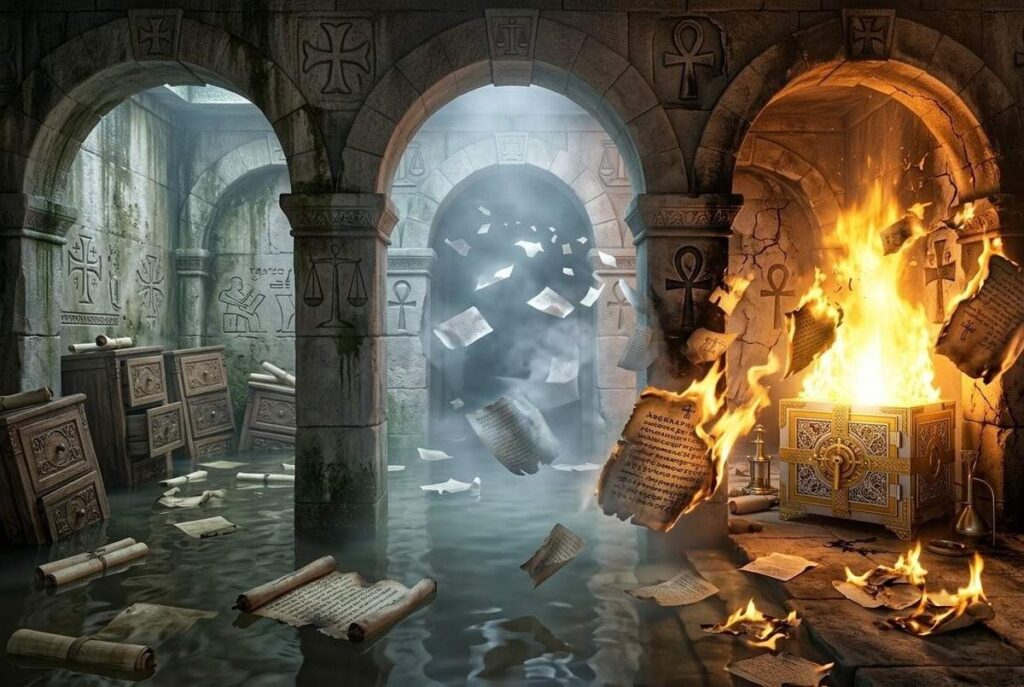
Primary Source Citation: NHC VI,4 38:16-39:15. “The aeon of the flesh comes into being in the great bodies… the vengeance of the father of the flesh, the water, takes place. He sends the flood upon men, sparing only Noah.” Translation: Wisse and Williams, The Nag Hammadi Library in English.
The Three Aeons of Salvation History
The text organises salvation history into three distinct aeons, each associated with a cosmic element, a divine manifestation, and a specific degree of metaphysical processing [1]. This tripartite division functions as cosmic filing categories–ways of sorting spiritual substance according to its resistance to divine dissolution.
The Aeon of the Flesh: Preliminary Filing
The first aeon corresponds to the period from creation to Noah’s flood–a tenure of fleshly ignorance when humanity lived in complete absence of its divine origins [1]. During this dispensation, the “father of the flesh,” the water, sends the flood as vengeance upon the giants (the offspring of fallen angels, compare Genesis 6:1-4), sparing only Noah and his family [1]. Yet the text treats this preservation as preliminary filing at best: the flood’s aquatic jurisdiction could only address surface contamination, not the root of evil embedded in fleshly structure.
The waters merely drowned the body while leaving the “wickedness of the flesh” to regenerate, suggesting that the first aeon functioned as a temporary holding pattern rather than genuine remediation [1]. The flood’s inadequacy establishes a crucial theological precedent: water–symbolic of material flux and superficial cleansing–proves insufficient for the deep sterilisation required before spiritual substance can return to source. This is administrative precedent proving that preliminary measures cannot complete the paperwork [8].
The Psychic Aeon: Temporary Jurisdiction
The second aeon represents the present dispensation, inaugurated after the flood and extending until the final conflagration [1]. The text describes it as “a small one, which is mixed with bodies, begetting in the souls and being defiled” [1]. This era of mixed jurisdiction permits partial knowledge but generates all manner of evils: “many works of wrath, anger, envy, malice, hatred, slander, contempt and war, lying and evil counsels, sorrows and pleasures, basenesses and defilements, falsehoods and diseases, evil judgments” [1].
The present aeon operates under temporary permits: spiritual perception granted but not fully operational, truth and error coexisting under provisional licensing agreements. The text exhorts its readers: “Yet you are sleeping, dreaming dreams. Wake up and return, taste and eat the true food. Hand out the word and the water of life! Cease from the evil lusts and desires and (the teachings of) the Anomoeans, evil heresies that have no basis” [1]. This “already but not yet” structure reflects the community’s liminal status–holding advanced spiritual credentials while operating within institutional frameworks still processing outdated fleshly paperwork [10].
The Imperishable Aeon: Final Audit
The third aeon will be inaugurated by a great fire that consumes all–not as punitive destruction but as alchemical purification [1]. Unlike the flood’s aquatic limitations, fire penetrates to the root of material existence, dissolving both matter and soul while leaving only spirit. The text specifies that this fire will burn for 1468 years (or 1460 years in some manuscript traditions), after which “the firmaments will fall down into the depth… the sons of matter will perish; they will not be, henceforth” [1][7].
This conflagration represents the final administrative protocol–the audit that closes all temporal accounts and dissolves the jurisdictional boundaries separating spirit from material encumbrance. Where water cleansed the surface and the psychic aeon aerated the intermediate depths, fire completes the paperwork by returning all spiritual substance to its unfiled, unconditioned origin. The elect, clothed in holy garments that the fire cannot touch, will enter into “immeasurable light” and find rest [1].
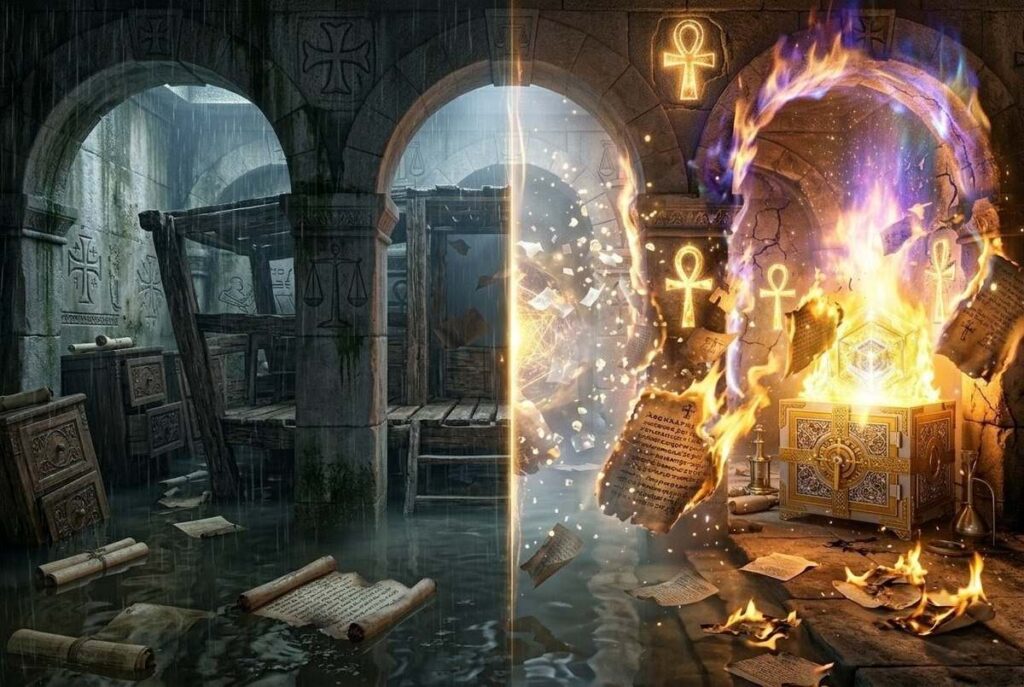
Primary Source Citation: NHC VI,4 45:27-46:33. “Then he will come to destroy all of them… their period, which was given to them to have power… is fourteen hundred and sixty years. When the fire has consumed them all, and when it does not find anything else to burn, then it will perish by its own hand.” Translation: Wisse and Williams, The Nag Hammadi Library in English.
The Flood as Type and Limit
The Concept’s treatment of the Noah narrative reveals sophisticated hermeneutical protocols distinguishing between temporary remedies and permanent solutions [1]. Unlike orthodox traditions that celebrate the flood as divine judgment successfully executed, this text treats it as necessary but administratively incomplete–a type anticipating the true preservation still pending.
Incomplete Remediation and Administrative Failure
The text’s assessment is brutally practical: the flood failed to achieve its ostensible purpose. The “wickedness of the flesh” persisted because aquatic jurisdiction cannot penetrate to the root of material conditioning–it affected only the body, not the underlying spiritual condition [1]. This limitation explains the theological necessity of the final conflagration; only fire possesses the administrative authority to dissolve the root permissions of fleshly existence.
This reading transforms the flood from success story to cautionary tale–an early attempt at cosmic sanitation that proved insufficiently thorough. The ark becomes not a triumph of divine engineering but a temporary holding cell, preserving specimens for a more comprehensive dissolution yet to come [8]. Noah’s preservation anticipates the gathering of the elect; the ark’s wooden shelter anticipates the fire’s ultimate transparency.
The Ark as Administrative Refuge
For those who “entered” the Power–who aligned themselves with the divine dunamis–the ark provided temporary shelter from the waters of ignorance. Yet the text emphasises this salvation’s provisional status: Noah spoke in the first aeon, but his preservation was merely a type of the true salvation that would come through the man who knows the Great Power in the psychic aeon [1]. The ark’s passengers survived not because they escaped transformation but because they underwent the preliminary version of what all spiritual substance must eventually endure [10].
This typological reading aligns with broader Gnostic hermeneutics: biblical events function not as historical endpoints but as prophetic prefigurations–administrative placeholders pointing toward future spiritual realities. The flood anticipates the final dissolution; Noah’s preservation anticipates the gathering of the elect; the wooden ark anticipates the imperishable light that awaits beyond the fire [8].
The Christian Interpolations
The Concept preserves one of the most extensive Christian redactional layers in the Nag Hammadi Library–a series of interpolations that transform the Jewish apocalyptic base into a proto-orthodox narrative of Jesus’s ministry, death, and triumph over Hades [7]. These additions reveal how fourth-century readers adapted existing apocalyptic literature to align with emerging Christian narratives [9].
The Man Who Knows the Great Power
The central Christian interpolation identifies the anticipated redeemer as “the man who knows the Great Power” [1]. He will drink from the milk of the mother, speak in parables, and proclaim the aeon to come–just as Noah spoke in the first aeon [1]. He speaks in seventy-two tongues, opens the gates of heaven with his words, and puts to shame the ruler of Hades [1]. The archons, provoked by his coming, deliver him up through the treachery of Judas, but “the nature of his flesh could not be seized” [1].
This docetic formulation–that the material body of Jesus was insubstantial and could not be grasped by the archons–parallels passages in the Second Treatise of the Great Seth (NHC VII,2), the Apocalypse of Peter (NHC VII,3), and the Apocryphon of John (NHC II,1) [7]. The redeemer mocks the archons, prepares himself to go down and put them to shame, and escapes from their custody [1]. This is not the suffering servant of Isaiah but the triumphant logos who cannot be contained by material jurisdiction–a divine diplomat whose credentials render him immune to archontic detention [10].
The Archon of the West and the Antichrist
Following the passion narrative, the text describes a series of eschatological tribulations: the sun setting during the day, evil spirits troubled, cities destroyed, mountains shaken, and animals dying [1]. These signs of the end are brought on by the dissolution of the archons–typical Jewish apocalyptic imagery found in the Ascension of Isaiah, 2 Enoch, and 4 Ezra [7].
The text then introduces an “archon of the west” who makes war and is the forerunner of the Antichrist [1]. Francis E. Williams has suggested that this figure refers to the emperor Julian the Apostate (361-363 CE), which would place the final redaction in the 360s [7]. An “imitating spirit” sent by the archons combats a divine child, and those who follow this false messiah will introduce circumcision and turn away from the Great Power [1]. These passages reveal a community engaged in fourth-century theological polemics–combating Arianism (the Anomoeans), responding to Julian’s pagan revival, and distinguishing true Christianity from Jewish-Christian practices [9].
Final Conflagration and Restoration
The text concludes with vivid imagery of the end times–not as catastrophic destruction but as administrative completion [1]. The Great Power will withdraw with everyone who knows him, and they will enter into “immeasurable light, where there is no one of the flesh nor the wantonness of the first to seize them” [1].
Purification and Judgment
Crucially, the conflagration is both purifying and discriminating. The text distinguishes between the “pure” and the “impure”: the souls of the pure, those who have maintained celibacy, will achieve their rest, while the souls of the impure will apparently spend eternity in penitence [1][7]. This is not the undifferentiated universalism sometimes attributed to Gnosticism; it is a rigorous soteriological sorting that rewards spiritual discipline and punishes moral laxity [8].
The fire operates as both solvent and chastiser: “They will be chastised until they become pure” [1]. When the fire has consumed all wickedness and finds nothing else to burn, it will “perish by its own hand” [1]. Then the souls who are holy through the light of the Power will appear, having become reflections in his light, shining and finding rest in his rest [1]. This is apokatastasis–the restoration of all things–but achieved through fire’s uncompromising audit rather than through universal amnesty [10].
Those Who Know the Power
Only those who know the Power survive this dissolution–not because they escape the fire but because they are protected by holy garments that the fire cannot touch [1]. This survival is not preservation of identity but recognition of identity: they do not endure as distinct souls but enter into the aeon of beauty, ready in wisdom, having given glory to him who is in the incomprehensible unity [1].
The text offers a streamlined eschatology: no bridal chambers, no angelic guides, no toll collectors–just the direct return of spirit to spirit, facilitated by fire’s ultimate administrative clearance [8]. Yet this streamlined vision does not lack moral rigour. The requirement of celibacy, the rejection of evil desires, and the chastisement of the impure demonstrate that the Concept’s soteriology demands ethical transformation alongside metaphysical knowledge [10]. Knowledge of the Power is not merely intellectual; it is embodied in purity, celibacy, and the rejection of fleshly contamination [1].
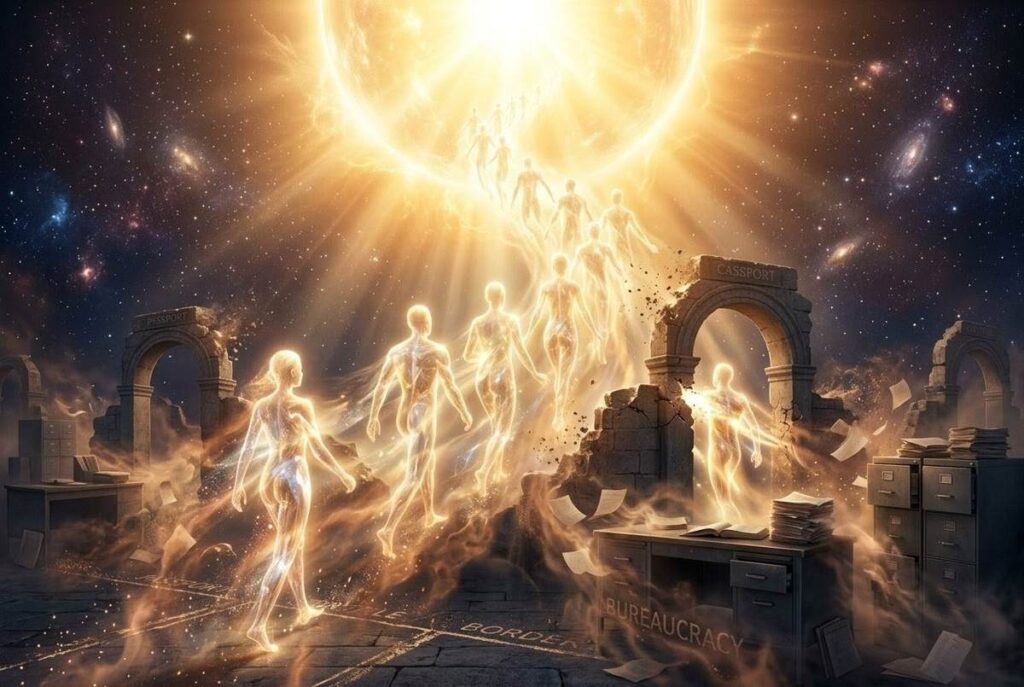
Primary Source Citation: NHC VI,4 46:8-24. “The souls will appear, who are holy through the light of the Power, who is exalted, above all powers, the immeasurable, the universal one, I and all those who will know me. And they will be in the aeon of beauty of the aeon of judgment, since they are ready in wisdom.” Translation: Wisse and Williams, The Nag Hammadi Library in English.
Theological Context and Classification
The Concept resists filing in any single theological cabinet. Madeleine Scopello classifies it as a Jewish apocalypse “slightly tinged with gnosticism” [7]. Birger A. Pearson notes its affinities with Jewish pseudepigrapha and its aim to describe world history in fundamental stages [7]. John D. Turner has analysed its Sethian connections, while Frederik Wisse and Francis E. Williams emphasise its composite nature [6][7].
The text’s classification matters because it demonstrates the fluid boundaries between Jewish apocalypticism, early Christianity, and Gnostic spirituality in Roman Egypt [9]. The base layer–a Jewish apocalypse of three aeons–could have circulated independently in synagogues or early Christian communities. The Christian additions–docetic Christology, anti-Arian polemic, and eschatological tribulation–reflect fourth-century Egyptian concerns. The Gnostic tint–invisibility, fire immunity, and the rejection of flesh–aligns the text with broader Nag Hammadi themes without requiring full Sethian or Valentinian systematics [10].
For modern scholars, the Concept illustrates that “Gnosticism” was not a unified movement with a fixed canon but a spectrum of approaches to divine knowledge, biblical interpretation, and cosmic destiny [14]. The text’s redactional history–Jewish base, Christian additions, Gnostic colouring–reveals a literary tradition that was alive, contested, and continuously adapted to address new theological and political challenges [9].
Why the Concept Matters
The Concept of Our Great Power matters because it preserves a vision of history as progressive dissolution–a bureaucratic process in which three successive aeons file away the material encumbrances that separate spirit from source [1]. Unlike the vertical ascent narratives of Zostrianos or Allogenes, this text offers a horizontal alternative: the soul’s journey is not upward through bureaucratic strata but forward through temporal phases until the final audit dissolves the filing system entirely [8].
For scholars of early Christianity, the text illuminates the redactional processes by which Jewish apocalypses were transformed into Christian scriptures [7]. Its references to the Anomoeans and the archon of the west provide rare evidence for how fourth-century communities updated ancient texts to address contemporary heresies and political threats [9]. The docetic passion narrative–“the nature of his flesh could not be seized”–offers a variant Christology that challenges simplistic equations of Gnosticism with anti-Christian hostility [10].
Furthermore, the text challenges any comfortable assumption that Gnostic soteriology lacks moral rigour. Its demand for celibacy, its chastisement of the impure, and its distinction between those who know the Power and those who do not demonstrate that salvation required ethical transformation alongside metaphysical recognition [1]. The Concept reminds us that even in the most bureaucratic of aeonic systems, the Power maintains rigorous standards–and that the fire’s final audit separates not merely matter from spirit but purity from impurity [8].
Frequently Asked Questions
What is the Concept of Our Great Power in the Nag Hammadi Library?
The Concept of Our Great Power (NHC VI,4) is an apocalyptic tractate describing world history through three aeons: the aeon of the flesh (from creation to Noah’s flood), the psychic aeon (the present age), and the imperishable aeon (final restoration through cosmic fire). It is a composite text combining a Jewish apocalypse with Christian additions about Jesus and fourth-century eschatological prophecies.
What are the three aeons described in the Concept of Our Great Power?
The text organises history into: (1) The aeon of the flesh–from creation to the flood, when giants ruled and water destroyed all but Noah; (2) The psychic aeon–the present age of sin, impurity, and mixed jurisdiction; and (3) The imperishable aeon–inaugurated by a great fire lasting 1468 years that consumes matter and restores holy souls to immeasurable light.
How does the Concept of Our Great Power differ from other Nag Hammadi apocalypses?
Unlike vertical apocalypses such as Zostrianos or Allogenes that document the soul’s journey through heavenly realms and aeons, the Concept presents horizontal eschatology–concerned with the unfolding of history toward dissolution rather than spatial navigation. It lacks elaborate angelic guides and celestial checkpoints.
What does the Great Power represent?
The ‘Great Power’ (Greek: dunamis) is a transcendent divine force that renders the knower invisible and immune to fire. It operates throughout history to transform and restore spiritual substance, manifesting differently in each aeon. The Power functions as an administrative force dissolving the barriers between spirit and matter.
Is the final fire destructive or purifying?
The fire is both purifying and discriminating. It chastises the impure until they become pure, and distinguishes between the pure (who achieve rest) and the impure (who spend eternity in penitence). Unlike some universalist interpretations, the text maintains rigorous moral standards alongside its metaphysical framework.
What is the significance of Noah’s flood in this text?
The flood represents a necessary but incomplete remedy–the aeon of flesh’s preliminary attempt at cleansing that failed to reach the root of evil. Noah’s preservation is a ‘type’ anticipating the true salvation through the man who knows the Great Power. The text treats the flood as administrative precedent proving water can only address surface conditions.
What are the Christian additions in the Concept of Our Great Power?
The Christian interpolations include: the ‘man who knows the Great Power’ (Jesus) who speaks in parables and conquers Hades; a docetic passion narrative where his flesh cannot be seized by archons; references to the Anomoean heresy; an ‘archon of the west’ possibly identifying Julian the Apostate; and an imitating Antichrist figure. These additions suggest fourth-century redaction.
Further Reading
These links connect the Concept of Our Great Power to related resources within the ZenithEye library, offering pathways into apocalyptic texts, eschatology, and the broader landscape of Nag Hammadi scholarship.
- The Restoration of All Things: Apokatastasis in Gnostic Eschatology — Compare the Concept’s streamlined dissolution theology with broader restoration themes across Gnostic traditions.
- The Apocalypse of Adam: The Last Words of the First Human — Study another “horizontal” apocalypse tracing history through epochs and kingdoms rather than vertical ascent.
- The Apocalypse of Paul: Heavenly Ascent Beyond the Fourth Heaven — Contrast the Concept’s horizontal eschatology with this elaborate vertical journey through celestial checkpoints.
- The Treatise on Resurrection: Letter to Rheginos — Examine another Codex VI text addressing Gnostic attitudes toward death, dissolution, and spiritual continuity.
- Codex VI: The Hermetic Compendium — Study the manuscript context containing the Concept alongside Hermetic and technical materials.
- Zostrianos: The Complete Journey Through the Thirteen Aeons — Explore the vertical alternative to the Concept’s horizontal approach.
- Allogenes: The Sethian Ascent to the Unknowable One — Investigate another technical ascent text featuring angelic guides and aeonic border control.
- The Authoritative Teaching: The Soul’s Descent and Return to Light — Continue reading Codex VI materials with this allegory of the soul’s educational journey.
- The Apocalypse of Peter: The Laughing Saviour and Docetic Cross — Examine another eschatological vision focusing on the illusory nature of material suffering.
- Nag Hammadi Library Complete Reader’s Guide — Navigate the full corpus with our comprehensive introduction to all 46 tractates.
References and Sources
The following sources support the claims and quotations presented in this article. All citations to the Nag Hammadi Library represent direct translations from the Coptic text as established in the standard critical editions.
Primary Sources and Critical Editions
- [1] NHC VI,4: The Concept of Our Great Power. Tr. Frederik Wisse and Francis E. Williams. In The Nag Hammadi Library in English, ed. James M. Robinson. 4th rev. ed. Leiden: Brill, 1996. Coptic text preserved on pages 36,1-48,15 of Codex VI.
- [2] NHC VII,2: The Second Treatise of the Great Seth. Tr. Gregory J. Riley. In The Nag Hammadi Library in English, ed. James M. Robinson. 4th rev. ed. Leiden: Brill, 1996.
- [3] NHC VII,3: The Apocalypse of Peter. Tr. James Brashler and Roger A. Bullard. In The Nag Hammadi Library in English, ed. James M. Robinson. 4th rev. ed. Leiden: Brill, 1996.
- [4] NHC II,1: The Apocryphon of John. Tr. Michael Waldstein and Frederik Wisse. In The Nag Hammadi Library in English, ed. James M. Robinson. 4th rev. ed. Leiden: Brill, 1996.
- [5] NHC VI,3: The Authoritative Teaching. Tr. George W. MacRae. In The Nag Hammadi Library in English, ed. James M. Robinson. 4th rev. ed. Leiden: Brill, 1996.
Scholarly Monographs and Commentaries
- [6] Robinson, James M., ed. The Nag Hammadi Library in English. 4th rev. ed. Leiden: Brill, 1996.
- [7] Scopello, Madeleine. “The Concept of Our Great Power.” In The Nag Hammadi Scriptures, ed. Marvin Meyer. New York: HarperOne, 2007.
- [8] Pearson, Birger A. Ancient Gnosticism: Traditions and Literature. Minneapolis: Fortress Press, 2007.
- [9] Van den Broek, Roelof. Gnostic Religion in Antiquity. Cambridge: Cambridge University Press, 2013.
- [10] Brakke, David. The Gnostics: Myth, Ritual, and Diversity in Early Christianity. Cambridge, MA: Harvard University Press, 2010.
Comparative Studies and Thematic Analyses
- [11] Williams, Francis E. Mental Perception: A Commentary on NHC VI,4 The Concept of Our Great Power. Nag Hammadi and Manichaean Studies 51. Leiden: Brill, 2001.
- [12] Turner, John D. Sethian Gnosticism and the Platonic Tradition. Bibliotheque copte de Nag Hammadi, Section “Etudes” 6. Quebec: Les Presses de l’Universite Laval, 2001.
- [13] Wisse, Frederik, and Francis E. Williams. “The Concept of Our Great Power.” In Nag Hammadi Codices V,2-5 and VI, ed. Douglas M. Parrott. Nag Hammadi Studies 11. Leiden: Brill, 1979.
- [14] Williams, Michael Allen. Rethinking “Gnosticism”: An Argument for Dismantling a Dubious Category. Princeton: Princeton University Press, 1996.
- [15] Denzey Lewis, Nicola. Cosmology and Fate in Gnosticism and Graeco-Roman Antiquity: Under Pitiless Skies. Nag Hammadi and Manichaean Studies 81. Leiden: Brill, 2013.