Hypsiphrone: The Five Seals and the Ascent of the Soul
What is Hypsiphrone?
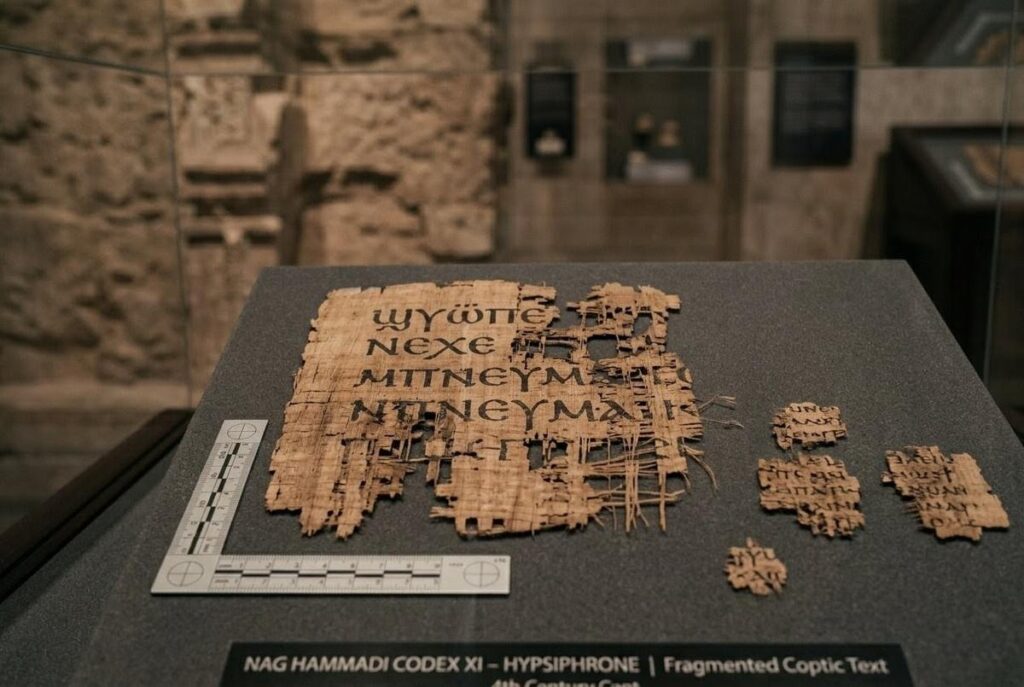
Hypsiphrone (Greek: Hypsiphrōn, “She of High Mind” or “Proud Thought”) is a fragmentary Sethian Gnostic text preserved as the fourth tractate of Nag Hammadi Codex XI (NHC XI,4). Composed in Coptic (Subachmimic dialect) circa 350-400 CE, though likely translated from an earlier Greek original of the 3rd century, the text survives only in damaged form—its beginning and end lost, its middle portions lacunose. What remains is a first-person visionary account of mystical ascent specifically structured around the Five Seals (sphragides), the Sethian initiatory sequence transforming the soul from material to spiritual substance. Unlike the systematic metaphysics of Allogenes or the narrative expansiveness of Zostrianos, Hypsiphrone presents concentrated experiential data: the actual “felt sense” of passing through initiatory checkpoints, encountering angelic examiners, and receiving the credentials necessary for continued ascent. The text references the “five trees” of Paradise, the angelic being Authrounios (possibly associated with the Saturnian sphere), and the “living water” of the First Seal, providing crucial evidence for reconstructing Sethian ritual practice.
Primary Source Citations: Nag Hammadi Codex XI,4; folios 27-29 of the Coptic manuscript (with significant lacunae at beginning and end). The text occupies a fragmentary section of Codex XI alongside Allogenes (XI,3), the Three Steles of Seth (XI,5), and other Platonising treatises. The Coptic title Hypsiphrōn appears at the end of the extant text, confirming Greek origins. Scholarly editions: Peel (1985), Turner (1990). The reference to “Authrounios” corresponds to the planetary archon Authrounios (Saturn) known from other Sethian sources including Zostrianos.
The Mysterious Fragment of Codex XI
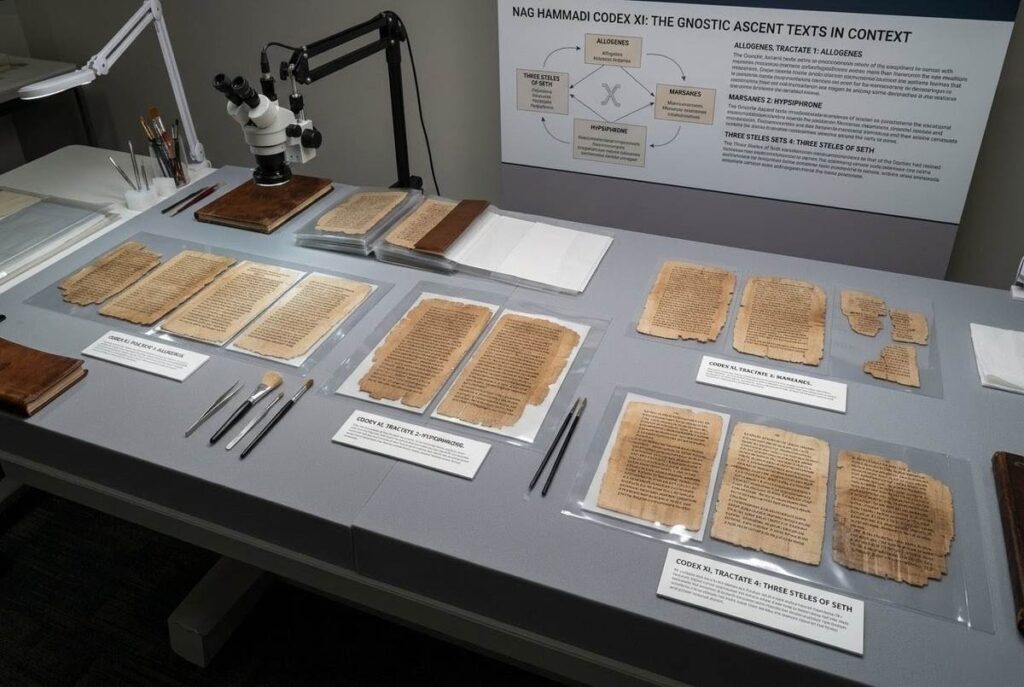
Amidst the sophisticated cosmological treatises and systematic metaphysics of Nag Hammadi Codex XI, Hypsiphrone stands as a tantalisingly incomplete dossier—its pages damaged, its narrative fragmented, yet its content precious precisely because of its raw experiential immediacy. Preserved alongside Allogenes, Marsanes, and other Platonising texts, this short work survives only in partial form: the opening lines destroyed, the conclusion lost to papyrus decay, the middle portions interrupted by lacunae that swallow crucial details of the ascent procedure.
The Value of Fragmentary Evidence
Yet what remains is operationally invaluable. Unlike the theoretical cartography provided by other texts, Hypsiphrone offers a first-person eyewitness account of the Five Seals in action—not as abstract sacramental categories but as lived checkpoints through which the ascending soul must pass. The text’s obscurity is compounded by distinctive vocabulary and mythological allusions that resist easy categorisation, suggesting either a highly specific ritual community’s dialect or a literary representation of altered states so intense that ordinary language fractures under the pressure.
The fragmentary nature proves oddly appropriate: Hypsiphrone documents an ascent necessarily incomplete within textual representation. The journey exceeds the report; the experience outstrips the documentation. We possess the middle permits of a celestial visa application whose cover page and final approval remain lost to administrative entropy.
The Speaker and Her Situation
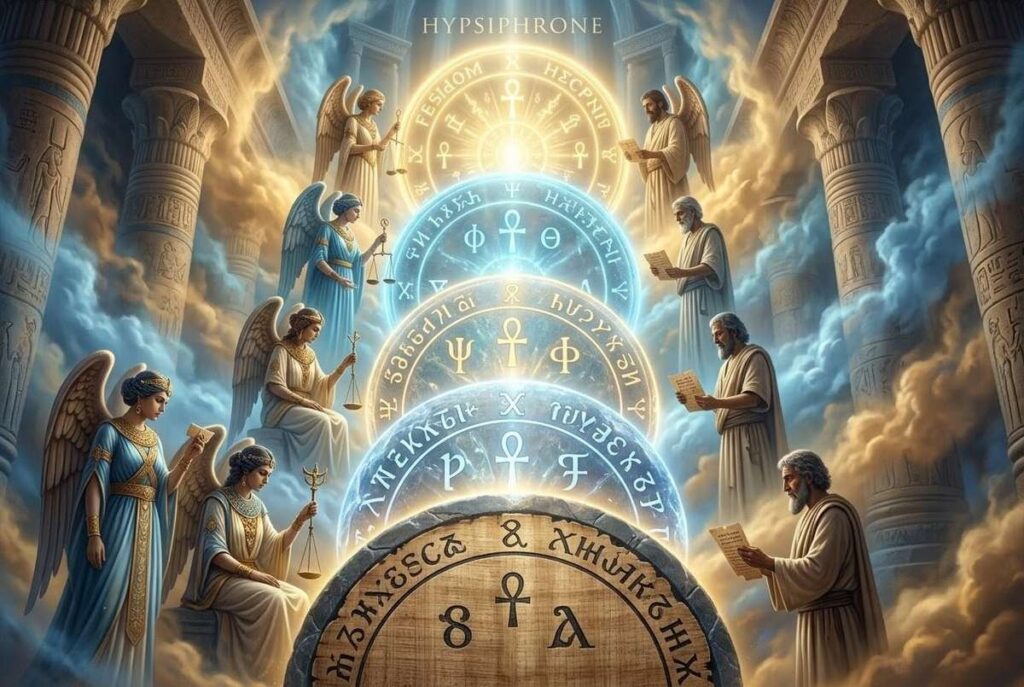
The text opens with the speaker—apparently named Hypsiphrone or identifying with this figure—describing her departure from a “place” and entry into visionary jurisdiction. The opening lines are severely damaged, but the narrative quickly achieves clarity: she ascends through multiple ontological levels, encounters various angelic functionaries, and undergoes systematic transformation through the Five Seals.
The Ambiguity of Identity
The name “Hypsiphrone” carries dangerous connotations. In Greek ethical literature, hypsēlophrosynē (high-mindedness) often indicates intellectual pride—the arrogance of those who believe themselves above ordinary mortal constraints. Yet here this quality appears positively revalued as the necessary credential for mystical daring. The speaker embodies the “proud thought” that refuses material limitations, insisting on direct knowledge of divine mysteries despite the jurisdictional barriers between mortal and immortal territories.
This may represent a self-designation of the historical visionary, a mythological figure whose experience initiates re-enact, or a textual persona allowing readers to inhabit the ascent experientially. Regardless, the presentation claims realised rather than merely hoped-for transformation: this is not catechetical instruction for beginners but the report of successful navigation through celestial bureaucracy, the testimony of a traveller who has actually obtained the seals and lived to dictate the encounter.
The Five Seals in Practice
While other Nag Hammadi texts mention the Five Seals—particularly the Apocryphon of John and Trimorphic Protennoia—Hypsiphrone provides the most detailed experiential account of their operational mechanics. The seals appear not merely as ritual actions performed upon the body but as stages of cognitive transformation, ontological checkpoints that upgrade the soul’s status as it passes through successive jurisdictions.
The First Seal: Immersion in Living Water
The First Seal involves entry into a realm characterised as “living water.” The speaker describes “descending” into this water and emerging transformed—language suggesting baptismal immersion but reinterpreted as vertical movement through aeonic space rather than horizontal ritual performance. The water serves as both solvent and credential: it dissolves the soul’s material adhesions while impressing the first official seal of initiatory clearance.
This aquatic jurisdiction aligns with broader Sethian baptismal theology, where water represents the first elemental boundary the soul must cross in its return to spiritual source. The “living” quality suggests water animated by divine presence—fluid that carries consciousness rather than merely washing surfaces.
Subsequent Seals and Angelic Examination
The subsequent seals associate with specific angelic beings who challenge and assist the ascending soul. These guardians require passwords or demonstrations of worthiness—credentials proving the traveller has undergone necessary preparation. This recalls the symbola (passwords) necessary for passage through planetary spheres in mystery cults and Jewish apocalyptic, suggesting Hypsiphrone preserves a ritual technology widespread in Mediterranean spiritual economies but specifically adapted to Sethian theological requirements.
The text mentions “the five trees” of Paradise—possibly corresponding to the five seals as sources of nourishment for the ascending soul. This arboreal imagery connects Hypsiphrone to the Gospel of the Egyptians, which similarly references five trees sustaining the seed of Seth, suggesting a shared ritual symbolism linking initiation to Edenic restoration.
“The seals function as credentials—proof that she has undergone the necessary preparation and deserves passage through the angelic jurisdictions.”
— NHC XI,4: Hypsiphrone
Angelic Opposition and Assistance
Unique to Hypsiphrone is its nuanced attention to angelic intermediaries operating within the celestial administrative hierarchy. Unlike the uniformly hostile archons who seek to prevent ascent in other texts—toll collectors demanding payment or border guards refusing passage—Hypsiphrone presents a mixed landscape: some angels challenge to test readiness; others actively assist the transformation process.
Authrounios and the Planetary Jurisdictions
The text mentions “Authrounios”—likely the angelic being associated with the sphere of Saturn in other Sethian sources. If this identification holds, Hypsiphrone preserves traces of the planetary ascent schema found more elaborately in Zostrianos, where the soul must pass through seven planetary spheres guarded by archontic powers. However, Hypsiphrone’s tone remains less adversarial than typical archontic mythology suggests.
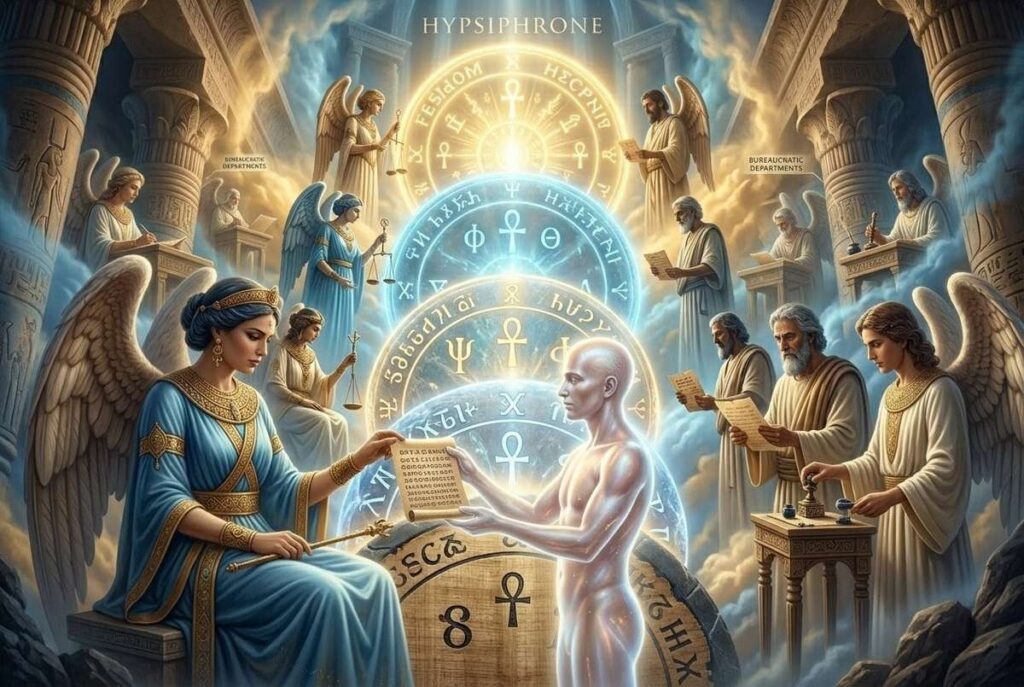
The speaker appears to expect these encounters, having prepared for them through prior initiation. The seals function as diplomatic credentials—documentation proving she has undergone necessary preparation and merits passage through jurisdictions that would otherwise deny entry to unprocessed material souls. This suggests a sophisticated understanding of celestial bureaucracy: angels are not enemies to be conquered but functionaries performing their appointed examinations.
Testing vs. Obstruction
The distinction proves crucial for understanding Sethian soteriology. The ascent is not merely escape from malevolent enemies but navigation through complex spiritual administration requiring proper paperwork. Angels challenge not to destroy but to verify; they obstruct not permanently but procedurally, ensuring only qualified candidates reach higher jurisdictions. Hypsiphrone thus presents a more theologically nuanced portrait of angelic function than the demonological caricatures found in polemical texts.
The Fragmentary Ending
The text breaks off as the speaker describes approaching the highest realm—the final jurisdiction beyond the Five Seals. We do not know whether she achieved full union with the divine, returned to teach others, or underwent further transformations beyond the preserved narrative. This incompleteness frustrates scholarly reconstruction yet proves theologically appropriate: Hypsiphrone represents ascent in progress, the journey rather than the destination, the process of credentialing rather than the final clearance.
The Limits of Textual Representation
What remains suggests the ascent culminated in vision of “the Power” or “the Light”—terminology consistent with Sethian theology but too fragmentary to specify. The final visible lines mention “sealing” and “perfection,” suggesting the Five Seals successfully completed their transformative work even if the ultimate destination remains obscured by manuscript damage.
The fragmentary ending perhaps preserves the most authentic wisdom: mystical ascent exceeds textual capture. The highest experiences necessarily escape literary documentation; they occur in jurisdictions where language loses its credentials and silence becomes the only appropriate response. Hypsiphrone breaks off precisely where it should—at the threshold of the unspeakable.
Relationship to Other Texts
Hypsiphrone’s placement in Codex XI alongside Allogenes, Marsanes, and the Three Steles of Seth suggests ancient readers understood these texts as complementary accounts of mystical ascent—different administrative departments processing the same fundamental application for divine reunion.
Complementary Approaches to Ascent
Where Allogenes provides philosophical framework and Marsanes systematic metaphysics, Hypsiphrone offers experiential immediacy—the phenomenological “what it feels like” of Sethian initiation. The shared concern with the Five Seals links Hypsiphrone to the Apocryphon of John and Trimorphic Protennoia, though its focus on angelic encounter and first-person narration is distinctive.
It may represent a specific ritual community’s adaptation of broader Sethian baptismal theology—a local variation on universal themes, the particular customs of one spiritual jurisdiction within the wider Sethian federation. The text’s uniqueness prevents generalisation about “the” Sethian ritual while simultaneously enriching our understanding of the tradition’s diversity.
The Autobiography of Transformation
Despite its fragmentary state, Hypsiphrone remains essential for understanding the full spectrum of Sethian literature. It demonstrates that the tradition included not only cosmological speculation and ethical exhortation but also the direct record of visionary experience—the autobiography of souls who had undergone the transformation they preached. In Hypsiphrone, we hear the voice of someone who has actually navigated the checkpoints, obtained the seals, and lived to describe—if not complete—the ascent paperwork.
Hypsiphrone (NHC XI,4) ultimately teaches that celestial ascent requires more than metaphysical knowledge—it demands the proper credentials, the sequential processing through administrative checkpoints, and the humility to submit to angelic examination despite one’s “high mind.” The fragmentary text preserves the middle chapters of a soul’s successful navigation through the Five Seals, offering irreplaceable evidence that Sethian Gnosticism was not merely speculative theology but practiced transformation. Though the beginning and end are lost to papyrus decay, the surviving pages provide sufficient testimony: the seals work, the angels verify, and the ascent proceeds according to protocol—even if the final clearance remains, appropriately, beyond the visible manuscript.
Frequently Asked Questions
What is Hypsiphrone in the Nag Hammadi Library?
Hypsiphrone (NHC XI,4) is a fragmentary Sethian Gnostic text preserved in Codex XI, named after its speaker (‘She of High Mind’). It provides a first-person account of mystical ascent through the Five Seals—initiatory checkpoints transforming the soul from material to spiritual substance. Unlike systematic treatises, it offers experiential immediacy of angelic encounters and ritual transformation.
What are the Five Seals mentioned in Hypsiphrone?
The Five Seals are a Sethian initiatory sequence mentioned in Hypsiphrone as stages of transformation. The First Seal involves immersion in ‘living water’ (baptismal imagery reinterpreted as vertical ascent). Subsequent seals involve angelic examinations and credentials. The text connects the seals to the ‘five trees’ of Paradise, suggesting nourishment and restoration motifs alongside initiatory transformation.
Why is Hypsiphrone fragmentary and incomplete?
The text survives only in damaged form within Codex XI, with beginning and end lost to papyrus decay and lacunae interrupting the middle. While frustrating for scholarship, this incompleteness is theologically appropriate: it represents ascent in progress, the journey rather than destination. The manuscript breaks off as the speaker approaches the highest realm, preserving the mystery of ultimate union.
Who is the speaker in Hypsiphrone?
The speaker is apparently named Hypsiphrone (Greek for ‘She of High Mind’ or ‘Proud Thought’) or identifies with this figure. The name suggests intellectual/spiritual daring necessary for mystical ascent. She may be a historical visionary, mythological figure, or literary persona allowing readers to inhabit the ascent. The text presents her as having successfully undergone the Five Seals transformation.
How does Hypsiphrone treat angels and archons during ascent?
Unlike texts presenting uniformly hostile archons, Hypsiphrone offers nuanced angelic bureaucracy: some angels challenge to test readiness; others actively assist. The tone is less adversarial—angels function as examiners verifying credentials rather than enemies preventing passage. The text mentions ‘Authrounios’ (possibly the Saturn sphere guardian), suggesting planetary ascent schema similar to Zostrianos but with less conflict.
How does Hypsiphrone relate to other Nag Hammadi texts?
Hypsiphrone appears in Codex XI alongside Allogenes (philosophical ascent), Marsanes (metaphysical system), and Three Steles of Seth (hymnic). It complements these by providing experiential immediacy. The Five Seals connect it to Apocryphon of John and Trimorphic Protennoia, while the ‘five trees’ imagery links to Gospel of the Egyptians. It represents a specific ritual community’s adaptation of broader Sethian themes.
What is the significance of Hypsiphrone for understanding Gnosticism?
Hypsiphrone is crucial for understanding Sethianism as practiced transformation rather than mere speculation. It provides direct evidence of ritual performance, showing how the Five Seals operated as actual initiatory procedures. The first-person narrative demonstrates that Gnostic communities included individuals claiming successful ascent, not just theoretical knowledge. It reveals the diversity of ascent accounts within the tradition—philosophical, metaphysical, and experiential.
Further Reading
Explore related texts on the Five Seals, Sethian ascent, and the manuscript context of Codex XI:
- The Five Seals: Sethian Initiation Mysteries – Study the comprehensive treatment of the seals across the Nag Hammadi library and their ritual significance.
- Allogenes: The Sethian Ascent to the Unknowable One – Compare the philosophical approach to ascent from the same codex (NHC XI,3).
- Zostrianos: The Complete Journey Through the Thirteen Aeons – Examine the elaborate baptismal ascent with detailed planetary sphere navigation.
- Trimorphic Protennoia: Three Descents and the Voice of Divine Thought – Study another detailed account of seal-giving and divine descent/ascent.
- The Apocryphon of John: The Gnostic Creation Account – Explore the classic presentation of the Five Seals within Sethian creation mythology.
- Codex XI: The Valentinian Technical and Sethian Platonizing Treatises – Learn about the manuscript context and physical condition of this fragmentary codex.
- The Gospel of the Egyptians: Sethian Cosmogony – Investigate the parallel tradition of the “five trees” of Paradise mentioned in Hypsiphrone.
- The Three Steles of Seth: Hymns of Ascent – Continue reading Codex XI materials with these liturgical hymns of praise and elevation.