Steganographia
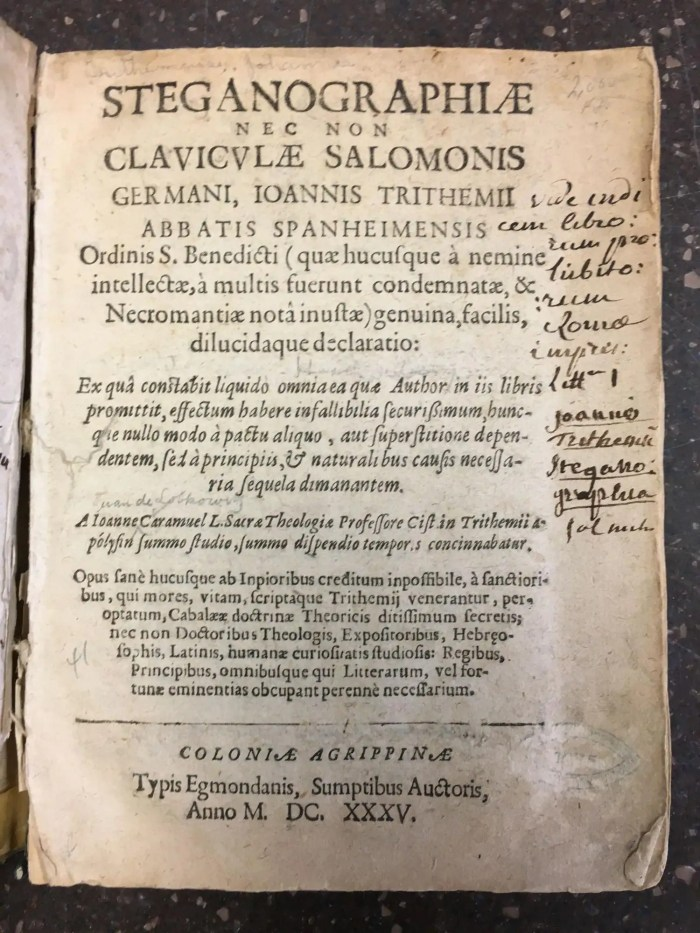
Steganographia is one of the strangest books in the history of hidden writing. Written around 1499 by the Benedictine abbot Johannes Trithemius and first printed in 1606, it appears to describe spirits who can carry messages across distance. Yet beneath the angelic and spirit language lies a sophisticated system of cryptography, steganography, memory, timing, concealment, and coded transmission.
This is what makes the text so powerful. It refuses the modern separation between code and spirit. To a literal reader, the book looks like a grimoire of spiritual messengers. To a cryptographic reader, it becomes a manual of concealed communication. To a symbolic reader, it reveals something deeper still: messages can be present and unreadable, visible and hidden, ordinary and charged with another layer of meaning.
Steganographia belongs to the same Renaissance world that later made John Dee possible: a world of angelic names, mathematical tables, hidden alphabets, sacred language, diplomatic secrecy, planetary order, and the conviction that reality may be structured like a text. This article reads the work historically and symbolically, without flattening it into either “just magic” or “just cryptography”. The cipher and the angel stand closer together here than modern categories prefer.

In Plain Terms
Steganographia is a work by Johannes Trithemius that appears to describe spirit communication but also conceals systems of cryptography and hidden writing.
Steganography means hiding the existence of a message, not merely scrambling the message itself. The message may be concealed inside ordinary-looking text, image, sound, ritual language, or another carrier.
The book became controversial because its angelic and spirit language made it look like a magical text, while its hidden methods also made it a practical guide to secret communication.
The safest reading is layered. Steganographia can be studied as cryptography, Renaissance esotericism, angelic symbolism, hidden writing, and a Gnostic-style meditation on concealed meaning and discernment.
Primary Sources and Traditions Discussed
- Johannes Trithemius’s Steganographia: the controversial work of hidden writing, spirit language, cryptographic concealment, and long-distance communication.
- Trithemius’s Polygraphia: the printed cryptographic companion work that presents systems of secret writing more openly.
- The Tabula Recta: the Table of Trithemius, a shifted alphabet grid used in polyalphabetic substitution and later symbolic readings of coded language.
- Renaissance cryptography: substitution ciphers, polyalphabetic methods, hidden writing, cipher wheels, diplomatic secrecy, and concealed transmission.
- Christian angelic and grimoire traditions: the language of spirits, names, messengers, timing, hierarchy, and invisible offices.
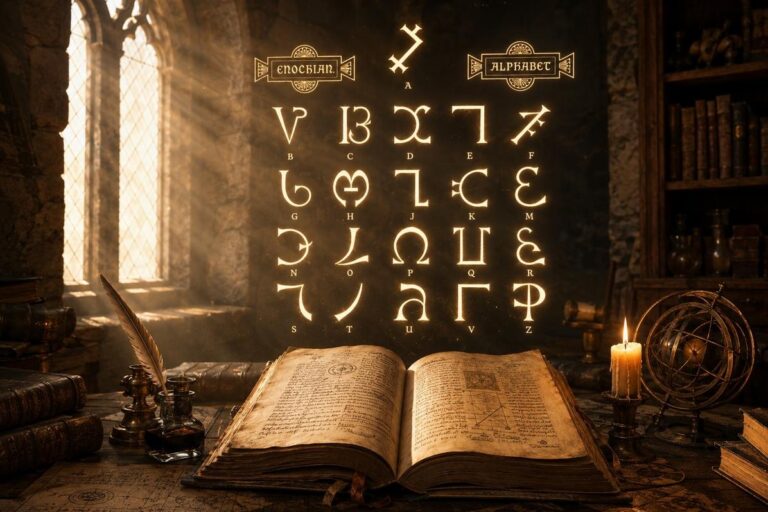
- John Dee and Elizabethan angelic science: the later world of sacred mathematics, Enochian letters, scrying, tables, angelic names, and coded revelation.
- Modern cryptographic scholarship: especially the later recognition that Book III also contains cipher material beneath its magical cover-language.
- Gnostic discernment: the distinction between hidden truth, theatrical secrecy, manipulative concealment, and direct liberating recognition.
How to Read This Article
This article is historical, symbolic, and contemplative. It does not provide secure modern encryption advice, magical training, spirit-contact instruction, operational ritual guidance, or a claim that every “spirit” in Steganographia should be understood in one simple way.
Three layers should be kept distinct. The cryptographic layer concerns hidden messages, cipher systems, and concealed communication. The angelic-magical layer concerns spirit names, timing, invocations, and Renaissance ideas of invisible mediation. The Gnostic layer asks what hidden writing reveals about secrecy, power, interpretation, and the recovery of direct knowing.
The book is most useful when it teaches careful reading. It becomes misleading when every secret is treated as sacred, every code as revelation, or every hidden pattern as proof of cosmic instruction.
Steganography does not merely hide meaning. It hides the fact that meaning is hidden.
Table of Contents
- What Is the Steganographia?
- Steganography: Hiding the Message in Plain Sight
- Johannes Trithemius: Abbot of Hidden Writing
- The Three Books: Spirits, Hours, and Concealed Ciphers
- Book I: Diurnal Spirits and Hidden Procedures
- Book II: Nocturnal Transmission and Deeper Concealment
- Book III: Magical Circles and the Solved Ciphers
- The Index: Why the Book Was Feared
- From Trithemius to John Dee
- From Hidden Writing to the Digital Age
- The Caution: Pattern, Code, and Obsession
- The Gnostic Reading: Hiddenness Is Not the Same as Liberation
- Related Glossary Terms
- Read Next
- Frequently Asked Questions
- Further Reading
- References and Sources
What Is the Steganographia?
Steganographia, meaning hidden writing, is Trithemius’s most famous and most controversial work. It was composed around 1499 and printed in Frankfurt in 1606, long after Trithemius’s death. It presents itself as a system by which spirits can transmit messages across distance, but much of the work also contains cryptographic and steganographic methods concealed beneath that spirit-language.
This double nature made the book difficult to classify. Was it a manual of angelic magic? A cryptographic treatise disguised as a grimoire? A devotional fantasy wrapped around cipher methods? A magical text that used cryptography as its outward garment? The answer depends on which layer is being read.
Modern scholarship has shown that Books I and II contain ciphers and concealed procedures, and that Book III, long treated as more purely magical, also contains cryptographic material. Yet this does not make the book duller. It makes it more fascinating. The old “spirits” do not vanish. They become ambiguous figures at the crossing point of name, key, memory, timing, message, and imagination.
The enduring power of Steganographia lies in this ambiguity. It is not merely a book about secret writing. It is a book that performs secrecy through its own structure. The reader must learn how to read before the text gives up its meaning.
Steganography: Hiding the Message in Plain Sight
Steganography differs from cryptography in an important way. Cryptography transforms a message so that it cannot be read without a key. Steganography hides the existence of the message itself. A cipher says, “There is a secret here, but you cannot read it.” Steganography says, “There is nothing to see.”
That makes steganography especially subtle. A hidden message may be concealed inside devotional writing, ordinary correspondence, poetry, numbers, names, diagrams, images, or ritual instructions. The carrier appears innocent. The message travels beneath the surface.
In Trithemius, this technique becomes more than practical secrecy. It becomes a spiritual metaphor. The message is present but veiled. The text speaks in one register to the casual reader and another to the trained reader. Meaning is not absent. It is covered.
This is why the book speaks so strongly to esoteric tradition. Sacred writing often works the same way. The outer text may carry story, prayer, myth, law, image, or doctrine. The inner text may carry instruction, pattern, map, warning, or direct recognition. The art is not only to hide. It is to prepare the reader.
Johannes Trithemius: Abbot of Hidden Writing
Johannes Trithemius (1462-1516), born Johann Heidenberg, was a Benedictine abbot, historian, scholar, theologian, cryptographer, and one of the most curious figures of the Renaissance. He governed monasteries, built libraries, wrote histories, trained students, and became associated with both learned humanism and magical theology.
His students and later admirers placed him near the beginning of a powerful esoteric lineage. Heinrich Cornelius Agrippa knew his work. Later Renaissance and early modern readers encountered Trithemius as a figure who stood between monastery and magic, disciplined scholarship and hidden transmission, spiritual authority and coded method.
Trithemius’s significance does not lie only in whether he “believed in spirits” in a simple modern sense. His importance lies in the way his work binds together several forms of mediation. Letters mediate thought. Ciphers mediate secrecy. Angels mediate divine order. Books mediate memory. Names mediate invisible functions. In his world, these forms of mediation could overlap without embarrassment.
The modern reader may separate code and spirit, but Trithemius shows an older imagination in which both belonged to the same question: how does meaning travel between worlds without being lost, stolen, or misunderstood?
The Three Books: Spirits, Hours, and Concealed Ciphers
The traditional Steganographia is organised into three books. Each book presents methods of hidden transmission through a language of spirits, hours, names, invocations, alphabets, and tables. The structure grows stranger as it proceeds.
At the surface level, the text appears to describe spiritual messengers who can carry words across distance. At the technical level, many of these figures encode procedures. Spirit names, invocatory phrases, timing structures, and tables can function as keys, disguises, or mnemonic containers for cryptographic operations.
This does not require the reader to decide that the spirits are “only” fake, or that the ciphers are “only” magical camouflage. Trithemius’s world allows for layered meaning. A spirit-name may serve as a devotional figure, memory hook, cipher key, symbolic intelligence, and magical mask at once.
Book I: Diurnal Spirits and Hidden Procedures
Book I presents spirits associated with daylight hours and message transmission. Names such as Padiel, Aseliel, and Masemie appear within the text’s spiritual machinery. To the untrained reader, the material resembles a manual of spirit communication. To the cryptographic reader, these spirits can also function as parts of a concealed system.
The spirit names and invocatory structures become ways of organising information. They help the reader remember procedures, shifts, or patterns. The language of spirit contact provides a cover, but also a symbolic grammar. The operator does not simply hide a message. They place it within a structured invisible order.

From a symbolic angle, Book I teaches that communication is never merely mechanical. Every message has conditions: sender, receiver, timing, channel, key, intention, and possible interception. Even ordinary speech depends on invisible agreements. Trithemius makes those agreements visible by clothing them in spirits and hours.
Book II: Nocturnal Transmission and Deeper Concealment
Book II expands the system into more elaborate structures and nocturnal conditions. The symbolism of night matters. Night is the realm of hidden movement, secrecy, dreams, coded exchange, and messages travelling while ordinary sight sleeps. It is therefore the natural symbolic territory for deeper concealment.
The cryptographic methods become more complex, and the spiritual language thickens. The effect is deliberate. The reader must pass through layers of apparent magical instruction before recognising the hidden procedures beneath. The book trains a kind of double vision: one eye on the spirit-language, one eye on the cipher.
For modern readers, Book II is a reminder that concealment has levels. Some secrets are hidden by difficulty. Others are hidden by excess. A text may bury its message not by silence, but by surrounding it with enough symbolic noise that only a patient reader can hear the signal.
Book III: Magical Circles and the Solved Ciphers
Book III long held the most notorious reputation. Its tables, circular diagrams, angelic names, and magical-looking formulae seemed to support the view that Steganographia was primarily a spirit-working or demonological text. Yet modern cryptographic work showed that Book III also contains concealed cipher messages beneath its magical surface.
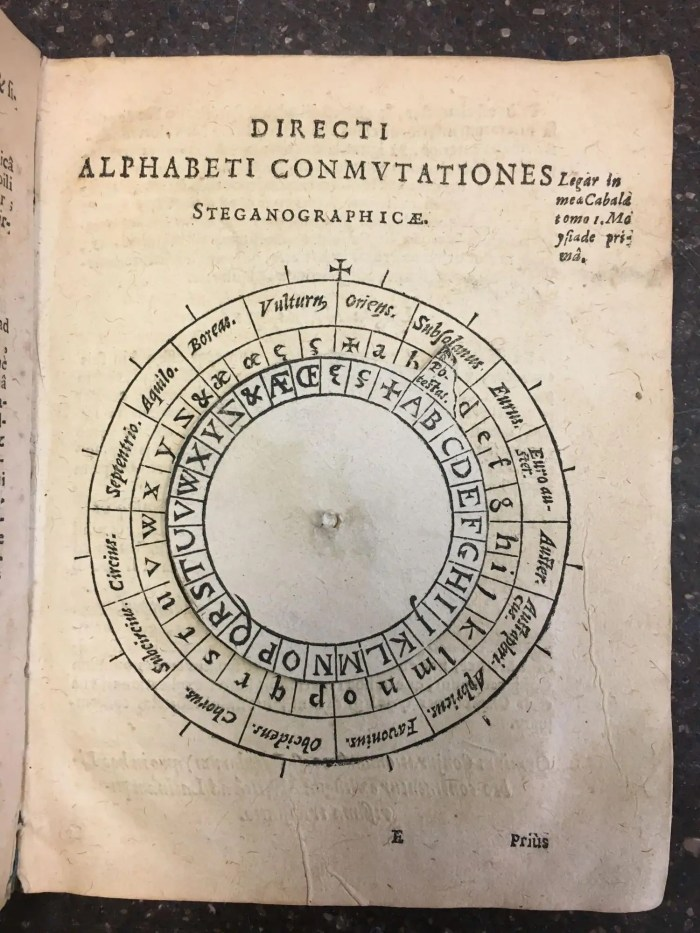
This discovery changed how the work is read. Book III can no longer be dismissed as merely occult theatre. Its magical forms also hide technical meaning. The circles and formulae are not dead decoration. They are part of the book’s practice of concealment.
That does not remove the spiritual aura of the text. It intensifies it. A book that hides ciphers beneath spirit-language is doing exactly what it describes: concealing transmission inside another form. Steganographia is not only about hidden writing. It is hidden writing.
The Index: Why the Book Was Feared
Steganographia was placed on the Index Librorum Prohibitorum in 1609 and removed in 1900. The reasons are not hard to understand. The book appeared to combine spirit communication, invisible messengers, secret transmission, magical names, and techniques for communicating across distance. For early modern religious and political authorities, that combination touched several fears at once.
There was the fear of unauthorised spiritual contact. There was the fear of concealed communication. There was the fear of magical practice. There was also the simple institutional anxiety that some forms of knowledge allow messages to move beyond approved channels.
It would be too simple to say the book was banned only because the Church misunderstood cryptography. It would also be too simple to say the book was banned only because it contained dangerous magic. The deeper issue is that Steganographia made boundaries unstable. Prayer and cipher, spirit and method, revelation and concealment, devotion and secrecy all began to overlap.
Authorities often fear unstable boundaries more than outright opposition. A forbidden message is one problem. A method for hiding messages inside acceptable forms is another.
From Trithemius to John Dee
John Dee inherited a world in which mathematics, cryptography, angelic communication, sacred language, and political secrecy could all belong to one intellectual atmosphere. Dee studied cryptographic and mathematical works seriously. His own angelic practice with Edward Kelley later produced tables, letters, calls, names, seals, and careful records of scrying sessions.
Trithemius helps us understand the world that made Dee possible. In both figures, communication is structured. The unseen does not arrive as vague inspiration only. It arrives through alphabets, diagrams, tables, timing, names, instruments, and records. Hidden knowledge needs a grammar.
This does not mean Dee simply copied Trithemius. It means the two belong to the same broad Renaissance current: the search for a sacred science of language, number, and invisible mediation. The cipher table and the angelic table are neighbouring technologies of contact.
The modern reader can see why this matters. A table can organise letters. A seal can organise symbolic attention. A ritual can organise the body. A diary can organise vision. Without structure, hidden knowledge dissolves into mood. With structure, even strange material can be examined, tested, and returned to.
From Hidden Writing to the Digital Age
The modern world lives inside hidden writing. Encryption protects banking, messaging, identity, privacy, state secrets, journalism, whistleblowing, dissident communication, and ordinary personal life. Steganography persists too: information can be hidden inside images, sound files, metadata, network traffic, or other carriers.
Trithemius is not the direct inventor of every modern technique, but his work belongs to the lineage of concealed communication that still shapes digital life. The core problem remains unchanged: how can a message move safely through a hostile or watchful environment?

In this sense, Steganographia feels newly relevant. It reminds us that communication is never neutral when power controls visibility. A message that can be seen can be intercepted. A message that announces itself as secret can be targeted. A message that hides inside another form may survive.
The Gnostic resonance is clear. The hidden spark does not always travel openly. Sometimes truth survives by disguise, symbol, parable, cipher, dream, fragment, myth, or apparently harmless story. The visible world may be the carrier. The message may be elsewhere within it.
The Caution: Pattern, Code, and Obsession
Any article about codes and hidden messages needs a caution. Once the mind learns to look for concealment, it can begin seeing concealment everywhere. This can become creative, but it can also become destabilising. Pattern recognition is powerful. Pattern obsession is dangerous.
Not every coincidence is a cipher. Not every strange phrase is a secret instruction. Not every hidden structure is spiritual revelation. Some hidden systems protect wisdom. Others protect manipulation. Some concealment is sacred. Some is simply secrecy serving power.
The old disciplines matter here: slow reading, record-keeping, ethical grounding, sober comparison, ordinary support, and the willingness to test interpretations over time. A real cipher must be solved carefully. So must a dream, symbol, synchronicity, ritual result, or hidden text.
Discernment asks what the interpretation produces. Does it increase clarity, humility, responsibility, embodiment, and compassion? Or does it increase paranoia, superiority, obsession, sleeplessness, fear, and isolation? The answer matters more than the elegance of the pattern.
The Gnostic Reading: Hiddenness Is Not the Same as Liberation
A Gnostic reading of Steganographia begins with hiddenness, but does not stop there. Gnosis is not secrecy for its own sake. It is direct liberating recognition. A hidden message is valuable only if it serves truth, freedom, and awakening. Secrecy that creates dependence, status, fear, or manipulation is another veil.
The book teaches that the surface is not always the whole text. A message may be present beneath another message. A spirit may be a name, a key, a mask, a memory device, or a symbol of mediation. A prayer may conceal a cipher. A cipher may reveal a structure. A structure may train the reader to see.
But the table, the spirit, the code, and the hidden method are not the Source. They are instruments. To worship the instrument is to become trapped in another system of control. The archonic pattern can use secrecy as easily as it uses ignorance.
The mature reader learns the syntax without kneeling to the system. They read the hidden message, recover the key, and then ask what kind of freedom the knowledge actually serves.
Steganographia endures because it makes the act of reading dangerous again. Not dangerous as spectacle, but dangerous because the text asks whether the reader can distinguish concealment from revelation, code from wisdom, and secrecy from gnosis.
Related Glossary Terms
For quick definitions, use the main ZenithEye Glossary. The key terms for this article are:
Read Next
Continue with: The Table of Trithemius: A Bridge of Secret Codes and Angelic Spirits
If Steganographia shows how hidden writing can disguise itself as spirit communication, the Table of Trithemius reveals the alphabetic grid behind the method: shifted letters, coded transmission, and the symbolic power of concealed language.
Within The Hidden Agreements
This article belongs to Cryptographic Systems & Occult Communication, the Hidden Agreements layer where ciphers, sacred alphabets, hidden writing, seals, coded doctrine, angelic languages, and concealed transmission are read as technologies of secrecy and revelation.
Frequently Asked Questions About Steganographia
What is the Steganographia by Johannes Trithemius?
Steganographia is a work by Johannes Trithemius, written around 1499 and first printed in 1606. It appears to describe spirit communication and long-distance message transmission, but it also contains systems of cryptography and hidden writing concealed beneath angelic and magical language.
What does steganography mean?
Steganography means hiding the existence of a message, rather than only scrambling its contents. A steganographic message may be hidden inside ordinary text, an image, a sound file, a diagram, or another carrier that does not appear secret at first glance.
Why was Steganographia placed on the Index of prohibited books?
Steganographia was placed on the Index Librorum Prohibitorum in 1609 and removed in 1900. It was controversial because it appeared to involve spirit communication, hidden powers, long-distance transmission, magical names, and concealed communication outside authorised channels.
Is Steganographia magic or cryptography?
It can be read as both, depending on the layer being examined. Modern scholarship has shown that much of its spirit language conceals cryptographic methods. At the same time, the text belongs to a Renaissance world where angelic names, hidden writing, memory, theology, and magical symbolism could overlap.
What did Jim Reeds solve in Steganographia?
Jim Reeds showed that Book III of Steganographia contains cipher material beneath its magical-looking surface. Earlier readers often treated Book III as more purely magical, but modern cryptographic work revealed further hidden writing within the text.
How is Steganographia related to the Table of Trithemius?
Steganographia and Polygraphia are closely related works in Trithemius’s hidden-writing tradition. Polygraphia presents cryptographic methods more openly, including the Tabula Recta or Table of Trithemius. Steganographia veils hidden writing beneath spirit-language and invocatory forms.
How does Steganographia relate to John Dee?
Steganographia belongs to the Renaissance world of hidden writing, sacred alphabets, angelic names, tables, and coded transmission that later shaped John Dee’s angelic and mathematical imagination. Dee’s Enochian system is not the same as Trithemius’s work, but both belong to a related culture of sacred science and concealed communication.
What is the Gnostic meaning of Steganographia?
A Gnostic reading treats Steganographia as a symbol of hidden meaning and discernment. The surface text may conceal another message, just as ordinary reality may conceal deeper truth. But secrecy itself is not liberation. The goal is direct knowing, not fascination with codes for their own sake.
Study and Safety Note
This article explores Trithemius, Steganographia, cryptography, steganography, spirit language, angelic communication, John Dee, hidden writing, and Gnostic discernment for educational and reflective purposes. It does not provide secure modern encryption advice, magical training, spirit-contact instruction, medical advice, psychological advice, psychiatric advice, or crisis support.
If work with codes, hidden messages, synchronicities, occult systems, or secret meanings becomes obsessive, frightening, isolating, or destabilising, step back and return to ordinary grounding. Not every pattern is a message. Not every hidden structure requires pursuit.
Hidden knowledge should deepen clarity, humility, ethical action, and embodied presence. If it increases paranoia, grandiosity, fear, sleeplessness, contempt, or loss of function, seek support and reduce intensity.
Further Reading
These ZenithEye links continue the themes of Trithemius, hidden writing, angelic communication, John Dee, cryptographic systems, sacred language, and informational sovereignty:
- The Table of Trithemius: A Bridge of Secret Codes and Angelic Spirits – The shifted alphabet grid behind Trithemius’s cryptographic tradition, read as cipher tool, symbolic map, and meditation on hidden language.
- The Art of Drawing Spirits into Crystals: A Complete Trithemian Guide – Crystal scrying, angelic authentication, theurgy, and spirit-contact discernment in the Trithemian tradition.
- John Dee Mathematical Preface 1570: Occult Foundation of Renaissance Magic and Esoteric Mathematics – Dee’s sacred science, mathematical worldview, and the intellectual soil in which angelic systems could grow.
- The 19 Occult Arts: John Dee’s Complete Renaissance Magic Curriculum – Dee’s wider magical curriculum, where mathematics, optics, astronomy, navigation, and contemplative discipline form a sacred programme of knowledge.
- Scrying the Enochian Aethyrs: The Ultimate Guide to Higher Dimensional Gnosis – Dee’s visionary Aethyr sequence, read through altered states, symbolic ascent, and grounded discernment.
- Heptarchia Mystica: Commanding John Dee’s 7 Planetary Kings – Dee’s sevenfold angelic and planetary order, read through kings, princes, ministers, seals, timing, and sacred rhythm.
- The Enochian Cipher: Occult Cryptography and the Language of Angels – Angelic alphabets, Dee’s received language, and the occult imagination of sacred code.
- Deciphering the Esoteric Meaning: The Bible as Technology of Consciousness – Sacred texts, symbolic concealment, layered meaning, and the hidden language of esoteric Christianity.
- The Power of Words: Etymology, Conscious Language, and the Magic of Speech – Language as vibration, meaning, symbolic force, and conscious practice.
- Gnosis in the Digital Age: Reclaiming Your Sovereignty from the Algorithm – A modern companion on attention, algorithms, digital power, and informational self-governance.
References and Sources
The following sources support the historical, cryptographic, esoteric, and comparative framework used in this article.
Primary Trithemian Sources
- Trithemius, Johannes. Steganographia. Composed c. 1499, first printed Frankfurt, 1606. Important for hidden writing, spirit language, and the overlap between cryptography and angelic communication.
- Trithemius, Johannes. Polygraphia. First printed 1518. Foundational work for the Tabula Recta and early modern systems of secret writing.
- Trithemius, Johannes. De Septem Secundeis. A short work on planetary intelligences and historical cycles, relevant to Trithemius’s wider angelic and cosmological reputation.
- Skinner, Stephen and Clark, Daniel, eds. The Steganographia: Books I-IV. Golden Hoard Press, 2024.
- McLean, Adam, trans. The Steganographia of Johannes Trithemius. Magnum Opus Hermetic Sourceworks, 1982.
Cryptography, Steganography, and Hidden Writing
- Reeds, Jim. “Solved: The Ciphers in Book III of Trithemius’s Steganographia.” Cryptologia, 22(4), 291-317, 1998.
- Ernst, Thomas. “The Numerical-Astrological Ciphers in the Third Book of Trithemius’s Steganographia.” Cryptologia, 22(4), 318-341, 1998.
- Kahn, David. The Codebreakers: The Comprehensive History of Secret Communication from Ancient Times to the Internet. Scribner, revised edition, 1996.
- Singh, Simon. The Code Book: The Science of Secrecy from Ancient Egypt to Quantum Cryptography. Fourth Estate, 1999.
- Schmeh, Klaus. Codebreaking: A Practical Guide. Wiley, 2020.
- Friedman, William F. and Friedman, Elizebeth S. The Shakespearean Ciphers Examined. Cambridge University Press, 1957. Useful context for evaluating hidden-writing claims critically.
Trithemius, Magic, and Renaissance Esotericism
- Brann, Noel L. Trithemius and Magical Theology: A Chapter in the Controversy over Occult Studies in Early Modern Europe. SUNY Press, 1999.
- Brann, Noel L. The Abbot Trithemius (1462-1516): The Renaissance of Monastic Humanism. Brill, 1981.
- Hanegraaff, Wouter J., ed. Dictionary of Gnosis and Western Esotericism. Brill, 2005.
- Yates, Frances A. The Occult Philosophy in the Elizabethan Age. Routledge, 1979.
- Agrippa, Heinrich Cornelius. De Occulta Philosophia Libri Tres. 1533. English translation by John French, 1651. Modern edition edited by Donald Tyson, Llewellyn, 1993.
- Walker, D. P. Spiritual and Demonic Magic from Ficino to Campanella. University of Notre Dame Press, 1975.
John Dee, Angelic Communication, and Sacred Mathematics
- Dee, John. The Mathematical Preface to Henry Billingsley’s English translation of Euclid’s Elements. London, 1570.
- Dee, John. John Dee’s Five Books of Mystery: Original Sourcebook of Enochian Magic. Edited by Joseph H. Peterson. Weiser Books, 2003.
- Casaubon, Meric, ed. A True & Faithful Relation of What Passed for Many Years Between Dr. John Dee and Some Spirits. London, 1659.
- Harkness, Deborah E. John Dee’s Conversations with Angels: Cabala, Alchemy, and the End of Nature. Cambridge University Press, 1999.
- French, Peter J. John Dee: The World of an Elizabethan Magus. Routledge, 1972.
- Asprem, Egil. Arguing with Angels: Enochian Magic and Modern Occulture. SUNY Press, 2012.
- Clucas, Stephen, ed. John Dee: Interdisciplinary Studies in English Renaissance Thought. Springer, 2006.
Language, Symbol, and Gnostic Discernment
- Robinson, James M., ed. The Nag Hammadi Library in English. Revised edition. HarperOne, 1990.
- Meyer, Marvin, ed. The Nag Hammadi Scriptures. HarperOne, 2007.
- Layton, Bentley. The Gnostic Scriptures. Yale University Press, 1987.
- King, Karen L. What Is Gnosticism?. Harvard University Press, 2003.
- Eco, Umberto. The Search for the Perfect Language. Blackwell, 1995.
- Couliano, Ioan P. Eros and Magic in the Renaissance. University of Chicago Press, 1987.
- Copenhaver, Brian P. Hermetica: The Greek Corpus Hermeticum and the Latin Asclepius. Cambridge University Press, 1992.