The Shem HaMeforash: God’s Explicit Name and the 72-Fold Secret
There is a name that Jewish tradition considers too potent for ordinary speech. It is not a prayer, not a mantra, and not a magic word in the fairy-tale sense. It is, according to Kabbalistic teaching, the explicit name of God–the Shem HaMeforash–and its history winds from the golden incense of the Temple’s Holy of Holies to the manuscript pages of medieval grimoires, from the whispered transmissions of High Priests to the printed manuals of modern Kabbalah study groups. The name has been called the source code of creation, the master key to the 72 angelic intelligences, and the very frequency by which the Red Sea parted.
This article traces the Shem HaMeforash from its biblical roots in Exodus to its medieval elaboration in Kabbalah and beyond. It separates what the texts actually say from what later tradition added, examines the historical moment when the pronunciation was deliberately concealed, and asks why a name–a sequence of breath and consonant–has been guarded for two millennia as the most protected knowledge in the Jewish mystical tradition.
Table of Contents
- The Three Verses — Exodus 14:19-21 and the 72-Letter Claim
- From Tetragrammaton to 72 Names — A History of Expansion
- The Temple and the Holy of Holies — When the Name Was Spoken Aloud
- The 72 Names — Angelic Map or Medieval Construction?
- Sefer Raziel and the Magical Tradition
- Why the Name Was Hidden — Restriction as Protection
- Modern Echoes — From Hasidic Whisper to New Age Workshop
- What the Name Actually Means
- Frequently Asked Questions
- Further Reading
- References and Sources
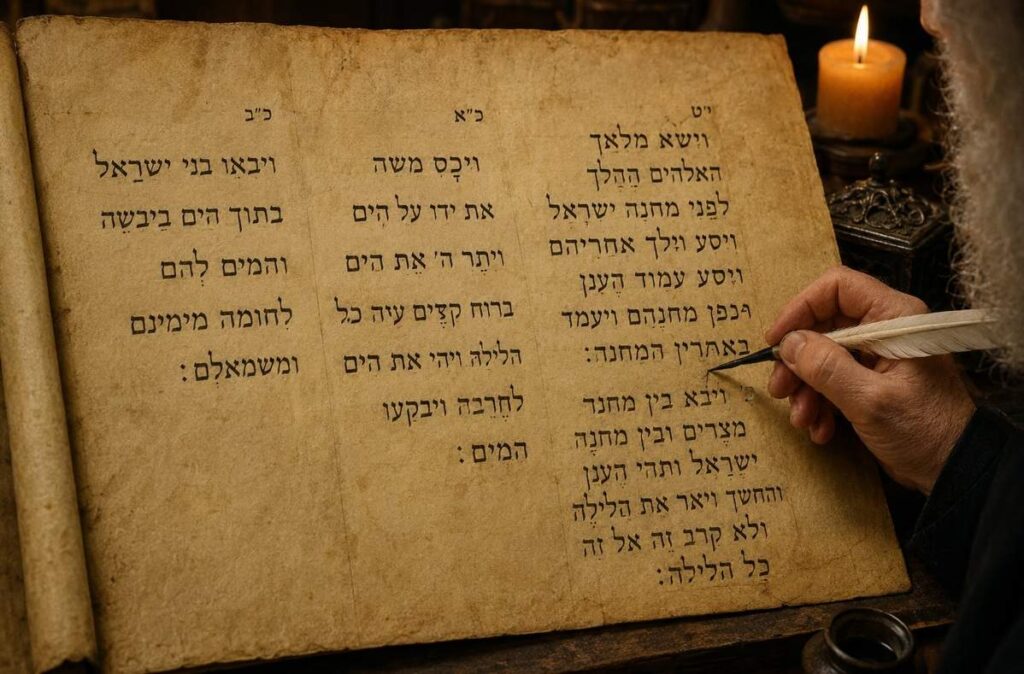
The Three Verses — Exodus 14:19-21 and the 72-Letter Claim
The entire edifice of the 72-fold name rests on a textual oddity. In the Book of Exodus, three consecutive verses describing the parting of the Red Sea–14:19, 20, and 21–are said by Kabbalistic tradition to contain exactly 72 Hebrew letters apiece. Read forward, reversed, and forward again, then stacked in vertical columns of three, they yield 72 triplet combinations. Each triplet becomes a “name,” and together they form the Shem HaMeforash in its 72-fold version.
This method, known as boustrophedon reading (literally “ox-turning,” as the plough reverses direction), is first explicitly documented in the Sefer HaBahir, a Kabbalistic text circulating in Provence between 1150 and 1200 CE. Rashi, the great eleventh-century French commentator, alludes to a 72-letter name in his commentary on Sukkah 45a, though he does not describe the full extraction method. The Zohar later elaborates the technique in its commentary on Beshalach, linking the three verses to the three sefirotic columns of Chesed (loving-kindness), Gevurah (judgment), and Tiferet (harmony).
What is crucial to understand is that the 72-letter count is a Kabbalistic reading of the text, not a plain-surface fact visible to any scribe. Medieval and modern scholars have debated whether the Masoretic text consistently yields exactly 72 letters in each verse across all manuscript traditions. The tradition treats the count as a discovered secret; critical scholarship treats it as an interpreted pattern. Both perspectives agree, however, that the three verses describe a liminal moment–the threshold between slavery and freedom, between water and dry land–and that the Kabbalists chose this moment as the cryptographic seed for their most elaborate divine name.
From Tetragrammaton to 72 Names — A History of Expansion
Here is where much popular teaching goes astray. The term Shem HaMeforash originally meant something far simpler. In Tannaitic sources–the Mishnah and early Talmudic literature–the “explicit name” refers almost exclusively to the Tetragrammaton, the four-letter name YHVH. Maimonides, writing in the twelfth century, is explicit: “This is what is referred to as the ‘explicit name’ in all sources… the name YHVH, as it is written.” The High Priest on Yom Kippur pronounced this four-letter name, not a 72-letter string.
The expansion into longer names–12 letters, 22 letters, 42 letters, and finally 72 triads–belongs to the Geonic and early medieval periods, between the eighth and thirteenth centuries. The 42-letter name appears in the responsa of Hai Gaon (tenth century), who admits that its proper vocalisation had already been lost. The 22-letter name surfaces in Sefer Raziel HaMalakh as a string of seemingly foreign syllables: Anaktam Pastam Paspasim Dionsim. The 72-fold name, the most elaborate of all, is the youngest major variant, achieving its complete form only in the Sefer HaBahir and the Zohar.
To speak of the 72 names as “the” Shem HaMeforash is therefore anachronistic before the High Middle Ages. The ancient Temple tradition knew the four-letter name. The 72-fold construction is a medieval Kabbalistic development–profound, intricate, and spiritually potent, but not the original meaning of the term.
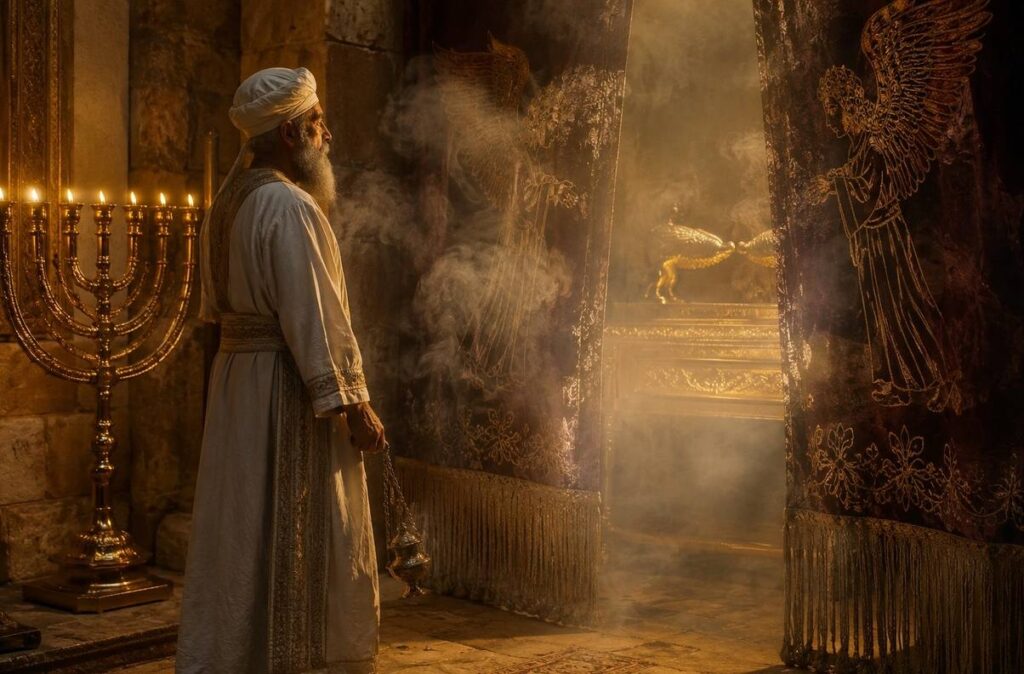
The Temple and the Holy of Holies — When the Name Was Spoken Aloud
The Mishnah records a scene of extraordinary drama. On Yom Kippur, the Kohen Gadol (High Priest) entered the Holy of Holies–the innermost sanctuary where the Ark once stood–and pronounced the explicit name ten times during the day’s service. The congregation, assembled in the Temple court, responded with the formula Baruch Shem Kevod Malchuto LeOlam VaEd (“Blessed be the Name of His glorious kingdom forever and ever”), and prostrated themselves upon the ground.
The Talmud adds a telling detail: measures were taken to ensure the name could not be overheard. According to tradition, priests and Levites made noise–some sources say they sang, others that they raised their voices or used instruments–to drown out the pronunciation. The reason was not merely jealousy but fear of misuse. A name considered to carry such concentrated theurgical power could not be allowed to fall into hands that might employ it for sorcery or personal gain. The Mishnah’s description of this practice is one of the few concrete historical records we possess of the Shem HaMeforash being vocalised in ritual context.
When the Second Temple fell in 70 CE, the liturgical context vanished. Without the Holy of Holies, there was no authorised venue for pronouncing the name as written. Rabbinic Judaism gradually substituted Adonai (“My Lord”) or other circumlocutions. The original vocalisation points–the niqqud that would tell a reader how to pronounce YHVH–were deliberately omitted from written texts. The name was not lost by accident; it was retired by consensus, preserved only in esoteric chains of transmission that grew thinner with each generation.
The 72 Names — Angelic Map or Medieval Construction?
The recording you may have heard assigns specific functions to each of the 72 names: Vehuiah for divine will, Jeliel for harmony, Sitael for obstacles, Elemiah for hidden things, Mahasiah for soul-level correction, Lelahel for healing at the root. These attributions are not ancient. They belong to the late medieval and early modern periods, particularly the sixteenth and seventeenth centuries, when Kabbalists such as Rabbi Moshe Zacuto compiled systematic correspondences between the names and spiritual functions.
Earlier sources–the Zohar, the Bahir, Rashi–do not provide this granular functional map. For them, the 72 names are primarily a theurgical unit, a collective name of power derived from the Exodus narrative. The individual “angelic” identities and therapeutic specialisations emerge only when Christian Kabbalists such as Johann Reuchlin (1517) begin adding the suffixes -El or -Yah to the triads, transforming them into pronounceable angel names. Reuchlin’s De Arte Cabbalistica lists 72 angels of the Shem HaMephorash, each ruling over a specific demon from the Ars Goetia. This is not biblical material; it is Renaissance occult synthesis.
The modern popular presentation of the 72 names as a toolkit for manifestation, healing, and prosperity–one name for each specific need–is therefore a contemporary packaging of much older materials. The names themselves are medieval; their individual functions are early modern; their marketing as a “technology for reality” is twenty-first century. None of this invalidates the tradition, but it is essential to know what date each layer was laid down.
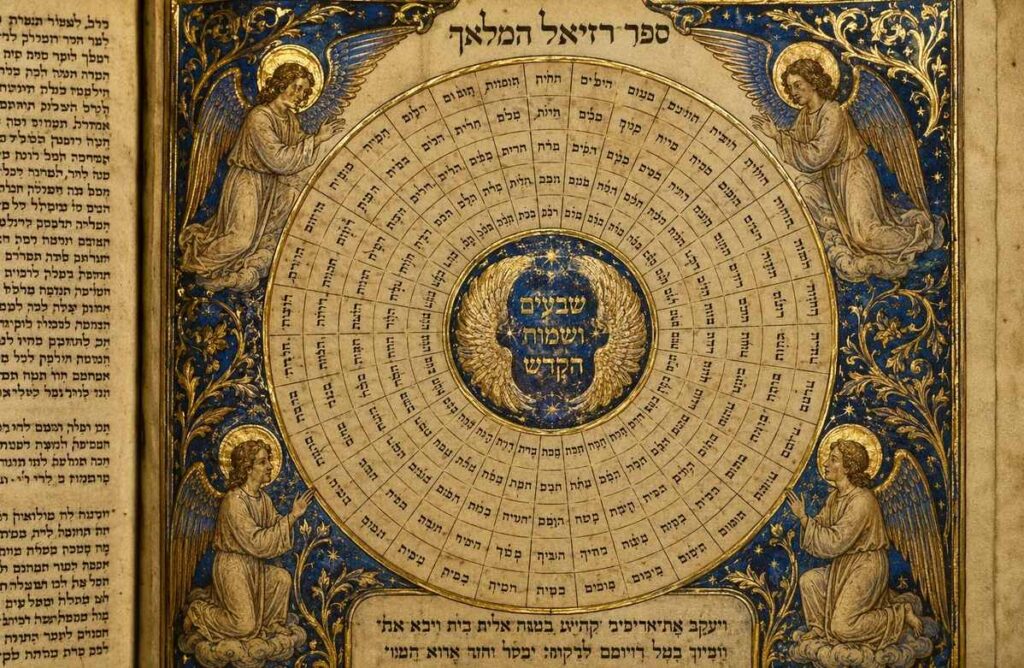
Sefer Raziel and the Magical Tradition
The Sefer Raziel HaMalakh (“Book of Raziel the Angel”) occupies a liminal space between theology and magic. According to the text’s own mythology, the angel Raziel taught Adam the secrets of creation after the expulsion from Eden, including the power of speech, the combinations of the Hebrew alphabet, and the 72-fold name. The book that preserves this teaching–actually a composite of texts from the Geonic period onward–contains elaborate angelologies, zodiacal magic, gematria tables, and protective amulets.
The 72-fold name is central to Sefer Raziel. The text claims that Moses used it to part the Red Sea, and that later holy men employed it to cast out demons, heal the sick, and even kill enemies. These are not metaphorical claims in the grimoire tradition; they are operational instructions. The book became notorious in German Renaissance magic, named by Johannes Hartlieb as among the most abominable works of necromancy. Roger Bacon, in 1260, complained that the Latin translation (Liber Semamphoras) had been so linguistically corrupted that its Hebrew original was barely recognisable.
The magical tradition thus presents the Shem HaMeforash as a technology of causation–a sequence of sounds that alters physical reality. This is a far cry from the rabbinic understanding of the name as a marker of divine presence, or the philosophical Kabbalistic view of the name as a map of emanation. The grimoire tradition literalises what the rabbis guarded and what the philosophers abstracted, turning a theological mystery into a operative manual.
Why the Name Was Hidden — Restriction as Protection
It’s possible that the name was hidden because a population with access to the “source code of reality” would be “by definition ungovernable.” This is a romantic reading. The historical reasons for the name’s restriction were more varied and more practical.
First, there was the theological concern of shvut–the rabbinic prohibition against pronouncing the divine name casually, derived from the Third Commandment. Second, there was the magical concern: a name believed to compel angels or alter natural processes could not be distributed widely without safeguards. Third, there was the political concern. In a world where rival Jewish sects, early Christians, and various Gnostic groups all claimed access to secret teachings, the rabbis tightened control over the most potent symbols of divine intimacy. The name became a boundary marker: those who knew it correctly were inside the tradition; those who did not were outside.
The restriction was indeed progressive. From public use in the First Temple period, the Tetragrammaton moved to liturgical substitution, then to esoteric transmission, then to complete non-pronunciation. By the Geonic period, even the 42-letter name’s vocalisation was disputed. The 72-fold name, being the most elaborate and youngest variant, was never widely pronounced at all; it was primarily a meditative and visual construct, scanned with the eyes rather than spoken with the tongue.
Modern Echoes — From Hasidic Whisper to New Age Workshop
In the twentieth century, the 72 names underwent a curious democratisation. The Kabbalah Centre, founded by Rabbi Yehuda Berg and others, popularised the names as a “technology for the soul,” teaching that meditation on specific triplet combinations could heal illness, attract prosperity, or dissolve negative karma. The names appeared on bracelets, keychains, and meditation CDs. What had been guarded for centuries as esoteric knowledge became consumer merchandise.
Academic scholarship, meanwhile, took a different path. Gershom Scholem’s historical studies of Kabbalah (mid-twentieth century) placed the 72 names firmly in their medieval context, tracing their development from the Bahir through the Zohar to the Lurianic Kabbalah of sixteenth-century Safed. Scholem’s work made it impossible to claim the 72 names as a biblical secret in the simple sense; they were revealed to be a product of specific historical moments, shaped by the theological pressures of exile, messianism, and mystical experience.
Between these two poles–popular commercialisation and scholarly historicisation–the contemporary seeker must navigate carefully. The names are not a magic wand. They are not a biblical password. They are a sophisticated symbolic system developed over centuries, carrying genuine spiritual weight for those who engage them with proper preparation, and carrying genuine risk of trivialisation for those who do not.
What the Name Actually Means
After separating the layers–biblical, Talmudic, medieval, Renaissance, modern–what remains? The Shem HaMeforash, in all its variants, points to a single intuition: that the divine is not merely described by language but is somehow present in language. The Hebrew letters are not arbitrary signs; in the Kabbalistic view, they are the building blocks of reality. To arrange them correctly is not to “cast a spell” in the vulgar sense, but to align human speech with the structural grammar of creation.
The name was hidden not because humanity could not handle it, but because language that powerful demands a container–a tradition, a community, a practice of purification–without which it becomes noise.
The restriction of the Shem HaMeforash is therefore best understood not as conspiracy but as ecology. A sacred name is a concentrated force, and forces require vessels. The rabbis who stopped pronouncing YHVH, the Kabbalists who visualised rather than vocalised the 72 names, and the modern teachers who insist on ethical preparation before theurgical practice–all are engaged in the same work: ensuring that the container matches the content. The name that parts seas also demands a sea-worthy vessel.
Frequently Asked Questions
What is the Shem HaMeforash and is it the same as the 72 names of God?
Originally, Shem HaMeforash referred to the Tetragrammaton (YHVH), the four-letter name of God pronounced by the High Priest in the Temple. The 72-fold name is a later Kabbalistic development derived from Exodus 14:19-21, first fully documented in the medieval Sefer HaBahir (c. 1150-1200 CE). They are related but historically distinct.
Do Exodus 14:19-21 really contain exactly 72 letters each?
Kabbalistic tradition holds that these three verses each contain exactly 72 Hebrew letters, yielding 72 triplet combinations when read boustrophedonically. This count is accepted within Kabbalistic exegesis but is an interpreted pattern rather than a plain-text fact visible across all manuscript traditions.
Did Moses use the 72 names to part the Red Sea?
This claim appears in Kabbalistic legends recorded in the Zohar and Sefer Raziel HaMalakh, not in the biblical text itself. Critical scholarship treats it as a medieval mystical interpretation of the Exodus narrative, not a historical fact.
Why was the pronunciation of God’s name lost?
After the destruction of the Second Temple in 70 CE, the liturgical context for pronouncing the Tetragrammaton vanished. Rabbinic Judaism gradually substituted Adonai and other circumlocutions. The original vocalisation points were deliberately omitted from written texts, and the correct pronunciation was transmitted only in restricted esoteric chains that eventually faded.
Are the 72 names actually names of angels?
The 72 triads become angelic names primarily when the suffixes -El or -Yah are added, a practice developed by Christian Kabbalist Johann Reuchlin in 1517. In Jewish Kabbalah, they are more commonly understood as divine names or energetic permutations rather than independent angelic beings.
Can the 72 names be used for healing or manifestation?
Modern Kabbalistic and New Age traditions assign specific functions to each name (healing, protection, prosperity, etc.). These attributions date to the 16th-17th centuries and later. Traditional Jewish practice treats the names as objects of meditation and visualisation rather than spoken tools for personal gain.
Is it dangerous to pronounce the Shem HaMeforash?
Jewish tradition treats the explicit name with extreme reverence, restricting its pronunciation to specific ritual contexts and qualified individuals. The danger, in the traditional view, is not supernatural retaliation but misuse–treating a sacred name as a mundane tool, or pronouncing it without the proper ethical and ritual preparation.
Further Reading
- The Nag Hammadi Library: A Complete Reader’s Guide — Essential context for understanding Gnostic and early Jewish mystical traditions that intersect with divine name theology.
- The Apocryphon of John: Gnostic Creation — Explores how alternative Jewish-Christian traditions treated divine names and angelic hierarchies.
- Hermetic Connections in the Nag Hammadi Library — The Alexandrian milieu where Jewish name mysticism merged with Hermetic and alchemical traditions.
- The Emerald Tablet: Hermetic Foundation and Correspondence — “As above, so below”–the tradition of cosmic linguistics that parallels the Kabbalistic view of Hebrew letters.
- The Tree of Life: Kabbalistic Architecture — Understanding the sefirotic system within which the 72 names are mapped.
- Jewish Apocalyptic Roots of Gnosticism — Traces the Merkavah and apocalyptic traditions that predate and influence Kabbalistic name mysticism.
- John Dee’s Mathematical Preface: Occult Foundation — How Renaissance Christian Kabbalists like Dee and Reuchlin transformed Jewish name mysticism into Western esoteric practice.
- Esoteric Lineages: The Hidden Agreements — Maps the transmission chains through which name mysticism passed from medieval Judaism to modern occultism.
- What is Gnosticism? Defining the Undefinable — Background on the theological tensions between esoteric knowledge and institutional religion.
- The Language of the Birds: 7 Traditions on Divine Speech — Cross-cultural perspectives on sacred language, from Hebrew name mysticism to Sufi and alchemical traditions.
References and Sources
The following sources represent the scholarly and primary materials consulted in the preparation of this article.
Primary Sources and Critical Editions
- The Holy Scriptures. Exodus 14:19-21. Masoretic Text.
- Mishnah. Yoma 3:8; 4:1; 6:2. (High Priest’s confessional and the people’s response.)
- Talmud Bavli. Sukkah 45a; Yoma 37a; Pesahim 56a; Kiddushin 71a. (References to the 12-, 42-, and 72-letter names.)
- Sefer HaBahir. Circulated Provence, c. 1150-1200. (Earliest extant documentation of the 72-fold name derived from Exodus 14:19-21.)
- Zohar. Parashat Beshalach. (Elaboration of the boustrophedonic reading and the three sefirotic columns.)
- Sefer Raziel HaMalakh. Geonic and medieval composite. (Magical uses of the 72-fold name.)
- Maimonides. Mishneh Torah. Hilchot Tefila 14:10; Hilchot Avodat Yom HaKippurim 2:6. (Defines Shem HaMeforash as the Tetragrammaton.)
Scholarly Monographs and Comparative Studies
- Scholem, Gershom. (1965). Major Trends in Jewish Mysticism. Schocken Books.
- Scholem, Gershom. (1972). Kabbalah. Meridian Books.
- Idel, Moshe. (1988). Kabbalah: New Perspectives. Yale University Press.
- Dan, Joseph. (2007). Kabbalah: A Very Short Introduction. Oxford University Press.
- Reuchlin, Johann. (1517). De Arte Cabbalistica. (Critical bilingual edition recommended; see W. Hammann and F. Lelli, eds.)
- Trachtenberg, Joshua. (1939). Jewish Magic and Superstition. Behrman’s Jewish Book House. (On the 42-letter name and its disputed vocalisation.)
- Izmirlieva, Valentina. (2008). All the Names of the Lord: Lists, Mysticism, and Magic. University of Chicago Press.
- Lesses, Rebecca. (1998). Ritual Practices to Gain Power: Angels, Incantations, and Revelation in Early Jewish Mysticism. Trinity Press International.
Specialist Articles and Encyclopaedic References
- “Shem HaMephorash.” Wikipedia. Accessed May 2026. (Cross-referenced with primary sources cited above.)
- “72 Names of God.” Chabad.org. Accessed May 2026.
- “The 72 Names of Hashem.” King David Kabbalah. Accessed May 2026.
- “72 Shem Ha-Mephorash Angels.” Contemplation.info. Accessed May 2026.
- “Shem HaMephorash.” Occult.live. Accessed May 2026.
Safety Notice: This article explores advanced esoteric and Kabbalistic traditions involving divine names and theurgical practice. It is a scholarly and historical study, not a manual for spiritual operation. Traditional Jewish sources restrict the pronunciation and manipulation of divine names to qualified individuals with proper ethical and ritual preparation. Attempting to pronounce or “activate” these names without grounding in the living tradition and without the guidance of a qualified teacher is strongly discouraged by the sources themselves. If you are experiencing psychological distress, obsessive thoughts about “secret codes,” or spiritual emergency, please contact professional emergency services or a trauma-informed therapist.