
Neo Gnosticism and the Divine Spark: The Inner Light in Modern Life
Neo Gnosticism becomes clearest when it turns from systems, symbols and hidden powers back to the human being who can recognise them. At the centre of that recognition is the divine spark: the hidden light within the person that does not belong entirely to the world that surrounds it.
This is not a doctrine about becoming special. It is a symbol about becoming real. The divine spark is the part of the human being that remembers there is more to life than the world’s machinery can measure.
What does it mean to carry an inner light in a world shaped by algorithms, social pressure, institutional authority, spiritual confusion and constant distraction?
In Plain Terms
The divine spark is the hidden capacity for direct knowing within the human being. In Gnostic language, it is the inner light that comes from a higher source and can recognise when life has become false, mechanical or forgetful. In Neo Gnosticism, the divine spark is not a supernatural badge of superiority. It is the part of the human being that can wake up, remember, discern and return attention to what is real.
Primary Sources and Traditions Discussed
- The Apocryphon of John
- The Gospel of Thomas
- The Gospel of Philip
- The Gospel of Truth
- Thunder: Perfect Mind
- The Tripartite Tractate
- Sethian and Valentinian Gnostic traditions
- Christian mysticism, Hermetic influence and modern depth psychology
- Neo Gnosticism and modern contemplative practice
How to Read This Article
This article reads the divine spark as a symbol of recognition, dignity and spiritual responsibility. It does not treat the spark as proof that the ego is special, chosen or above ordinary life. A healthy reading of the divine spark makes a person more grounded, humble and discerning, not more inflated.
The spark is not narcissism. Inner light is not emotional intensity. Recognition is not superiority. Awakening is not escape from the body. The question is how the hidden light becomes lived attention, ethical clarity and ordinary presence.
Table of Contents
- In Plain Terms
- Primary Sources and Traditions Discussed
- How to Read This Article
- What Is the Divine Spark in Neo Gnosticism?
- The Short Answer
- Ancient Roots of the Divine Spark
- The Divine Spark in the Apocryphon of John
- The Gospel of Thomas and the Light Within
- The Gospel of Truth and Remembering the Source
- Why the Divine Spark Matters Now
- The Spark Is Not the Ego
- Inner Light and Digital Attention
- The Divine Spark and the Archons
- The Divine Spark and the Demiurge
- The Spark, the Body and Ordinary Life
- How Neo Gnosticism Protects the Spark
- Divine Spark and Christian Mysticism
- Divine Spark and Modern Psychology
- Healthy and Risky Readings of the Divine Spark
- Practising from the Divine Spark
- Common Misunderstandings
- Related Glossary Terms
- Read Next
- Neo Gnosticism Route Box
- Frequently Asked Questions
- Further Reading
- References and Sources
- Study Note
What Is the Divine Spark in Neo Gnosticism?
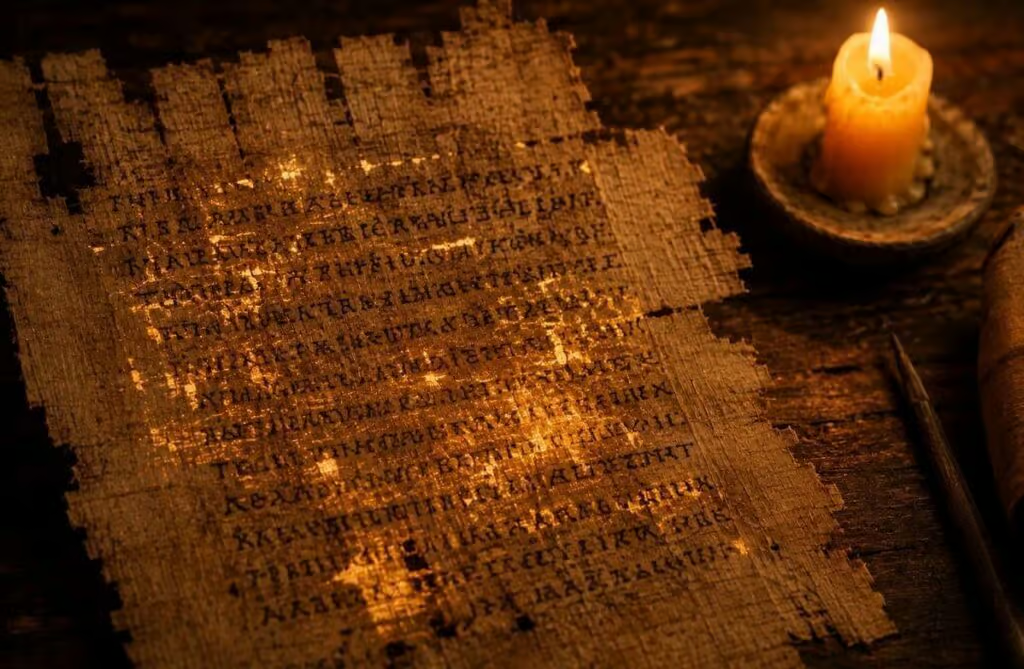
The divine spark is one of the most important ideas in ancient and modern Gnostic thought. It names the hidden presence of divine origin within the human being. The person is not only a social role, biological organism, consumer profile or psychological pattern. Something within the human being can recognise truth, resist falsehood and long for return.
Ancient Gnostic texts describe this presence through many images: a spark of light, a seed, a fragment of the divine fullness, a living power trapped in matter. The language varies, but the pattern is consistent. Something that belongs to a higher order has become entangled in the lower world, and it carries the capacity to wake up.
Neo Gnosticism reads this symbol not as a claim about biological difference or spiritual elitism. It reads the spark as a claim about attention. The spark is what can turn inward and recognise. It is the capacity through which gnosis becomes possible.
The Short Answer
Neo Gnosticism understands the divine spark as the inner light of recognition. It is the hidden capacity to know truth directly, to sense when reality has been reduced, to resist false authority and to return attention to its source.
It is not ego, mood, self-importance, fantasy identity, spiritual rank, chosen-person mythology or rejection of the body. It is recognition, inner dignity, direct knowing, spiritual memory, capacity for discernment and the hidden light within ordinary life.
Ancient Roots of the Divine Spark
The language of the divine spark varies across ancient sources, but the pattern is consistent. Something divine has become entangled in the lower world and needs awakening. The shared themes include divine origin, forgetfulness, captivity, the call from above, recognition, return and restoration to fullness.
Many Gnostic traditions share what scholars call a family resemblance around inner divine origin and awakening. They do not all teach the same doctrine with identical vocabulary. Some speak of a spark, others of a seed, others of spiritual substance. Yet they converge on one question: what in the human being can recognise the light?

The Divine Spark in the Apocryphon of John
The Apocryphon of John presents the human being as a contested site. The body belongs to the formed world, but the living power within the human being exceeds the rulers who try to control it.
In this text, the archons fashion the first human from matter and soul, but they cannot animate it. The divine realm sends a spark of living power into the creature, and the archons immediately seek to bind or obscure it. The text describes how the lower powers imitate life but cannot create true spirit. The revealer comes to awaken recognition, and liberation happens through knowledge of origin.
The Apocryphon does not flatter the body. Yet even here, the spark is not anti-biological. It is anti-captivity. The concern is not that the body exists, but that the body has been claimed by forces that would keep the living power asleep.
The Gospel of Thomas and the Light Within
The Gospel of Thomas gives direct, crisp language for the inner light. In saying 24, the disciples ask to be shown the place where Jesus is, and he replies: “There is light within a man of light, and he lights the whole world. If he does not shine, there is darkness.”
This is not a command to seek elsewhere. It is a command to recognise what is already present. Thomas does not send the seeker away from life. It turns the seeker toward the light already present, but not yet recognised. The kingdom is inside and outside. The person of light already carries the light. The task is not acquisition but actualisation.
The Gospel of Truth and Remembering the Source
The Gospel of Truth describes ignorance as a nightmare or fog. Those who do not know the Father are like people deep in sleep, running from phantoms, fighting shadows, falling from heights. When they wake, they know these things were nothing.
Recognition is waking. The Father is the source. Error dissolves through knowledge. Salvation is remembrance. In the Gospel of Truth, salvation is not merely being given new information. It is remembering the source so deeply that the false world loses its grip.
Why the Divine Spark Matters Now
Today the human being is increasingly treated as a data profile, an attention reservoir, a consumer pattern, a productivity unit. Identity is shaped by platforms. Value is defined externally. Technology can imitate intelligence without inner recognition. Social systems reward performance over presence.
The divine spark matters because it names what cannot be reduced to metrics, algorithms, productivity, status or social approval. It is the quiet insistence that the human being is more than a user, a brand, a role or a metric. It is the capacity to ask: is this real?
The Spark Is Not the Ego
This distinction is essential. The divine spark is not the personal ego announcing itself as special. It is not the part that wants to be superior, chosen or exempt from humility.
Ego wants importance. The spark recognises origin. Ego seeks confirmation. The spark seeks truth. Ego wants to escape ordinary life. The spark returns ordinary life to depth. A healthy reading of the divine spark makes the person more honest, embodied, patient and responsible, not more inflated.
Inner Light and Digital Attention
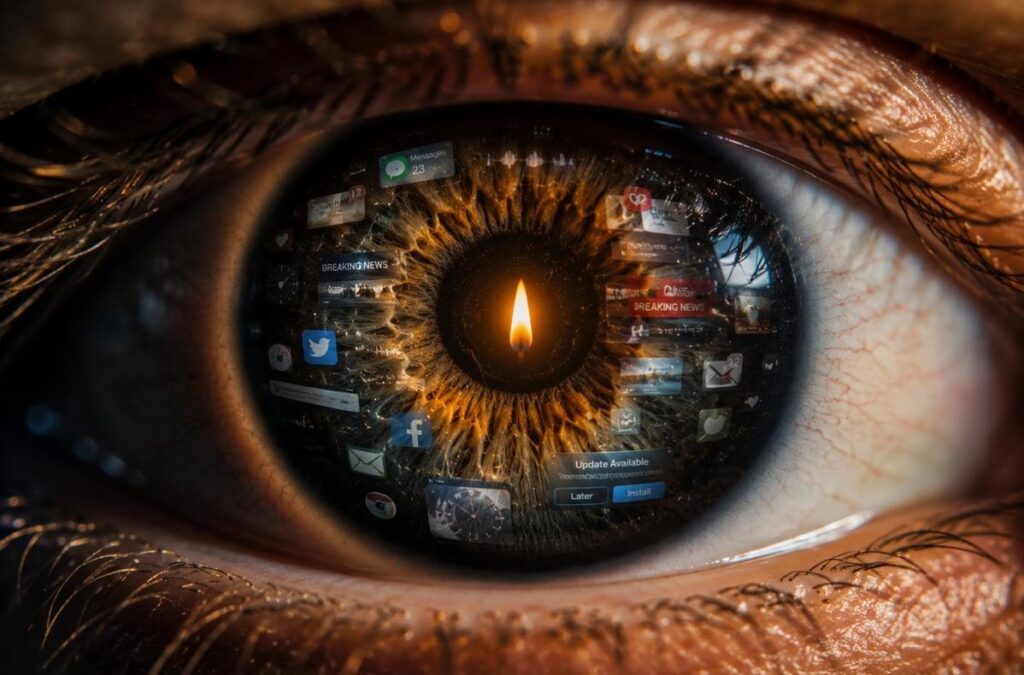
Digital systems often work by capturing attention, predicting behaviour and rewarding reaction. They do not need to destroy the divine spark. They only need to keep attention fragmented enough that the spark is forgotten.
The danger is not that a machine can steal the divine spark. The danger is that a person can live so distractedly that the spark is no longer heard. The spark does not demand silence. It demands presence. And presence is exactly what the attention economy is designed to dissolve.
The Divine Spark and the Archons
In Gnostic cosmology, archons are powers that bind perception. They may appear as mythic beings, psychological complexes, institutional forces or systemic patterns. The divine spark is what the archonic pattern cannot fully manufacture.
The archons can imitate authority, intelligence, social proof, fear and desire. They can build systems that feel inevitable. They cannot produce true recognition. The spark is the element that sees through the imitation. It is the part that knows when a system is serving life and when it is serving only itself.
The Divine Spark and the Demiurge
The Demiurge represents a partial maker who mistakes the formed world for ultimate reality. He is not evil in the sense of personal malice. He is ignorant in the sense of limitation. He believes the world he has made is the whole story.
The divine spark is the element within the human being that can recognise the partial as partial. The Demiurge says, “This is all there is.” The divine spark quietly knows that it is not.
The Spark, the Body and Ordinary Life
Neo Gnosticism must keep the spark grounded. The spark is not opposed to embodiment. It needs embodiment to become lived. It is found in breath, in the nervous system, in ethical choices, in relationships, in work, in rest, in care for the body and in ordinary reality.
The spark is not proven by leaving the world behind. It is proven by bringing more truth into the life already being lived. A disembodied spark is not a liberated spark. It is a forgotten spark wearing spiritual costume.

How Neo Gnosticism Protects the Spark
Practical safeguards include slow attention, regular grounding, contemplative study, digital boundaries, honest shadow work, humility, community or trusted support, reading symbols symbolically, testing insight in ordinary life and avoiding superiority narratives.
These practices do not guarantee awakening. They create conditions in which the spark is less likely to be drowned out by noise, inflation or escape.
Divine Spark and Christian Mysticism
Christian mysticism often speaks of the image of God, the ground of the soul, divine indwelling, inner prayer, union with God and transformation of the heart. Neo Gnosticism may read these alongside the divine spark. The language differs, but the shared concern is direct participation in divine life.
Christian mysticism usually remains inside a Christian theological frame. Neo Gnosticism may read the same inner language through Gnostic cosmology, alternative texts and direct knowing. The spark is not owned by any single tradition. It is recognised by many.
Divine Spark and Modern Psychology
Modern psychology can help interpret the divine spark as inner wholeness, symbolic centre, deeper self, conscience, integration, capacity for meaning and recovery from false identity. But the spark should not be reduced to psychology alone.
For Neo Gnosticism, the spark is more than a mental state. It is a symbol of origin, recognition and spiritual reality. Psychology can describe the container. The spark names what the container holds.
Healthy and Risky Readings of the Divine Spark
The divine spark is a stabilising symbol when it deepens humility, embodiment and discernment. It becomes risky when it is confused with ego, superiority or escape.
| Area | Healthy reading | Risky reading |
|---|---|---|
| Identity | The spark gives dignity without superiority. | The spark becomes proof that the ego is special or chosen. |
| Practice | The spark is strengthened through attention, grounding and ethical life. | The spark becomes an excuse to avoid discipline. |
| Body | The body becomes a place where recognition is lived. | The body is treated as a prison to be despised. |
| Others | Every person may carry hidden light. | Others are dismissed as asleep, soulless or inferior. |
| Technology | Digital life is used with discernment. | Technology becomes a paranoid cosmic enemy. |
| Emotion | Insight becomes steadier, quieter and more compassionate. | Intensity is mistaken for awakening. |
| Authority | Authority is tested by whether it serves recognition. | All authority is rejected automatically. |
| Daily life | The spark deepens ordinary responsibilities. | Ordinary life is abandoned for spiritual drama. |
Practising from the Divine Spark
The spark is not a theory to be defended. It is a capacity to be exercised. Simple practices keep the channel open without turning practice into performance.
A morning attention check: before reaching for a device, notice what is already present. The quality of the breath. The temperature of the room. The sound outside. This is not mysticism. It is orientation.
Hand on heart, slow breath. The gesture is ancient and immediate. It brings attention back into the body before the mind begins its daily narration.
Ask: what is real here? This question cuts through performance, anxiety and social scripting. It does not require an immediate answer. It requires the sincerity of the asking.
Notice what fragments attention. Not with paranoia, but with curiosity. The spark is not threatened by distraction. It is only unheard when distraction is never questioned.
Read one short passage slowly. Let the words rest without immediate interpretation. The spark often moves more slowly than the mind prefers.
Practise one ethical action without announcement. The spark is not proven by visibility. It is proven by integrity.
Reduce one false performance. The social self is necessary, but it need not dominate every room.
Return to the body before interpreting symbols. A symbol is only as useful as the embodied life it serves.
End the day by asking where recognition appeared. Not where success happened. Where recognition happened. The difference is the difference between the ego and the spark.

Common Misunderstandings
The divine spark does not mean the ego is divine. It means the ego is not the whole story. The spark is not a promotion for the self. It is a quieting of the self so that something deeper can be heard.
The spark does not mean some people are spiritually superior. If the spark is real, it is hidden in everyone, not displayed by a chosen few. The moment it becomes a badge of rank, it has been confused with the ego.
The body is not worthless. The spark needs the body to become lived. A spirituality that despises the body is not Gnostic liberation. It is Gnostic escape, and escape is not the same as return.
Ordinary life is not spiritually irrelevant. The spark does not require a dramatic setting. It requires an honest one. The kitchen, the commute, the conversation, the quiet hour before sleep: these are the places where the spark is proven.
Technology cannot destroy the divine spark. It can only obscure it. The spark is not fragile in the way a device is fragile. It is hidden in the way a seed is hidden. The question is not whether technology is powerful. The question is whether attention is present.
The spark is not the same as emotional intensity. Intensity can be exciting, but it can also be noise. The spark often speaks in a quieter register: steadiness, clarity, compassion, patience.
Direct knowing does not mean rejecting study. Gnosis is not anti-intellectual. It is simply not limited to the intellectual. The spark can work through study, but it is not produced by study.
Awakening does not mean leaving community. The solitary path is one path, but the spark can also be recognised in relationship, in dialogue, in the difficult honesty of shared life.
The divine spark does not belong only to Gnostics. The symbol belongs to anyone who recognises it. Neo Gnosticism does not own the spark. It tries to keep the language clean enough that the spark can be recognised.
The spark is not merely a metaphor with no spiritual force. It is a symbol, but symbols are not empty. They are the language of the part of the mind that knows before it thinks.
Related Glossary Terms
Read Next
Continue with the foundation article on the divine spark, then move outward into Neo Gnostic belief, practice, digital attention and the safety of grounded discernment.
- What Is the Divine Spark?
- What Do Neo Gnostics Believe?
- Neo Gnostic Practice
- Digital Archons
- Is Neo Gnosticism Dangerous?
Neo Gnosticism Route Box
Neo Gnosticism route
- Neo Gnosticism Hub
- What Is Neo Gnosticism?
- What Do Neo Gnostics Believe?
- Is Neo Gnosticism a Religion, Philosophy or Practice?
- Neo Gnosticism vs Ancient Gnosticism
- Neo Gnostic Practice
- Digital Archons
- Is Neo Gnosticism Dangerous?
- Neo Gnosticism and Christianity
- Neo Gnosticism and the Divine Spark: You are here
- How Gnosticism Survived 2,000 Years
- Who Are the Neo Gnostics?
- Living Gnosis
- Transhumanism as Neo Gnosticism
Frequently Asked Questions
What is the divine spark in Neo Gnosticism?
The divine spark is the hidden capacity for direct knowing within the human being. It is the inner light that can recognise when life has become false, mechanical or forgetful. In Neo Gnosticism, it is not a badge of superiority but the part of the person that can wake up, remember, discern and return to reality.
Is the divine spark the same as the soul?
The spark and the soul are related but not identical. In many Gnostic texts, the soul is the middle realm of emotion, morality and choice, while the spark is the spiritual element that can recognise divine origin. The soul can be refined by experience, but the spark is the capacity through which gnosis becomes possible.
Is the divine spark the same as the ego?
No. The ego wants importance, confirmation and escape from ordinary life. The spark recognises origin, seeks truth and returns ordinary life to depth. A healthy reading of the spark makes a person more honest and humble, not more inflated or special.
Do all people have the divine spark?
Neo Gnosticism reads the spark as a hidden potential in human beings rather than a privilege granted to a select group. The spark may be more awake in some and more obscured in others, but the capacity for recognition is not a spiritual caste system.
How does the divine spark relate to gnosis?
Gnosis is the act of recognition, and the spark is the capacity that makes recognition possible. Without the spark, gnosis would have no inward receptor. Without gnosis, the spark would remain dormant or unheard.
How do archons affect the divine spark?
Archons are powers that bind perception. They do not destroy the spark, but they can keep attention so fragmented that the spark is forgotten. The archons imitate authority, fear and desire, but they cannot produce true recognition.
Can technology destroy the divine spark?
Technology cannot destroy the spark, but it can obscure it by capturing attention and rewarding fragmentation. The danger is not that a machine can steal the divine spark. The danger is that a person can live so distractedly that the spark is no longer heard.
How can someone practise from the divine spark?
Begin with simple acts of attention: slow the breath, return to the body, notice what fragments awareness, read one passage slowly, practise one ethical action and ask where recognition appeared during the day. The spark is strengthened by humble, embodied attention rather than spiritual performance.
Further Reading
- What Is the Divine Spark? — A foundation guide to the hidden light, Gnostic anthropology and the spark’s ancient sources.
- What Is Neo Gnosticism? — The main doorway into the modern revival of ancient direct knowing.
- What Do Neo Gnostics Believe? — Core beliefs, cosmology and practice in the Neo Gnostic route.
- Neo Gnostic Practice — Daily methods for attention, grounding and spiritual discernment.
- Digital Archons — How algorithmic systems shape attention, and why discernment matters now.
- Is Neo Gnosticism Dangerous? — Safeguards, risks and healthy boundaries in modern Gnostic exploration.
- Neo Gnosticism and Christianity — Jesus, revelation, hidden teaching and early Christian Gnostic texts in context.
- What Is Gnosis? — Direct knowing, recognition and the turn of attention toward truth.
- Archons — The ruling powers that bind perception and imitate authority.
- The Demiurge — The partial maker, the architect of form and the question of false authority.
- The Counterfeit Spirit — False imitation, borrowed vitality and the appearance of spiritual life without recognition.
- The Pleroma — Divine fullness, origin and the higher context of return.
- The Kenoma — Emptiness, deficiency and the lower field where forgetfulness takes shape.
- The Gospel of Thomas — Sayings of Jesus, the inner kingdom and the light within.
- The Apocryphon of John — Sethian creation myth, archons, divine origin and awakening.
- The Gospel of Truth — A Valentinian meditation on error, remembering and return to the source.
References and Sources
The following sources are grouped by category for clarity.
Primary Sources and Critical Editions
- The Apocryphon of John (NHC II,1; III,1; IV,1; BG 8502,2). In The Nag Hammadi Library in English, ed. James M. Robinson. HarperSanFrancisco, 1990.
- The Gospel of Thomas (NHC II,2). In The Nag Hammadi Scriptures, ed. Marvin Meyer. HarperOne, 2007.
- The Gospel of Philip (NHC II,3). In The Nag Hammadi Scriptures, ed. Marvin Meyer. HarperOne, 2007.
- The Gospel of Truth (NHC I,3; XII,2). In The Nag Hammadi Library in English, ed. James M. Robinson. HarperSanFrancisco, 1990.
- The Thunder, Perfect Mind (NHC VI,2). In The Nag Hammadi Scriptures, ed. Marvin Meyer. HarperOne, 2007.
- The Tripartite Tractate (NHC I,5). In The Nag Hammadi Library in English, ed. James M. Robinson. HarperSanFrancisco, 1990.
Scholarly Monographs
- Karen L. King. What Is Gnosticism? Harvard University Press, 2003.
- David Brakke. The Gnostics: Myth, Ritual, and Diversity in Early Christianity. Harvard University Press, 2010.
- Elaine Pagels. The Gnostic Gospels. Random House, 1979.
- Michael Allen Williams. Rethinking Gnosticism: An Argument for Dismantling a Dubious Category. Princeton University Press, 1996.
- April D. DeConick. The Gnostic New Age: How a Countercultural Spirituality Revolutionised Religion from Antiquity to Today. Columbia University Press, 2016.
- Birger A. Pearson. Ancient Gnosticism: Traditions and Literature. Fortress Press, 2007.
- Bentley Layton. The Gnostic Scriptures. Doubleday, 1987.
Comparative and Mystical Studies
- Pseudo-Dionysius. The Mystical Theology. Trans. Colm Luibheid. Paulist Press, 1987.
- Meister Eckhart. Selected Treatises and Sermons. Trans. James M. Clark and John V. Skinner. Faber and Faber, 1958.
- The Cloud of Unknowing. Trans. Ira Progoff. Julian Press, 1957.
- Carl G. Jung. Aion: Researches into the Phenomenology of the Self. Princeton University Press, 1959.
- Carl G. Jung. Psychology and Religion: West and East. Princeton University Press, 1958.
Study Note
Study Note: This article treats the divine spark as a spiritual symbol of recognition, dignity and direct knowing. It does not encourage spiritual superiority, rejection of the body, contempt for ordinary life or suspicion toward other people. A healthy reading of the divine spark brings attention back into life with more humility, clarity and care.