Beyond the Visible Slit: Symbol, Third Eye and Expanded Awareness
Article 4 of 4 in The Architecture of Perception series.
The visible world is not the whole field. It is the portion of the field that this body has learned to render.
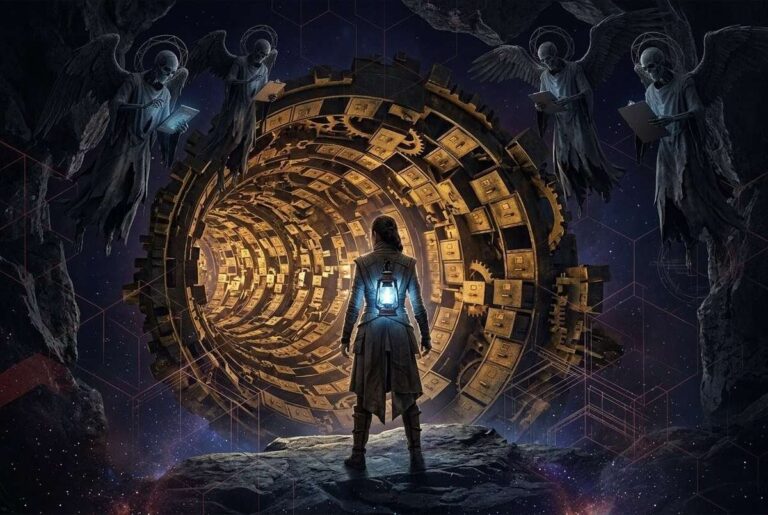
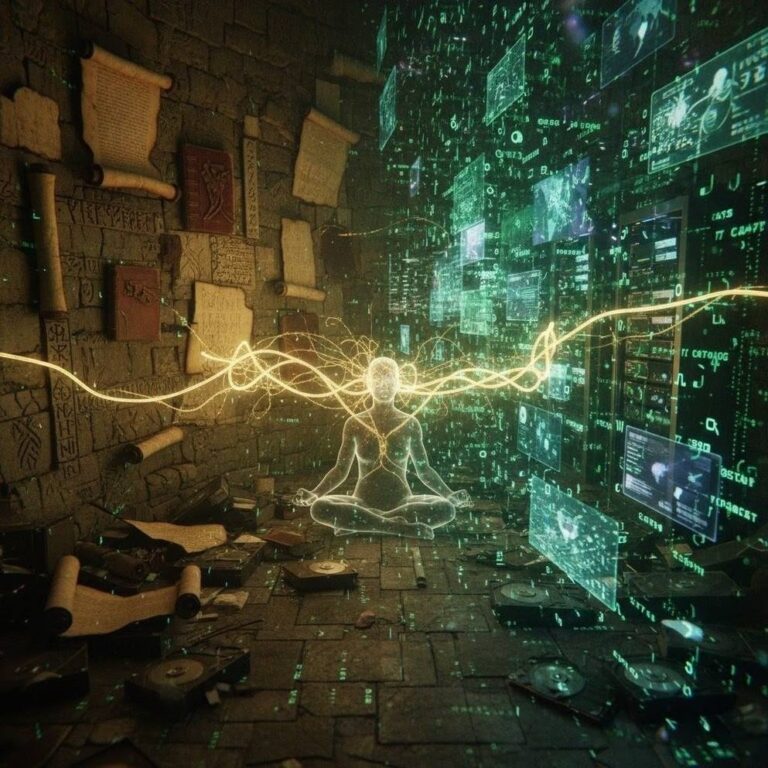
Ancient traditions did not speak in the language of nanometres, neural prediction or sensory bandwidth. They spoke in images: the third eye, the single eye, veils, lamps, hidden light, mirrors, celestial ascent and the eye that sees beyond ordinary sight. The question is not whether these symbols are literal organs or scientific diagrams. The question is what kind of knowing they were trying to preserve.
This article completes the series that began with the narrow slit of perception, moved through the nervous system as a rendering engine, and confronted the central error of mistaking the interface for the whole. Now we turn to what lies beyond the visible aperture: symbolic sight, inner vision, expanded awareness and the grounded discernment that keeps them from becoming fantasy or dogma.
In Plain Terms
Beyond the visible slit means moving from ordinary sensory limitation into symbolic, contemplative and recognitive forms of seeing. The third eye, single eye, Eye of Horus and Gnostic inner light are treated as disciplined symbols of perception, not as crude anatomical claims or permission for fantasy.
Primary Sources and Traditions Discussed
- The visible spectrum and the narrowness of ordinary human perception.
- Yogic and tantric symbolism of Ajna, the third eye and inner vision.
- Matthew 6:22, the single eye and Christian contemplative seeing.
- The Eye of Horus, Wadjet symbolism, restoration and sacred perception.
- Gnostic language of inner light, recognition and awakening.
- Pineal gland biology, melatonin and caution around DMT claims.
- Discernment, integration and grounded symbolic sight.
How to Read This Article
Read this as a symbolic and contemplative closing piece for the series. It does not turn ancient symbols into laboratory diagrams or inflate inner vision into certainty. It asks how symbols preserve modes of knowing that ordinary literal language cannot hold.
Article Map
- The Visible Slit and the Hidden Field
- Why Ancient Traditions Spoke in Symbols
- The Third Eye: Inner Vision Without Anatomical Reduction
- The Single Eye and the Lamp of the Body
- The Eye of Horus and the Symbolism of Sacred Perception
- Gnostic Inner Light and Recognition
- Symbolic Sight: Pattern, Meaning and Direct Knowing
- Pineal Myths, Biology and Caution
- Expanded Awareness Without Inflation
- Practices for Seeing More Clearly
- Integration: Bringing Inner Vision Back to Ordinary Life
- What This Article Is Not Saying
- Conclusion: The Eye Opens by Becoming Humble
- Related Glossary Terms
- Read Next
- Further Reading
- Frequently Asked Questions
- References and Sources

The Visible Slit and the Hidden Field
The first article in this series established that human perception is narrow. The human eye receives only a tiny fraction of the electromagnetic spectrum–the so-called 0.0035% problem, more a teaching image than a precise measurement, but accurate in its deeper point: what is visible is not the whole of what is. The second article showed that even within this narrow band, the nervous system renders reality through prediction, memory, attention, threat and bodily state. The third article named the central error: mistaking the rendered interface for the totality of what is.
This fourth article asks what lies beyond the visible slit. Not in the sense of a fantasy elsewhere, but in the sense of modes of knowing that exceed ordinary sensory perception. The hidden field is not automatically supernatural. It is the unperceived, the implicit, the subtle and the not-yet-recognised. What lies beyond ordinary perception is not always elsewhere. Sometimes it is here, but not yet visible to the current mode of seeing.
The visible slit is not false. It is incomplete. The hidden field begins where the interface stops pretending to be complete. This is not a rejection of the senses. It is an expansion of what sensing can mean when it is disciplined, grounded and integrated.
Why Ancient Traditions Spoke in Symbols
Ancient traditions used symbols because subtle perception is difficult to describe literally. A symbol is not a weaker form of knowledge. It is knowledge folded into an image. Symbolic language can preserve experiential knowledge without reducing it to doctrine. A symbol does not prove the experience, but it can point toward it. Good symbolic reading avoids both literalism and dismissal.
The Eye of Horus, the third eye, the single eye, the lamp, the veil–these are not crude anatomical diagrams or failed attempts at scientific description. They are maps of inner geography. Ancient maps do not prove the territory. They preserve the memory that a territory was encountered. The symbol protects what ordinary language would flatten. When a tradition says “the eye that sees the hidden,” it is not claiming a literal organ behind the forehead. It is describing a quality of perception that has become refined enough to notice what ordinary attention misses.
This is why symbolic literacy matters. A culture that reads symbols only literally or dismisses them entirely loses access to a whole register of human knowing. The symbol is a door, not a destination. The work is to learn to read the door without mistaking it for the room beyond.
The Third Eye: Inner Vision Without Anatomical Reduction
The third eye appears across yogic, tantric and broader esoteric traditions as a symbol for inner vision, intuitive perception and expanded awareness. In Sanskrit, the sixth chakra is called Ajna, meaning “to perceive,” “command” or “beyond wisdom.” It is traditionally represented as a two-petaled lotus at the centre of the head, level with the space between the eyebrows, associated with the element of light and the colour indigo. Its psychological function is described as intuition, insight, vision and the capacity to see beyond surface appearance.
The third eye is not ordinary sight made stronger. It is perception no longer trapped inside the first surface. It is less an extra eyeball than a disciplined way of seeing. Inner vision is not proved by pointing at one gland. It is tested by what it reveals, how it changes perception and whether it deepens life. When the yogic tradition speaks of the third eye, it is describing a shift in the quality of attention–from scattered to gathered, from outward-only to inward-and-outward, from reactive to recognitive.
The danger is reduction on one side and inflation on the other. Reducing the third eye to the pineal gland misses the symbolic depth. Inflating it into a guaranteed paranormal organ misses the necessity of practice, discipline and grounding. The third eye, rightly understood, is a symbol for integrated perception: attention, intuition, discernment and inward seeing working together. It is not a gift. It is a cultivation.
The Single Eye and the Lamp of the Body
The Christian contemplative tradition offers its own language for unified perception. In the Gospel of Matthew, the text states: “The eye is the lamp of the body. If your eye is healthy, your whole body will be full of light.” The Greek word translated as “healthy” is haplous, which can also mean “single,” “simple” or “undivided.” The single eye is not a magic organ. It is perception gathered into one flame.
When attention is divided, the world fractures. When attention gathers, the world can become transparent. The lamp of the body is not merely what looks outward. It is the quality of seeing itself. Fragmented perception sees through fear, division and desire. The single eye suggests undivided attention and purified seeing–a quality of perception no longer pulled in competing directions by worry, craving and reactive interpretation.
This connects directly to the ZenithEye understanding of attention as the first gateway of consciousness. Attention is not passive noticing. It is world-building. The single eye is the gathered beam–the capacity to hold awareness steady enough that the surface of things begins to disclose depth. This is not mysticism in the sense of escape. It is mysticism in the original sense: a practice of seeing more clearly.
The Eye of Horus and the Symbolism of Sacred Perception
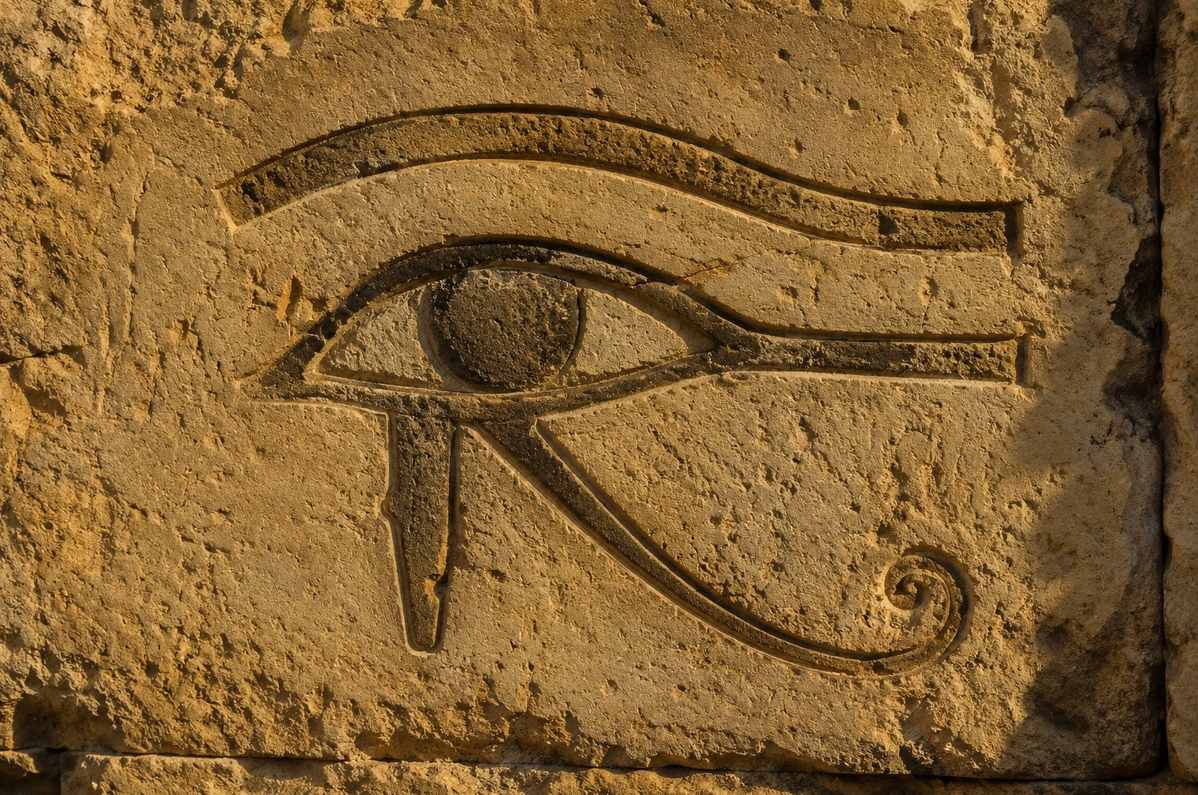
The Eye of Horus, known to the ancient Egyptians as Wadjet, is one of the most enduring symbols of sacred perception. Its origin myth is instructive: the falcon-headed god Horus lost his left eye in battle with Set, the god of chaos. The eye was later restored by Thoth, the deity of wisdom and writing. Through this act of divine healing, the eye became a symbol of protection, healing, restoration and wholeness.
The left eye of Horus was associated with the moon, intuition and the feminine aspect of cosmic balance, while the right eye was linked to the sun, reason and masculine strength. Together they embodied the totality of light and darkness, reason and intuition, life and death. The Egyptians used the Eye of Horus in measurements, dividing it into six parts representing fractions–1/2, 1/4, 1/8, 1/16, 1/32 and 1/64–which corresponded to the six senses. The sum of these fractions totals 63/64, with the missing piece symbolising the divine aspect beyond human comprehension.
For the ZenithEye reader, the Eye of Horus offers a powerful symbolic pattern: perception can be damaged, fragmented and restored. The restored eye is not only a symbol of seeing. It is a symbol of perception healed after fragmentation. Sacred sight is not more information. It is restored wholeness of perception. The Eye does not merely watch. It remembers how to see whole. The ancient Egyptians wore the Eye as an amulet, placed it in tombs and painted it on ships–not as decoration, but as a living symbol of the capacity to see clearly through danger, darkness and the underworld.
Gnostic Inner Light and Recognition
Gnostic traditions speak repeatedly of light, awakening, recognition and remembrance. The Nag Hammadi texts describe a condition of sleep, ignorance and false perception from which the human being must awaken. This is not a moral failing in the conventional sense. It is a perceptual condition. The Gnostic problem is that humans mistake a rendered interface for the whole of reality, and in doing so, they forget their origin in the fuller field.
Inner light, in the Gnostic context, is not necessarily visual. It is a mode of knowing. Gnosis is not belief about hidden things. It is direct recognition–the moment when the hidden becomes obvious without becoming ordinary. The inner eye is the faculty that recognises what ordinary perception misses. The Gospel of Truth, preserved in the Nag Hammadi Library, speaks of error and ignorance as a kind of sleep from which the spirit awakens through recognition. The awakening is not an acquisition of new facts. It is a remembering of what was always present but unseen.
The inner light is not always seen as brightness. Sometimes it is known as certainty without argument. Gnosis is the eye behind belief. Recognition is the moment the hidden becomes obvious without becoming ordinary. This is why the ZenithEye tradition places so much weight on recognition rather than doctrine. Recognition is the event that interrupts the render. It is the seeing that sees the seeing.
Symbolic Sight: Pattern, Meaning and Direct Knowing
Symbolic sight is the ability to perceive pattern, resonance, implication and meaning without reducing everything to literal facts or compulsive interpretation. It is not paranoia. It is not the forced reading of cosmic significance into every coincidence. Symbolic sight differs from paranoia because it remains grounded, humble and testable. It allows a text, an event, a dream or an image to disclose layered meaning without demanding that every layer be decoded immediately.
Symbolic sight sees pattern without needing every pattern to become prophecy. The opened eye does not interpret everything. It knows when to stop. Direct knowing is quiet enough to leave some things unclaimed. This is the discipline that sits between two extremes: the literalist who sees only surface, and the fantasist who sees only hidden meaning. Symbolic sight is the middle path–the capacity to hold multiple layers of meaning at once, to let a symbol resonate without forcing it to confess.
The test of symbolic sight is practical. Does it increase clarity or confusion? Does it deepen humility or inflate the self? Does it help the person see the human being in front of them more clearly, or does it distract them into abstract patterns? Symbolic sight that does not return to the ordinary world is not sight. It is escape.
Pineal Myths, Biology and Caution
The pineal gland is a small endocrine organ located near the centre of the brain. Its principal biological function is the production of melatonin, a hormone that regulates circadian rhythm and sleep-wake cycles. The adult human pineal gland weighs less than 0.2 grams and secretes approximately 30 micrograms of melatonin per day. It is part of the photo-neuro-endocrine system, receiving light information via the retina and the suprachiasmatic nucleus to time melatonin release with darkness.
The pineal has long carried symbolic associations with light, darkness and inner vision. René Descartes called it the “seat of the soul.” Its histological similarities to the lateral eyes of vertebrates earned it the unofficial title of “the third eye” in some scientific literature. These associations are genuine and interesting. But they have also been inflated into claims that the scientific evidence does not support.
One persistent claim is that the pineal gland produces N,N-dimethyltryptamine (DMT)–the powerful psychedelic compound–in quantities sufficient to generate mystical experiences, particularly at birth, during dreaming and near death. A 2018 review by pharmacologist David E. Nichols in the Journal of Psychopharmacology examined this claim carefully and found that while “very minute concentrations of N,N-dimethyltryptamine have been detected in the brain, they are not sufficient to produce psychoactive effects.” The review concluded that “scientific evidence… is not consistent with these ideas.” The pineal does not need to be turned into a fantasy machine for its symbolism to matter. Biology can support symbol without being forced to prove it.
Pineal calcification is common, increasing with age and present in an estimated 40% of Americans by age seventeen. Calcification is associated with reduced melatonin production, though whether it directly causes sleep problems remains inconclusive. A careful article does not need to inflate the gland to honour the eye. The symbolic value of the pineal–its association with light, darkness and the rhythm of waking and sleeping–does not require exaggerated biology. The symbol and the science can coexist without either being forced to serve the other.
Expanded Awareness Without Inflation
Expanded awareness can become dangerous when it is forced, inflated or confused with dissociation, paranoia or spiritual superiority. Seeing more does not make someone superior. Inner vision must be tested by humility, ethics and integration. Unstable nervous systems may confuse intensity with truth. True expansion makes a person more grounded, not less.
If the opened eye makes the self larger, it has opened in the wrong direction. Expanded awareness is not status. It is responsibility. The test of inner vision is not spectacle. It is humility, clarity and care. The person who sees more must also see more clearly the impact of their actions, the needs of others and the limits of their own knowing. Inner vision that does not deepen kindness is not vision. It is hallucination wearing spiritual clothing.
This is why the ZenithEye tradition insists on integration. Every ascent needs a landing place. The opened eye must learn to return to the room, the body, the conversation and the task at hand. Without this return, expanded awareness becomes dissociation–a floating above life rather than a deeper entry into it.
Practices for Seeing More Clearly
The following practices are offered not as esoteric techniques but as grounded methods for refining perception and cultivating symbolic sight safely.
1. The Attention Gather
Sit quietly. Let attention settle on one simple object–a stone, a cup, a leaf. Notice how the field changes when attention stops scattering. The object may begin to disclose texture, weight, history and presence that were invisible when attention was divided. This is not mysticism. It is the natural consequence of undivided attention.
2. The Symbol Pause
Look at a symbol, image or phrase. Do not interpret immediately. Ask what it does in the body before asking what it means. Does it tighten or open? Does it invite or repel? The bodily response is often more honest than the mental interpretation. This pause protects against both literalism and compulsive over-reading.
3. The Three-Layer Reading
When encountering a text, dream or meaningful event, read it at three levels. Literal: what is here? Psychological: what does it reveal in me? Gnostic: what false perception does it expose? Not every event requires all three layers. But the capacity to move between them prevents fixation on any single level.
4. The Reality Check
Ask whether the insight makes you more grounded, ethical and kind. If it increases fear, grandiosity or isolation, slow down. True recognition tends to soften the edges of the self, not sharpen them. The test is not how extraordinary the experience feels. The test is how ordinary it allows you to become.
5. The Return to the Room
End every inner-vision practice by naming ordinary details in the room. Feet, breath, light, sound, object, water. The eye opens safely when the feet remain in the room. Symbolic sight must learn to return to the table, the cup and the next human being. Every ascent needs a landing place.

Integration: Bringing Inner Vision Back to Ordinary Life
Inner vision must become behaviour. Expanded awareness should deepen ordinary life, not replace it. Insight must enter ethics, relationship, patience, repair and humility. The opened eye should help someone see the person in front of them, not only hidden cosmic patterns. Inner vision is not complete until it can wash a bowl, answer gently and keep a promise.
The sacred eye proves itself in ordinary life. Seeing beyond the visible slit should make the visible world more tender, not disposable. The ZenithEye tradition has always insisted on this return. The contemplative who cannot meet the cashier, the neighbour or the difficult relative with the same quality of attention they bring to meditation has not integrated their seeing. They have merely split their life into two compartments: the sacred and the ordinary, the visionary and the mundane.
Integration is not a final stage. It is a continuous practice. Every insight must be tested in the laboratory of ordinary relationship. Every recognition must be worn in the body, spoken through the voice and enacted through the hands. The slow work of integration is not less important than the flash of insight. In many ways, it is more important. Insight without integration becomes spiritual entertainment. Integration without insight becomes mere competence. The two need each other.
What This Article Is Not Saying
It is essential to guard this inquiry against misunderstanding. This article is not saying that the third eye is literally a physical eye. It is not saying that the pineal gland has been proven to generate mystical visions. It is not saying that every symbol is a secret code, or that expanded awareness means paranormal certainty. It is not saying that inner vision makes someone superior, that ordinary perception is worthless, or that dissociation is awakening.
It is not saying that seeing symbols everywhere is healthy, that science has proven esoteric claims, or that esoteric traditions should replace medical or psychological care. The visible slit is not the enemy. It is the ordinary aperture through which life becomes intimate. The work is not to destroy the interface. It is to see through it while remaining fully present within it.
The Eye Opens by Becoming Humble
This series began with perception as a narrow slit. It moved through the nervous system as a rendering engine, and confronted the central error of mistaking the interface for the whole. It now closes with symbolic sight and expanded awareness–not as escape from limitation, but as the humble recognition that limitation exists.
The eye opens not by claiming everything, but by becoming honest about what it cannot yet see. Beyond the visible slit is not a fantasy elsewhere. It is the wider field pressing quietly against the limits of ordinary seeing. Gnosis does not make the human being all-seeing. It makes the human being honest enough to stop pretending the slit is the sky.
The filtered self is not an enemy. The rendered world is not a prison. The visible slit is not a mistake. They are the necessary conditions of embodied life. The problem is forgetting that they are conditions. The work is to live within the render while remaining in contact with the wider field. That is the architecture of perception. That is the beginning of freedom.
Related Glossary Terms
These terms place symbolic sight and expanded awareness within the wider ZenithEye map of inner vision, discernment and integration.
- Visible Slit
- Hidden Field
- Third Eye
- Ajna
- Single Eye
- Lamp of the Body
- Eye of Horus
- Wadjet
- Inner Light
- Symbolic Sight
- Pineal Gland
- Expanded Awareness
- Direct Knowing
- Gnosis
- Recognition
- Integration
Read Next: The Architecture of Perception
Follow the four-part route from perceptual limitation, through nervous-system rendering, into the interface problem, and finally toward symbolic sight and expanded awareness.
- The Receiver Mind: Consciousness, Perception and the 0.0035% Problem
- The Filtered Self: How the Nervous System Renders Reality
- The Interface Is Not the World: Gnosis and the Limits of Human Perception
- Beyond the Visible Slit: Symbol, Third Eye and Expanded Awareness
Further Reading
- Attention: The First Gateway of Consciousness — The foundational role of attentional discipline in perceptual sovereignty.
- The All-Seeing Eye Decoded — A deeper exploration of the Eye of Horus and related symbols of sacred perception.
- Pattern Recognition Without Paranoia — Discerning signal from noise without becoming captured by compulsive interpretation.
- The Discipline of Not Interpreting Everything — The practice of pausing before the render completes.
- What Is Gnosis? Meaning, Recognition and Direct Knowing — The ancient intuition of knowing through immediate seeing.
- What Is Recognition? The Moment of Direct Seeing That Changes Everything — The lived event of seeing through the render.
- The Slow Work of Integration — How insight becomes behaviour over time.
- The Quiet Ethics of Awakening — How expanded awareness translates into ordinary kindness and responsibility.
- Planes of Consciousness and Higher Dimensions — Mapping the subtle bodies and expanded states across traditions.
- The Five Gateways to Direct Knowing — Practical pathways for cultivating recognition and direct perception.
Fact-Check Table
The following table presents key claims from this article and their verification status.
Pineal Gland and DMT
Claim: The pineal gland produces melatonin and regulates circadian rhythm, but does not produce DMT in quantities sufficient to cause psychoactive effects.
Status: Verified. The adult pineal gland weighs less than 0.2 grams and produces approximately 30 micrograms of melatonin per day. A 2018 review by pharmacologist David E. Nichols in the Journal of Psychopharmacology found that while “very minute concentrations of N,N-dimethyltryptamine have been detected in the brain, they are not sufficient to produce psychoactive effects.” The review concluded that “scientific evidence… is not consistent with these ideas” regarding the pineal as a source of endogenous DMT visions.
Pineal Calcification
Claim: Pineal calcification is common and increases with age, present in approximately 40% of Americans by age seventeen.
Status: Verified. A 1982 CT study by Zimmerman and Bilaniuk published in Radiology found calcification in an estimated 40% of Americans by age seventeen. Calcification is associated with reduced melatonin production, though whether it directly causes sleep problems remains inconclusive according to subsequent research.
Third Eye / Ajna Chakra
Claim: Ajna is the sixth chakra, Sanskrit for “to perceive” or “beyond wisdom,” associated with intuition, insight and inner vision.
Status: Verified. Standard yogic and tantric sources confirm Ajna as the sixth chakra, located between the eyebrows, associated with the element of light, the colour indigo and the capacity for intuition and insight. The pineal gland is sometimes associated with Ajna in esoteric literature, but this is interpretive symbolism rather than established anatomy.
Eye of Horus
Claim: The Eye of Horus symbolises protection, healing and restoration, originating from the myth of Horus losing his eye to Set and its restoration by Thoth.
Status: Verified. Egyptian mythology and archaeological sources confirm the Eye of Horus (Wadjet) as a symbol of protection, healing and wholeness. The myth of Horus losing his left eye to Set and its restoration by Thoth is well attested. The six fractions of the Eye (totalling 63/64) were used in Egyptian mathematics and associated with the senses.
Single Eye (Matthew 6:22)
Claim: The “single eye” in Matthew 6:22 refers to unified, undivided perception, with the Greek haplous meaning “single,” “simple” or “healthy.”
Status: Verified. The Greek word haplous (Matthew 6:22) can indeed be translated as “single,” “simple” or “sound/healthy.” The parallel passage in Luke 11:34 uses the same image. Christian contemplative tradition has long read this as referring to spiritual vision and the quality of undivided attention.
Gnostic Inner Light
Claim: Gnostic texts speak of light, awakening and recognition, with gnosis understood as direct knowing rather than doctrinal belief.
Status: Verified. The Nag Hammadi texts, including the Gospel of Truth, describe error and ignorance as a kind of sleep from which the spirit awakens through recognition. Gnosticism is widely understood by scholars (e.g., Pagels, Meyer, Layton) as emphasising direct spiritual knowledge (gnosis) over institutional authority.
References and Sources
This article draws on contemporary neuroscience, Egyptology, biblical studies and Gnostic scholarship. Key sources are mentioned in flowing prose throughout the text. For readers seeking deeper engagement, the following categories may be useful.
Neuroscience and Biology
- Nichols, D.E. (2018). “N,N-dimethyltryptamine and the pineal gland: Separating fact from myth.” Journal of Psychopharmacology, 32(1), pp. 30-36.
- Healthdirect Australia. (2025). “Pineal gland.” Available at healthdirect.gov.au.
- Zimmerman, R.A. and Bilaniuk, L.T. (1982). “Age-related incidence of pineal calcification detected by computed tomography.” Radiology, 142(3), pp. 659-662.
- Tan, D.X. et al. (2018). “Pineal Calcification, Melatonin Production, Aging, Associated Health Consequences and Rejuvenation of the Pineal Gland.” Molecules, 23(2), p. 301.
Egyptology and Symbolic Studies
- Pinch, G. (2002). Handbook of Egyptian Mythology. ABC-CLIO.
- Wilkinson, R.H. (1992). Reading Egyptian Art: A Hieroglyphic Guide to Ancient Egyptian Painting and Sculpture. Thames & Hudson.
Gnostic and Contemplative Studies
- Layton, B. (ed.). (1989). Nag Hammadi Codex II, 2-7. Brill.
- Meyer, M. (ed.). (2007). The Nag Hammadi Scriptures. HarperOne.
- Pagels, E. (1979). The Gnostic Gospels. Random House.
- Attridge, H.W. and MacRae, G.W. (1985). “The Gospel of Truth.” In Nag Hammadi Codex I (The Jung Codex), pp. 55-117. Brill.
Frequently Asked Questions
What does beyond the visible slit mean?
It means recognising that ordinary sensory perception is only one narrow mode of knowing. Human beings see, hear and interpret only a limited portion of reality. Beyond the visible slit refers to symbolic, contemplative and intuitive modes of perception that may disclose meaning beyond surface appearance.
What is the third eye?
The third eye is a symbolic expression for inner vision, intuitive perception and expanded awareness. It should not be reduced to a literal physical eye or treated as proof of paranormal certainty. In grounded practice, it points to a disciplined capacity for subtle seeing.
Is the third eye the same as the pineal gland?
Not exactly. The pineal gland has biological functions, especially in circadian rhythm through melatonin. It has also carried symbolic associations with inner light and vision. This article treats the pineal carefully and does not claim that it has been proven to generate mystical experience.
What is symbolic sight?
Symbolic sight is the ability to perceive meaning, pattern and resonance without reducing everything to literal facts or compulsive interpretation. It is grounded, humble and discerning. It differs from paranoia because it does not force every pattern into prophecy.
How does this relate to Gnosticism?
Gnosticism often speaks of light, awakening, recognition and seeing through false perception. Symbols of inner vision help describe the movement from ordinary sight to direct knowing. Gnosis is not merely belief in hidden things. It is recognition.
Can expanded awareness be dangerous?
It can be destabilising if forced, inflated or confused with dissociation, paranoia or spiritual superiority. Expanded awareness needs grounding, discernment, humility and integration. If practices cause distress or difficulty functioning, professional support is important.
How can inner vision be practised safely?
Begin with attention, grounding and symbolic reflection. Do not force visions or interpret everything. Keep the body settled, remain connected to ordinary life and test insight by whether it increases clarity, humility, kindness and practical responsibility.
Safety Notice: This article explores symbolic perception, third eye language, inner vision, expanded awareness, Gnostic recognition and contemplative practice. It does not constitute medical, psychological, neurological or psychiatric advice. If meditation, symbolism, altered-state practice, visionary experience or inner-vision inquiry causes panic, derealisation, dissociation, paranoia, psychosis, mania, severe distress, suicidal thoughts or difficulty functioning, seek support from a qualified mental health professional or appropriate medical service. Do not confuse dissociation, grandiosity or compulsive pattern-finding with awakening. Do not use spiritual models to reject clinical care, medication, therapy, relationships or ordinary responsibilities.
Study Note: Beyond the visible slit is not an invitation to fantasy. It is an invitation to humility. Ordinary perception is limited, symbolic perception is powerful and inner vision must be grounded. The opened eye does not make the human being superior. It makes the human being more responsible for seeing clearly, interpreting carefully and returning insight to ordinary life.