The All Seeing Eye Decoded: From Ancient Egypt to Freemasonry and Modern Spirituality
You are not merely physical. This statement, which sounds either mystical or bureaucratically insane depending on your conditioning, is actually a precise description of your current estate. You have a physical body, yes–this dense vessel serves as the anchor that keeps you present in the slowest dimension of reality, the cosmic equivalent of a ground wire. But you also possess additional bodies–subtle, energetic, mental, causal–that extend into dimensions invisible to the physical eye yet no less real for their invisibility. Understanding these dimensions, learning to navigate them consciously, constitutes the primary work of the esoteric practitioner; remaining unconscious of them is to be blown about by forces you do not recognise, to be the effect of causes you cannot see, to remain a passive subject in the administration of reality rather than an awakened citizen of the cosmos.
The concept of planes of existence provides a topology for this multidimensional reality–not a map in the sense of fixed territory but as a frequency spectrum of consciousness, a description of the various vibrations at which awareness can oscillate and the experiences available at each frequency. This is not escapism from the physical world but the recognition that the physical dimension is merely the surface of a much deeper reality, the visible tip of an iceberg whose submerged mass contains the records of your soul’s entire evolutionary history.
Table of Contents
- Horus: The Falcon-Eyed Sky God
- The Active Eye: Perception as Creation
- The Christian Adaptation: The Eye of Providence
- The Great Seal and the Dollar Bill: Symbol or Conspiracy?
- The Single Eye: Jesus’s Teaching on Integrated Perception
- The Third Eye: Eastern Correspondences
- The Esoteric Significance: What the Eye Actually Represents
- The Alchemical Eye: Vision and Transformation
- Conspiracy Theory as Distraction
- Practical Application: Developing the Inner Eye
- Frequently Asked Questions
- Further Reading
- References and Sources
Horus: The Falcon-Eyed Sky God
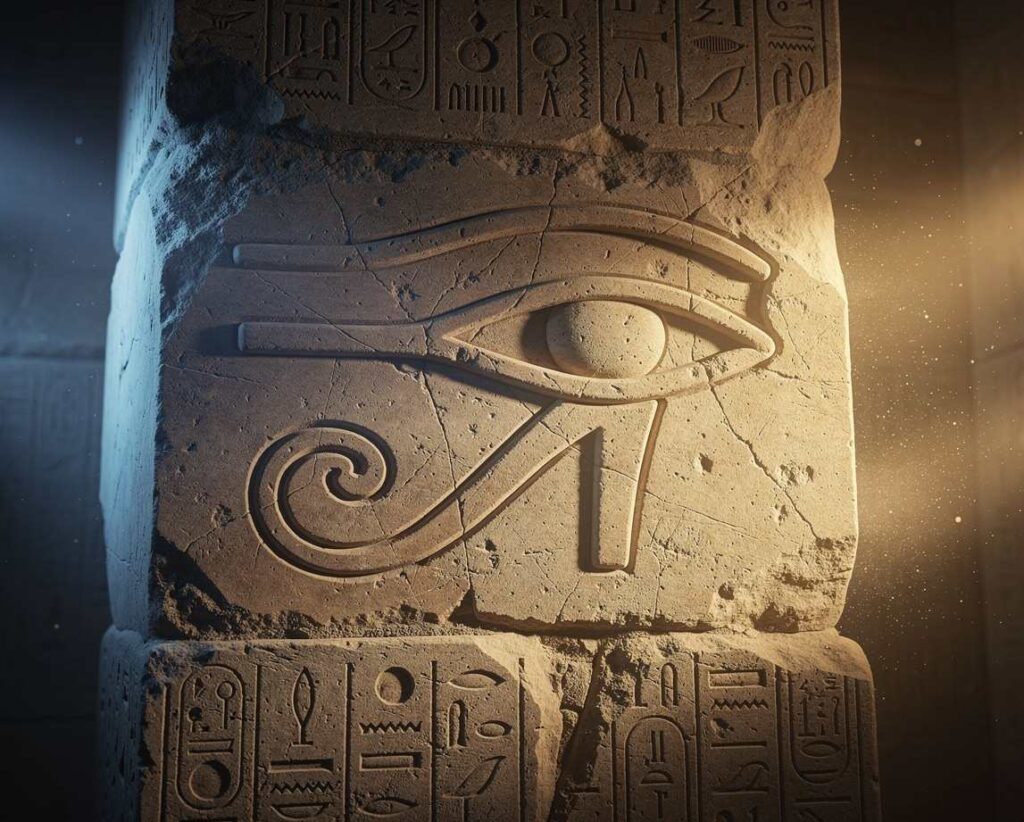
The earliest form of the all-seeing eye is the Egyptian Eye of Horus–the wedjat eye, one of the most powerful protective symbols in Egyptian culture. Horus, the falcon-headed god of the sky, was associated with the sun and the moon; his right eye represented the sun, his left the moon. The distinctive shape of the wedjat eye, with its stylised markings, carried specific meanings related to the fractions used in ancient Egyptian mathematics. The six parts of the eye corresponded to the fractions 1/2, 1/4, 1/8, 1/16, 1/32, and 1/64–a system that allowed Egyptian scribes to perform calculations for grain distribution, land measurement, and temple offerings. The eye was not merely symbolic; it was a practical mathematical tool encoded in sacred form.
The myth of Horus and Set provides the narrative context. Set, the god of chaos, tore out Horus’s left eye in their battle for the throne of Egypt. The eye was restored by Thoth, the god of wisdom, through a process of healing that involved the assembly of its scattered parts. This restoration represents the healing of consciousness–the recovery of wholeness through the integration of what has been fragmented. The Eye of Horus thus symbolises not merely protection but the process of spiritual healing and the restoration of integrated awareness. The scattered fractions, once reassembled, become the complete vision; the broken perception, once healed, becomes the unified gaze.
The eye that was torn out and restored is your eye–the capacity for perception that was fragmented by the fall into duality and can be restored through the work of integration.
— Egyptian mythological interpretation
The Active Eye: Perception as Creation
The Egyptian understanding of the eye as active rather than passive has profound implications. The eye was not merely a receiver of external light but a projector of consciousness that participated in creating what it saw. This understanding anticipates contemporary discoveries in quantum physics about the role of observation in determining reality. The eye that sees is also the eye that shapes; conscious perception is a creative act that participates in the ongoing construction of the world. The wedjat was not a window but a lamp–a source of illumination that cast light upon what it encountered, transforming the object by the very act of perception.
Perception as Participation
The sun was understood as the visible manifestation of divine consciousness–the eye of the supreme deity Ra that sees and knows all. The daily journey of the sun across the sky represented the ongoing activity of divine awareness, watching over the world and maintaining cosmic order. The human eye, as the organ of sight, was understood as the microcosmic reflection of this cosmic principle, the means by which individual consciousness participates in the divine capacity for knowing. To see was not merely to register but to co-create; to perceive was to bring into being the pattern that perception recognised. This is not solipsism but participation: the observer does not create the object ex nihilo, but brings forth the specific qualities that consciousness can apprehend.
The Christian Adaptation: The Eye of Providence
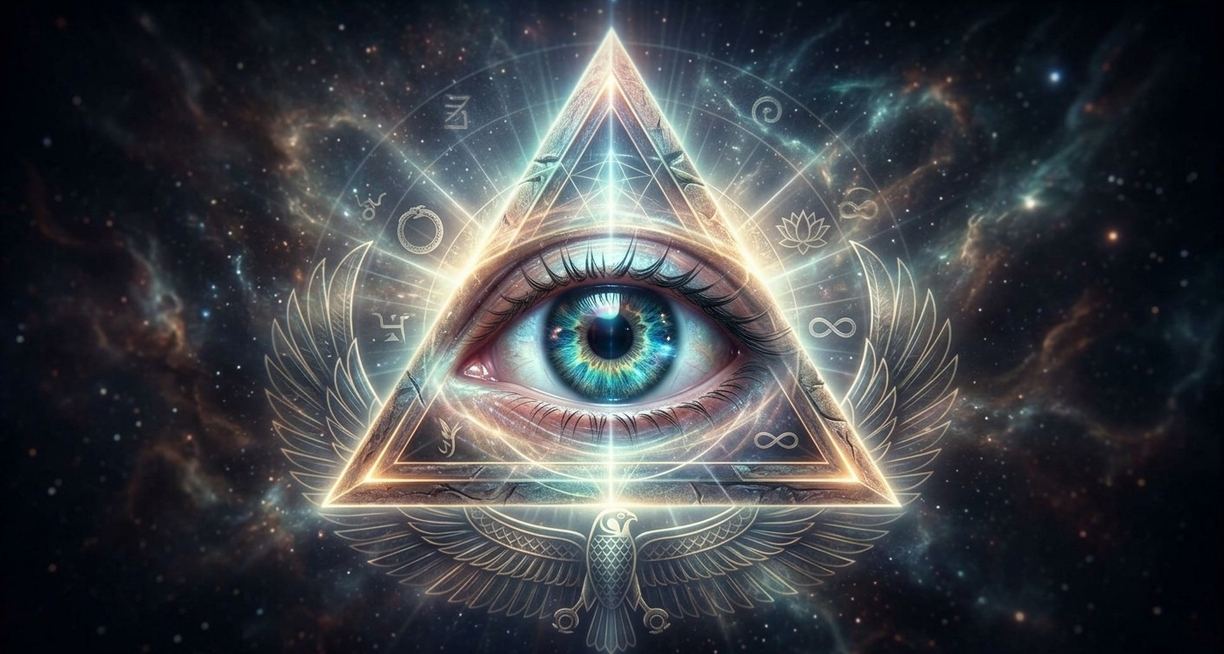
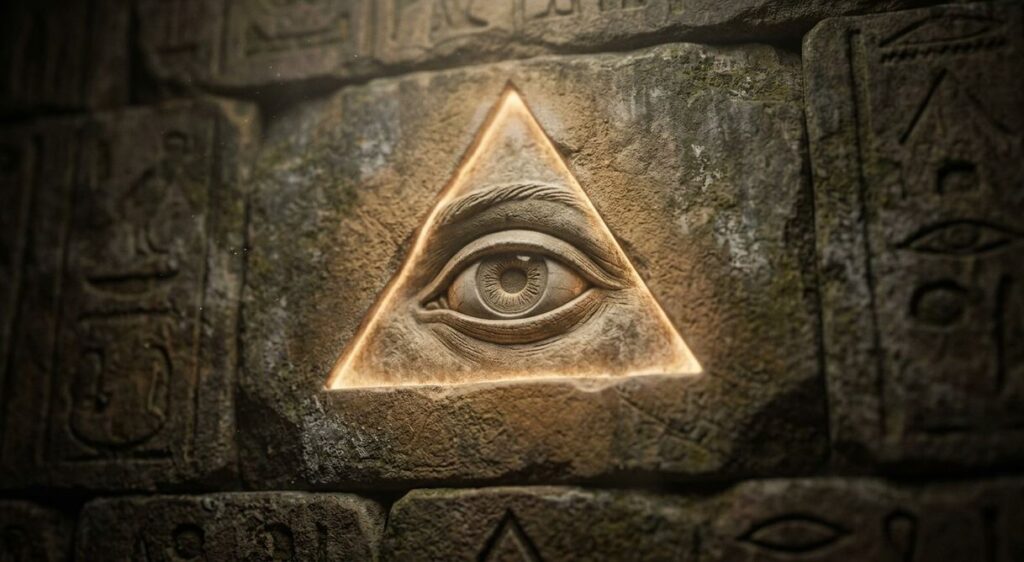
The transition of the eye symbol from Egyptian to Christian usage occurred through the cultural synthesis of the Hellenistic and Roman periods. The Eye of Providence, as it became known in Christian tradition, retained the associations of divine watching and protection while being integrated into the monotheistic framework. The triangle surrounding the eye came to represent the Holy Trinity; the eye itself represented the divine omniscience that sees and knows all. In Renaissance art, the Eye of Providence appeared above the throne of God, in the centre of the Trinity, and as the capstone of the church–a visual theology of divine presence.
From Renaissance Altarpiece to Public Seal
In Christian art and architecture, the Eye of Providence served as a reminder of divine presence and the accountability of human action. The eye that sees all was understood as both protective and judgmental–offering comfort to the faithful while warning against sin. This dual function reflects the dual nature of divine awareness, which both supports and evaluates human activity. The Baroque churches of Europe placed the eye high above the altar, looking down upon the congregation–not as surveillance but as the gaze of a parent who sees everything and loves anyway. The symbol migrated from cathedral ceilings to state documents not through conspiracy but through the natural diffusion of a universally recognised emblem of divine oversight.
The Great Seal and the Dollar Bill: Symbol or Conspiracy?
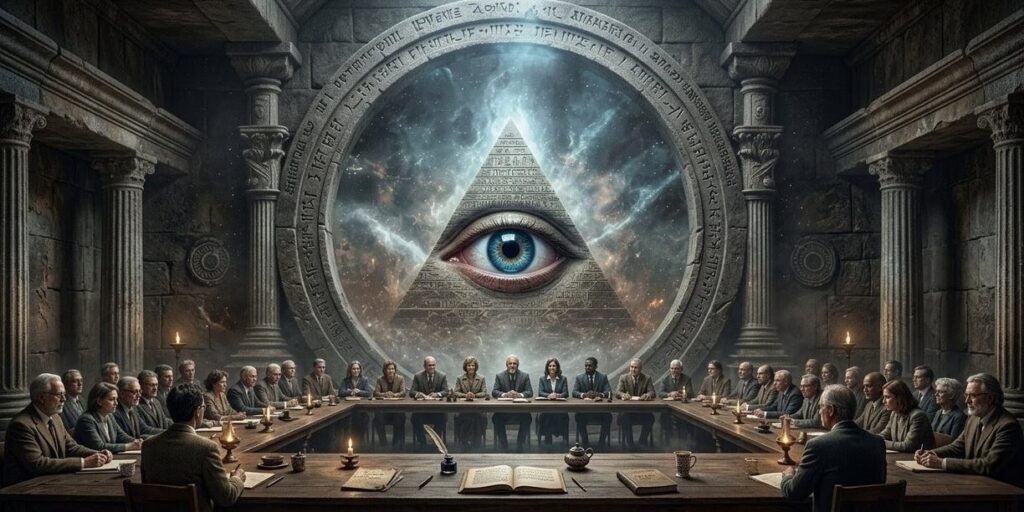
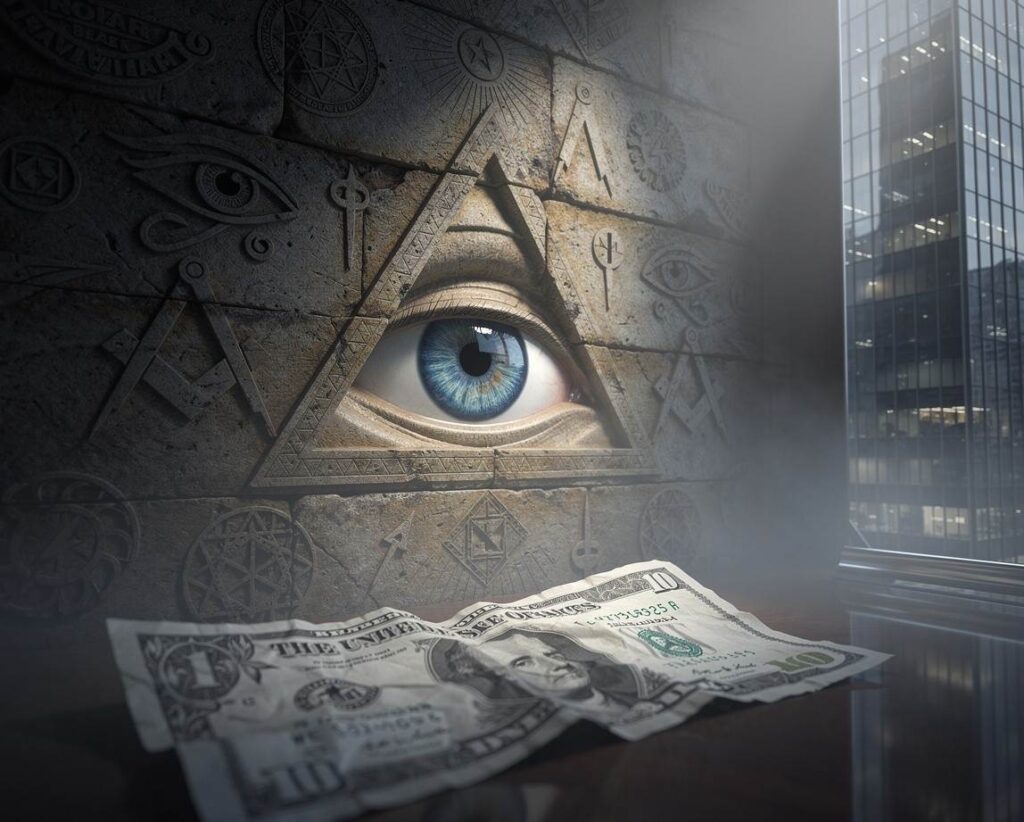
The appearance of the all-seeing eye on the Great Seal of the United States and subsequently on the dollar bill has generated extensive speculation. The official history is well-documented: congressional secretary Charles Thomson submitted a great seal design in June 1782 that borrowed elements from three previous committees. On the seal’s reverse, Thomson’s design included the unfinished pyramid topped by the Eye of Providence and the mottos Annuit Coeptis (God has favoured our undertakings) and Novus Ordo Seclorum (a new order of the ages). The design was adopted on June 20, 1782, and first used on September 16 of that year on a document authorising George Washington to negotiate a prisoner exchange.
Chronology and Evidence
Thomson’s own explanation, recorded in his “Remarks and Explanations,” states that “the Eye over it and the Motto allude to the many signal interpositions of providence in favour of the American cause.” The pyramid signifies strength and duration; the eye represents divine providence watching over the new nation. This interpretation reflects the deistic beliefs of many founding fathers who saw God’s hand in America’s establishment–not a secret society’s stamp but a public declaration of dependence upon divine favour.
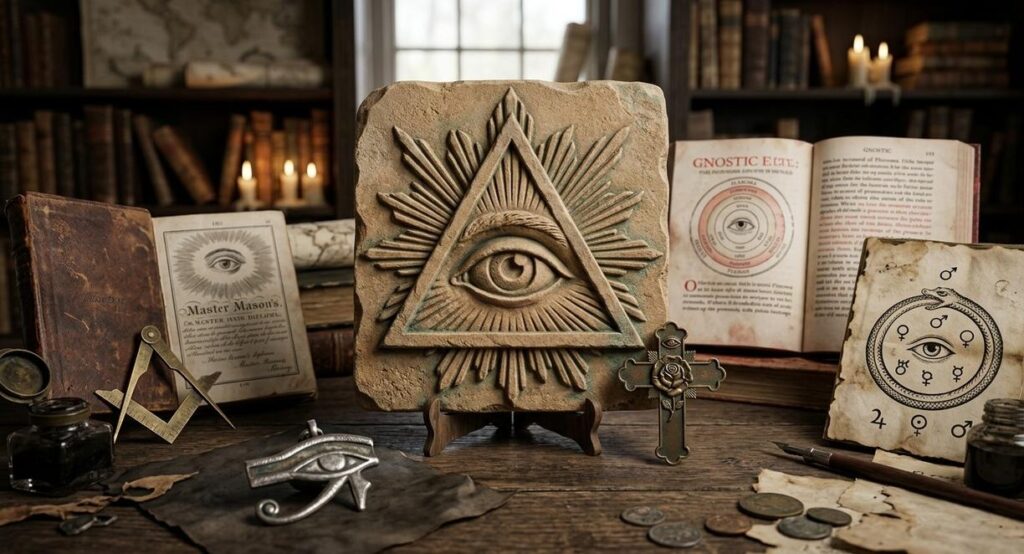
Claims that the symbol represents control by secret societies, particularly the Freemasons, require careful examination. Freemasonry did adopt the all-seeing eye as one of its symbols, but this adoption occurred after the symbol’s use on the Great Seal, not before. The earliest Masonic uses of the eye appeared in the personal seal of Bro. Robert Moray, a Scottish soldier and philosopher, in the seventeenth century. By the mid-1700s, the symbol had been embraced by Freemasonry, and Thomas Webb brought it to American Freemasonry in 1797 with his publication The Freemason’s Monitor. The Masonic use of the eye reflects the fraternity’s interest in esoteric symbolism and its belief in a supreme architect of the universe. While Masonic symbolism has influenced Western culture, the claim that Masons control world events through secret manipulation is not supported by credible evidence. The symbol on the dollar bill is public, not secret; its meaning is explained in official documents, not hidden in cipher.
The Single Eye: Jesus’s Teaching on Integrated Perception
Jesus’s statement that “if your eye is single, your whole body will be full of light” (Matthew 6:22) represents the same principle that the all-seeing eye symbol encodes–but its interpretation requires care. Biblical scholarship understands the Greek word haplous (translated as “single” in the King James Version and “healthy” in many modern translations) within the context of Hebrew idioms about the “good eye” and the “bad eye.” In Hebrew, tov ‘ayin (good eye) means generosity; ra’ ayin (bad eye) means stinginess or selfishness. Jesus is using a wordplay: the single-minded, focused, sincere eye is the generous eye; the bad eye is the duplicitous, self-serving eye.
The Good Eye and the Generous Heart
However, the esoteric reading is not thereby invalidated–it is deepened. The “single eye” as the eye of the heart, the capacity for direct knowing that transcends the limitations of the senses, has been developed by Christian mystics from Meister Eckhart to the Hesychast tradition of Mount Athos. This single eye is not a physical organ but the eye of the heart, the capacity for direct knowing that transcends the limitations of the senses. The development of this single eye is the goal of Christian contemplative practice and the source of the light that illuminates the whole being. When the eye is “single”–when perception is integrated rather than fragmented–the body (the whole embodied self) becomes “full of light”–illuminated by the clarity of awakened awareness. The biblical scholar and the mystic are not contradicting each other; they are describing different elevations of the same mountain.
The Third Eye: Eastern Correspondences
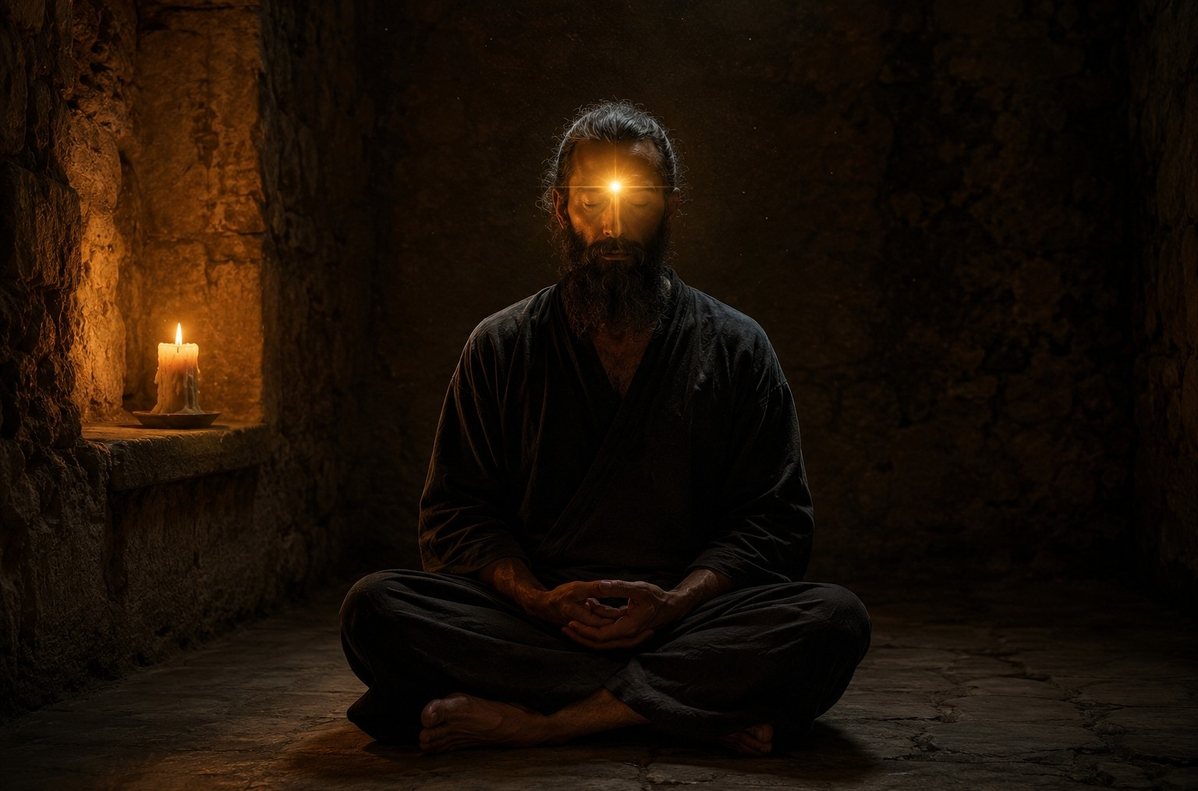
The third eye of Eastern traditions, located between and slightly above the physical eyes, represents the same capacity for inner vision. This ajna chakra, as it is known in yoga, is the centre of intuition and direct knowing, the eye that perceives realities beyond the physical. When activated through meditation and spiritual practice, the third eye opens to perceive the subtle dimensions that interpenetrate the material world. The pineal gland, located at the geometric centre of the brain, has been identified across traditions as the physical correlate of the third eye. This small gland, shaped like a pine cone, produces melatonin that regulates sleep cycles.
The Pineal Hypothesis: Fact and Speculation
The claim that the pineal gland produces DMT (dimethyltryptamine), a compound associated with altered states of consciousness, originates from psychiatrist Rick Strassman’s 2000 book DMT: The Spirit Molecule. While trace amounts of DMT have been detected in the pineal glands of rats, scientific review has found no conclusive evidence that the human pineal gland produces sufficient DMT to cause psychoactive effects. The adult human pineal gland weighs less than 0.2 grams and produces approximately 30 micrograms of melatonin per day–quantities insufficient to generate the milligram-level DMT doses required for psychedelic experience. Endogenous DMT exists in minute concentrations throughout the brain and body, but its precise source and function remain under investigation. The pineal gland is more accurately understood as the regulator of circadian rhythm through melatonin, with any role in visionary experience remaining speculative rather than established.
The calcification of the pineal gland that occurs with age has been documented by researchers including Jennifer Luke, who in 2001 reported high fluoride concentrations in aged human pineal glands and a correlation with calcium accumulation. However, subsequent research has produced mixed findings regarding the fluoride-calcification relationship. Whether one accepts the metaphysical framing or not, the biological reality is clear: calcified pineals produce less melatonin, disrupting sleep, mood regulation, and the circadian rhythms that govern everything from hormone release to immune function. The “closing of the gates” may be metaphorical, but the physiological consequences are measurable. The third eye is not merely the pineal gland–it is the energetic vortex, the chakra, the point where individual consciousness interfaces with the collective field of awareness that pervades the cosmos.
The Esoteric Significance: What the Eye Actually Represents
Beyond historical usage and cultural adaptation, the all-seeing eye represents several universal principles that converge across traditions:
The Capacity for Awareness
The eye represents the defining characteristic of consciousness–the ability to know and to be known. This is not merely human consciousness but the divine consciousness of which individual awareness is a reflection. The eye does not create the light; it registers it. The eye does not generate reality; it reveals it. In this sense, the all-seeing eye is the symbol of consciousness itself–the capacity that makes all other capacities possible.
The Threefold Structure of Knowing
The triangle surrounding the eye represents subject, object, and the relationship between them–the threefold structure that constitutes all knowing. The eye at the centre represents the unity that transcends and includes this threefold division. In Kabbalistic terms, this is the triad of Keter, Chokmah, and Binah; in Christian terms, the Holy Trinity; in philosophical terms, the knower, the known, and the knowing. The triangle is not a cage but a frame; it does not limit the eye but gives it dimension.
The Projection of Consciousness
The rays of light emanating from the eye in many depictions represent the active dimension of perception–the extension of awareness to touch and illuminate what is encountered. The eye is not merely receptive but projective; consciousness does not passively register but actively shapes. This is the Hermetic principle of mentalism in visual form: the universe is mental, and the eye is the organ of its creation.
The Witness Consciousness
The all-seeing eye also represents the aspect of consciousness that observes all experience without becoming entangled in it–the capacity for detached awareness that is essential for spiritual development. This is the sakshi of Vedanta, the witness of Christian mysticism, the observer of quantum physics. The eye that sees without judging, knows without possessing, and illuminates without consuming.
The Integration of Three Aspects
The symbol of the eye within the triangle also represents the integration of the three aspects of consciousness–thinking, feeling, and willing–that constitute the complete human being. The triangle represents the integration of these three, with the eye at the centre representing the unified awareness that transcends and includes them all. This integration is the goal of psychological and spiritual development–the achievement of wholeness that allows the full expression of human potential. The all-seeing eye thus represents the integrated self, the fully developed human being who has achieved harmony of thought, feeling, and action.
In Rudolf Steiner’s anthroposophical psychology, the human being is understood as a threefold organism: the nerve-sense system (thinking), the rhythmic system (feeling), and the metabolic-limb system (willing). Health is the harmonious interweaving of these three; pathology is their dissociation. The eye within the triangle is the symbol of this harmony–the consciousness that has achieved integration rather than fragmentation. The Gnostic would add a fourth element: the spark, the divine fragment that animates the three and is not reducible to any of them.
These bodies are not separate entities but aspects of a single continuum–different densities of the same essential energy, different frequencies of the same fundamental consciousness, like layers of an onion sharing a common centre.
— Theosophical analogy
The Alchemical Eye: Vision and Transformation
In alchemical tradition, the all-seeing eye represents the capacity for inner vision necessary for the Great Work. The alchemical eye sees beyond the surface appearance of matter to perceive the subtle energies and processes that underlie physical reality. This inner vision is essential for the alchemist’s work, as it allows the perception of how matter can be transformed. The eye symbolism connects to the broader understanding of the philosopher’s stone as the fully awakened consciousness that has achieved integration and wholeness.
Jung and the Psychology of Alchemy
The four stages of alchemical work–nigredo (blackening), albedo (whitening), citrinitas (yellowing), and rubedo (reddening)–each involve the development of perception, the gradual clearing of vision that allows the alchemist to see more clearly. Nigredo is the shattering of the old lens, the dissolution of ordinary perception in the darkness of the unconscious. Albedo is the emergence of clarity, the washing away of impurities that obscured vision. Citrinitas is the dawning of solar consciousness, the integration of insight into practical wisdom. Rubedo is the completion of the work, the reddening that signals the union of opposites and the birth of the stone–the fully awakened eye that sees all things in their divine nature.
Carl Jung, who devoted his later career to the study of alchemical symbolism, interpreted these stages as psychological processes: confession (nigredo), illumination (albedo), education (citrinitas), and transformation (rubedo). For Jung, the alchemist’s eye was the eye of the unconscious, projecting its own contents onto the chemical work. The Magnum Opus was not about turning lead into gold but about turning the fragmented psyche into the integrated Self. The all-seeing eye, in this reading, is the symbol of the Self–the archetype of wholeness that guides the individuation process.
Conspiracy Theory as Distraction
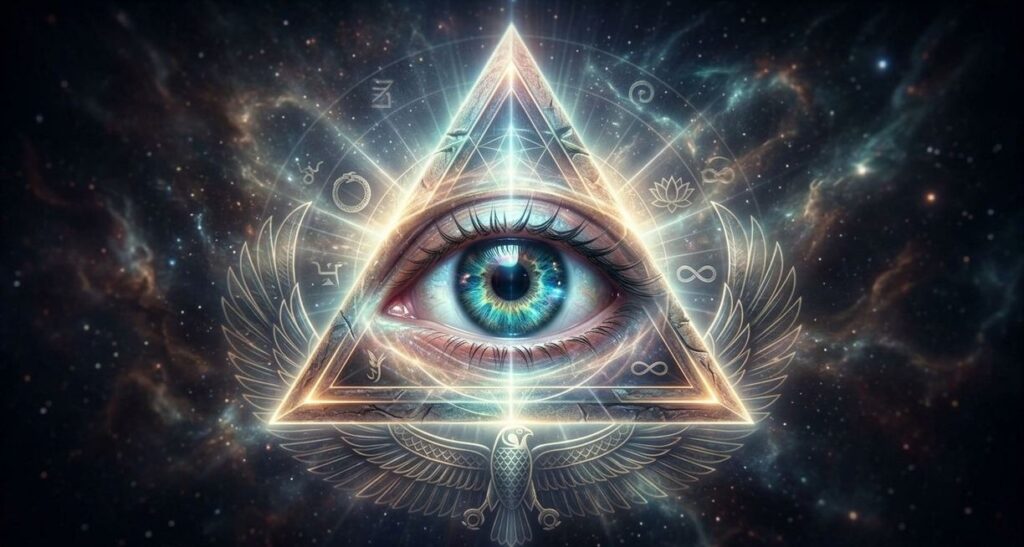
The conspiracy theories that surround the all-seeing eye, while often reflecting legitimate concerns about power and control in society, ultimately distract from the symbol’s genuine significance. By focusing on external threats and secret manipulations, these theories divert attention from the internal work of consciousness development that the symbol actually represents. The paranoid reading sees the eye as surveillance; the esoteric reading sees it as self-knowledge. The paranoid asks “who is watching me?”; the esoteric asks “what am I capable of seeing?” Both questions have their place, but only one leads to transformation.
The Archon of Distraction
The all-seeing eye is not a symbol of external surveillance but of internal awakening, not of control by others but of self-mastery. Understanding this transforms the symbol from a source of fear into an inspiration for growth. The Gnostic recognises that the ruling powers do not need to watch you if they can prevent you from watching yourself. The conspiracy that matters is not the conspiracy of secret societies but the conspiracy of distraction–the systematic colonisation of attention that prevents the development of inner vision. The eye on the dollar bill is not the problem; the eye that cannot see its own reflection is the problem.
Practical Application: Developing the Inner Eye
The practical application of the all-seeing eye’s wisdom involves the cultivation of the witnessing awareness that the symbol represents. This is not a single technique but a way of being that gradually transforms the relationship between consciousness and experience.
Meditation Practice
Through meditation, you develop the capacity to observe your own experience with detachment, seeing thoughts as thoughts, emotions as emotions, rather than identifying with them. The witness consciousness–the sakshi–does not suppress experience but holds it in a larger context. The thought arises; the witness notes it; the thought passes. This simple practice, repeated over time, builds the muscle of non-identification that is the foundation of inner vision.
Mindfulness in Daily Life
The integration of the all-seeing eye’s wisdom into daily life involves the cultivation of mindful awareness in all activities–maintaining the relaxed alertness that allows experience to be known as it arises. The eye that sees the traffic jam as traffic jam, not as personal affront; the eye that sees the difficult conversation as difficult conversation, not as threat to identity. This is not dissociation but clarity: the capacity to see things as they are, without the projections that ordinarily obscure them.
Self-Reflection
The eye that sees itself is the eye that knows itself. Regular self-reflection–honest examination of motives, patterns, and consequences–develops the capacity for self-knowledge that the symbol represents. This is not narcissistic self-obsession but disciplined inquiry: the willingness to look at one’s own shadow, to acknowledge the gap between intention and action, and to correct course when necessary. The all-seeing eye demands nothing less than radical honesty.
Ethical Accountability
The recognition that “all is seen” encourages ethical behaviour–not from fear of punishment but from understanding of the interconnected nature of reality, from the recognition that your actions have consequences that you cannot escape. The eye does not judge; it registers. The law is not external but internal: the natural consequence of action upon the field of consciousness in which all beings participate. To act ethically is not to obey a commandment but to align with the structure of reality itself.
Frequently Asked Questions
What does the all-seeing eye actually represent?
The all-seeing eye represents the capacity for awakened perception and self-knowledge, not external surveillance or secret control. Across traditions–from the Egyptian Eye of Horus to the Christian Eye of Providence to the Eastern third eye–the symbol points to the divine awareness that sees through all particular seeing. It is a mirror inviting the viewer to develop inner vision, not a camera recording external behaviour.
Is the all-seeing eye on the dollar bill a Masonic symbol?
No. The Eye of Providence on the Great Seal of the United States was adopted in 1782, before Freemasonry widely adopted the symbol in America. Congressional secretary Charles Thomson explicitly stated that the eye represents divine providence watching over the new nation. While Freemasonry later incorporated the all-seeing eye into its iconography, the claim that Masons secretly placed it on the Great Seal is chronologically impossible and not supported by historical evidence.
What is the Eye of Horus and how is it related to the all-seeing eye?
The Eye of Horus (wedjat) is an ancient Egyptian protective symbol representing the eye of the falcon-headed sky god Horus. Its distinctive shape encoded a system of fractions used in Egyptian mathematics. The myth of Horus and Set–in which Horus’s eye was torn out and restored by Thoth–represents the healing of fragmented consciousness. The Eye of Horus directly influenced European iconography during the Renaissance and led to the emergence of the Eye of Providence, making it the earliest ancestor of the all-seeing eye symbol.
What did Jesus mean by the ‘single eye’ in Matthew 6:22?
Biblical scholarship interprets Jesus’s ‘single eye’ (Greek haplous) within Hebrew idioms about the ‘good eye’ (generous) versus the ‘bad eye’ (stingy). In this context, the single eye means focused, sincere, and generous. However, Christian mystics from Meister Eckhart onward have developed an esoteric reading: the ‘single eye’ as the eye of the heart–the capacity for direct knowing and integrated perception that transcends duality. Both readings are valid: the scholarly reading addresses ethics, while the mystical reading addresses consciousness.
What is the connection between the all-seeing eye and the third eye chakra?
The all-seeing eye and the third eye (ajna chakra) represent the same capacity for inner vision across different cultural frameworks. The ajna chakra, located between the eyebrows, is the centre of intuition and direct knowing in yogic tradition. The pineal gland at the geometric centre of the brain is often identified as its physical correlate. Both symbols point to the dormant capacity for perception beyond ordinary sight–the recognition of subtle dimensions that interpenetrate the physical world.
Does the all-seeing eye prove the existence of the Illuminati?
No. The all-seeing eye is a public symbol with documented historical origins and publicly stated meanings. Its appearance on currency, in churches, and in corporate logos reflects its widespread adoption as a symbol of divine awareness, not evidence of a secret society’s control. The ‘Illuminati’ interpretation is a modern conspiracy theory that mistakes the symbol’s genuine esoteric significance for evidence of external manipulation. The symbol invites internal awakening, not paranoid projection.
How can I develop my own ‘inner eye’ or witnessing awareness?
Developing the inner eye involves sustained practice across four domains: (1) Meditation–observing thoughts and emotions without identification; (2) Mindfulness–maintaining relaxed alertness in daily activities; (3) Self-reflection–honest examination of motives and patterns; (4) Ethical accountability–recognising that actions have inescapable consequences in the field of consciousness. The goal is not supernatural vision but clarified ordinary perception–the capacity to see things as they are rather than as projection and habit make them appear.
Further Reading
These links connect the all-seeing eye to related resources within the ZenithEye library, offering context on Egyptian wisdom, esoteric Christianity, sacred architecture, and the broader landscape of direct knowing.
- Egyptian Wisdom: Anubis, the Tongue and Sacred Speech Power — The Egyptian roots of the all-seeing eye explored in greater depth; essential context for understanding the symbol’s origins.
- The Hidden Language of the Bible: Decoding Esoteric Christianity — The “single eye” teaching of Jesus in its biblical and allegorical context; the Christian development of eye symbolism.
- The Divine Architecture Within: How Your Body Mirrors the Universe — The pineal gland and its role as the physical correlate of the third eye; the physiology of inner vision.
- States of Knowing: What Happens When Consciousness Unravels — The experience of awakened perception that the all-seeing eye represents; what changes when consciousness shifts.
- The Hidden Agreements: Why Esoteric Traditions Keep Inventing the Same Architecture — The all-seeing eye appears across multiple traditions; this exploration reveals why certain symbols recur universally.
- The All-Seeing Eye Decoded: From Ancient Egypt to Freemasonry — The evolution of the eye symbol from ancient Egypt through Freemasonry to contemporary esotericism.
- The Chakra System: Origins, Development, and Modern Misconceptions — Understanding the traditional chakra framework and the ajna centre as the seat of intuition.
- Contemplative Techniques: The Thread’s Practical Foundation — Specific methods for cultivating the witnessing awareness that the all-seeing eye represents.
- The Physiology of Mystical Experience: How the Brain Changes During Awakening — Neuroscientific perspectives on the biological correlates of inner vision and expanded awareness.
- The Living Thread: How Forbidden Knowing Survives — The complete map of ZenithEye’s pillars, from historical survival of Gnosis to contemplative practice.
References and Sources
The following sources support the claims and historical data presented in this article. Egyptological and biblical sources follow standard academic conventions; esoteric sources by original publication date where available.
Primary Sources and Historical Documents
- American Revolution Institute. (2021). The Great Seal of the United States. Lesson Plans: Objects of Revolution.
- Thomson, C. (1782). Remarks and Explanations of the Great Seal of the United States. Congressional records, June 20.
- Webb, T. (1797). The Freemason’s Monitor. C. Hosmer.
- Illinois Freemasonry Blog. (2024). The Eye of Providence.
Biblical and Egyptological Scholarship
- Bible Project. (2024). What Matthew 6:22-23 (The Eye Is the Lamp of the Body) Means.
- Premier Christianity. (2021). A Good Eye: Unlocking Jesus’ Commonly-Misunderstood Idiom.
- Christ’s Words. (2025). Matthew 6:22: The Light of the Body Is the Eye.
- Robins, G. (1994). Egyptian mathematics and the Eye of Horus. Mathematics in School, 23(2), 12-14.
Scientific and Medical Sources
- Healthline. (2020). Pineal Gland DMT: 4 FAQs Answered.
- Nichols, D. E. (2018). N,N-dimethyltryptamine and the pineal gland: Separating fact from myth. Journal of Psychopharmacology, 32(1), 30-36.
- Luke, J. (2001). Fluoride deposition in the aged human pineal gland. Caries Research, 35(2), 125-128.
- Tharnpanich, T., et al. (2016). Association between high pineal fluoride content and pineal calcification in a low fluoride area. Fluoride, 49, 472-484.
Esoteric and Comparative Studies
- Jung, C. G. (1968). Psychology and Alchemy. Collected Works, Vol. 12. Princeton University Press.
- Edinger, E. F. (1985). Anatomy of the Psyche: Alchemical Symbolism in Psychotherapy. Open Court.
- Steiner, R. (1910). Theosophy: An Introduction to the Spiritual Processes in Human Life and in the Cosmos. Anthroposophic Press.
- Leadbeater, C. W. (1927). The Chakras. Theosophical Publishing House.
Safety Notice: This article explores esoteric and historical frameworks for understanding symbolism and consciousness. It does not constitute medical, psychological, or spiritual advice. If you experience persistent paranoia, delusional thinking, or symptoms of psychosis related to conspiracy beliefs, please contact professional mental health services. Contemplative practices complement but do not replace clinical treatment when needed.