The Concept of Our Great Power: The Apocalypse of the Elect
The Concept of Our Great Power (NHC VI,4) stands among the most intellectually demanding texts in the Nag Hammadi Library. Composed in Greek during the second or third century CE, likely in Alexandria, and preserved in a fourth-century Coptic translation, this tractate abandons the mythological narratives familiar from the Apocryphon of John in favour of austere metaphysical abstraction [1]. It presents a supreme Power (dunamis) that remains impersonal, silent, and resting beyond the creator god, the planetary archons, and even the self-generated realm of spirit. For scholars of ancient philosophy and early Christianity, the text offers crucial evidence of the philosophical syncretism that characterised Egyptian religious thought under the Roman Empire; for the contemporary reader, it challenges conventional assumptions about divinity, personhood, and the nature of salvation.
This article examines the Concept of Our Great Power through the combined lenses of codicology, philosophical theology, and comparative religion. We explore its radical apophaticism, its tripartite division of salvation history, its distinctive anthropology, and its affinities with Hermetic and Platonic traditions. Throughout, we maintain scholarly rigour while acknowledging the text’s capacity to unsettle comfortable theological certainties. The Power does not administer grace through personal intervention; it simply remains, like an executive headquarters that issues no memoranda yet sustains every branch office in existence.
Table of Contents
- Introduction to the Concept
- The Manuscript and Its Context
- The Great Power: An Impersonal Absolute
- The Three Ages of Salvation History
- Theological Distinctives
- The Hermetic Context
- Reading the Concept Critically
- Why the Concept Matters
- Frequently Asked Questions
- Further Reading
- References and Sources
Introduction to the Concept
What is the Concept of Our Great Power?
The Concept of Our Great Power (NHC VI,4) is a second-to-third-century CE apocalyptic tractate from the Nag Hammadi Library presenting a theology of absolute divine transcendence. Unlike the mythological narratives of the Apocryphon of John, this text describes a supreme “Power” (dunamis) that remains impersonal, silent, and resting–beyond the creator god, the planetary archons, and even the “autogenes” (self-generated realm). It organises salvation history into three ages (Flesh, Soul, Spirit) and teaches the “resurrection of the soul” as separation from fleshly illusion rather than bodily revivification. The text represents a hybrid of Sethian, Valentinian, and Hermetic theological vocabularies, often termed “the apocalypse of the philosophers.”
The text takes its title from its opening line, which speaks of “the concept [melete] of our great Power.” The Greek term melete carries resonances of contemplation, care, diligent study, and meditative absorption–suggesting that this is not a narrative to be merely read but an object of continuous philosophical attention [2]. Unlike the dramatic cosmogonic tragedies of the Apocryphon of John, where Sophia falls and Yaldabaoth roars his counterfeit claim to divinity, the Concept of Our Great Power offers a theology stripped of personalised mythology. The Power remains unnamed and undescribed throughout the tractate: a supreme reality beyond the creator god, beyond the stars, beyond even the autogenes (self-generated) realm that lesser texts might identify as the highest heaven.
If the Apocryphon of John provides the Gnostic bible–the definitive account of cosmogonic tragedy–the Concept of Our Great Power offers its mystical theology: the attempt to speak of the unspeakable source beyond all cosmogonic drama. Where John names the demiurge Yaldabaoth and describes Sophia’s fall in humiliating detail, the Power remains resolutely silent, “resting in himself alone.” This is not a deity who files reports on cosmic activity; it is the silent ground that makes all filing possible.
The Manuscript and Its Context
Codex VI and the Hermetic Collection
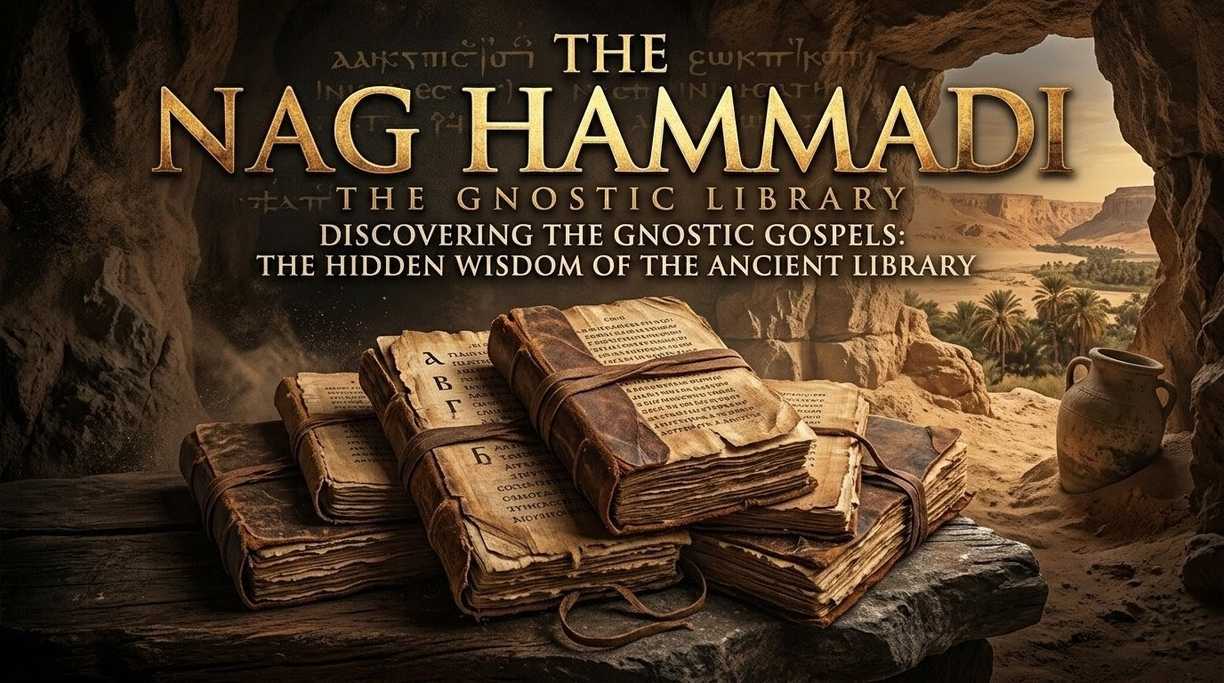
The Concept of Our Great Power occupies pages 36 through 44 of Codex VI, one of thirteen leather-bound volumes discovered in December 1945 near the town of Nag Hammadi in Upper Egypt [3]. The codex contains an extraordinary range of materials: the Prayer of Thanksgiving, the Discourse on the Eighth and Ninth, a fragment of Plato’s Republic, the Asclepius, and the Concept of Our Great Power itself. This curatorial choice suggests that ancient readers recognised the Power’s teaching as compatible with–or complementary to–the Hermetic ascent traditions and Platonic political philosophy that dominate the codex. The manuscript thus functioned not as a sectarian manifesto but as a philosophical anthology for contemplatives engaged in the melete of metaphysical truth.
Where other codices gather related Gnostic tractates into something resembling a theological filing cabinet, Codex VI juxtaposes Egyptian Hermeticism, Platonic excerpts, and Christian apocalyptic material without apparent anxiety about their theological differences [4]. The presence of the Concept of Our Great Power alongside the Discourse on the Eighth and Ninth–a Hermetic dialogue describing initiation into the Ogdoad–suggests that the ancient curators understood these texts as participating in a shared discourse about ascent beyond the planetary spheres. This intellectual breadth is unusual even in the diverse Nag Hammadi collection, revealing a readership comfortable with philosophical syncretism.
Dating and Provenance
Linguistic analysis indicates that the text was composed in Koine Greek during the late second or early third century CE, most probably in Alexandria, the intellectual capital of Roman Egypt [5]. The surviving Coptic translation, produced by the mid-fourth century, exhibits features of the Subachmimic dialect alongside standard Sahidic forms, suggesting translation activity within monastic or scholarly circles familiar with multiple Coptic idioms. The manuscript’s preservation in a sealed jar near a Pachomian monastery raises enduring questions about whether Gnostic and Hermetic texts were hidden by sympathetic monks seeking to protect them from Theodosian persecution, or by orthodox authorities attempting to remove heterodox materials from circulation [6].
The physical condition of Codex VI presents fewer challenges than some other Nag Hammadi volumes, though water damage and torn pages occasionally obscure the translator’s choices. Nevertheless, the crucial passages describing the Power’s silence, the three ages, and the rejection of fleshly resurrection remain legible, preserving what scholars have identified as “the most apophatic theology in the entire Nag Hammadi collection” [7].
The Great Power: An Impersonal Absolute
Dunamis Beyond Mythology
The “great Power” is not a warrior deity like the Melchizedek of Codex IX, nor a complex aeonic system like the Barbelo of Sethian texts. It is, simply, Power itself—dunamis–the capacity for existence that precedes existence, the potential that actualises worlds without being diminished by them [8]. Drawing on Aristotelian and Stoic philosophical vocabularies, the text presents a deity so transcendent that it makes no sense to speak of it acting, creating, or even knowing in any anthropomorphic sense. The Power does not manage the cosmos like a celestial administrator reviewing personnel files; it simply emanates, like light from a sun that knows nothing of the illumination it provides.
This Power “remains in himself alone, silent and resting” (NHC VI,4 38:5-10). Emanations flow from it like light from a sun that knows nothing of the illumination–automatic, necessary, and impersonal. This represents perhaps the most radical apophatic theology in the entire Nag Hammadi collection: a divine that exceeds even the negative descriptions of the One in Plotinus. Where the Apocryphon of John can describe the divine as “the Spirit” and “the First Thought” (Barbelo), the Power is simply Power–dunamis without personality, will, or even being in any predicate sense. The executive headquarters has been emptied of all personnel, leaving only the structure itself–a building that sustains every branch office without ever issuing a directive.
Primary Source Citation: NHC VI,4 38:5-10
“The great Power remains in himself alone, silent and resting. Emanations flow from him like light from a sun that knows nothing of the illumination.”
Scholarly Taxonomical Challenges
Scholars struggle to classify this text with the obsessive precision of archivists attempting to file a document that refuses categorisation. Is it Sethian? The presence of the “great Power” and the “incorruptible one” suggests Sethian theological vocabulary, as does the three-nature anthropology. Is it Hermetic? The text’s emphasis on nous (mind) and its tripartite division of humanity align with Hermetic teachings found elsewhere in Codex VI. Is it Valentinian? The three-age structure and the emphasis on spiritual election recall Valentinian systems [9].
Most likely, the Concept of Our Great Power represents a hybrid genre: the apocalypse of the philosophers. It uses the literary form of revealed end-time scenarios to convey metaphysical truths about the nature of reality and the destiny of the soul. Unlike the first-person visionary frameworks of Zostrianos or the Apocalypse of Paul, this text speaks with the anonymous authority of metaphysical deduction–the “we” of philosophical consensus rather than the “I” of ecstatic experience. This anonymity suits its subject: an impersonal Power requires no personal revealer, only the contemplative recognition of those capable of seeing beyond the cosmic filing system.
The Three Ages of Salvation History
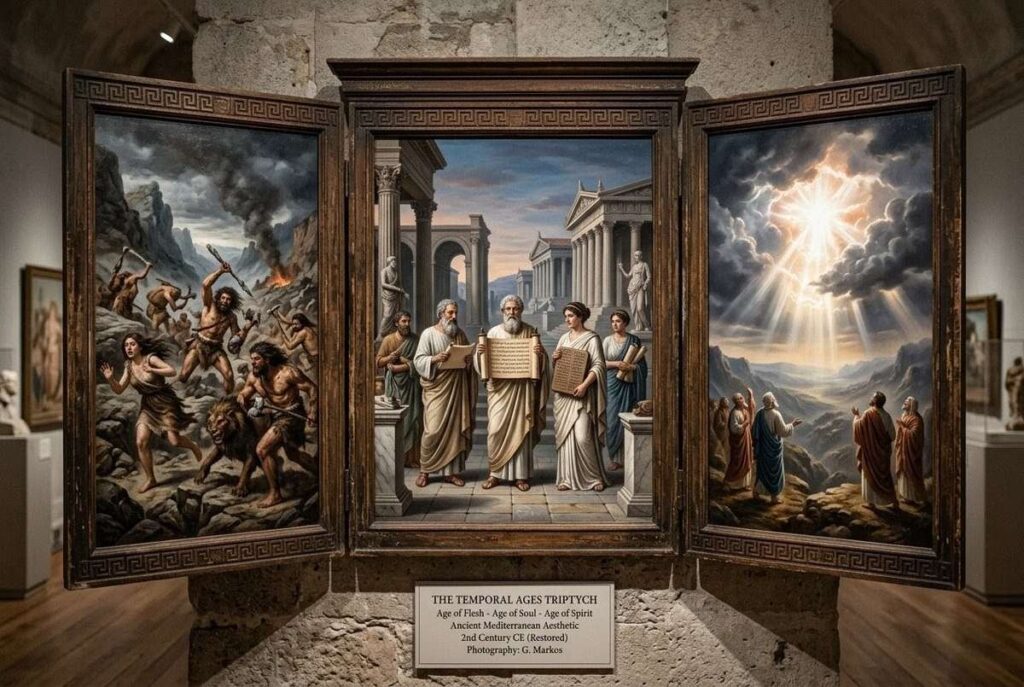
The text organises history into three great ages, corresponding to three revelations of the divine–a periodisation that maps neatly onto the Valentinian tripartite anthropology while maintaining a distinctive focus on the impersonal Power that sustains all three:
The Age of the Flesh
The initial creation by the “great archon”–a demiurgic figure who establishes the material cosmos and the Adam of dust–corresponds to the biblical period before the flood, characterised by violence and ignorance [10]. This is the realm of pure hylic (material) existence, where the sparks of spirit lie dormant in fleshly prisons. Crucially, however, the great Power does not abandon this creation to chaos. It “keeps it in being,” preventing the total collapse of matter into the void–a metaphysical safety net that maintains the possibility of future revelation even in the darkest administrative period of cosmic history.
The Age of the Soul
Initiated by the flood and the appearance of “the man who came into being from the seed,” this period introduces the psychic level of reality–the realm of emotion, virtue, vice, and ethical striving [11]. Here the great Power reveals itself through the prophets and the law, preparing humanity for a higher revelation through the pedagogical strictures of moral instruction. The text speaks of this age as one of “mixture” (mixis), where spirit and matter intermingle in the human composite. This is the condition of most historical humanity–neither fully asleep in matter nor fully awake in spirit, but suspended in the ethical ambivalence of the psychikoi (soulish ones) who must choose between the flesh and the spirit through the cultivation of virtue.
The Age of the Spirit
The present age–at least for the readers of the text–has been inaugurated by the coming of the “great Saviour” who reveals the incorruptible truth [12]. This is the eschatological moment, the “departure from the flesh” and the “revealing of the great Power” to those who have received the spiritual seed. Unlike other apocalypses that predict a future cataclysm deferred to a distant millennium, the Concept of Our Great Power suggests that the apocalypse is always now–the perpetual opportunity to recognise one’s spiritual nature and depart from the illusion of materiality. The end times are not chronological but noetic; the destruction of the world is the dissolution of false perception in the mind of the recogniser.
This present-tense eschatology distinguishes the text from both orthodox Christian futurism and deterministic Gnostic predestination. The apocalypse arrives not at the end of history but at the end of false consciousness–a shift in perception rather than a shift in cosmic administration. The branch office does not close; the employee simply realises they have always worked for the executive headquarters.
Theological Distinctives
Divine Impassibility and the Silent Source
Perhaps the most striking feature of the text is its insistence on the absolute transcendence and impassibility of the great Power. Unlike the emotional, jealous god of the Old Testament or even the providential demiurge of Middle Platonism, this supreme Power remains entirely self-contained [13]. It neither creates nor destroys in any meaningful sense; rather, lower realities emanate from it through metaphysical necessity, not deliberate intention. This is not a deity who intervenes in history like a chief executive issuing edicts; it is the ground of history itself, silent and unmoved.
This radical apophasis (negative theology) goes beyond even the Sethian descriptions of the Invisible Spirit. Where the Apocryphon of John can describe the divine as “the Spirit” and “the First Thought” (Barbelo), the Power is simply Power–dunamis without personality, will, or even being in any predicate sense. This anticipates the medieval via negativa of Pseudo-Dionysius while remaining grounded in the Hellenistic philosophical milieu of second-century Alexandria. The text effectively empties the executive headquarters of all personnel, leaving only the building itself–a structure that sustains every branch office without ever issuing a directive.
The Three Classes of Humanity
Primary Source Citation: NHC VI,4 36:15-20
“The opportunity is given to everyone. For the vessel of flesh will be broken, and the vessel of soul will be dissolved, and the vessel of spirit will be saved.”
Following a pattern seen in Valentinian and Sethian systems, the text divides humanity into three natures: the Spiritual (pneumatikoi), those who recognise the great Power immediately; the Psychic (psychikoi), those who require ethical cultivation and instruction; and the Material (hylicoi), those bound to fleshly concerns who lack the spiritual capacity for recognition [14]. Yet unlike the deterministic systems sometimes attributed to Gnosticism by its polemical enemies (Irenaeus, Tertullian), the text emphasises that “the opportunity is given to everyone.” The revelation is universally available, though not all have the eyes to see it. This is not arbitrary predestination but the recognition of different capacities for vision–a distinction between the near-sighted and the blind, not the elect and the damned by bureaucratic decree.
The Resurrection of the Soul
Primary Source Citation: NHC VI,4 40:1-5
“Do not expect, therefore, the resurrection of the flesh, for you will not find it. The resurrection of the soul is the separation from the fleshly prison and the ascent to the Ogdoad.”
The text offers a distinctive and controversial interpretation of resurrection that directly contradicts emerging orthodox Christian doctrine: “Do not expect, therefore, the resurrection of the flesh, for you will not find it” (NHC VI,4 40:1-5). This is not a denial of afterlife existence but its radical reinterpretation. The “resurrection of the soul” consists in the separation of the spiritual essence from the fleshly prison–a process described with imagery of ascent through planetary spheres to reach the “eighth heaven” of the Ogdoad, where the great Power dwells [15]. This is the anastasis (standing up) of the spiritual nature from the prostrate condition of material bondage, not the resuscitation of corpses.
The text thus denies the jurisdiction of the fleshly branch office entirely, offering exit visas that bypass material conditions altogether. The soul does not wait for a future general resurrection; it ascends now, through recognition, through the dissolution of false perception, through the realisation that the material filing system has no authority over those who know their true employer. This soteriology places enormous emphasis on present-tense awakening rather than future-tense hope.

The Hermetic Context
Philosophical Syncretism in Alexandria
The placement of this text in Codex VI alongside explicitly Hermetic materials suggests that the ancient curators recognised its affinities with Egyptian Hermeticism. Both traditions share a tripartite anthropology, planetary ascent imagery, and conceptions of an impersonal divine beyond name and form [4]. The text’s reference to nous (mind) and its division of humanity into material, psychic, and spiritual natures align with Hermetic teachings found throughout the Corpus Hermeticum. The Discourse on the Eighth and Ninth–found in the same codex–describes an ascent to the Ogdoad that mirrors the Power’s soteriology of spiritual departure from material bondage.
Yet the Concept of Our Great Power maintains a distinctly Christian-apocalyptic framework, referring to the “great Saviour” and the prophetic preparation of the Age of the Soul. It represents not pure Hermeticism but the syncretistic edge where Gnostic Christianity meets Egyptian philosophy–a borderland where revelations are received not in desert visions but in the contemplative study (melete) of metaphysical truths [9]. This hybridity reflects the intellectual environment of Alexandria, where Jewish, Christian, Platonic, and Egyptian traditions intermingled in the lecture halls and libraries of the Mediterranean’s greatest city.
The Ogdoad and Planetary Ascent
The journey through the spheres of the planets to reach the Ogdoad (eighth sphere) beyond the cosmic dome is a central Hermetic motif that the Concept of Our Great Power shares with its codex companions. In both traditions, the planetary spheres function as administrative checkpoints staffed by archontic functionaries who attempt to detain the ascending soul [8]. The Gnostic or Hermetic adept must pass through these spheres not by force but by knowledge–possessing the proper passwords, seals, or recognition of one’s true identity to bypass the cosmic bureaucracy.
Where the Discourse on the Eighth and Ninth describes this ascent through ritual initiation and ecstatic dialogue, the Concept of Our Great Power presents it as the natural consequence of metaphysical recognition. The soul does not battle the planetary administrators; it simply sees through them, realising that their authority extends only over those who accept the legitimacy of their paperwork. This difference in tone–ritual drama versus philosophical detachment–illuminates the range of approaches within the Nag Hammadi Library’s ascent literature.
Reading the Concept Critically
Challenges to Embodied Spirituality
For modern readers, the Concept of Our Great Power presents both challenges and gifts. Its strict dualism–spirit good, matter ultimately unreal–conflicts with ecological and embodied spiritualities that celebrate material existence, the wisdom of the body, and the sacrality of the natural world [10]. The text’s rejection of fleshly resurrection can read as world-denying escapism, a spiritual elitism that abandons the earth to its archonic administrators. Those who find meaning in incarnational theology, sacramental materialism, or ecological mysticism may find the Power’s silence cold rather than liberating.
Resonances with Negative Theology
Yet its emphasis on the “great Power” as impersonal potential rather than anthropomorphic deity resonates with certain Buddhist conceptions of sunyata (emptiness) as the ground of becoming, and with process theological conceptions of God as persuasive rather than coercive power [11]. The Power’s “silence” resembles the Buddhist avyakata (the undeclared)–questions that the Buddha refused to answer because they proceed from false assumptions about the nature of reality. The text’s rejection of fleshly resurrection in favour of “the concept”–the contemplative recognition of one’s true nature–anticipates modern existentialist and phenomenological approaches to religion.
Salvation here is not a future event but a present recognition: “When the creation comes to an end, then their thought will separate from the darkness” (NHC VI,4 41:1-5). The apocalypse is the dissolution of false perception, not the destruction of the world. This present-tense soteriology distinguishes the text from both orthodox Christian futurism and deterministic Gnostic systems, offering instead a contemplative pragmatism that measures salvation by the quality of recognition rather than the quantity of ritual observance.
The Spectrum of Gnostic Response
Read alongside Thunder: Perfect Mind or Trimorphic Protennoia, the Concept of Our Great Power reveals the Nag Hammadi Library’s remarkable theological diversity. Where those texts speak in the voice of the divine feminine–personal, paradoxical, relational–this tractate speaks in the abstract register of metaphysical power [13]. Where they emphasise descent and incarnation, it emphasises transcendence and ascent. Together, these texts suggest that Gnosticism was never a single system but a spectrum of responses to the mystery of suffering, embodiment, and divine presence.
The text ends where it begins: with silence. The great Power “remains in himself alone.” What remains for the reader is the melete–the contemplation, the care, the concept of that which cannot be contained by concepts. In the library of forbidden knowing, this may be the most dangerous text of all: the one that suggests that knowing itself must finally be transcended.

Why the Concept Matters
The Concept of Our Great Power matters because it preserves the most radical apophatic theology in the Nag Hammadi Library. It demonstrates that early Christians and their philosophical contemporaries entertained conceptions of divinity far beyond the personalist theism that would dominate later orthodoxy–conceptions that included impersonal power, silent transcendence, and the absolute rejection of material resurrection [7].
The text also illuminates the philosophical sophistication of Egyptian religious thought under the Roman Empire. Its synthesis of Aristotelian dunamis, Stoic cosmology, Platonic ascent, and Christian soteriology reveals a culture of intellectual creativity that modern categories of “pagan,” “Christian,” and “Gnostic” cannot adequately capture [9]. The ancient curators of Codex VI recognised this creativity, placing the Power alongside Plato and Hermes Trismegistus without apparent concern for anachronistic boundaries.
Finally, the treatise challenges any comfortable theology of divine personhood. Whether one accepts or rejects its impersonal absolute, the text forces readers to confront the question: must God be personal to be real? And what follows–for ethics, for spirituality, for the natural world–if the ultimate reality is not a person but a Power? The Concept of Our Great Power offers no easy answers, only the stark clarity of a vision that found conventional personifications wanting.
Frequently Asked Questions
What is the Concept of Our Great Power?
The Concept of Our Great Power (NHC VI,4) is a second-to-third-century CE apocalyptic tractate from the Nag Hammadi Library presenting a theology of absolute divine transcendence. It describes a supreme ‘Power’ (dunamis) that remains impersonal, silent, and resting–beyond the creator god and planetary archons.
What are the three ages in the Concept of Our Great Power?
The text organises history into three ages: (1) The Age of the Flesh–initial material creation by the great archon; (2) The Age of the Soul–period of mixture initiated by the flood, characterised by psychic development through law and prophets; (3) The Age of the Spirit–present eschatological moment inaugurated by the great Saviour, offering immediate recognition of the Power.
Does the Concept of Our Great Power deny resurrection?
The text denies the ‘resurrection of the flesh’ (somatic resurrection) but affirms the ‘resurrection of the soul’–understood as the separation of spiritual essence from fleshly prison and ascent to the Ogdoad (eighth heaven). This represents a spiritual rather than bodily conception of afterlife existence.
Is the Great Power a personal god?
No. The text describes the Power (dunamis) as radically impersonal and transcendent. It ‘remains in himself alone, silent and resting,’ emanating worlds without knowing them, like light from a sun unaware of its illumination. This represents the most apophatic (negative) theology in the Nag Hammadi Library.
What are the three classes of humanity in the text?
The text divides humanity into: (1) Spiritual (pneumatikoi)–those who immediately recognise the Power; (2) Psychic (psychikoi)–those requiring ethical cultivation and instruction; (3) Material (hylicoi)–those bound to darkness who cannot perceive the light. Unlike deterministic systems, the text states ‘the opportunity is given to everyone.’
How is Concept of Our Great Power different from Apocryphon of John?
While Apocryphon of John provides detailed mythological narrative (Sophia’s fall, Yaldabaoth’s birth, archonic creation), Concept of Our Great Power offers abstract metaphysics without personalised mythology. Where John describes a providential albeit fallen cosmos, Power describes an impersonal absolute beyond all cosmogonic drama.
Is this text Gnostic, Hermetic, or Christian?
Scholars classify it as a hybrid: philosophically Hermetic in its tripartite anthropology and planetary ascent imagery, Christian in its reference to the ‘great Saviour’ and prophetic age, and Gnostic in its soteriology of awakening and rejection of fleshly resurrection. It represents the ‘apocalypse of the philosophers’–revelation through metaphysical contemplation rather than visionary experience.
Further Reading
These links connect the Concept of Our Great Power to related resources within the ZenithEye library, offering context on apophatic theology, Sethian cosmology, Hermetic ascent, and the broader landscape of Nag Hammadi scholarship.
- The Apocryphon of John: Gnostic Creation Myth — Compare the demiurgic narratives and personalised mythology with the abstract theology of the Great Power.
- Thunder: Perfect Mind — Contrast the impersonal Power with the personal, paradoxical voice of the divine feminine speaking in the first person.
- Melchizedek: The Warrior Priest — Explore another Codex VI text with apocalyptic themes but very different theology of sacrifice and struggle.
- Zostrianos: The Journey Through the Thirteen Aeons — A more detailed first-person visionary ascent narrative sharing the Power’s concern with heavenly journeys.
- The Discourse on the Eighth and Ninth — The Hermetic text from the same codex dealing with ascent to the Ogdoad.
- Hermeticism and Gnosticism: Egyptian Wisdom Traditions — Understand the philosophical context of Codex VI’s hybrid texts.
- Trimorphic Protennoia — Compare the three descents of the divine feminine with the three ages of the Power.
- Nag Hammadi Library: The Complete Guide — Contextualise the Concept of Our Great Power within the full collection of 46 tractates.
- Codex VI: Hermetic and Platonic Texts — Discover the other texts found alongside the Power in the same codex.
- On the Origin of the World — Another creation narrative with three-age structure and eschatological focus.
References and Sources
The following sources support the claims and quotations presented in this article. All citations to the Nag Hammadi Library represent direct translations from the Coptic text as established in the standard critical editions.
Primary Sources and Critical Editions
- [1] James M. Robinson, ed., The Nag Hammadi Library in English, 4th rev. ed. (Leiden: Brill, 1996), 289-97. Translation of NHC VI,4 by John D. Turner and Orval S. Wintermute.
- [2] Louis Painchaud, Le Deuxieme Traite du Grand Seth (NH VII, 2), Bibliotheque copte de Nag Hammadi, Section “Textes” 6 (Quebec: Les Presses de l’Universite Laval, 1982). Critical Coptic edition methodology applicable to Codex VI texts.
- [3] James M. Robinson, “The Discovery of the Nag Hammadi Codices,” Biblical Archaeologist 42, no. 4 (1979): 206-24. Codicological context of the Nag Hammadi Library discovery.
- [4] Jean-Pierre Mahe, “Hermes et la gnose: a propos de l’Asclepius copte de Nag Hammadi,” Bulletin de la Societe francaise d’egyptologie 120 (1991): 25-36. Hermetic context of Codex VI materials.
- [5] Stephen E. Robinson, “The Concept of Our Great Power,” in The Coptic Encyclopedia, ed. Aziz S. Atiya (New York: Macmillan, 1991). Encyclopaedic overview of manuscript and contents.
Scholarly Monographs and Commentaries
- [6] David Brakke, The Gnostics: Myth, Ritual, and Diversity in Early Christianity (Cambridge, MA: Harvard University Press, 2010). Contextualises hybrid texts within early Christian diversity.
- [7] Michael Allen Williams, Rethinking “Gnosticism”: An Argument for Dismantling a Dubious Category (Princeton: Princeton University Press, 1996). Critical reassessment of Gnosticism as a scholarly category.
- [8] John D. Turner, “The Gnostic Threefold Path to Enlightenment,” Novum Testamentum 22 (1980): 324-51. Analysis of Sethian and Hermetic ascent patterns.
- [9] Birger A. Pearson, Ancient Gnosticism: Traditions and Literature (Minneapolis: Fortress Press, 2007). Survey of hybrid Gnostic-Hermetic texts.
- [10] Nicola Denzey Lewis, Introduction to “Gnosticism”: Ancient Voices, Christian Worlds (New York: Oxford University Press, 2013). Accessible introduction to Nag Hammadi diversity.
Comparative Studies and Thematic Analyses
- [11] Roelof van den Broek, Gnostic Religion in Antiquity (Cambridge: Cambridge University Press, 2013). Historical and theological analysis of apophatic trends.
- [12] Gedaliahu A. G. Stroumsa, Another Seed: Studies in Gnostic Mythology (Leiden: Brill, 1984). Examination of Sethian mythology and three-age structures.
- [13] April D. DeConick, The Gnostic New Age: How a Countercultural Spirituality Revolutionised Christianity from Antiquity to Today (New York: Columbia University Press, 2016). Comparative analysis of Nag Hammadi theological diversity.
- [14] Elaine Pagels, The Gnostic Gospels (New York: Random House, 1979). Classic study of resurrection controversies in early Christianity.
- [15] Hans-Martin Schenke, “The Phenomenon and Significance of Gnostic Sethianism,” in The Rediscovery of Gnosticism, ed. Bentley Layton (Leiden: Brill, 1981), 588-616. Definitive study of Sethian theological vocabulary and anthropology.