What Are the Hidden Agreements? Unseen Contracts That Shape Perception
The Hidden Agreements are the unseen contracts, patterns, symbolic systems, institutional structures, and inherited assumptions that shape human perception and behaviour. They are not conspiracy theories. They are not secret societies pulling levers in a smoke-filled room. They are the quiet accords–cultural, linguistic, architectural, and cognitive–that operate below the threshold of conscious awareness, determining what is seen, what is ignored, and what is considered impossible.
As a pillar of ZenithEye, The Hidden Agreements examines how these invisible contracts function across history and culture. It maps the cross-cultural patterns that suggest parallel recognition rather than isolated invention. It studies the sacred architecture that encodes knowledge in stone and proportion. It traces the esoteric lineages that preserved and transmitted forbidden teachings through coded manuscripts and oral transmission. And it asks the most difficult question: if these agreements are hidden, how does one see through them–and what does it cost to withdraw consent?
The Hidden Agreements are the unseen contracts, patterns, symbolic systems, institutional structures, and inherited assumptions that shape human perception and behaviour.
Table of Contents
- What Are the Hidden Agreements?
- The Architecture of Invisible Contracts
- Cross-Cultural Patterns: Parallel Recognition
- Sacred Architecture and Symbolic Encryption
- Esoteric Lineages and the Transmission of Secrecy
- The Withdrawal of Consent
- Why the Hidden Agreements Matter
- Frequently Asked Questions
- Further Reading

What Are the Hidden Agreements?
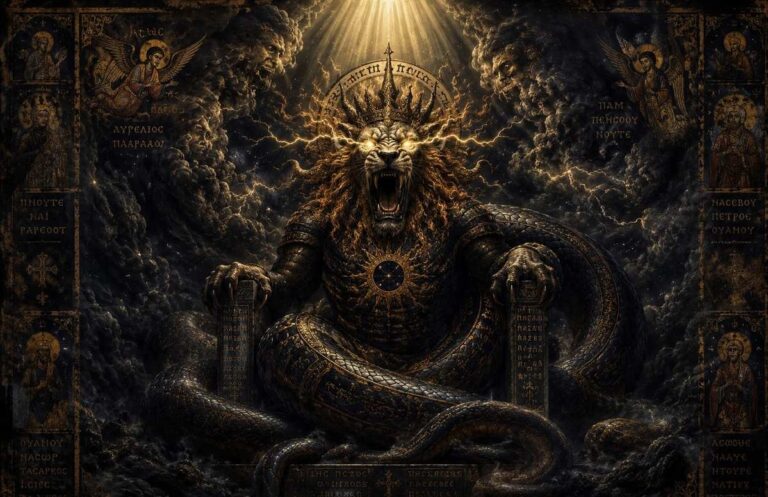
The concept is both ancient and urgently modern. In Gnostic cosmology, the archons are rulers who operate through deception, maintaining control not by force alone but by making their dominion appear natural, inevitable, and invisible. The Nag Hammadi texts describe the counterfeit spirit, a force that mimics divine authority while binding the soul to cycles of ignorance. These are mythological formulations of a recognisable truth: power is most effective when it is least visible.
The Hidden Agreements updates this recognition for a contemporary audience. It examines how language itself encodes assumptions–how the words available to a culture limit the thoughts available to its members. It studies how institutional structures, from religious hierarchies to digital platforms, create default settings that shape behaviour without explicit instruction. It examines how inherited cosmologies–the automatic belief that matter is primary and consciousness secondary–function as unexamined articles of faith. And it traces how symbolic systems, from corporate logos to national flags, operate as condensed packets of meaning that bypass rational analysis and speak directly to the unconscious.
The Architecture of Invisible Contracts
Institutional Structures
Institutions do not merely make rules; they produce reality. A school teaches not only curriculum but the hidden agreement that knowledge is delivered by authority and received by submission. A hospital teaches not only medicine but the agreement that the body is a machine to be fixed by external expertise. A social media platform teaches not only connectivity but the agreement that attention is currency and visibility is value. These structures do not announce their assumptions. They embed them in procedure, architecture, and interface.
Inherited Assumptions
Every culture transmits a cosmology–a set of answers to questions so fundamental they are rarely asked. What is real? What is possible? What is the relationship between mind and matter? What happens after death? These answers are not delivered as propositions to be evaluated. They are delivered as atmosphere, as the water in which the fish swims. The hidden agreement of materialism, for instance, is not a scientific conclusion but a metaphysical stance that has become so pervasive it is mistaken for common sense. To question it feels, to many, like questioning gravity.
Cross-Cultural Patterns: Parallel Recognition
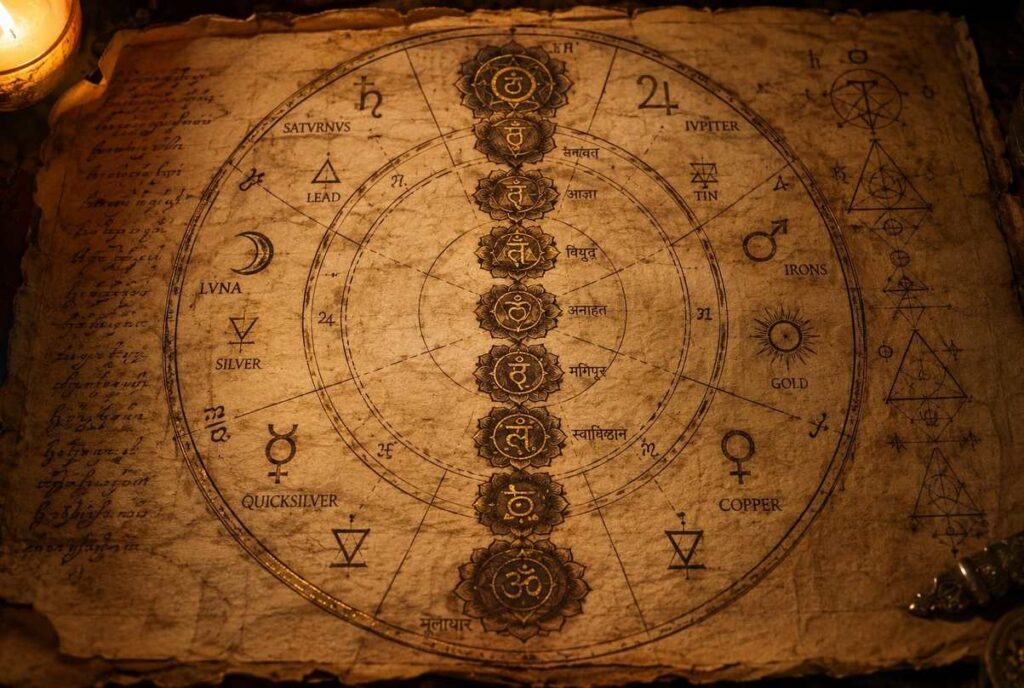
The Cross-Cultural Patterns subcategory of The Hidden Agreements examines the recurring structures that appear across civilisations separated by geography and epoch. The sevenfold correspondence of planets, metals, days, and chakras appears in Hindu tantra, Hermetic alchemy, and medieval astrology. The axis mundi–the cosmic centre connecting heaven and earth–appears as the Egyptian djed pillar, the Buddhist stupa, the Christian cathedral spire, and the shamanic world tree. The concept of a hidden realm accessible through specific techniques appears in the Gnostic pleroma, the Kabbalistic sefirot, the Buddhist pure lands, and the shamanic upper and lower worlds.
These parallels are not evidence of a single tradition from which all others descended, nor are they mere coincidence. They suggest something more interesting: that human consciousness, operating under similar conditions across cultures, recognises similar patterns. The hidden agreement here is not that there is one true tradition, but that the human mind and the cosmos it inhabits share structural features that become visible when the usual filters are suspended. The agreement is between consciousness and reality, not between one culture and another.
Sacred Architecture and Symbolic Encryption
Sacred Architecture studies how stone, proportion, and orientation were used to create conditions conducive to altered states and to encode teachings in durable form. The Gothic cathedral is not merely a building but a three-dimensional theology: the nave as the body of Christ, the rose window as the mandala of the cosmos, the labyrinth as the path of return. The Egyptian temple is oriented to catch the first light of the solstice, its hypostyle columns representing the papyrus marshes of creation. The Hindu temple is a mandala in stone, its proportions mapping the subtle body of the devotee.
These structures encode hidden agreements about the nature of reality, the relationship between macrocosm and microcosm, and the techniques by which the individual might align with cosmic order. They were not built for passive viewing but for active participation: walking the labyrinth, standing at the crossing of nave and transept, facing the rising sun through the temple door. The architecture is a teaching device, and the hidden agreement is that the body in space is the primary instrument of knowledge.
Symbol Encryption extends this principle to the two-dimensional plane. Esoteric traditions have long used symbols that operate on multiple levels: the exoteric meaning for the uninitiated, the esoteric meaning for those with the keys. The language of the birds, the alchemical emblem, the cryptographic system–all are methods of hiding in plain sight. The hidden agreement is that some knowledge must be concealed not from the worthy but from the dangerous, and that the worthy will recognise the signal because they have done the work of preparation.

Esoteric Lineages and the Transmission of Secrecy
Esoteric Lineages traces the institutional and subterranean channels through which hidden knowledge moved. From the Library of Alexandria to the House of Wisdom in Baghdad, from the Toledo School of Translators to the private libraries of Renaissance magi, knowledge travelled in manuscripts, in oral transmission, and in the direct contact between teacher and student. The hidden agreement here is not merely that knowledge was preserved but that it was transformed by each transmission, adapted to new languages, new cosmologies, and new dangers.
The lineage is not a straight line but a web. Jewish scholars preserved Arabic translations of Greek philosophy. Sufi mystics transmitted Indian breath techniques under Islamic formulae. The Corpus Hermeticum, attributed to the Egyptian Hermes Trismegistus, was composed in Greek by authors deeply influenced by Platonic and Jewish thought. The Rosicrucian manifestos of 1614 announced a hidden brotherhood that may never have existed as described, yet catalysed a century of alchemical and philosophical inquiry. The hidden agreement is that secrecy is not merely protection but a generative force: the very act of concealment creates the conditions for discovery.
The Withdrawal of Consent
If the hidden agreements are contracts, then the most radical act is not to break them violently but to withdraw consent. The Gnostic texts insist that the archons have no power over those who have recognised their deception. This is not a call to political revolution but a call to recognition. To see the agreement is already to dissolve its binding force, because the agreement depends on unconscious participation.
The subcategory of Modern Synthesis asks how this withdrawal operates today. Digital minimalism is the withdrawal of consent from the attention economy. Somatic sovereignty is the withdrawal of consent from the medicalisation of the body. Spiritual discernment is the withdrawal of consent from the counterfeit spirituality of the wellness industry. Each withdrawal is a small act of gnosis: the recognition that the agreement was never truly binding, only habitually obeyed.

Why the Hidden Agreements Matter
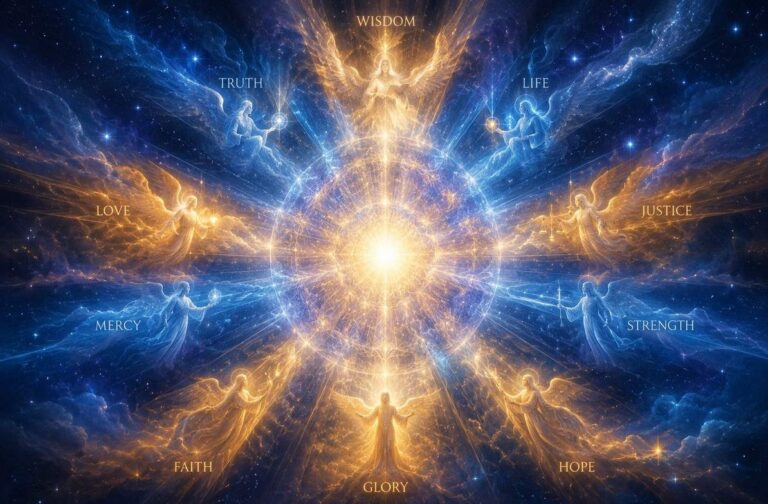
The pillar matters because Gnosticism is not merely a set of ancient texts. It is a method of seeing–a persistent refusal to accept the official version of reality as the only version. The Hidden Agreements provides the tools for that refusal. It teaches the reader to recognise patterns across traditions, to decode symbols, to see architecture as argument, and to understand that the most powerful constraints are often the ones that have never been named.
In an age of algorithmic governance, predictive policing, and the architecture of the infinite scroll, the hidden agreements are no longer merely esoteric. They are the operating system of daily life. To study them is not to retreat into conspiracy but to reclaim the capacity for independent perception. As the Nag Hammadi texts teach, the children of the light are not those who have memorised doctrine but those who have recognised the illusion and walked through it.
Frequently Asked Questions
What are the Hidden Agreements?
The Hidden Agreements are the unseen contracts, patterns, symbolic systems, institutional structures, and inherited assumptions that shape human perception and behaviour. They operate below conscious awareness, determining what is seen, ignored, or considered impossible.
Are the Hidden Agreements a conspiracy theory?
No. The Hidden Agreements are not about secret societies or deliberate plots. They are about the unconscious structures–cultural, linguistic, architectural, and cognitive–that shape reality without explicit announcement. Power is most effective when it appears natural and inevitable.
What are the subcategories of the Hidden Agreements pillar?
The subcategories include Cross-Cultural Patterns, Sacred Architecture, Symbol Encryption, Esoteric Lineages, and Modern Synthesis. Each examines a distinct dimension of how hidden knowledge and hidden control operate across history and culture.
What are cross-cultural patterns in esoteric traditions?
Cross-cultural patterns are recurring structures that appear across civilisations separated by geography and epoch, such as the sevenfold correspondence of planets and metals, the axis mundi, and the concept of hidden realms accessible through specific techniques. They suggest parallel recognition rather than direct transmission.
How does sacred architecture encode hidden knowledge?
Sacred architecture uses proportion, orientation, and spatial design to create conditions conducive to altered states and to encode teachings about cosmology and the relationship between macrocosm and microcosm. The building itself becomes a three-dimensional teaching device.
What is meant by the withdrawal of consent?
The withdrawal of consent is the recognition that hidden agreements depend on unconscious participation. To see the agreement is to dissolve its binding force. This can manifest as digital minimalism, somatic sovereignty, or spiritual discernment–small acts of recognition in daily life.
How do esoteric lineages preserve hidden knowledge?
Esoteric lineages preserve knowledge through manuscripts, oral transmission, and direct teacher-student contact. The transmission is not a straight line but a web that crosses cultures, languages, and epochs, adapting the teaching to new contexts while maintaining its core.
Further Reading
Explore these ZenithEye articles to deepen your understanding of hidden patterns, esoteric architecture, and the structures that shape perception:
- The Hidden Agreements: Esoteric Architecture — The foundational pillar article examining cross-cultural patterns, sacred geometry, and the encrypted symbols that connect the world’s esoteric traditions.
- The Withdrawal of Consent: Breaking the Karmic Contract — A deep exploration of how recognition dissolves binding agreements, from ancient contracts to modern digital capture.
- Soul Contract Revocation: Breaking Agreements You Never Signed — Examining the invisible contracts of karma, ancestral inheritance, and the ceremony of liberation.
- The Sevenfold Pattern: Planets, Metals, and Chakras — A study of the recurring sevenfold correspondence that appears across Hindu, Hermetic, and alchemical traditions.
- Sacred Architecture: Temples as Teaching Devices — How stone, proportion, and orientation encode cosmological knowledge in structures from Egypt to Gothic Europe.
- Symbol Safety Protocol: Why Esotericism Hides — The deliberate use of steganography, alchemical emblems, and encrypted transmission to protect knowledge from misuse.
- Esoteric Lineages: The Subterranean Web — Tracing the channels through which forbidden knowledge travelled from Alexandria to Baghdad to the Renaissance and beyond.
- The Axial Age: Why Wisdom Emerged Simultaneously — Examining the parallel emergence of interiority, universalism, and transcendence across unconnected civilisations.
- Syncretism vs Synthesis: Why the Difference Matters — A critical examination of how traditions are combined without being collapsed, preserving difference while tracing resonance.
- What Is the Thread? ZenithEye’s Complete Explainer — The foundational article introducing the Five Pillars and the architecture of the ZenithEye project.