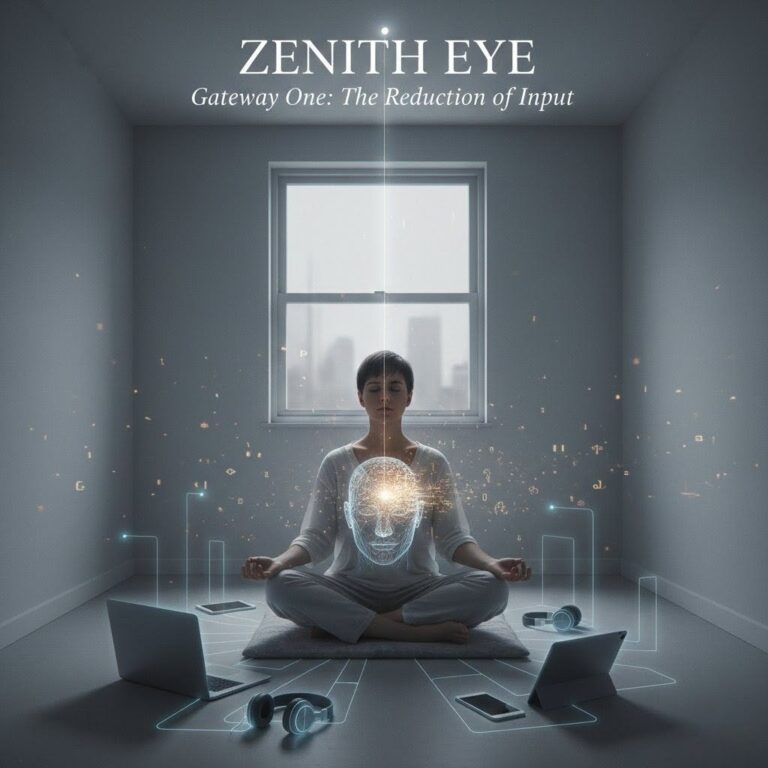

Reclaiming the Cortex: Opening the Gateways of Direct Knowing
There is a moment after the body has been convinced it will survive–a quiet threshold where the alarm bells stop ringing and the nervous system exhales. Most people rush past it. They reach for their phone, rehearse tomorrow’s grievances, or simply fall asleep. But the ancient contemplative traditions knew this interval as something precious: the open window. Once the amygdala has stood down and blood returns to the prefrontal cortex, a temporary gateway appears between ordinary cognition and direct knowing. The question is not whether the window exists, but whether you have the patience to sit in the sill.
This is the third movement in our series on the biological barrier. The first article examined how survival biology locks the door. The second detailed how to de-escalate the amygdala and signal safety to the body. Here, we address what comes next: how to reclaim the cortex itself, transforming it from an anxious administrator into an instrument of gnosis.
Table of Contents
- The Open Window: When Safety Becomes Opportunity
- The Neurobiology of Cortical Reclamation
- Frontal Midline Theta: The Gateway Frequency
- Three Practices for Reclaiming the Cortex
- The Integration Window: From Insight to Embodiment
- The Ordinary Cortex as Sacred Instrument
- Frequently Asked Questions
- Further Reading

The Open Window: When Safety Becomes Opportunity
Survival mode is not a character flaw. It is a biological inheritance, a legacy from ancestors who needed to outrun predators before they could philosophise about them. When the sympathetic nervous system dominates, the prefrontal cortex–that evolutionary newcomer responsible for reflection, moral reasoning, and sustained attention–is effectively benched. Blood flow is diverted to the limbs and the amygdala. The body does not care about your mystical aspirations when it believes a tiger is loose in the corridor.
But once safety is established–through breath, through grounding, through the deliberate signalling that the environment is secure–the body begins to redistribute its resources. The prefrontal cortex comes back online. And here is what the survival manuals do not tell you: the first minutes of cortical re-engagement are not merely a return to normal. They constitute a liminal state, a transitional zone where the usual filters are weakened and the boundary between conscious and subconscious thought becomes unusually permeable.
The Gnostics spoke of metanoia, a turning of the nous or inner eye. Neuroscience describes something structurally similar: a shift from high-beta vigilance to slower, more integrative frequencies. Both traditions agree on the essential point. The window opens not when you force it, but when the body consents to lower its guard. Your job is to be present when it happens.
The Neurobiology of Cortical Reclamation
The prefrontal cortex is not merely a control centre. It is the brain’s chief integrator, the region that weaves together memory, emotion, bodily sensation, and abstract reasoning into a coherent narrative of self and world. When researchers at Harvard Medical School used MRI to study long-term meditators, they found increased cortical thickness in the prefrontal cortex and right anterior insula–regions associated with attention, interoception, and sensory processing. The data suggested that meditation does not simply calm the mind; it structurally remodels the very architecture of executive awareness.
Dr Andrew Newberg’s SPECT imaging studies of Tibetan Buddhist meditators and Franciscan nuns revealed a complementary pattern: increased cerebral blood flow in the medial and orbital prefrontal cortex during deep contemplative states, alongside reduced activity in the superior parietal lobe. The prefrontal regions responsible for focus and emotional regulation brightened, while the area generating the sense of spatial self-boundary dimmed. The result was not cognitive shutdown but a refined cognition–one capable of sustained attention without the usual egoic scaffolding.
This is the biological basis of what the traditions call direct knowing. Not belief. Not inference. A mode of cognition in which the subject and object of knowledge temporarily collapse into a single field of recognition. The prefrontal cortex, when sufficiently resourced and freed from threat-response, appears capable of sustaining precisely this kind of non-dual awareness. It is not that the cortex creates the insight–the Gnostic would insist that the divine spark remains the source–but the cortex can be trained to stop obstructing it.
The prefrontal cortex does not generate the light; it removes the shade.
ZenithEye
Frontal Midline Theta: The Gateway Frequency
Not all theta waves are created equal. While hippocampal theta–generated in the medial temporal lobe–dominates during memory consolidation and dream states, a distinct variant known as frontal midline theta emerges from the anterior cingulate cortex and medial prefrontal cortex. This frequency, oscillating between four and eight hertz, is associated with focused internal attention, error monitoring, and what researchers call cognitive control. It appears during mental arithmetic, during sustained meditation, and during moments when the brain must monitor its own performance while remaining locked onto an internal process.
What makes frontal midline theta relevant to spiritual insight is its role as a bridge. Theta oscillations are slow enough to synchronise distant brain networks–allowing the prefrontal cortex to communicate with the limbic system, the insula, and the default mode network–yet fast enough to carry meaningful information. A 2023 study published in the Journal of Neuroscience demonstrated that theta signal transfer from the precuneus to the superior frontal gyrus specifically predicts the transition from implicit to explicit knowledge. In other words, the moment a pattern becomes consciously available–the flash of recognition, the sudden insight–is preceded by a measurable theta wave travelling from posterior memory regions to the prefrontal cortex.
For the contemplative practitioner, this is not abstract neuroscience. It is the electrical signature of recognition. The state in which the body is safe enough to sustain theta dominance, yet alert enough to retain prefrontal engagement, is precisely the state in which esoteric texts stop being merely intellectual and begin to function as mirrors. The Gospel of Thomas speaks of making the two into one. Frontal midline theta may be the frequency at which the brain’s dual hemispheres, its memory and executive systems, achieve sufficient coherence for that unity to become experiential rather than conceptual.
Three Practices for Reclaiming the Cortex
Understanding the biology is useful only if it informs practice. The following three methods are designed to exploit the open window–that interval after somatic safety has been established and before ordinary mental chatter resumes. They require no special equipment, no subscription, and no spiritual pedigree. They do require that you stop checking your email long enough to let the prefrontal cortex complete its boot sequence.
1. The Contemplative Pause
After any somatic safety practice–whether extended exhalation, grounding, or cold-water immersion–do not move. Remain still for ten to fifteen minutes. The body has just shifted from sympathetic to parasympathetic dominance. The prefrontal cortex is receiving renewed blood flow, but its habitual circuits have not yet reasserted control. This is the gap.
During this pause, do not attempt to meditate in the conventional sense. Do not focus on the breath or repeat a mantra. Simply remain open. Allow the theta state to deepen without forcing it. Research on hypnagogia–the twilight state between waking and sleep–has shown that participants who enter theta-dominant drowsiness are three times more likely to discover hidden patterns in complex problems than those who remain in full beta alertness. The same principle applies to spiritual insight. The prefrontal cortex, when not tasked with active problem-solving, becomes available for pattern recognition on a much larger scale.
2. Inverted Attention
Ordinary attention is outward-facing. It scans the environment for threats, opportunities, and notifications. Inverted attention turns the beam around. Rather than looking at thoughts, one looks from the place where thoughts arise. This is not introspection; introspection is still a form of outward attention directed inward. Inverted attention is the shift from the content of consciousness to the field in which that content appears.
Neurobiologically, this correlates with decreased default mode network activity and increased prefrontal-insular connectivity. The meditator is not suppressing thought but relocating the vantage point from which thought is observed. When the prefrontal cortex is sufficiently resourced, it can sustain this meta-cognitive stance without collapsing into analytical commentary. The result is a state the Gnostics called parrhesia–bold speech, but also bold seeing. A clarity that does not require argumentation because it precedes the division into subject and object.
3. The Slow Read
Take a short passage from an esoteric text–the Gospel of Thomas, the Discourse on the Eighth and Ninth, or a paragraph from a contemplative writer–and read it with prefrontal slowness. This means one sentence at a time, followed by a full minute of silence. Do not interpret. Do not note the literary devices. Allow the sentence to resonate in the theta field you have cultivated. If the passage is alive, it will begin to read you.
This practice exploits the theta-to-PFC signal transfer documented in neuroscience. The text serves as an external pattern. The slow reading allows the precuneus–the brain’s memory buffer–to transmit associated material to the prefrontal cortex at theta frequency. Insights that would remain buried in implicit memory are ignited into conscious awareness. The text becomes a technology for cortical reclamation, a means of forcing the prefrontal cortex to process information that habitual beta consciousness would filter out as irrelevant or threatening.

The Integration Window: From Insight to Embodiment
Direct knowing is not an endpoint. It is a threshold. The danger of any insight–neurobiological or mystical–is that it remains a peak experience, a moment of clarity that evaporates the moment the body re-enters survival mode. The integration window is the period following cortical reclamation in which the insight must be anchored into the body, the relationships, and the daily practice of the knower.
Neuroplasticity research suggests that the prefrontal cortex thickens most reliably in practitioners who integrate their contemplative sessions with ordinary activity. Lazar’s study found that the cortical changes correlated not with the intensity of meditation retreats but with sustained daily practice integrated into work and family life. The brain does not distinguish between the cushion and the kitchen. It distinguishes between repeated attentional states and isolated peak events.
From a Gnostic perspective, this is the difference between the pneumatic and the merely psychic. The psychic individual may have flashes of insight, moments of recognition. But without integration–without allowing the insight to restructure perception, behaviour, and ethical commitment–the recognition remains a souvenir rather than a transformation. The integration window is where the esoteric becomes exoteric, where the private gnosis becomes public virtue. It is not enough to reclaim the cortex for fifteen minutes of theta bliss. The cortex must be reclaimed for the entire architecture of a life.
Practically, this means that after a session of contemplative pause, inverted attention, or slow reading, you do not immediately return to high-stimulation environments. You transition gradually. You write a single sentence summarising the insight–not an essay, a sentence. You carry that sentence into the next conversation, the next meal, the next decision. The prefrontal cortex, now operating from a place of sufficiency rather than scarcity, begins to reorganise the entire perceptual field around the new recognition. The world does not change. The filter changes.
The Ordinary Cortex as Sacred Instrument
The prefrontal cortex is not a divine implant. It is an evolutionary adaptation, a piece of biological hardware that happens to be capable of sustaining attention, moral reasoning, and–under the right conditions–direct recognition. It is also fragile, expensive to run, and easily hijacked by survival circuitry. The biological barrier is not a metaphor. It is a measurable redirection of blood flow, a literal theft of executive resources by the amygdala.
But the barrier is not a wall. It is a door with a biometric lock, and the key is somatic safety. Once the body believes it will survive, the cortex returns. And when it returns, it can be trained. Not through force, but through frequency. Through repeated entry into the theta gateway. Through the willingness to sit in the open window and let the prefrontal architecture rearrange itself around a larger light.
The Gnostics claimed that the divine spark is already present, buried beneath accretions of habit, fear, and false identity. The neuroscientist observes that the prefrontal cortex is already present, buried beneath accretions of cortisol, amygdalar hijack, and default mode rumination. Both traditions arrive at the same practical conclusion: the work is not acquisition but reclamation. You are not building a bridge to somewhere else. You are removing the debris from a bridge that was already there.

Safety Notice: This article explores advanced contemplative practices and their neurobiological correlates. It does not constitute medical, psychological, or spiritual advice. If you experience dissociation, psychosis, or severe emotional distress during meditation or breathwork, please contact professional emergency services or a trauma-informed therapist. Contemplative practice complements but does not replace clinical mental health treatment.
Frequently Asked Questions
What is cortical reclamation in spiritual practice?
Cortical reclamation refers to the deliberate re-engagement of the prefrontal cortex after it has been suppressed by survival responses. Once the body signals safety and the amygdala de-escalates, blood flow returns to the prefrontal cortex, creating a window for sustained attention, moral reasoning, and direct insight.
How long does the open window last after somatic safety?
The open window typically lasts between ten and twenty minutes after the nervous system shifts from sympathetic to parasympathetic dominance. This interval varies by individual and depends on environmental cues, baseline stress levels, and the depth of the preceding safety practice.
Can meditation physically change the prefrontal cortex?
Yes. Neuroimaging studies have shown that long-term meditation practice correlates with increased cortical thickness in the prefrontal cortex and anterior insula. These structural changes are associated with improved attention, emotional regulation, and interoceptive awareness.
What are theta brainwaves and why do they matter for intuition?
Theta waves oscillate between four and eight hertz and are linked to memory consolidation, emotional processing, and creative insight. Frontal midline theta, generated in the prefrontal cortex, specifically supports focused internal attention and appears to facilitate the transfer of implicit knowledge into conscious awareness.
Is direct knowing the same as intellectual understanding?
No. Intellectual understanding is conceptual and discursive, operating through language and analysis. Direct knowing, or gnosis, is a mode of recognition in which the knower and the known are not experienced as separate. It is pre-conceptual and often arises when the prefrontal cortex is operating in synchrony with slower brainwave frequencies.
Why does insight often fade after a contemplative session?
Insight fades when it is not integrated into the neural architecture of daily life. Neuroplasticity requires repetition and contextual embedding. Without integration practices–such as writing, ethical application, or sustained attention–the insight remains a peak experience rather than a structural change.
Can anyone access direct knowing or is it reserved for advanced practitioners?
The capacity for direct knowing appears to be a function of nervous system regulation rather than spiritual seniority. Beginners who establish somatic safety and allow the prefrontal cortex to operate without habitual interference often report spontaneous insights. The barrier is usually biological, not metaphysical.
Further Reading
- The Somatic Cage: How Survival Biology Blocks Gnosis — Part one of this series, examining the physiological lockdown that prevents higher states of knowing.
- De-Escalating the Amygdala: The Mechanics of Somatic Safety — Part two, detailing the breath and grounding practices that create the open window addressed here.
- What Is States of Knowing? — The foundational ZenithEye explainer on consciousness, perception, and the recognition of reality.
- What Is Recognition? — An exploration of the moment of direct seeing that changes everything, from Gnostic and contemplative perspectives.
- Neuroplasticity and Transformation: Rewiring the Self — How the brain’s capacity for change supports sustained spiritual growth and integration.
- The Five Gateways of Direct Knowing — The complete framework for attention, breath, sensation, movement, and vision as paths to gnosis.
- Attention: The First Gateway of Consciousness — Why attention is the foundational practice for all subsequent cortical reclamation work.
- The Exit Is Inward: Practice, Attention, and the End of Repetition — How sustained attention practices break the cycles that keep the prefrontal cortex locked in habitual rumination.
- Default Mode Network Dissolution and the Self — The neuroscience of ego-dissolution and how reduced DMN activity correlates with self-transcendent experience.
- What Is The Thread? ZenithEye’s Complete Explainer — The master guide to the five pillars and how this article fits within the broader architecture.