Pleroma and Kenoma: The Foundational Geography of Gnostic Cosmology
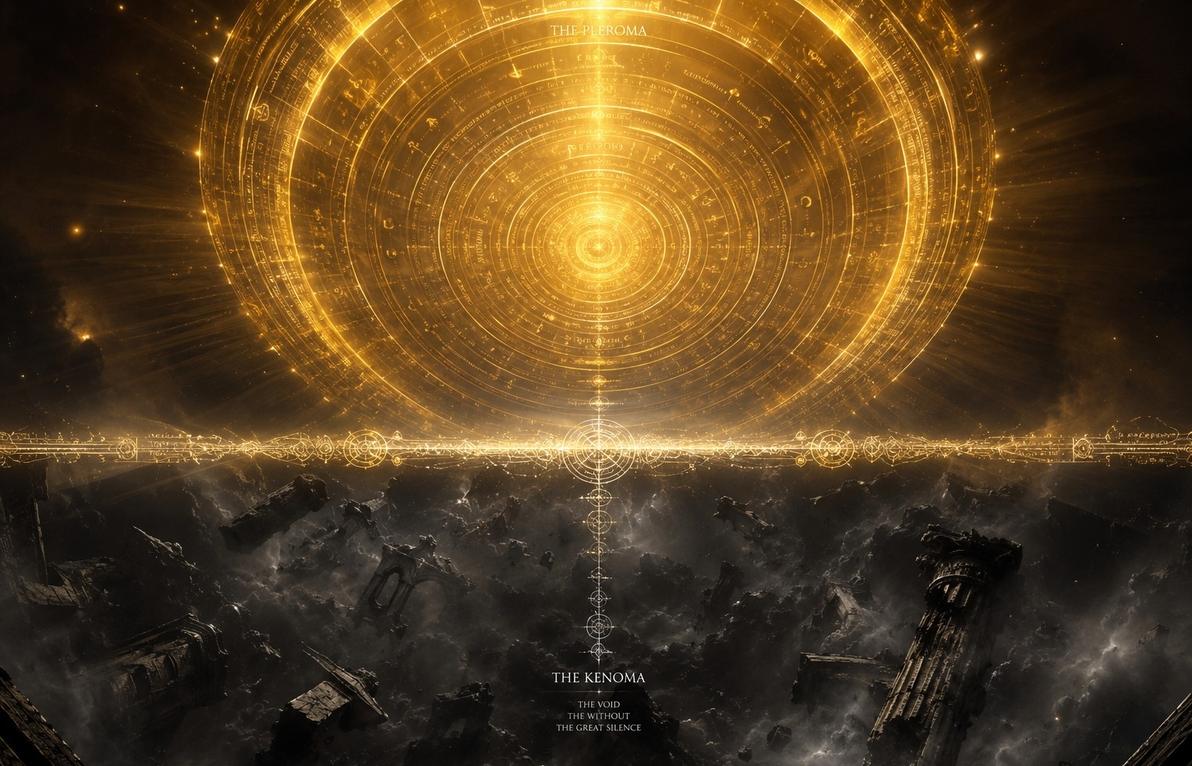
At the heart of Gnostic cosmology lies a stark question: is the world we inhabit shaped by divine fullness or by deficiency? The answer is mapped through two Greek terms that became central to Gnostic thought: Pleroma and Kenoma. The Pleroma is fullness, the divine realm of wholeness, light, knowledge and living completion. The Kenoma is deficiency, the lower realm of lack, fragmentation, forgetfulness and false finality.
Together, Pleroma and Kenoma form the foundational geography of Gnostic cosmology. They explain why the lower world can feel ordered yet incomplete, why the Demiurge can create form without knowing the highest source, why the archons can administer limitation, and why the divine spark feels exiled in a world that is not its true home.
In Plain Terms
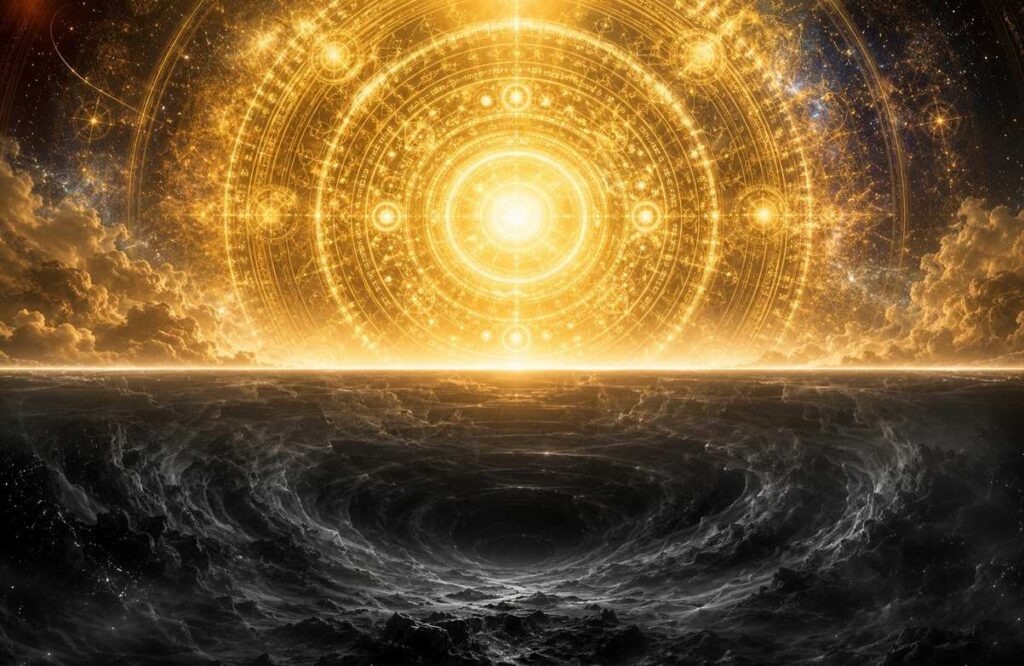
Pleroma and Kenoma are the two great realms or conditions in Gnostic cosmology. The Pleroma is divine fullness: wholeness, light, knowledge and spiritual completeness. The Kenoma is deficiency: lack, fragmentation, forgetfulness and the lower world shaped by the Demiurge.
Put simply: the Pleroma is the fullness the divine spark remembers. The Kenoma is the lower realm where that spark forgets itself. Gnosis is the recognition that the world of deficiency is real at one level, but not final.
Primary Sources and Traditions Discussed
- Pauline usage: early Christian use of pleroma as fullness, especially in Colossians and Ephesians.
- The Apocryphon of John: a Sethian creation text describing the divine realm, Barbelo, Yaldabaoth and the lower world.
- The Gospel of Truth: a Valentinian meditation on error, deficiency, knowledge and the restoration of fullness.
- The Tripartite Tractate: a systematic Valentinian account of divine emanation, fall and restoration.
- Valentinian Gnosticism: the major school most associated with the Pleroma, syzygies, Sophia, Achamoth and the three substances.
- Sethian Gnosticism: the tradition in which the Pleroma is structured around the Invisible Spirit, Barbelo, Autogenes and the luminaries.
- Modern interpretation: psychology, systems theory, digital life and the critique of partial realities that mistake themselves for the whole.
How ZenithEye Reads This
ZenithEye reads Pleroma and Kenoma as the core map behind Gnostic cosmology. They are not only ancient technical terms. They describe a lived contrast between wholeness and lack, source and system, divine origin and lower imitation.
The Pleroma is what Yaldabaoth cannot see. The Kenoma is the lower frame he mistakes for the whole. The spiritual task is not hatred of the world, but discernment within it: to recognise the deficiency of the lower order without forgetting the fullness that exceeds it.
Table of Contents
- In Plain Terms
- Primary Sources and Traditions Discussed
- How ZenithEye Reads This
- What Are Pleroma and Kenoma?
- Etymology and Pre-Gnostic Usage
- The Sethian Pleroma: Barbelo and the Aeons
- The Valentinian Pleroma: Syzygies and the Thirty Aeons
- Kenoma: The Realm of Deficiency
- The Horos and the Boundary Between Realms
- Pleroma, Kenoma and the Three Natures
- The Demiurge, Archons and the Lower Order
- Contemporary Resonance
- Why Pleroma and Kenoma Still Matter
- Related Glossary Terms
- Read Next
- Frequently Asked Questions
- Further Reading
- References and Sources
What Are Pleroma and Kenoma?
Pleroma and Kenoma are two foundational terms in Gnostic cosmology. They describe the difference between divine fullness and lower deficiency, between the realm of complete being and the realm of lack.
The Pleroma is fullness. It is the divine realm of completeness, light, knowledge, life and harmonious relation. In many Gnostic systems, it is the realm of the Aeons, the divine emanations or living qualities that proceed from the unknowable source.
The Kenoma is deficiency. It is the lower order of emptiness, fragmentation, ignorance and forgetfulness. It is not simple nothingness. It is a deficient something: a world that exists, but exists without the fullness that would make it complete in itself.
The drama of Gnostic salvation happens between these two conditions. The divine spark belongs to fullness but finds itself hidden in deficiency. The Demiurge rules the lower realm without knowing the higher one. The archons administer a system that mistakes the lower frame for reality itself. Gnosis begins when the spark recognises the difference.
Pleroma is divine fullness. Kenoma is deficiency. Gnosis is the recognition that the lower world is not the whole of reality.
ZenithEye
Etymology and Pre-Gnostic Usage
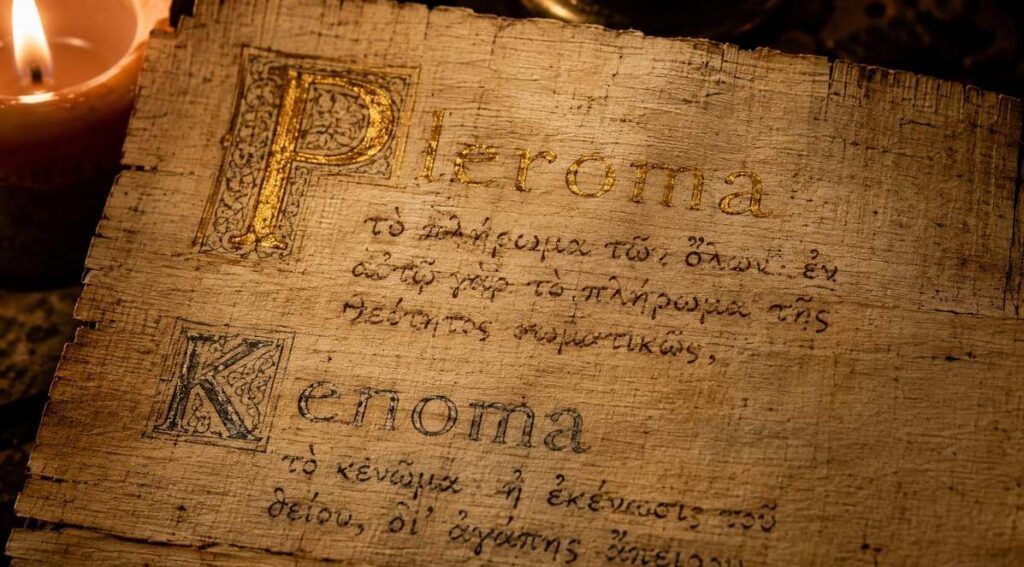
The Greek word pleroma comes from a root meaning to fill, fulfil or complete. In ordinary use, it could refer to something filled up, complete or brought to its full measure. In philosophical and religious contexts, it came to suggest totality, fullness and completion.
The Greek word kenoma comes from a root connected with emptiness, voidness or lack. In Gnostic usage, it becomes more than empty space. It names a realm or condition of deficiency: a lower order that lacks divine fullness while still presenting itself as reality.
Before Gnostic teachers developed these terms into a full cosmological contrast, pleroma already had theological force in early Christian language. Paul uses the term to speak of fullness, especially divine fullness associated with Christ and the life of believers. Later Gnostic teachers, particularly Valentinians, expanded this language into a wider map of divine fullness, emanation, fall and return.
This does not mean Paul was simply teaching later Gnostic cosmology. It means that the language of fullness was already spiritually charged. Gnostic schools took that charged word and built an entire metaphysical geography around it.
The Sethian Pleroma: Barbelo and the Aeons
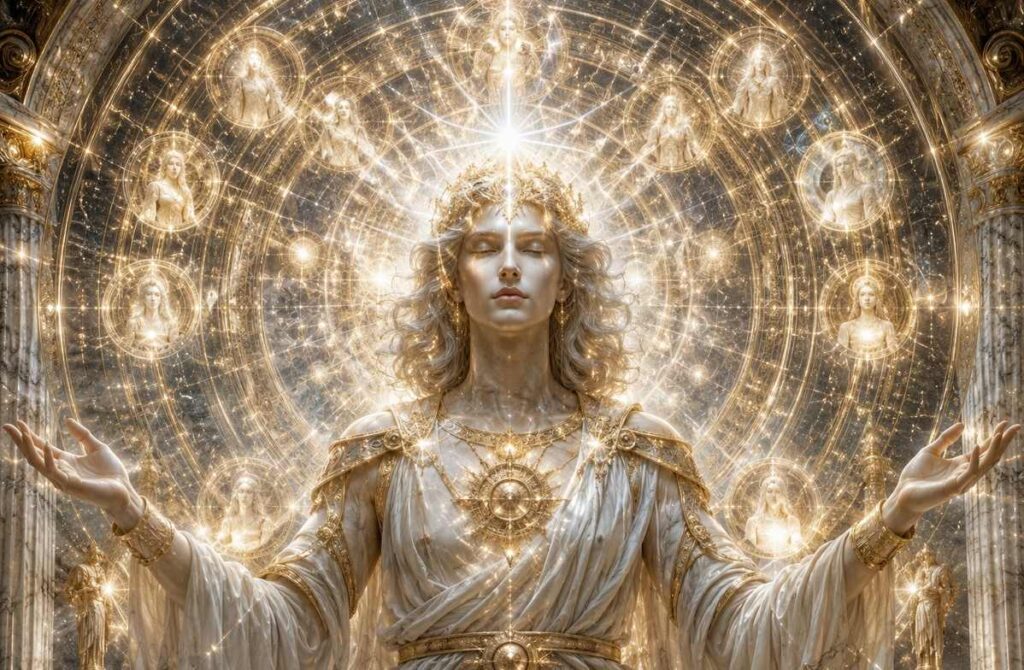
In Sethian Gnostic texts such as the Apocryphon of John, the Pleroma begins beyond ordinary naming. At the summit stands the Invisible Spirit or Monad: the source beyond form, gender, limitation and direct comprehension. This source is not one being among others. It is the ineffable ground from which divine reality unfolds.
From the Invisible Spirit emerges Barbelo, the First Thought. Barbelo is often described in maternal, androgynous and luminous language. She is the first self-revelation of the invisible source, the womb or matrix through which divine fullness begins to express itself.
Through Barbelo, further divine realities appear: Autogenes, the Self-Generated One, the Four Luminaries and their associated Aeons. These figures are not simply characters in a mythic drama. They are symbolic expressions of divine knowing, life, light and order.
The Sethian Pleroma is therefore not a distant sky-palace. It is a metaphysical condition of fullness and luminous intelligence. It is above the lower realm, yet it also sends revelation into the lower realm. The divine fullness reaches down because something of itself has become scattered, trapped or forgotten below.
This is why Sethian cosmology is both severe and hopeful. It presents a sharp distinction between the divine fullness and the lower world of the archons, yet it also insists that help descends from above. The Pleroma does not merely remain untouched. It remembers what has fallen from it.
The Valentinian Pleroma: Syzygies and the Thirty Aeons
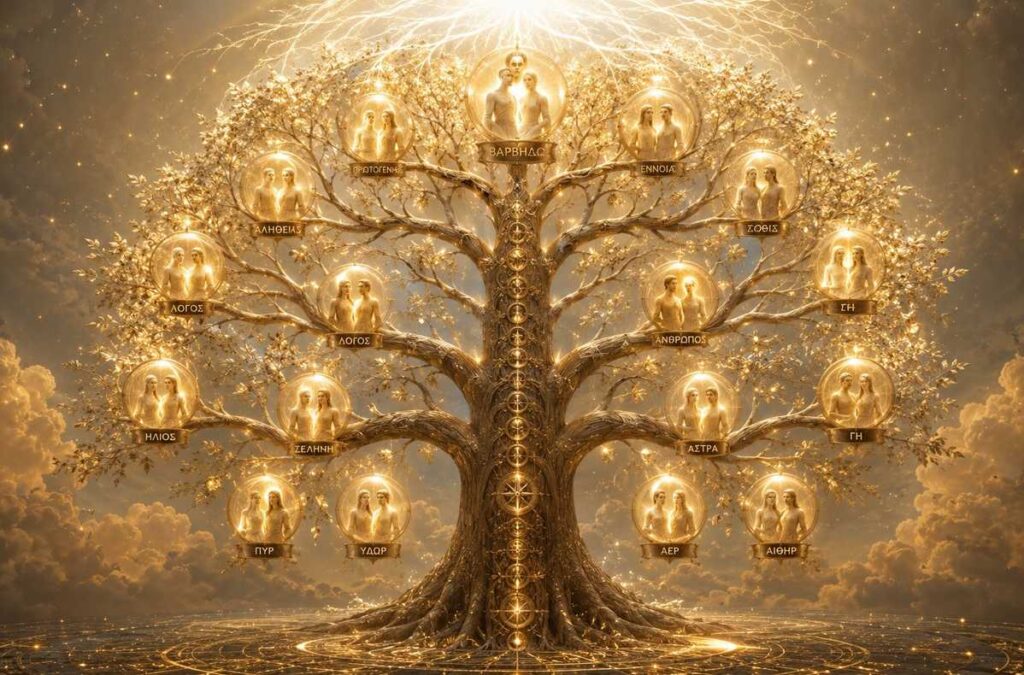
The Valentinian tradition gives one of the most systematic accounts of the Pleroma. In the classical scheme reported by early Christian writers, the Pleroma contains thirty Aeons arranged in fifteen paired relations called syzygies.
These pairs express a core Valentinian insight: divine reality is relational. Fullness is not solitary isolation. It is harmonious relation. Pairs such as Depth and Silence, Mind and Truth, Word and Life, Human Being and Church express the way divine qualities unfold together rather than as isolated fragments.
The Valentinian Pleroma is therefore a living architecture of completeness. Its structure is not domination from top to bottom, but ordered relation. Each Aeon participates in the whole, and the whole is full because no divine quality is missing from its proper relation.
Valentinian sources are not all identical. The Tripartite Tractate, for example, presents a more fluid and complex system than the neat lists preserved in heresiological summaries. Its vision of divine unfolding is less like a static chart and more like a living development within the Father.
Even so, the essential principle remains: the Pleroma is fullness without deficiency. The tragedy begins when something at the margin of that fullness overreaches, falls, becomes disturbed or gives rise to lack. From that disturbance, the drama of Kenoma begins.
Kenoma: The Realm of Deficiency
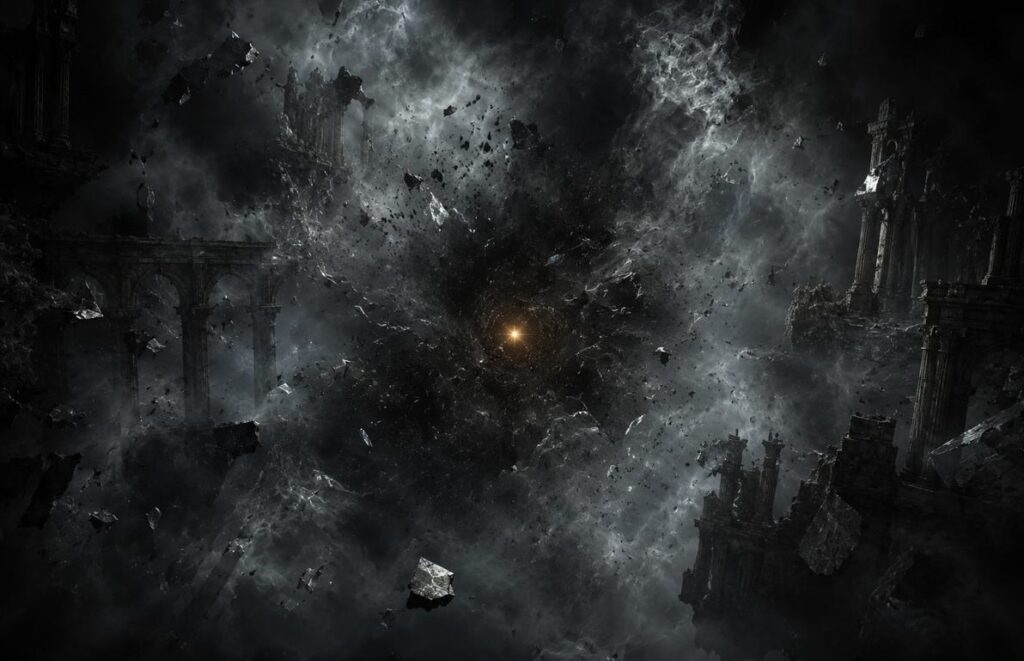
If the Pleroma is fullness, the Kenoma is deficiency. The Kenoma is the lower condition where something is missing, where reality appears solid but remains incomplete, where fragmentation and forgetfulness become the basic atmosphere of existence.
In Valentinian cosmology, the Kenoma is associated with the fall or disturbance of Sophia, especially the lower Sophia known as Achamoth. Outside the fullness, she experiences grief, fear, bewilderment, longing and repentance. These passions become the basis of the lower substances: matter, soul and hidden spirit.
From this deficient substrate, the Demiurge shapes the material cosmos. He does not create from the divine fullness directly. He works with lower material and limited understanding. His world therefore carries the signature of the Kenoma: form without fullness, law without ultimate wisdom, order without final truth.
The Gospel of Truth gives a different but deeply related account. There, deficiency appears as ignorance, error and oblivion. Forgetfulness becomes dense, like fog. Yet error has no ultimate root. When knowledge appears, deficiency is exposed and completion begins to dissolve lack.
The Kenoma is therefore not pure evil or absolute nothingness. It is a lower something that mistakes itself for everything. Its power lies in forgetfulness. Its weakness is that it cannot survive true recognition.
The Horos and the Boundary Between Realms
Between the Pleroma and the Kenoma stands the Horos, the Limit or boundary. In Valentinian systems, the Horos protects the divine fullness from deficiency while also marking the threshold that separates higher wholeness from lower fragmentation.
The Horos is not simply a wall of rejection. It is a principle of distinction. It prevents confusion between fullness and lack. It keeps deficiency from being mistaken for divine completeness. It also makes salvation intelligible, because a return requires a boundary to cross.
This boundary appears in different forms across Gnostic literature: veils, heavens, gates, planetary spheres, angelic checkpoints and thresholds of ascent. The symbolism varies, but the underlying idea remains: the soul must learn the difference between lower powers and true divinity.
The boundary therefore has a pedagogical function. It teaches discernment. The ascending soul must recognise what belongs to the Kenoma and what belongs to the Pleroma, what is imitation and what is source, what is archonic administration and what is divine fullness.
In this sense, the Horos is not only cosmic. It is interior. Every seeker encounters a boundary between the false self and the deeper spark, between inherited systems and direct recognition, between the lower frame and the fullness it cannot contain.
Pleroma, Kenoma and the Three Natures
The distinction between Pleroma and Kenoma also shapes Gnostic anthropology. Some traditions describe human beings through three natures or orientations: hylic, psychic and pneumatic.
The hylic is bound to matter and the lower order. The psychic belongs to soul, moral life, faith, development and intermediate awareness. The pneumatic carries spirit, or pneuma, the divine element that belongs to fullness and can awaken through gnosis.
This language should be handled with care. It should not become a badge of superiority or a social ranking system. At its best, it describes degrees of identification and recognition. The question is not “which people are worth more?” but “what level of reality is consciousness identified with?”
The hylic is fully identified with the Kenoma. The psychic senses moral and spiritual depth but may remain attached to lower forms. The pneumatic recognises that the deepest light within the human being belongs to the Pleroma and is not authored by the lower world.
In this framework, salvation is not merely legal pardon or external reward. It is recognition of origin. The spark does not become divine by effort. It awakens to the fact that it was never truly native to deficiency.
The Demiurge, Archons and the Lower Order
The Kenoma is the realm in which the Demiurge and archons operate. The Demiurge is the lower craftsman who shapes the material cosmos, while the archons administer limitation, fate, imitation and false authority within that cosmos.
This does not mean the lower world is chaotic in a simple sense. The Kenoma has structure. It can possess order, law, beauty, mathematics, ritual, institution and hierarchy. But its order is incomplete because it is not rooted in full knowledge of the source.
The Demiurge’s error is false finality. He mistakes his crafted domain for the whole of reality. The archons continue that error by maintaining systems that keep the soul identified with the lower order. The result is a cosmos that can look coherent while remaining spiritually deficient.
This is why the Pleroma-Kenoma distinction matters for the whole Core Gnostic Foundation Cluster. The Demiurge creates within deficiency. Yaldabaoth gives that lower creator a mythic face. The archons administer his system. The counterfeit spirit internalises the lower order inside the seeker. The divine spark is the hidden element that does not belong to that system. Gnosis is the recognition that breaks the spell.
Contemporary Resonance
Pleroma and Kenoma remain useful because modern life often intensifies the experience of deficiency. Many people live among vast information systems, social feeds, markets, institutions and identities that appear complete while leaving the deeper self untouched.
In psychological terms, the Pleroma can be read as a symbol of wholeness, while the Kenoma resembles the fragmented field of the defensive ego: partial, anxious, repetitive and organised around lack. Jung’s engagement with Gnostic language helped bring this symbolic reading into modern psychology, especially through the idea of the Self as a deeper totality beyond the surface ego.
In digital life, the Kenoma appears wherever partial models replace living wholeness. A feed can seem like the world because it hides what it cannot measure. A profile can seem like a self because it compresses a human being into visible signals. An algorithm can feel authoritative because it repeats its own frame with great confidence.
This does not make technology evil by default. Tools can clarify, connect and serve. But they become Kenomic when the partial model pretends to be total reality. A system built from data does not necessarily know wisdom. A machine can organise information without understanding the fullness of a human soul.
The Pleroma, in this modern reading, names what exceeds the model: depth, relation, presence, spirit, interiority, moral meaning and unmeasurable life. The Kenoma names the reduction of that fullness into partial frames. Gnosis is the refusal to mistake the frame for the whole.
Why Pleroma and Kenoma Still Matter
Pleroma and Kenoma still matter because they name a contrast that every serious seeker eventually feels: fullness and lack, source and system, living truth and constructed imitation. The language is ancient, but the experience is immediate.
The Pleroma tells the soul that fullness is real. The Kenoma explains why the lower world cannot satisfy the hunger for that fullness. Together, they prevent two errors: naive optimism that denies deficiency, and despair that forgets fullness.
A grounded Gnostic reading does not require hatred of matter or withdrawal from ordinary life. It requires right proportion. The world of form is real, but not final. Systems are useful, but not ultimate. The lower order has lessons, but it is not the source. The body is meaningful, but it does not exhaust the spirit.
This is the map: the spark lives in the Kenoma while belonging to the Pleroma. The Demiurge shapes the lower world, but cannot author the hidden light. The archons administer limitation, but cannot define the source. Gnosis is the moment the soul recognises the difference and begins to live from the fullness it had forgotten.
The Kenoma says: this is all there is. The Pleroma answers: fullness was never absent, only obscured.
Related Glossary Terms
These terms help place Pleroma and Kenoma inside the wider Gnostic foundation map and the ZenithEye route through fullness, deficiency and return.
- Pleroma: divine fullness, the higher realm of completeness, light and knowledge.
- Kenoma: the lower realm of deficiency, emptiness and forgetfulness.
- Gnosis: direct recognition that remembers the source beyond deficiency.
- Divine Spark: the hidden light within humanity that belongs to fullness.
- Pneuma: spirit, breath or divine life, the element within the human being that can recognise the Pleroma.
- Demiurge: the lower craftsman who shapes the Kenomic cosmos.
- Yaldabaoth: the blind god and chief archon who mistakes the lower realm for the whole.
- Archons: the ruling powers who administer the lower order of limitation.
- Counterfeit Spirit: the false inner pattern that keeps the soul attached to deficiency.
- Sophia: wisdom, whose fall or disturbance opens the drama between fullness and deficiency.
Read Next
Best next step: What Is Sophia?. If Pleroma and Kenoma give the map, Sophia gives the drama: the movement from fullness into disturbance, exile and eventual restoration.
For the standalone upper realm, read What Is the Pleroma?. For the standalone lower realm, read What Is the Kenoma?. For the lower creator inside deficiency, read What Is the Demiurge?.
Frequently Asked Questions
What do Pleroma and Kenoma mean in Gnosticism?
In Gnosticism, Pleroma means divine fullness, the higher realm of wholeness, light and knowledge. Kenoma means deficiency or emptiness, the lower realm of lack, fragmentation and forgetfulness. Together they form the basic geography of Gnostic cosmology.
What is the difference between Pleroma and Kenoma?
The Pleroma is fullness and completeness. The Kenoma is lack and deficiency. The Pleroma is the source remembered by the divine spark, while the Kenoma is the lower realm where the Demiurge and archons operate and where the spark becomes obscured.
Is the Kenoma the same as the material world?
The Kenoma includes the material world in many Gnostic systems, but it is broader than matter alone. It is the condition of deficiency, ignorance and forgetfulness in which the lower cosmos is shaped and experienced.
What is the Horos in Gnostic cosmology?
The Horos, or Limit, is the boundary between the Pleroma and the Kenoma. In Valentinian systems, it protects fullness from deficiency and marks the threshold crossed in the soul’s return to divine fullness.
How do Sethian and Valentinian views of the Pleroma differ?
Sethian texts usually describe the Pleroma through the Invisible Spirit, Barbelo, Autogenes and the Luminaries. Valentinian texts often describe the Pleroma through paired Aeons called syzygies, traditionally arranged as thirty Aeons in fifteen pairs.
Who rules the Kenoma?
In many Gnostic systems, the Kenoma is ruled or shaped by the Demiurge and administered by the archons. The Demiurge creates order within deficiency, while the archons maintain limitation, fate and false authority.
How are Pleroma and Kenoma related to the divine spark?
The divine spark belongs to the fullness of the Pleroma but becomes hidden in the deficiency of the Kenoma. Gnosis is the recognition through which the spark remembers its origin and begins its return.
Why do Pleroma and Kenoma matter today?
Pleroma and Kenoma matter because they name the difference between wholeness and lack. They help modern readers recognise when systems, identities, technologies or beliefs are partial models pretending to be complete reality.
Safety Notice: This article explores symbolic, spiritual and philosophical ideas about fullness, deficiency, spiritual origin, false authority and return. It does not constitute medical, psychological, legal or spiritual advice. If spiritual or cosmological ideas become distressing, obsessive or destabilising, please seek support from a qualified mental health professional or appropriate emergency service. The intended outcome is discernment, grounded reflection and spiritual literacy, not fear, despair, grandiosity or withdrawal from ordinary responsibility.
Further Reading
Explore these ZenithEye articles to deepen your understanding of Pleroma, Kenoma, Sophia, the Demiurge and the wider Gnostic foundation map.
Core Gnostic Foundations
- What Is Gnosis?: direct recognition that remembers the source beyond deficiency.
- What Is the Divine Spark?: the hidden light within humanity that belongs to fullness.
- What Is the Pleroma?: divine fullness, the higher realm of completeness.
- What Is the Kenoma?: the lower realm of deficiency and forgetfulness.
- What Is the Demiurge?: the lower craftsman who shapes the Kenomic cosmos.
- Who Is Yaldabaoth?: the blind god and chief archon who mistakes the lower realm for the whole.
- Archons: The Ruling Powers That Shape Reality: the powers who administer the lower order.
- What Is the Counterfeit Spirit?: the false inner pattern that keeps the soul attached to deficiency.
Pleroma, Kenoma and Gnostic Source Texts
- What Is Sophia?: wisdom, fall and redemption in the drama between fullness and deficiency.
- The Apocryphon of John: the primary Sethian text for the divine realm, Yaldabaoth, archons and the divine spark.
- The Tripartite Tractate: a major Valentinian account of Pleroma, fall and restoration.
- The Gospel of Truth: a Valentinian meditation on error, oblivion and fullness.
- On the Origin of the World: a Sethian cosmological text on chaos, lower creation and divine light.
- Sethian and Valentinian Traditions in the Nag Hammadi Library: a comparison of the two major Gnostic schools.
- The Doctrine of Emanation: from Plotinus to Kabbalah, with context for Gnostic emanation theory.
- The Nag Hammadi Library: complete guide to the codices and source texts.
- The Nag Hammadi Library: A Reader’s Map: a navigational route through the tractates.
- The Digital Demiurge: modern systems, algorithmic reality and the return of the lower architect motif.
References and Sources
The following sources support the historical, philological and theological claims made in this article.
Primary Sources and Critical Editions
- Robinson, James M., ed. The Nag Hammadi Library in English. HarperSanFrancisco, revised editions.
- Meyer, Marvin, ed. The Nag Hammadi Scriptures. HarperOne, 2007.
- Layton, Bentley, ed. The Gnostic Scriptures. Doubleday, 1987.
- The Apocryphon of John. In The Nag Hammadi Library in English and related critical editions.
- The Gospel of Truth. In The Nag Hammadi Library in English and related critical editions.
- The Tripartite Tractate. In The Nag Hammadi Library in English and related critical editions.
- On the Origin of the World. In The Nag Hammadi Library in English and related critical editions.
- The Treatise on the Resurrection. In The Nag Hammadi Library in English and related critical editions.
- Irenaeus. Against Heresies. Especially Book I for reports of Valentinian cosmology.
- Hippolytus. Refutation of All Heresies. For reports of Gnostic and Valentinian terminology.
Scholarly Monographs and Critical Studies
- King, Karen L. What Is Gnosticism? Harvard University Press, 2003.
- Williams, Michael Allen. Rethinking “Gnosticism”: An Argument for Dismantling a Dubious Category. Princeton University Press, 1996.
- Thomassen, Einar. The Spiritual Seed: The Church of the Valentinians. Brill, 2006.
- Pearson, Birger A. Ancient Gnosticism: Traditions and Literature. Fortress Press, 2007.
- Turner, John D. Sethian Gnosticism and the Platonic Tradition. Presses de l’Université Laval, 2001.
- Brakke, David. The Gnostics: Myth, Ritual, and Diversity in Early Christianity. Harvard University Press, 2010.
- Jonas, Hans. The Gnostic Religion: The Message of the Alien God and the Beginnings of Christianity. Beacon Press, revised editions.
- Pagels, Elaine. The Gnostic Gospels. Random House, 1979.
- Rudolph, Kurt. Gnosis: The Nature and History of Gnosticism. Harper & Row, 1983.
- Filoramo, Giovanni. A History of Gnosticism. Basil Blackwell, 1990.
Comparative and Modern Interpretation
- Jung, C. G. Seven Sermons to the Dead. Various editions.
- Jung, C. G. Aion: Researches into the Phenomenology of the Self. Princeton University Press, 1959.
- Jung, C. G. The Archetypes and the Collective Unconscious. Princeton University Press, 1959.
- Couliano, Ioan P. The Tree of Gnosis: Gnostic Mythology from Early Christianity to Modern Nihilism. HarperSanFrancisco, 1992.
- Hoeller, Stephan A. Gnosticism: New Light on the Ancient Tradition of Inner Knowing. Quest Books, 2002.
- Hanegraaff, Wouter J. Western Esotericism: A Guide for the Perplexed. Bloomsbury, 2013.
- Hanegraaff, Wouter J. Esotericism and the Academy: Rejected Knowledge in Western Culture. Cambridge University Press, 2012.
Pleroma and Kenoma are the two great coordinates of Gnostic cosmology: fullness and deficiency, source and lower frame, wholeness and lack. The spark awakens when it recognises that the Kenoma is not the whole. The map becomes useful only when it stops being a theory and becomes recognition.