Rosicrucianism and Gnosticism: The Hidden Inheritance from the Fama to the Chemical Wedding
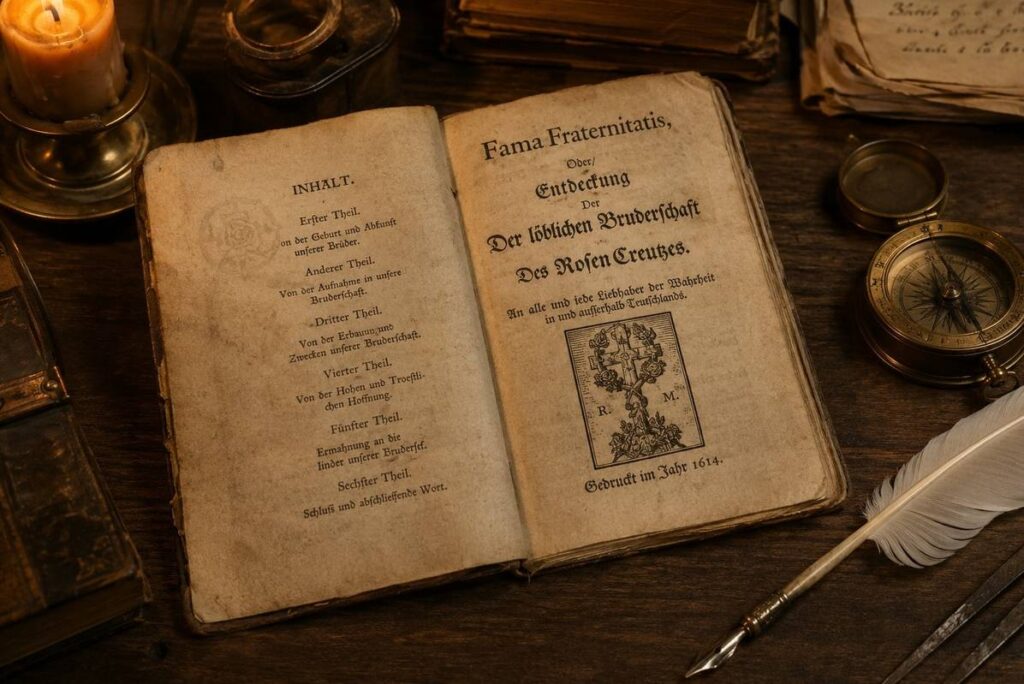
In the autumn of 1614, a curious pamphlet appeared in the bookshops of Kassel. It claimed to reveal the existence of a secret brotherhood–the Fraternity of the Rosy Cross–possessing ancient wisdom capable of reforming the whole of European society. The Fama Fraternitatis did not merely announce an alchemical society. It declared the survival of a pneumatic tradition that had travelled from the East through Egypt and Arabia, encoded in Hermetic symbolism, and preserved by an invisible college of initiates. That tradition was Gnostic in character, even if the word itself was rarely spoken aloud. What the Rosicrucian manifestos transmitted was not a new invention but a hidden inheritance: the same current of direct knowing, anti-dogmatic spirituality, and cosmological dissent that the Nag Hammadi library would later confirm had flourished fifteen centuries earlier.
This article traces the lineage from the Gnostic currents of late antiquity into the Rosicrucian explosion of the seventeenth century. It examines the three foundational manifestos–the Fama Fraternitatis (1614), the Confessio Fraternitatis (1615), and the Chymical Wedding of Christian Rosenkreutz (1616)–and asks how a German Lutheran theologian, writing under the shadow of the Thirty Years’ War, came to restate ideas that would not look out of place in the Apocryphon of John or the Gospel of Truth.
Table of Contents
- The Three Manifestos and the Myth of Christian Rosenkreutz
- The Gnostic Current: Surviving Through Hermetic Channels
- The Chymical Wedding as Gnostic Allegory
- The Hermetic Transmission: From Ficino to the Invisible College
- Pneumatic Echoes: Elect, Healing, and the Rejection of Dogma
- The Seventeenth-Century Furore and Its Aftermath
- Frequently Asked Questions
- Further Reading
- References and Sources
The Three Manifestos and the Myth of Christian Rosenkreutz
Between 1614 and 1616, three anonymous texts detonated across the learned circles of Europe. The Fama Fraternitatis (1614) narrated the life of a mythical pilgrim, Father Brother C.R.C., born in 1378, who travelled to Damcar, Egypt, and Fez in search of hidden knowledge. The text described his discovery of a subterranean vault, sealed for 120 years, containing the accumulated wisdom of the fraternity–books, scientific instruments, and the uncorrupted body of the founder himself. The Confessio Fraternitatis (1615) followed as a theological clarification, insisting that the brotherhood belonged to the Protestant Reformation yet possessed a wisdom that transcended denominational boundaries. Finally, the Chymical Wedding of Christian Rosenkreutz (1616) offered an allegorical romance in seven days, recounting an initiatic journey through a castle of marvels, culminating in death, resurrection, and knighthood.
Scholars have long debated authorship. Johann Valentin Andreae, a Lutheran theologian at Tubingen, almost certainly played a central role, though he later dismissed the manifestos as a ludibrium–a youthful jest. Whether fiction or coded communication, the texts achieved something remarkable. They announced that an ancient wisdom, previously concealed, was now ready to surface. The claim was not original to Rosicrucianism; it was the same announcement that Gnostic texts had made in the second century, that Hermeticists had made in the Renaissance, and that Theosophists would make again in the nineteenth. The form changed; the structural assertion remained constant.
The Fama explicitly states that Brother C.R.C. studied “Magia and Cabala” in the East and returned with a secret book called the Liber Mundi, linked alchemically to the Book of Nature. The text praised Paracelsus, the Swiss physician and alchemist who had died in 1541, as a precursor. Paracelsus himself had drawn upon a syncretic mixture of Neoplatonism, Arabic medicine, and Hermetic philosophy–a blend in which Gnostic ideas about the divine spark, the fall of Sophia, and the imprisonment of spirit in matter had already been partially absorbed. The Rosicrucian manifestos did not cite Nag Hammadi; they could not. The library lay buried in the Egyptian desert. Yet they cited the same tradition that Nag Hammadi had preserved.
The Gnostic Current: Surviving Through Hermetic Channels
To speak of a direct lineage from the Nag Hammadi library to seventeenth-century Rosicrucianism is, strictly speaking, chronologically impossible. The thirteen codices were buried near Nag Hammadi around 400 CE and remained undisturbed until Muhammad Ali al-Samman uncovered them in 1945. No Rosicrucian author had read the Apocryphon of John or the Trimorphic Protennoia. Yet this does not sever the connection. It merely relocates it. The Gnostic tradition–by which we mean the cluster of second- to fourth-century movements emphasising direct inner knowledge (gnosis), the divine spark trapped in matter, the demiurgic deception, and the ascent through planetary spheres–did not vanish when the codices were sealed. It mutated, fragmented, and found refuge in other vessels.
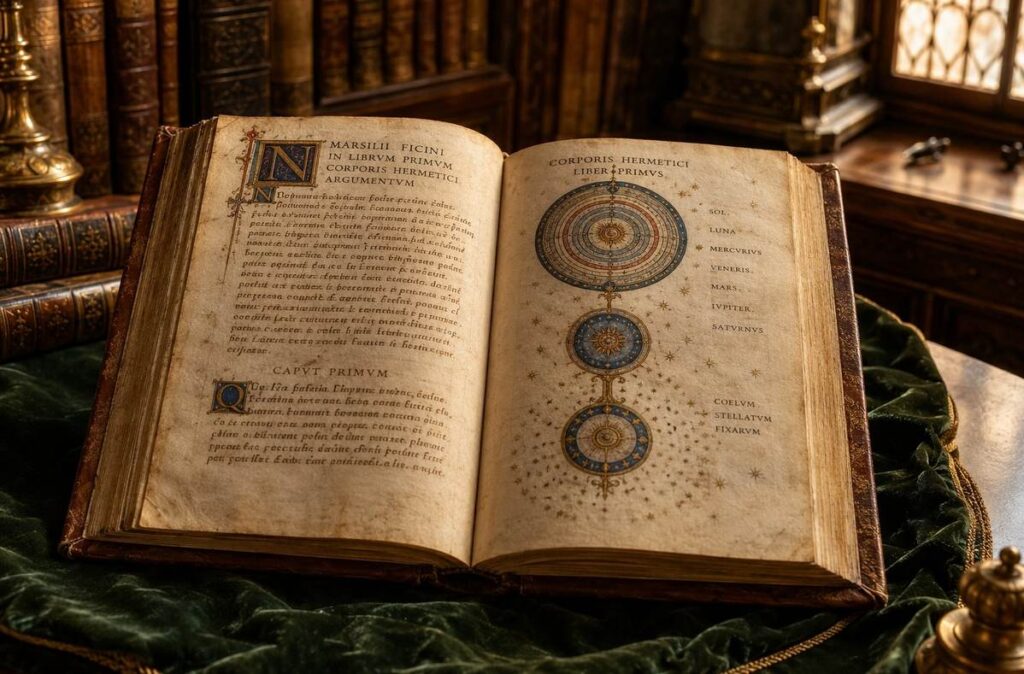
The most important vessel was Hermeticism. The Corpus Hermeticum, a collection of Greek texts attributed to Hermes Trismegistus, circulated in Byzantine and Arabic circles before Marsilio Ficino translated it into Latin in 1471. These texts contained recognisably Gnostic motifs: the divine mind (nous) awakening the sleeper, the descent of the soul through the seven planetary spheres, the yearning for rebirth and return to the divine source. When Ficino’s translation reached northern Europe, it carried with it a cosmology that paralleled the Sethian and Valentinian systems buried at Nag Hammadi. The Hermetic texts spoke of a kosmos governed by planetary powers and a human soul capable of transcending them through knowledge–precisely the architecture that the Zostrianos and the Apocalypse of Paul would later confirm in Coptic.
Paracelsus, the towering figure behind Rosicrucian alchemy, absorbed this Hermetic-Gnostic synthesis. He taught that the human being contained an astrum–a star-like immortal body–and that disease resulted from disharmony between the microcosm and macrocosm. His medicine was spiritual as much as chemical. The Rosicrucian manifestos praised Paracelsus precisely because he had unified natural philosophy with esoteric wisdom, a project that the Fama presented as the restoration of an ancient, pre-dogmatic Christianity. In this respect, the Rosicrucians were heirs to the same restorationist impulse that had animated the Gnostics: the conviction that the visible Church had lost the inner secret, and that a hidden remnant preserved it.
The Chymical Wedding as Gnostic Allegory
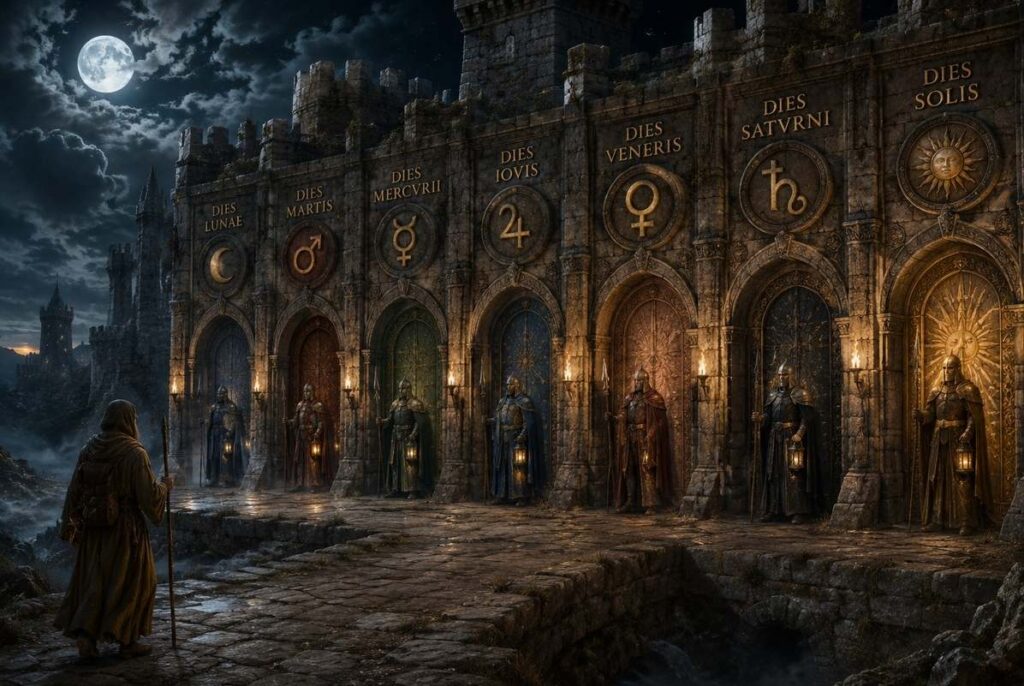
Of the three manifestos, the Chymical Wedding of Christian Rosenkreutz is the most explicitly initiatic. Framed as an allegorical romance spanning seven days, it recounts how the narrator receives a mysterious invitation to a royal castle, where a king and queen are to be married. The journey involves trials, purifications, symbolic death, and resurrection. On the seventh day, Rosenkreutz is knighted. The year is 1459; the allegory is timeless.
The structure invites comparison with Gnostic ascent literature. The seven days mirror the seven planetary spheres that the soul must traverse in Sethian and Hermetic texts. The castle, with its guarded gates, mysterious attendants, and tests of worthiness, functions as an allegorical pleroma–the divine fullness into which only the prepared may enter. The royal wedding itself is the coniunctio, the alchemical marriage of opposites, but it also echoes the Valentinian nymphon or bridal chamber, the sacramental union that restores the divided soul to its androgynous origin.
The invitation to the wedding bears the symbol of John Dee’s Monas Hieroglyphica (1564), a glyph unifying the sun, moon, and elements into a single hieroglyph of cosmic totality. Dee, the Elizabethan mathematician and occult philosopher, was himself a conduit between Renaissance Hermeticism and later Rosicrucianism. His symbol, appearing at the threshold of the Chymical Wedding, signals that the text is not merely alchemical but cosmological–a map of the soul’s return to unity through successive stages of dissolution and rebirth.
The death-and-resurrection motif is particularly striking. Rosenkreutz witnesses beheadings, dismemberments, and transformations that are simultaneously alchemical operations and initiatic ordeals. This is not orthodox Christian resurrection theology; it is the Gnostic pattern of the soul’s descent into chaos, its fragmentation, and its reconstitution through knowledge. The Exegesis on the Soul from Nag Hammadi describes the soul as a prostitute who must recognise her true nature and return to her father’s house. The Chymical Wedding describes the initiate as a pilgrim who must lose his old identity to gain a new one. The metaphors differ; the grammar is identical.
The Hermetic Transmission: From Ficino to the Invisible College
The Rosicrucian manifestos did not emerge from a vacuum. They were the culmination of a century of Hermetic revival that had begun in Florence and migrated northward through the courts and universities of Germany, France, and England. Ficino’s translation of the Corpus Hermeticum (1471) had introduced a new vocabulary of divine emanation, cosmic sympathy, and the magus as restorer of nature. Pico della Mirandola’s 900 Theses (1486) added Kabbalah to the synthesis, proposing that Jewish mystical numerology and Hermetic philosophy described a single hidden truth. By the time Johannes Reuchlin published De Arte Cabalistica (1517), the three streams–Hermeticism, Kabbalah, and alchemy–were flowing together.
The Rosicrucians drank from this confluence. The Fama explicitly names “Magia and Cabala” as the sciences studied by Brother C.R.C. in Arabia. It praises the Emerald Tablet–the foundational Hermetic text attributed to Hermes Trismegistus–and links the brotherhood’s philosophy to the Liber Mundi, the Book of the World. This was not merely bookish antiquarianism. It was a claim to possess the prisca theologia, the ancient theology that predated and underlay all revealed religions. The Gnostics had made the same claim, arguing that their secret teachings represented the original Christianity before its institutional capture. The Rosicrucians restated the claim in alchemical code.
Robert Fludd, the English physician and Hermeticist who defended the Rosicrucians in print, made the transmission explicit. In his Apologia Compendiaria (1616), Fludd argued that true philosophy must unite the macrocosm and microcosm through a hidden science of correspondences. His cosmology–layered, emanationist, and suffused with divine light–bears structural similarities to the Valentinian pleroma as described in the Tripartite Tractate. Fludd had not read the Tripartite Tractate; it was buried in Egypt. But he had read the Hermetic and Neoplatonic sources that had informed it, and he reproduced its architecture independently.

Pneumatic Echoes: Elect, Healing, and the Rejection of Dogma
The Gnostics divided humanity into three natures: the hylic, bound to matter; the psychic, capable of faith but not direct knowledge; and the pneumatic, the spiritual elect who possessed the divine spark and could recognise their true origin. This tripartite anthropology surfaces repeatedly in Rosicrucian literature, though clothed in alchemical and medical terminology. The Fama states that the brotherhood will accept only those “worthy” of the secret, and that the fraternity’s knowledge is not for the multitude. The Confessio goes further, declaring that the Rosicrucians possess a wisdom that the learned and the powerful of Europe lack, and that they will reveal it only when the time is ripe.
This elitism of the spirit, rather than of social class, is a Gnostic hallmark. The Gospel of Thomas records Jesus saying, “It is to those who are worthy of my mysteries that I tell my mysteries.” The Apocryphon of John presents the Saviour revealing secret teachings to John alone, while the masses remain in the demiurge’s ignorance. The Rosicrucian manifestos replicate this pattern exactly: a small elect, bound by oath, preserving a wisdom too dangerous or too precious for general dissemination.
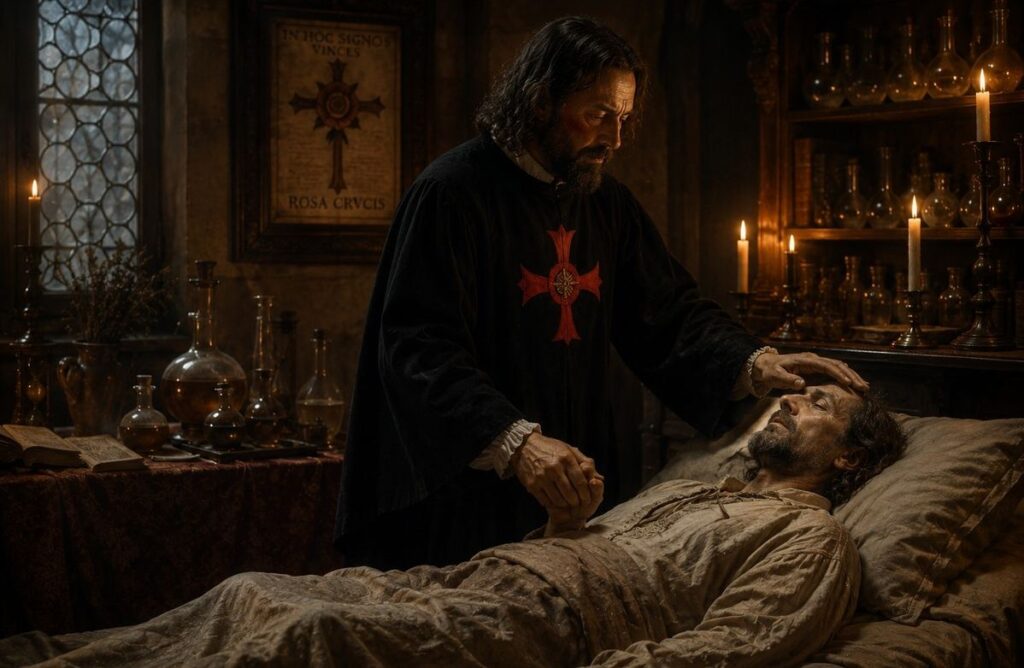
The healing mandate reinforces the connection. The Fama declares that the brothers will cure the sick “gratis,” without payment. This echoes the charismatic healing attributed to Gnostic groups in the second century, as reported by Irenaeus and Hippolytus, who claimed that their pneumatic members could heal and exorcise through spiritual power rather than medical art. The Rosicrucian emphasis on healing as a spiritual service, not a commercial transaction, aligns with the Gnostic rejection of the material economy in favour of an economy of grace.
Most significantly, both movements defined themselves against orthodox institutional authority. The Gnostics rejected the emerging episcopal Church as an archonic construct, a counterfeit spirituality designed to keep souls imprisoned. The Rosicrucians, writing in the aftermath of the Reformation and the Wars of Religion, proposed a “General Reformation” that would transcend Catholic and Protestant divisions alike. Their Christianity was esoteric, not dogmatic; experiential, not credal. The Confessio explicitly criticises the Pope and the Emperor as guardians of a false order, while praising the brotherhood’s invisible governance. This is not political rebellion in the modern sense; it is the Gnostic insistence that true authority resides in direct knowledge, not in hierarchical office.
The Seventeenth-Century Furore and Its Aftermath
The publication of the manifestos triggered what Frances Yates called the “Rosicrucian Enlightenment”–a brief but intense period during which hundreds of pamphlets, treatises, and responses circulated across Europe. Between 1614 and 1620, approximately 400 publications addressed the Rosicrucian question. Some sought admission to the brotherhood; others denounced it as a Satanic conspiracy. The Jesuits, in particular, attacked the Rosicrucians as heretics, while alchemists and Kabbalists defended them as restorers of ancient wisdom. The furore peaked in 1622, when mysterious posters appeared on the walls of Paris declaring that the deputies of the Rose Cross were present in the city, visible only to those who truly sought them.
The brotherhood itself–if it existed as an organised body–never revealed itself. The manifestos remained a literary fiction, a ludibrium, a mirror in which each reader saw his own spiritual longing reflected. Yet the fiction was productive. It inspired Robert Fludd’s defence, Michael Maier’s Silentium Post Clamores (1617), and Elias Ashmole’s Theatrum Chemicum Britannicum (1650). It influenced the development of Freemasonry in the eighteenth century, particularly the Scottish Rite with its Rosicrucian degrees. It fed directly into the Hermetic Order of the Golden Dawn in the nineteenth century, and from there into modern Theosophy, Anthroposophy, and the various contemporary Rosicrucian orders such as AMORC.
What survived through all these transformations was the core Gnostic-Hermetic structure: the belief in an ancient wisdom, the division between outer and inner knowledge, the initiatic journey through symbolic ordeals, and the ultimate restoration of the soul to its divine origin. The Nag Hammadi discovery in 1945 did not create this tradition; it validated it. When scholars opened the buried jar and found the Gospel of Truth, the Thunder: Perfect Mind, and the Allogenes, they uncovered the textual foundations of a current that Rosicrucianism–and Hermeticism before it–had already been transmitting for centuries, albeit in coded and fragmented form.
The Rosicrucians were not Gnostics in the historical sense. They were Lutheran Christians, alchemists, and natural philosophers working within a very different cultural moment. Yet they preserved, perhaps unknowingly, the pneumatic grammar of Gnosticism: the conviction that the world is not what it appears, that a secret knowledge liberates the elect, and that the true Church is invisible, bound not by creed but by recognition. The hidden inheritance was real. It simply travelled under other names.
Frequently Asked Questions
Did the Rosicrucians have access to the Nag Hammadi library?
No. The Nag Hammadi codices were buried around 400 CE and remained undiscovered until 1945. The Rosicrucian authors of the seventeenth century could not have read these texts. However, they drew upon the same Hermetic and Gnostic currents that had survived through Byzantine, Arabic, and Renaissance channels, preserving many of the same cosmological and theological ideas.
Who wrote the Rosicrucian manifestos?
The manifestos were published anonymously, but scholars widely attribute primary authorship to Johann Valentin Andreae, a Lutheran theologian at the University of Tubingen. Andreae later referred to the manifestos as a youthful jest or ludibrium, though the depth of their esoteric content suggests more than mere satire.
What is the Chemical Wedding of Christian Rosenkreutz?
Published in 1616, the Chymical Wedding is an allegorical romance in seven days describing an initiatic journey through a mystical castle. It involves trials, symbolic death, resurrection, and a royal marriage–alchemical and spiritual symbolism that parallels Gnostic ascent literature and the Valentinian bridal chamber or nymphon.
How does Rosicrucianism relate to Hermeticism?
Rosicrucianism emerged directly from the Renaissance Hermetic revival. The Fama Fraternitatis explicitly praises Hermes Trismegistus, the Emerald Tablet, and the Corpus Hermeticum. Rosicrucian alchemy, cosmology, and the concept of the magus as restorer of nature all derive from Hermetic sources that had absorbed Gnostic ideas during late antiquity.
Is there a real Rosicrucian Order?
The original seventeenth-century brotherhood described in the manifestos was almost certainly a literary fiction. However, the manifestos inspired numerous actual fraternities from the eighteenth century onward, including the Order of the Golden and Rosy Cross, Societas Rosicruciana in Anglia, and the modern Ancient Mystical Order Rosae Crucis (AMORC).
What are the three natures in Gnostic and Rosicrucian thought?
Gnosticism divides humanity into hylic (material), psychic (soul-bound), and pneumatic (spiritual) natures. Rosicrucian literature preserves this tripartite structure in alchemical and medical disguise, distinguishing between those capable of receiving the secret wisdom and those who remain bound to surface appearances.
How did the Nag Hammadi discovery affect our understanding of Rosicrucianism?
The 1945 discovery provided textual confirmation that the cosmological structures found in Rosicrucian and Hermetic literature–divine emanations, planetary archons, the divine spark, and initiatic ascent–were not Renaissance inventions but had ancient roots in second- to fourth-century Gnosticism. It revealed the hidden inheritance for what it was: a continuous, if fragmented, transmission.
Further Reading
The following ZenithEye articles trace related threads through the hidden agreements and the living tradition:
- Hermeticism and Gnosticism: Where They Meet and Where They Diverge — A rigorous comparison of the two traditions that converged in Rosicrucian philosophy.
- Hermetic Connections in the Nag Hammadi Library — Explores the Hermetic texts buried alongside the Gnostic codices, confirming their shared cosmological roots.
- The Emerald Tablet: Hermetic Foundation and the Law of Correspondence — The central text that Brother C.R.C. allegedly studied, and the cornerstone of Rosicrucian alchemy.
- Esoteric Lineages: The Hidden Archives of Western Mysticism — Maps the transmission channels through which Gnostic and Hermetic ideas survived the centuries.
- Transmission and Lineage: How the Thread Survives — Examines the mechanisms–oral, textual, and initiatic–by which forbidden knowing persists across generations.
- John Dee’s Mathematical Preface: The Occult Foundation of Renaissance Science — Dee’s Monas Hieroglyphica appears in the Chymical Wedding; this article explains his role in the Hermetic transmission.
- The Doctrine of Emanation: From Plotinus to Kabbalah — The Neoplatonic and Kabbalistic cosmology that underpins both Gnostic and Rosicrucian metaphysics.
- The Nag Hammadi Library: A Complete Guide to the Gnostic Scriptures — The definitive map of the texts that preserve the same pneumatic tradition the Rosicrucians transmitted in code.
- Gnostic Schools: Sethians, Valentinians, and Hermetics — Distinguishes the major Gnostic currents whose ideas survived into early modern esotericism.
- The Living Thread: How Forbidden Knowing Survives — The broader pattern of suppressed wisdom transmission of which Rosicrucianism is one chapter.
References and Sources
The following sources are organised by category for scholarly verification and further study.
Primary Sources and Critical Editions
- Anonymous. (1614). Fama Fraternitatis Rosae Crucis. Kassel: Wessel. First English translation, 1652.
- Anonymous. (1615). Confessio Fraternitatis. Frankfurt: Wessel.
- Anonymous [attributed to Johann Valentin Andreae]. (1616). Chymical Wedding of Christian Rosenkreutz. Strasbourg: Zetzner.
- Ficino, M. (1471/1999). Corpus Hermeticum (Latin translation). In C. Salaman et al. (Trans.), The Way of Hermes. London: Duckworth.
- Robinson, J. M. (Ed.). (1990). The Nag Hammadi Library in English (3rd ed.). San Francisco: HarperSanFrancisco.
Scholarly Monographs
- Edighoffer, R. (2005). “Rosicrucianism I: First half of the 17th Century.” In W. J. Hanegraaff et al. (Eds.), Dictionary of Gnosis and Western Esotericism (Vol. 1, pp. 1009-1015). Leiden: Brill.
- Godwin, J. (1994). The Theosophical Enlightenment. Albany: SUNY Press.
- McIntosh, C. (1997). The Rosicrucians: The History, Mythology, and Rituals of an Esoteric Order. York Beach, ME: Weiser Books.
- Yates, F. A. (1972). The Rosicrucian Enlightenment. London: Routledge and Kegan Paul.
- Debus, A. G. (1965). The English Paracelsians. London: Oldbourne.
Comparative and Contextual Studies
- Faivre, A. (1994). Access to Western Esotericism. Albany: SUNY Press.
- Goodrick-Clarke, N. (2008). The Western Esoteric Traditions: A Historical Introduction. Oxford: Oxford University Press.
- King, K. L. (2003). What Is Gnosticism? Cambridge, MA: Harvard University Press.
- van den Broek, R., & Hanegraaff, W. J. (Eds.). (1998). Gnosis and Hermeticism from Antiquity to Modern Times. Albany: SUNY Press.