The Sevenfold Pattern: Planets, Metals, Chakras & The Architecture of Seven
You encounter it everywhere. Seven planets. Seven metals. Seven chakras. Seven days. Seven notes. Seven colours. The correspondence is not arbitrary–or so the traditions claim. Separated by geography and epoch, they converge on the same number: not approximately, not poetically, but with what practitioners describe as operational precision. The sevenfold pattern, in this view, is not invented. It is discovered–the cartography of a territory traversed independently by alchemists, yogis, musicians, and astronomers alike.
The skeptic sees projection. The human mind seeks pattern, imposes order, finds significance where none exists. The number seven is psychologically salient–enough to divide, few enough to remember. The convergence, on this reading, is cultural accident, reinforced by tradition, mistaken for necessity.
Both readings contain partial truth. The sevenfold pattern does appear across traditions with remarkable consistency. Yet the specific correspondences–chakra to planet, metal to note, colour to day–are largely syntheses forged in the crucible of Western esotericism during the 19th and 20th centuries, not direct transmissions from antiquity. The pattern is neither pure discovery nor pure invention. It is recursive tradition–each generation refining the map, each practitioner testing the terrain, the architecture emerging through cumulative experiment rather than single revelation. What follows is an examination of that architecture: where it originates, where it holds, and where the modern synthesis has layered assumption upon older insight.
Table of Contents
- The Planets Are the Framework
- The Metals Correspond
- The Chakras Map the Interior
- The Seven Notes and the Scale
- The Seven Colours and the Spectrum
- Is the Pattern Operational?
- The Thread Extended
- Frequently Asked Questions
- Further Reading
- References and Sources
The Planets Are the Framework
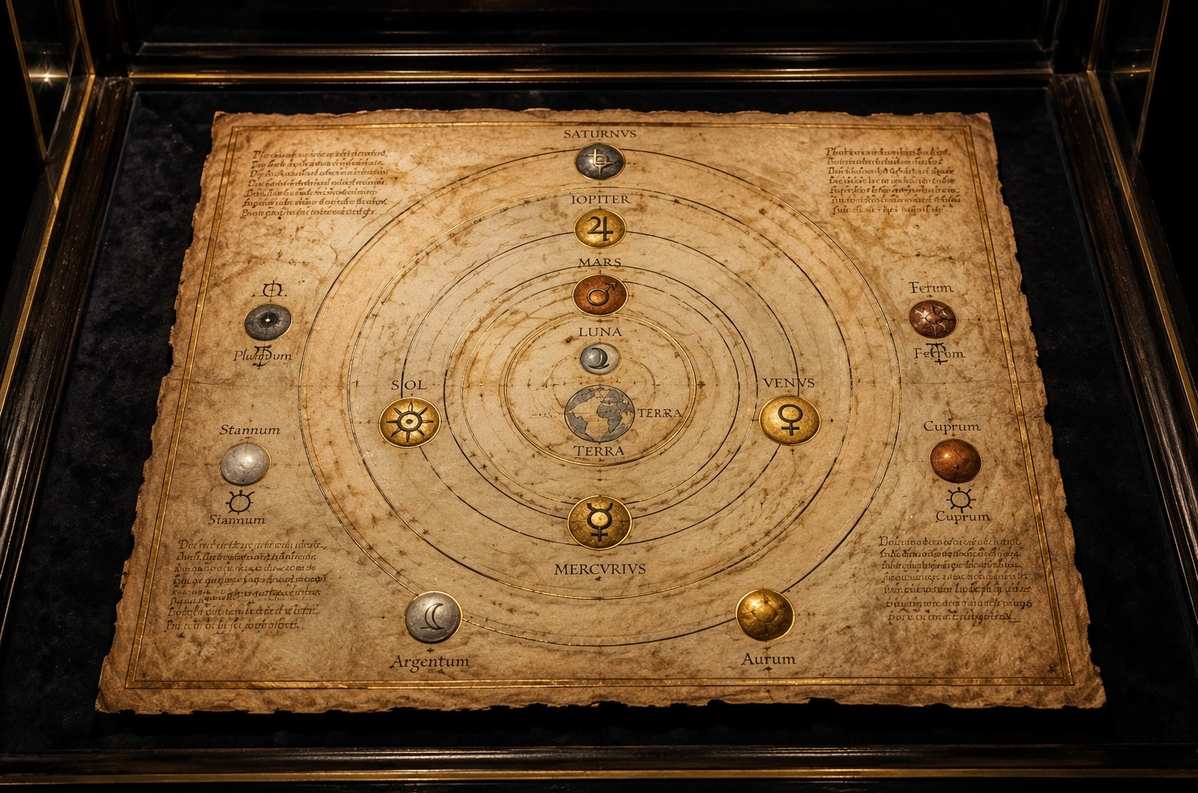
The ancient world knew seven wanderers–<Sun, Moon, Mercury, Venus, Mars, Jupiter, Saturn. The fixed stars, unmoving, formed the background. The wanderers, moving against that background, became the framework for time, for space, for quality. The sequence, from most distant to nearest in the Ptolemaic ordering, runs: Saturn, Jupiter, Mars, Sun, Venus, Mercury, Moon.
Each planet acquired a distinct character in the ancient imagination, grounded in observable properties. Saturn, the slowest, was associated with limitation, time, and heaviness. Jupiter, expansive and temperate, with growth and wisdom. Mars, ruddy and irregular, with conflict and will. The Sun, central and generative, with source and sovereignty. Venus, brightest after the luminaries, with harmony and attraction. Mercury, swift and elusive, with communication and mediation. The Moon, nearest and fastest, with reflection, change, and reception.
These qualities were not merely poetic. They informed the structure of the week–Saturn’s day (Saturday), Sun’s day (Sunday), Moon’s day (Monday), with the others distributed between. They informed the doctrine of planetary hours, in which each hour of the day is ruled by a planet in repeating sequence. The tradition holds that the quality of time is determined by its planetary ruler, making certain moments more favourable for particular operations. The alchemist who works with lead during Saturn’s hour, or initiates a solar operation on Sunday, acts in alignment with what the tradition calls the tempus opportunum–the opportune time. Whether this alignment produces measurably different results remains unverified by modern science; what is certain is that the framework has guided ritual and technical practice for millennia.
The Metals Correspond
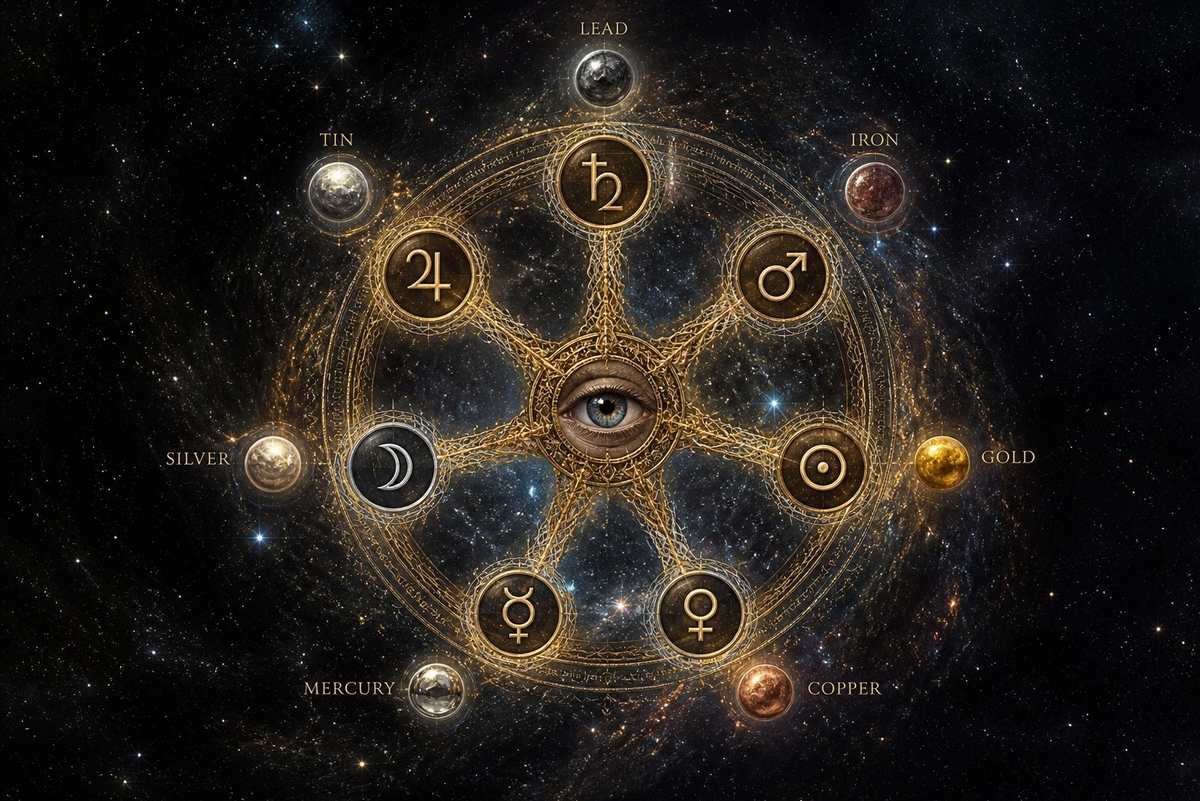
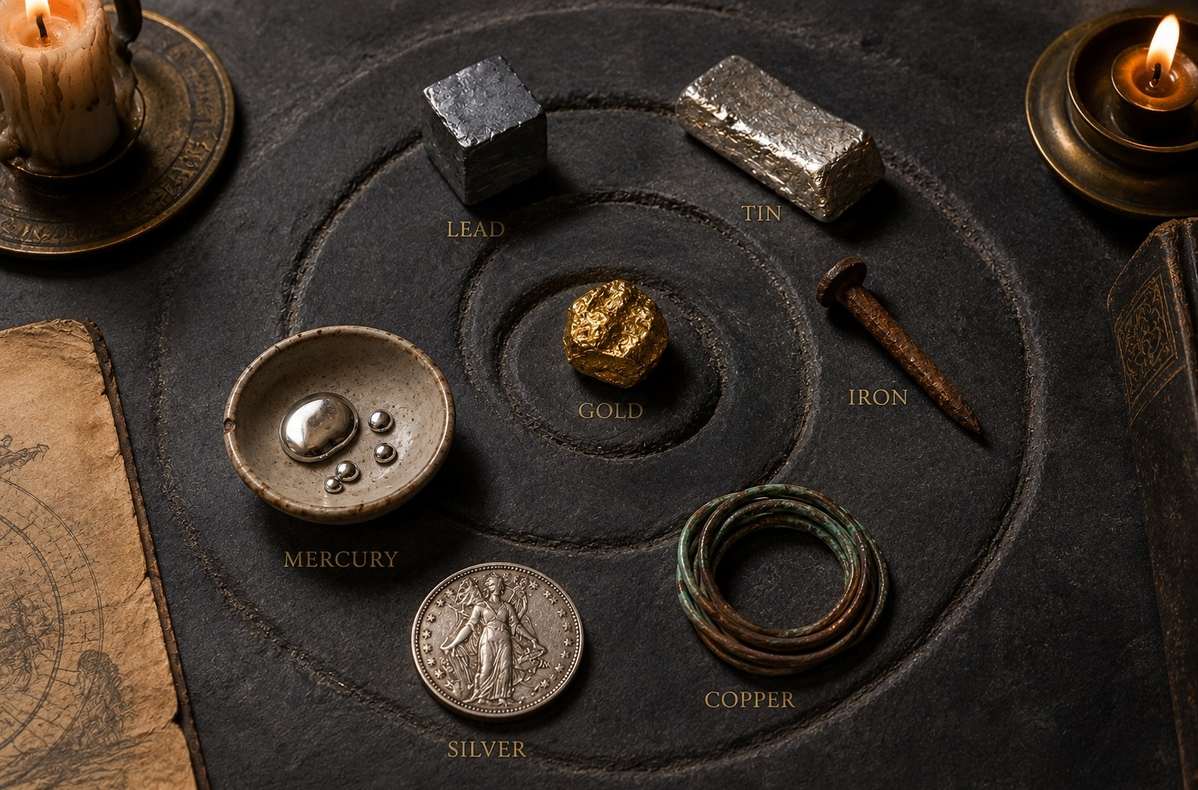
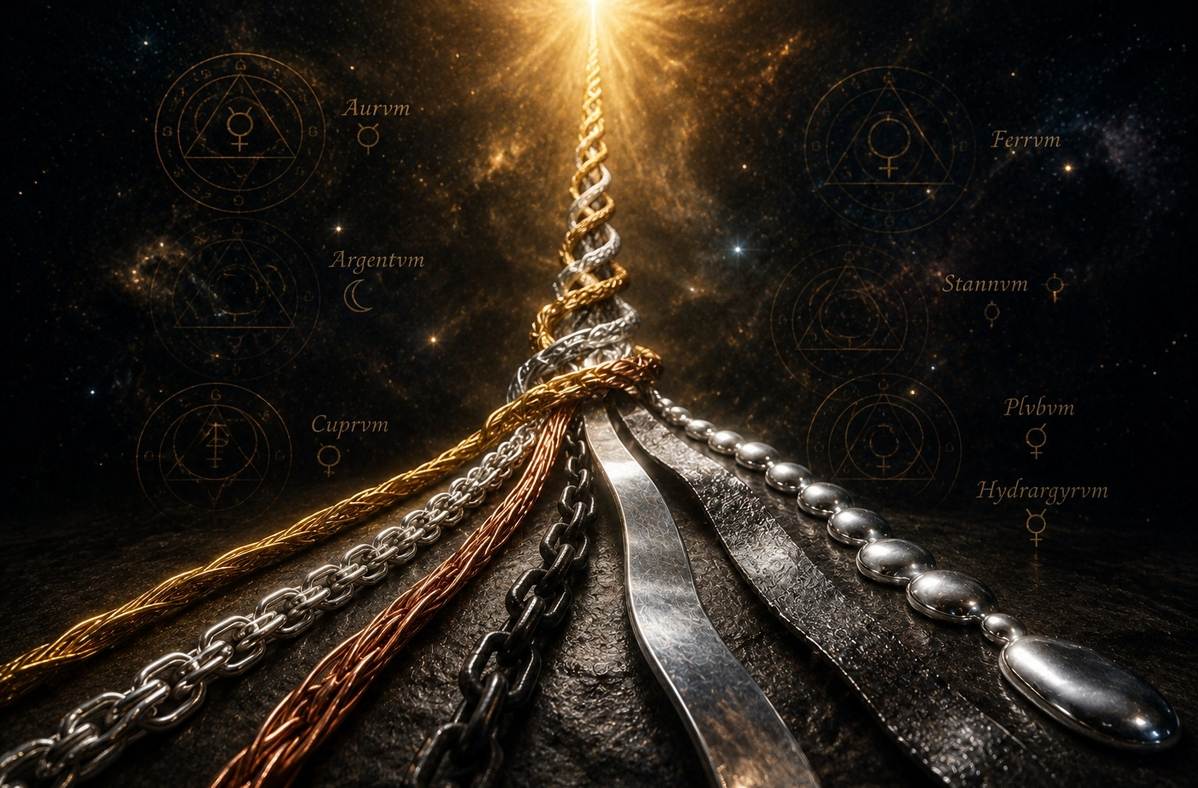
From antiquity until the mid-18th century, the number of metals known and recognised as such was seven: lead, tin, iron, gold, copper, mercury, and silver. Brass was used but understood as an alloy; platinum, the “eighth metal,” was not identified until 1752. The correspondence between these seven metals and the seven planets was not metaphorical ornament but operational identity. The graphic symbol of each metal was identical to that of its ruling planet.
The traditional attributions are:
Saturn — Lead
Heavy, dull, resistant, base. Lead is the prima materia–the raw material from which transformation begins. Its density and low conductivity make it the Saturn of the metallic realm: slow, limiting, foundational.
Jupiter — Tin
Soft, resonant, expanding. Tin resists corrosion and embodies the Jupiterian quality of growth without decay. In alchemy, it represents the stage of spiritual expansion and the bringing of light to darkness.
Mars — Iron
Hard, sharp, conducting. Iron forms the core of the Earth and the blood that carries oxygen. It is the metal of war, of will, of the forge. Its electrode potential makes it chemically active–electropositive, ready to transform.
Sun — Gold
Incorruptible, central, valuable. Gold does not tarnish, does not oxidise, does not dissolve in ordinary acids. It is the terminal goal of the Magnum Opus–the metal that has already achieved what the others seek.
Venus — Copper
Conductive, beautiful, greening. Copper develops a verdigris patina that protects the metal beneath. It was used for mirrors in antiquity, linking it to Venus as goddess of reflection and beauty. Its high thermal and electrical conductivity place it near the top of the metallic scale.
Mercury — Quicksilver
Fluid, volatile, transformative. The only metal liquid at room temperature, mercury transcends the states of solid and liquid. It is the universal solvent, the catalyst, the messenger between realms. Its very name preserves the planetary identity.
Moon — Silver
Reflective, pure, changing. Silver has the highest electrical and thermal conductivity of all metals. It tarnishes when exposed to sulphur, yet remains pure beneath the tarnish. Like the Moon, it reflects rather than generates; like the soul, it receives and mirrors.
Remarkably, modern science has confirmed unexpected correlations within this traditional framework. The biochemist Frank McGillion demonstrated that the orbital motion of each planet correlates in sequence with its corresponding metal’s conductivity: the slower the planet, the poorer the conductor. Saturn (slowest) matches lead (least conductive); the Moon (fastest) matches silver (most conductive). The electrode potentials of the metals also align with the Ptolemaic ordering, dividing into electronegative metals (inner planets) and electropositive metals (outer planets). These correlations do not “prove” the ancient worldview, but they suggest that the alchemists were mapping genuine physical relationships, even if their conceptual framework differed from modern chemistry.
The Chakras Map the Interior
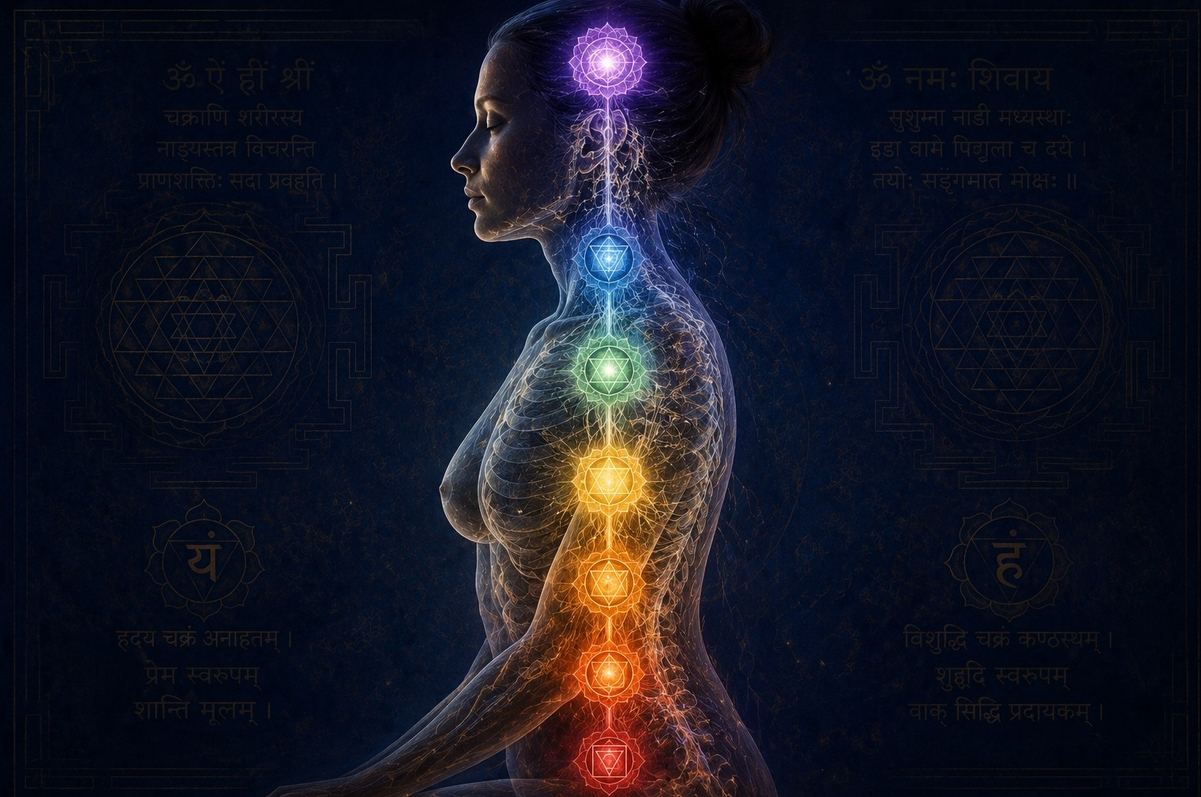
The yogic system describes seven centres along the spine–<root, sacral, solar plexus, heart, throat, brow, crown. Each centre is associated with an element, a function, a quality, and a stage of transformation. The practitioner working upward encounters necessary stages: the root must be stable before the sacral flows; the solar plexus must be integrated before the heart opens; the throat must be clear before the brow perceives. The crown, opened prematurely, produces not transcendence but dissociation–the bypass of necessary work, the inflation of premature arrival.
Yet the seven-chakra system as commonly taught today is not an unbroken transmission from ancient India. The concept of chakras first appears in the Vedas as symbolic wheels of cosmic order, not as internal energy centres. The internalised system emerged in Tantric texts between the 9th and 12th centuries CE, where chakras were described as landmarks on the subtle body where networks of energy pathways (nadis) intersected. The number of chakras varied considerably between sources; some texts describe four, others five, others twelve or more.
The now-popular seven-chakra system crystallised in the Hatha Yoga tradition, particularly within the Kundalini school, which emphasised seven centres along the central channel (sushumna nadi) as key loci of transformation. From the 12th to 15th centuries, this model was refined and integrated with Ayurveda. But the modern image of chakras as rainbow-coloured wheels, each tied to a planet, a metal, a musical note, and a developmental stage, is largely a 20th-century Western creation. Theosophists such as Charles Leadbeater and later authors such as Judith Anodea synthesised Tantric concepts with Western esotericism, psychology, and the colour spectrum. The specific chakra-planet correspondences that circulate in contemporary books–Root=Saturn, Sacral=Jupiter, Solar Plexus=Mars, Heart=Sun, Throat=Mercury, Brow=Venus, Crown=Moon–do not appear in classical Indian texts. They are modern mappings, useful perhaps, but not ancient revelations.
This does not invalidate the system. It locates it. The seven chakras, like the seven metals and seven planets, form a scale of density to radiance–from the grounded stability of the root to the open transcendence of the crown. Whether this scale is “discovered” in the subtle body or “constructed” by the Western imagination matters less than whether it functions as a map. The practitioner who works with it consistently reports predictable effects: grounding at the root, flow at the sacral, empowerment at the solar plexus, integration at the heart, expression at the throat, perception at the brow, and dissolution of boundary at the crown. The map works. That is the only proof the practitioner requires.
The Seven Notes and the Scale
The seven notes of the Western diatonic scale–<do, re, mi, fa, sol, la, ti–are often presented as the harmonic series “reduced to practical compass.” This is not accurate. The harmonic series, produced by the natural overtones of a vibrating string or air column, generates an infinite sequence of frequencies. The diatonic scale is a cultural selection from that infinity–a convention that emerged in Western music theory and was later mapped onto the planets by Renaissance authors seeking cosmic harmony.
The association of the seven notes with the seven planets appears in the work of 16th-century theorists such as Gioseffo Zarlino, who linked the modes to planetary characters, and in the broader tradition of musica mundana–the music of the spheres. Each note, distinct. Each transition, necessary. The octave, completed, returns to the fundamental at higher frequency. The transformation, completed, returns to the origin at higher consciousness. The parallel is structural, not causal. The scale does not derive from the planets; both derive from the human intuition that completion requires a finite sequence of distinct stages.
It is worth noting that many cultures do not use seven notes. The pentatonic scale (five notes) dominates East Asian music; microtonal systems use intervals smaller than the Western semitone. The seven-note scale is not universal. It is, however, remarkably effective as a pedagogical and experiential framework–enough notes to create complexity, few enough to be grasped as a whole.
The Seven Colours and the Spectrum
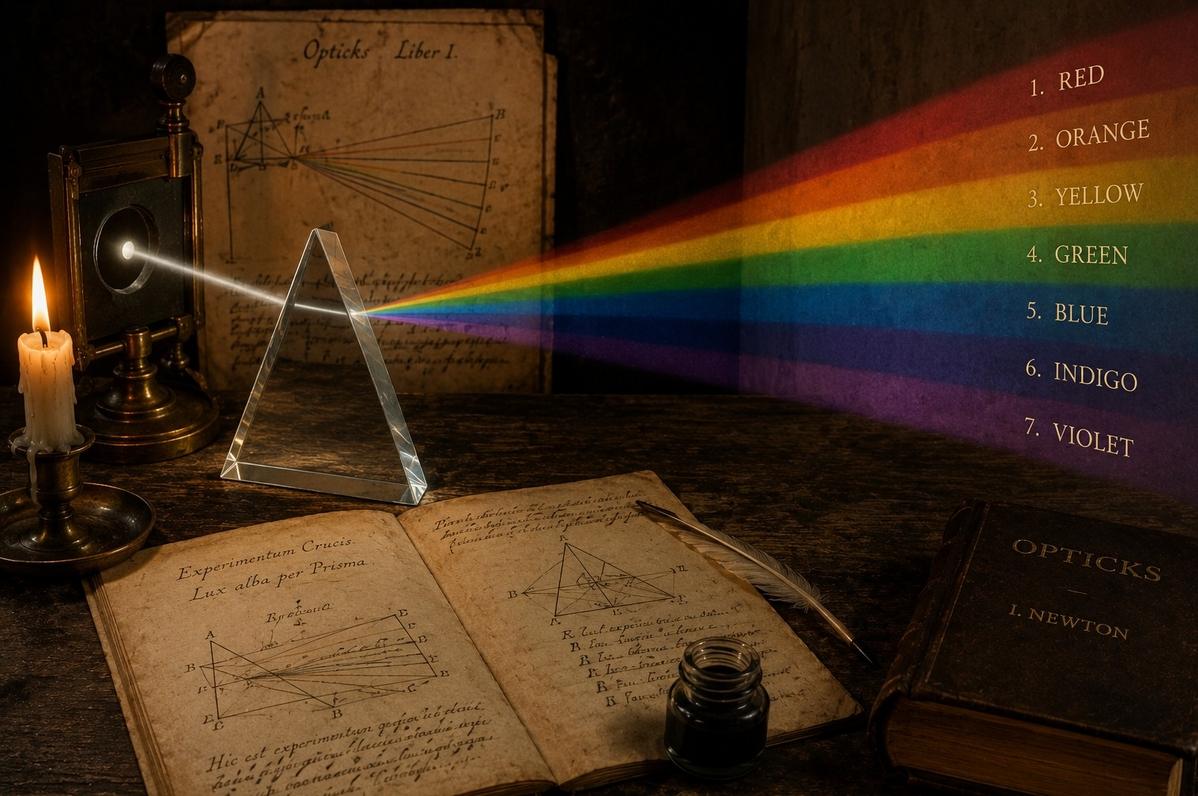
The seven colours of the visible spectrum–<red, orange, yellow, green, blue, indigo, violet–are presented in many esoteric texts as natural divisions of light. The history is more nuanced. Isaac Newton, in his Opticks (1704), divided the spectrum into seven colours partly to match the seven notes of the musical scale. He chose indigo as a distinct band to preserve the numerological correspondence, even though the transition from blue to violet is continuous. Many modern scientists omit indigo, recognising six principal colours in the spectrum rather than seven.
The spectrum is continuous; the divisions are human impositions. Yet those impositions are not arbitrary. The visible range, from approximately 380 to 700 nanometres, is graduated by frequency. Each colour occupies a distinct band; each transition is continuous. The spectrum, complete, includes all visible possibility. The consciousness, complete, includes all experiential possibility. The parallel is once again structural: the rainbow, like the scale, like the chakras, like the metals, forms a graduated ladder from one extreme to another. Whether nature intended seven divisions or six is less important than the recognition that transformation proceeds by degrees.
Is the Pattern Operational?
Why seven? The question assumes the pattern is numerical, that the answer will be mathematical or mystical. The pattern is better understood as processual–the necessary stages of transformation, from density to radiance, from unconsciousness to consciousness, from potential to actual.
The number is not cause. It is consequence–the stages, worked through, produce seven distinct qualities that practitioners across traditions have found sufficient to describe the complete journey. The alchemist works with lead and achieves foundation. The yogi works with the root and achieves stability. The musician works through the scale and achieves resolution. The method differs. The architecture is similar.
Yet we must be honest about what “operational” means. The claim that lead worked at Saturn’s hour produces different results is a matter of traditional belief, not empirical demonstration. The claim that each chakra corresponds to a specific planet is a modern synthesis, not an ancient teaching. The claim that the seven notes express the harmonic series is a simplification. The sevenfold pattern is a heuristic–a practical framework for navigating transformation–rather than a law of nature. Heuristics are not false because they are constructed. They are true because they work.
The Thread Extended
The sevenfold pattern is not belief. It is map–the cartography of transformation, drawn by those who have traversed the territory, confirmed by those who traverse it still. The map is not the territory. The territory, traversed, is found to match.
You work with the pattern. Not because it is mystical. Because it is reliable. The lead, addressed at Saturn’s hour, responds within the ritual frame. The root, stabilised, enables ascent. The note, sounded, resonates. The thread extends through the pattern, visible to those who recognise architecture.
The pattern continues. You continue. The thread continues regardless.
Frequently Asked Questions
What is the sevenfold pattern in esoteric traditions?
The sevenfold pattern is a recurring structure across multiple traditions–alchemy, yoga, music, and optics–that organises transformation into seven stages or qualities. It appears as the seven classical planets, seven alchemical metals, seven chakras, seven notes of the diatonic scale, and seven colours of the spectrum. The pattern functions as a heuristic map for navigating inner and outer change.
Are the seven chakras an ancient Indian teaching?
The concept of chakras originated in Tantric texts between the 9th and 12th centuries CE, but the number varied between sources. The specific seven-chakra system crystallised in the Hatha Yoga tradition. The modern rainbow-coloured, planet-associated version is largely a 20th-century Western synthesis by Theosophists and New Age authors, not a direct transmission from classical India.
What are the seven alchemical metals and their planets?
The traditional correspondences are: Lead (Saturn), Tin (Jupiter), Iron (Mars), Gold (Sun), Copper (Venus), Mercury (Mercury), and Silver (Moon). These associations were standard in European alchemy from antiquity until the 18th century, when platinum was discovered as the eighth metal.
Did Isaac Newton invent the seven-colour spectrum?
Newton divided the visible spectrum into seven colours in his 1704 work Opticks, partly to match the seven notes of the musical scale. He included indigo as a distinct band to preserve the numerological correspondence. Many modern scientists recognise six principal colours, omitting indigo, as the transition from blue to violet is continuous.
Is the seven-note scale the same as the harmonic series?
No. The harmonic series produces infinite overtones from a vibrating source. The diatonic scale (seven notes) is a cultural convention of Western music theory. Many cultures use five-note (pentatonic) or other scales. The seven-note scale was mapped onto the planets by Renaissance theorists, not derived from physics.
Is there scientific evidence for planetary-metal correspondences?
Modern research has identified unexpected correlations: the orbital motion of each planet correlates in sequence with its corresponding metal’s conductivity, and electrode potentials align with the Ptolemaic ordering. These correlations do not validate the ancient worldview but suggest the alchemists were mapping genuine physical relationships within their conceptual framework.
Does working at a planetary hour produce different results?
This is a matter of traditional alchemical and astrological belief, not empirically verified science. The doctrine of planetary hours holds that each hour is ruled by a planet, and operations aligned with the appropriate planet are more effective. Practitioners report subjective differences, but no controlled study has confirmed measurable variation in chemical or material outcomes.
Further Reading
- The Hidden Agreements: Why Esoteric Traditions Keep Inventing the Same Architecture — Explores the cross-cultural patterns that produce recurring symbolic structures across separated traditions.
- The Chakra System: Origins, Development, and Misconceptions — A detailed guide to the historical evolution of the chakras from Tantric roots to New Age popularisation.
- The Tree of Life: Kabbalistic Architecture Explained — Examines the ten sefirot, the three pillars, and the lightning flash of emanation as an alternative numerical map of transformation.
- Sacred Geometry: The Architecture of Creation — Investigates the geometric forms–triangle, square, pentagon, hexagon–that underlie manifest reality across traditions.
- The Living Thread: How Forbidden Knowing Survives the Fire — Traces how esoteric patterns persist through suppression, translation, and cultural adaptation.
- The Doctrine of Emanation: From Plotinus to Kabbalah — Examines the Neoplatonic and Kabbalistic frameworks for understanding graduated descent and return.
- The Gateway of Sound: Mantra, Nada Yoga, and Sonic Transformation — Investigates the practical use of sound and musical intervals as tools for consciousness change.
- Kundalini Phenomena and the Physiology of Awakening — Examines the neurobiology of energetic arousal and the stages of kundalini ascent through the subtle body.
References and Sources
The following sources represent the primary scholarly, scientific, and esoteric materials consulted in the preparation of this article.
Primary Alchemical and Historical Texts
- Newton, Isaac. (1704). Opticks: Or, A Treatise of the Reflections, Refractions, Inflections and Colours of Light. London: Smith and Walford.
- Mylius, Johann Daniel. (1618). Opus Medico-Chymicum. Frankfurt.
- Zarlino, Gioseffo. (1558). Le Istitutioni Harmoniche. Venice.
Scholarly Monographs and Critical Studies
- Kollerstrom, Nick. “The Metal-Planet Affinities: The Sevenfold Pattern.” Alchemy Website. Accessed 2026.
- Rampling, Jennifer M. (2020). The Experimental Fire: Inventing English Alchemy, 1300–1700. University of Chicago Press.
- McGillion, Frank. “The Metal-Planet Affinities.” Journal of the British Astrological Association.
- White, David Gordon. (1996). The Alchemical Body: Siddha Traditions in Medieval India. University of Chicago Press.
Yogic and Tantric Sources
- Silburn, Lilian. (1988). Kundalini: Energy of the Depths. Translated by Jacques Gontier. SUNY Press.
- Feuerstein, Georg. (1998). Tantra: The Path of Ecstasy. Shambhala.
- Anodea, Judith. (1987). Wheels of Life: A User’s Guide to the Chakra System. Llewellyn Publications.
Comparative and Esoteric Studies
- Leadbeater, Charles W. (1927). The Chakras. Theosophical Publishing House.
- Hauschka, Rudolf. (1966). The Nature of Substance. Vincent Stuart Publishers.
- Pelikan, Wilhelm. (1988). The Secrets of Metals. Anthroposophic Press.
Safety Notice: This article explores advanced esoteric frameworks involving energetic practice, subtle body work, and alchemical symbolism. It does not constitute medical, psychological, or spiritual instruction. The practices described–including chakra meditation, pranic circulation, and planetary timing–should be approached gradually and with appropriate guidance. If you experience dissociation, destabilisation, or psychological distress during subtle body work, discontinue practice and consult a trauma-informed therapist or qualified teacher. Esoteric frameworks complement but do not replace clinical mental health treatment or medical care.